
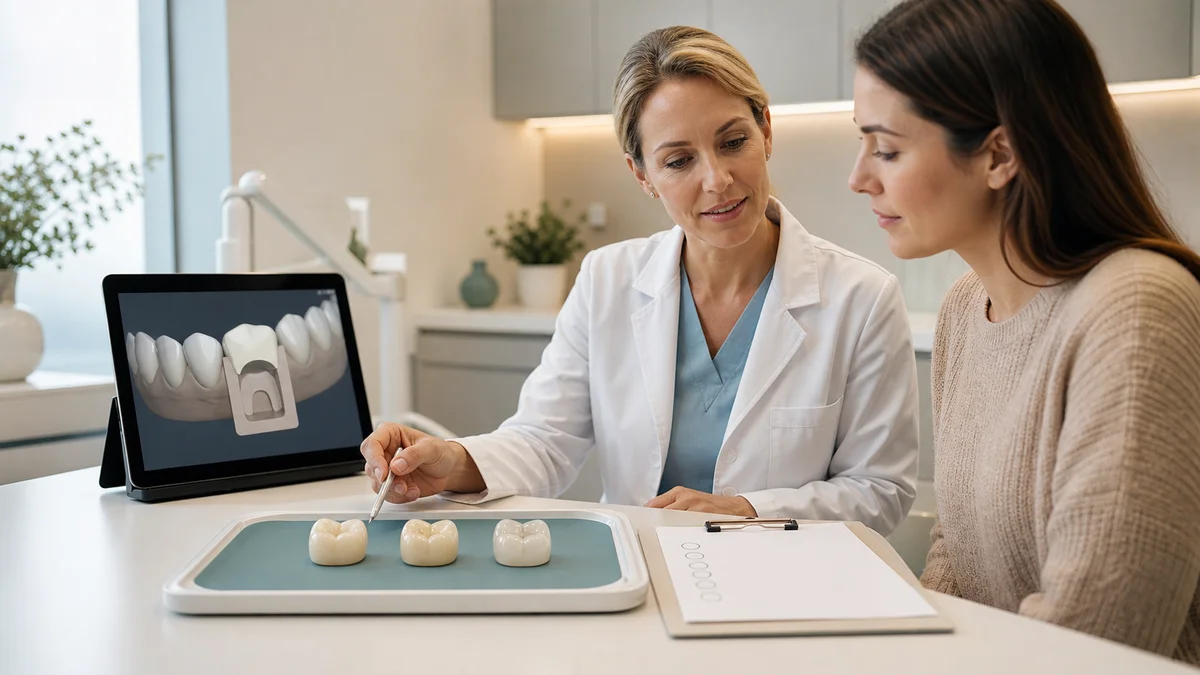
Quick answer: zirconia crowns reviews can reveal recurring questions about appearance, comfort, bite and service, but they cannot show whether a tooth was correctly diagnosed or compare like-for-like materials. Judge a proposed crown through twelve checks: indication, support, formulation, design, tooth position, bite, finish, margins, retention, maintenance, records and follow-up. A dentist must assess suitability individually.
People searching zirconia crowns reviews often meet confident five-star stories, alarming one-star complaints and clinic galleries that show only the final smile. These accounts may describe a real personal experience, yet they rarely identify the diagnosis, the exact zirconia formulation, whether the crown was monolithic or layered, the supporting tooth or implant, the preparation design, the cement, the bite, the laboratory process or the length and quality of follow-up. Without those details, two reviews that appear to contradict each other may actually describe very different treatments.
Zirconia is a family of dental ceramics rather than one uniform product. Its composition, translucency, strength, thickness requirements and intended indications vary. A highly translucent anterior single crown, a strong monolithic molar crown, a veneered zirconia restoration and a multi-unit bridge should not be treated as interchangeable. The American Dental Association’s current review of indirect restorative materials makes the same essential distinction: zirconia formulations and constructions have different properties, and increasing translucency can involve a strength trade-off.
This guide does not rank individual dentists, clinics or brands. It offers a structured way to read zirconia crowns reviews, prepare for a consultation and compare a written plan with published evidence. It does not diagnose a damaged tooth, promise a lifespan or guarantee a cosmetic result. A crown is irreversible treatment, so the first question is not whether zirconia is popular; it is whether full coverage is justified and maintainable for the particular tooth or implant.
zirconia crowns reviews: What They Can and Cannot Tell You
Useful zirconia crowns reviews can alert readers to questions worth asking. Repeated descriptions of a crown feeling high, looking too opaque, trapping food, coming loose or requiring an adjustment may identify topics for a clinical checklist. Positive comments about clear communication, written material records, careful shade selection, bite checks and accessible follow-up can also reveal good service processes.
A review cannot prove why an outcome occurred. Pain after a crown might reflect temporary pulpal irritation, an occlusal contact, cement remnants, a crack, root canal disease, gum inflammation or an unrelated tooth. A chip may involve veneering porcelain rather than the zirconia framework. A “crown fell out” account may concern retention, decay, preparation geometry, cementation, trauma or the underlying tooth. Only an examination and appropriate records can separate these possibilities.
Online ratings also combine different time points. A review written on fitting day mainly describes service, appearance and immediate comfort. It says little about margin health, recurrent decay, long-term retention, antagonist wear or the condition of an implant’s surrounding tissues. Give more weight to reviews that state when treatment occurred, what was restored, what maintenance took place and how a problem was managed.
Start Every zirconia crowns reviews Check With the Diagnosis
Before material selection, a zirconia crowns reviews search should be translated into a diagnostic question: why does this tooth need full coverage? A crown requires circumferential preparation and irreversible removal of tooth tissue. It may be proportionate for extensive structural loss, a large failing restoration, weakened cusps, a restorable crack, severe wear or an implant restoration. It may be excessive when a direct filling, inlay, onlay, overlay or another conservative approach can predictably meet the need.
A crown does not treat every source of tooth pain. Pulpal inflammation, root canal infection, periodontal disease, a vertical root fracture, temporomandibular pain and muscle-related symptoms require their own assessment. Placing a strong ceramic over an uncertain foundation does not make the foundation healthy. The clinician should explain the diagnosis, show the relevant findings and state which alternatives were considered.
Ask what sound tissue will remain after decay and old restorations are removed. Ask whether the margin can sit on maintainable tooth structure and whether a crack is considered restorable. Root canal treatment is not automatically required before zirconia, and a post is not a universal reinforcement. Those decisions depend on pulpal diagnosis and remaining structure, not the crown label.
A 12-Point Decision Table for zirconia crowns reviews
The following table converts zirconia crowns reviews into verifiable clinical and service questions. A favourable review should never replace these checks, and an unfavourable review should not be assumed to predict another patient’s result.
| Decision point | What to verify | Why a review alone is insufficient |
|---|---|---|
| 1. Indication | Why full coverage is needed and which conservative alternatives were considered | Reviewers rarely report the original structural diagnosis |
| 2. Foundation | Natural tooth or implant, remaining support, periodontal and pulpal status | Similar-looking crowns may sit on biologically different foundations |
| 3. Formulation | Exact zirconia system, translucency class and manufacturer indication | “Zirconia” does not identify one material |
| 4. Construction | Monolithic, micro-layered or conventionally veneered design | Chipping pathways differ by construction |
| 5. Position | Front or back tooth, smile-line needs and substrate masking | Aesthetic priorities vary by site |
| 6. Space and thickness | Product-specific dimensions without disproportionate tooth removal | A photograph cannot show internal clearance |
| 7. Bite | Contacts, guidance, bruxism signs and opposing material | Static smile images do not show function |
| 8. Surface finish | Complete polishing after any chairside adjustment | Microscopic roughness is not visible in a review |
| 9. Fit and margins | Contact, contour, cleanability, cement control and radiographic checks when indicated | Immediate appearance does not establish marginal quality |
| 10. Retention | Preparation geometry, contamination control and cementation protocol | Brand satisfaction cannot predict retention |
| 11. Maintenance | Home cleaning, risk-based reviews and protective measures if appropriate | A crown remains part of a biological system |
| 12. Records and follow-up | Material, laboratory, implant components, dates and a problem pathway | Future care depends on transferable details |
Material Type Matters More Than a Single zirconia crowns reviews Score
When zirconia crowns reviews praise “strength” or criticise “opacity,” ask which zirconia was used. Traditional high-strength zirconia is relatively opaque. Newer formulations can improve translucency, but the ADA notes that increasing yttria content generally raises translucency while reducing some mechanical properties. That does not make one formulation good and another bad; it means the selection must fit the restoration’s location, design and dimensions.
A monolithic crown is milled primarily as one zirconia structure. Stain, glaze or limited characterization may be added, but there is no full external veneering layer creating the whole contour. A layered crown uses veneering ceramic over a zirconia framework to control colour and optical depth. Layering can be useful in selected visible sites, but it introduces a veneering interface that can chip. A review that says “my zirconia chipped” is incomplete until the damaged layer is identified.
Product instructions matter. The intended span, connector size, minimum thickness, sintering process, finishing method and cementation choices are system-specific. A generic online claim cannot override the manufacturer’s indication or the dentist’s case assessment. Ask for the final material and construction in writing rather than accepting “premium zirconium” as the whole description.
How Evidence Reframes zirconia crowns reviews About Longevity
Claims about lifespan are common in zirconia crowns reviews, but survival evidence needs careful reading. A restoration can remain in place after a repair and therefore count as surviving even if it did not meet a stricter definition of success. Study findings also differ by single crown versus bridge, tooth versus implant, anterior versus posterior position, monolithic versus layered construction and length of follow-up.
The ADA’s updated materials review reports encouraging short-term zirconia outcomes while cautioning that long-term survivability evidence remains limited. A PubMed-indexed systematic review of monolithic CAD/CAM tooth-supported zirconia assessed survival together with biological and technical complications. Another recent review of tooth-supported zirconia fixed dental prostheses found important design-specific concerns and a shortage of evidence beyond ten years. These findings should not be compressed into a fixed “lasts for X years” promise.
Patient factors matter as well. Decay risk, dry mouth, gum disease, smoking, diet, hygiene, trauma, clenching, grinding and missed recalls can change the tooth-crown system. Laboratory design, preparation, cementation, occlusal adjustment and polishing also influence performance. A material cannot neutralise every biological and technical risk.
Appearance Claims in zirconia crowns reviews Need Context
Many zirconia crowns reviews focus on shade and naturalness. Appearance is not determined by material name alone. Tooth position, neighbouring teeth, underlying tooth or abutment colour, restoration thickness, zirconia formulation, surface texture, fluorescence, laboratory characterization, lighting and gum contours all contribute.
A dark preparation, metal post or implant abutment may need masking. An unnecessarily opaque restoration beside translucent natural incisors can look flat. A highly translucent option may not mask a dark foundation adequately and may have different mechanical indications. The clinician and technician must balance these demands rather than choosing from a shade tab alone.
For visible teeth, useful planning records may include shade selection before dehydration, photographs under controlled lighting, a stump or abutment shade, texture maps and information about neighbouring restorations. A digital preview can support communication but is not a guarantee of an exact biological or optical result. Gum position and lighting can change how the crown appears.
Be cautious when a review promotes preparation of several intact teeth solely to create uniform colour. Whitening, orthodontics, additive bonding, limited veneers or a mixed plan may preserve more tissue in suitable cases. A smile package and a medically necessary single crown are not equivalent decisions.
Bite, Bruxism and Opposing-Tooth Wear in zirconia crowns reviews
A recurrent topic in zirconia crowns reviews is whether the material is “too hard.” Hardness alone does not predict clinical wear. Contact pattern, surface roughness, polishing, parafunction, opposing material and time all matter. The ADA review distinguishes a polished zirconia surface from a rough adjusted one and notes that surface condition influences wear against opposing teeth.
A PubMed-indexed systematic review and meta-analysis found that antagonist teeth can experience progressive wear opposite monolithic zirconia. This does not mean every zirconia crown damages the opposing tooth, nor does it identify an exact outcome for an individual. It supports careful occlusal design, complete finishing and polishing, and ongoing review of both surfaces.
After fitting, the dentist should check the bite in closure and relevant movements. Any chairside grinding should be followed by the appropriate multi-step zirconia finishing and polishing protocol. A crown that feels high, rough or different during chewing deserves prompt review. Waiting for the bite to “wear in” can expose the tooth, restoration and opposing dentition to unnecessary force.
Bruxism does not automatically exclude zirconia, and a zirconia crown does not treat bruxism. Signs of grinding, previous fractures, muscle symptoms and the overall contact pattern should inform the design. A protective appliance may be discussed for selected patients, but it cannot compensate for active disease, poor fit or an incorrect bite.
Fit, Margins and Cementation Behind zirconia crowns reviews
Some negative zirconia crowns reviews describe food trapping, bleeding gums, floss shredding, sensitivity or loss of retention. These complaints cannot be assigned to the ceramic without examining contour, proximal contact, margin position, fit, surface finish, cement remnants, preparation geometry and underlying disease.
A tooth-supported crown should have contacts and contours that support function while remaining cleanable. The margin should be evaluated for integrity and accessibility. Tooth-supported crowns can still develop recurrent decay at exposed tooth structure. Implant crowns do not develop tooth decay, but their emergence profile, connection, cement control and surrounding tissues require separate monitoring.
Zirconia is not conditioned in the same way as silica-based glass ceramic. Cleaning after try-in, surface treatment, primer chemistry and cement choice must follow the exact material and manufacturer protocol. Saliva, blood and other contamination can affect retention. A short or over-tapered preparation may need a more demanding strategy or a redesigned plan.
For an implant crown, ask whether it is screw-retained or cement-retained and why. Screw retention can improve retrievability in suitable access positions; cement retention has its own indications and demands meticulous excess-cement control. Neither design is universally superior, and neither conclusion can be derived from a generic review.
Natural-Tooth and Implant zirconia crowns reviews Are Not Interchangeable
To interpret zirconia crowns reviews accurately, separate natural-tooth crowns from implant-supported crowns. A natural tooth has enamel, dentine, a pulp and a periodontal ligament. It can develop decay, crack, lose vitality or need root canal treatment. An implant is connected to bone through osseointegration and uses implant, abutment, screw and restorative components. Its mechanical and tissue risks differ.
Evidence for posterior implant-supported monolithic zirconia single crowns cannot automatically answer questions about a root-treated incisor or a tooth-supported bridge. Likewise, a study of multi-unit fixed dental prostheses includes connector and span risks that a single crown does not share. Good evidence remains useful only when applied to the restoration it actually studied.
Ask the provider to state the evidence category being used. Is the claim based on a single crown, an implant crown, a bridge, a laboratory survey, a short randomized trial or a long observational series? Is the outcome survival, success, chipping, fracture, retention, gum health or patient-reported appearance? These distinctions protect against impressive but irrelevant percentages.
How to Read Positive zirconia crowns reviews
Positive zirconia crowns reviews are most informative when they describe a reproducible process rather than only enthusiasm. Look for details that show diagnostic care, consent, material traceability, fit verification and planned follow-up.
- The reviewer explains whether the restoration was on a natural tooth or implant and identifies the tooth region.
- The consultation included conservative alternatives and the reason full coverage was selected.
- The provider discussed monolithic versus layered construction and appearance limitations.
- Shade, substrate masking and laboratory communication were addressed before preparation.
- Contacts, margins and bite were checked, and adjusted surfaces were polished.
- The patient received cleaning instructions, records and a route for review after treatment.
- Any early concern was assessed rather than dismissed or managed only through messaging.
Even a detailed positive account cannot guarantee the same outcome for another person. Use it to identify good questions and service behaviours. The clinical plan must still fit the new patient’s diagnosis, anatomy, risk profile and preferences.
How to Read Negative zirconia crowns reviews
Negative zirconia crowns reviews deserve attention without automatic attribution. First separate the reported symptom from the assumed cause. “The material failed” may describe a high contact, a veneer chip, a loose cemented crown, a fractured tooth, recurrent decay, a screw problem or a service dispute. Each requires a different response.
- Pain or sensitivity: note onset, triggers, duration, swelling and whether the tooth had previous deep treatment.
- High bite: ask whether contacts were checked and whether symptoms changed after adjustment.
- Chipping: identify monolithic zirconia, a veneering layer or another material.
- Loss of retention: assess preparation, contamination, cementation, decay and remaining tooth structure.
- Food trapping or bleeding: examine contact, contour, margin, hygiene access, cement and gum condition.
- Colour dissatisfaction: compare the approved shade brief, foundation colour, lighting and neighbouring teeth.
- Implant concern: record mobility, screw status, tissue findings, radiographs when justified and component identity.
The quality of the clinic’s response is often more revealing than the existence of a complication. Ethical care includes examination, documentation, explanation and an appropriate remedy or referral. No restoration is complication-free, but dismissing persistent pain, swelling, mobility or a changed bite is not an acceptable follow-up strategy.
Red Flags When Using zirconia crowns reviews to Choose a Clinic
Marketing sometimes turns zirconia crowns reviews into promises the evidence cannot support. Pause when the plan is built around a product label before diagnosis, when several healthy teeth are proposed for irreversible preparation without alternatives or when the exact material and construction cannot be named.
- A fixed lifespan, “unbreakable” claim or guaranteed cosmetic match is offered before examination.
- All zirconia products, tooth sites and restoration designs are described as equivalent.
- Price or review score replaces discussion of disease, tooth structure, bite and maintenance.
- Remote photographs are presented as enough for a definitive plan.
- The clinic cannot provide the laboratory, material, implant or cementation records.
- There is no plan for temporaries, fitting, polishing, follow-up or complications after travel.
- Reviews appear copied, use identical language or lack any treatment and timing detail.
- Before-and-after images are treated as proof that the same result is available to everyone.
Independent reviews can contribute to a broader decision, but professional registration, informed consent, infection-control processes, written records, accessible communication and a proportionate clinical plan deserve greater weight than a star average.
Comparing Quotes Mentioned in zirconia crowns reviews
Price comparisons in zirconia crowns reviews are rarely like-for-like. One quote may include examination, clinically justified imaging, disease control, core build-up, a temporary crown, laboratory work, the final restoration, implant components, fitting, adjustments and follow-up. Another may list only a ceramic unit.
Request an itemised written plan that identifies the tooth or implant, diagnosis, restoration design, material, laboratory pathway and inclusions. Ask whether root canal treatment, post and core, gum treatment, extraction, implant abutment, sedation, protective appliance, repairs or replacement temporaries are separate. Insurance decisions are administrative and do not establish which material is clinically best.
Do not let a short trip or promotional deadline compress diagnosis. A lower fee cannot reverse unnecessary tooth preparation, and a premium fee does not prove suitable design. Compare the full pathway and the provider’s responsibility for follow-up rather than the word “zirconia” alone.
Using zirconia crowns reviews for Dental Travel Planning
International zirconia crowns reviews often emphasize speed, hospitality and savings. These are relevant service factors, but they do not show crack depth, pulpal condition, gum support, occlusion, restorative space or healing needs. Remote photographs and video calls can support preliminary discussion; they cannot replace a clinical examination and any imaging justified by findings.
Travel dates should allow time for diagnosis, disease stabilization, preparation, temporary care, laboratory stages, fitting, adjustment and review. Ask what happens if the final crown needs laboratory modification, if the tooth becomes symptomatic, if an implant component is unavailable or if travel is delayed. Clarify whether local follow-up at home will be coordinated and which records will be supplied.
At Redent Klinik, a crown discussion should begin with the tooth or implant foundation and the patient’s priorities rather than a package label. Bring recent radiographs if available, medication and allergy information, root canal or implant records, and details of grinding or previous restoration fractures. To request an individual assessment, use the Redent Klinik contact page.
Aftercare Lessons From zirconia crowns reviews
Aftercare themes in zirconia crowns reviews are useful when they encourage maintenance rather than imply a crown is permanent and maintenance-free. Brush twice daily with fluoride toothpaste, clean between teeth using a method suited to the contacts and implant contours, and attend recalls based on personal disease risk.
A tooth-supported crown can develop decay at its margin, and its underlying pulp or root can develop disease. Gum inflammation or recession can expose margins and alter appearance. An implant crown needs monitoring of peri-implant tissues and mechanical components. Cleaning difficulty should be reported because contour, contact or inflammation may require professional assessment.
Avoid opening packaging or biting hard non-food objects with restored teeth. Report a crown that feels high, becomes mobile, catches or shreds floss, feels persistently rough, produces new biting pain or changes the bite. If a night guard is prescribed, it also needs cleaning, fit checks and replacement when worn.
Seek prompt dental care for persistent or increasing pain, swelling, a bad taste, a fractured or loose crown, trauma or new implant mobility. Facial swelling with difficulty breathing or swallowing, rapidly spreading swelling, eye involvement, serious trauma or uncontrolled bleeding requires urgent local care. Do not postpone emergency assessment in order to return to a preferred clinic.
Frequently Asked Questions About zirconia crowns reviews
Do zirconia crowns reviews prove zirconia is the strongest crown?
No. zirconia crowns reviews are personal accounts and do not compare standardized materials under controlled conditions. Zirconia formulations can have high fracture resistance, but “strongest” is not a complete clinical decision. Tooth position, space, remaining tissue, bite, translucency, retention, finish and the exact product indication all matter.
Why do some zirconia crowns reviews say the crown looks opaque?
Opacity can depend on zirconia formulation, thickness, underlying tooth or abutment colour, laboratory layering, surface texture and neighbouring teeth. More translucent zirconia options exist, but optical improvement can involve different mechanical properties and indications. Shade planning and substrate assessment are therefore essential.
Do zirconia crowns reviews show how long my crown will last?
No. zirconia crowns reviews cannot predict an individual lifespan. Published studies report group outcomes for defined restorations and follow-up periods, while patients differ in disease risk, bite, habits and maintenance. The crown design, foundation, laboratory process, cementation and follow-up also affect performance.
Are monolithic zirconia crowns always better than layered zirconia?
No. Monolithic construction avoids a full veneering interface and may reduce some chipping pathways, while layering can provide additional optical characterization in selected visible areas. Each design still has limitations. The choice should follow aesthetic demands, bite, material dimensions and the exact restoration type.
Can zirconia crowns wear the opposite tooth?
They can contribute to antagonist wear, particularly when surface and contact conditions are unfavourable. Evidence emphasizes that wear depends on more than material name. Correct design, careful bite adjustment and complete polishing after grinding are important, followed by monitoring of the crown and opposing tooth.
Can I choose a clinic using only zirconia crowns reviews?
No. Use zirconia crowns reviews to build questions, then verify professional credentials, diagnosis, alternatives, consent, exact material, laboratory records, infection-control processes, fit checks and follow-up. A high rating cannot determine whether full coverage is appropriate for your tooth.
Does a zirconia crown require root canal treatment first?
Not automatically. Root canal treatment is based on pulpal and apical diagnosis, not the planned ceramic. Some crowned teeth already need endodontic care; others do not. Deep decay, cracks and previous symptoms require individual assessment. A post is used for core retention in selected cases, not simply to strengthen every tooth.
What should I ask for after my zirconia crown is fitted?
Request the tooth or implant identification, material and construction, laboratory, treatment date, cementation information where useful, implant components when relevant, cleaning instructions and follow-up pathway. Keep these records for future repair, endodontic access, removal or treatment in another clinic.
What symptoms after a zirconia crown need assessment?
Contact a dentist for persistent or increasing pain, pain on biting, swelling, bad taste, mobility, fracture, a high or changed bite, floss shredding or difficulty cleaning. Breathing or swallowing difficulty, rapidly spreading facial swelling, eye involvement, major trauma or uncontrolled bleeding needs urgent local care.
What is the safest conclusion from zirconia crowns reviews?
The safest conclusion is that zirconia crowns reviews describe experiences, not universal outcomes. A sound choice combines published evidence, a diagnosis, the dentist’s expertise, the exact restoration system and the patient’s needs and preferences. Ask for uncertainty and trade-offs to be explained in writing.
Final Checklist: Turn zirconia crowns reviews Into Better Questions
Before agreeing to treatment, use zirconia crowns reviews as the beginning of due diligence, not the end. Confirm:
- the diagnosis and why full coverage is more proportionate than a conservative alternative;
- whether the restoration is tooth-supported or implant-supported;
- the exact zirconia formulation, manufacturer indication and construction;
- the plan for shade, foundation masking, thickness, contacts and bite;
- how chairside adjustments will be finished and polished;
- the retention or implant connection strategy;
- how margins and contours will remain cleanable;
- what is included in the written quote and what may be additional;
- which records, review visits and problem pathways will be provided;
- which symptoms require routine, prompt or urgent care.
The most trustworthy plan will not promise that zirconia is perfect. It will explain why a specific restoration is justified, how its limitations will be managed and which alternatives remain available. That is a more patient-safe use of zirconia crowns reviews than choosing by popularity, one dramatic story or a fixed price.
Authoritative Sources
- American Dental Association: Materials for Indirect Restorations, updated 2025
- American Dental Association: Clinical Evaluators Reports on Zirconia Restorations
- PubMed: Clinical Performance of Monolithic CAD/CAM Tooth-Supported Zirconia Restorations
- PubMed: Clinical Performance of Zirconia-Based Tooth-Supported Fixed Dental Prostheses
- PubMed: Wear in Antagonist Teeth Produced by Monolithic Zirconia Crowns
- PubMed: Posterior Implant-Supported Monolithic Zirconia Versus Metal-Ceramic Single Crowns
- U.S. Food and Drug Administration: Dental Zirconia Ceramic Device Summary
- World Health Organization: Oral Health Fact Sheet