
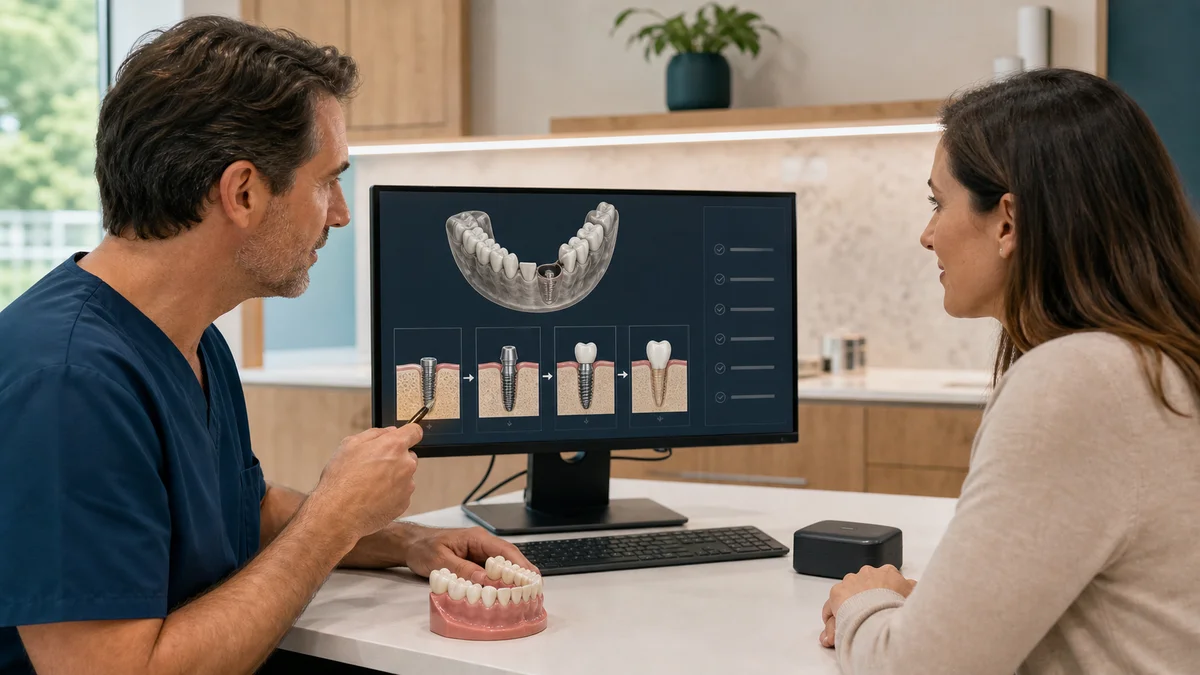
Quick answer: There is no safe universal answer to “how much is a bottom tooth implant” because a complete single-tooth pathway may include assessment, imaging, extraction, site preservation, bone or gum grafting, implant surgery, an abutment, a custom crown, a temporary tooth and follow-up. Compare written plans line by line, including exclusions, rather than comparing one advertised figure.
When someone asks how much is a bottom tooth implant, the phrase can refer to three very different things: the implant body placed in the lower jaw, the abutment connecting it to the restoration, or the complete tooth replacement including the visible crown. A quote that includes only one component will look lower than a plan that covers the whole pathway, even when the second plan is more transparent.
This guide does not publish a fixed price because cost depends on diagnosis, anatomy, treatment scope, location, clinician and laboratory. It shows how to build a comparable quote without sacrificing safety. The aim is to understand what is included, what could be added after examination, what happens if the implant cannot be placed as planned, and which alternatives deserve consideration.
how much is a bottom tooth implant: define “complete” first
The best first response to how much is a bottom tooth implant is a scope question. The U.S. Food and Drug Administration explains that a dental implant system consists of an implant body and an abutment and may include an abutment fixation screw. The system then supports an artificial tooth such as a crown, bridge or denture. These are related parts, not one billable object.
A complete single-tooth plan may involve examination, radiographs, digital records, extraction, management of infection, bone or soft-tissue procedures, implant placement, healing components, an abutment, a temporary replacement, a crown, laboratory work and reviews. Some plans bundle several items; others list every stage separately. Neither structure is automatically better, but the patient must be able to reconcile it.
Ask the provider to label the quote as “implant body only,” “surgical phase,” “restorative phase” or “complete planned care.” For how much is a bottom tooth implant, the total is meaningful only when the endpoint is defined: a healed implant with a functioning, cleansable crown and an agreed follow-up arrangement.
The lower front, premolar and molar sites are not equivalent
To answer how much is a bottom tooth implant, the exact lower tooth matters. A narrow lower incisor space has different restorative and positional constraints from a premolar or molar site. Back teeth usually face greater chewing load and require a different crown form. Space between roots, available bone and the path of the lower-jaw nerve also vary.
The visible gap cannot show all of this. Before estimating how much is a bottom tooth implant, the clinician evaluates neighboring teeth, ridge width and height, gum tissues, bite, smile, root positions and relevant anatomy. Leeds Teaching Hospitals notes that implant assessment may use imaging to evaluate neighboring roots, nerves and bone. Three-dimensional imaging should be clinically justified rather than treated as an automatic mark of quality.
Different positions can change implant dimensions, surgical access, component selection, crown design and laboratory steps. Therefore, a price from a front-tooth example should not be assumed to apply to a lower molar, and a molar advertisement should not be used to estimate a narrow incisor site.
Checkpoint 1: examination and diagnosis
Every reliable answer to how much is a bottom tooth implant begins with diagnosis. The team must confirm why the tooth is missing or failing, whether infection or gum disease is active, whether adjacent teeth are healthy, and whether retaining the tooth is still possible. Implant treatment should not be proposed from a photo alone.
Assessment can include medical and dental history, oral examination, gum measurements, bite analysis, standard radiographs and digital or physical records. These inputs make how much is a bottom tooth implant a case-specific calculation. Additional imaging may be indicated when it answers a specific anatomical or surgical question. The written quote should say which records are included and which might be charged separately.
This stage also identifies health factors that influence timing and risk. The FDA notes that overall health affects candidacy and healing, while smoking may affect healing and long-term outcome. Medication, diabetes control, previous gum disease, grinding, antiresorptive therapy and prior jaw radiation may require added coordination without automatically excluding every patient.
Checkpoint 2: keeping the tooth versus extracting it
The question how much is a bottom tooth implant should not bypass tooth preservation. A restorable tooth may have endodontic, periodontal, restorative or combined options. A second opinion can be valuable when extraction is irreversible, particularly if the tooth appears structurally savable or two plans disagree.
If extraction is appropriate, the answer to how much is a bottom tooth implant should state whether its fee, sedation or local anaesthetic, imaging and early review are included. A simple extraction and a surgical extraction can involve different resources. The socket may be left to heal, preserved with graft material or prepared for immediate implant placement depending on infection, bone walls, position and the restorative plan.
Immediate placement can reduce the number of surgical episodes in selected cases, but it does not mean the biology is instantly healed or that a final crown is always fitted that day. For how much is a bottom tooth implant, the plan should distinguish extraction, implant placement, provisionalization and final restoration rather than merging them under “same-day tooth.”
Checkpoint 3: bone volume and grafting
Bone is a major variable in how much is a bottom tooth implant. The implant needs an appropriate three-dimensional position and adequate surrounding tissue. A narrow or deficient ridge can follow long-standing tooth loss, infection, trauma or previous surgery. Bone condition is assessed in relation to the planned crown, not by a generic measurement alone.
Possible approaches in how much is a bottom tooth implant include no graft, socket preservation at extraction, a small simultaneous contour graft, a staged ridge augmentation or a different treatment design. Leeds and the American Academy of Periodontology both describe ridge modification when upper or lower jaw defects leave inadequate bone. Added grafting increases materials, clinical time, healing, reviews and potential risk.
A quote should identify whether grafting is confirmed, optional if a defect is found, or excluded. It should also describe the material category, donor site if relevant, membrane or fixation, whether a separate surgery is expected and how a change will be authorized. “Bone graft included” is too vague for comparing plans.
Checkpoint 4: gum tissue and cleanability
People researching how much is a bottom tooth implant often focus on bone and overlook gum tissue. The final crown must emerge through tissue that can be kept healthy and cleaned. Thin, deficient or poorly positioned tissue may influence appearance, comfort, recession risk and access for daily hygiene.
A soft-tissue graft is not automatically necessary. In the how much is a bottom tooth implant discussion, ask about its purpose, timing, donor material, healing and alternatives. The value should be linked to a specific finding such as tissue thickness, keratinized tissue, contour or a restorative need, not presented as a standard upgrade.
Cleanability can also be improved through crown contour and contact design. A technically successful implant with a bulky or inaccessible crown may generate long-term maintenance problems. The restorative clinician and surgeon should therefore plan the site together.
Checkpoint 5: the implant surgery fee
The surgical portion of how much is a bottom tooth implant may include sterile setup, local anaesthetic, implant placement, a cover screw or healing abutment, sutures and early review. Some practices include standard postoperative imaging; others itemize it. Ask whether the figure changes with guided surgery, staged exposure or unexpected grafting.
A “guided” procedure can alter how much is a bottom tooth implant and can refer to digital planning, a pilot guide or a fully guided template. The term alone does not prove greater safety or justify a price difference. The clinician should explain the clinical reason, the guide’s role, its limitations and what records or laboratory work are required.
The lower jaw has relevant nerves and neighboring roots. The FDA lists post-surgical numbness from nerve impingement or damage among implant risks. This does not mean every lower implant is high-risk, but risk assessment, implant position and informed consent belong in the surgical fee rather than being treated as optional extras.
Checkpoint 6: anaesthesia and comfort options
A quote for how much is a bottom tooth implant should state what anaesthesia is included. Many implant placements are performed with local anaesthetic. Sedation or general anaesthesia may add clinician, facility, monitoring, medicines, recovery and escort requirements. More anaesthesia is not automatically safer or clinically necessary.
The anaesthesia part of how much is a bottom tooth implant depends on procedure complexity, patient health, anxiety, ability to cooperate and local regulation. A medical assessment may be required. Patients should disclose medicines, allergies, pregnancy, sleep apnoea, heart or lung conditions, and prior anaesthetic problems.
If sedation is offered, ask who provides it, their qualifications, where it occurs, what monitoring is used, what the fee covers, cancellation rules and who handles complications. Travel and accommodation may need adjustment after sedation and should be budgeted separately from dental treatment.
Checkpoint 7: implant brand, model and components
Device selection affects how much is a bottom tooth implant, but a premium label alone does not establish the best plan. The FDA recommends asking which brand and model are used and keeping that information. Future access to compatible screws, drivers and restorative components can matter if the crown needs maintenance elsewhere.
For continuity as well as how much is a bottom tooth implant, the implant record should identify the system, dimensions, lot or reference information where available, date and site. The abutment may be prefabricated or customized, and the crown may be screw-retained or cement-retained. Each design has indications, trade-offs and a different laboratory workflow.
A quote should not hide component substitutions. Ask whether the abutment and screw are original, compatible third-party or custom-manufactured, and what documentation is supplied. These questions support continuity of care rather than brand-based marketing.
Checkpoint 8: abutment and crown
The visible result is central to how much is a bottom tooth implant. An implant body without an abutment and crown does not replace the missing tooth for normal function. The restorative phase can include digital or conventional impressions, bite records, shade selection, provisional components, custom abutment design, crown fabrication, insertion and adjustments.
The restorative answer to how much is a bottom tooth implant varies by crown material, position, bite, space and appearance. A lower molar may prioritize strength and occlusal control; a lower front tooth may require careful emergence and space management. No material is universally best, and no crown is maintenance-free.
Ask whether the final quote includes the abutment, screw, crown, laboratory, try-in, insertion and post-insertion adjustment. If a provisional crown is separate, identify why it is recommended and whether the fee will be credited or remain additional.
Checkpoint 9: temporary tooth options
Temporary replacement can change how much is a bottom tooth implant. Options may include no temporary tooth, a removable flipper, a bonded temporary, a modification to an existing denture or a provisional implant crown in selected cases. Location, appearance, bite and implant stability guide the choice.
For how much is a bottom tooth implant, a provisional attached to the implant is not the same as the final crown and does not prove complete integration. It may need reduced bite contact, dietary precautions and later replacement. A removable option may be less complex but can require adjustments to avoid pressure on a graft or healing site.
The quote should identify the temporary design, number of adjustments, replacement policy if it breaks and how long it is expected to be used. “Teeth in a day” should be translated into the exact provisional and definitive sequence.
Checkpoint 10: healing, second-stage surgery and timing
Time is a cost variable in how much is a bottom tooth implant. The FDA notes that implant healing may take several months or longer. Healing depends on site, bone, grafting, stability, health, smoking and treatment protocol. A calendar estimate is not a biological guarantee.
Timing changes how much is a bottom tooth implant: some implants heal with a component visible through the gum; others are covered and later require a smaller exposure procedure. Guy’s and St Thomas’ NHS describes implant care as a sequence that can include assessment, grafting, implant placement and restorative treatment. Each stage can involve several visits.
Ask whether second-stage exposure, healing abutments, scans, checks and delays are included. Also ask what happens financially if the implant does not integrate and cannot support a crown. A transparent plan distinguishes included remedial care from new procedures that would require consent and fees.
A line-by-line decision table for quotes
Use this table when asking how much is a bottom tooth implant. It is not a fee schedule. It is a scope check designed to reveal why two totals differ.
| Quote item | What should be clear | Common reason totals differ |
|---|---|---|
| Assessment and imaging | Examination, standard images, scan criteria and records | One plan includes advanced imaging; another bills it separately |
| Extraction and site care | Simple or surgical extraction, socket management and review | The lower quote starts after the tooth has already been removed |
| Bone or gum graft | Indication, material, membrane, donor site, timing and review | Grafting is excluded or listed only as a possible supplement |
| Implant placement | Device, surgery, healing component, sutures and early follow-up | Anaesthesia, guide or second-stage exposure is separate |
| Temporary tooth | Type, adjustments, duration and replacement terms | One plan includes a provisional and the other does not |
| Abutment and crown | Components, material, lab, insertion and bite adjustment | An advertised “implant” excludes the visible tooth |
| Maintenance and complications | Review schedule, implant record, urgent contact and exclusions | Aftercare is limited by time, geography or provider |
Why two clinics can quote different totals
Two answers to how much is a bottom tooth implant may differ without one being dishonest. They may reflect different diagnoses, components, crown design, laboratory, clinician roles, imaging, temporary teeth, graft assumptions, anaesthesia, review periods, currency or tax treatment. The plans may also aim at different endpoints.
Differences in how much is a bottom tooth implant become concerning when scope is hidden, necessary components are marketed as optional surprises, or a guaranteed outcome is tied to payment. A provider should be able to explain each item, likely contingencies and which findings could change the plan.
Compare the same tooth, same diagnosis and same completed outcome. Request itemized written plans and ask each provider to mark included, excluded, conditional and third-party costs. Convert currency on the same day and budget for bank fees and travel without assuming an exchange rate will remain stable.
Insurance and dental benefit plans
Coverage can materially affect how much is a bottom tooth implant, but benefit design varies. The American Dental Association explains that dental plans can use networks, maximum allowable fees, deductibles, co-insurance, schedules of allowance, annual limits and exclusions. A procedure can be clinically appropriate while not covered by a plan.
Before relying on insurance to answer how much is a bottom tooth implant, request a written estimate or pre-treatment review when available. Confirm whether benefits apply separately to extraction, grafting, implant placement, abutment and crown; whether waiting periods, missing-tooth clauses, frequency limits or alternate benefits apply; and whether the provider is in network. Pre-authorization is not always a guarantee of final payment.
Read the explanation of benefits rather than relying on a verbal percentage. Ask whether the plan’s “allowed amount” differs from the clinic charge and how a non-covered service is handled. Do not let an insurer’s payment rule substitute for a clinical discussion of alternatives.
Maintenance is part of the lifetime cost
Long-term how much is a bottom tooth implant calculations should include maintenance. The FDA, AAP and NHS sources all emphasize regular cleaning and follow-up. Implant crowns do not develop decay, but plaque can inflame surrounding tissues, nearby natural teeth can decay, and components can loosen or wear.
The lifetime view of how much is a bottom tooth implant can include routine examinations, professional cleaning, radiographs when indicated, bite adjustment, replacement of a screw or crown, treatment of peri-implant disease and management of grinding. The interval depends on personal risk rather than a universal schedule.
No responsible plan can promise a device or crown will never need repair. Ask who provides long-term care, which records they need and whether the crown can be removed or serviced. Keep the implant brand and component information for future clinicians.
What if the implant does not integrate?
Risk belongs in any answer to how much is a bottom tooth implant. An implant may fail to join predictably with bone, become infected, feel loose or lose support later. Guy’s NHS notes a risk of non-integration and component loosening or wear, while the FDA lists early and late complications including implant body failure.
If integration fails, treatment can involve removing the implant, allowing healing, treating infection, grafting, retrying with a revised plan or choosing an alternative. The best option depends on cause, damage, anatomy, health and patient preference. Replacement is not always immediate or appropriate.
Before paying, ask what the clinic’s policy covers if failure occurs during healing. Separate the cost of removing a failed implant, grafting, a replacement device, a new temporary tooth and new travel. A warranty cannot guarantee biology and may contain conditions about hygiene, smoking and reviews.
Alternatives may change the value calculation
A complete answer to how much is a bottom tooth implant compares alternatives. Depending on the site and bite, options can include preserving the existing tooth, a conventional bridge, a resin-bonded bridge, a removable partial denture, orthodontic space closure or accepting the space with monitoring in selected cases.
A bridge may avoid implant surgery but can require preparation of neighboring teeth. A resin-bonded bridge is more conservative but has narrower indications and can debond. A removable tooth may cost less initially but has comfort, stability and maintenance considerations. No treatment avoids procedures but can affect chewing, tooth movement or appearance depending on the gap.
The “cheapest” first step may not be the best value, and the most complex plan is not automatically superior. The decision should consider prognosis, invasiveness, effect on adjacent teeth, repairability, hygiene, total pathway and personal priorities.
Dental travel: count logistics and aftercare
Travel changes how much is a bottom tooth implant beyond the clinic invoice. Flights, accommodation, local transport, time away from work, a companion, medication, extra healing days and return visits can matter. Currency movement and card fees can also change the final amount.
The travel answer to how much is a bottom tooth implant should state how many visits are planned, the minimum interval between surgery and crown, who decides when the implant is ready, and what happens if grafting or delayed healing extends the stay. A return ticket should never force a final crown onto an implant that is not ready.
NHS England’s guidance recognizes that complications can arise after self-funded dental treatment received inside or outside the UK. Arrange local urgent care and routine maintenance before travel. The English Redent Klinik site describes the treatment setting, and the Redent Klinik contact page can organize existing records for a preliminary discussion. Redent Klinik in Istanbul cannot replace emergency services at the patient’s current location.
A safe written quote should include these items
For a usable answer to how much is a bottom tooth implant, ask for one document that states diagnosis, treatment objective, site, stages, components, fees, currency, validity period, likely contingencies and alternatives. It should separate confirmed care from options that depend on surgical findings.
- assessment, records and imaging already completed or still required,
- extraction type and management of the socket,
- bone or soft-tissue grafting with timing and material category,
- implant body, healing components, abutment, screw and crown,
- temporary tooth and the number of included adjustments,
- anaesthesia or sedation provider, facility and monitoring,
- review visits, second-stage exposure and restorative appointments,
- laboratory fees, taxes, imaging copies and implant documentation,
- management of non-integration, repair and urgent problems,
- excluded travel, accommodation, maintenance and third-party charges.
Questions to ask at the consultation
Turn how much is a bottom tooth implant into a clinical and financial checklist. Ask the clinician to show the proposed site, nerve and neighboring roots on the images. Clarify what is known, what remains uncertain and which finding would change the treatment or cost.
- Can the existing tooth be predictably preserved?
- Is this plan for a lower incisor, premolar or molar, and why does that matter?
- Is bone or gum grafting confirmed, conditional or unlikely?
- Does the quote include implant body, abutment, screw and final crown?
- Which temporary tooth is planned, and can it load the implant?
- How are nerve proximity, bite and grinding risk managed?
- How many visits and trips are expected under the usual and delayed pathways?
- What happens clinically and financially if the implant does not integrate?
- Who provides urgent care and long-term maintenance after I return home?
- Which alternatives offer a comparable endpoint with different risks?
Common questions about how much is a bottom tooth implant
Does the advertised implant price include the crown?
Not necessarily. “Implant” may refer only to the body placed in bone, while the abutment, screw, custom crown, laboratory and insertion are separate. Ask for a written completed-tooth total with every component marked included, excluded or conditional.
Why might a lower molar cost differently from a lower front tooth?
Space, bone shape, neighboring roots, nerve position, bite load, implant dimensions, crown material and laboratory design can differ. The amount is determined by the specific diagnosis and plan, not simply by whether the tooth is in the bottom jaw.
Is extraction included in how much is a bottom tooth implant?
It depends on the quote. Some pathways begin after the tooth has already been removed, while others include simple or surgical extraction and socket care. Ask whether anaesthesia, grafting, sutures and the extraction review are separate.
Will I definitely need a bone graft?
No. Grafting depends on the three-dimensional defect and intended implant position. It may be unnecessary, performed at extraction, added with implant placement or staged in advance. The clinician should explain the finding, technique, alternative and cost status.
Does dental insurance cover a bottom tooth implant?
Coverage varies by plan, network and component. Implant placement, grafting, abutment and crown may be treated differently. Obtain a written pre-treatment estimate, check deductibles, annual limits, exclusions and alternate benefits, and remember that prior review may not guarantee final payment.
Is same-day treatment cheaper?
Not automatically. Immediate extraction, placement or provisionalization can reduce stages in selected cases, but needs careful diagnosis and may involve special components or a provisional. “Same day” often describes a temporary tooth, not completed healing or the final crown.
What should happen if the implant fails during healing?
The site should be assessed for cause, infection, bone damage and alternatives. Removal, healing, grafting, replacement or another type of tooth replacement may be considered. Ask in advance which professional services and components are covered and which create new fees.
How many trips will international implant treatment require?
That depends on extraction, grafting, healing protocol, temporary tooth and readiness for the final crown. A plan may require separate diagnostic, surgical and restorative visits. Budget for delays and a possible extra trip rather than assuming the shortest itinerary.
Do I need a custom abutment?
Not every case does. A custom abutment may help manage tissue contour, angulation, space or crown design, while a prefabricated component may be suitable elsewhere. Ask why it is proposed, which system is used and whether it is included.
What records should I receive after treatment?
Keep the implant brand, model, dimensions, site, date and component information, plus relevant radiographs, restorative details and care instructions. These records can make maintenance or repair safer if another clinician treats you later.
Final answer: compare completed care, not one component
The honest response to how much is a bottom tooth implant is an itemized care pathway, not a universal number. Diagnosis, lower-jaw site, extraction, bone and gum condition, implant surgery, anaesthesia, components, temporary tooth, abutment, crown, follow-up and geography all shape the total.
A useful quote names the endpoint, documents the device, explains conditional costs and includes realistic alternatives. It also plans maintenance and complications. The lowest visible figure may exclude essential work, while a higher figure may include stages that another clinic bills later. Compare scope, safety and long-term responsibility before comparing totals.
Sources and further reading
Medical and financial-planning statements were checked against current official and professional sources. Coverage and clinical recommendations still require individual confirmation.
- U.S. FDA: Dental Implants – What You Should Know
- MouthHealthy by the American Dental Association: Implants
- American Dental Association
- American Dental Association: Types of Dental Plans
- American Dental Association: Explanation of Benefits
- American Academy of Periodontology: Dental Implant Procedures
- Leeds Teaching Hospitals NHS Trust: Dental Implants
- Guy’s and St Thomas’ NHS Foundation Trust: Dental Implants
- NHS England: Self-funded dental treatment and NHS intervention
- U.S. CDC: About Oral Health
- World Health Organization: Oral health