
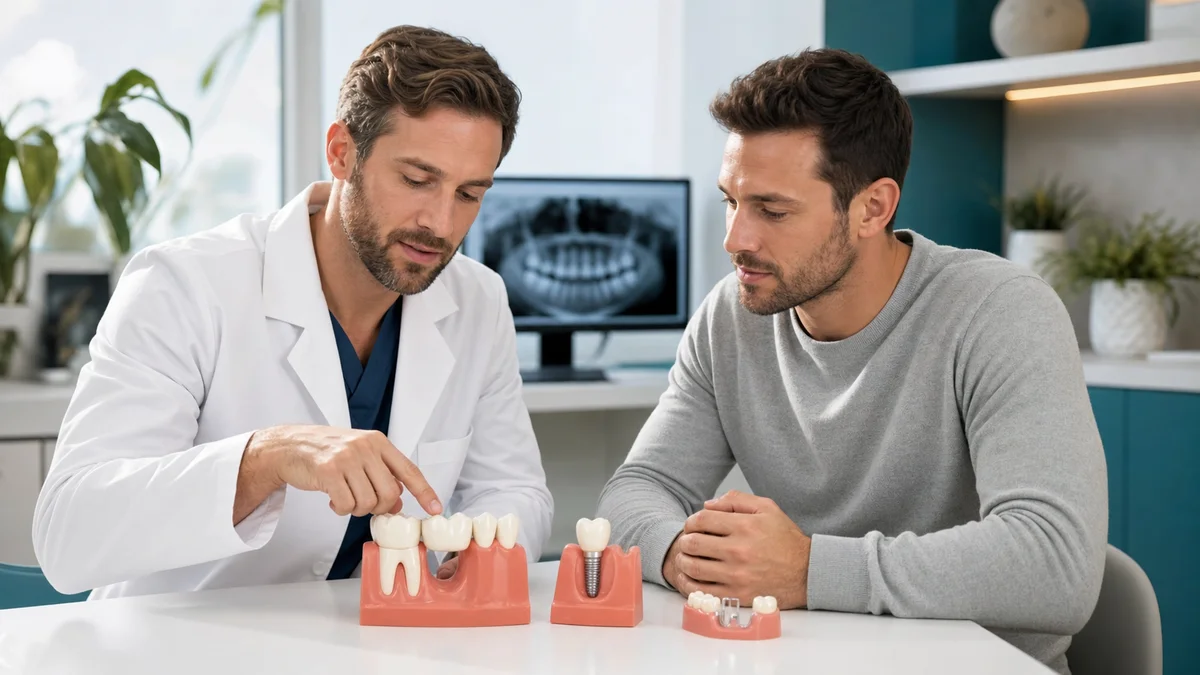
permanent bridge teeth cost is not one universal number because “a bridge” can describe several different restorations. A conventional three-unit bridge replacing one tooth is not the same service as a longer bridge, a resin-bonded bridge, a cantilever design or an implant-supported bridge. The condition of the supporting teeth, the number of units, material selection, laboratory work, temporary restoration, bite adjustment and follow-up can all change the written plan.
A fixed dental bridge replaces one or more missing teeth with artificial teeth connected to retainers on natural teeth or implants. The American Dental Association defines a fixed partial denture as a prosthetic replacement attached to abutment natural teeth or implant replacements. When comparing permanent bridge teeth cost, it is important to identify exactly which teeth or implants will provide support and what preparation they need. A low headline fee may not include diagnostic records, core build-ups, treatment of decay, temporaries or the final material you expect.
This guide explains the clinical and financial components that make bridge quotes different. It does not diagnose your mouth, promise a result or provide a fixed fee. A personal estimate requires an examination, appropriate imaging when justified, assessment of the gums and supporting teeth, and a discussion of alternatives. The content is evidence-informed, prioritizes patient safety and is prepared for clinical review by Dentist Esma Çevrük Çakır.
Quick answer: permanent bridge teeth cost depends on the bridge design, number of units, supporting teeth or implants, restorative material, laboratory method, temporary bridge, treatment needed before placement and insurance rules. A complete quote should identify every included unit and material, possible added procedures, maintenance and alternative options. The least expensive initial bridge is not always the lowest-cost or most conservative long-term choice.
permanent bridge teeth cost starts with the exact bridge design
The word “permanent” usually means a definitive fixed prosthesis intended for extended use, not a restoration guaranteed to last forever. A dentist can remove a fixed bridge when clinically necessary even though a patient does not take it out each day. For permanent bridge teeth cost, ask whether “permanent” distinguishes the final bridge from a provisional bridge worn while tissues settle or a laboratory completes the final restoration.
A traditional bridge commonly uses a crown on each side of a missing tooth and a pontic between them. That example contains three units: two retainers and one replacement tooth. If two missing teeth are replaced or an additional supporting tooth is required, the number of units may increase. permanent bridge teeth cost may therefore be quoted per unit, per retainer, per pontic or as a combined case fee. Those formats cannot be compared until the full unit count is written down.
Bridge design is a biological decision, not only a financial one. Supporting teeth need sufficient structure and periodontal support, and the proposed span must tolerate the expected bite. A healthy, untouched tooth may require preparation for a conventional bridge, whereas an already heavily restored tooth may benefit differently from being used as an abutment. The appropriate balance depends on the individual examination.
What is included in a complete bridge quote?
A transparent permanent bridge teeth cost estimate separates known services from procedures that are only possible after evaluation. It should state the tooth numbers, the missing tooth or teeth being replaced, the type of retainer, the number of pontics, the material and whether laboratory, provisional and follow-up services are included. If a quote simply says “bridge,” request a line-by-line explanation.
- Comprehensive or problem-focused examination and diagnostic records;
- Dental radiographs when clinically justified and any digital scans or impressions;
- Decay removal, core build-up or replacement of failing restorations if needed;
- Periodontal treatment required before the supporting teeth can be used;
- Preparation of the abutment teeth and a provisional bridge;
- Laboratory fabrication, shade selection and selected framework or ceramic;
- Try-in, adjustment, cementation or bonding and bite refinement;
- Follow-up appointments and management of early sensitivity or fit concerns;
- Any night guard, hygiene device or maintenance visit recommended after delivery.
Root canal treatment is not automatically required simply because a tooth will support a bridge. It may be indicated if the tooth has irreversible pulpal disease, previous damage or another diagnosis, but it should not be presented as a routine add-on without clinical justification. When reviewing permanent bridge teeth cost, ask which preparatory treatments are confirmed, which are only potential and what findings would trigger them.
Comparison table: four fixed bridge approaches
The following table helps organize permanent bridge teeth cost conversations. It does not determine which design is suitable for you. Position in the mouth, bite forces, enamel availability, span length, supporting tissue and patient preferences can change the recommendation.
| Bridge approach | Typical support | Potential advantage | Important limitation or cost question |
|---|---|---|---|
| Traditional fixed bridge | Prepared natural teeth on both sides of the gap | Fixed design with familiar laboratory options | Requires preparation of supporting teeth; ask how many units and whether cores or root treatment may be needed |
| Cantilever bridge | Support on one side of the missing tooth | May avoid preparing a tooth on the other side in selected situations | Force control is critical; not suitable for every position or bite |
| Resin-bonded or Maryland bridge | Wing-like retainer bonded mainly to enamel | Often less tooth reduction in carefully selected cases | Bonding surface, bite and debonding risk matter; ask whether rebonding is included |
| Implant-supported bridge | Dental implants rather than natural teeth | Can avoid preparing neighboring natural teeth | Includes surgical assessment, implant components, healing and implant-level prosthetic work |
These are not interchangeable products. A resin-bonded bridge may involve fewer units and less tooth preparation but can have different retention limits. An implant-supported bridge can preserve neighboring teeth, yet it adds surgical and healing considerations. A conventional bridge may be efficient when adjacent teeth already need full-coverage restorations. permanent bridge teeth cost only becomes meaningful after benefits, risks and invasiveness are compared alongside the fee.
Factor 1: number of units and span length
Laboratories generally fabricate each retainer and pontic as part of a multi-unit restoration. More units involve more material, design work, contacts, shade characterization and fit verification. For this reason, permanent bridge teeth cost frequently rises with the length and complexity of the bridge. A four-unit bridge is not merely a three-unit bridge with one small addition; the biomechanics and connector design also change.
Longer spans can flex more and place greater demand on the abutment teeth. The number, root form and periodontal support of those teeth matter. Adding a support tooth is not always the correct answer, because linking more teeth also makes the restoration larger and can complicate cleaning. The dentist must decide whether a fixed bridge remains reasonable or whether implants, a removable partial denture or another strategy offers a safer distribution of forces.
When a clinic discusses permanent bridge teeth cost “per tooth,” clarify whether that means every pontic and every retainer unit. Confirm whether a five-unit bridge means five fabricated units even though fewer than five teeth are missing. This simple question prevents many apparently conflicting quotes.
Factor 2: condition of the supporting teeth
Abutment teeth are the foundation of a tooth-supported bridge. They are assessed for decay, cracks, remaining tooth structure, existing crowns or fillings, root shape, mobility, gum attachment and bone support. If a supporting tooth has active disease, it should be stabilized before final bridge fabrication. These findings can substantially change permanent bridge teeth cost and, more importantly, whether a bridge is a responsible choice.
A core build-up may be needed when a large portion of tooth structure is missing. A post can sometimes support a core in a root-treated tooth, but posts do not strengthen every tooth and are not routinely required. Periodontal treatment may be necessary if inflammation or deposits compromise the supporting tissues. Crown lengthening is considered only for specific restorative or periodontal reasons, not as a default bridge procedure.
Ask for the prognosis of each supporting tooth separately. If one abutment fails, the entire connected bridge may be affected. A quote that omits the condition of the supports can make permanent bridge teeth cost appear lower while leaving the most important risk unexplained. A written plan should state what is known and what uncertainty remains.
Factor 3: bridge material and laboratory method
Fixed bridges may be made from metal alloys, metal-ceramic combinations, zirconia or other all-ceramic systems, depending on the location and design. The ADA notes that indirect restorative materials differ in strength, fracture behavior, appearance, wear and technique requirements. Material choice therefore influences permanent bridge teeth cost, but a more expensive material is not automatically the best for every bridge.
Metal-ceramic bridges use a metal substructure veneered with tooth-colored ceramic. Zirconia can be monolithic or layered for different aesthetic and mechanical goals. Some all-ceramic materials may be better suited to particular span lengths or bonding situations. The selected material must provide sufficient connector dimensions while respecting available space and the opposing bite.
Laboratory work also varies. Digital scans, computer-aided design and milling can improve workflow, but they do not eliminate the need for clinical fit, contact and bite verification. Complex shade matching, tissue contours, multiple try-ins and a highly visible front-tooth bridge require additional time. When comparing permanent bridge teeth cost, request the full material name, not labels such as “premium porcelain” that do not identify the restoration.
Factor 4: provisional bridge and treatment timeline
After conventional abutment teeth are prepared, a provisional bridge can protect them, maintain appearance and help assess contours while the definitive bridge is made. The provisional is not designed to have the same long-term material properties as the final prosthesis. permanent bridge teeth cost may or may not include the temporary bridge, repairs or replacement if treatment extends longer than expected.
A provisional can also provide useful diagnostic information. The dentist can assess speech, bite, tissue response, tooth length and cleansability. In complex cases, a longer provisional phase may be recommended before the final bridge. That additional step has a clinical purpose and should be described in the quote rather than hidden as a later charge.
Same-day milling is possible in some settings for selected restorations, but speed is not a quality guarantee and not every multi-unit bridge is suitable. Traditional laboratory workflows may require more than one visit. permanent bridge teeth cost should be considered together with the number of appointments, the provisional plan and what happens if a fit or shade correction is necessary.
Factor 5: front teeth, back teeth and bite forces
An anterior bridge may demand detailed shade, translucency, tooth form and gum contour work because it is highly visible. A posterior bridge experiences stronger chewing loads and may need different material thickness or connector design. These demands can affect permanent bridge teeth cost even when the number of units is identical.
Grinding or clenching can increase stress on ceramics, connectors, cement and supporting teeth. A night guard may be recommended after assessment, although it cannot prevent every complication. Limited space, deep bite, an opposing implant restoration or an uneven bite may require additional planning. The patient should disclose past fracture, jaw muscle symptoms and appliance use.
Cosmetic goals also need realistic discussion. A bridge can replace missing teeth, but it cannot always correct every gum level, jaw relationship or neighboring tooth color without additional treatment. Before accepting a higher permanent bridge teeth cost for an aesthetic material, make sure the achievable result and the limitations are clearly explained.
Factor 6: conventional, cantilever or resin-bonded bridge
A conventional bridge usually requires circumferential preparation of the supporting teeth for crowns. This may be reasonable when those teeth already have large restorations or need crowns for separate reasons. If the neighboring teeth are intact, the loss of healthy structure becomes an important trade-off. The financial comparison should include biological cost as well as permanent bridge teeth cost.
A cantilever design relies on support from one side. It can be useful in selected low-load situations, but the lever effect must be considered. It is not simply a cheaper traditional bridge with one crown removed. A resin-bonded bridge uses a wing or wings bonded to enamel and can be more conservative. Enamel availability, moisture control, bite and pontic position are critical to retention.
If a resin-bonded bridge debonds, it may sometimes be rebonded, but the situation must be examined for decay, damage and occlusal causes. Ask whether follow-up or rebonding is included in permanent bridge teeth cost and for how long. No bridge type can be guaranteed against debonding, chipping or support-tooth disease.
Factor 7: implant-supported bridge costs are a separate pathway
An implant-supported bridge does not use neighboring natural teeth as crown retainers. It requires evaluation of bone and gum conditions, implant placement, healing, implant components and an implant-level final bridge. For that reason, permanent bridge teeth cost for an implant-supported design should never be compared with a tooth-supported bridge by counting only the visible replacement teeth.
The implant plan may include three-dimensional imaging, extraction or grafting, a surgical guide, temporary tooth replacement, implant abutments and additional maintenance. Immediate placement or immediate loading is not suitable for everyone. Healing time, stability and risk factors are assessed individually. A separate written surgical and prosthetic estimate is often clearer than one unexplained package price.
Implants avoid preparing adjacent teeth but introduce surgical risks and require meticulous long-term care. Tooth-supported bridges avoid implant surgery but use natural teeth as supports. The most appropriate option depends on anatomy, health, time, preferences and prognosis. permanent bridge teeth cost should be one decision factor, not the diagnosis.
Bridge versus implant versus removable partial denture
A missing tooth does not automatically require a bridge. Alternatives may include a single implant crown, an implant-supported bridge, a removable partial denture, orthodontic space closure or—in selected circumstances—accepting the space with monitoring. Each option changes treatment time, invasiveness, hygiene, repair and permanent bridge teeth cost.
- Traditional bridge: fixed and usually faster than an implant pathway, but prepares supporting teeth.
- Resin-bonded bridge: often more conservative, but limited by bite, position and retention conditions.
- Single implant crown: preserves adjacent teeth but requires surgery, healing and sufficient bone.
- Removable partial denture: can replace several teeth with less tooth preparation, but is patient-removable and may feel bulkier.
- Orthodontic space management: may close or redistribute space, with a different timeline and eligibility.
- Monitoring: may be reasonable for some spaces, but drifting, bite and appearance should be discussed.
A good consultation describes why an option is recommended and what is deliberately not being treated. It should not present the most expensive choice as automatically superior. Comparing permanent bridge teeth cost with an implant or removable option requires the full pathway, including maintenance and likely replacement or repair needs over time.
Insurance, annual maximums and pre-treatment estimates
Dental insurance benefits vary by country, employer, plan and contract year. A plan may cover a percentage of an allowed fee, apply a deductible, limit replacement frequency, impose a waiting period or use an annual maximum. The plan’s allowed amount can differ from the dentist’s fee. Therefore, advertised permanent bridge teeth cost and personal out-of-pocket cost are not the same figure.
Ask the dental office to submit a pre-treatment estimate when available, but understand that it is not always a final payment guarantee. Claims are adjudicated under the policy active on the service date. Some dental plans use a least expensive alternative treatment provision: the dentist may recommend a fixed bridge while the plan calculates benefits based on a removable partial denture or another lower-cost option. The ADA’s benefit-plan guidance highlights how such clauses can affect what a patient owes.
For U.S. readers, Original Medicare does not cover most routine dental services. Medicare’s current official page lists limited circumstances in which dental services directly related to certain covered medical treatment may be covered. A routine fixed bridge generally should not be assumed to qualify. Medicare Advantage dental benefits vary by plan. Verify permanent bridge teeth cost and coverage directly with the insurer using the exact procedure and tooth information.
Before treatment, ask for:
- The proposed procedure codes and tooth numbers;
- The dentist’s full fee and the plan’s estimated allowed amount;
- Deductible, coinsurance, annual maximum and remaining benefit;
- Waiting period or replacement-frequency rules;
- Any missing-tooth clause or pre-existing-condition provision where legally applicable;
- Whether an alternative benefit provision changes reimbursement;
- A written explanation of benefits after the claim is processed.
Do not delay urgent infection care solely while waiting for a benefit estimate. Coverage rules do not determine clinical necessity. If the proposed permanent bridge teeth cost is difficult to manage, discuss phased treatment, a safe provisional approach or a different definitive option rather than choosing an unverified direct-to-consumer prosthesis.
Travel treatment and comparing an international quote
Travel can make permanent bridge teeth cost appear different because professional fees, laboratory expenses, exchange rates and local operating costs vary. The comparison should also include travel, accommodation, time away from work, additional visits and the plan for complications after returning home. A bridge may need shade changes, bite adjustments or reassessment if sensitivity develops.
Request the material, manufacturer when relevant, unit count, provisional plan, clinician credentials, treatment records and follow-up policy in writing. Clarify who is responsible if a local dentist must remove or replace the bridge. Low prices do not prove low quality, and high prices do not guarantee excellence; continuity and documentation are practical quality factors.
Redent Klinik provides general information about its dental care approach on the English Redent Klinik homepage. For an individualized assessment and written treatment-plan request, use the English contact page. A remote inquiry can support planning, but final suitability and permanent bridge teeth cost require a clinical examination and appropriate records.
Risks, maintenance and the true long-term budget
Potential complications include sensitivity, decay at a margin, gum inflammation, loss of cement, ceramic chipping, connector fracture, wear, debonding and failure of a supporting tooth. These events are not inevitable, and their likelihood varies. They also cannot be ruled out by choosing a particular material. A responsible permanent bridge teeth cost discussion includes maintenance and repair rather than promising lifetime permanence.
Cleaning beneath the pontic is essential because ordinary floss cannot pass down through connected units in the usual way. Floss threaders, super floss, interdental brushes or a water irrigator may be recommended according to the bridge design. The bridge contours should permit cleaning without creating an excessive food trap. Professional examinations help monitor margins, supporting teeth and periodontal tissues.
Daily fluoride toothpaste, individualized interdental cleaning, a balanced diet and tobacco avoidance support oral health. If a bridge feels loose, the bite suddenly changes, a piece chips, a bad taste persists or the supporting tooth becomes painful or swollen, contact a dentist promptly. Do not use household glue. Early assessment may provide more options and protect the supports.
The long-term budget may include hygiene appointments, radiographs when indicated, bite guard replacement, recementation, repair or eventual bridge replacement. No restoration lasts indefinitely in every person. Comparing permanent bridge teeth cost should therefore consider whether the design is cleanable, repairable and supported by teeth with a reasonable prognosis.
How to read a written treatment plan
A strong plan links every fee to a diagnosis and service. It identifies whether the bridge is traditional, cantilever, resin-bonded or implant-supported; lists units and tooth numbers; names the material; and distinguishes provisional from definitive care. It also records alternatives and major risks. This turns permanent bridge teeth cost from an advertising figure into a clinical document you can compare.
Useful questions include:
- Why is this bridge design recommended for my bite and supporting teeth?
- How many retainers and pontics are included in the unit count?
- Which existing teeth need treatment before the bridge, and why?
- What material and laboratory workflow will be used?
- Is a provisional bridge included, and what happens if it breaks?
- What alternatives preserve more natural tooth structure?
- How will I clean under the pontic, and what maintenance is expected?
- Which services could be added after treatment begins?
- How does insurance estimate my out-of-pocket responsibility?
If several teeth will be prepared, an implant is proposed, supporting teeth have uncertain prognosis or two plans differ substantially, a second opinion can be useful. Bring the same radiographs and records to each consultation. A second opinion is most helpful when it explains the reasons behind the difference, not when it offers only another permanent bridge teeth cost total.
Frequently asked questions about permanent bridge teeth cost
Why do two three-unit bridge quotes differ so much?
The unit count may be the same while materials, laboratory skill, temporary care, diagnostic records and preparation of the supporting teeth differ. One quote may include core build-ups, a provisional and follow-up; another may not. Insurance network rules can also change out-of-pocket cost. Compare each component of permanent bridge teeth cost, not only the final line.
Is a bridge charged per missing tooth or per unit?
Billing formats vary. A traditional bridge replacing one tooth often contains two retainer crowns and one pontic, so it has three units even though only one tooth is missing. Ask the clinic to list all retainers and pontics, procedure codes where relevant and laboratory components. This makes the quoted permanent bridge teeth cost easier to understand.
Does a permanent bridge require root canal treatment?
Not automatically. Root canal treatment is based on the pulp and root diagnosis, not on the bridge label alone. A deeply damaged, infected or previously traumatized tooth may need treatment, while a healthy abutment may not. Ask which findings support any endodontic recommendation and whether that service is included in permanent bridge teeth cost.
Is zirconia always worth the higher fee?
Zirconia can provide tooth-colored aesthetics and useful strength, but the appropriate choice depends on bridge length, connector size, space, bite, opposing teeth and laboratory design. Layered and monolithic zirconia are not identical. Metal-ceramic or another material may be reasonable in some cases. Material should be selected clinically, not solely to raise or lower permanent bridge teeth cost.
Will dental insurance pay for a permanent bridge?
Many dental plans provide some benefit for fixed prosthodontics, but deductibles, percentages, annual maximums, waiting periods, replacement limits and alternative-benefit rules differ. A pre-treatment estimate helps but may not guarantee payment. Original Medicare covers most routine dental care only in limited medical circumstances. Verify your personal permanent bridge teeth cost with the insurer and written plan.
How long should a permanent bridge last?
No fixed lifespan applies to every bridge. Supporting-tooth health, material, span, bite, cleaning, smoking, diet and regular care affect longevity. Bridges may need recementation, repair or replacement, and a supporting tooth can develop disease. Be cautious with lifetime guarantees. A realistic permanent bridge teeth cost discussion includes long-term maintenance and uncertainty.
Is an implant cheaper than a bridge over time?
There is no universal answer. An implant can avoid preparing neighboring teeth but adds surgery, healing, components and implant-specific maintenance. A bridge may have a shorter pathway but connects the prognosis of its supporting teeth. Compare the complete treatment and future repair scenarios rather than using the initial permanent bridge teeth cost alone.
Can I buy a permanent bridge directly online?
A definitive bridge requires diagnosis, tooth or implant preparation, accurate records, fit verification, bite adjustment and professional responsibility. An unsupervised impression or mail-order prosthesis may miss decay, gum disease, inadequate support or unsafe contacts. The ADA states that the dentist-provider is responsible for prosthetic care. Do not trade necessary examination for a low advertised permanent bridge teeth cost.
Conclusion: compare the whole treatment, not one price
permanent bridge teeth cost reflects the bridge type, number of units, material, abutment condition, laboratory process, provisional, follow-up and insurance contract. A conventional bridge, resin-bonded bridge and implant-supported bridge solve different clinical problems. The safest quote is not necessarily the highest or lowest; it is the one that clearly connects diagnosis, design, risks, alternatives and included services.
Request tooth numbers, unit count, material, preparatory procedures and maintenance in writing. Ask how you will clean the bridge and what happens if a supporting tooth or provisional has a problem. Confirm insurance benefits directly and seek a second opinion when the plan is extensive or unclear. That process makes permanent bridge teeth cost a useful decision tool instead of a misleading headline.
Sources and further patient information
- American Dental Association MouthHealthy: Bridges – patient information on fixed bridges, supporting teeth and bridge materials.
- American Dental Association: Materials for indirect restorations – clinical overview of ceramics, metals and material properties for crowns and bridges.
- Medicare.gov: Dental service coverage – current official U.S. information on routine dental exclusions and limited medically related coverage circumstances.
- NHS: Dental treatments – official patient explanation of bridges as fixed replacements for missing teeth.
- World Health Organization: Oral health fact sheet – global context on oral disease, prevention and risk factors.
Sources were reviewed on July 30, 2026. Clinical recommendations, fees and benefit rules can change. Your examination, current written treatment plan and direct confirmation from the relevant insurer or public payer remain controlling.