
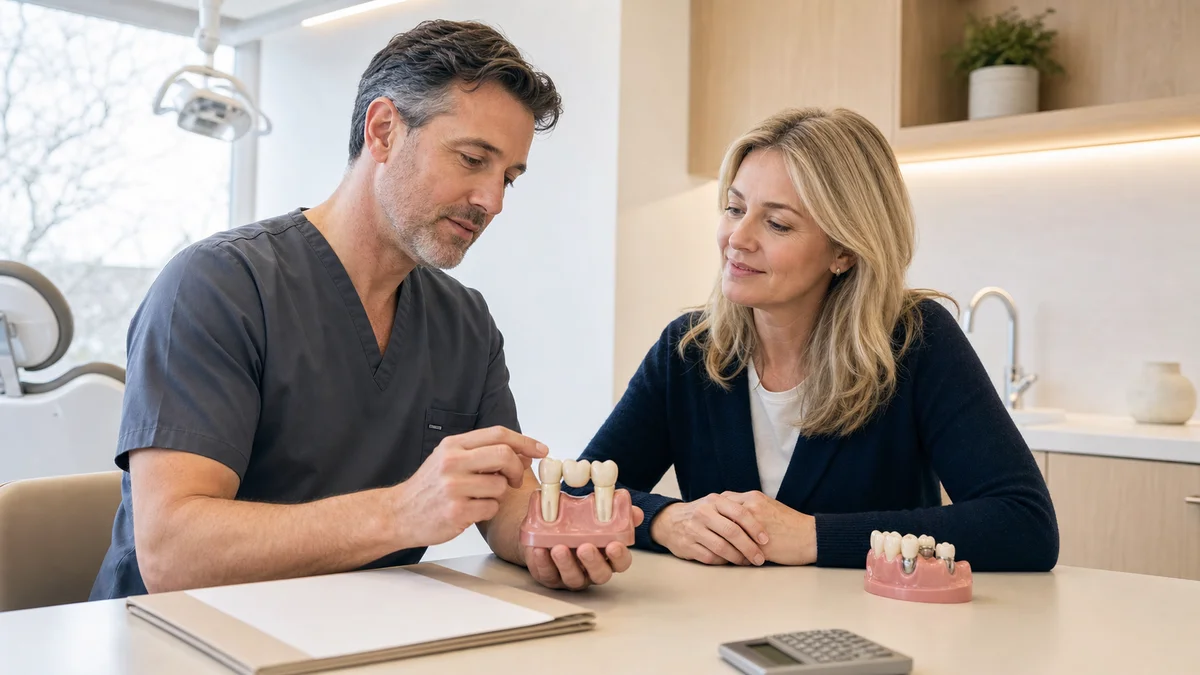
If you are searching how much is a bridge for teeth on NHS, the shortest accurate answer depends on where in the UK you receive care, whether a bridge is clinically necessary, and whether the whole course is NHS, private, or mixed. In England, a clinically necessary bridge normally falls within Band 3. From 1 April 2026, the published Band 3 patient charge is £332.10 for people who pay NHS dental charges. That is a charge for a course of treatment, not a retail price for each bridge unit.
This guide was checked against NHS and NHS Business Services Authority information available on 2 August 2026. Charges and rules can change, and Scotland, Wales and Northern Ireland do not all use England’s banded system. Ask the treating dental practice to confirm the current charge and provide a written treatment plan before irreversible treatment begins. This article provides general education, not a diagnosis, personal quotation or promise that a bridge will be offered.
1. How Much Is a Bridge for Teeth on NHS in England Right Now?
For a charge-paying adult in England, the official NHS page lists a fixed replacement for one or more missing teeth—a bridge—among treatments that may be included in Band 3. The published Band 3 charge from 1 April 2026 is £332.10. When people ask how much is a bridge for teeth on NHS, this is usually the number they want, but it needs context: it is the patient charge for the eligible NHS course, not the total laboratory value and not a price per missing tooth.
The charge applies when the dentist considers the bridge clinically necessary to keep the mouth, teeth and gums healthy, and when it is provided under NHS arrangements. A cosmetic preference, a particular premium material or a design outside the NHS option may be private. A practice should explain which elements are NHS and which are private before treatment. If you are exempt or qualify for help, your patient contribution can be lower or zero.
In other words, how much is a bridge for teeth on NHS is answered by the applicable patient-charge rules, not by a per-unit laboratory calculation.
2. Is the NHS Bridge Charge Per Tooth or Per Bridge Unit?
No. The England charge structure is based on a course of treatment and its highest applicable band. It is not calculated by multiplying £332.10 by the number of teeth in the bridge. If the same accepted course includes examinations, necessary X-rays, fillings or extractions as well as an eligible bridge, the patient normally pays the Band 3 charge rather than adding Band 1, Band 2 and Band 3 charges together.
This distinction makes the question how much is a bridge for teeth on NHS different from asking for a private itemised quotation. A private fee may reflect clinician time, bridge units, material, laboratory work and complexity. An NHS patient charge follows the statutory band for the course. The practice still needs to tell you the expected charge and document private additions separately.
A written answer to how much is a bridge for teeth on NHS should therefore name the band, course and exemption status rather than merely count replacement teeth.
What counts as one course of NHS dental treatment?
A course generally covers treatment identified as necessary at the assessment and accepted in the plan. It may take several visits. NHSBSA states that you pay one charge even if you return more than once to complete that course. A later, separate course can generate a new charge. The boundaries matter, so ask when the course starts, what it includes, and when it is considered complete.
3. When Can a Dental Bridge Be Provided on the NHS?
The NHS provides clinically necessary treatment needed to maintain oral health. The dentist uses examination findings and clinical judgement to decide which options are appropriate. Missing a tooth does not automatically create a right to a particular bridge type. The gap location, health of adjacent teeth, bite, gum condition, decay risk, cleaning ability and expected benefit all matter.
Someone asking how much is a bridge for teeth on NHS should first ask whether a bridge is suitable at all. A bridge uses supporting teeth, and a conventional design normally requires preparation of those teeth. If the potential abutments are weak, mobile, heavily decayed or poorly positioned, another option may be safer. Active gum disease or decay may need treatment before definitive replacement.
The phrase how much is a bridge for teeth on NHS only becomes personally meaningful after that clinical assessment confirms an NHS bridge is a reasonable option.
- Clinical need: the replacement should contribute to health or function, not be requested only as an elective cosmetic upgrade.
- Suitable supports: abutment teeth and their surrounding tissues need adequate stability.
- Manageable span: the number and position of missing teeth must suit the proposed design.
- Cleanability: the patient must be able to clean around the bridge and beneath the replacement tooth.
- Informed consent: risks, benefits, alternatives, material and likely maintenance should be discussed.
4. What Does Band 3 Include With an NHS Bridge?
Band 3 includes the necessary items from Bands 1 and 2 within that course, plus custom-made restorations or appliances such as crowns, dentures and bridges. The NHS charge page explains that if treatment from different bands is needed in the same course, the patient pays the highest applicable band. This is why how much is a bridge for teeth on NHS cannot be answered by adding every appointment and procedure as separate band fees.
However, “included” does not mean every material or design a patient might prefer is available under NHS terms. A back-tooth crown, for example, may be offered in a metal-coloured option. Private alternatives can be discussed, but their risks, benefits and charges should be clear. The bridge plan must reflect clinical suitability and the provider’s NHS obligations.
For accurate consent, how much is a bridge for teeth on NHS and what Band 3 includes should appear together in the treatment discussion.
Does Band 3 cover the examination and X-rays?
When they form part of the same accepted Band 3 course, necessary assessment and diagnostic items covered by the lower bands are included in the Band 3 patient charge. If an assessment is a separate completed course and the bridge is planned later, charge handling can differ. Ask the practice to show how the proposed courses are recorded rather than assuming every previous or future visit is included.
5. When Might You Pay More Than One NHS Charge?
You may pay a new charge for a separate course of treatment after the original course has ended. The NHS cost page also explains that if further treatment is needed within two months, no extra charge is usually due when that treatment is in the same or a lower band; if a higher band is required, the higher fee applies. After two months, a new relevant charge can apply. Individual records determine how this rule is used.
Therefore, the answer to how much is a bridge for teeth on NHS should separate the bridge course from future check-ups, unrelated treatment, maintenance and replacement. Urgent re-cementing may fall under urgent care, while a new definitive bridge could be Band 3. Do not assume a repair, re-cementation, remake and replacement after loss are charged in the same way.
Can a practice charge separately for multiple visits?
Not simply because the bridge requires several appointments. NHSBSA says only one band charge is paid when several visits are needed to complete one course. Separate private services or a genuinely separate NHS course may create additional charges. The written plan should make the distinction visible before you agree.
6. Why a Written Treatment Plan Matters
NHS guidance says a dentist must provide a treatment plan for Band 2, Band 3, or a mixture of NHS and private treatment. It records the proposed care and costs, is signed, and should be copied to the patient. If the plan changes after further investigation or changes in oral health, those changes should be discussed and agreed.
When comparing how much is a bridge for teeth on NHS with a private option, insist on comparable detail. The plan should identify which tooth or teeth are being replaced, the bridge design, which teeth are used as supports, what is NHS, what is private and the expected patient charge. A verbal total without this structure is difficult to evaluate.
The signed plan turns how much is a bridge for teeth on NHS from an online estimate into a documented charge for an agreed course.
- Ask whether the assessment and bridge are recorded as one course or separate courses.
- Confirm the NHS band and current patient charge at the start date.
- Ask which bridge material and design the NHS option uses.
- Request a separate written price for any optional private upgrade.
- Check what happens if clinical findings change during preparation.
- Keep your signed plan, receipts and laboratory or implant details when relevant.
7. NHS Bridge Materials and Design Choices
A dental bridge can be made using metal, ceramic, porcelain fused to metal or other approved restorative materials. Design may be conventional, cantilevered or adhesive, depending on the gap and supporting teeth. Not every material or design is appropriate for every location. NHS care aims to provide a clinically necessary option, whereas private care may offer a broader material or aesthetic choice.
The phrase how much is a bridge for teeth on NHS can hide this important difference. Two bridges may replace the same tooth but require different preparation, laboratory work and maintenance. A minimally prepared adhesive bridge may suit a selected small gap, while a conventional bridge may be considered when supporting teeth already need crowns. The dentist should explain why the recommended design fits your mouth.
Can you choose a tooth-coloured NHS bridge?
Material decisions depend on the clinical site and what is appropriate under the NHS course. A particular cosmetic material is not automatically guaranteed. Ask what the standard NHS option would look like, why it has been selected, and whether a private alternative changes only appearance or also preparation, strength, repairability and cost.
8. The Clinical Examination Behind the Price
A bridge quote should follow an examination, not precede it as a guarantee. The dentist may assess decay, existing fillings or crowns, gum health, tooth mobility, bite forces, available space and the condition of the tooth roots. X-rays may be clinically needed. If infection, decay or periodontal disease is found, it may need stabilisation before the final bridge is made.
This is why a search for how much is a bridge for teeth on NHS cannot replace diagnosis. A bridge that looks possible in a photograph may be inappropriate once root support or gum disease is assessed. Conversely, a supporting tooth that needs a crown might make a bridge more reasonable than preparing two completely healthy teeth. The decision should balance tissue preservation, function and long-term care.
9. Bridge, Denture or Implant: Cost and Clinical Differences
NHS guidance describes a bridge as a fixed replacement supported by surrounding teeth. A partial denture is removable and can replace one or more teeth. An implant is placed in the jawbone to support a crown, bridge or denture, but NHS implants are usually available only in limited circumstances; most are provided privately. These options have different surgery, cleaning and maintenance requirements.
Asking how much is a bridge for teeth on NHS is useful only after the viable options are known. A lower patient charge does not make a bridge safe if its support teeth are unsuitable. A removable partial denture may preserve tooth tissue and be easier to extend, but some patients dislike removal or visible clasps. An implant may avoid preparing adjacent teeth but requires surgery and carries biological and financial considerations.
| Decision point | NHS bridge in England | Private bridge | Partial denture | Implant-supported crown |
|---|---|---|---|---|
| How charged | Band 3 patient charge when clinically necessary | Itemised private quotation | May fall within NHS Band 3 or be private | Usually private; limited NHS circumstances |
| Fixed or removable | Fixed | Fixed | Removable | Fixed crown on implant |
| Support | Usually adjacent teeth | Usually adjacent teeth | Teeth and oral tissues | Jawbone through implant |
| Tooth preparation | Depends on bridge design | Depends on bridge design | Often limited, design-dependent | Adjacent teeth often not prepared |
| Surgery | Usually no implant surgery | Usually no implant surgery | Usually none | Required |
| Material choice | Clinically appropriate NHS option | Potentially wider, with added cost | Design-dependent | System and restoration-dependent |
| Cleaning | Under pontic and around retainers | Under pontic and around retainers | Remove and clean plus remaining teeth | Around implant crown and gum margin |
| Future repair | Depends on cause and NHS rules | Depends on provider terms | May be repairable or adjustable | Component and tissue dependent |
| Key uncertainty | Clinical eligibility and current band rules | Full scope of quotation | Retention, comfort and maintenance | Health, bone, surgery and total cost |
10. Who Can Get Free NHS Dental Treatment or Cost Help?
Some people in England are entitled to free NHS dental treatment, including specified age, education, maternity, benefit and other qualifying groups. Eligibility rules are detailed and proof may be required. Do not tick an exemption box unless you are sure; NHSBSA warns that incorrect claims can lead to a penalty charge.
For an eligible person, how much is a bridge for teeth on NHS may be zero for the NHS course, but any private element remains payable. People on a low income may apply to the NHS Low Income Scheme. A valid HC2 certificate can provide full help, while HC3 can provide partial help according to the certificate. Check validity dates against the treatment course.
Does pregnancy automatically make a private bridge free?
No. An NHS maternity exemption relates to eligible NHS charges, not private treatment. Confirm that the proposed bridge is clinically necessary, offered as NHS treatment and started within the valid exemption period. Ask for NHS and private portions to be shown separately.
11. England, Wales, Scotland and Northern Ireland Are Different
The £332.10 Band 3 figure discussed above applies to England from 1 April 2026. Wales introduced a different care-package charging structure in 2026, and the NHSBSA current-charge page lists a specific crown-or-bridge patient charge for Wales. Scotland uses a percentage-based contribution system with its own maximum for a course, subject to eligibility. Northern Ireland has separate arrangements and should be checked through its official health service information.
Accordingly, a UK-wide search for how much is a bridge for teeth on NHS should begin with your nation, not with a single national figure. Even within one nation, exemption status and whether the care is NHS or private can change the amount paid. Always verify the current official page for the location where treatment will occur.
Never use England’s answer to how much is a bridge for teeth on NHS as a quotation for treatment delivered elsewhere in the UK.
12. What If an NHS Bridge Is Lost, Broken or Worn?
NHSBSA states that a practice charges for replacement of a lost or broken NHS denture, bridge or orthodontic appliance. From 1 April 2026 in England, the listed Regulation 11 replacement charge is £99.60 per appliance. This charge can apply even to someone usually entitled to free or reduced NHS dental services, although a refund may be considered in specified hardship or reasonable-care circumstances.
If the bridge needs replacement because of wear and tear or because clinical needs changed, NHSBSA says the normal Band 3 charge applies unless the person is entitled to free or reduced-cost NHS care. This is a different question from how much is a bridge for teeth on NHS when a new bridge is first clinically planned. The dentist must examine why the bridge failed before choosing re-cementation, repair, remake or a different treatment.
Are bridges covered by the 12-month NHS guarantee?
The NHSBSA guaranteed-items list names fillings, root fillings, inlays or onlays, porcelain veneers and crowns, with exceptions. It does not list bridges as a general guaranteed item. Do not assume the crown guarantee automatically covers an entire bridge. Ask the original practice how the bridge problem is classified and which regulation applies.
13. Urgent Re-cementing Is Not the Same as a New Bridge
The NHS cost page lists re-fixing crowns and bridges among treatments that urgent care can include. The current England urgent or unscheduled care charge is £27.90. Urgent care aims to manage the immediate problem; it does not necessarily provide the final replacement. Further definitive care may require another course and an additional relevant charge.
If a bridge comes loose, keep it safe and do not use household glue. Contact a dental practice, especially if there is pain, swelling, trauma or a sharp edge. The answer to how much is a bridge for teeth on NHS will differ depending on whether the bridge can be safely re-fixed, needs a new supporting tooth treatment, or must be replaced entirely.
14. NHS and Private Treatment in the Same Plan
A practice may offer both NHS and private options. NHS guidance says the dentist must make clear which treatments can be provided on the NHS, which are private, and the costs of each. Choosing a private material or design should not make unrelated clinically necessary NHS care unclear. The mixed plan should record the distinction.
When someone asks how much is a bridge for teeth on NHS, a private upgrade must not be quietly added to the Band 3 figure. Ask whether the quoted private amount replaces the NHS bridge charge or is an additional optional element. Confirm who provides aftercare, what laboratory is used, what happens if the treatment plan changes, and whether any maintenance is excluded.
Can an NHS dentist insist on a private bridge?
The NHS provides clinically necessary care, while treatment that is not clinically necessary or is cosmetic is usually private. A dentist should explain the NHS options they consider appropriate and why a preferred alternative is private. If the explanation remains unclear, request the written plan and consider seeking another clinical opinion without delaying urgent care.
15. Private Bridge Quotes: What Should Be Included?
Private dentistry does not use the NHS band as its price. A quote can vary with the number of units, bridge design, material, supporting-tooth treatment, laboratory, temporary bridge, imaging and complexity. No responsible provider can guarantee a personal price before assessing the mouth. Ask for an itemised quote and its validity period.
Comparing private figures with how much is a bridge for teeth on NHS requires matching scope. One quote may include a temporary bridge and core build-ups; another may not. Root canal treatment, gum stabilisation or extraction can change the plan. A low headline amount has little meaning if essential stages and follow-up are omitted.
16. Considering Treatment Abroad
Patients sometimes compare an NHS pathway with private care abroad. Travel changes the logistics of assessment, laboratory stages, fit appointments, aftercare and urgent review. A remote estimate cannot establish whether the supporting teeth are healthy enough for a bridge. Existing decay, gum disease and bite problems should be identified before definitive preparation.
The English Redent Klinik overview explains available dental-care pathways, while the Redent Klinik English contact page can be used for organisational questions. These links do not replace NHS eligibility advice or a clinical examination. Anyone comparing how much is a bridge for teeth on NHS with overseas private care should include travel, accommodation, possible return visits and a written aftercare route.
What records should you request?
Keep the diagnosis, tooth numbers, X-rays where appropriate, material, bridge design, laboratory details, consent form, treatment plan and receipts. If another dentist later needs to help, clear records reduce uncertainty. Ask who is responsible for temporary work, adjustments, repairs and complications after you travel home.
17. A 9-Question Checklist Before You Agree
The most useful response to how much is a bridge for teeth on NHS is a documented clinical and financial plan. Take this checklist to the appointment and ask the dentist to explain unfamiliar terms in plain language.
- Is replacing this gap clinically necessary, and why is a bridge recommended?
- Are the supporting teeth healthy enough, and what preparation will they need?
- Is this bridge offered fully on the NHS, privately, or as a mixed plan?
- Which charge band applies, and is the published amount current for my nation?
- What is included in this course, and when does the course end?
- What bridge design and material are proposed under the NHS option?
- What are the reasonable alternatives, including a denture, implant or no immediate replacement?
- How will I clean beneath the bridge, and what maintenance is expected?
- What happens financially and clinically if the bridge loosens, breaks or needs replacement?
18. How Much Is a Bridge for Teeth on NHS in 13 Common Scenarios?
The following quick scenarios show why the same search phrase can lead to different patient contributions. They are prompts for a treatment-plan conversation, not personal quotations.
- If you ask how much is a bridge for teeth on NHS for a new clinically necessary bridge in England, check the current Band 3 charge.
- If you ask how much is a bridge for teeth on NHS for several bridge units, remember the patient charge is not multiplied per unit.
- If you ask how much is a bridge for teeth on NHS with fillings in the same course, the highest applicable band normally determines the charge.
- If you ask how much is a bridge for teeth on NHS after a separate completed assessment course, ask whether a new course and charge will begin.
- If you ask how much is a bridge for teeth on NHS while validly exempt, confirm that every proposed element is NHS rather than private.
- If you ask how much is a bridge for teeth on NHS with an HC2 certificate, show the valid certificate before the course starts.
- If you ask how much is a bridge for teeth on NHS with an HC3 certificate, use the contribution stated for partial help.
- If you ask how much is a bridge for teeth on NHS in Wales, Scotland or Northern Ireland, use that nation’s current official system.
- If you ask how much is a bridge for teeth on NHS after it loosens, distinguish urgent re-fixing from definitive replacement.
- If you ask how much is a bridge for teeth on NHS after it is lost or broken, check the separate replacement-appliance rule.
- If you ask how much is a bridge for teeth on NHS because of wear, expect a clinical review before the charge is classified.
- If you ask how much is a bridge for teeth on NHS with a private material upgrade, require separate NHS and private figures.
- If you ask how much is a bridge for teeth on NHS before an examination, treat any number as general guidance rather than a personal plan.
Frequently Asked Questions About How Much Is a Bridge for Teeth on NHS
How much is a bridge for teeth on NHS if I need two missing teeth replaced?
In England, the NHS patient charge is generally based on the highest band for the course, not multiplied by the number of missing teeth. A clinically necessary bridge is within Band 3, currently £332.10 from 1 April 2026 for a paying adult. The design must still be clinically suitable, and a separate course can create another charge.
How much is a bridge for teeth on NHS if I am exempt?
If you are validly exempt from NHS dental charges when the course starts, the NHS patient charge may be zero. Private treatment is not covered by that exemption. Some replacement-appliance charges have separate rules and can apply even when a person normally receives free NHS dental care, so verify the exact situation.
How much is a bridge for teeth on NHS with an HC3 certificate?
An HC3 certificate provides partial help and states the maximum contribution expected under the scheme. The exact amount depends on the certificate and course. Show the valid certificate to the practice and ask it to calculate the contribution before treatment. HC2 generally provides full help with NHS charges.
How much is a bridge for teeth on NHS after an urgent appointment?
Urgent care may temporarily re-fix a bridge or manage pain, but a definitive new bridge can require a later Band 3 course. The urgent charge and subsequent course should be explained separately. If further treatment is part of the same course or occurs within relevant time rules, charge handling may differ.
How much is a bridge for teeth on NHS if an adhesive design is recommended?
Adhesive bridges are recognised bridge designs, but availability depends on clinical necessity, suitability and the provider’s assessment. They may preserve more tooth tissue in selected cases but are not appropriate for every gap or bite. Ask which NHS design is proposed and why.
How much is a bridge for teeth on NHS if I want a different material?
A private material or design may be offered, but it should be clearly separated from the NHS treatment plan. Ask for risks, benefits and charges in writing. Do not assume an optional private upgrade is part of the Band 3 patient charge or that it guarantees a better clinical outcome.
How much is a bridge for teeth on NHS compared with an implant?
Implants are usually provided privately. NHS guidance says they are sometimes available in limited circumstances, such as when a person cannot wear dentures for particular reasons including major trauma or mouth cancer. Individual specialist criteria apply. A preference to avoid preparing adjacent teeth does not itself guarantee NHS implant funding.
How much is a bridge for teeth on NHS if it follows an extraction?
Timing depends on infection, tissue condition, bite, temporary needs and the chosen design. Some provisional solutions can be used while tissues heal, but a definitive bridge may be delayed. Examination is essential; online cost information cannot determine readiness.
How much is a bridge for teeth on NHS if my preferred design is not offered?
Ask for the clinical reasons, the NHS option considered appropriate, available alternatives and their risks and costs. Request the written plan. You may seek another opinion, but availability and clinical judgement can differ. Do not delay treatment for acute infection, swelling or severe pain.
How much is a bridge for teeth on NHS if it later needs replacement?
No fixed lifespan can be promised. Supporting-tooth health, gum disease, decay, bite forces, bridge design, material, cleaning and attendance all affect service. Ask how the bridge can be maintained or repaired and which warning signs require prompt review.
What symptoms need urgent dental advice?
Seek prompt advice for severe or worsening pain, swelling, fever, pus, uncontrolled bleeding, trauma, a loose bridge that creates a choking risk, or difficulty swallowing or breathing. Rapidly increasing swelling or breathing difficulty requires urgent medical help. Cost planning should not delay emergency assessment.
Conclusion: Confirm the Band, the Course and the Clinical Need
For England, the current direct answer to how much is a bridge for teeth on NHS is usually the Band 3 patient charge of £332.10 from 1 April 2026 when a bridge is clinically necessary and provided as NHS care. The amount is per eligible course, not per bridge tooth. Exemptions and low-income support can reduce the contribution, while private choices remain separately chargeable.
The safest next step is a clinical assessment and written plan. Confirm whether the bridge is fully NHS, private or mixed; what material and design are included; which supporting teeth are involved; and how future repair or replacement would be handled. Because national systems and charges change, verify the official information at the time your course begins rather than treating any online figure as a permanent quotation.
Sources and Further Reading
- NHS: How much NHS dental treatment costs
- NHS: Dental treatments, including bridges
- NHS: Dental services available on the NHS
- NHS: Who can get free NHS dental treatment or cost help
- NHSBSA: Current NHS dental charges
- NHSBSA: England dental charges from 1 April 2026
- NHSBSA: Replacement dental appliances
- NHSBSA: NHS Low Income Scheme
- American Dental Association
- World Health Organization oral health fact sheet