
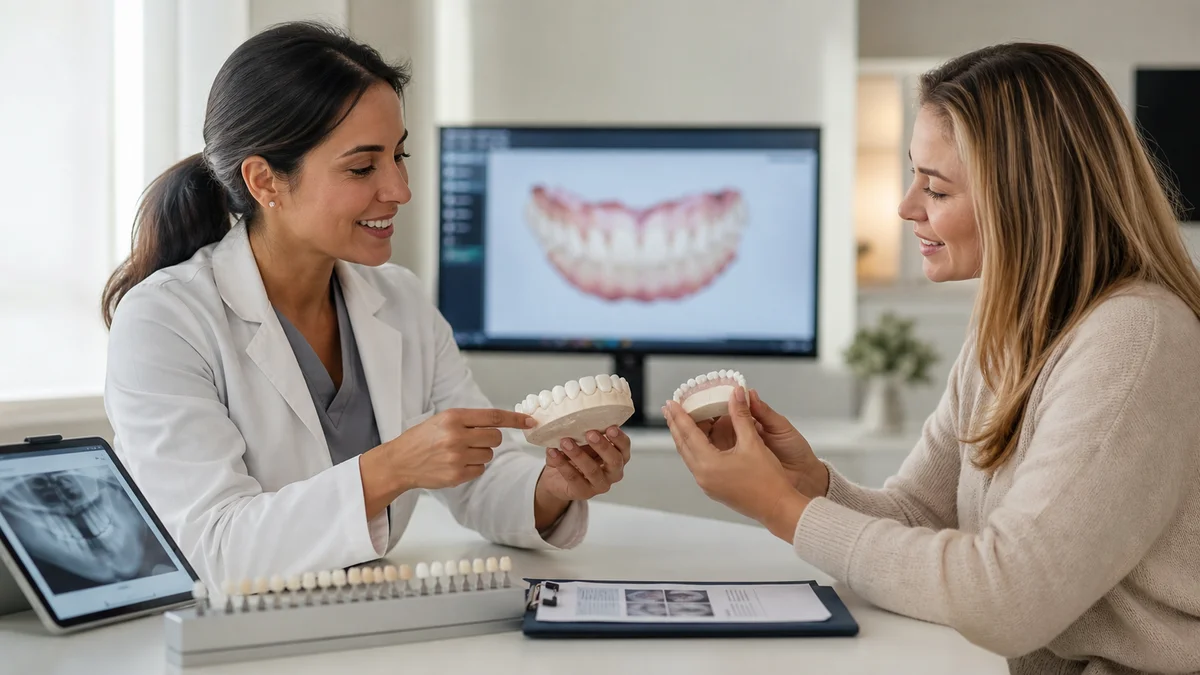
Quick answer: A trustworthy real veneers price is not an online shell price or a one-line “per tooth” advert. It should identify porcelain or composite, the exact teeth, examination and imaging, treatment of decay or gum disease, preparation, mock-up, temporaries, laboratory work, bonding, bite adjustment, reviews and repair terms. Only an examination can turn those items into a personal total.
Searching real veneers price can produce three very different products: custom porcelain veneers made by a dental laboratory, composite veneers shaped directly by a dentist, and removable cosmetic shells sold as “instant” or “snap-on” smiles. These are not interchangeable. A bonded veneer is a dental restoration made for a particular tooth. A removable shell covers several teeth temporarily and does not diagnose or treat decay, gum disease, bite problems or pain.
The word “real” should therefore describe an accountable clinical process, not a promise of extreme whiteness. A legitimate real veneers price plan starts with a licensed dentist, records the condition of each tooth, compares alternatives, explains irreversible steps and gives a written estimate. This evidence-led guide is prepared for review by Dentist Esma Çevrük Çakır. It offers decision support rather than diagnosis, a fixed clinic fee or a result guarantee.
1. What does real veneers price actually mean?
The American Dental Association’s patient resource defines veneers as custom-made coverings for the front surfaces of teeth. It distinguishes two main types: porcelain and composite. Porcelain veneers are thin shells produced to fit individual teeth; composite veneer material is bonded and sculpted at the chair. Crowns are different because they cover much more of the tooth. A removable cosmetic appliance is different again because it is not bonded to each prepared tooth.
That distinction changes every real veneers price comparison. Porcelain may involve scans or impressions, laboratory fabrication, a provisional phase and a later bonding visit. Composite can sometimes be completed in fewer visits, but artistic time, finishing and future repair still matter. A removable product may have a lower purchase price, yet it cannot be compared line by line with treatment that includes examination, disease control, consent, clinical preparation and long-term review.
A real veneers price quote is meaningful only when it states:
- the exact restoration or appliance, not just “Hollywood smile”;
- the material used and whether it is direct or laboratory-made;
- the tooth numbers and the clinical reason for including each tooth;
- what preparation is expected and whether it is irreversible;
- what is included before, during and after delivery;
- who provides treatment and how follow-up problems are handled.
2. Custom porcelain, composite and removable shells compared
Custom porcelain veneers are bonded to the front and sometimes limited side surfaces of selected teeth. The dentist may remove a small amount of enamel to create space and a suitable bonding form. The ADA describes an impression or digital model being sent to a dental laboratory, with a temporary veneer sometimes used while the definitive veneer is made. Because enamel removal may be involved, the decision is generally not reversible.
Composite veneers are built from tooth-coloured resin. They may require less enamel removal and fewer visits in some cases. They can be easier to repair, but the ADA notes that they are generally less resistant to staining and wear than porcelain. A lower initial real veneers price for composite should therefore be assessed alongside likely maintenance, polishing and repair rather than judged only on the day-one total.
Removable shells are not the same treatment, so their retail amount is not a bonded real veneers price. Some are dentist-supervised appliances; others are sold directly online or placed by people who are not licensed to diagnose and treat dental disease. They may alter speech, eating space or the bite while worn. No shell should be used to hide unexplained pain, swelling, loose teeth, decay or bleeding gums. If a removable option is being considered, ask a licensed dentist whether it is compatible with the health and position of your teeth.
Decision table: compare like with like
| Option | What it is | Quote should identify | Key limitation to discuss |
|---|---|---|---|
| Porcelain veneer | Custom laboratory-made facing bonded to one tooth | Tooth number, ceramic, laboratory, temporary, bonding and reviews | Enamel may be removed; chips, debonding and replacement can occur |
| Composite veneer | Tooth-coloured resin shaped and bonded by a dentist | Tooth number, layers, finishing, polishing and repair policy | May stain, wear or need maintenance sooner |
| Removable cosmetic shell | Multi-tooth appliance taken in and out | Provider, material, fit assessment, wearing and cleaning instructions | Does not treat disease and is not equivalent to bonded veneers |
| Crown | Restoration covering substantially more tooth structure | Clinical reason, material, core treatment, temporary and cementation | More extensive preparation; not a synonym for a veneer |
| No veneer yet | Monitoring or an alternative such as whitening, bonding or orthodontics | Reason, expected benefit, limitations and review point | May not produce the same shape or colour change |
3. Why no universal real veneers price exists
Private dental fees are set by individual practices and vary with location, clinician time, laboratory arrangements, material, complexity and service model. The UK General Dental Council states that it does not set private dental prices and that private charges have no single fixed limit. It requires dental professionals to give clear cost information; variable items may be shown as a range, but the patient should receive a written treatment plan with a realistic indication of cost before care begins.
A real veneers price can change when an examination reveals untreated decay, active gum disease, a large old filling, an unfavourable bite, severe grinding or a need for orthodontic movement first. Those findings do not mean that every extra procedure is automatically necessary. Each should have a diagnosis, an explanation, an alternative and a separate fee. If the plan changes during treatment, the revised cost should be provided in writing before non-urgent work continues.
The real veneers price cost drivers most commonly include:
- porcelain versus composite and the specific restorative design;
- the number and position of teeth in the visible smile;
- clinical examination, photographs, scans and necessary radiographs;
- gum, decay, root canal, filling or orthodontic treatment first;
- diagnostic wax-up, digital design or trial smile;
- temporary veneers and extra laboratory stages;
- complex shade matching, masking or bite management;
- review visits, night guard, maintenance and repair conditions.
4. Examination before the quote
A photograph can communicate a cosmetic goal, but it cannot show decay between teeth, root condition, bone support or every bite contact. A dentist should examine the teeth and gums, ask about symptoms and medical history, and decide whether radiographs are clinically justified. Photographs, impressions or a digital scan may then document tooth proportions, gum levels and occlusion.
This stage protects the patient and makes the real veneers price more accurate. The ADA advises that decay and gum disease should be treated before veneers; covering unhealthy teeth may worsen existing problems. A patient who clenches or grinds, or who has a deep overbite, may not be a suitable candidate without further planning. Suitability is therefore not a sales question answered by choosing a shade.
After assessment, request a tooth-by-tooth real veneers price record with:
- the problem being addressed on each tooth;
- the proposed veneer type and material;
- how much preparation is anticipated and why;
- alternatives, including delaying or doing nothing;
- the expected sequence and number of appointments;
- all fees, exclusions, review arrangements and emergency contact details.
5. Tooth preservation comes before real veneers price
Veneers can be appropriate for selected discolouration, chips, shape changes or spaces, but healthy enamel should not be removed without a clear clinical and aesthetic reason. The NHS explains that fitting some veneers involves drilling away a little of the front tooth, while not all veneers require the same preparation. The exact amount depends on tooth position, material thickness, colour masking, existing restorations and the intended contour.
Marketing terms such as “no-prep” do not prove that no alteration will occur in a particular case. Adding material without adequate space can create bulky contours or difficult cleaning areas. Conversely, aggressive preparation is not justified merely to make every tooth look identical. Before accepting a low real veneers price package for many healthy teeth, ask for the preparation design and obtain a second opinion if the explanation is unclear.
Alternatives may include whitening, edge bonding, direct composite repair, orthodontic movement, gum treatment or no immediate treatment. Each has different limits and maintenance needs. A licensed dentist should explain why the proposed veneer offers a proportionate benefit compared with these less invasive options, then show how that choice affects the real veneers price.
6. How tooth count changes the total
There is no medically correct package number for every smile. The number of visible teeth changes with lip movement, smile width, facial proportions and tooth position. Existing crowns, fillings and colour differences may also influence how many teeth need treatment for a coherent result. A “full smile” advert might mean six teeth in one clinic and twenty in another, so the phrase cannot substitute for tooth numbers.
Ask why every tooth is included in the real veneers price. Some patients may meet their goal with one or two repairs and whitening; others may need a broader plan to avoid an obvious colour transition. A mock-up can help visualise the proposed number, but it is a communication tool rather than a guaranteed final result. The written plan should show upper versus lower teeth and distinguish veneers from crowns or implants.
7. Design, laboratory and shade work
Porcelain veneers involve coordination between dentist and dental technician. The laboratory uses impressions or scans and a prescription to design fit, contour, contact points, texture and shade. A single veneer next to untouched teeth may demand different shade work from a planned set. Masking a dark underlying tooth can also affect material selection and thickness.
Laboratory involvement is one reason two real veneers price estimates can differ. Ask whether the quote includes a diagnostic wax-up, prototype or mock-up, provisional veneers, shade photographs, extra try-ins and one agreed laboratory revision. Request the material and laboratory record after delivery. “Premium porcelain” without a named material or traceable prescription is not enough information.
Before definitive bonding, review shape, phonetics, visible length and colour under appropriate lighting. Some adjustments are possible at try-in, while major changes after bonding may require remaking the veneer. The approval process and who pays for elective changes should be described in the real veneers price document before treatment starts.
8. Temporaries, mock-ups and trials are different
A mock-up is a preview of a proposed shape placed before or during planning. A temporary veneer protects and restores an already prepared tooth while the laboratory makes the definitive veneer. A digital simulation is an image-based communication aid. These three tools have different purposes, limitations and real veneers price effects.
If “trial smile included” appears in a real veneers price quote, ask what will actually be provided and for how long. Find out whether temporary repairs, replacement after accidental loss and out-of-hours advice are included. Temporary veneers may feel or look different from the final ceramics; they should not be presented as a precise guarantee of the definitive shade or longevity.
9. Bonding appointment and bite adjustment
At delivery, the dentist checks fit, margins, contacts and appearance. Teeth and restorations are prepared according to the chosen adhesive protocol, the veneers are bonded, and excess material is removed. Bite contacts should be checked in normal closure and movements. Moisture control, clinical time and careful finishing are part of the treatment rather than optional cosmetic extras.
The real veneers price should state whether minor bite adjustment and an early review are included. It may take a few days to adapt, but the ADA advises telling the dentist if the bite does not feel right after placement. Significant pain, swelling, mobility, a fractured veneer or a feeling that one tooth hits first warrants prompt professional review.
10. Risks and future costs
Even well-planned veneers may chip, crack, wear, loosen or require replacement. Sensitivity, gum irritation, colour dissatisfaction or a bite problem can occur. Natural tooth structure around or beneath a veneer can still decay. The chance and consequence of each problem vary with the tooth, design, bonding surface, bite, habits and maintenance, which is why future care belongs in a real veneers price comparison.
A high real veneers price does not guarantee a complication-free result, and a low one does not eliminate biological limits. Ask how the practice handles early debonding, laboratory defects, accidental damage, decay and elective colour changes. A “guarantee” should be written with its duration, exclusions and required maintenance; it should never be confused with a promise that the restoration will last for life.
Grinding and clenching can increase mechanical load. A night guard may be advised after individual assessment, but it cannot prevent every failure. Include the guard, adjustments and replacement interval when comparing lifetime cost. Avoid biting fingernails, ice, packaging or other hard objects with veneered teeth.
11. Insurance and financing
The ADA notes that veneers are generally considered cosmetic, so insurance may not cover them unless a plan deems the service medically necessary. Coverage language, exclusions, annual limits, waiting periods, network rules and prior authorisation vary. A financing plan changes when payment is made; it does not reduce the clinical price and may add interest or fees.
Before relying on insurance to lower the real veneers price, send the insurer the proposed procedure, tooth numbers, clinical reason and provider details. Request a written pre-treatment estimate while recognising that it is not always a final payment guarantee. Ask the clinic to separate cosmetic additions from any clinically indicated restorative work rather than promising coverage.
For a financed real veneers price offer, compare:
- cash total versus financed total;
- deposit, interest rate, setup fees and late charges;
- refund rules if the plan changes after examination;
- responsibility for laboratory work already commissioned;
- what happens if treatment pauses for health reasons;
- whether repairs or replacement are separate contracts.
12. Licensed care versus “veneer technicians”
The ADA warns the public about veneer services that eliminate the dentist’s role. It states that unsupervised treatment by unlicensed individuals can cause damaging complications, including infection and nerve damage, and may place material over unhealthy teeth without diagnosis. Professional clothing, a social-media certificate or an impressive before-and-after feed does not establish a licence to practise dentistry.
An unusually low real veneers price is not proof of unlicensed care, but verify the person who examines, diagnoses, prepares and bonds the teeth. In the United States, licence verification is available through state dental boards; other countries have their own regulators. Ask whose name appears on the consent form, invoice and clinical record. If no licensed dentist accepts responsibility, do not proceed with an irreversible procedure.
Warning signs in a real veneers price promotion include:
- no health history, examination or periodontal assessment;
- veneers offered at a salon, hotel room or short training event;
- material bonded over teeth without disease screening;
- cash-only pressure and no written treatment plan;
- no provider licence, laboratory record or emergency route;
- claims of zero risk, zero preparation for everyone or permanent results.
13. Are removable “snap-on” products real veneers?
They may be real removable appliances, but they are not the same as individually bonded porcelain or composite veneers. The distinction should be explicit in advertising and consent. A removable shell may serve a limited cosmetic purpose for some people, yet it can occupy space around teeth and gums and may influence speech or chewing. Its fit, cleaning instructions, wearing time and effect on the bite need professional consideration.
Do not compare the mail-order amount directly with a bonded real veneers price. The scope is different. A custom dental treatment quote includes diagnosis, disease control, irreversible-procedure consent, clinical placement and review. A product purchase may not. If a shell traps food, causes sore gums, changes the bite, loosens a tooth or causes pain, stop wearing it and seek a dentist’s assessment.
14. Dental tourism and travel costs
Treatment abroad can be appropriate when care is well planned, documented and followed, but an advertised real veneers price package may exclude flights, accommodation, extra scans, provisional repairs, laboratory remakes and a return visit. Currency movement and card fees can also change the amount paid. Jurisdiction, complaint routes and professional indemnity may differ from home.
For a cross-border real veneers price, obtain the same tooth-by-tooth plan you would request locally. Confirm how long the laboratory needs, what happens if a try-in is not accepted, and who provides urgent care after you return. Do not compress biologically necessary healing or review time merely to fit a flight. A low travel package is not a complete comparison without aftercare.
15. Maintenance and realistic longevity
No universal lifespan can be promised, so a real veneers price should not be sold as a lifetime purchase. Material, remaining enamel, bonding, bite, grinding, hygiene, diet, trauma and professional review all influence service. Porcelain can resist staining well, while composite may need polishing or repair; neither protects the natural tooth from decay at the edges. Gum levels and neighbouring teeth also change over time.
Lifetime real veneers price planning should include examinations, professional cleaning as advised, repair and eventual replacement. Brush twice daily with fluoride toothpaste and clean between the teeth. The World Health Organization emphasises prevention and control of shared risk factors in oral disease; veneers do not replace preventive care. Report persistent bleeding, pain, bad taste, movement or a bite change rather than waiting for a cosmetic review.
16. A written real veneers price checklist
The General Dental Council’s standards say a written plan should describe the proposed treatment, give a realistic cost indication and distinguish public from private elements where relevant. Estimated costs should be reviewed, and patients should receive an updated written version if the plan changes. Although these standards govern UK professionals, the checklist is useful anywhere.
Before paying a deposit, confirm that the real veneers price document includes:
- provider name, professional registration and clinic contact details;
- diagnosis, goals and alternatives for each tooth;
- porcelain, composite, crown or removable appliance clearly identified;
- examination, necessary imaging, photographs and scans;
- pre-treatment for decay, gums, roots, bite or alignment;
- mock-up, preparation, temporaries and laboratory stages;
- try-in, bonding, finishing and bite adjustment;
- material and laboratory documentation;
- review schedule, emergency route and maintenance;
- itemised total, exclusions, payment timing and revision rules.
Do not sign a real veneers price form you cannot understand or feel pressured to accept immediately. Ask for time to consider alternatives and seek a second opinion before extensive irreversible treatment. A responsible estimate can be updated when new clinical information appears, but the change and its reason should be explained before proceeding.
17. Questions to ask at consultation
Bring a concise goal rather than a demanded technique: for example, “I want to improve this chip while preserving enamel.” Share medical conditions, medications, allergies, grinding, previous orthodontics and any history of sensitivity or trauma. Reference photographs can communicate preferences, but another person’s smile cannot be copied exactly onto different teeth and facial proportions.
Use these questions to test a real veneers price proposal:
- Why is a veneer appropriate for each named tooth?
- Could whitening, bonding, orthodontics or monitoring meet the goal?
- How much enamel is likely to be removed and can I seek a second opinion?
- Is the material porcelain or composite, and who makes it?
- What do the mock-up, temporary and try-in include?
- What risks are most relevant to my bite and dental history?
- Which fees could change, and when will I receive a revised written plan?
- Who handles urgent problems, repairs and care after I travel home?
Frequently asked questions
What is a realistic real veneers price?
There is no responsible universal figure. A realistic estimate follows an examination and identifies material, tooth numbers, preparation, laboratory or chair time, temporaries, bonding, reviews and exclusions. Private fees vary by practice and location. Compare itemised plans with the same scope, not isolated online figures.
Are porcelain veneers more expensive than composite?
Porcelain often has a higher initial fee because it usually includes laboratory fabrication and multiple clinical stages. Composite may involve fewer visits, but polishing, staining, wear and repair can affect long-term cost. Suitability and tooth preservation should guide the choice before price.
Is a crown included in real veneers price?
It should not be silently substituted. A crown covers substantially more tooth structure than a veneer and can involve different preparation, temporary and laboratory work. If some teeth need crowns, the written plan should name those teeth and explain why they are not receiving veneers.
How many veneers do I need?
There is no standard package number. Smile width, lip movement, tooth position, colour differences, existing restorations and the specific goal matter. Ask for a reason beside every included tooth and compare less invasive options before accepting a multi-tooth package.
Does real veneers price include temporary veneers?
Not automatically. Porcelain plans may require temporaries after preparation, while some designs or direct composite work may not. The quote should state whether temporaries, repairs, replacement after accidental loss and the provisional review are included.
Are no-prep veneers always reversible?
No. “No-prep” is a marketing description, not proof that every tooth will remain untouched or that a bonded restoration can be removed without consequence. Tooth position, contour and colour determine whether preparation is needed. Request the planned preparation in writing.
Can veneers fix unhealthy teeth?
Veneers change appearance; they do not cure decay, gum disease, infection or unexplained pain. The ADA advises treating dental disease before veneers. Covering a problem without diagnosis can delay care and may worsen the condition.
Will insurance reduce real veneers price?
Veneers are commonly classed as cosmetic and may be excluded unless a plan accepts medical necessity. Coverage depends on the policy, procedure, tooth and provider. Submit a written pre-treatment estimate and verify limits, exclusions, network rules and authorisation directly with the insurer.
Are online snap-on veneers the same as porcelain veneers?
No. Snap-on products are removable multi-tooth shells; porcelain veneers are custom restorations bonded to individual teeth by a dentist. A removable shell does not diagnose or treat oral disease. Have pain, swelling, bleeding or loose teeth assessed before covering them.
How can I verify a veneer provider?
Check the treating professional’s licence with the relevant dental regulator, not only a social profile or course certificate. The person who diagnoses, prepares and bonds teeth should be legally authorised and named on the consent, invoice and clinical record.
Can a very low real veneers price be safe?
Price alone cannot prove safety or danger. A lower fee may reflect composite, fewer teeth, another location or limited inclusions. Confirm licence, diagnosis, tooth-by-tooth design, material, laboratory, sterilisation, consent and follow-up. Walk away from pressure, hidden scope or guaranteed results.
How long do veneers last?
No fixed lifespan applies to everyone. Material, remaining enamel, bonding, bite, grinding, hygiene, diet and trauma all matter. Veneers can chip, loosen, stain or need replacement. Ask for maintenance and repair terms rather than an unconditional lifetime promise.
Does the quote include a night guard?
Only if it is itemised. A dentist may recommend a guard when grinding or bite forces create concern, but it cannot prevent every complication. Clarify the fitting, adjustment, care and replacement costs.
What if real veneers price changes during treatment?
Ask why the plan changed and request an updated written estimate before non-urgent additional work. The GDC requires UK dental professionals to keep estimated costs under review and inform patients of changes. Similar written transparency is sensible in any country.
When should I seek urgent dental care?
Seek prompt professional advice for facial swelling, severe or worsening pain, trauma, uncontrolled bleeding, difficulty breathing or swallowing, or a restoration that creates an airway risk. A cosmetic appointment or removable shell should never delay urgent assessment.
Conclusion: the real price is an accountable care pathway
A useful real veneers price answers four questions: What exactly is being provided, why is it appropriate for each tooth, what is included in the total, and who is responsible if the plan or result needs review? Custom porcelain, direct composite and removable shells have different purposes and should never be compared as though they were the same product.
For an individual assessment, review the care approach on the Redent Klinik English website and use the Redent Klinik contact page to ask about examination and written planning. No website can confirm suitability, final cost or outcome without clinical assessment.
Sources and verification notes
This guide was checked on 2 August 2026 against the following professional and official sources. They support general education and do not replace a personal dental examination.
- American Dental Association MouthHealthy: Veneers
- American Dental Association
- ADA News: Public advice about “veneer technicians”
- NHS: Dental treatments and veneers
- General Dental Council: Dental costs
- General Dental Council: Communicate effectively with patients
- General Dental Council: Standards for the Dental Team (PDF)
- World Health Organization: Oral health fact sheet