
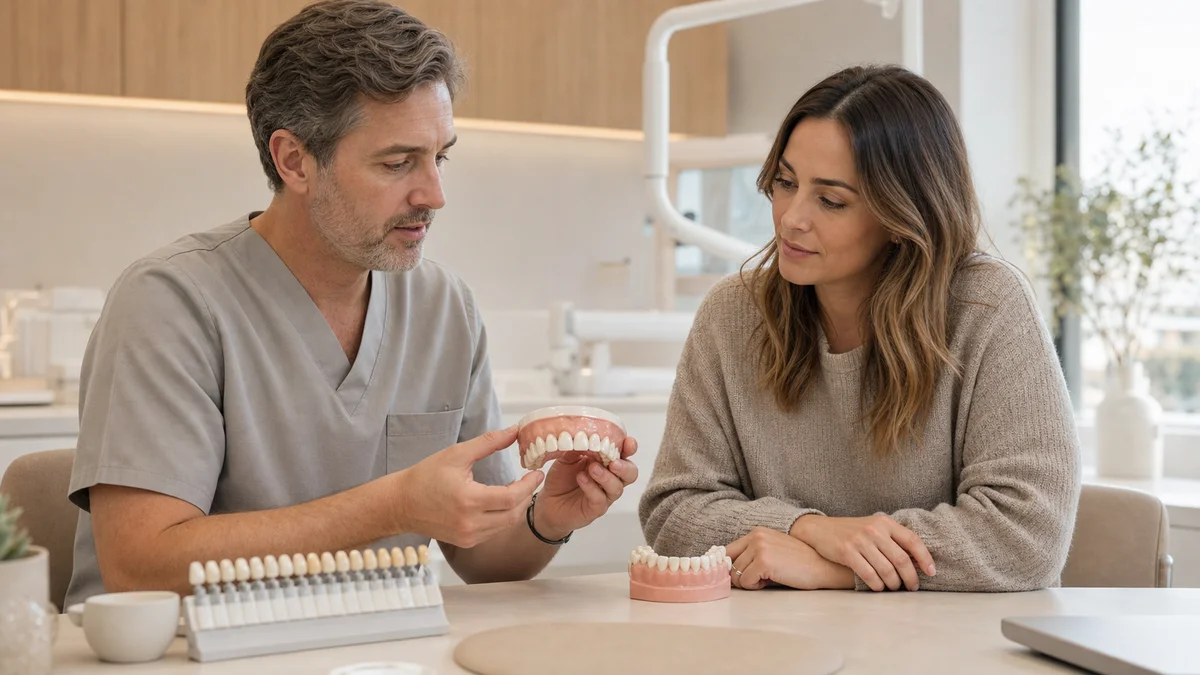
A veneers top only cost quote usually means veneers are being considered for selected upper teeth—the teeth most visible when you smile—while the lower teeth remain untreated. That sounds straightforward, but the total cannot be calculated safely from “top only” alone. Tooth count, material, smile line, tooth position, enamel, bite, gum health, laboratory stages, temporary work and aftercare all affect the plan. A responsible quotation follows an examination rather than promising one package to every person.
This evidence-led guide does not provide a fixed clinic price, diagnose suitability or promise a result. The NHS describes veneers as new facings for discoloured or chipped teeth and notes that some techniques remove tooth surface; veneers are generally private unless there is clinical need. The American Dental Association’s patient resource emphasises that treatment can be irreversible when enamel is removed, existing disease should be treated first, and veneers can chip, wear, loosen or need replacement. Those facts belong in every cost conversation.
1. What Does “Top Only” Mean in a Veneer Plan?
“Top only” generally means treating upper teeth and leaving lower teeth unrestored. It does not automatically mean every upper tooth from one side of the mouth to the other. The visible treatment zone may include only certain front teeth, but the appropriate boundary depends on lip movement, smile width, tooth alignment and shade transitions. A veneers top only cost estimate should name the precise tooth numbers rather than use a vague arch label.
A narrow treatment zone can look harmonious when natural teeth at its edges already match. It can also create an obvious colour, length or surface transition if the selected veneers stop inside the visible smile. Treating more teeth merely to make the boundary less visible adds biological intervention and cost, so it requires justification. The goal is not the highest count; it is the smallest defensible plan that addresses the patient’s priorities without overlooking function.
For that reason, veneers top only cost should be tied to a justified treatment boundary, not a preselected promotional count.
Does top only mean six, eight or ten veneers?
No universal number applies. Package counts promoted online are marketing categories, not diagnoses. Some people display fewer upper teeth; others show premolars when smiling broadly. Photographs, video, clinical examination and a reversible preview can help define the visible zone. Your veneers top only cost plan should explain why each proposed tooth is included.
2. Why Tooth Count Is Only the Starting Point
Many providers price veneers per tooth, so count has a clear financial effect. Yet multiplying a headline fee by a number can omit assessment, scans, wax-up, mock-up, provisional restorations, laboratory customisation or follow-up. It can also hide the fact that some teeth need different preparation or prior care. Use tooth count as one line in the veneers top only cost calculation, not the whole calculation.
Ask for a tooth-by-tooth map. A tooth with sound enamel and favourable position may need a conservative approach, while a rotated, heavily filled or dark tooth may demand another strategy. Teeth that are too compromised may need a crown or another restorative plan rather than a veneer. Adding such a tooth to a cosmetic bundle without separate assessment can create false price certainty.
3. Porcelain Versus Direct Composite on Upper Teeth
Porcelain veneers are thin custom-made shells produced outside the mouth, usually with a dental laboratory or digital manufacturing workflow. Direct composite veneers are sculpted from tooth-coloured resin by the clinician. ADA patient information notes that composite may require less enamel removal and fewer visits, and can be easier to repair, while porcelain is typically stronger, longer-lasting and more resistant to staining. Individual materials and techniques still vary.
Material changes veneers top only cost because it changes chair time, laboratory involvement, provisional needs, finishing and future maintenance. A lower initial composite figure does not prove lower lifetime expenditure, and a higher porcelain figure does not guarantee a better outcome. The appropriate comparison includes reparability, likely staining, bite forces, enamel availability, desired translucency and the patient’s willingness to attend reviews.
A fair veneers top only cost comparison therefore names both the material and every clinical or laboratory stage included with it.
| Decision factor | Porcelain veneers | Direct composite veneers | Alternative to discuss |
|---|---|---|---|
| How made | Custom indirect shells | Resin shaped directly on teeth | No-preparation monitoring where no treatment is needed |
| Visits | Often staged with laboratory work | May need fewer visits | Whitening before deciding on restorations |
| Enamel change | Preparation depends on case and design | May be more conservative in selected cases | Orthodontic alignment |
| Repair | May need laboratory or replacement planning | Often more directly repairable | Small localised bonding |
| Stain and wear | Generally more stain-resistant | More prone to surface wear or discolouration | Professional polishing or no restoration |
| Aesthetic control | Layered ceramic translucency and texture | Clinician-controlled layering and polish | Selective reshaping when safe |
| Cost structure | Clinical plus laboratory stages | Primarily clinical time and material | Compare total, not headline fee |
| Key risk question | Preparation, bonding, fracture and replacement | Wear, staining, chipping and maintenance | Whether intervention is needed at all |
4. Smile Design and Mock-Ups Affect the Quote
Upper-only veneers need to fit the person’s face, lips, speech and lower teeth. Planning may use calibrated photographs, digital scans, a diagnostic wax-up or a trial mock-up placed temporarily over the teeth. These steps allow discussion of length, width, edge position and smile curvature before irreversible preparation. They may be separately itemised or included in a package.
A complete veneers top only cost proposal should say whether a wax-up or mock-up is included, whether changes are allowed, and whether the design fee is credited if treatment proceeds. A digital image is helpful for communication but is not a guarantee that tissue, colour and material will behave exactly like a screen preview. A physical trial can reveal speech or bite issues that a still image cannot.
Is a digital smile preview the same as consent?
No. Valid consent requires a discussion of relevant options, benefits, risks, possible costs and the patient’s priorities. The General Dental Council states that consent must be obtained before treatment and that the discussion should be documented. A polished preview should support—not replace—that conversation.
5. Enamel Preparation and Reversibility
Some veneers require removal of enamel from the front and sides of the tooth to create space and a bonding surface. ADA information warns that treatment is not reversible when enamel is removed. “No-prep” or minimal-prep language does not prove that no tooth change will occur in a particular mouth; bulky contours, margins and bite still need evaluation.
Preparation affects veneers top only cost through clinical time, anaesthesia when needed, provisional veneers, scans or impressions and the complexity of bonding. More importantly, it creates a biological commitment. Ask the dentist to identify expected preparation per tooth and why. A treatment plan that cannot explain enamel preservation should be reconsidered before cost becomes the deciding factor.
Never assess veneers top only cost without also recording the expected enamel change for each proposed upper tooth.
6. Gum Health, Decay and Existing Restorations
Veneers should not be placed over untreated decay or active gum disease. Inflamed gums can bleed, change margin accuracy and make shade or contour assessment unreliable. ADA patient guidance specifically advises treating dental problems such as decay or gum disease first. Existing large fillings, cracks or root-canal treatment may also change whether a veneer is the right restoration.
Pre-treatment can alter veneers top only cost but should never be hidden inside a cosmetic headline. Ask for disease-control work to be listed separately, with the reason and timing. Stable gums and cleanable margins support safer planning. If a tooth is structurally weak, a veneer may not solve the underlying problem even if it improves the front surface.
- Comprehensive examination and relevant medical history
- Decay and existing-restoration assessment
- Gum inflammation, recession and periodontal stability review
- Bite, clenching and grinding assessment
- Photographs, scans or X-rays where clinically justified
- Discussion of tooth-preserving alternatives
7. Shade Matching Upper Veneers to Untreated Lower Teeth
Upper-only treatment makes colour coordination especially important. Lower teeth remain visible during speech and many smiles, and neighbouring upper teeth frame the veneer zone. Choosing an extremely bright, opaque shade can create contrast. Natural enamel also changes appearance under daylight, indoor lighting and photography, so shade selection should not rely on a filtered image.
Shade planning influences veneers top only cost when whitening is considered first, custom characterisation is needed, or a laboratory shade appointment is recommended. Whitening natural teeth after matching veneers can create a new mismatch because porcelain does not whiten like enamel. If whitening is appropriate, it is usually planned before the final veneer shade, allowing time for colour to stabilise.
The most useful veneers top only cost plan explains how the restored upper teeth will relate to every untreated tooth that remains visible.
Should the lower teeth be whitened first?
Possibly, but only after examination and discussion of sensitivity, restorations and realistic limits. Whitening may reduce the shade difference without placing lower veneers. It is not suitable for every person and will not change the colour of existing fillings, crowns or veneers. Its cost and maintenance should be separate from the veneer quote.
8. Bite, Grinding and the Risk of Chipping
The edges of upper front veneers contact lower teeth during biting and jaw movements. A deep overbite, edge-to-edge bite, tooth wear, clenching or grinding can increase technical risk. ADA patient information notes that veneers may be unsuitable for some people who grind or have a deep overbite. The dentist may recommend bite correction, another material or a different treatment sequence.
Bite management changes veneers top only cost when extra diagnostic records, adjustment, orthodontics or a protective night guard are clinically appropriate. A guard is not a guarantee against fracture, and it needs review and replacement over time. A quote that ignores obvious wear or grinding may underestimate both risk and maintenance.
9. Temporaries, Laboratory Work and Bonding Visits
Porcelain veneer treatment may involve preparation, an impression or scan, temporary veneers, laboratory fabrication, trial fitting and final bonding. Temporary veneers protect prepared teeth and preview shape, but they may feel or look different from definitive ceramics. Ask how temporary breakage, sensitivity or changes are handled between visits.
A transparent veneers top only cost breakdown should state whether temporaries, laboratory customisation, try-in, adjustments and final polish are included. It should also name the currency, payment schedule and circumstances that may change the quote. A “per tooth” figure that excludes mandatory stages is not comparable with an inclusive plan.
10. What a Written Quote Should Include
The UK Competition and Markets Authority advises patients to understand whether care is NHS or private and what it will cost. GDC consent standards require relevant options and possible costs to be explained. For cosmetic upper veneers, the quote should be itemised enough to reveal the full treatment pathway rather than only a promotional total.
Before accepting a veneers top only cost proposal, request the tooth numbers, material, preparation approach, clinician and laboratory roles, diagnostic steps, provisionals, bonding, follow-up, repair terms and excluded work. If the plan changes after examination or preparation, consent and cost should be revisited before continuing.
- Assessment: consultation, diagnostics and records
- Design: wax-up, mock-up or digital planning and revision limits
- Treatment: exact teeth, material, preparation and provisional stage
- Prior care: fillings, gum treatment, whitening or orthodontics
- Aftercare: review visits, adjustments and hygiene instruction
- Maintenance: polishing, repairs, night guard and replacement policy
- Exclusions: future disease, trauma, travel or unplanned procedures
11. NHS, Insurance and Financing Questions
The NHS states that veneers are generally only available privately unless there is a clinical need. Aesthetic upper-only veneer treatment is therefore usually a private expense in the UK. Insurance policies differ, and cosmetic treatment may be excluded unless specific restorative criteria are met. Obtain written confirmation rather than relying on an informal assumption.
Financing changes when you pay, not the biological suitability of care. Compare the total repayable amount, fees, cancellation conditions and what happens if treatment is stopped. A monthly figure can make veneers top only cost appear smaller while obscuring total liability. Do not let a finance approval replace time for clinical consent.
Write the total repayable veneers top only cost beside the cash quote before comparing monthly finance offers.
12. Maintenance and Future Replacement Costs
Veneers can chip, crack, wear, loosen or require re-bonding, repair or replacement. Natural teeth beneath and around them can still develop decay, and gums can recede. Brushing twice daily with fluoride toothpaste, cleaning between teeth, professional reviews and avoiding damaging habits remain important. A sports mouthguard may be advised for activities with injury risk.
Your veneers top only cost decision should include a maintenance reserve rather than assuming one payment lasts forever. Ask which problems can be polished or repaired, which require a new veneer, and whether the practice has written terms. No fixed lifespan can be guaranteed because oral health, bite, habits, trauma, material and care vary.
Are replacement veneers always the same price?
No. Future fees, materials, tooth condition and clinical complexity can change. Replacing one veneer in an older set may also involve shade-matching challenges. A current quote cannot guarantee a future replacement price, so written aftercare terms should describe the process rather than promise an unchanged fee.
13. Alternatives That May Lower Biological or Financial Cost
Veneers are not the only way to change an upper smile. Depending on the concern, alternatives may include professional whitening, limited composite bonding, orthodontic alignment, reshaping, repairing an existing restoration or no treatment. A crown is not merely a stronger veneer; it covers more tooth structure and has different indications. Each option has limitations and maintenance.
Compare veneers top only cost with the cost and consequences of the least invasive option that can meet the goal. Orthodontics can take longer but may avoid covering healthy enamel. Whitening can address colour but not shape. Bonding may be more repairable but may stain or wear sooner. Sometimes accepting a minor difference is the safest and least costly choice.
14. Red Flags in Top-Veneer Advertising
Be cautious when an offer guarantees a celebrity result, recommends a fixed number from photographs alone, uses heavily filtered before-and-after images, pressures immediate payment or avoids naming the treating dentist. ADA warns against unlicensed “veneer technicians” because unsupervised treatment can cause infection or nerve damage and may cover unhealthy teeth.
A credible veneers top only cost discussion includes uncertainty, alternatives and the possibility that no veneer treatment is advised. It never uses a low package price to bypass examination or informed consent. Verify professional registration where treatment will occur and ask how complaints, records, insurance and emergencies are handled.
15. Travelling Abroad for Upper Veneers
Overseas treatment may be quoted differently, but travel adds flights, accommodation, time away, currency changes and possible return visits. The GDC advises patients considering care abroad to research regulation, clinician qualifications, language support, aftercare, complaints and what happens if complications occur. It recommends assessment by a qualified dentist before a plan and cost estimate.
The English Redent Klinik overview can help you understand available treatment pathways, and organisational questions can be submitted through the Redent Klinik English contact page. These links are not a diagnosis or price promise. When comparing veneers top only cost across countries, include travel, diagnostic and follow-up stages and obtain a written aftercare route.
An overseas veneers top only cost figure is incomplete until likely travel, return visits and local urgent-care arrangements are understood.
Can a remote photo produce a final veneer quote?
No. Photos may help an initial conversation, but they cannot reliably show decay, gum stability, enamel thickness, root condition or dynamic bite. The final treatment plan and quote should follow an in-person clinical assessment and any justified records. Unexpected findings must be discussed before irreversible work.
16. A Safe Step-by-Step Decision Process
- Define the concern: colour, shape, spacing, wear, damage or a combination.
- Assess health: identify decay, gum disease, cracks, existing restorations and medical factors.
- Evaluate function: record bite, wear, grinding and lower-to-upper contacts.
- Compare options: include no treatment and reversible or less invasive choices.
- Preview carefully: use a mock-up when helpful, without treating it as a guaranteed result.
- Review the quote: itemise every stage, exclusion and maintenance term.
- Consent without pressure: allow time for questions or a second opinion.
- Plan aftercare: know how reviews, repairs and urgent concerns will be handled.
This sequence turns veneers top only cost from a promotional number into a defensible health decision. A lower count or lower fee is not automatically safer; a higher count or premium material is not automatically better. The right plan is the one that treats the appropriate teeth with the least justified intervention and can be maintained.
17. Questions to Ask Before Signing
Use these questions to compare veneers top only cost proposals on equal terms. Ask for the answers in writing when they affect consent, scheduling or payment.
- Which exact upper teeth are included, and why does the visible zone end there?
- What would happen if I treat fewer teeth or choose no treatment?
- Are porcelain, composite, bonding, whitening or orthodontics reasonable alternatives?
- How much enamel is expected to be removed from each tooth?
- How will the upper veneers match untreated lower and neighbouring teeth?
- What bite or grinding risks have been identified?
- Are mock-up, temporaries, laboratory, bonding and reviews included?
- Which future repairs or replacement costs are excluded?
- Who provides urgent review if I live far away?
18. Veneers Top Only Cost in 12 Quote Scenarios
These scenarios show how one headline can represent very different plans. They are comparison prompts, not personal price estimates.
- A veneers top only cost quote for four teeth should explain why the treatment boundary will not show in a broad smile.
- A veneers top only cost quote for a wider smile should identify every included tooth rather than say “upper arch”.
- A porcelain veneers top only cost quote should state laboratory, temporary, try-in and bonding inclusions.
- A composite veneers top only cost quote should state finishing, polishing and repair terms.
- A minimal-preparation veneers top only cost quote should document expected enamel changes tooth by tooth.
- A veneers top only cost quote after whitening should show the sequence and allow shade stabilisation.
- A veneers top only cost quote with gum treatment should separate disease control from cosmetic stages.
- A veneers top only cost quote for a person who grinds should include the bite-risk discussion and guard terms if advised.
- A financed veneers top only cost quote should show the total repayable amount, not only a monthly instalment.
- An insured veneers top only cost quote should not assume cosmetic cover without written pre-authorisation.
- An overseas veneers top only cost quote should add travel, return appointments and aftercare responsibility.
- Any veneers top only cost quote should remain provisional until a qualified dentist completes the clinical assessment.
Frequently Asked Questions About Veneers Top Only Cost
Is veneers top only cost always half of full-mouth veneers?
No. “Full mouth” and “top only” packages may contain different tooth counts, materials and clinical stages. Assessment, design, mock-up and aftercare do not necessarily halve. A meaningful comparison lists exact tooth numbers and inclusions instead of applying a simple fraction.
Does veneers top only cost rise with every extra tooth?
Often tooth count affects the quote, but fees may also reflect design, laboratory and complexity. Adding a tooth can change symmetry or shade planning, while some shared stages remain constant. Ask for an itemised update before approving a wider treatment zone.
Can I get only four upper veneers?
Possibly, if those teeth are the correct clinical and aesthetic zone. The transition to untreated teeth must be assessed in your natural smile. A mock-up can help. Do not choose four solely because a package is cheaper; equally, do not add healthy teeth without a clear reason.
Are no-prep veneers cheaper and fully reversible?
Not necessarily. “No-prep” is a technique claim, not proof that no enamel adjustment or future commitment will occur. Suitability depends on tooth position, colour, contour and bite. Bulky margins or over-contoured teeth can create hygiene problems. Ask what physical changes are planned for each tooth.
Can upper veneers be much whiter than lower teeth?
They can be made in many shades, but a large mismatch may look unnatural when lower teeth show. Discuss whitening natural teeth first if appropriate, and remember restorations do not whiten like enamel. Choose shade in realistic lighting and avoid relying on filtered photographs.
Does composite reduce veneers top only cost?
Direct composite can have a lower initial fee in some practices because it avoids certain laboratory stages, but that is not universal. It may need more polishing, repair or replacement over time. Compare the complete maintenance pathway and suitability, not only the first payment.
Are top-only veneers covered by the NHS?
The NHS states that veneers are generally available privately unless there is a clinical need. Cosmetic upper-only treatment is therefore usually private. A dentist should clarify any NHS option and its clinical basis separately from an elective private plan.
Will dental insurance pay veneers top only cost?
Policies differ, and cosmetic veneers are often excluded. Some plans may contribute when treatment meets defined restorative criteria. Obtain pre-authorisation in writing, confirm annual limits and waiting periods, and do not assume a claim will be accepted because a dentist recommended treatment.
What happens if one upper veneer chips?
The dentist must assess the chip, bite and remaining bond. Minor defects may sometimes be polished or repaired; other cases require replacement. Do not file or glue it yourself. Keep any fragment, avoid biting with the area and contact the treating practice.
Can veneers fix very crooked upper teeth?
Veneers can alter the visible shape, but using them to mask significant position may require substantial preparation or create bulky contours. Orthodontic movement may be more tooth-preserving. Examination and an option comparison are essential before choosing speed over biology.
How long do upper veneers last?
No exact lifespan can be promised. Material, bonding, enamel, bite, grinding, diet, trauma, oral hygiene and professional care affect service. Ask how the specific design can be maintained and repaired and what replacement could involve.
When should I seek urgent care after veneers?
Contact a dentist promptly for severe or increasing pain, swelling, fever, trauma, a loose restoration that could be swallowed, uncontrolled bleeding, or bite changes that prevent normal closure. Breathing or swallowing difficulty requires urgent medical help. Cost concerns should not delay emergency assessment.
Conclusion: Compare the Whole Plan, Not a Top-Arch Headline
A reliable veneers top only cost estimate begins with the exact upper teeth, material and health findings. It then adds design, mock-up, preparation, provisional work, laboratory or direct placement, bonding, review and foreseeable maintenance. The untreated lower teeth are part of the aesthetic and functional plan even when they receive no veneers.
Request an itemised written quotation after examination, compare alternatives and ask how much enamel will be changed. Avoid pressure, fixed outcome promises and remote package counts that ignore disease or bite. A patient-safe choice balances appearance with enamel preservation, gum health, cleanability, repair options and the long-term financial commitment.
Sources and Further Reading
- NHS: Dental treatments, including veneers
- Competition and Markets Authority: Choosing and paying for dental care
- General Dental Council: Obtain valid consent
- General Dental Council: Going abroad for dental treatment
- MouthHealthy by the American Dental Association: Veneers
- American Dental Association
- American Dental Association: Home oral care
- World Health Organization oral health fact sheet