
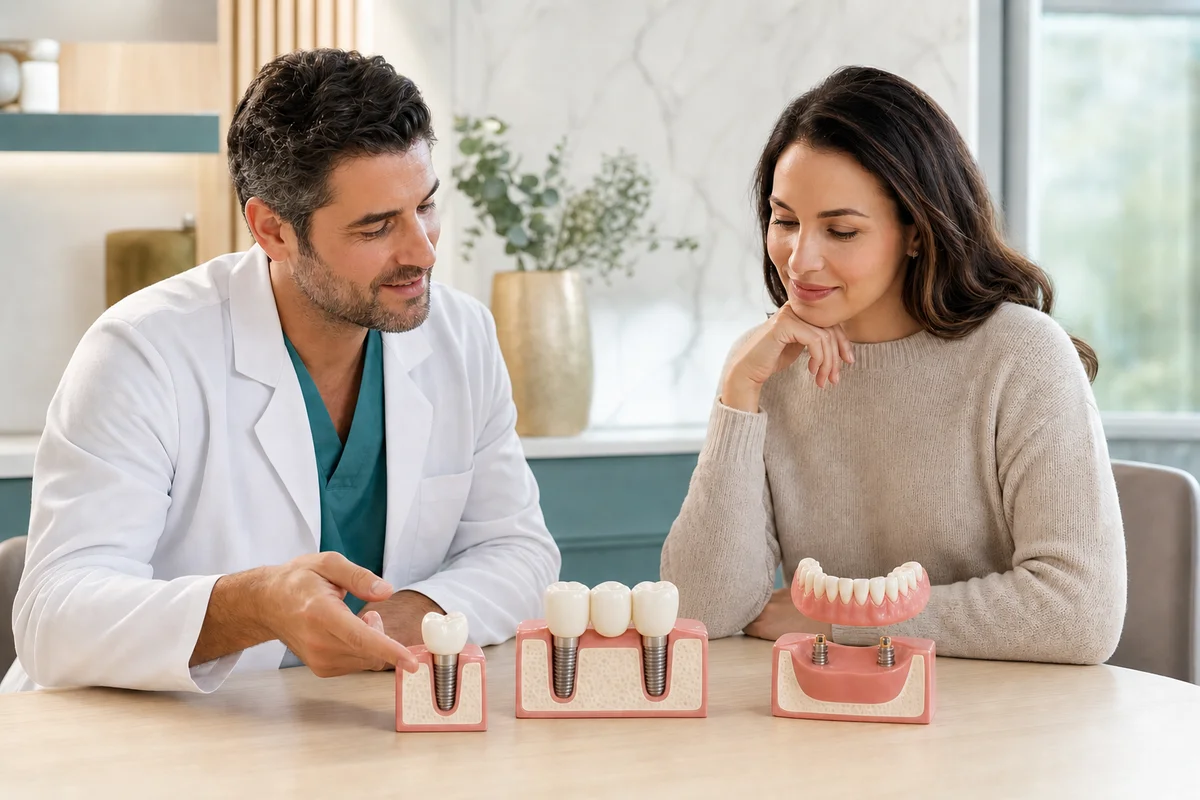
Typing how much to have dental implants into a search box appears to ask for one price. In clinical practice, it first asks a more important question: what are the implants supporting? One implant with a crown, two implants supporting a short bridge, a removable overdenture and a fixed full-arch bridge are different treatments. They use different numbers of devices, connectors, laboratory stages, temporary teeth and maintenance pathways. A responsible estimate therefore starts with a defined restoration and an examination, not a universal package figure.
This guide explains how to build that complete comparison without diagnosing candidacy, promising a result or publishing a fixed price. It prioritizes the preservation of treatable teeth and patient safety. Dentist Esma Çevrük Çakır will review the clinical framing, while your own final plan must come from a dentist who has examined you and reviewed appropriate records.
1. Why how much to have dental implants has no single answer
The phrase how much to have dental implants can refer to a missing front tooth, several missing back teeth, a loose conventional denture or an entire arch of failing teeth. Those situations are not interchangeable. The implant body is the part placed in bone. The abutment or connector and the visible crown, bridge or denture are separate components. The FDA describes implant systems in these component terms, which is why an advertisement for an “implant” may not include the tooth that you ultimately use.
Two estimates can also differ because one includes diagnostic records, disease control, temporary teeth and the definitive restoration while another lists only surgical placement. Geography, laboratory fees and clinician experience affect totals, but they do not make unlike scopes comparable. When someone asks how much to have dental implants, the safest first step is to turn every offer into the same list of clinical stages and written assumptions.
- Define the unit: one implant fixture, one completed implant crown, one arch or a complete course of care.
- Define the prosthesis: single crown, implant-supported bridge, removable overdenture or fixed full-arch bridge.
- Define the timing: immediate provisional teeth, staged healing or a later definitive restoration.
- Define conditional care: extractions, grafting, sedation or repairs that apply only when clinically indicated.
- Define aftercare: reviews, hygiene visits, worn parts, professional removal and emergency support.
2. Define the restoration before comparing how much to have dental implants
A single implant crown replaces one tooth with an implant body, a connector and a custom crown. An implant-supported bridge replaces a span of teeth but may use fewer implants than the number of replacement teeth. A removable implant overdenture connects to implants for retention but is taken out by the patient. A fixed full-arch bridge is secured to multiple implants and is normally removed only by a clinician for service. Asking how much to have dental implants without naming one of these pathways invites a misleading comparison.
The word “permanent” does not resolve the ambiguity. It can be used informally for a fixed provisional, a definitive fixed bridge or simply an implant intended for long-term support. Ask who can remove the teeth, whether the quoted teeth are temporary or final, what material and framework are planned, and how every surface will be cleaned. A responsible response to how much to have dental implants should identify the arch and should never assume that all remaining teeth must be extracted to fit a package.
3. A decision table for the main implant pathways
Use this table to identify what a quote actually describes. It is not a ranking and does not select a treatment. The right pathway depends on tooth prognosis, anatomy, health, bite, hygiene ability, expectations and informed preference. The answer to how much to have dental implants becomes meaningful only after the rows are separated.
| Pathway | What is supported | Key maintenance question | Items the estimate should name |
|---|---|---|---|
| Single implant crown | One crown on one implant site | Can floss or an interdental aid clean both sides? | Implant, healing component, abutment, temporary if used, final crown and reviews |
| Implant-supported bridge | Several connected teeth on selected implants | How is the space beneath the pontic cleaned? | Number of implants, bridge units, connectors, provisional, framework and final bridge |
| Removable implant overdenture | A patient-removable denture retained by implants | Which attachments wear and how often are they checked? | Implants, abutments, housings or inserts, denture, adjustments, relines and replacement parts |
| Fixed full-arch bridge | An arch of teeth secured to multiple implants | Can the patient clean beneath it, and who services it? | Implants, multi-unit components, provisional bridge, definitive framework and teeth, professional maintenance |
4. Single-tooth costs are more than one implant fixture
For one missing tooth, how much to have dental implants should mean the cost of a completed, maintainable implant crown pathway. That may include consultation, records, appropriate imaging, site preparation, the implant fixture, a healing component, an abutment, a temporary tooth when needed, a custom final crown, bite adjustment and reviews. The crown may be made after a healing interval rather than on the day of surgery.
The comparison should also explain alternatives. A tooth-supported bridge or a removable option may be relevant in some situations, while doing nothing has consequences that should be discussed honestly. If the tooth is still present, its prognosis should be assessed before extraction. Asking how much to have dental implants is not consent to remove a tooth that could reasonably be treated and retained.
5. An implant bridge is not priced per visible tooth
When several adjacent teeth are missing, a bridge may connect replacement teeth to strategically placed implants. The number and position of implants are determined by anatomy, span length, bite, restorative design and cleansability. A three-unit bridge supported by two implants is not three separate implant crowns. That distinction changes both the scope and the answer to how much to have dental implants.
Request the number of implant fixtures and the number of bridge units separately. Ask which units are supported directly and which are pontics, what the provisional plan is, how the bridge will be cleaned, and how a loosened screw or damaged ceramic would be managed. A bridge that looks inexpensive because the advertised answer to how much to have dental implants is “per implant” may omit the entire laboratory restoration.
6. A removable overdenture has its own cost pattern
An implant overdenture can improve retention while remaining removable for cleaning. It includes more than implant placement: the denture base and teeth, implant abutments, attachment housings or bars, processing, adjustments and future replacement of wearing parts all matter. When how much to have dental implants refers to an overdenture, the quote should state the number and position of implants and the exact attachment concept.
Ask whether the denture is new or an existing denture will be converted, whether a temporary denture is included, and whether later relines are expected. Attachment inserts can wear and need service; that is routine maintenance rather than automatic treatment failure. For how much to have dental implants, the estimate should distinguish initial treatment from foreseeable recurring care so a low entry total does not conceal a higher service burden.
7. Fixed full-arch treatment is a complete rehabilitation
A fixed full-arch bridge is not simply a larger version of a single crown. It may involve tooth-prognosis decisions, extractions, multiple implants, grafting when indicated, anesthesia, a provisional bridge, healing reviews, a definitive framework, final teeth and a structured maintenance program. For this pathway, how much to have dental implants must specify whether the quote is for one arch or both.
Ask what “same-day teeth” means. They are often provisional teeth used during healing, not the definitive prosthesis. Immediate loading depends on clinical conditions such as implant stability, bone, bite and surgical findings; it cannot be guaranteed from an advertisement. A complete how much to have dental implants estimate should say what you will wear and how timing and payment change if fixed provisional teeth are not appropriate that day.
8. The first 15 cost lines to request in writing
A useful response to how much to have dental implants is an itemized estimate with each line marked included, excluded, not currently indicated or conditional. A line does not need a charge if it is unnecessary. It needs to be considered so that its absence is visible.
- Consultation and health review: dental history, medical conditions, medicines, allergies, smoking and patient goals.
- Diagnostic records: appropriate radiographs, photographs, scans, impressions or digital models and bite records.
- Three-dimensional imaging when justified: scan acquisition, interpretation and any radiology report.
- Disease control: care for active decay, gum inflammation or infection before definitive treatment.
- Tooth preservation or extraction: individual prognosis, alternatives and complexity of any required removal.
- Bone or soft-tissue procedures: site, purpose, material, alternatives and effect on timing.
- Anesthesia, sedation and facility: provider, monitoring, recovery requirements and separate facility fees.
- Implant fixtures: number, manufacturer, model family and planned sites.
- Surgical and healing components: cover screws, healing abutments, membranes or other specified parts.
- Temporary teeth: fixed or removable design, delivery time, adjustment and repair policy.
- Definitive connectors: stock, custom or multi-unit abutments and retaining screws.
- Final restoration: crown, bridge or denture design, material, framework, laboratory and try-ins.
- Postoperative and restorative reviews: suture care, healing checks, fit, bite and hygiene instruction.
- Maintenance: professional monitoring, cleaning, component service and suggested recall pattern.
- Contingency: response to delayed healing, non-integration, fracture, additional travel or a changed plan.
9. Diagnosis and imaging shape how much to have dental implants
A safe plan starts with diagnosis rather than a product count. The dentist may assess remaining-tooth prognosis, gum health, available bone, restorative space, the bite, jaw relationship and the position of nearby structures such as nerves or the sinus. Imaging should be clinically justified, and not every patient needs every test. Therefore, how much to have dental implants can be preliminary before evaluation, while a final surgical promise made without adequate evaluation deserves caution.
Remote photographs and existing scans can support a preliminary discussion, but they may not show current infection, bone dimensions, bite forces or whether a tooth can be saved. A remote answer to how much to have dental implants should label its assumptions and explain what can change after examination. Ask whether the estimate includes new records if the supplied images are incomplete or out of date.
10. Preserve treatable teeth before pricing extraction
Implants replace missing teeth; they are not inherently better than healthy or predictably treatable natural teeth. Every proposed extraction should have a documented reason and a discussion of alternatives, limitations and prognosis. A package that makes the same extraction recommendation for every patient is not a personalized answer to how much to have dental implants.
Disease control may be needed before implant surgery. Untreated periodontal disease, poor plaque control or active infection can affect planning and long-term maintenance. Stabilizing oral health may add visits to the answer for how much to have dental implants, but it can also prevent a rushed irreversible decision. Ask which teeth can be retained, how each conclusion was reached, and whether a staged plan would preserve options.
11. Grafting is conditional, not an automatic fee
Bone or soft-tissue augmentation may be recommended when anatomy does not support the planned implant position or restorative contour. It is not required for every person, and “graft-free” care is not automatically superior. The recommendation should connect the site and procedure to the intended restoration. This is a major reason how much to have dental implants cannot be finalized from a generic menu.
Ask what material is proposed, whether the graft is performed at the same visit or separately, what alternatives exist and how the procedure changes healing time. If a quoted amount is conditional, the contract should identify the finding that triggers it. You should have the opportunity to review a changed plan and financial consent before unplanned elective work continues.
12. Implant, abutment and crown are separate components
The implant body sits in bone, the abutment connects the implant to the restoration, and the crown or bridge is the visible tooth structure. Healing components and retaining screws may also be involved. When an advertisement answers how much to have dental implants with a low “implant-only” figure, ask whether abutments, restorative parts and final teeth are excluded.
The FDA encourages patients to retain the implant system’s brand and model information. Request an implant passport or equivalent record with manufacturer, model, dimensions, position and placement date. Future clinicians may need compatible components for maintenance. A clinic’s promise that “all implants are the same” is not an adequate device record.
13. Temporary teeth can be a separate laboratory stage
A temporary crown, bridge or denture may protect appearance and function while tissues heal or the definitive restoration is made. It may have different materials, contours and loading limits. The answer to how much to have dental implants should state whether a provisional is included, how many adjustments are included and who repairs it if it chips or loosens.
For front-tooth care, a removable temporary, bonded temporary or provisional implant crown may be considered depending on the case. For full-arch care, the first fixed bridge may be a healing prosthesis. Ask whether a later final restoration requires a new laboratory fee and payment milestone. “Teeth in a day” should never conceal the cost or existence of definitive teeth.
14. Final material labels do not determine value alone
Zirconia, titanium frameworks, ceramics, acrylics and composite materials may appear in implant restorations, but a material name does not guarantee fit, cleansability, appearance or longevity. Design, laboratory communication, bite, framework accuracy, repairability and patient factors all matter. A useful how much to have dental implants proposal describes the complete prosthesis rather than relying on “premium” as a specification.
Ask how shade and tooth position are approved, which try-ins are included, what counts as an adjustment and what counts as a remake. If a warranty is offered, read the remedy, exclusions, maintenance requirements and geographic limits. A warranty can define commercial service; it cannot guarantee biological integration or eliminate the possibility of complications.
15. Anesthesia and sedation require a defined scope
Local anesthesia may be adequate for many procedures. Sedation or general anesthesia may be considered based on the procedure, health, anxiety and provider assessment. These options can change facility, monitoring, escort and recovery requirements. Therefore how much to have dental implants should identify the proposed method and who provides it, not list a vague “comfort package.”
Ask whether presedation evaluation, medicines, monitoring, facility use and postoperative observation are included. Follow fasting, escort and medication instructions exactly. The lowest sedation quote is not the safest decision criterion; provider qualifications, appropriate monitoring and a plan for medical emergencies are fundamental.
16. Treatment time and payment time are different
The FDA notes that implant-body healing may take several months or longer. Some patients may receive a restoration earlier, while others need staged care. Healing is biological and cannot be made certain by paying faster. A quote answering how much to have dental implants should link payment milestones to defined clinical and laboratory stages.
A practical schedule may separate diagnosis, preparatory care, surgery, provisional teeth, definitive records and final delivery. Ask what is refundable if treatment is postponed or a later stage becomes inappropriate. Paying the entire pathway before diagnosis transfers unnecessary risk to the patient, especially when final design depends on healing.
17. Risks and contingency costs belong in informed consent
The FDA lists possible problems including injury to nearby teeth or tissues, sinus or nerve injury, infection, difficulty cleaning, an altered bite, screw loosening and implant-body failure. These events are not predicted for every patient, but they explain why no ethical answer to how much to have dental implants can promise a complication-free lifetime.
Ask who manages an implant that does not integrate, a loose screw, a fractured provisional or persistent numbness. The proposal should explain what is included, what may carry a new fee and which decisions require a new consent. Increasing swelling, fever, uncontrolled bleeding, breathing or swallowing difficulty, worsening pain, persistent numbness or a mobile restoration warrants timely professional advice rather than waiting for a routine visit.
- Biological events: delayed healing, infection, inflammation around an implant or loss of integration.
- Mechanical events: screw loosening, attachment wear, chipping, fracture or a changed bite.
- Hygiene problems: restoration contours that are difficult for the patient to clean.
- Anatomical events: effects on nearby teeth, tissues, nerves, sinus or bone.
- Logistical events: unavailable components, laboratory delay or urgent care away from the treating clinic.
18. Long-term maintenance changes how much to have dental implants
Implants are not maintenance-free. Daily cleaning and regular professional reviews are important, and the schedule should reflect individual risk. A single crown needs access around both sides; a bridge needs cleaning beneath pontics; an overdenture needs attachment and tissue checks; a full-arch bridge needs access beneath the prosthesis. These differences belong in the lifetime view of how much to have dental implants.
Ask what home-care tools are recommended, who performs professional maintenance and whether the fixed restoration is periodically removed. Discuss smoking, grinding, hygiene limitations and health changes openly. Keep copies of scans, implant records, restorative specifications and radiographs so another clinician can help if you move or travel.
19. Private dental insurance needs procedure-by-procedure verification
Private coverage is contract-specific. A plan may treat examination, imaging, extraction, grafting, implant surgery and prosthetic work differently. It may apply annual maximums, waiting periods, network rules, a missing-tooth clause or an “alternative benefit” based on a less costly covered treatment. Insurance therefore does not provide a universal answer to how much to have dental implants.
Request a written pretreatment estimate or predetermination when available, while recognizing that it may not guarantee final payment. Confirm current eligibility, procedure codes, exclusions, network status, deductible, remaining annual maximum and documentation requirements directly with the insurer. Ask the clinic to separate expected insurance payment from your contractual responsibility.
- Does the policy exclude implants or teeth missing before coverage began?
- Does it pay an alternative benefit based on a bridge or denture?
- Is preauthorization required for imaging, grafting, surgery or the prosthesis?
- Are surgeon, restorative dentist, laboratory and facility all in network?
- Could stages completed in different benefit years use separate annual maximums?
- What records are required, and is predetermination binding or only an estimate?
20. Medicare, Medicaid and tax rules need current verification
Medicare.gov states that Original Medicare does not cover routine dental services or items such as dentures and implants in most cases. It may cover limited dental services directly linked to certain covered medical treatments, but that does not automatically make replacement implant teeth covered. When estimating how much to have dental implants, verify the specific service and plan rather than assuming a medical exception pays for the full dental rehabilitation.
Medicaid.gov explains that states choose which dental benefits to provide adults and that there are no federal minimum requirements for adult dental coverage. Coverage therefore varies by state and program. The IRS’s current Publication 502 discusses artificial teeth and dental treatment within medical and dental expense rules, subject to itemization, reimbursement and adjusted-gross-income requirements. This guide is not tax advice; use the current publication and a qualified tax professional.
21. Financing changes cash flow, not clinical suitability
Monthly payments can make a large treatment easier to budget, but they do not make an unnecessary procedure appropriate. Compare annual percentage rate, origination fees, deferred-interest terms, total repayment, late-payment effects and refund rules. A monthly advertisement is not the same as a complete answer to how much to have dental implants.
Prefer payments tied to completed stages. Confirm what happens to a loan or clinic credit if surgery is delayed, an implant cannot be placed, or the final restoration changes. Do not let an expiring discount compress the time needed for an examination, a second opinion or informed consent.
22. Dental travel must include the aftercare pathway
International treatment can be considered, but flights and hotel nights are only part of the comparison. Time away from work, a companion, multiple visits, laboratory delays, dietary restrictions, unexpected return travel and local emergency care can alter the real answer to how much to have dental implants. A short trip should not force a biological healing schedule.
Ask how many trips are expected, the minimum safe stay after each stage, which restoration is delivered on the first trip and who handles problems after you return home. Confirm whether a local dentist can obtain compatible parts. For an individualized preliminary discussion, the Redent Klinik English information hub explains available services, and the Redent Klinik English contact page can be used to ask which current records are needed. Remote information remains preliminary until examination and appropriate imaging.
23. Red flags in a how much to have dental implants offer
A low total is not automatically unsafe, and a high total is not proof of quality. The concern is an offer that prevents informed comparison or treats uncertainty as certainty. Pause when how much to have dental implants is answered before the restoration, arch, treating clinicians, exclusions and aftercare have been identified.
- A final nonrefundable package issued before adequate records and clinical examination.
- Extraction of all remaining teeth proposed without individual prognosis or preservation discussion.
- Immediate fixed teeth or implant survival described as guaranteed.
- An implant-only price that omits abutments, final teeth, anesthesia or reviews.
- No written backup if grafting, immediate loading or the planned implant position is unsuitable.
- No implant-system record, component manufacturer, maintenance schedule or repair contact.
- Pressure to sign financing or consent before questions and alternatives are explained.
24. Questions that make two quotes comparable
Take the same checklist to every consultation. The goal is not to force every clinician into the same plan; it is to understand why their plans differ. A clear answer to how much to have dental implants identifies assumptions, conditional items and responsibilities instead of hiding them in a package title.
- Which teeth can reasonably be preserved, and what evidence supports each extraction?
- What exact restoration is proposed, for which site or arch, and who can remove it?
- Which part is provisional, which is definitive, and when is each delivered?
- How many implants and replacement-tooth units are included?
- Which scans, grafts, anesthesia, laboratory work, reviews and maintenance are included?
- What finding could change the plan, timing or total?
- What implant and restorative records will I receive?
- Who provides urgent help, repair and maintenance after treatment?
Frequently asked questions about how much to have dental implants
Why do advertisements show one implant price?
An advertisement may describe only the implant fixture or a simplified standard case. It may not include consultation, imaging, extraction, grafting, abutment, temporary tooth, final crown, anesthesia or follow-up. Ask for the price of a completed pathway and the exact assumptions. That converts how much to have dental implants from a headline into a comparable scope.
Are the implant, abutment and crown the same item?
No. The implant body is placed in bone, the abutment connects it to the restoration, and the crown is the visible replacement tooth. Healing parts and screws may also be required. A quote should list these separately or explicitly state that they are bundled.
Does insurance pay when I ask how much to have dental implants?
It depends on the specific contract and procedure. Verify exclusions, missing-tooth rules, alternative benefits, deductible, network status, annual maximum and authorization requirements. A predetermination can help but may not guarantee final payment. Do not treat an insurer’s estimate as a clinical recommendation.
Does Original Medicare cover dental implants?
In most cases Original Medicare does not cover routine dental services, dentures or implants. Limited dental services directly connected with certain Medicare-covered medical treatments may qualify, but that does not automatically cover the implant restoration. Check the current Medicare rules and the exact service before proceeding.
Is bone grafting always needed?
No. Grafting depends on anatomy, the intended implant position and the restorative goal. When recommended, ask for the site, purpose, material, alternatives and timing. A generic online response to how much to have dental implants cannot determine whether you need a graft.
Can a clinic give an exact quote from photographs?
Photographs and existing records may support a preliminary estimate, but they may not reveal current infection, bone, nearby anatomy, bite or tooth prognosis. A final diagnosis-based plan generally follows examination and the imaging considered appropriate. Ask the clinic to label assumptions and possible revisions.
How long does implant treatment take?
Timing varies with the restoration, health, healing, extractions, grafting and loading plan. The FDA notes that healing may take several months or longer. Immediate temporary teeth may be possible in selected situations, but they do not remove the need for biological review or a definitive restorative stage.
Do dental implants last for life?
No ethical clinician can guarantee that. Implants and restorations can function for many years, but biological and mechanical complications may occur. Daily hygiene, professional review, risk-factor management and repair access matter. A lifetime calculation of how much to have dental implants should include maintenance rather than only placement.
Conclusion: price a defined care pathway, not an implant count
The most useful answer to how much to have dental implants starts by defining the missing tooth or arch, the restoration, the diagnostic basis and the proposed sequence. It then itemizes preparation, surgery, components, provisional and final teeth, anesthesia, reviews, maintenance, coverage assumptions and contingencies. Only totals describing the same pathway can be compared responsibly.
Bring the fifteen-line checklist to a dentist who can examine you. Ask which natural teeth can be retained, what might change the plan, how you will clean the restoration and who will provide long-term care. The result of asking how much to have dental implants should be informed consent and a readable treatment scope—not a fixed-price promise or a guaranteed outcome.
Official sources and evidence notes
- U.S. Food and Drug Administration: Dental Implants—What You Should Know
- U.S. Food and Drug Administration: Implants and Prosthetics
- MouthHealthy by the American Dental Association: Implants
- MouthHealthy by the American Dental Association: Bridges
- American Dental Association
- World Health Organization: Oral Health
- European Federation of Periodontology: Dental Implant FAQs
- European Federation of Periodontology: Peri-Implant Diseases
- European Federation of Periodontology: Peri-Implant Disease Prevention
- Medicare.gov: Dental Service Coverage
- Medicaid.gov: Dental Care
- Medicaid.gov: Mandatory and Optional Benefits
- Internal Revenue Service: Publication 502, Medical and Dental Expenses
- American College of Prosthodontists: Missing Teeth and Prosthodontic Options
Official source pages were checked on 30 July 2026. Educational content does not replace individual examination, diagnosis, informed consent, insurer confirmation, legal advice or tax advice.