
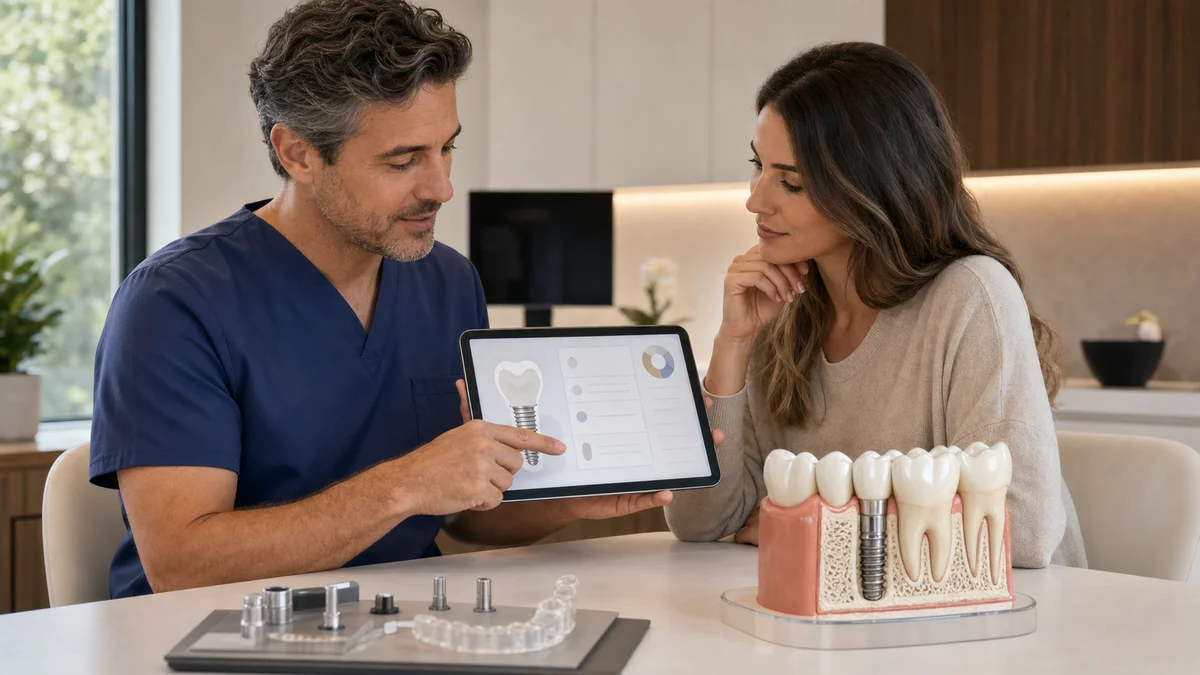
Quick answer: There is no universal total for dental implants. A complete quote may include assessment, scans, the implant body, abutment, crown or bridge, possible grafting, temporary teeth, monitoring and maintenance. Your anatomy, health, number of missing teeth and restoration design change the plan. Compare itemised, clinician-approved proposals rather than advertised “per implant” prices.
If you are searching how much to have teeth implants, the first number you see may not represent a finished tooth. A dental implant system can include the implant body placed in the jaw, an abutment that connects components and a crown, bridge or denture that replaces the visible teeth. Assessment, imaging, surgical care, temporary restorations and follow-up may be included, separated or excluded. That is why two offers with the same headline can describe very different care.
A safe answer to how much to have teeth implants starts with diagnosis. The dentist needs to understand why teeth are missing, whether disease remains active, how much suitable bone is present, where nerves and sinuses lie, how the bite functions and what type of replacement will meet your needs. A photograph, price calculator or telephone call cannot establish all of those factors.
This guide shows how to compare proposals without promising a fixed price, a particular timeline or a guaranteed result. It is educational, not a diagnosis, and is prepared for review by Dentist Esma Çevrük Çakır. The final recommendation must follow an examination and informed consent. In some cases, a bridge, removable denture, treatment of disease first or leaving a space may be more appropriate than implant surgery.
How Much to Have Teeth Implants After a Proper Assessment?
When a clinic answers how much to have teeth implants, ask what has actually been assessed. A comprehensive consultation may include medical and dental history, examination of teeth and gums, bite assessment and discussion of expectations. Standard radiographs, photographs, impressions or a digital scan may be appropriate. Three-dimensional cone-beam computed tomography may be recommended when it provides information needed for safe planning, but imaging should be clinically justified rather than sold as an automatic upgrade.
General health matters. Medicines, previous surgery, healing conditions, uncontrolled diabetes, tobacco use and other factors can influence risk and timing. The US Food and Drug Administration advises patients to discuss overall health, healing, smoking and the benefits and risks with their dental provider. A clinician may need information from another health professional before recommending surgery. Do not stop prescribed medicines unless the appropriate clinician instructs you to do so.
Oral health matters just as much. Active decay, infection or unstable periodontal disease can require treatment before an implant pathway proceeds. Existing teeth may need stabilisation, and oral hygiene must be manageable around the proposed restoration. If preliminary care is necessary, request a separate estimate so the answer to how much to have teeth implants distinguishes disease control from implant reconstruction.
- Clinical examination of teeth, gums, bite and the proposed implant site
- Relevant medical, medicine, smoking and dental history
- Radiographs or three-dimensional imaging when clinically justified
- Digital scan, impressions and photographs for restorative planning
- Alternative options, material choices, limitations and maintenance needs
- A written sequence showing who provides each stage and where it occurs
Ask whether the assessment fee covers records, planning and a written proposal or only the first visit. Separate fees are not inherently misleading; an unclear scope is. If the plan is based on records taken elsewhere, confirm that the treating clinician has reviewed their quality and relevance.
“Per Implant” Is Not Always the Price of a Complete Tooth
The phrase how much to have teeth implants often leads to “per implant” advertising. Before comparing it, identify what the unit means. An implant body replaces the root portion of a missing tooth. It normally supports a separate prosthetic component. For a single missing tooth, the visible result may also require an abutment and crown. For several missing teeth, implants may support a bridge or help retain a removable overdenture.
When asking how much to have teeth implants, remember that a quote for placement of the implant body alone may exclude the final restoration. Another quote may combine surgery, components and the crown. A third may include temporary teeth and routine reviews as well. The apparent difference can disappear—or reverse—when all stages are totalled. Ask for the quantity and role of every component rather than assuming “implant” means the whole pathway.
Component brand and model information should be recorded. The FDA recommends asking which implant system is being used and keeping that information. Records can be important if a component needs maintenance or replacement years later. However, no particular brand name guarantees success, and a higher material price by itself does not prove that the clinical design is better.
14 Components That Can Shape the Complete Implant Quote
A useful response to how much to have teeth implants is an itemised proposal. The following decision table helps reveal omissions. Not every person needs every item, and inclusion does not mean a procedure is clinically indicated.
| Quote component | Why it may be needed | Question for the provider |
|---|---|---|
| 1. Consultation | Reviews health, goals, alternatives and likely suitability. | Who examines me, and is a written plan included? |
| 2. Diagnostic records | Radiographs, scans, photographs or impressions support planning. | Which records are justified and included? |
| 3. Digital or laboratory planning | Coordinates implant position with the intended replacement teeth. | Does the surgical plan begin with the final restorative objective? |
| 4. Tooth removal | A failing tooth may need extraction before or with implant placement. | Is extraction included, and what timing is proposed? |
| 5. Bone or soft-tissue procedure | Some sites require augmentation; many do not. | Why is it indicated, what material is planned and what are the alternatives? |
| 6. Implant body | The surgically placed device supports the restoration. | How many implant bodies are planned, and which system is documented? |
| 7. Surgical guide | A guide may support the planned placement in selected cases. | Is it recommended for my anatomy, and is it included? |
| 8. Anaesthesia or sedation | Local anaesthesia is common; additional services may require separate assessment. | What is planned, who provides it and what monitoring is included? |
| 9. Temporary replacement | A provisional tooth or denture may be needed while tissues heal. | What can I wear during healing, and is adjustment included? |
| 10. Abutment | This connects the implant body to the prosthetic replacement. | Is a standard or customised abutment included? |
| 11. Crown, bridge or overdenture | The visible and functional replacement completes the restorative stage. | Which material and design are quoted, and is laboratory work included? |
| 12. Reviews and imaging | Monitoring evaluates healing, function and restoration fit. | Which routine post-operative visits are included? |
| 13. Maintenance | Professional review and cleaning support long-term health. | What ongoing schedule and likely charges should I budget for? |
| 14. Contingency and repair terms | Components can loosen, wear, fracture or require unplanned care. | What is covered, for how long and under which conditions? |
Use the table when asking how much to have teeth implants. Mark every item as included, excluded, optional or not clinically required. Ask whether fees are fixed for the stated scope or may change after surgery or laboratory review. A responsible provider should explain uncertainty without claiming that complications are inevitable.
How the Number of Missing Teeth Changes the Design
The number of missing teeth does not necessarily equal the number of implants. One missing tooth may be restored with a single implant-supported crown when appropriate. Several adjacent missing teeth may sometimes be replaced by an implant-supported bridge using fewer implant bodies than teeth. A fully edentulous arch may be restored with an implant-supported fixed prosthesis or an implant-retained removable overdenture. Each design has different surgical, laboratory, cleaning and repair implications.
This is a major reason how much to have teeth implants has no honest universal answer. Counting spaces without planning the prosthesis can produce a misleading estimate. Implant positions must support the intended teeth, accommodate anatomy and allow hygiene. Adding more implants is not automatically better, and using fewer is not automatically cheaper if it compromises design or requires a more complex restoration.
Ask to see the proposed number of implant bodies, the teeth or prosthesis they will support and whether the restoration is fixed or removable. This makes how much to have teeth implants a defined comparison. Clarify whether the quotation refers to one jaw or both jaws. “Full mouth,” “full arch,” “all-on” and similar commercial phrases can be used inconsistently, so the written component list is more reliable than the label.
Bone Grafting, Sinus Procedures and Soft-Tissue Care
Bone volume and shape can change after tooth loss. Some people have enough appropriate bone for the proposed plan; others may need a graft or a different design. Depending on the location, the clinician may discuss socket preservation, local bone augmentation, a sinus-related procedure or alternative implant positions. Soft-tissue procedures may also be considered when the gum condition affects health, cleansability or the restorative result.
Do not assume grafting is always necessary or always included in how much to have teeth implants. The clinician should explain the finding that supports it, the proposed material, whether the graft is performed before or with implant placement, the healing implications, alternatives and relevant risks. Imaging and examination must guide that decision.
A low advertised answer to how much to have teeth implants may exclude graft material, membranes, donor-site care or extra reviews. Conversely, a package that includes “bone grafting” for everyone may not reflect individual diagnosis. Ask for the graft stage as its own line and request an updated written total if the need can only be confirmed during treatment.
Temporary Teeth, Healing Time and Staged Payments
The restorative pathway often unfolds in stages. There may be extraction, healing, implant placement, integration with bone, exposure or abutment placement, impressions or scanning, provisional restorations and delivery of the final crown, bridge or denture. Not every case follows every stage, and immediate placement or immediate provisional teeth are not suitable for everyone.
The FDA notes that healing around the implant body may take several months or longer. That does not predict your timeline; it shows why how much to have teeth implants should include what happens between surgery and the final restoration. Ask whether a temporary tooth, adjusted denture or healing abutment is planned and whether repairs or adjustments during healing are included.
Payment schedules often follow clinical stages. Request the deposit, each milestone, the amount due before laboratory manufacture and any balance at delivery. Record how much to have teeth implants as the total, not only a monthly figure. If treatment is paused because more healing is needed, understand how payment is handled. A monthly figure may look manageable while concealing a large final laboratory payment, so compare the total payable amount.
Location, Provider Roles, Materials and Laboratory Work
Fees vary by country, city, clinic overhead, professional experience, regulatory environment, laboratory arrangements and the complexity of the case. If more than one professional is involved, determine whether the surgeon, restorative dentist, anaesthesia provider and laboratory are included in a combined proposal or bill separately.
When comparing how much to have teeth implants, find out who is responsible for the overall plan and who provides each stage. A coordinated team can be appropriate, but the hand-off should be clear. Ask whom to contact for pain, a loose provisional, a restoration problem or care while travelling.
Restorative materials and manufacturing methods can affect laboratory fees and maintenance. The relevant question behind how much to have teeth implants is not simply “Which material costs more?” It is whether the design suits the bite, space, appearance, repair strategy and hygiene needs. Request the material and component information in writing. A claim that one material will last forever is not credible.
Insurance, Financing and Cross-Border Quotes
Insurance coverage for implants varies widely, so how much to have teeth implants after benefits is plan-specific. Some plans exclude implants, apply waiting periods, use annual or lifetime maximums, cover only an alternative treatment allowance or split benefits across surgical and restorative codes. A pre-treatment estimate can clarify likely benefits, but the insurer—not the clinic—makes the final coverage decision.
To calculate how much to have teeth implants out of pocket, separate the clinic’s full fee, the estimated insurer payment and your estimated responsibility. Ask whether the provider is in network, whether benefits are paid at each stage and what happens if coverage changes before the restoration is complete. Do not choose a clinically unsuitable design only because a policy favours it.
Financing changes timing, not the treatment need. To answer how much to have teeth implants, compare deposit, interest, fees, instalment count, late-payment terms, early repayment and total payable. If using tax-advantaged health accounts, verify current eligibility with the administrator or an appropriate adviser.
Cross-border proposals require additional questions. Travel, accommodation, time away from work, repeat visits, emergency support, component compatibility and local maintenance can affect the real total. Ask who manages a complication after you return home and whether a local provider has agreed to take responsibility. A “guarantee” may have conditions requiring travel at your expense.
Risks, Alternatives and Long-Term Maintenance
Dental implants can support crowns, bridges and dentures and may improve chewing or appearance for suitable patients. They are also medical devices placed surgically in the jaw. Risks described by the FDA include injury to nearby teeth or tissues, sinus or nerve-related injury, infection, difficulty cleaning, component loosening, implant failure and the possibility of further procedures. Smoking and uncontrolled health conditions can affect healing.
Those risks should not be used to frighten you, but they belong beside how much to have teeth implants in informed consent. Ask which risks are especially relevant to your anatomy and health, how the team reduces them and what symptoms require urgent contact. No clinician can guarantee integration, a complication-free course or lifelong survival.
Alternatives may include a conventional bridge, resin-bonded bridge, partial or complete denture, orthodontic space management or no replacement when function and appearance permit. NHS patient resources also emphasise that implants are not right for everyone and that suitability depends on general health, smoking, oral health, available bone and commitment to care.
Maintenance is part of the answer to how much to have teeth implants. Clean the restoration and surrounding tissues as instructed, attend professional reviews and report pain, mobility, swelling, bleeding, altered bite or a loose component. The FDA advises regular cleaning and dental visits and recommends contacting the provider if an implant feels painful or loose. Implant crowns and prosthetic parts may need adjustment, repair or replacement over time even when the implant body remains integrated.
- Daily cleaning tools and techniques matched to the restoration design
- Regular dental and periodontal review based on individual risk
- Professional cleaning that can access implant-supported components safely
- Assessment of bite, screws, attachments, dentures and restorative wear
- Future repair, relining, replacement or component costs
- Updated health and medicine information shared with the dental team
How to Compare Two Dental Implant Quotes Safely
Start by confirming that both quotes are based on a clinical assessment and are designed to solve the same problem. A single crown is not comparable to an implant bridge, and a removable overdenture is not the same product as a fixed full-arch prosthesis. Compare the planned number of implant bodies, the type and material of restoration, grafting assumptions, temporary teeth, maintenance and provider roles.
When reviewing how much to have teeth implants, use this sequence:
- Write down the diagnosis and agreed functional and aesthetic objectives.
- Confirm the implant quantity and the crown, bridge or denture it supports.
- List records, extraction, grafting, sedation and temporary teeth separately.
- Check abutments, restorative materials, laboratory fees and delivery.
- Identify routine reviews, maintenance and likely future component costs.
- Read cancellation, transfer, complication and warranty conditions.
- Calculate the total payable, including financing and travel.
- Compare alternatives, risks and the consequence of no treatment.
Be cautious if the answer to how much to have teeth implants is available only after immediate payment, if a clinician has not examined you, if the final teeth are missing from the scope or if success is guaranteed. High cost does not prove high quality, and low cost does not prove poor care. Transparency, appropriate diagnosis, consent, coordinated treatment and maintainability are more meaningful signals.
For a personal assessment, you can read about Redent Klinik and use the Redent Klinik contact page to ask how examinations and records are organised. A remote conversation can help with logistics, but the final plan and fee require clinical assessment.
Frequently Asked Questions About How Much to Have Teeth Implants
How Much to Have Teeth Implants for One Missing Tooth?
How much to have teeth implants for one missing tooth depends on whether the quotation includes the implant body, abutment and crown, plus assessment, imaging, extraction, grafting, provisional care and reviews. Ask for the complete restored-tooth total. A price for the implant body alone is not equivalent to a finished implant-supported crown.
How Much to Have Teeth Implants for Several Missing Teeth?
How much to have teeth implants for several missing teeth depends on the restoration design. An implant-supported bridge may replace several adjacent teeth without one implant per tooth, while separated spaces may require another approach. The clinician must plan implant position, bone, bite, cleansability and prosthetic support before giving a reliable total.
How Much to Have Teeth Implants for a Full Arch?
How much to have teeth implants for a full arch varies with the number and position of implant bodies, fixed or removable design, materials, extractions, grafting, temporary teeth, sedation and maintenance. Confirm whether “full arch” means one jaw and whether the advertised figure includes the final prosthesis rather than only surgery.
Does the Dental Implant Quote Include the Crown?
Not always. Some providers quote implant placement separately from the abutment and crown. Others use a combined package. When asking how much to have teeth implants, request an itemised line for the final crown, bridge or denture, its material, laboratory work and delivery appointments.
Does Bone Grafting Always Increase the Price?
Grafting can add materials, clinical time and follow-up when it is indicated, but not every patient needs it. The clinician should explain the anatomical finding, proposed procedure, alternatives and timing. Do not assume a generic graft charge belongs in every answer to how much to have teeth implants.
Can Dental Insurance Pay for Implants?
Some plans contribute; others exclude implants or limit payment through annual maximums, waiting periods, network rules or alternative-treatment allowances. Verify surgical and restorative benefits separately. A pre-treatment estimate helps budgeting but is not a payment guarantee, so do not subtract it as certain income.
Why Is One Dental Implant Quote Much Lower Than Another?
The lower quote may cover a different restoration, fewer records, implant placement only, another material, excluded grafting or less follow-up. It may also reflect normal geographic or practice differences. Compare identical clinical scope, component count and total payable before deciding which response to how much to have teeth implants is genuinely lower.
Are Same-Day Implants and Teeth Suitable for Everyone?
No. Immediate placement or provisional teeth may be appropriate in selected situations, but anatomy, infection, bone stability, bite and other risk factors influence the decision. “Same day” can also refer only to a temporary restoration. Ask what is placed that day and when the definitive restoration is expected.
How Long Do Dental Implants Last?
No ethical provider should promise a lifetime result. Health, smoking, hygiene, bone support, bite, implant position, restoration design and maintenance all matter. Components can loosen or wear, and disease can develop around implants. Budget for review and possible future repair when considering how much to have teeth implants.
A Complete Quote Is a Clinical Plan, Not a Headline
The safest answer to how much to have teeth implants is a personalised, written plan. It should connect examination and imaging to the implant quantity, restoration design and care sequence. It should state whether extraction, grafting, temporary teeth, abutments, laboratory work, reviews and maintenance are included.
Ask what could change the estimate and who is responsible at each stage. Review benefits, risks and alternatives without pressure. Consider ongoing cleaning and component care alongside the initial fee. If two providers recommend different plans, a second opinion can help clarify whether they are treating the same problem or proposing different objectives.
Most importantly, do not let a promotional number decide suitability. Dental implants can be valuable for appropriate patients, but they involve surgery, a restoration and long-term maintenance. A transparent response to how much to have teeth implants supports budgeting; a thorough clinical assessment supports safety.
Sources and Clinical References
- US Food and Drug Administration: Dental Implants—What You Should Know — device components, patient considerations, benefits, risks and maintenance.
- Leeds Teaching Hospitals NHS Trust: Dental Implants — current patient information on suitability, assessment, restorative designs and alternatives.
- Guy’s and St Thomas’ NHS Foundation Trust: Dental Implants — stages, grafting, consent, risks, alternatives and long-term care.
- American Dental Association — authoritative dental health and benefits resources.
- World Health Organization: Oral Health — current global context on tooth loss, prevention and access to oral healthcare.