
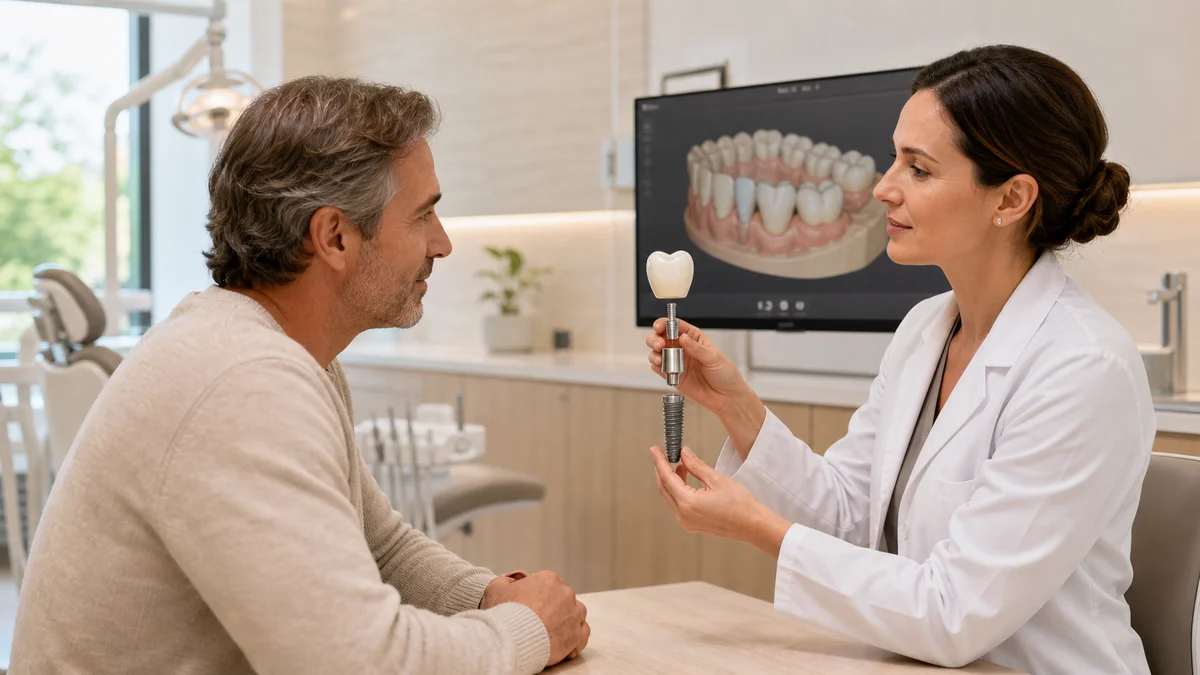
If you searched implant repair near me, avoid chewing on the area, do not wiggle or glue the restoration, save any detached part, and arrange prompt dental assessment. A loose crown or screw is different from a mobile implant body or inflamed supporting tissue. Rapid swelling, breathing or swallowing difficulty, uncontrolled bleeding, or major trauma needs emergency care.
A search for implant repair near me often starts with a worrying change: an implant-supported crown moves, a bridge clicks, a denture attachment no longer holds, the bite feels different, or the gum bleeds. “Dental implant” can refer to an entire restoration, but the system usually includes several parts. The implant body sits in bone, an abutment connects above it, a screw may secure components, and a crown, bridge, or denture supplies the visible and functional replacement.
That distinction matters because a repairable prosthetic problem is not the same as loss of implant integration or peri-implant disease. Only an examination can identify which component is moving, whether surrounding tissues are healthy, and whether the existing parts can be reused safely. This guide explains how to act, what an implant repair near me appointment may involve, how options and costs are determined, and which warning signs need urgent escalation. It does not diagnose a specific implant or guarantee that repair is possible.
1. Define what “implant repair” could involve
The U.S. Food and Drug Administration describes dental implant systems as an implant body in the jaw, an abutment, and sometimes an abutment fixation screw, supporting an artificial tooth or teeth. A patient may feel “the implant is loose” when only a crown, attachment, or screw is moving. Conversely, a stable-looking crown does not rule out inflammation around the implant.
An implant repair near me clinic may assess several different categories:
- Prosthetic surface problem: chipped ceramic, worn acrylic, fractured denture tooth, or lost access-hole material.
- Retention problem: a cemented crown has loosened or a screw-retained restoration moves.
- Component problem: an abutment screw, abutment, attachment, or framework is loose, worn, or fractured.
- Bite or load problem: the restoration contacts too heavily, clenching or grinding is suspected, or the prosthesis no longer seats correctly.
- Biological problem: soft-tissue inflammation, infection, bone loss, or another peri-implant condition is present.
- Implant-body problem: the part integrated in bone is mobile, fractured, poorly positioned, or otherwise compromised.
The appropriate response may be smoothing, recementing, accessing and retightening a screw, replacing a component, remaking a crown or bridge, adjusting the bite, treating peri-implant disease, referring to a specialist, or removing and later replacing an implant. A careful implant repair near me assessment starts by identifying the failing layer instead of selling one universal solution.
2. Stop loading the area and protect loose parts
If an implant restoration moves, avoid deliberately testing it with your tongue or fingers. Repeated movement can damage a screw, abutment, crown, nearby tissue, or the internal implant connection. Chew on the other side and choose foods that do not require strong biting until an implant repair near me clinician advises you. This is temporary risk reduction, not treatment.
Do not use household glue, nail products, hardware tools, or an online torque driver. Implant systems use specific components and controlled techniques. Adhesive can contaminate surfaces, injure tissue, interfere with evaluation, or make professional removal harder. An implant repair near me appointment should use parts and instruments compatible with the identified system.
If a crown, screw, attachment, or fragment comes out, do not throw it away. Place it in a clean, closed container and bring it to the implant repair near me visit. Do not force it back into the mouth because it may not seat correctly and could be swallowed or inhaled. Continue gentle cleaning around the area if it can be done without dislodging a component, but do not probe deeply beneath the gum.
Call promptly rather than waiting for the next routine check. The FDA advises telling a dental provider right away if an implant feels loose or painful. Timely implant repair near me triage can reduce continued loading and identify whether the concern is prosthetic, biological, or both.
3. Know which implant symptoms need urgent attention
A loose or fractured restoration deserves prompt dental assessment even without pain. Seek faster triage when there is new swelling, pus, fever, malaise, escalating pain, bleeding that does not settle, trauma, numbness, a rapid bite change, difficulty opening the mouth, or a part that might detach. Tell the implant repair near me clinic about immune suppression, uncontrolled diabetes, anticoagulants, recent surgery, pregnancy, allergies, and all medicines.
Difficulty breathing or swallowing, rapidly spreading face or neck swelling, uncontrolled heavy bleeding, major facial trauma, or serious general deterioration requires emergency medical services or a hospital—not a routine implant repair near me waiting room. Hospital care may be needed to protect the airway, control bleeding, assess trauma, or manage systemic illness before dental reconstruction.
Symptoms can change after an initial phone call. If swelling spreads, fever or malaise develops, or the restoration becomes an aspiration risk, seek reassessment. A photo sent to an implant repair near me service cannot establish how stable the implant body is or whether bone support has changed.
4. Use this decision table to describe the problem accurately
This comparison helps prepare for an implant repair near me call. It cannot identify the diagnosis, and several problems can occur together.
| What you notice | Possible level involved | What to do now | What the dentist may assess |
|---|---|---|---|
| Crown or bridge clicks or rotates | Retention, screw, abutment, prosthesis, or implant body | Stop chewing there; call promptly; do not keep testing movement | Which component moves, connection condition, bite, images |
| Small chip without movement | Restorative material or framework | Avoid hard foods and sharp edges; arrange assessment | Extent, opposing bite, repairability, material compatibility |
| Redness, tenderness, bleeding, bad taste, or discharge | Peri-implant soft tissue, possible deeper disease | Seek prompt professional assessment; clean gently | Inflammation, probing findings, plaque access, bone levels |
| Implant area feels mobile as one unit | Implant body, bone integration, fracture, or coupled components | Do not load it; arrange urgent dental evaluation | True implant mobility, component separation, imaging, prognosis |
| Denture attachment no longer snaps or holds | Insert, attachment, housing, abutment, denture fit | Do not force seating; save detached inserts | Wear, alignment, implant stability, tissue and denture support |
| Sudden change after trauma | Prosthesis, screw, implant, jaw, or nearby teeth | Urgent triage; hospital for major trauma or serious symptoms | Fracture, displacement, soft tissue, bone and adjacent structures |
When calling an implant repair near me provider, describe movement, onset, pain, swelling, bleeding, trauma, and whether a part detached. Avoid saying only “the implant failed,” because that conclusion may hide useful details and may not be correct.
5. Call before traveling and ask about system compatibility
Implant repairs can require system-specific screws, drivers, components, torque guidance, and restoration knowledge. Call before traveling and ask whether the implant repair near me clinic evaluates existing systems placed elsewhere. Give the implant brand and model if known, the date and location of treatment, whether the restoration is a crown, bridge, or denture, and who last serviced it.
The FDA recommends keeping the brand and model information for an implant system. An implant card, passport, invoice, operative report, laboratory prescription, radiograph, or previous dentist’s record may contain this information. Send records through a secure channel when requested. A well-prepared implant repair near me clinic may identify needed parts before your visit, but it should not promise compatibility without reviewing the case.
Ask these practical questions:
- Does the practice assess both implant restorations and the supporting tissues?
- Which dentist will examine me, and what relevant training or referral pathway is available?
- Can the clinic work with an unknown or discontinued implant system?
- Should I bring detached parts, a night guard, denture, records, and previous images?
- Is the first appointment diagnostic, or could repair be attempted if safe and compatible?
- What happens if a screw is fractured or cannot be retrieved?
- How are periodontal, surgical, prosthodontic, or laboratory referrals coordinated?
- What examination, imaging, and emergency fees apply before the final plan is known?
An implant repair near me result that promises every repair immediately may be oversimplifying. Safe care sometimes requires ordering components, contacting the original provider, consulting the laboratory, or coordinating a periodontist, oral surgeon, prosthodontist, or restorative dentist.
6. Bring records that shorten—not replace—the examination
Useful records include the implant manufacturer, product line, diameter and length when available, abutment details, screw type, restoration material, placement date, operative notes, laboratory information, previous radiographs or scans, and maintenance history. Bring a medication list, allergies, medical conditions, tobacco or nicotine history, and any history of clenching or grinding.
Previous images can show change over time, but the dentist may still need current imaging based on symptoms and clinical findings. A responsible implant repair near me evaluation uses the minimum imaging needed to answer a clinical question rather than repeating scans automatically.
If records are unavailable, do not delay urgent assessment. The implant repair near me clinician may be able to identify components through examination, imaging, photographs, measurements, manufacturer resources, or consultation with an implant laboratory. Uncertainty should be explained before any attempt to remove or manipulate a component.
7. Expect an examination of the restoration, implant, and tissues
The implant repair near me dentist will usually begin with the history: when the implant was placed, when the restoration was fitted, what changed, previous repairs, hygiene routine, periodontal history, medical factors, trauma, and parafunctional habits. The clinical examination may evaluate the crown or prosthesis, mobility pattern, contacts with opposing teeth, access opening, soft tissues, plaque-retentive areas, and nearby teeth.
Peri-implant tissues require their own assessment. The American Academy of Periodontology describes peri-implant mucositis as inflammation limited to soft tissues without bone loss, while peri-implantitis includes inflammation and deterioration of supporting bone. Red or tender gums and bleeding when brushing can be warning signs, but diagnosis requires professional evaluation.
An implant repair near me visit may include careful probing, bleeding or suppuration assessment, implant mobility testing, bite analysis, and comparison with previous bone levels. Clinically indicated radiographs can help evaluate bone, component fit, fracture clues, and adjacent structures. A three-dimensional scan is not necessary for every loose crown.
The implant repair near me dentist may need to remove restorative material from a screw-access channel or carefully separate a prosthesis to discover which part is moving. Consent should address the possibility that a crown, screw, or abutment may be damaged during access, particularly if the original design or cement is unknown.
8. Distinguish a loose screw from a mobile implant body
The sensation can be similar, but the clinical implications differ. A loose abutment screw may make the restoration rotate or click while the implant body remains integrated in bone. The FDA specifically lists a loose or twisting sensation resulting from abutment screw loosening as a recognized implant-system risk.
Retightening is not simply “turning the screw.” An implant repair near me clinician should investigate why it loosened, inspect the screw and connection, assess the prosthesis fit and bite, consider component replacement, use manufacturer-compatible instruments, and follow appropriate technical guidance. Reusing a damaged screw or ignoring overload can allow recurrence or fracture.
True mobility of the implant body can indicate loss of integration, fracture, advanced supporting-tissue damage, or another serious problem. It is not safely managed by tightening the visible crown. The implant repair near me plan may involve removal, control of disease, healing, reconstruction, or alternatives, and should be based on clinical and imaging findings.
9. Understand crown, bridge, and denture repair pathways
A chipped implant crown may sometimes be polished or repaired, while a larger fracture, poor fit, material failure, or recurrent overload may require remake. A loose cemented crown may be recemented only after the cause, fit, cleanliness, cement access, and underlying components are evaluated by an implant repair near me dentist. Residual cement around an implant can be difficult to detect and should not be treated casually.
Screw-retained crowns and bridges may require removal of access material, evaluation of the screw, cleaning, component replacement when needed, controlled tightening, bite review, and resealing of access. A multi-unit bridge adds complexity because movement can transmit force across several implants. An implant repair near me appointment may therefore stabilize a bridge first and schedule laboratory work later.
Implant-retained dentures contain wear components such as inserts, clips, bars, housings, or attachments. Loss of retention may come from worn parts, an ill-fitting denture base, misalignment, tissue change, or an implant/abutment problem. Replacing the soft insert alone is not always the complete answer.
Ask which components will be reused, replaced, or sent to a laboratory, and whether temporary function is possible. A provisional solution can protect the area while a definitive restoration is made, but it has limitations that should be explained.
10. Treat peri-implant inflammation as more than a hardware issue
Bleeding, tenderness, swelling, discharge, bad taste, gum recession, or difficulty cleaning may point to tissue disease rather than—or in addition to—a mechanical repair. The European Federation of Periodontology’s evidence-based guideline uses a staged, multidisciplinary approach to prevent and treat peri-implant mucositis and peri-implantitis.
An implant repair near me plan should consider plaque control, restoration contours, cleanability, smoking, diabetes control, previous periodontal disease, maintenance attendance, and implant position. Treatment may include personalized hygiene instruction, professional decontamination, non-surgical therapy, reassessment, modification of the restoration, and in selected peri-implantitis cases, surgical management. The exact sequence depends on diagnosis and response.
A loose crown should not be repeatedly repaired while active inflammation or destructive loading is ignored. Conversely, redness alone does not prove that the implant must be removed. Evidence-based implant repair near me care separates soft-tissue inflammation, bone loss, prosthetic design, and implant stability before setting a prognosis.
11. Ask why the problem happened before accepting the repair
A successful repair is more than restoring today’s appearance. The clinician should consider factors that may have contributed: screw preload loss, component wear, restoration misfit, heavy bite contacts, cantilever design, clenching or grinding, material fracture, inaccessible hygiene, tissue inflammation, bone change, trauma, or incompatible parts.
Not every cause can be proven, and a repair can fail again even after thoughtful care. Ask the implant repair near me provider what was observed, what remains uncertain, and what changes may reduce recurrence. If a night guard is proposed, ask what habit or wear pattern supports that recommendation and how the guard will be maintained.
Repeated screw loosening, recurrent fracture, or chronic inflammation deserves a broader review. Simply repeating the same repair may conceal a design, loading, component, tissue, or maintenance issue. A second opinion on an implant repair near me plan can be reasonable when it is extensive, irreversible, or unclear.
12. Compare repair, remake, removal, and replacement
The least invasive option is not always the most durable, and the most extensive option is not automatically better. An implant repair near me dentist should explain the condition of each component, supporting tissue, predicted limitations, and alternatives. Repair may preserve more existing work, while remake can address fit, material, shape, or access. Removal may be indicated when a component or implant cannot be safely maintained.
Use a shared-decision conversation with your implant repair near me clinician:
- Which part is damaged or diseased, and what evidence supports that conclusion?
- Is the implant body stable and surrounded by maintainable tissue?
- Can the restoration be removed without destroying it, and what is the uncertainty?
- Would component replacement correct the cause or only the symptom?
- What are the benefits, material risks, limitations, maintenance needs, and alternatives?
- What happens if treatment is delayed or no repair is attempted?
- Will a temporary tooth or prosthesis be possible during laboratory or healing time?
- Who will provide future maintenance and manage complications?
No ethical implant repair near me provider can promise that a repaired implant will last for a fixed number of years. Prognosis depends on the actual defect, tissue support, health, habits, design, materials, and follow-up.
13. Understand cost without trusting a fixed online quote
The cost of assessment and repair depends on diagnostic imaging, whether the implant system can be identified, access difficulty, screw retrieval, component availability, crown or framework material, laboratory work, tissue treatment, specialist involvement, temporary restoration, and follow-up. A headline price cannot account for all of these before examination.
Ask the implant repair near me clinic for an itemized written estimate after the diagnosis is sufficiently clear. Separate the examination and imaging, urgent stabilization, components, chairside repair, laboratory work, treatment of surrounding tissues, temporary prosthesis, and follow-up. Ask what could change the plan after the restoration is accessed.
Insurance language requires verification. “We accept your insurance” is not the same as being in network, and repair or replacement may be processed differently depending on plan rules, timing, prior treatment, exclusions, annual limits, and documentation. Confirm with both the clinic and insurer; a pre-treatment estimate is generally conditional, not a guarantee of payment.
If cost is a barrier, ask whether the implant repair near me assessment can be staged and whether a dental school, periodontology or prosthodontics teaching clinic, or qualified community program can assess the problem. Availability and eligibility vary. Do not postpone emergency medical care for spreading swelling, airway symptoms, uncontrolled bleeding, or major trauma because of cost concerns.
14. Verify the clinician and avoid repair red flags
Identify the treating dentist and verify current licensure through the official regulator for the location. Ask what experience and training are relevant to implant restorative complications and peri-implant disease. A general dentist may manage many problems; complex mechanical, periodontal, surgical, or prosthetic cases may need coordinated specialist input.
Reviews and directories can help discover an implant repair near me provider, but they cannot establish system compatibility or clinical quality. Give more weight to official licensure, a careful examination, secure records, diagnostic transparency, informed consent, appropriate referral, and a clear follow-up process.
Pause non-urgent care when:
- the clinic promises to tighten or replace the implant without examining which part moves;
- household glue, generic parts, or non-compatible tools are suggested;
- the treating clinician will not be named;
- you are pressured to pay for a new full-arch solution before diagnostic review;
- bleeding or bone changes are dismissed as “only cosmetic”;
- risks, alternatives, records, or a second opinion are discouraged;
- no one explains aftercare, maintenance, or who handles a complication.
If you are considering Redent Clinic or any other clinic, apply the same independent checks. A provider’s website can explain services and logistics but cannot determine your component failure or prognosis remotely.
15. Expect infection prevention and careful component handling
Implant repair may expose screw channels, internal connections, or tissue-facing surfaces. Standard dental infection-prevention practices still apply, including hand hygiene, appropriate personal protective equipment, safe handling and sterilization of reusable instruments, safe injection practices, and cleaning and disinfection of clinical surfaces.
A busy implant repair near me clinic should not shortcut instrument processing or use unpackaged components of uncertain identity. Ask whether replacement parts are compatible with the known implant system and how the parts will be documented for your records.
After repair, obtain the manufacturer and component information when available, along with the date, procedure, and clinician. This updated implant passport can make future maintenance more efficient. If a device problem appears reportable, the FDA accepts voluntary MedWatch reports for dental implant system concerns; a dental provider can help identify useful device details.
16. Follow aftercare and maintenance instructions precisely
Before leaving, ask what was tightened, replaced, repaired, or left provisional; when you may chew on it; how to clean; which symptoms are expected; and when the next assessment is due. Do not assume that lack of pain means no follow-up is necessary. A screw retightening, tissue treatment, or temporary repair may require planned reassessment.
Regular home care and professional monitoring are essential because implants and their restorations can develop both mechanical and biological complications. The FDA advises careful cleaning and regular dental visits. The AAP also emphasizes brushing, interdental cleaning, and routine professional evaluation to preserve implant health.
Your implant repair near me maintenance plan may include tools suited to the restoration design, professional debridement, periodic tissue measurements, clinically indicated images, bite review, denture insert replacement, or night-guard monitoring. There is no universal interval; risk and findings should guide recall.
Contact the clinician if movement returns, the bite changes, a new chip appears, tissues bleed or swell, or cleaning becomes harder. Recurrent symptoms are information, not a reason for shame. Early review may provide more options than waiting for a larger failure.
17. Coordinate care when the original clinic is far away
The original provider may hold valuable records and understand the implant system and restoration design. Contacting that clinic can help even if you cannot travel. Ask it to securely transfer operative notes, implant labels, radiographs, laboratory information, and prior maintenance or repair details to the local clinician.
A local implant repair near me dentist may stabilize the problem while the original provider, manufacturer representative, or specialist helps identify parts. Clarify which clinic is responsible for immediate care, definitive repair, warranty questions, and long-term follow-up. Warranty or goodwill policies vary and should never determine whether urgent health needs are assessed.
For treatment received abroad, request records in a usable language, component identifiers, and contact information. Travel should not be assumed safe or necessary until a local clinician evaluates urgency. If returning to the original clinic, plan how complications will be managed after you come home.
Frequently asked questions
Can an implant repair near me dentist tighten a loose implant crown?
Possibly, but the implant repair near me dentist must first identify what is moving. A screw may need access, inspection, replacement, and controlled tightening; a cemented crown may have a different problem. The bite, connection, restoration fit, and implant-body stability should be assessed so that tightening does not hide a deeper issue.
Is a loose implant crown an emergency?
It requires prompt dental assessment because continued movement can damage components or create a swallowing or inhalation risk. Avoid loading and do not keep testing it. Emergency medical care is warranted for breathing or swallowing difficulty, rapidly spreading swelling, uncontrolled bleeding, or major trauma. The dental team can triage other urgent symptoms.
Can I glue an implant crown back on at home?
No. Household adhesives are not designed for oral tissues or implant components and can contaminate surfaces, injure tissue, alter fit, or prevent safe removal. Save the crown in a clean container, avoid chewing there, and arrange professional assessment. Do not force a detached part back into place.
Why does my implant move but not hurt?
Movement may come from a crown, screw, abutment, attachment, framework, or the implant body. Some mechanical problems and peri-implant diseases may not cause strong pain early. Absence of pain does not establish safety. A clinician should identify the moving level and evaluate tissue and bone support.
Does bleeding around an implant mean it failed?
Not necessarily. Bleeding can be associated with soft-tissue inflammation, but diagnosis depends on professional examination, probing findings, comparison with prior bone levels, plaque control, restoration design, and implant stability. Early peri-implant mucositis may be manageable, while peri-implantitis requires a more involved plan. Do not self-diagnose removal.
How much will implant repair near me cost?
No single price is reliable before assessment. Cost depends on the failing component, imaging, system identification, screw retrieval, replacement parts, crown or bridge repair, laboratory work, tissue treatment, specialist care, temporary restoration, and follow-up. Request an itemized written estimate and ask what could change it.
Can a dentist repair an implant placed by another clinic?
Often a dentist can evaluate it, but repair depends on records, component compatibility, clinician scope, tools, and the condition found. Bring an implant card, brand and model, prior images, operative notes, and detached pieces when available. Referral or manufacturer support may be needed for unknown or discontinued systems.
When does an implant need removal rather than repair?
Removal may be considered when the implant body is mobile, fractured, poorly maintainable, severely affected by supporting-tissue disease, or otherwise unsuitable to retain. That decision requires clinical and imaging evidence, alternatives, risks, and patient factors. A loose crown or screw alone does not automatically mean the implant body must be removed.
Bottom line: identify the moving part before choosing a fix
An implant repair near me search should lead to diagnosis, not a blind tightening appointment. Protect the area from loading, keep detached parts, gather implant records, and call a provider who can assess the restoration, components, implant body, surrounding tissues, bite, and medical context.
Seek emergency medical care for airway symptoms, spreading swelling with serious signs, uncontrolled bleeding, or major trauma. For non-life-threatening problems, verify the clinician, ask about system compatibility, obtain an itemized plan, and understand whether the proposed care is a repair, remake, disease treatment, removal, or staged combination.
To ask about logistics for a Redent Clinic evaluation, use the official contact page. Suitability and prognosis can only follow an individual clinical assessment. The best implant repair near me decision preserves health, function, maintainability, and clear long-term follow-up—not merely today’s appearance.
Sources and further reading
- U.S. Food and Drug Administration: Dental Implants—What You Should Know
- American Academy of Periodontology: Peri-Implant Diseases
- European Federation of Periodontology: Guideline on Treatment of Peri-Implant Diseases
- European Federation of Periodontology: Peri-Implant Disease Treatment
- American Dental Association: Professional and Patient Resources
- Centers for Disease Control and Prevention: Infection Prevention Practices in Dental Settings
- Health Resources and Services Administration: Get Affordable Health Care
- World Health Organization: Oral Health Fact Sheet