
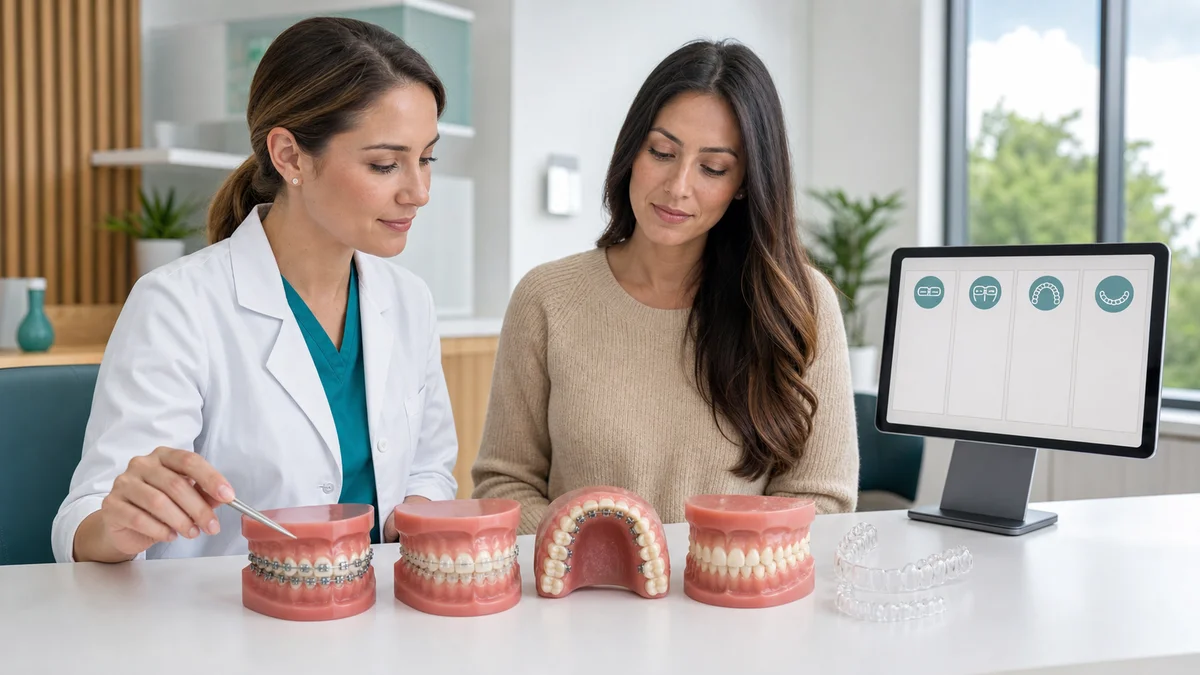
People searching for invisalign alternatives may want a lower-visibility appliance, more predictable control, a different payment structure or a treatment that requires less daily tray discipline. Invisalign® is one commercial clear aligner system. It is not the name for every transparent tray, and replacing one brand with another does not change the need for diagnosis, professional prescription, monitoring and retention.
The best alternative is not a universal product. It is the treatment pathway that can safely address the diagnosed tooth and jaw relationships while fitting the patient’s health, preferences and ability to cooperate. A person with mild spacing, healthy gums and excellent removable-appliance wear may have different reasonable options from someone with an impacted tooth, severe rotation, reduced periodontal support or a major skeletal discrepancy.
The American Association of Orthodontists and NHS patient information describe several appliance categories, including fixed braces, ceramic braces, lingual braces and clear aligners. They also emphasize assessment before choosing a method. The U.S. Food and Drug Administration classifies sequential aligners as prescription orthodontic devices. This guide therefore compares clinical pathways rather than ranking brands or promising that one appliance is faster, cheaper or better for everyone.
1. Start With the Problem, Not the Appliance
Orthodontics treats malocclusion: the position of teeth and the way the upper and lower dentitions relate. A visible concern such as crowding, a gap or a protruding tooth may be only one part of the diagnosis. Roots, supporting bone, gum condition, missing teeth, restorations, jaw relationships and growth can influence which mechanics are suitable.
A complete assessment may use medical and dental history, clinical examination, photographs, scans or models and radiographs when indicated. Each record has a purpose. A surface scan captures tooth shape but cannot by itself show every root, bone level or impacted tooth. Treatment should not begin while active decay or uncontrolled gum disease makes movement unsafe.
Before comparing appliances, ask the clinician to define:
- the diagnosis and the patient’s priority;
- which teeth and roots must move, and in what direction;
- whether both arches and the bite need treatment;
- periodontal, restorative or endodontic limitations;
- whether space requires IPR, expansion, distal movement or extraction;
- which outcomes are realistic and which compromises may remain;
- what would make the proposed method unsuitable or require a change.
Only after these questions are answered can two invisalign alternatives be compared fairly. Otherwise, a discreet limited plan may be mistaken for a comprehensive correction.
2. Invisalign Alternatives: Decision Table
The table summarizes broad pathways. It does not prescribe treatment or imply that every clinic offers every option. Availability, material and mechanics vary, and the same appliance can be planned differently by different clinicians.
| Pathway | Potential fit | Main trade-off | Key question |
|---|---|---|---|
| Other clinician-prescribed clear aligners | Patients suitable for removable staged movement who prefer low visibility | Still requires wear discipline; system limits and monitoring vary | How does the prescribed plan address my diagnosis? |
| Metal fixed braces | Broad range of tooth and bite movements, including many complex cases | Most visible; cleaning and food habits require adjustment | Which movements gain control from fixed mechanics? |
| Ceramic fixed braces | Patients wanting fixed control with less visible front brackets | Still visible up close; material, friction, staining and breakage considerations vary | Are ceramic brackets appropriate on both arches? |
| Lingual braces | Selected patients seeking fixed appliances behind the teeth | Access, speech, tongue comfort, hygiene and clinician expertise can be limiting | Can this system predictably treat my specific problem? |
| Hybrid treatment | Cases benefiting from more than one appliance or auxiliary | More phases and responsibilities to understand | What does each component accomplish? |
| Functional or growth-modifying appliances | Selected growing patients with particular jaw relationships | Age, growth and cooperation determine relevance | Is growth remaining, and what is the actual treatment objective? |
| Restorative camouflage | Selected shape, size or color concerns where tooth movement is not the chosen goal | Does not move roots or correct a skeletal bite; may alter tooth structure | Would orthodontics preserve more tooth tissue or improve function? |
| No treatment or monitored review | Patients who understand the condition and decline elective correction | The concern may remain or change; preventive care is still needed | What are the realistic consequences of waiting? |
Jaw surgery may also be part of care when a substantial skeletal relationship cannot be corrected by tooth movement alone. It is not simply another brace style and requires multidisciplinary assessment. Similarly, extraction is a space-management decision, not an appliance category.
3. Other Clinician-Prescribed Clear Aligner Systems
Among invisalign alternatives, another clinician-prescribed aligner system is the closest match in daily routine: trays remain removable, staged and dependent on professional planning. Similar appearance, however, does not prove identical indications, software rules, refinement access or oversight.
Many manufacturers produce sequential clear aligners. The FDA device classification describes an aligner as a thermoplastic prescription device, potentially accompanied by scanning software, that progressively moves teeth. Different systems may use different materials, trim lines, software features, attachment libraries, manufacturing arrangements and package rules. Those differences can matter, but the commercial name is only one component of care.
The treating dentist or orthodontist diagnoses the problem, designs or approves movement, prescribes auxiliaries, checks fit and changes the plan when biology differs from the simulation. A sophisticated material cannot compensate for an incomplete diagnosis. Conversely, a less familiar brand is not automatically inferior if the clinician has selected it appropriately, understands its limits and provides accountable monitoring.
When comparing one aligner system with another, ask:
- Is the device prescribed for the full diagnosed problem or a limited goal?
- Who approves the digital setup and remains responsible for decisions?
- Which movements may need attachments, elastics, IPR or another appliance?
- How often are fit, gums, roots and bite reviewed?
- How many stages and refinement rounds are included?
- What happens if a tray is lost, damaged or does not seat?
- How are records, transfer and urgent concerns handled?
- Which retainers and retention reviews follow active movement?
Do not assume that two clear aligner quotes cover identical care. One may include examination, records, attachments, refinements and retainers; another may list only a tray package. Compare the clinical episode from diagnosis through retention.
4. Metal Fixed Braces
Conventional fixed braces use brackets bonded to teeth and wires that guide movement. Because the appliance remains attached, tooth movement does not depend on the patient remembering to reinsert trays. The clinician can adjust wires, add elastics and use other auxiliaries to address a wide range of malocclusions.
For patients comparing invisalign alternatives, metal braces offer the clearest contrast between removable and fixed control. Their visibility is greater, but the appliance delivers prescribed mechanics continuously between visits.
Fixed braces can be especially useful when movements require consistent force, detailed root control, management of impacted teeth or mechanics that are less predictable with a removable appliance. This does not mean braces are automatically required for every complex case or that aligners cannot manage complexity. The choice depends on the actual movement plan and clinician’s judgment.
The trade-offs are visibility, oral hygiene demands, food precautions and the possibility of bracket or wire irritation. Plaque can collect around brackets if cleaning is inconsistent. Patients need instruction in brushing and interdental cleaning and should continue routine dental care. Hard or sticky foods may damage components, and a loose bracket or protruding wire may require attention.
Fixed appliances still require cooperation. Appointments, elastics, hygiene and dietary guidance matter. “Not removable” does not mean “automatic.” Treatment time and result cannot be guaranteed because biology, breakages, attendance and starting complexity vary.
5. Ceramic Fixed Braces
Ceramic braces place tooth-colored or translucent brackets on the visible tooth surfaces, usually with a wire. They provide fixed mechanics while appearing less prominent than metal brackets from a distance. For some adults, this balance is more practical than daily aligner removal.
Ceramic does not mean invisible. The wire, elastic modules and bracket outlines can still be seen, and some components may stain. Bracket material, size and design differ. Ceramic brackets may be more brittle than metal, and their interaction with opposing teeth can influence where they are appropriate. A clinician may recommend metal on selected lower teeth or in areas at risk of contact.
Ask whether the planned mechanics and appointment schedule differ from metal braces, whether ceramic is proposed on one or both arches, how breakage is managed and whether there is a fee difference. The aesthetic choice should not reduce safety or control merely to make the appliance less visible.
6. Lingual Braces Behind the Teeth
Lingual braces are fixed to the inner, tongue-facing surfaces of teeth. They can be difficult to see from the front while providing fixed-appliance mechanics. NHS information lists lingual braces among private orthodontic options, and the AAO notes that not every orthodontic problem can be treated successfully with every lingual system.
The inner position changes the experience. Tongue irritation, speech adaptation and access for cleaning can be more demanding. Bonding and adjustments are technically different, and not every clinician offers lingual treatment. Tooth shape, bite depth and available surface area can affect suitability.
A patient considering lingual braces should ask about the clinician’s training with the proposed system, which teeth will carry brackets, realistic adaptation, emergency access, cleaning tools and whether any movements require another method. Lingual braces are not simply ordinary braces moved out of sight; they are a distinct technique with their own mechanics and limitations.
7. Hybrid and Combined Orthodontic Treatment
Some cases benefit from more than one appliance. A clinician might use a short phase of fixed braces to control a difficult movement and continue with clear aligners, or use aligners with elastics, buttons, temporary anchorage or other prescribed auxiliaries. Restorative or periodontal care may be coordinated before, during or after movement.
Hybrid care is not evidence that the original appliance failed when it is planned from the start. It can allocate each task to the method that handles it efficiently. It can also become a contingency when tracking differs from the digital plan. The consent discussion should distinguish a planned phase from an unplanned change.
Ask for a phase-by-phase outline:
- the objective of each appliance or procedure;
- which phase depends most on patient cooperation;
- what triggers movement to the next phase;
- whether all components and appointments are included in the fee;
- how oral hygiene and urgent issues are managed;
- how the final bite and retention plan are assessed.
A combined plan may be more appropriate than insisting that a single appliance solve every problem. The number of devices is less important than the clarity of diagnosis and responsibility.
8. Functional Appliances and Growth-Related Options
Functional appliances are designed for selected growing patients with particular jaw and bite relationships. They may be removable or fixed and can interact with growth and muscle function. They are not a general adult substitute for Invisalign, and timing matters.
Parents should ask what growth remains, what the appliance is expected to change, which dental changes may occur, how cooperation affects the result and whether a later fixed-appliance or aligner phase is likely. An early phase does not always remove the need for comprehensive treatment.
Adults who are told that a simple removable device will permanently enlarge or remodel a mature jaw should request precise terminology and evidence for the proposed device and indication. Dental arch expansion, tooth tipping, skeletal expansion and jaw surgery are not interchangeable concepts.
9. Orthodontic Surgery for Skeletal Discrepancies
When the main problem is a substantial relationship between the jaws, moving teeth alone may not achieve the desired function or facial balance. Orthognathic surgery can be considered with orthodontic treatment in selected cases after specialist assessment. It is a major pathway involving an orthodontist and oral and maxillofacial surgeon, not a cosmetic add-on.
Some adults choose dental camouflage instead, accepting limits while teeth are moved to improve the bite within the existing jaw relationship. Others choose no treatment. The decision depends on diagnosis, health, goals, risks and personal values. Clear aligners or braces may be used before and after surgery according to the plan.
No online comparison can determine whether surgery is appropriate. A responsible clinician should explain the skeletal and dental components of the problem, reasonable alternatives, expected sequence and material risks without pressuring the patient.
10. Restorative Camouflage Is Not Orthodontic Movement
Bonding, veneers and crowns can change tooth shape, color and apparent alignment. For selected minor shape discrepancies, restorative care may be a reasonable choice. It does not move roots, correct an impacted tooth, coordinate arches or treat a skeletal bite. Covering a rotated or protruding tooth may require adding material, removing enamel or both.
Healthy tooth structure should not be altered merely because restorative treatment appears faster in an advertisement. Ask whether orthodontics could achieve the goal with less irreversible preparation, whether a combined conservative plan is possible and how the restoration will be maintained. Veneers and crowns may need future repair or replacement; they are not permanent substitutes without maintenance.
Whitening is not an alignment treatment. A retainer is not an active alternative for moving untreated teeth unless a clinician has specifically prescribed an active component. Similarly, a night guard protects against selected loading patterns but does not ordinarily correct malocclusion.
11. No Treatment or Monitored Review
Orthodontic treatment is often elective. A patient may decide that the expected benefit does not justify time, cost, appliance visibility or risk. Informed consent includes the option not to proceed. The clinician should explain what is likely to remain, what could worsen and which preventive measures matter.
Observation may be reasonable for a stable, mild concern that does not impair health or function, but it is not a universal recommendation. Crowding can make hygiene more difficult for some people, and bite problems can have different consequences. Regular dental review allows changes in gums, decay, wear or tooth position to be identified.
Waiting can also be an active choice when oral disease needs control, growth is being observed, restorative care must be completed or the patient is not ready to cooperate with treatment. A delayed decision should have a review plan rather than being forgotten.
12. Why Direct-to-Consumer Aligners Are Not Equivalent
Remote check-ins can support professional care, but a mail-order impression, scan or selfie is not a complete diagnosis. The American Dental Association strongly discourages direct-to-consumer laboratory services that eliminate the dentist’s role in diagnosis, treatment planning and ongoing management because unsupervised care can cause damage and irreversible complications.
The safety issue is not simply whether trays are transparent. Patients should know the licensed clinician responsible for prescribing movement, how gums, roots and bite are assessed, which records are required, how progress is reviewed and who handles a problem. A customer-service representative or automated simulation should not make clinical decisions.
- Confirm the treating clinician’s identity, location and licensure.
- Ask which examination and diagnostic records support the prescription.
- Clarify which reviews must occur in person.
- Know how a non-seating tray, gum problem or bite change is assessed.
- Request access to records and a transfer pathway.
- Read cancellation, refund and finance agreements separately from clinical consent.
Teledentistry can be legitimate when it preserves professional accountability. Convenience should not erase it.
13. Appearance, Comfort and Daily Routine
Appliance appearance is a valid preference, but it should be evaluated alongside daily life. Clear aligners are discreet and removable, yet they must be stored, cleaned and worn as prescribed. Frequent meals, long social events or difficulty maintaining routines can reduce practical wear. Attachments and elastics may still be visible.
The most practical invisalign alternatives are therefore not always the least noticeable options. A fixed appliance may suit someone who cannot maintain tray wear, while a removable system may suit someone who can reliably manage meals and hygiene.
Metal braces are most visible but stay in place. Ceramic brackets reduce contrast but remain noticeable. Lingual braces hide behind teeth but can affect speech and tongue comfort. Any appliance can cause pressure or irritation, especially after activation or a new stage. Comfort varies by person and phase; no method is pain-free for everyone.
Before choosing, simulate the routine:
- Can you remove, store and reinsert trays reliably?
- Can you clean around fixed brackets after meals?
- Does your work require frequent eating, speaking or travel?
- Can you attend the monitoring schedule?
- Are you willing to wear elastics or other auxiliaries?
- How will urgent care work away from the clinic?
The appliance that looks easiest in a photograph may not fit the patient’s actual week.
14. Oral Hygiene and Dental Health
NHS guidance states that orthodontic treatment should begin with a good standard of oral hygiene because appliances can increase the risk of decay and gum problems. Fixed brackets create additional plaque-retentive areas. Clear aligners allow normal brushing when removed, but wearing them over plaque, sugar or acid can keep exposure close to enamel.
Whichever method is chosen, patients should brush with fluoride toothpaste, clean between teeth, follow appliance-specific instructions and continue routine examinations and professional cleaning. Active decay, gum inflammation or periodontitis may need treatment before elective movement. A scan does not replace a dental check-up.
Tell the clinician about dry mouth, smoking or nicotine use, diabetes, pregnancy, bone conditions, relevant medications, previous trauma, root canal treatment and periodontal history. These factors do not automatically prohibit treatment, but they can affect risk and monitoring.
15. Predictability, Speed and Treatment Changes
Advertising often labels one system faster. Duration actually depends on diagnosis, number and type of movements, biological response, appliance wear, breakages, appointments and refinements. A fixed appliance can provide advantages for selected mechanics, while a well-chosen aligner plan can be efficient for other problems. No honest comparison can promise one category always finishes first.
Digital setups are planning tools, not guaranteed outcomes. Teeth may not track exactly as programmed. Additional aligners, wire changes, attachment revisions or a switch in method may be needed. Patients should ask what the clinician expects to be difficult and what would trigger a change.
Faster movement is not automatically better. Orthodontic force must respect roots, bone and gums. Avoid claims that a device can bypass biological limits or guarantee a result by a fixed date.
16. Compare Complete Costs, Not Headline Appliance Fees
Fees vary by diagnosis, location, clinician time, records, appliance, laboratory arrangements, monitoring, refinements and retention. This article does not provide a fixed price. Obtain written, personalized estimates and compare the same clinical goals.
When pricing invisalign alternatives, normalize scope before comparing totals. A limited aligner package, a comprehensive fixed-brace plan and a restorative proposal may solve different problems even when their headline fees appear similar.
A complete quote should identify:
- consultation, examination and diagnostic records;
- one or both arches and the intended bite correction;
- appliance placement or initial aligner series;
- attachments, elastics, IPR or other auxiliaries;
- routine, remote and urgent reviews;
- repairs, lost trays or breakages;
- refinements or additional treatment phases;
- appliance removal, finishing records and retainers;
- transfer, pause, cancellation and refund conditions.
A low monthly payment is not the same as a low total cost. Compare cash price, deposit, amount financed, annual percentage rate, fees, number of payments and total repayment. Insurance coverage depends on the individual contract and should be confirmed directly with the insurer.
17. Retention Follows Every Active Option
Retainers are not an Invisalign-specific requirement. Teeth can move after metal braces, ceramic braces, lingual braces, clear aligners and hybrid treatment. NHS information explains that retainers hold teeth while surrounding tissues adjust and that movement is likely when retainer wear stops.
The retainer may be removable, fixed or combined. Type and wear schedule should be individualized. Ask how many retainers are included, when they are fitted, how retention is reviewed and what replacement costs. Fixed retainers need cleaning and checks; removable retainers can wear, distort, crack or become lost.
An invisalign alternatives comparison that ends when active appliances are removed is incomplete. Long-term responsibility, maintenance and relapse risk belong in the original decision.
18. Red Flags in an Alternatives Consultation
- One appliance or brand is declared best before examination.
- A final plan or guaranteed result is offered from selfies alone.
- Gum health, roots, bone and bite are dismissed as unnecessary.
- A surface scan is presented as a complete substitute for all diagnostic records.
- The responsible treating dentist or orthodontist cannot be identified.
- A limited front-tooth plan is sold as comprehensive bite correction.
- Veneers or crowns are described as moving teeth or correcting roots.
- Adult jaw remodeling claims use vague language without a clear device indication.
- Risks, alternatives, no treatment and retention are minimized.
- Monthly finance is advertised without total repayment.
- Monitoring, refinements, repairs and urgent care are missing from the scope.
- The patient is pressured to pay before receiving written consent and cancellation terms.
These signs do not prove that a provider is unsafe, but they justify pausing. A good consultation explains why each option can or cannot meet the diagnosis and allows time for questions.
19. A Practical Shortlist Process
First, obtain the diagnosis and treatment goals. Second, identify which appliance categories can realistically deliver the required movements. Third, compare the daily responsibilities and monitoring model. Fourth, normalize written fees from records through retention. Finally, consider visibility, comfort and schedule after safety and clinical fit.
A useful shortlist of invisalign alternatives usually contains only methods that can meet the same agreed clinical objective. Removing unsuitable options early makes the final lifestyle and cost comparison more honest.
Use these questions:
- Which two or three options are clinically reasonable for me?
- What can each option accomplish, and what compromise may remain?
- Which movements are least predictable with my preferred method?
- How do fixed and removable options change my responsibilities?
- What would trigger refinements, auxiliaries or a method change?
- Who is responsible for monitoring and urgent decisions?
- What complete amount covers the same goal through retainers?
- What are the realistic consequences of no treatment?
Redent Klinik’s English dental services overview provides general information about available care. The English contact page can be used to request a preliminary record review. Any remote opinion remains provisional until clinical findings are confirmed.
Frequently Asked Questions About Invisalign Alternatives
Are other clear aligner brands real Invisalign alternatives?
They can be, when a licensed clinician prescribes and monitors a system that is suitable for the diagnosis. Compare the treatment plan, movements, records, refinements, oversight and retention rather than material or brand name alone.
Are metal braces better than Invisalign?
Neither is universally better. Fixed braces may offer advantages for selected complex movements and do not rely on tray reinsertion. Aligners are removable and less visible but require wear discipline. The diagnosis and treatment goals determine the better fit.
Do ceramic braces work like metal braces?
Both are fixed bracket-and-wire systems, but materials and clinical handling differ. Ceramic brackets are less visually prominent, while breakage, opposing-tooth contact, friction and staining considerations may influence where they are used.
Are lingual braces completely invisible?
They are placed behind the teeth and are difficult to see from the front, but no appliance should be promised as invisible in every situation. Speech, tongue comfort, hygiene, bite and clinician expertise affect suitability.
Can veneers replace orthodontic treatment?
Veneers can change visible tooth shape and color but do not move roots or correct jaw relationships. They may require irreversible enamel preparation and future maintenance. Orthodontic and restorative options should be compared conservatively.
Is a retainer an alternative to clear aligners?
A passive retainer maintains tooth position after active treatment; it is not normally designed to correct untreated malocclusion. Some devices can contain active components, but they require a clinician’s specific diagnosis and prescription.
Are mail-order aligners a safe cheaper alternative?
Price does not establish safety. The ADA discourages services that remove the dentist from diagnosis and ongoing management. Patients need an accountable licensed clinician, appropriate records, monitoring, urgent support and a retention plan.
Which option is fastest?
No category is always fastest. Duration depends on the diagnosed problem, movement complexity, biology, cooperation, breakages and refinements. Ask for an individualized estimate with assumptions, not a guaranteed date.
Which option is best for poor tray compliance?
A fixed appliance removes the need to reinsert trays, but it still requires hygiene, appointments, food precautions and possibly elastics. The clinician should discuss why fixed treatment is suitable and whether other cooperation demands are realistic.
Do all alternatives need retainers?
Active orthodontic options generally require retention because teeth can move afterward. The type and schedule vary. Ask about fixed and removable retainers, reviews, maintenance, replacement and long-term wear before treatment begins.
What symptoms need prompt review with any appliance?
Contact the treating team for worsening pain, a non-seating tray, broken appliance, persistent ulcer, unexpected bite change, significant gum bleeding or unusual mobility. Seek urgent local care for facial swelling, fever, pus, trauma, breathing or swallowing difficulty, or a severe allergic-type reaction.
Conclusion: Choose a Pathway, Not a Brand Promise
The strongest comparison of invisalign alternatives begins with a diagnosis and ends with retention. Other prescribed aligners, metal braces, ceramic braces, lingual systems and hybrid treatment can each be appropriate. Growth-related appliances, surgery, restorative camouflage or no treatment may enter the discussion for different clinical goals.
Ask which options can safely deliver the required tooth, root and bite changes. Compare monitoring, daily responsibilities, contingencies and complete cost through retainers. A thoughtful plan does not need to declare one appliance universally best; it should explain why the chosen method fits the individual patient and what happens if treatment does not follow the initial forecast.
Official Sources and Evidence Notes
- American Association of Orthodontists: Orthodontic Treatment Methods
- American Association of Orthodontists: Metal, Ceramic and Lingual Braces
- American Association of Orthodontists: Clear Aligners
- NHS: Orthodontic Treatments, Aligners, Lingual Braces and Retainers
- American Dental Association: Direct-to-Consumer Dental Services Policy
- American Dental Association: Home Oral Care and At-Home Orthodontic Safety
- U.S. Food and Drug Administration: Sequential Aligner Device Classification
- World Health Organization: Oral Health Fact Sheet
Sources reviewed July 19, 2026. This article provides general education, not an individual diagnosis, treatment plan, quote or result guarantee. Commercial system availability and device indications vary by country; the treating clinician must confirm local regulatory status and patient suitability.