
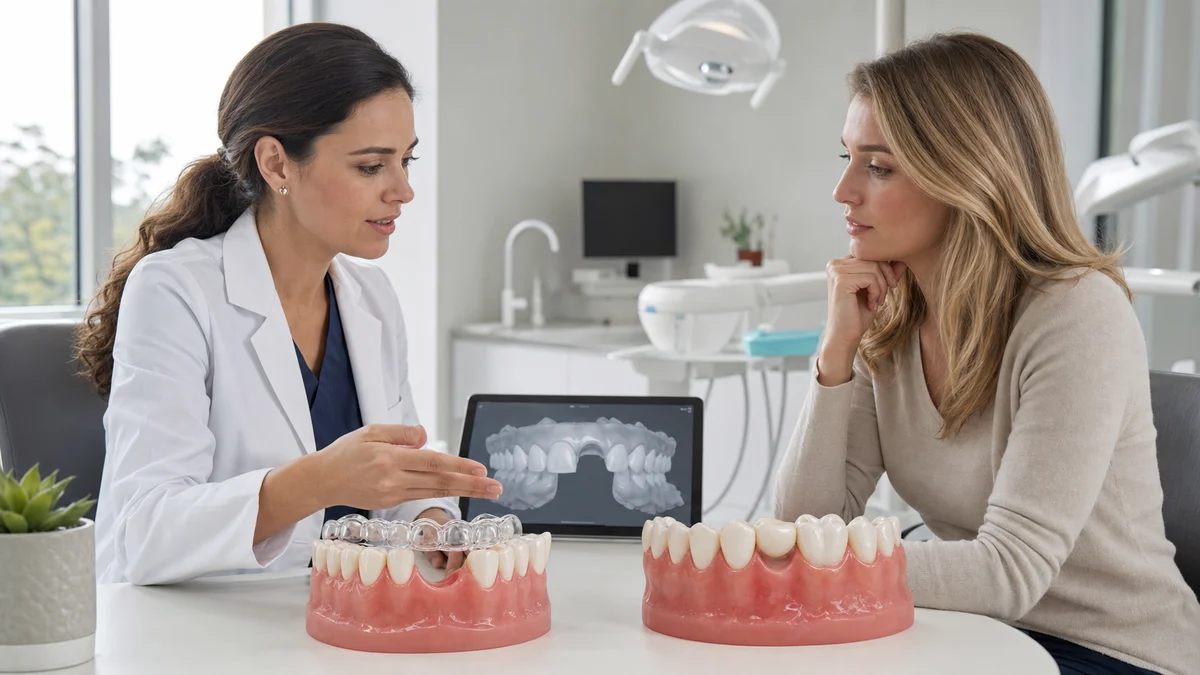
Short answer: Invisalign and a dental bridge do different jobs. Clear aligners move teeth; a bridge replaces a missing tooth with an artificial tooth supported by neighbouring teeth. Aligners may close the gap or create ideal space for a bridge, but they do not supply a replacement tooth. The best plan depends on why the tooth is missing, bite, root positions, adjacent-tooth health, age, bone, appearance, maintenance and long-term stability.
The search invisalign or dental bridge which is better often appears when one tooth is missing and the surrounding teeth have shifted. Invisalign is a branded clear-aligner system used for orthodontic movement. A fixed dental bridge uses a false tooth, called a pontic, attached to one or more supporting teeth. They are not interchangeable products.
An orthodontic plan can sometimes close a missing-tooth space so no artificial tooth is needed. In other cases, aligners open or preserve the correct space and position the roots before a bridge, implant or removable replacement. A bridge fills the resulting gap but does not correct a broader bite problem unless it is part of a coordinated plan.
This guide explains the decision sequence. It does not diagnose whether your gap should be closed or restored, and it does not guarantee that clear aligners can deliver the required movement.
Invisalign or Dental Bridge Which Is Better: Define the Goal
For invisalign or dental bridge which is better, first decide whether the goal is to close space, redistribute space or replace a tooth. The American Association of Orthodontists notes that orthodontics may close a missing-tooth space or create and preserve enough space for a replacement. The American Dental Association defines a bridge as a fixed partial denture that replaces one or more missing teeth.
- Close the space: move adjacent teeth together and reshape or manage them as needed.
- Create ideal space: move tilted or drifted teeth so a replacement has correct width and root clearance.
- Maintain space: prevent further movement while growth, healing or restorative planning continues.
- Replace the tooth: use a bridge, implant restoration or removable prosthesis.
- Leave the gap: consider only when function, stability, appearance and future options remain acceptable.
The answer changes by location. Closing a small front-tooth space affects symmetry and tooth proportions differently from closing a posterior extraction space. The entire bite, not just the visible gap, needs assessment.
Why Is the Tooth Missing?
A safe invisalign or dental bridge which is better decision starts with cause. A tooth may be congenitally absent, lost to decay, gum disease or trauma, extracted for orthodontic reasons, or impacted beneath the gum. Each cause creates different risks.
If gum disease caused the loss, inflammation and remaining bone support must be stabilised before movement or a bridge. If trauma damaged adjacent teeth, their roots and vitality influence whether they can support a bridge. If the tooth is impacted, imaging may show whether it can be guided into place instead of replaced.
A recently opened gap can also reflect active tooth migration rather than a truly missing tooth. New spacing, mobility or bleeding needs diagnosis before cosmetic closure.
How Invisalign Can Manage a Missing-Tooth Space
In the orthodontic side of invisalign or dental bridge which is better, sequential trays apply clinician-prescribed forces to move teeth. The plan may close the gap, upright tilted teeth, correct rotations, align roots or coordinate the upper and lower arches.
Space closure can remove the need for a prosthetic tooth, but it may require substantial movement and careful control of midlines, bite, root angulation and tooth shape. A canine moved into a lateral-incisor position, for example, may need reshaping and colour management; the opposing bite must also be adjusted appropriately.
Clear aligners are not suitable for every space-closure movement. Fixed braces, temporary anchorage devices or a hybrid plan may provide better control in complex cases. The appliance should follow the biomechanics, not the preference for an invisible tray.
How a Dental Bridge Replaces a Tooth
On the restorative side of invisalign or dental bridge which is better, a bridge places an artificial tooth in the gap. The restoration is fixed and can only be removed by a dentist. Its success depends on the supporting foundation, including neighbouring teeth, gums, bite and hygiene.
A conventional bridge commonly involves preparing one or more adjacent teeth for crowns that support the pontic. This may be reasonable when those teeth already need crowns or large restorations, but it removes tooth structure. A resin-bonded or adhesive bridge uses one or more wings bonded mostly to enamel and may require little preparation in suitable situations. It can be more conservative but may debond.
An implant-supported crown or bridge does not rely on adjacent natural teeth in the same way, but requires surgery, suitable bone, healing and maintenance. A bridge discussion should include these alternatives rather than presenting one fixed design as the only replacement.
Decision Table: Close, Open or Restore the Space
This table converts invisalign or dental bridge which is better into clinical questions. It is not a substitute for interdisciplinary diagnosis.
| Decision area | Aligner-led space management | Dental bridge |
|---|---|---|
| Main action | Moves natural teeth | Places an artificial tooth in the gap |
| Missing tooth | May eliminate gap or prepare ideal space | Directly replaces visible crown portion |
| Roots | Can reposition roots under planned force | Does not move neighbouring roots |
| Adjacent enamel | Usually preserved; selected IPR may be planned | Conventional bridge requires preparation; adhesive designs may be minimal |
| Time | Biological movement over months, followed by retention | Usually fewer active visits after the space is ready |
| Maintenance | Retainers and periodontal review | Cleaning under pontic and around retainers, plus restorative review |
| Common risks | Unwanted movement, root change, recession, relapse | Decay, debonding, fracture, gum inflammation, support-tooth problems |
| Best fit | When movement improves bite or can close/prepare space safely | When a stable gap needs fixed replacement and supports are suitable |
Adjacent Teeth: Healthy, Filled or Crowned?
One of the strongest factors in invisalign or dental bridge which is better is the condition of the teeth beside the gap. A conventional bridge may be efficient when adjacent teeth already have large restorations and need crowns. Preparing untouched healthy teeth solely to support a bridge carries a different biological cost.
An adhesive bridge can preserve more enamel in suitable front-tooth cases, but design, bite and available bonding area matter. The wing may debond, and repeated rebonding is not always possible without changes.
Orthodontic movement also requires healthy supporting tissues. A tooth with short roots, active periodontitis, significant mobility or extensive restoration may need modified force or may not be a safe anchor. Neither option should be selected from a smile photograph.
Bite, Midline and Facial Proportions
For invisalign or dental bridge which is better, closing the gap changes the arrangement of the entire dental arch. The clinician reviews centre lines, overjet, overbite, canine relationship, crowding, arch width and the opposing teeth. Closing one space can create another problem if the bite has nowhere safe to finish.
Opening or maintaining space for a bridge also requires precision. The gap must fit a natural-looking tooth, and the roots beside it must be positioned to support periodontal health and any future implant option. Surface crowns may look correctly spaced while roots remain too close; appropriate imaging can reveal this.
Tooth-size differences influence appearance. Orthodontics and restorative dentistry should agree on final widths before movement starts, particularly when a congenitally missing lateral incisor is involved.
Age, Growth and Timing
The timing of invisalign or dental bridge which is better matters in younger patients with congenitally missing teeth. Jaw growth, eruption and tooth development can continue. A definitive implant is generally delayed until growth is sufficiently complete, while orthodontics and temporary replacement may be used earlier.
A resin-bonded bridge can sometimes provide a conservative fixed replacement during or after growth, depending on bite and enamel. A removable retainer with an artificial tooth may preserve appearance and space between stages. The plan must anticipate future changes rather than treat the first temporary solution as permanent.
Adults also need timing coordination. Periodontal treatment, extraction healing, orthodontics and bridge placement may occur in stages. Compressing all stages for travel or convenience can compromise planning.
Can Invisalign Close the Gap Completely?
In invisalign or dental bridge which is better, clear aligners may close selected gaps, but “possible” is not the same as advisable. The required movement, anchorage, root position, facial profile, bite and tooth size determine whether closure can finish well.
Large posterior spaces or complex root movements may be less predictable with trays alone. Attachments, elastics, interproximal reduction or other appliances may be needed. If the case does not track, new records and refinement trays or a switch to fixed appliances may be discussed.
The digital animation is a proposed path, not proof that biology will follow it exactly. Monitoring and a fallback plan are essential.
Can a Bridge Correct Crooked or Drifted Teeth?
A bridge can alter visible crown shape but does not reposition roots, so the answer within invisalign or dental bridge which is better is limited. If the supporting teeth have tilted into the gap, preparing them for a conventional bridge may require extra reduction or create unfavourable contours.
Orthodontic uprighting before bridgework can create better space, root alignment and cleaning access. This is why the two treatments may be sequential rather than competing. A short orthodontic phase can sometimes make the bridge more conservative and easier to maintain.
Masking a major positional problem with bulky crowns or a wide pontic can harm appearance and hygiene. Ask to see diagnostic wax-ups or digital previews while remembering they do not guarantee tissue response.
Health Checks Before Either Option
No reliable invisalign or dental bridge which is better recommendation begins before oral disease is controlled. Decay, gum inflammation, active periodontitis, root infection and unstable bite should be assessed. The cause of the missing tooth may indicate risks for the remaining teeth.
- Medical and dental history
- Clinical examination of teeth, gums and bite
- Periodontal charting where indicated
- Radiographs based on clinical need
- Vitality and restorability of supporting teeth
- Root position and bone at the gap
- Space width, midline and opposing contacts
- Oral hygiene and maintenance capacity
Recent unexplained tooth loss or mobility may require periodontal or medical coordination before elective treatment.
Risks of Orthodontic Space Closure
Aligner-related risks in invisalign or dental bridge which is better include temporary soreness, gum irritation, unwanted movement, root shortening, recession, mobility, bite changes and relapse. Poor hygiene can lead to decay or inflammation while trays are worn.
Space closure may change tooth proportions and contact relationships. Reshaping, bonding or whitening can be needed to make a moved tooth resemble the one it substitutes for. These additional steps should be planned and costed before orthodontics.
Retention is a long-term commitment. Teeth can drift after active movement, especially where a large space was closed. The retention strategy must also allow cleaning and restorative care.
Risks of a Dental Bridge
Bridge-related risks in invisalign or dental bridge which is better depend on design. Conventional preparation permanently removes tooth structure. Supporting teeth can develop decay, sensitivity, pulp problems, fracture or periodontal disease. The bridge can chip, loosen or require replacement.
Adhesive bridges preserve more tooth structure but can debond, particularly with unfavourable contacts or design. A debonded bridge should be assessed rather than repeatedly glued without investigating cause.
Cleaning under the pontic and around retainers is essential. A fixed bridge does not prevent bone change in the missing-tooth area and does not last indefinitely. Future repair or replacement should be included in consent.
Other Options: Implant, Denture or No Replacement
The choice in invisalign or dental bridge which is better is not limited to two paths. A dental implant can support a crown without preparing adjacent teeth, but requires surgery, adequate bone, healing, medical suitability and maintenance. A removable partial denture may replace one or more teeth and can be easier to modify.
Leaving a gap may be acceptable in selected low-impact positions if appearance, chewing, stability and future options are understood. Teeth may drift into the space, which can make later replacement harder. Monitoring is important.
- Orthodontic space closure
- Orthodontic space creation plus adhesive bridge
- Conventional fixed bridge
- Implant-supported crown
- Removable partial denture
- Monitored gap without replacement
A complete consent discussion compares these categories against the same diagnosis.
Combining Aligners and a Bridge
Often the best answer to invisalign or dental bridge which is better is both in sequence. Orthodontics can create the correct gap, align the roots and level the bite. A bridge then replaces the missing tooth. The restorative dentist and orthodontic clinician should plan final tooth width and bridge design before movement begins.
- Diagnose the missing tooth and stabilise oral health.
- Choose closure or replacement as the final goal.
- Design the final restorative space and root positions.
- Complete monitored orthodontic movement.
- Provide temporary retention with an artificial tooth if needed.
- Confirm gum stability and supporting-tooth condition.
- Place the definitive bridge.
- Adjust or remake retainers around the final restoration.
A bridge placed before necessary movement can block orthodontic space correction. A retainer made before the definitive bridge may no longer fit afterward.
Time, Cost and Insurance
Cost comparisons for invisalign or dental bridge which is better must include the complete pathway. Aligner fees may include records, trays, attachments, refinements and retainers. Bridge fees may include preparation, temporary restoration, laboratory work, cementation and review. Combined care includes both phases.
Insurance can classify orthodontics and prosthodontics under separate benefits, with different deductibles, annual or lifetime limits, waiting periods and age rules. A plan may cover a bridge but not elective orthodontics, or provide an orthodontic benefit while limiting restorative materials. Obtain written estimates for every phase.
The cheaper first-year option may not be cheaper over a lifetime. Include retainer replacement, bridge maintenance, future repairs and the cost of changing plans if treatment does not progress as expected.
Planning Treatment in Turkey
International patients asking invisalign or dental bridge which is better need continuity across orthodontic and restorative visits. Aligners require monitoring and may need refinements. A bridge requires preparation, laboratory production, fit checks and long-term access for repair.
You can review interdisciplinary care on the Redent Klinik English website and submit records through the English contact page. A remote review can discuss possible pathways, but the definitive plan needs an in-person bite, periodontal and radiographic assessment.
Before travel, clarify the number of visits, temporary tooth during space management, aligner delivery, refinement rules, bridge material, record transfer and emergency support after returning home. A short package should not force biologic tooth movement into an unsafe schedule.
Red Flags
Pause an invisalign or dental bridge which is better decision if you encounter:
- A plan based only on a front-smile photograph
- No explanation of why the tooth is missing
- Gap closure promised without a bite or root assessment
- Healthy adjacent teeth prepared without discussing conservative alternatives
- A bridge promised to correct a major bite problem
- Aligners presented as a replacement tooth
- No coordination between orthodontic and restorative providers
- No retention or bridge-maintenance plan
- A digital simulation presented as a guaranteed result
Irreversible tooth preparation and complex orthodontic movement both deserve a second opinion when the diagnosis or end point is unclear.
Frequently Asked Questions
Invisalign or dental bridge which is better for one missing tooth?
It depends on whether closing the gap creates a healthy bite and acceptable appearance. If the space should remain, a bridge can replace the tooth. Aligners may still be used first to position the roots and create ideal space for that bridge.
Can Invisalign replace a missing tooth?
No. Aligners move existing teeth. They may close the space or prepare it for a replacement, but they do not provide an artificial tooth. A temporary tooth can sometimes be incorporated into a tray or retainer for appearance during treatment.
Can a bridge close a gap without moving teeth?
A bridge fills the visible gap with a pontic, but it does not reposition roots or correct broader alignment. If neighbouring teeth are tilted or the space is the wrong width, orthodontic movement before the bridge may improve design and hygiene.
Does a conventional bridge damage healthy teeth?
Conventional bridge preparation removes tooth structure from supporting teeth. That may be reasonable when they already need crowns, but it is a biological cost when they are untouched. Adhesive bridges and implants may preserve more adjacent tissue in selected cases.
How long does space closure take?
There is no universal timeline. Distance, root movement, bone, bite, age, appliance, adherence and biological response all matter. Large or complex spaces can take substantial time, and retention follows active movement. A digital estimate is not a guarantee.
Can I have a bridge after Invisalign?
Yes. This is a common coordinated pathway when orthodontics creates the correct space and root positions. The bridge should be planned before movement, and the final retainer should be made or adjusted after the definitive restoration is placed.
Is an implant better than a bridge?
An implant avoids preparing adjacent teeth but requires surgery, suitable bone and healing. A bridge avoids implant surgery but relies on supporting teeth. Neither is universally better. Medical suitability, growth, bone, neighbouring teeth, time, maintenance and cost decide.
What happens if I leave the gap?
Some gaps can be monitored, especially where function and appearance are acceptable. Adjacent teeth may drift or tilt, and opposing teeth can change position. Discuss the risk and future replacement difficulty, then maintain regular review.
Final Checklist
Use invisalign or dental bridge which is better as a multidisciplinary checklist:
- Confirm why the tooth is missing.
- Assess gum health, bone, roots and adjacent teeth.
- Decide whether to close, open or maintain space.
- Plan final tooth widths, root positions and bite.
- Compare bridge, implant, denture and no-replacement options.
- Choose aligners only if they can deliver the needed movement safely.
- Choose bridge design based on support and tissue preservation.
- Coordinate retention with the final restoration.
- Compare complete lifetime costs and maintenance.
The correct conclusion to invisalign or dental bridge which is better is that aligners manage tooth position and a bridge replaces a tooth. The best plan may use one, the other or both in sequence. Diagnosis and a shared orthodontic–restorative end point matter more than speed.
This evidence-informed patient guide is prepared for clinical review by Dentist Esma Çevrük Çakır. It does not replace an in-person diagnosis, orthodontic prescription, restorative consent, growth assessment, insurance decision or personalised treatment plan.
Authoritative Sources
- American Dental Association, MouthHealthy: Bridges – bridge purpose, support and maintenance.
- American Dental Association, MouthHealthy: Implants – implant-supported alternatives and adjacent-tooth preservation.
- American Association of Orthodontists: Missing teeth and orthodontics – closing space or preparing space for replacement.
- Nottingham University Hospitals NHS: Missing teeth – interdisciplinary closure and replacement planning.
- Leeds Teaching Hospitals NHS: Bridges – conventional and adhesive bridge designs and alternatives.
- US Food and Drug Administration: Clear aligners – orthodontic movement, wear and retention.
- American Dental Association – professional and patient oral-health guidance.
- World Health Organization: Oral health fact sheet – prevention and global oral-health context.
Disclosure: this page may contain affiliate links. We may earn a commission if you use them, at no extra cost to you.