
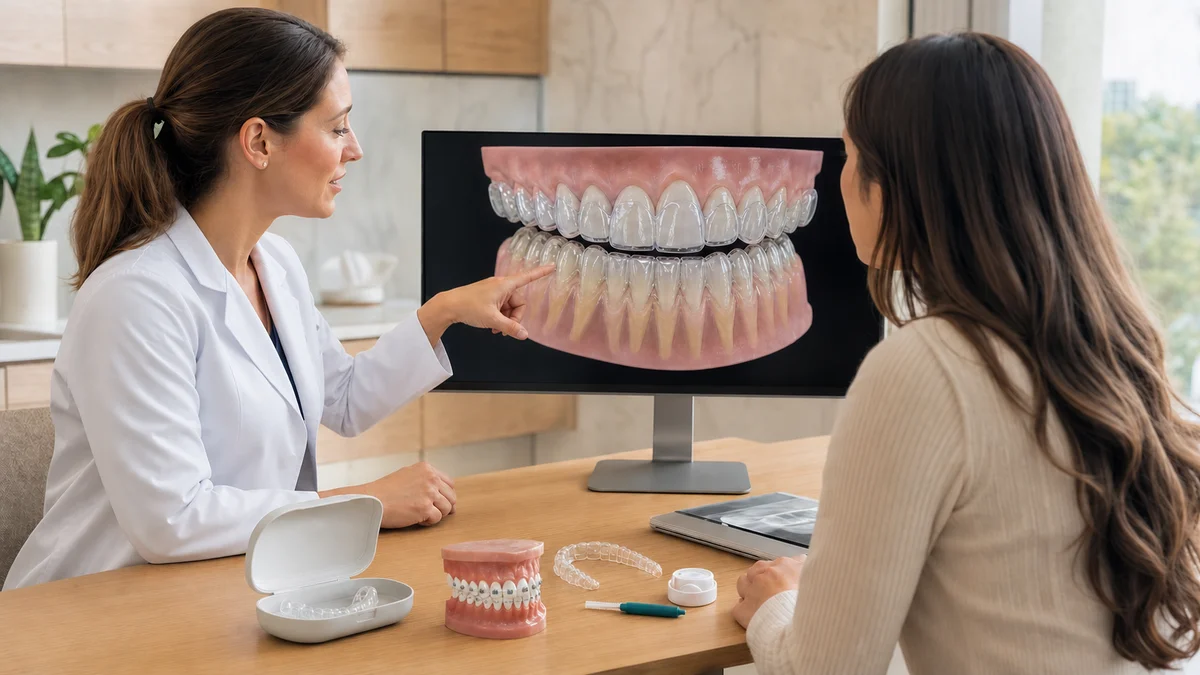
Quick answer: invisalign risks range from temporary pressure, speech changes and tray irritation to decay, gum recession, root shortening, unwanted bite changes, tracking failure and relapse. Clear aligners are not suitable for every person or every tooth movement. A clinical examination, appropriate imaging, healthy teeth and gums, a realistic plan, correct wear, regular monitoring and long-term retainers help reduce avoidable harm.
Invisalign risks are often presented in two unhelpful extremes: either clear aligners are described as effortless and risk-free, or every uncomfortable sensation is treated as a complication. The more accurate view is that Invisalign is a prescription orthodontic system. It moves teeth through bone by applying planned forces. Some short-lived pressure and adjustment effects may be expected, while other symptoms require the treating dentist or orthodontist to reassess the plan.
Invisalign is a brand of clear aligner. Many biological and mechanical risks discussed in this guide apply to orthodontic tooth movement generally, not only to one manufacturer. Some risks relate to removable plastic trays; others relate to attachments, enamel reduction, elastics, oral hygiene, the original bite or the limits of a particular treatment plan. Individual risk cannot be diagnosed from a photograph, scan simulation or online article.
This evidence-based guide is designed to support informed consent. It does not promise a particular outcome and does not replace an examination. Treatment suitability depends on tooth and root health, gum and bone support, restorations, missing teeth, jaw relationships, growth, habits, medical history, expected cooperation and the movements needed to create a functional bite.
1. What counts among Invisalign risks?
A risk is a possible unwanted outcome, not a prediction that it will happen. The likelihood and significance can vary widely. Mild tenderness during the first days of a new tray is different from persistent severe pain, gum swelling or a tooth becoming unusually mobile. A good discussion of invisalign risks separates expected adaptation, manageable side effects, treatment limitations and complications that may alter or stop treatment.
The US Food and Drug Administration explains that clear aligners are removable devices used in a planned series and that they may not work for every person’s teeth. Its consumer information on braces and aligners also stresses following wear and retainer instructions and maintaining careful oral hygiene. Regulatory clearance means a device may be marketed for its intended use; it is not a guarantee that every patient or movement is suitable.
Risk also has a benefit side. Correcting a clinically meaningful malocclusion may improve function, access for cleaning or the distribution of forces. The decision is therefore not “risk versus no risk.” It is whether the expected benefits justify the case-specific burdens and uncertainty compared with monitoring, braces, another appliance, restorative care or no active treatment.
2. Invisalign risks begin with diagnosis, not the first tray
Moving teeth without understanding the supporting tissues can worsen an undetected problem. Before treatment, the clinician should assess decay, existing restorations, gum inflammation, periodontal attachment, recession, tooth mobility, root form, impacted teeth, missing teeth, jaw relationships and the bite. Radiographs may be needed according to clinical judgment. A surface scan records shape well but does not show everything below the gum line.
The American Association of Orthodontists notes that in-person evaluation and appropriate imaging can reveal root health, impacted teeth and periodontal concerns that photographs and scans cannot show. It warns that moving teeth where gum health is poor can contribute to recession, root shortening or tooth loss. These are important invisalign risks to screen before accepting a remote plan.
A medical and medication history matters too. Conditions that influence bone turnover, healing, bleeding, saliva or immune response may affect planning. Previous trauma, root canal treatment, implants, crowns, bridges, veneers and active jaw symptoms should be recorded. This does not mean those features automatically exclude aligners; it means the plan may need additional testing, coordination or different expectations.
3. Invisalign risks: expected effects versus warning signs
New aligners commonly create pressure or tenderness as forces begin. The edges may rub a cheek, lip or tongue. Speech can sound different temporarily, and saliva or mouth dryness may change while the patient adapts. Attachments can feel rough when trays are out. These effects are usually monitored and managed, but “expected” should never be used to dismiss worsening or prolonged symptoms.
| Observation | Possible meaning | Reasonable next action | Urgency |
|---|---|---|---|
| Mild pressure after a scheduled tray change | Expected adaptation to planned force | Follow prescribed wear; contact the clinic if it persists or escalates | Usually routine |
| Sharp tray edge or localized ulcer | Mechanical irritation or poor edge fit | Stop self-cutting or reshaping; request professional advice | Prompt if painful or not healing |
| Tray no longer seats, visible gap around a tooth | Tracking loss, damaged tray or wrong sequence | Do not advance automatically; contact the treating team | Prompt |
| Bleeding gums, swelling, bad taste or increasing mobility | Plaque-related disease, periodontal problem or another condition | Arrange clinical assessment and hygiene review | Prompt |
| Severe pain, facial swelling, fever, swallowing or breathing difficulty | Possible urgent dental or medical problem | Seek urgent professional care | Urgent or emergency |
Do not force a tray that appears wrong, use a sharp tool to alter it, or jump to the next stage to “catch up.” Managing invisalign risks requires distinguishing a normal transition from a plan that is no longer tracking.
4. Invisalign risks involving soreness and soft-tissue irritation
Orthodontic forces can make teeth temporarily tender, especially after a new stage. Chewing may feel different for a short time. Pain intensity is individual and does not prove whether movement is safe or effective. Severe, focal, increasing or persistent pain deserves assessment because it may reflect an ill-fitting tray, decay, a cracked tooth, inflamed gums, trauma from the appliance or another dental problem.
Tray margins, precision features, buttons or elastic hooks can irritate soft tissue. The clinician can check whether the tray is fully seated, damaged or in need of safe adjustment. Patients should not aggressively file or cut a prescribed device without instruction because changing its shape may alter retention or force. One of the practical invisalign risks is delaying contact because discomfort was advertised as automatically normal.
Over-the-counter medicines are not appropriate for everyone. Ask a pharmacist, dentist or doctor if pain relief is needed, particularly with allergies, pregnancy, anticoagulants, kidney or stomach conditions, or other medicines. Do not place aspirin against gums or exceed package directions.
5. Invisalign risks involving decay and gum inflammation
Clear aligners are removable, which can make brushing and flossing easier than with fixed brackets. However, a tray can hold sugar, acid or plaque against teeth when it is replaced after eating or drinking without cleaning. Frequent sweet or acidic drinks sipped through the day can increase exposure. Poor cleaning can contribute to demineralization, cavities, bad breath, swollen gums and bleeding.
The NHS states that teeth and gums must be kept very clean during orthodontic care to reduce decay and gum disease. Its orthodontics guidance recommends continued regular dental care. Preventing these invisalign risks involves both appliance hygiene and normal preventive dentistry; aligner appointments do not automatically replace examinations with the patient’s regular dentist.
- Remove trays for meals and for drinks other than plain water unless the treating team instructs otherwise.
- Brush with fluoride toothpaste as advised and clean between teeth consistently.
- Clean trays with the recommended method and cool or lukewarm water; hot water may distort plastic.
- Do not put dirty trays back over teeth after eating.
- Report white or brown enamel changes, persistent bleeding, swelling, pain or bad taste.
- Attend preventive dental and professional hygiene visits at the recommended intervals.
6. Invisalign risks involving gum recession and support
Gum recession means the gum margin moves and exposes more of a tooth or root. It can be influenced by pre-existing thin tissue, periodontal disease, tooth position, brushing trauma, smoking, plaque and orthodontic movement. If a tooth is moved beyond the available bone envelope, the supporting tissues may be placed under additional strain. Clear trays do not make a patient immune to these biological limits.
Leeds Teaching Hospitals NHS Trust lists loss of gum and bone around teeth among orthodontic risks and says active decay, gum disease and inadequate plaque control should be addressed before treatment. Periodontal screening, realistic movement goals and monitoring are therefore central to reducing invisalign risks.
New recession, root sensitivity, bleeding or increasing mobility should be reviewed. Depending on findings, the plan may be paused, modified or coordinated with periodontal care. A simulation showing straight crowns does not demonstrate the future position of roots within bone and should not be treated as a biological guarantee.
7. Invisalign risks involving roots and tooth vitality
Orthodontic movement can be associated with external root resorption, meaning some root structure is shortened. Minor changes may have limited clinical significance, while greater changes can affect prognosis. Individual susceptibility is difficult to predict perfectly. Previous trauma, unusual root shape, earlier orthodontics and the magnitude or duration of forces may influence how the clinician plans and monitors treatment.
A tooth can also lose vitality for reasons including prior trauma, deep restorations, cracks or other disease. Orthodontic treatment may reveal symptoms in a vulnerable tooth, but timing alone does not prove the aligner caused every pulpal problem. Appropriate records and testing help separate pre-existing conditions from treatment-related changes. Honest consent should include these invisalign risks without implying that every patient will experience them.
Contact the treating team for persistent spontaneous pain, marked color change, swelling, a pimple on the gum or a tooth that feels dramatically different. Radiographic follow-up should be based on clinical need and radiation-protection principles, not a rigid marketing schedule.
8. Invisalign risks involving bite changes and incomplete correction
Straight-looking front teeth do not necessarily create a stable or functional bite. Aligners may fail to achieve a planned rotation, extrusion, root movement or bite correction. Posterior teeth can temporarily contact differently, and some patients develop an open contact or a bite that feels uneven. The plan may require refinements, auxiliaries, additional aligners, braces, restorative adjustment or acceptance of a limited result.
The AAO explains that some, but not all, orthodontic problems can be treated successfully with clear aligners. Suitability depends on the movements and the patient’s consistency. A digital animation is a planned target, not a recording of what the biology will do. One of the most important invisalign risks is consenting to a cosmetic simulation without understanding the intended bite outcome and its limitations.
Ask the clinician to explain overjet, overbite, midlines, crossbite, arch width, tooth inclinations, contacts and any compromises. If the bite becomes progressively uncomfortable, chewing changes or a tooth strikes first, contact the clinic rather than waiting until all trays are finished.
9. Invisalign risks from tracking failure and poor compliance
Tracking describes how closely the teeth and attachments follow the staged plan. Gaps between plastic and tooth edges, a tray that rocks, repeated attachment loss or an inability to seat a new tray may indicate tracking problems. Causes can include insufficient wear, an incorrect sequence, damaged trays, difficult movements, incomplete attachment engagement or biological variability.
Wear instructions are individualized. Many systems are prescribed for most of the day, removed for eating and cleaning, but patients should follow their clinician’s exact schedule. Wearing trays much less than prescribed can delay or derail movement. Advancing early without approval does not safely accelerate treatment. These behavioral invisalign risks can increase the need for rescanning, refinements or a change of appliance.
- Keep trays in their numbered case when they are not in the mouth.
- Do not switch stages early to meet a deadline or travel date.
- Ask what to do if a tray is lost, cracked, warped or contaminated.
- Check that attachments are present and the tray seats as demonstrated.
- Bring current and recent trays to appointments when requested.
- Contact the clinic before reverting several stages or ordering an unofficial replacement.
10. Invisalign risks linked to attachments, IPR and auxiliaries
Many Invisalign plans use tooth-colored composite attachments to improve control. They may make trays more visible, collect plaque at margins, feel rough when trays are removed or occasionally detach. Removing attachments at the end also requires care to minimize damage to enamel or restorations. Ask how many are planned, where they will be placed and how attachment loss is managed.
Interproximal reduction, often abbreviated IPR, removes a prescribed small amount of enamel between selected teeth to create space or adjust tooth shape. It is irreversible. The consent discussion should identify the teeth, purpose, intended amount, alternatives and possible sensitivity or shape effects. IPR should not be improvised by the patient. These procedure-related invisalign risks are separate from the plastic tray itself.
Elastics, buttons, temporary anchorage devices or other auxiliaries may be required for bite correction. Each has its own hygiene, irritation, breakage and compliance considerations. A quote or consent form that describes only “invisible trays” may be incomplete if these additions are likely.
11. Invisalign risks with crowns, veneers, implants and missing teeth
Natural teeth, crowned teeth and implant-supported restorations behave differently. Dental implants do not move orthodontically like natural teeth. Crowns or veneers may need special bonding for attachments, and the bond can fail or affect the restoration surface. Bridges connect teeth and can limit movement. Missing teeth may be preserved as spaces, closed or prepared for replacement according to the wider plan.
Existing restorations can also change how a tray fits. A new filling, crown or implant restoration during treatment may require a rescan or replacement trays. Conversely, definitive cosmetic work is often timed after orthodontic positions stabilize. Coordinated planning helps limit invisalign risks such as moving teeth into a space that does not fit the planned implant or creating a bite that overloads a veneer.
Ask who is responsible for coordination between the orthodontic clinician, general dentist, periodontist, oral surgeon and restorative dentist. The final plan should state what happens first and which assumptions could change.
12. Invisalign risks and jaw-joint symptoms
Some patients begin treatment with jaw-joint clicking, muscle pain, clenching or headaches. Symptoms can fluctuate for many reasons. Clear aligners alter tooth contacts during wear and may feel similar to a thin appliance, but they should not be sold as a guaranteed cure for temporomandibular disorders. Nor should every new symptom automatically be attributed to Invisalign without assessment.
Record pre-treatment symptoms and report meaningful changes. The clinician may assess jaw movement, muscles, bite, sleep-related factors and other possible causes. Severe limitation, locking, trauma, swelling, neurological symptoms or systemic illness may require other professional evaluation. Balanced information about invisalign risks avoids both exaggerated fear and unsupported therapeutic claims.
13. Invisalign risks involving sensitivity and tray damage
Most patients tolerate prescribed aligner materials, but irritation or hypersensitivity is possible. Red or swollen lips, widespread mouth soreness, rash, breathing difficulty or other suspected allergic symptoms require prompt advice; breathing difficulty is an emergency. Symptoms may also have unrelated causes, so professional assessment is needed rather than self-diagnosis.
The FDA’s public 510(k) record identifies the Invisalign System as a prescription sequential aligner device for orthodontic treatment of malocclusion. Patients should use the supplied device only as prescribed. Do not boil, bleach, expose trays to high heat, share them, or use an unapproved repair material. Warped or cracked trays can fit incorrectly and add avoidable invisalign risks.
14. Invisalign risks in remote and direct-to-consumer care
Remote check-ins can be useful within an established clinician-patient relationship, but they do not make every step safely remote. Gum probing, tooth mobility, tray fit, attachment integrity and certain bite or root concerns may require direct examination. The UK General Dental Council states that direct-to-consumer clear aligner services are dentistry and that professional standards apply in remote settings.
Before paying, identify the dentist or orthodontist who diagnoses, prescribes and monitors care. Confirm registration, how to obtain an in-person visit, who handles urgent problems, whether radiographs are reviewed when indicated and how treatment is modified if teeth do not track. An automated scan, app or customer-service agent cannot independently manage clinical invisalign risks.
Avoid do-it-yourself impression kits or mail-order plans that do not provide appropriate professional assessment. Do not buy another person’s trays or use copied treatment files. Teeth and supporting tissues are individual, and applying force without diagnosis can cause irreversible harm.
15. Pregnancy, teenagers and changing dentitions
Pregnancy does not create one universal rule about aligners. Gum tissues can respond differently during pregnancy, nausea may affect wear and cleaning, and elective procedures or imaging should be coordinated according to clinical need. Patients who are pregnant, may be pregnant or are planning pregnancy should tell the dental team and ask how timing, medicines, radiographs and periodontal monitoring will be handled.
Teenagers may have erupting teeth, growth changes and variable wear. Parents and clinicians should agree on responsibility for hygiene, tray sequence, lost appliances, attendance and retainer use. Mixed dentition or complex growth-related jaw problems can require options other than aligners. These age- and timing-related invisalign risks are planning issues, not reasons for blanket promises or exclusions.
16. Invisalign risks after treatment: relapse and retention
Teeth can move after any orthodontic treatment. Bone and gum tissues adapt, growth and aging continue, and the original forces on teeth do not disappear. Retainers reduce unwanted movement but require long-term use, care and replacement when they wear, crack or no longer fit. The NHS notes that some tooth movement is likely if retainers are stopped and advises wearing them as directed.
Relapse is among the most predictable categories of invisalign risks when retention is ignored, yet no retainer can promise that teeth will remain absolutely unchanged forever. Ask which removable or fixed retainer is planned, when it will be delivered, how often it should be worn, how it is cleaned, which follow-up visits are included and what replacements cost.
Do not force an old retainer over clearly shifted teeth. A tight retainer may sometimes need professional assessment rather than being used as a do-it-yourself corrective aligner. Broken fixed retainers also need review because a partial bond can create unwanted movement or plaque retention.
17. Financial and time risks of refinements
The initial number of trays is not always the final treatment length. Teeth may not track fully, attachments can fail, the bite may need finishing, or the goals may change after informed discussion. Additional scans and refinement trays are common planning possibilities, but the number and terms vary. Treatment may also require braces, restorative work or acceptance of a compromise.
Before starting, ask whether the fee includes records, attachments, IPR, elastics, replacement trays, refinements, retainers, emergency visits and follow-up. Clarify expiry dates for the treatment package and fees caused by prolonged non-attendance. Financial transparency is part of managing invisalign risks; a low headline price can become misleading if essential monitoring or retention is excluded.
Who may need another option or treatment first?
Clear aligners can be effective for many people, but they are one tool among several. The preferred method should follow diagnosis rather than a request for a nearly invisible product. Braces, limited appliances, growth modification, surgery, restorative treatment, periodontal care or observation may sometimes better match the problem.
Treatment may need to wait or change when there is:
- untreated decay, active infection or uncontrolled gum disease;
- poor plaque control that makes additional appliance wear unsafe;
- unexplained pain, mobility, root concerns or an impacted tooth requiring assessment;
- a complex bite or movement that cannot be predictably controlled with the proposed aligner plan;
- insufficient commitment to wear, appointments or long-term retainers;
- restorative, implant or surgical treatment that needs coordinated sequencing;
- growth or eruption changes that require a different timing strategy.
This list is not a diagnosis. The safest response to these invisalign risks may be disease control, more records, a revised objective or another appliance—not necessarily abandoning orthodontic care.
How to reduce Invisalign risks before and during treatment
No checklist can make tooth movement risk-free, but a structured pathway can reduce avoidable problems. Start by confirming who is responsible for diagnosis and monitoring. Request a written explanation of the bite problem, goals, alternatives, limitations, likely auxiliaries, retention and costs. Understand what the digital setup represents and which parts are uncertain.
- Complete an appropriate dental, periodontal and orthodontic assessment before irreversible steps.
- Address active decay, gum disease and inadequate hygiene first.
- Provide a full medical, medication, trauma and dental-treatment history.
- Follow the prescribed tray sequence and wear schedule; do not self-accelerate.
- Keep teeth and trays clean and minimize frequent sugar or acid exposure.
- Attend monitoring visits and continue routine preventive dentistry.
- Report tracking gaps, lost attachments, worsening pain, recession or bite changes early.
- Use retainers exactly as advised and budget for maintenance or replacement.
Patients considering an assessment can review the Redent Klinik English website and contact the team through the Redent Klinik contact page. A remote conversation may help organize records and questions, but final suitability and case-specific invisalign risks require appropriate clinical evaluation.
Questions for informed consent
A useful consultation should leave enough time to understand the plan rather than only viewing a smile animation. Consider asking:
- What is my diagnosis, and which findings support it?
- Are my gums, bone, roots and teeth healthy enough for the proposed movements?
- Which goals are predictable, and which involve meaningful compromise?
- Would braces or another option control any movement better?
- Will I need attachments, IPR, elastics, extractions or other procedures?
- How will root, gum and bite changes be monitored?
- What should I do if a tray does not fit, an attachment is lost or pain increases?
- What refinements and retainers are included in the fee?
- Who provides in-person and urgent care if I am traveling?
- What happens if I stop, pause or change treatment?
Written answers help you compare the proposed benefits with invisalign risks and make a decision without sales pressure.
Frequently asked questions about Invisalign risks
Are Invisalign risks lower than braces?
There is no universal answer. Removable trays can make brushing and flossing easier and avoid some bracket-related problems, but they depend heavily on wear and can have tracking, hygiene, bite and retention issues. Both methods move teeth biologically and can be associated with root, gum, enamel and relapse concerns. The safer option depends on the diagnosis, movements, hygiene, cooperation and clinician’s ability to monitor and control the case.
Do Invisalign risks include permanent tooth damage?
Permanent changes are possible but not inevitable. Orthodontic treatment can be associated with root shortening, gum recession, enamel damage from disease or procedures, loss of vitality in a vulnerable tooth and altered bite contacts. Screening and monitoring reduce avoidable harm but cannot guarantee it will never occur. Ask how your roots, gum support, restorations and history affect individual risk.
Is pain one of the normal Invisalign risks?
Mild pressure or tenderness after a planned tray change can be an expected short-term effect. Sharp, severe, spontaneous, focal, increasing or persistent pain should not be dismissed. It may relate to tray fit, a cracked or decayed tooth, gum inflammation, trauma or another condition. Contact the treating team rather than advancing trays or modifying the appliance yourself.
Can Invisalign risks include gum recession?
Yes, recession is a recognized orthodontic concern and may be influenced by pre-existing tissue thickness, periodontal health, plaque, brushing, smoking, tooth position and the planned direction of movement. An in-person gum assessment and appropriate monitoring are important. New root exposure, sensitivity, bleeding or mobility should prompt review and may require a modified plan or periodontal care.
Can Invisalign risks include root resorption?
Root shortening can occur with orthodontic tooth movement, including treatment delivered by clear aligners. Severity varies, and individual susceptibility cannot be predicted perfectly. Previous trauma, root shape, earlier orthodontics and planned forces may influence monitoring. A scan of tooth crowns alone cannot evaluate roots; the clinician decides when clinical testing or radiographs are justified.
What happens if I do not wear the aligners enough?
Teeth may fail to follow the digital stages, so a later tray may not seat or planned movements may remain incomplete. Treatment can take longer and may require additional scans, refinements or another appliance. Do not compensate by switching early or wearing several trays out of sequence. Contact the clinic for case-specific instructions if wear has been interrupted.
Are online-only Invisalign risks different?
The biological risks of moving teeth remain, but inadequate assessment and delayed recognition can add risk. Surface scans and photographs cannot fully evaluate roots, bone, gum attachment, mobility or impacted teeth. Remote monitoring can support care when used appropriately, yet patients need a clearly identified prescribing clinician, access to direct examination and a plan for urgent or unexpected findings.
Can aligners cause cavities?
Aligners do not create decay by themselves, but replacing a tray over plaque, sugar or acidic drink residue can hold harmful conditions against enamel. Risk is influenced by diet, saliva, fluoride exposure, cleaning and existing disease. Remove trays as instructed for eating and drinking, clean teeth and trays, and keep regular preventive appointments.
Will teeth move back after Invisalign?
Relapse can occur after any orthodontic treatment because tissues adapt and teeth continue to change throughout life. Retainers reduce unwanted movement but require long-term use and replacement when they no longer fit or function. The retention plan, costs and follow-up should be discussed before active treatment begins, not only when the last tray is completed.
When do Invisalign risks require urgent care?
Seek urgent professional help for facial or rapidly spreading swelling, fever with dental symptoms, uncontrolled bleeding, severe trauma, difficulty swallowing or breathing, or a serious suspected allergic reaction. Contact the treating clinic promptly for increasing mobility, severe persistent pain, pus, a markedly changed bite, a tray that cannot seat, or significant soft-tissue injury.
Final perspective
Invisalign risks are best managed by accurate diagnosis, healthy teeth and gums, a movement plan that respects biological limits, correct wear, good hygiene, monitoring and long-term retention. Clear aligners are neither inherently harmless nor automatically dangerous. They are prescription orthodontic appliances whose safety depends on the patient, clinician, plan and follow-up.
Do not let a digital simulation replace discussion of roots, gums, bite and limitations. Ask for alternatives and written consent, and report changes early. The objective is not only straighter-looking teeth but a maintainable, functional result achieved with realistic expectations and an accessible care team.
Sources
- US Food and Drug Administration: Braces and clear dental aligners
- FDA 510(k) database: Invisalign System, sequential aligner
- American Association of Orthodontists: Adult orthodontic treatment questions
- Leeds Teaching Hospitals NHS Trust: Benefits and risks of orthodontic dentistry
- NHS: Braces and orthodontics
- NHS: Orthodontic treatments and retainers
- General Dental Council: Direct-to-consumer orthodontic treatment
- American Dental Association
- World Health Organization: Oral health fact sheet