
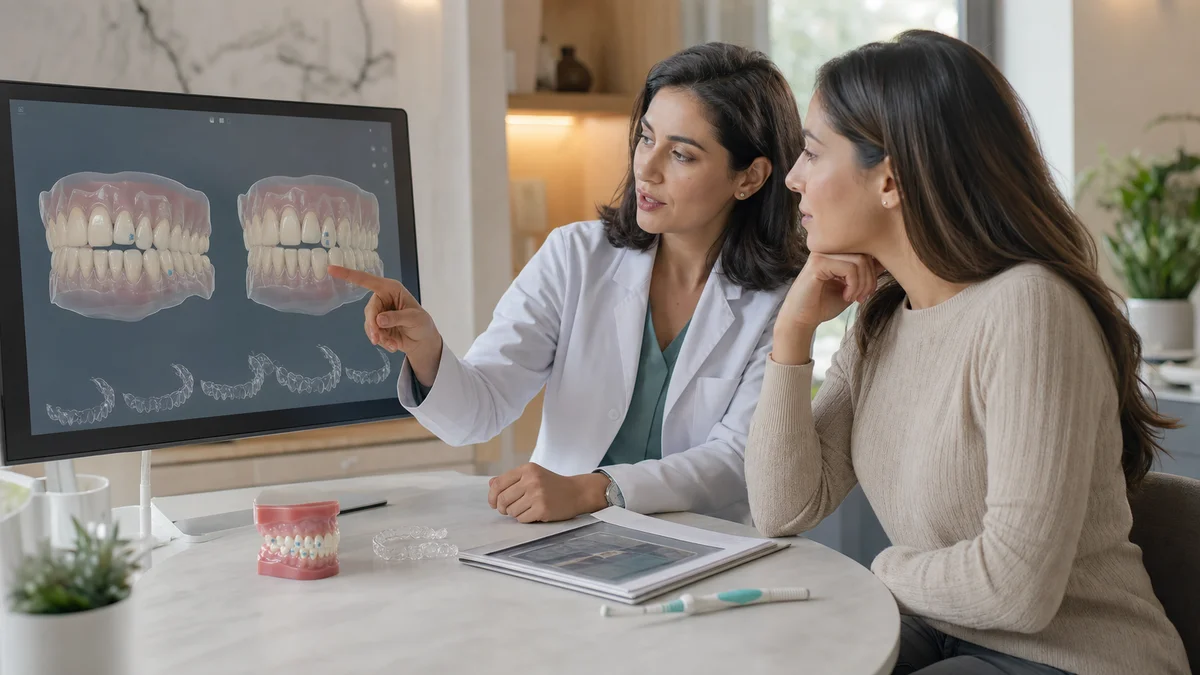
Quick answer: clear aligners success rate cannot be reduced to one reliable universal percentage. “Success” may mean completing treatment, improving alignment, achieving a specific tooth movement, producing a functional bite, avoiding complications or maintaining results after retainers. Outcomes depend on diagnosis, case complexity, clinician planning, appliance fit, prescribed wear, monitoring, refinements, oral health and retention. An individual prediction requires an appropriate clinical assessment.
A search for clear aligners success rate often leads to precise-looking numbers that measure different things. One study may calculate how closely a particular tooth movement matched a digital plan. Another may report whether patients completed treatment. A clinic may call the result successful when the front teeth look straighter, while a research team may require bite, overjet, overbite, root position and stability criteria. Those figures cannot be combined as if they describe the same endpoint.
Clear aligners are prescription orthodontic appliances that move teeth in staged increments. They can be effective in suitable cases, but not every movement is equally predictable and not every malocclusion is best treated with trays alone. A digital animation is a proposed path, not a guarantee that biology will reproduce every step. Refinement trays, attachments, elastics, interproximal reduction or a change of appliance may be part of responsible treatment rather than evidence that the entire course failed.
This guide explains how to interpret claims without inventing a universal statistic. It is educational, not a diagnosis or personal forecast. The expected outcome for one person depends on tooth and root health, gum and bone support, the bite, growth, restorations, missing teeth, habits, medical history, wear capacity and the exact movements required.
1. Why clear aligners success rate has no single answer
The denominator changes the result. A movement-accuracy study may analyze thousands of individual planned movements rather than whole patients. A treatment-completion report may count anyone who reaches the final prescribed tray, even if further finishing is needed. A patient-satisfaction survey measures experience, not necessarily root position or bite. A stability study asks whether the result remains after treatment and retention.
Time also matters. A smile may look improved after the initial series but need refinements to meet the final objective. A technically good result can relapse if retainers are not used. Conversely, a limited plan can be successful if the patient and clinician explicitly agreed to a modest, safe objective. A headline clear aligners success rate that omits endpoint, population and follow-up is therefore not clinically interpretable.
The FDA describes sequential aligners as prescription devices intended to move teeth progressively for orthodontic treatment of malocclusion. Its consumer information notes that aligners may not work for everyone and emphasizes prescribed wear, hygiene and retainers. Regulatory clearance supports an intended use; it does not supply a universal patient success percentage.
2. Define clear aligners success rate before comparing claims
A useful conversation starts by deciding what “success” means for the patient’s problem. Cosmetic alignment can be one goal, but orthodontics also considers function and health. Depending on the diagnosis, the plan may address crowding, spacing, rotations, overjet, overbite, crossbite, open bite, midlines, arch coordination or preparation for restorative treatment.
| Success dimension | What can be measured | What it does not prove alone | Useful follow-up point |
|---|---|---|---|
| Completion | Patient reaches the final active tray or agreed endpoint | Every planned movement or bite target was achieved | Final clinical examination |
| Movement accuracy | Observed position compared with a planned position | Whole-mouth function, health or stability | After initial series and refinements |
| Alignment | Reduction in crowding or spacing | Correct root torque, contacts or jaw relationship | At finishing records |
| Bite outcome | Overjet, overbite, contacts, crossbite and functional relationships | Long-term stability without retention | At delivery and settling reviews |
| Patient experience | Comfort, appearance, convenience and satisfaction | Biological safety or movement accuracy | Throughout care |
| Stability | Position maintained during a defined retention period | Teeth will never move later | Long-term retainer reviews |
When a provider quotes a clear aligners success rate, ask which row it represents, who was studied, how complex the cases were, whether refinements were included and how long outcomes were observed.
3. What current evidence says about clear aligners success rate
Recent systematic reviews support a cautious conclusion: clear aligners can be effective, especially for selected mild-to-moderate problems, but accuracy varies by movement and case, evidence is heterogeneous, and long-term stability data are limited. A 2024 review indexed by PubMed on accuracy and stability of clear aligner treatment included only a small group of eligible studies and highlighted variability and limited long-term follow-up.
Another 2024 systematic review of clear aligners versus fixed appliances concluded that aligners may be an effective alternative but that more research is needed. A 2025 review of deep-bite correction found that planned correction often exceeded achieved correction and rated the evidence low because of bias, indirectness and imprecision. These findings do not mean aligners never work; they mean one global clear aligners success rate would hide clinically important variation.
Research quality matters. Retrospective studies can be affected by case selection and incomplete records. Different software generations, materials, attachment protocols, clinicians and refinement policies make studies difficult to compare. Some samples exclude dropouts or complex cases. Manufacturer involvement and reporting choices can also influence interpretation. Readers should look beyond the abstract’s most favorable sentence.
4. Case selection shapes clear aligners success rate
A suitable appliance is chosen after diagnosis, not because a patient prefers nearly invisible trays. The American Association of Orthodontists says that some, but not all, orthodontic problems can be successfully treated with clear aligners. Its orthodontic FAQ explains that aligners are staged appliances and may use tooth-colored attachments to improve control.
Mild crowding or spacing may be different from severe rotations, large vertical corrections, major root movements, impacted teeth or skeletal jaw discrepancies. Extractions, missing teeth, short roots, compromised gum support, multiple restorations or active growth can add planning demands. Complexity does not automatically make aligners impossible, but it can change predictability, duration, auxiliaries and the probability of needing refinements or another appliance.
A meaningful individual clear aligners success rate forecast should therefore describe the specific objectives: which teeth need which movements, which goals are highly controllable, which are uncertain and which compromises are acceptable.
5. Diagnosis is the foundation of clear aligners success rate
A surface scan captures crowns and soft-tissue contours but cannot independently show root length, bone levels, impacted teeth, decay beneath restorations or periodontal attachment. The clinician decides which clinical tests and radiographs are justified. Gum health, tooth mobility, existing restorations, trauma history, missing teeth, jaw relationship and oral hygiene all matter before forces are prescribed.
The AAO adult orthodontics guidance emphasizes in-person examination and appropriate imaging because photographs and scans cannot reveal every root, bone or periodontal concern. The UK General Dental Council likewise states that there is currently no effective substitute for a physical clinical examination as the foundation for orthodontic suitability assessment in its direct-to-consumer orthodontics statement.
Untreated decay, active gum disease or inadequate plaque control should be managed first. A high advertised clear aligners success rate cannot compensate for an unsuitable biological foundation.
6. Movement type changes clear aligners success rate
Aligners do not move an entire tooth as a simple block. A crown may tip while the root lags. Rotation, extrusion, intrusion, torque, bodily movement and root uprighting place different demands on appliance shape, attachments, staging and anchorage. Tooth anatomy and available space also influence how well a tray can grip and deliver force.
Accuracy should therefore be reported movement by movement, not as a universal appliance property. A plan might align incisors well while falling short on a rotated rounded premolar or vertical bite correction. Attachments, elastics, overcorrection in software or auxiliary appliances may improve control, but they do not create certainty.
Ask the clinician to identify the movements most likely to determine your clear aligners success rate. Useful questions include whether root torque, extrusion, molar movement or bite opening is essential and how shortfalls would be detected and managed.
7. Tracking and appliance fit affect clear aligners success rate
Tracking means teeth are following the staged plan closely enough for the next tray to seat. Visible gaps, rocking, repeated attachment loss or an inability to seat a new aligner can indicate that observed movement has diverged. Causes can include insufficient wear, damaged trays, difficult movements, incomplete attachment engagement, unexpected biology or an inaccurate assumption in the plan.
Early detection matters. Advancing through poorly fitting trays can compound the difference. The treating team may extend wear, replace an attachment, adjust an auxiliary, rescan, order refinements or change the appliance. A responsible course treats tracking as a monitored clinical variable, not a patient’s private problem.
- Learn what a fully seated tray should look and feel like.
- Follow the prescribed change schedule rather than accelerating it.
- Store trays in their case and report loss, cracks or heat distortion.
- Check attachments as instructed and report repeated detachment.
- Contact the clinic before skipping forward or reversing several stages.
- Bring relevant trays to review appointments when requested.
Tracking is an intermediate measure, not the whole clear aligners success rate, but poor tracking can prevent later stages from expressing as planned.
8. Wear behavior influences clear aligners success rate
Clear aligners are removable, so the patient’s behavior is part of the delivery system. The prescribed daily wear and stage duration should come from the treating clinician. Frequently removing trays, forgetting them after meals or moving to the next stage early can reduce force consistency and increase tracking problems. Wearing a wrong or warped tray longer is not a safe substitute for advice.
Compliance data can also distort published outcomes. People who choose aligners may be unusually motivated, while those unable to maintain wear may drop out and disappear from final analyses. A study’s clear aligners success rate should be interpreted differently if it reports only completers.
Honest self-assessment is useful before treatment. Work patterns, school, eating frequency, travel, dexterity, memory and access to cleaning facilities can influence whether prescribed wear is realistic. Braces may be a more controllable option for some patients, while others value aligner removability and can manage it consistently.
9. Refinements are part of clear aligners success rate interpretation
A refinement is an additional planned series based on updated records. It may address movements that underexpressed, improve contacts, coordinate arches or finish aesthetic details. Refinements do not automatically mean treatment failed. They can demonstrate appropriate monitoring and willingness to adjust when biology differs from simulation.
However, a success claim should state whether it describes the first series or the final outcome after refinements. A system that reaches its endpoint after several additional series is different from one that reproduces the initial plan directly, even if both end acceptably. Treatment burden includes extra appointments, wear time and costs.
Before starting, ask how refinements affect the quoted fee, package expiry, expected duration and retainer timing. A transparent clear aligners success rate discussion includes the probability of additional stages without promising a fixed number.
10. Attachments, IPR and elastics can change clear aligners success rate
Attachments are composite shapes bonded to selected teeth to improve grip or force direction. Interproximal reduction, often called IPR, creates prescribed space by removing a small amount of enamel between teeth. Elastics, buttons and other auxiliaries can help control bite relationships. These may make treatment less “invisible” than marketing suggests, but they can be clinically important.
Success figures from a protocol using attachments, elastics and refinements should not be applied to a tray-only mail-order plan. The appliance name alone does not describe the full treatment system. The skill of diagnosis, staging, monitoring and adjustment also matters.
Ask which additions are planned, their purpose, alternatives, risks and fees. When comparing clear aligners success rate claims, confirm that the clinical protocol resembles the treatment you are being offered.
11. Bite and function belong in clear aligners success rate
Patients usually notice the front teeth first, but a complete outcome includes how upper and lower teeth meet. Overjet, overbite, crossbite, open bite, arch coordination and contact distribution can affect chewing and stability. A smile can look straighter while posterior contacts remain incomplete or a tooth hits prematurely.
Clear plastic covers the biting surfaces during wear and can change how contacts feel. Some settling may occur after active treatment, but significant or worsening bite changes need review. The final assessment should occur in the mouth, not only on a digital setup.
A patient-focused clear aligners success rate should specify whether functional bite goals were included, which compromises were accepted and how the opposing arch was evaluated. Cosmetic improvement alone may be an appropriate limited goal only when the clinician confirms that it does not create an unsafe functional result.
12. Oral health is part of clear aligners success rate
A treatment that straightens teeth but contributes to uncontrolled decay, gum inflammation, recession or root damage is not a complete success. Removable trays can support brushing and flossing, yet replacing a tray over plaque, sugar or acidic drink residue can trap a harmful environment against enamel. Periodontal health must be monitored when teeth move through supporting bone.
The NHS says orthodontic outcomes depend on caring for teeth and gums, wearing appliances as instructed and following professional advice. Its orthodontic treatment guidance also emphasizes retainers. Oral-health endpoints should therefore accompany any clear aligners success rate figure.
- Address active disease and establish workable hygiene before treatment.
- Remove trays for eating and for drinks other than plain water unless instructed otherwise.
- Brush with fluoride toothpaste and clean between teeth consistently.
- Clean trays using the recommended method without hot water.
- Continue routine examinations and professional hygiene care.
- Report bleeding, swelling, recession, mobility, persistent pain or enamel changes early.
13. Treatment duration does not equal clear aligners success rate
Shorter is not automatically better. Duration depends on starting complexity, biological response, stage design, prescribed wear, appointment timing, missed visits, refinements and the final quality standard. A limited cosmetic plan can finish faster than comprehensive bite correction because it has different objectives.
Marketing timelines may describe an initial tray count rather than the full pathway through refinements and retention. A delay can reflect poor wear or tracking, but it can also reflect cautious staging, healing after another procedure or a decision to improve finishing. Speed must not be pursued by increasing force or advancing trays without approval.
When reviewing clear aligners success rate, separate effectiveness from efficiency. Effectiveness asks whether the goal was achieved; efficiency asks what time and resources were required.
14. Clear aligners success rate versus braces
Clear aligners and fixed appliances are tools with different control, hygiene, visibility and cooperation profiles. Braces do not depend on the patient remembering to wear them, while aligners can be removed for cleaning and eating. Certain movements or complex bites may be controlled more predictably with fixed appliances or a combined approach. Other suitable cases may be treated effectively with aligners.
Systematic reviews comparing modalities often combine different populations, objectives and protocols. A finding that aligners and braces produce similar results for selected cases should not be stretched to every severe malocclusion. Nor does one difficult movement prove braces are always superior.
The relevant comparison is not a brand-wide clear aligners success rate against a brand-wide braces rate. It is which appliance and clinician-controlled strategy best match the individual diagnosis, movements, health and capacity for cooperation.
15. Remote monitoring and clear aligners success rate
Remote tools can help share photographs, wear data or fit observations, but they do not eliminate the need for an identified prescribing clinician and access to direct assessment. Gum probing, tooth mobility, attachment integrity, certain bite relationships and root or bone concerns may require in-person examination and appropriate imaging.
The GDC says remote care can provide benefits but that some parts of orthodontic care require physical assessment, direct professional interaction and valid consent. A direct-to-consumer service should therefore not use a generic clear aligners success rate to substitute for diagnosis or access to a responsible dentist.
Before enrolling, confirm the clinician’s name and registration, how to ask clinical questions, the schedule and purpose of reviews, where an in-person examination occurs, who handles emergencies and what happens if trays do not track. Customer support is not the same as clinical oversight.
16. Retention determines long-term clear aligners success rate
Teeth naturally tend to move after active orthodontics. Bone and gum tissues adapt, growth and aging continue, and the forces that influenced the original positions remain. Retainers help limit relapse but require long-term wear, cleaning, review and replacement when damaged or no longer fitting.
A study that measures outcome immediately at the last tray answers a different question from one that evaluates stability years later. Limited long-term data are one reason a lifetime clear aligners success rate cannot be stated reliably.
Discuss retention before paying for active treatment. Ask whether removable, fixed or combined retainers are recommended; when they will be delivered; how often they should be worn; what reviews and replacements cost; and what to do if movement occurs. Retention is part of orthodontic treatment, not an optional warranty.
How to evaluate a clear aligners success rate claim
Use a structured evidence check rather than accepting the largest number:
- Endpoint: Was success alignment, movement accuracy, completion, satisfaction, bite quality or stability?
- Population: Were cases mild, moderate, complex, growing, adult, extraction or non-extraction?
- Unit: Did the percentage refer to patients, teeth, movements or planned millimeters?
- Protocol: Were attachments, IPR, elastics, refinements or braces included?
- Comparator: Was there an appropriate braces or untreated comparison group?
- Follow-up: Was outcome measured after the first series, final refinement or retention?
- Missing data: Were dropouts and non-compliant patients included?
- Evidence quality: Was the study prospective, blinded where possible and independently funded?
If several answers are absent, the clear aligners success rate may be a marketing simplification rather than a useful clinical estimate.
Personal factors that influence clear aligners success rate
Individual response is not fully predictable, but planning can identify important influences. Teeth with unusual root form, prior trauma or reduced periodontal support may need additional caution. Crowns, veneers, bridges and implants change attachment bonding and movement options. Grinding, tongue posture, missing teeth, eruption and jaw growth can affect goals or retention.
Daily behavior also matters:
- ability to wear trays for the prescribed schedule;
- oral hygiene and frequency of sugar or acidic drinks;
- attendance and early reporting of fit problems;
- care of trays and attachments;
- use of elastics or other auxiliaries as directed;
- commitment to long-term retainers.
These factors do not justify blaming a patient for every shortfall. Treatment design and biological variability also contribute. A realistic clear aligners success rate conversation divides responsibilities clearly between patient, clinician and appliance.
Questions to ask before accepting a success prediction
Bring your goals, dental history and concerns to the consultation. Ask the clinician to show the diagnosis, not only the final animation. Useful questions include:
- What exact problems are being treated, and which are left unchanged?
- Which movements are most and least predictable in my plan?
- Are my roots, gums, bone and restorations suitable for these movements?
- Would braces or a combined approach improve control?
- Will I need attachments, IPR, elastics, extractions or other procedures?
- How will tracking, bite, gums and roots be monitored?
- What does the digital simulation show, and what does it not prove?
- How often do comparable plans require refinements, without promising a fixed figure?
- What is included if treatment takes longer or the appliance changes?
- What retention and long-term review are planned?
Patients can review general orthodontic information on the Redent Klinik English website and request an individualized assessment through the Redent Klinik contact page. Remote records can support an initial discussion, but a personal clear aligners success rate prediction requires appropriate clinical evaluation.
Frequently asked questions about clear aligners success rate
What is the average clear aligners success rate?
There is no single scientifically valid average that applies to all patients, movements, products and definitions of success. Studies may measure movement accuracy, completion, bite correction, satisfaction or stability in different populations. Ask what outcome a quoted percentage represents, whether refinements were included and how long the patients were followed. A case-specific estimate should follow diagnosis.
Does clear aligners success rate mean every planned movement occurs?
No. Digital staging is a prescription and simulation, not a guarantee. Some movements express more predictably than others, and teeth can diverge from the plan. Attachments, elastics, extended wear, rescanning or refinement trays may be needed. The final result should be assessed clinically for alignment, root and gum health, bite, function and stability rather than judged by animation alone.
Is clear aligners success rate higher for mild crowding?
Selected mild problems are often more straightforward than severe rotations, major vertical correction, extraction space closure or skeletal discrepancies, but “mild” does not ensure success. Root position, gum support, tooth shape, bite, restorations and wear still matter. The relevant question is whether the exact movements and objectives fit an aligner protocol and can be monitored safely.
Do refinements lower clear aligners success rate?
Not automatically. Refinements are additional trays made from updated records to improve movements or finishing. They may represent responsible adaptation to biological variability. However, studies and price quotes should disclose whether their outcome was achieved after the initial series or after multiple refinements because time, appointments and treatment burden differ.
How does wear time affect clear aligners success rate?
Aligners rely on prescribed wear to deliver staged forces. Repeated under-wear can contribute to poor tracking and delays, while changing trays early is not a safe way to accelerate care. Follow the treating clinician’s schedule and contact the clinic after an interruption. Published results among highly compliant completers may not predict outcomes for someone unable to maintain wear.
Does clear aligners success rate include long-term stability?
Often it does not. Many reports measure positions at the end of active treatment, while stability requires later follow-up. Teeth can move throughout life, and retainers reduce but cannot eliminate change. Ask when the outcome was measured and whether retainer use, replacement and relapse were included before interpreting a percentage as long-term success.
Is clear aligners success rate better than braces?
Neither appliance has one universal rate. Comparative evidence depends on the malocclusion, movements, protocol, clinician, patient behavior and endpoint. Aligners may be effective for suitable cases and easier to remove for cleaning, while fixed appliances can offer different control and do not depend on daily wear. The appropriate comparison is case-specific, not brand-wide.
Can online scans predict clear aligners success rate?
A surface scan can support digital planning but cannot independently assess roots, bone, periodontal attachment, decay under restorations, mobility or every jaw relationship. It also cannot predict biological response perfectly. Clinical examination, appropriate imaging and ongoing monitoring are needed. A simulation should be explained as a plan, not a guaranteed probability.
What lowers clear aligners success rate?
Important factors can include unsuitable case selection, active disease, difficult movement types, inadequate wear, damaged or poorly fitting trays, lost attachments, missed monitoring, incomplete use of auxiliaries and lack of retention. Biology and treatment design also matter, so a shortfall should not automatically be blamed on the patient. Early reassessment can limit compounding errors.
Can a dentist guarantee my clear aligners success rate?
No ethical treatment can guarantee a personal percentage or permanent outcome. A clinician can explain the diagnosis, evidence, expected benefits, limitations, alternatives and contingency plan. Individual biology, cooperation and future changes create uncertainty. Be cautious of promises based only on photos, a scan animation or a limited-time sales package.
Final perspective on clear aligners success rate
The most honest answer is not a single percentage. Clear aligners success rate depends on what is measured, who is treated, which movements are attempted, how care is delivered and when outcome is assessed. Suitable aligner treatment can be effective, but movement accuracy varies and refinements or another appliance may be appropriate.
Define success before treatment: healthy tissues, realistic alignment and bite goals, manageable wear, accessible monitoring, transparent costs and a long-term retention plan. Ask for a diagnosis-based estimate rather than a marketing average. The goal is a safe, functional and maintainable result—not merely reaching the last numbered tray.
Sources
- US Food and Drug Administration: Braces and clear aligners
- FDA 510(k) summary: Invisalign System intended use and device description
- American Association of Orthodontists: Clear aligner FAQ
- General Dental Council: Direct-to-consumer orthodontics
- NHS: Orthodontic treatments and retainers
- PubMed: Accuracy and stability of clear aligner treatment
- PubMed: Clear aligners versus fixed appliances for movement control
- PubMed: Effectiveness and accuracy of clear aligners for deep bite
- American Dental Association
- World Health Organization: Oral health fact sheet