
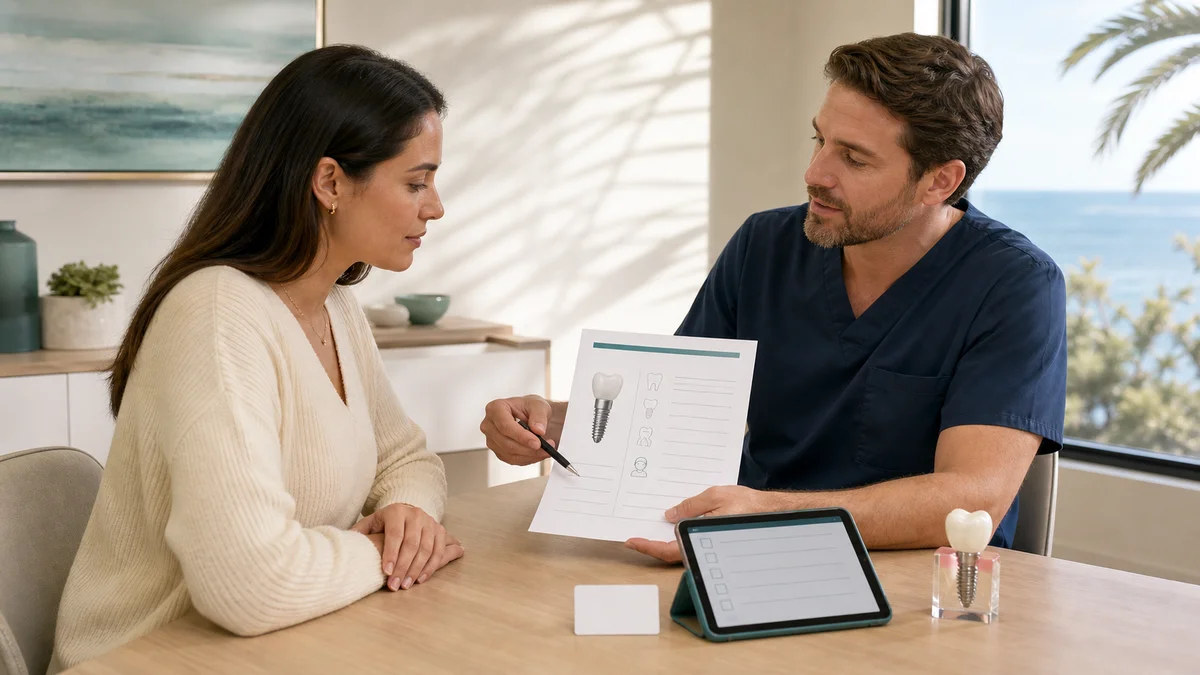
Quick answer: California lists dental implants among Medi-Cal benefits, but that does not mean routine implant replacement is automatically covered. Current Medi-Cal Dental criteria require documented exceptional medical conditions, a medical-necessity review and prior authorization. Eligibility, provider participation, exact procedures and supporting records must all be verified before treatment begins.
People searching medi cal cover dental implants often want a simple yes or no. The accurate answer is more specific: the California Department of Health Care Services (DHCS) lists dental implants as a Medi-Cal benefit, while the current Medi-Cal Dental Manual of Criteria limits implant services to cases involving documented exceptional medical conditions and requires prior authorization. A missing tooth alone should not be assumed to meet that standard.
This guide interprets the unhyphenated search phrase medi cal cover dental implants as a question about California’s Medi-Cal Dental program. It explains the official 2026 rules in patient-friendly language. It does not determine anyone’s eligibility, diagnose a condition, authorize treatment or promise payment. A participating provider and Medi-Cal must evaluate the individual case.
Implant care is not one billable event. The plan may include examination, radiographs or scans, extraction, grafting, an implant body, an abutment, a crown or denture, anesthesia, postoperative care and maintenance. The fact that one procedure is a benefit does not automatically make every related component payable. The safest approach is to verify eligibility, clinical suitability, documentation, codes and authorization separately.
1. Does medi cal cover dental implants in California?
DHCS’s public benefits page includes “dental implants” under dental benefits for adults, children, older adults and people with disabilities. That broad list is useful, but it is only the first layer of a medi cal cover dental implants review. DHCS also tells members to ask their clinician or plan whether Medi-Cal covers a particular service.
The controlling clinical detail appears in the Medi-Cal Dental Provider Handbook’s Manual of Criteria. Its implant-services policy says implant services are a benefit only when exceptional medical conditions are documented, are reviewed for medical necessity and receive prior authorization. The current CDT-26 criteria apply to dates of service on or after July 1, 2026.
Therefore, in a medi cal cover dental implants check, “implants appear on the benefit page” and “my proposed implant has been authorized” are not equivalent statements. Coverage is conditional. The member must be eligible for the relevant dental benefit on the date of service, the provider must follow the applicable delivery-system process, and the request must satisfy current program criteria.
2. Why the phrase medi cal cover dental implants can mislead
The proper program name is Medi-Cal, with a hyphen. The focus phrase medi cal cover dental implants is how some people type the question into a search engine. It is not a formal benefit category, authorization status or clinical diagnosis. Search results that remove the policy conditions can create false confidence.
“Cover” can also mean several things: a service may be listed as a potential benefit, accepted for prior-authorization review, approved for a specific member, or paid after a compliant claim. Each stage can have a different result. An approval for the implant body may not describe the final prosthesis, and an approved treatment authorization does not replace eligibility verification at the time care is delivered.
A reliable medi cal cover dental implants answer names the current policy, the member’s aid code and dental delivery system, the precise requested procedures, the exceptional medical condition, the documentation, the treating provider and the authorization decision. General statements cannot substitute for that file.
3. The medi cal cover dental implants decision table
Use this table to organize the decision. It is a checklist, not a coverage guarantee.
| Decision gate | What the official rules indicate | What to verify |
|---|---|---|
| Benefit listing | DHCS publicly lists dental implants among Medi-Cal dental benefits. | Do not stop at the summary page; review current implant criteria. |
| Eligibility | The member must have the dental scope that applies on the date of service. | Ask the provider to verify the current aid code and eligibility. |
| Clinical threshold | Implant services are limited to documented exceptional medical conditions and reviewed for medical necessity. | Which exceptional condition and functional limitation does the record support? |
| Prior authorization | Implant placement under D6010 requires prior authorization. | Was a complete request submitted, and what did the written notice approve? |
| Procedure components | Some components refer back to D6010 criteria; others are expressly not benefits or are bundled. | How is every proposed item described and coded under the current manual? |
| Provider and delivery system | Members may receive dental care through fee-for-service or dental managed care, depending on program arrangements. | Is the provider enrolled, participating and following the correct process? |
| Payment and review | Authorization and eligibility support payment but do not excuse a noncompliant claim. | Keep the authorization, treatment plan, notices and appeal instructions. |
4. Exceptional medical conditions are the central coverage test
The current Manual of Criteria gives examples of exceptional medical conditions for implant services. The list is introduced as including, but not limited to, the examples below. That means an unlisted condition is not necessarily impossible, but it must still be documented and reviewed. It also means an example cannot be self-applied without a clinical record.
The policy examples include:
- oral-cavity cancer requiring ablative surgery and/or radiation that destroys alveolar bone so the remaining bone cannot support a conventional dental prosthesis;
- severe atrophy of the mandible and/or maxilla that cannot be corrected with specified extension or augmentation procedures, when the patient cannot function with conventional prostheses;
- skeletal deformities that prevent the use of conventional prostheses, with examples such as ectodermal dysplasia, partial anodontia and cleidocranial dysplasia; and
- traumatic destruction of the jaw, face or head when the remaining bone cannot support conventional dental prostheses.
These are serious, case-specific circumstances. A medi cal cover dental implants request should explain why a conventional prosthesis cannot provide function in the documented situation. The medi cal cover dental implants narrative should not merely say that an implant is preferable, more comfortable or aesthetically desirable.
5. Routine tooth replacement is not automatically an exceptional condition
Many people have missing teeth because of decay, periodontal disease, fracture or earlier extraction. Those conditions can cause real functional and quality-of-life concerns, yet the implant-services policy still requires the exceptional-condition and medical-necessity review. A dentist’s general recommendation does not itself establish program coverage.
For a sound medi cal cover dental implants file, the provider should document the actual anatomy, disease history, functional limitation and alternatives considered. If a conventional removable or fixed prosthesis is feasible, the program may evaluate that alternative under its rules. Patients deserve a clinical explanation of all reasonable options regardless of which option the program may authorize.
Never ask a dental office to change a diagnosis, omit an alternative or exaggerate a condition to obtain medi cal cover dental implants approval. Records and codes must reflect the care actually evaluated and delivered. Improper coding can lead to denial, repayment obligations and fraud concerns.
6. Prior authorization is required before implant placement
The current criteria for D6010, surgical placement of an endosteal implant body, state that prior authorization is required. DHCS explains that prior authorization is a provider-submitted request used for certain medical, pharmacy and dental services. The provider knows how and when to submit it and can check its status.
A medi cal cover dental implants conversation should occur before irreversible treatment or a self-pay commitment. Ask whether the provider has submitted the implant request, what services were included, whether Medi-Cal asked for more information and whether the written determination has arrived. “We usually get approval” is not the same as an authorization for the member’s case.
A medi cal cover dental implants prior authorization evaluates the information submitted at that time. Eligibility, the authorized scope, dates, provider participation and claim accuracy still matter. A clinical treatment plan can also change after examination or surgery, so any new component may need separate review.
7. What documentation supports medi cal cover dental implants?
For D6010, the current Manual of Criteria calls for arch and preoperative periapical and/or panoramic radiographs as applicable, photographs as applicable, and written documentation. The narrative should describe the condition addressed, the medical-necessity rationale, pertinent history and proposed treatment. A tooth or arch code is required as appropriate.
The general implant policy also tells providers to submit complete case documentation needed to demonstrate medical necessity. Examples include radiographs, scans, operative reports, craniofacial panel reports, diagnostic casts, intraoral and extraoral photographs, and tracings. The appropriate set depends on the condition; not every file requires every item.
A patient can help a medi cal cover dental implants review by making relevant medical and dental records available through secure channels and by giving a complete history. The clinical team, not the patient, should decide which records are pertinent. Copying an unrelated approval letter or generic medical-necessity template can weaken rather than strengthen a request.
8. The implant body, abutment and final tooth are separate items
The FDA describes a dental implant system as an implant body placed in the jaw and an abutment that supports an artificial tooth such as a crown, bridge or denture. Insurance rules likewise evaluate distinct procedures. An answer about the fixture does not necessarily answer whether the abutment or final prosthesis is included.
The current Medi-Cal manual directs many medi cal cover dental implants components back to the D6010 criteria. It also identifies some procedures as not benefits and treats some services as included in another fee rather than separately payable. Examples can change as procedure terminology changes, so patients should not build a plan from an old code list.
Ask for an itemized medi cal cover dental implants plan that separates:
- examination, radiographs and any three-dimensional imaging;
- extraction or management of active disease;
- grafting or other site-development procedures if clinically indicated;
- the implant body and surgical stages;
- the abutment, connecting components and provisional work;
- the final crown, bridge or implant-supported removable prosthesis;
- sedation, anesthesia or facility services when applicable; and
- postoperative care, hygiene and long-term maintenance.
Some patients will not need every item. The list demonstrates why “Medi-Cal covers implants” is not an adequate financial estimate.
9. Eligibility and aid code must be current on the service date
Medi-Cal eligibility can change with renewal, age, pregnancy status, household circumstances and program rules. A Benefits Identification Card alone does not prove that a particular dental scope is active for a future date. Providers have official methods to verify eligibility, and members can contact Medi-Cal Dental for help.
For medi cal cover dental implants, ask the provider to verify eligibility before the authorization request and again before treatment. Determine whether the member is in full-scope coverage, restricted-scope coverage or another arrangement. Also confirm whether a Share of Cost applies.
Do not delay urgent care for severe pain, swelling, uncontrolled bleeding or suspected infection while trying to arrange a medi cal cover dental implants review. Emergency assessment and the later implant plan are different clinical and benefit questions.
10. Current 2026 Medi-Cal Dental eligibility changes
Coverage information must reflect the date. As of August 2026, DHCS says the scheduled end of regular dental benefits for certain adults based on immigration status has been delayed to July 1, 2027. DHCS’s FAQ also distinguishes adults who applied before January 1, 2026 from those applying on or after that date. The effect depends on immigration status, pregnancy or postpartum status, age and foster-care history.
DHCS states that children under 19, people designated as pregnant or within one year postpartum, and qualifying foster or former foster youth under 26 retain dental protections described on the benefit-change page. Affected adults who have emergency-only coverage may still receive defined emergency dental services, but a routine medi cal cover dental implants reconstruction should not be assumed to be an emergency benefit.
Because these rules are time-sensitive, a medi cal cover dental implants article cannot replace real-time eligibility verification. Check the current DHCS notice, member aid code and program information close to the proposed service date.
11. Fee-for-service and dental managed care can use different routes
Medi-Cal Dental care can be delivered through fee-for-service or through a Dental Managed Care plan in the counties and populations where that arrangement applies. The underlying benefit rules matter in both settings, but provider directories, authorization channels, notices, complaints and appeal steps can differ.
Ask whether the member’s medi cal cover dental implants request belongs with Medi-Cal Dental fee-for-service or a specific dental plan. Verify that the general dentist, implant clinician, prosthetic provider and any facility are enrolled or participating as required. A provider listed in a directory may not currently accept new patients, so call the office and the program.
If the member seeking medi cal cover dental implants has other dental insurance, Medi-Cal is generally secondary to other available coverage. Give the provider accurate insurance information and ask how coordination of benefits will work before treatment.
12. Finding a participating implant provider
The official Medi-Cal Dental provider directory can identify offices that may be accepting new patients, but the directory warns that availability is not guaranteed. Some general dentists do not provide advanced implant services, and a specialist may accept Medi-Cal for some services but not be available for the requested case.
For a medi cal cover dental implants referral, ask whether the office:
- is currently enrolled in the correct Medi-Cal Dental delivery system;
- is accepting new members and performs the proposed implant service;
- will submit the prior-authorization request and requested records;
- can coordinate with the member’s medical or craniofacial team when necessary;
- provides the restorative phase or works with another participating provider; and
- offers needed language, accessibility or care-coordination support.
The Medi-Cal Dental Telephone Service Center can help locate a medi cal cover dental implants provider and answer questions about a Treatment Authorization Request. Interpreter services and care coordination may also be available.
13. Clinical suitability is separate from Medi-Cal approval
Authorization is an administrative coverage decision; it is not proof that surgery is safe or likely to succeed for an individual. The FDA advises patients to discuss benefits, risks and candidacy with a dental provider. Overall health influences candidacy, healing and how long an implant may remain functional.
A clinical medi cal cover dental implants assessment may examine gum health, bone volume, bite, neighboring teeth and anatomical structures. Smoking, uncontrolled diabetes, untreated periodontal disease and some medicines can affect risk or healing. The dental provider may need to coordinate with a physician.
Patients should not stop anticoagulants, antiresorptive medicines or any prescribed treatment for a medi cal cover dental implants plan on their own. The prescriber and dentist should give individualized instructions. Possible implant complications include infection, injury to surrounding tissue or structures, altered sensation, mechanical problems and implant failure. No insurer or clinic can guarantee a biological result.
14. Alternatives must be discussed honestly
The Medi-Cal implant criteria repeatedly focus on whether conventional prostheses can provide function in exceptional conditions. That makes the alternatives discussion clinically and administratively important. Depending on the mouth, reasonable options may include no immediate replacement, a removable partial or complete denture, a tooth-supported bridge, or a different implant-supported design.
In a medi cal cover dental implants decision, an alternative is not automatically inferior, and an implant is not automatically best. Each option has different requirements for tooth preparation, surgery, hygiene, repair and maintenance. The dentist should explain expected benefits, material limitations, risks and follow-up without pressuring the patient.
For medi cal cover dental implants, the written record should accurately explain why conventional prostheses cannot provide function when that is the basis of the request. Preference alone should not be relabeled as medical necessity.
15. Cost rules: covered service, Share of Cost and self-pay
The Medi-Cal Dental Member Handbook says a provider may not charge a copayment for covered services and generally may not bill a member for a Medi-Cal-covered service, except to collect an applicable Share of Cost. A provider may charge for a service the member chooses that is not covered, so the distinction must be clear before consent.
Before signing a self-pay agreement related to medi cal cover dental implants, request a written or electronic treatment plan. Ask which services are covered, denied, pending or not requested; which medically necessary covered alternative exists; and why the office is asking for payment. Do not rely on a single package total.
If a member receives a medi cal cover dental implants bill for what appears to be a covered service, contact the office and the Medi-Cal Dental Telephone Service Center. Keep eligibility proof, authorization notices, the treatment plan, receipts and an itemized statement. This guide does not determine whether a particular charge is lawful.
16. What to do after a denial or modification
A denial can result from an ineligible benefit scope, failure to meet implant criteria, incomplete documentation, a nonparticipating provider, an omitted authorization, a nonbenefit procedure or another reason. Read the Notice of Medi-Cal Dental Action or plan notice carefully. The reason determines the next useful step.
If medi cal cover dental implants records were missing, the provider may be able to request reevaluation with additional documentation. If a clinically acceptable covered alternative exists, discuss it. If the patient and provider disagree with the decision and no suitable alternative is available, formal review rights may apply.
The fee-for-service Member Handbook describes a State Hearing request within 90 days of the notice. DHCS’s general help page describes a managed-care appeal within 60 days of the plan’s notice, followed by a possible State Fair Hearing under the stated timeline. Follow the instructions on the member’s actual notice because the correct route depends on the delivery system and decision.
A medi cal cover dental implants appeal should address the cited reason with accurate case-specific evidence. It should not simply repeat that implants are listed as a benefit.
17. Treatment outside California or the United States
Medi-Cal Dental is a California program with enrolled-provider and location rules. For medi cal cover dental implants, the Member Handbook says prior approval is required for out-of-state services other than emergencies and that dental services outside the country are generally not covered, except specified emergency hospitalization circumstances in Canada or Mexico.
Therefore, someone considering implant treatment in Türkiye should not assume that a medi cal cover dental implants authorization can be used there. Planned overseas implant care, travel insurance and emergency coverage are different concepts. Obtain program guidance before travel and plan for records, postoperative monitoring and management of complications.
Redent Klinik can provide an individualized dental assessment and itemized proposed treatment, but it cannot determine or promise Medi-Cal payment. Patients can review the Redent Klinik English website and use the Redent Klinik contact page to ask what clinical records are needed for a consultation.
A practical medi cal cover dental implants checklist
Before scheduling medi cal cover dental implants treatment, confirm each point below:
- Your current Medi-Cal dental eligibility and aid code were verified.
- You know whether care runs through fee-for-service or dental managed care.
- The provider is enrolled, participating and accepting the case.
- A clinical examination and appropriate imaging support the proposed treatment.
- The record identifies the exceptional medical condition and functional problem.
- Conventional prosthetic and other reasonable alternatives were discussed.
- Every implant, abutment, prosthetic, imaging, grafting and anesthesia component is itemized.
- The provider used the current Manual of Criteria for the planned service date.
- The complete prior-authorization request was submitted before treatment.
- You received and understood the written authorization, modification or denial.
- Any Share of Cost or noncovered self-pay item is explained in writing.
- You understand risks, healing, maintenance and where follow-up care will occur.
Red flags include guaranteed approval, guaranteed clinical success, pressure to pay before the benefit status is clear, a plan with no component breakdown, or a request to misstate a diagnosis. Pause and ask the program or another qualified provider for clarification.
Frequently asked questions about medi cal cover dental implants
Does medi cal cover dental implants for any missing tooth?
No. Although DHCS lists implants as a dental benefit, the current implant criteria require a documented exceptional medical condition, medical-necessity review and prior authorization. Ordinary tooth loss should not be assumed to qualify. A provider must assess the individual condition and alternatives.
Which exceptional medical conditions can qualify?
The current manual gives nonexclusive examples involving destructive oral-cancer treatment, severe jaw atrophy that cannot be corrected as described, skeletal deformities that prevent conventional prostheses, and traumatic destruction where remaining bone cannot support a conventional prosthesis. An example still requires case-specific proof.
Is prior authorization required for the implant body?
Yes. The current D6010 criteria require prior authorization. The provider submits clinical records, imaging and a written medical-necessity rationale. Patients should ask what was requested and keep the written decision before treatment begins.
Does approval of D6010 include the abutment and crown?
Not automatically. Implant placement, abutments, crowns, bridges, dentures and related surgical services are separate procedures. Some refer back to D6010 criteria, some are bundled and some are not benefits. The provider should verify every current code and component.
Can a dentist charge me for a denied implant?
A provider may charge for a service a member knowingly chooses that is not covered, while covered services generally cannot be billed to the member except for an applicable Share of Cost. Obtain the decision and a written treatment plan before signing a self-pay agreement, and contact Medi-Cal Dental with billing questions.
Do 2026 immigration-status changes affect dental implants?
They can affect the dental benefit scope for some adults. DHCS says the scheduled end of regular dental benefits for certain previously enrolled adults was delayed to July 1, 2027, while its FAQ distinguishes some new applicants from January 1, 2026. Verify the member’s current eligibility rather than relying on a general summary.
Can emergency-only Medi-Cal pay for a planned implant?
Emergency dental benefits address care needed immediately for severe pain or sudden serious problems. Planned implant reconstruction should not be assumed to qualify as emergency care. Acute infection, swelling, bleeding or trauma requires prompt clinical assessment independent of the later replacement plan.
How do I find a Medi-Cal implant dentist?
Use the official Medi-Cal Dental provider directory and call offices to confirm current enrollment, availability and implant services. The Telephone Service Center can help locate a provider and may assist with care coordination, language services and Treatment Authorization Request questions.
Can I appeal a medi cal cover dental implants denial?
Review rights may apply. The route and deadline depend on whether the decision came through fee-for-service or a dental managed-care plan. Read the notice, discuss alternatives and documentation with the provider, and follow the notice’s reevaluation, appeal or State Hearing instructions promptly.
Does Medi-Cal cover implant treatment in Türkiye?
Planned dental services outside the country are generally not covered by Medi-Cal Dental. The Member Handbook describes a narrow exception for emergency services requiring hospitalization in Canada or Mexico. Do not assume an authorization transfers to an overseas clinic.
Final answer: coverage is possible but tightly conditional
The clearest response to medi cal cover dental implants is: implants appear in California’s benefit summary, but the current program criteria make coverage exceptional rather than routine. The file needs an eligible member, a participating provider, a documented exceptional medical condition, a medically necessary and itemized plan, complete records and prior authorization.
Verify the current rules close to treatment because eligibility and procedure criteria can change. Clinical suitability must be decided separately through examination, imaging, medical-history review and informed consent. This educational guide cannot replace advice from Medi-Cal Dental, the member’s plan, a licensed dentist or the relevant medical team.
Official and clinical sources
- California DHCS: Medi-Cal Benefits
- Medi-Cal Dental: Current Manual of Criteria and Schedule of Maximum Allowances
- Medi-Cal Dental Provider Handbook, Section 5: Implant Services Criteria
- California DHCS: Medi-Cal Dental Benefit Changes
- California DHCS: Medi-Cal Dental Member Handbook
- Medicaid.gov: Dental Care
- U.S. Food and Drug Administration: Dental Implants—What You Should Know
- American Dental Association: Professional oral-health resources
- World Health Organization: Oral health fact sheet