
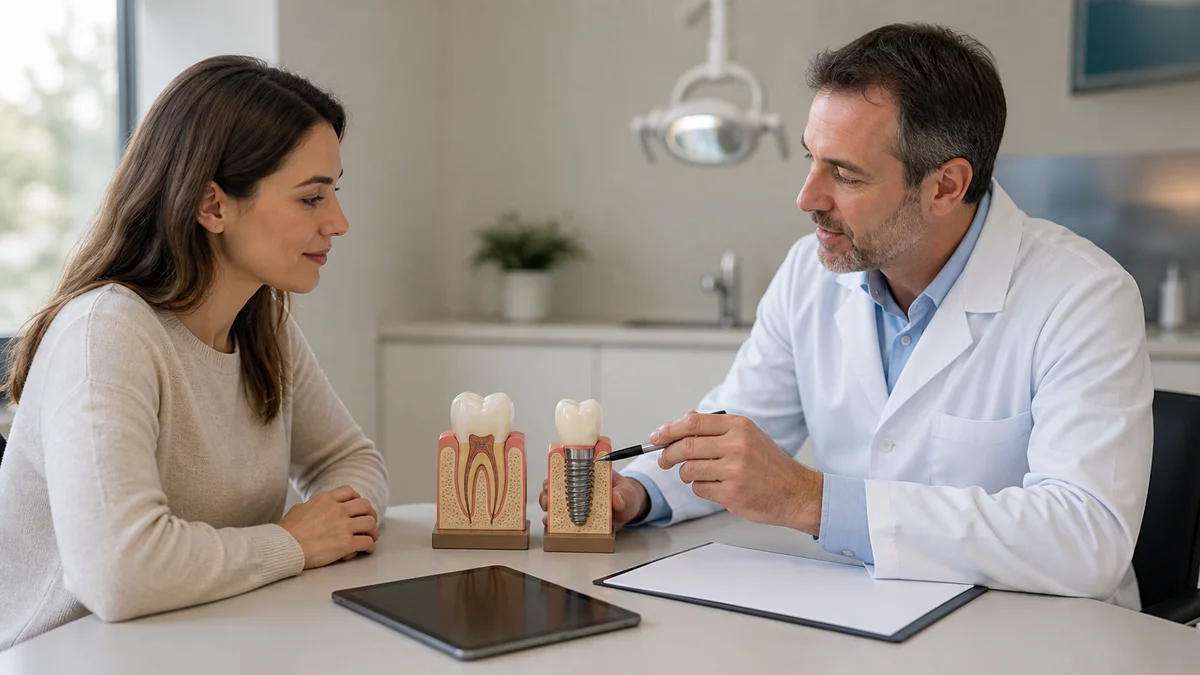
Quick answer: A fair root canal and crown vs implant cost comparison must include every stage, not one headline fee. Preserving a restorable tooth may require root canal treatment, a build-up and a crown; replacing a non-restorable tooth may involve extraction, grafting, implant placement, healing, an abutment and a crown. Examination and imaging determine which pathway is clinically reasonable.
People who search root canal and crown vs implant cost are rarely comparing two simple products. They are comparing two treatment pathways with different biological starting points. One pathway treats infection or inflammation inside a tooth, then restores the remaining tooth. The other removes a tooth that cannot predictably be retained and replaces it with an implant-supported restoration. The cheaper-looking line item can stop being the lower total once diagnostics, temporary restorations, surgical needs, laboratory work and follow-up are included.
This guide explains how to build a like-for-like estimate without publishing a fixed price that may be wrong for your tooth, region or insurance contract. It also keeps the clinical question in the foreground: is the tooth restorable, does it have adequate periodontal support, is there a crack or fracture, and is implant surgery suitable for your health and available bone? A root canal and crown vs implant cost decision should follow those findings—not replace them.
Root canal treatment does not make every tooth salvageable, and an implant is not a guaranteed lifetime device. Both options can be excellent in appropriately selected cases; both can develop complications. The safest way to compare them is to ask for written, itemised plans after an examination and appropriate radiographs. When the prognosis is uncertain, an endodontic, restorative or surgical opinion can clarify what each route would actually involve.
Keep the phrase root canal and crown vs implant cost attached to a complete clinical pathway throughout the discussion. Otherwise, similar-looking totals may describe very different endpoints.
1. What a root canal and crown vs implant cost comparison really measures
A reliable root canal and crown vs implant cost comparison measures complete care from diagnosis to a functioning final restoration. It should also distinguish an expected component from a contingency. For example, a core build-up may be expected after root canal treatment, while retreatment is a possible future event rather than an automatic charge. Bone grafting may be necessary for one implant site but unnecessary for another.
The comparison should answer three separate questions. First, what is clinically feasible? Second, what services are included now? Third, what maintenance or remedial care could reasonably arise later? Combining those questions prevents a common error: comparing a root canal quote that includes the final crown with an implant quote that covers only implant placement.
In other words, a root canal and crown vs implant cost total is meaningful only when both columns finish with a functional definitive tooth.
- Clinical scope: diagnosis, restorability, periodontal support, infection, fracture risk and adjacent anatomy.
- Financial scope: consultations, imaging, professional fees, laboratory work, temporaries, medicines when indicated and follow-up.
- Time scope: number of visits, healing intervals, time with a temporary restoration and likely time away from work.
- Risk scope: expected treatment versus optional, conditional or complication-related services.
When you request an estimate, ask the clinic to label every entry as included, optional, conditional or excluded. That simple format makes a root canal and crown vs implant cost worksheet much more useful than a single total with no explanation.
2. Start with one question: can the natural tooth be predictably restored?
Cost is relevant only after the dentist has assessed whether retaining the tooth is reasonable. Root canal treatment addresses the pulp space inside the tooth; it does not repair a vertical root fracture, recreate missing periodontal support or automatically provide enough tooth structure to hold a crown. The remaining walls, decay depth, crack pattern, root anatomy, gum and bone support, bite forces and ability to create a durable restoration all matter.
Professional endodontic guidance supports considering preservation of the natural tooth whenever it is feasible. That principle is not a command to save every tooth. A tooth with non-restorable decay, an unfavourable fracture or inadequate support may have a poor prognosis despite technically possible root canal treatment. Conversely, extraction solely because an implant sounds more modern can sacrifice a tooth that might have been predictably treated.
That prognosis-first approach keeps the root canal and crown vs implant cost question clinically grounded and patient specific.
For that reason, the first line in a root canal and crown vs implant cost consultation should be the prognosis for each route. Ask the dentist to describe it in plain language—favourable, guarded or poor—and to explain what finding drives that assessment. If the answer changes depending on what is seen after removing an old filling or crown, ask how the estimate handles that uncertainty.
3. What is included in the root canal and crown pathway?
According to the NHS description of root canal treatment, the clinician accesses the tooth, removes infected or inflamed tissue from inside, cleans and shapes the canals, and fills and seals the space. Treatment commonly takes more than one appointment. A temporary filling may protect the tooth between visits. The final restoration may be a filling or a crown, depending on the tooth and how much sound structure remains.
These stages must remain visible in a root canal and crown vs implant cost estimate so the definitive restoration is not accidentally omitted.
In a root canal and crown vs implant cost estimate, the tooth-retention pathway may contain several separate services:
- Clinical examination, vitality tests and diagnostic radiographs;
- Removal of decay, an old restoration or a crown when needed to assess restorability;
- Root canal treatment by a general dentist or endodontist;
- A temporary seal or temporary crown between stages;
- A core build-up and, in selected teeth, a post to help retain the restoration;
- A laboratory-made or digitally produced crown, plus fitting and bite adjustment;
- Follow-up, and treatment of periodontal or bite problems when separately indicated.
A post is not a universal requirement and does not strengthen every tooth; its role is usually to retain a core when remaining structure is limited. Likewise, not every root-treated tooth receives the same crown material. The tooth position, remaining enamel and dentine, bite, aesthetic zone and parafunctional habits influence restorative design. Those differences explain why another patient’s total is not a dependable forecast of yours.
4. What is included in the extraction and implant pathway?
An implant is a surgically placed medical device that supports a replacement tooth. The US Food and Drug Administration explains that a dental implant system generally includes an implant body placed in bone and an abutment that connects to the prosthetic tooth. In everyday estimates, “implant” may refer only to the fixture, while the abutment and crown are listed separately.
Confirming each component is essential when reviewing a root canal and crown vs implant cost quotation.
A complete root canal and crown vs implant cost comparison should check for extraction, socket management, three-dimensional imaging when indicated, surgical planning, implant placement, an abutment, a temporary replacement if required, the final crown and reviews. Some sites also require bone augmentation or a sinus-related procedure. These are clinical decisions, not automatic add-ons.
Implant treatment is usually staged because tissues must heal and the implant must become stable before loading in many cases. The FDA notes that healing can take months or longer. Immediate placement or an immediate temporary tooth may be possible in selected circumstances, but neither should be assumed from an advertisement. The clinician must consider bone quality, infection, primary stability, bite and patient-level risks.
Healing intervals can also change the personal side of a root canal and crown vs implant cost decision, including travel and time away from work.
5. The 15 cost drivers that change both estimates
The phrase root canal and crown vs implant cost sounds as though there should be one universal answer. In reality, at least 15 variables can change the scope:
- Diagnostic complexity: routine radiographs versus additional imaging and specialist assessment.
- Tooth position: front teeth, premolars and molars differ in anatomy, load and restorative demands.
- Canal anatomy: curved, calcified, previously treated or difficult-to-locate canals can increase complexity.
- Existing restorations: an old crown, bridge or large filling may need removal and replacement.
- Remaining tooth structure: a build-up, post or additional restorative procedure may be required.
- Cracks and fractures: their location and extent can change prognosis or make retention unsuitable.
- Periodontal condition: gum inflammation, bone support and mobility influence both pathways.
- Extraction difficulty: root shape, proximity to anatomy and prior treatment affect surgery.
- Bone volume: inadequate width or height may lead to grafting or a different plan.
- Temporary replacement: aesthetic or functional needs during healing can add a provisional appliance or crown.
- Restoration material: laboratory method, material choice and customisation affect the final crown.
- Clinician mix: endodontic, restorative, periodontal or surgical specialists may contribute.
- Sedation needs: if clinically appropriate and chosen, sedation is generally a separate service.
- Geography and practice setting: operating costs and local fee structures vary.
- Coverage rules: deductibles, annual maximums, waiting periods and exclusions change out-of-pocket cost.
Ask which of these factors applies to your case and which remains unknown. That is more informative than asking whether an average root canal and crown vs implant cost figure found online is “normal.”
Documenting these drivers creates a case-specific root canal and crown vs implant cost record that can be checked before consent.
6. Decision table: match the finding to the pathway
This table is a discussion aid, not a diagnosis. A clinician must interpret your examination and imaging before recommending treatment.
| Clinical or practical finding | Root canal plus restoration | Extraction plus implant | Question to ask |
|---|---|---|---|
| Tooth is restorable, supported and has a manageable endodontic problem | Often evaluated first because it retains the natural tooth | Usually considered if retention is not predictable or not chosen after informed discussion | What makes the tooth restorable, and what is its prognosis? |
| Suspected vertical root fracture or decay extending beyond a restorable margin | May be unsuitable even if the canals could technically be treated | May become an option after extraction-site and health assessment | What evidence confirms that the tooth cannot be predictably restored? |
| Insufficient bone at the proposed implant site | Does not automatically improve the tooth’s prognosis, but avoids creating an implant site | May require augmentation, altered timing or another replacement option | Is grafting expected, conditional or avoidable? |
| Previous root canal with persistent disease | Retreatment or endodontic surgery may sometimes be considered | May be considered when further retention is not predictable | Has an endodontist reviewed retreatment options? |
| Health, medication or smoking-related healing concern | Medical history still matters, especially for infection control and restoration | Surgical timing, healing and candidacy need individual assessment | Should treatment be coordinated with my physician? |
| Facial swelling, fever, spreading infection or difficulty swallowing/breathing | Requires prompt professional assessment; urgent safety comes before price comparison | Where should I obtain urgent care now? | |
The table shows why a root canal and crown vs implant cost calculation cannot determine the treatment by itself. Two complete estimates are useful only when both are clinically defensible.
7. Compare time, visits and temporary-tooth needs
Time has a real personal cost even when it does not appear on the dental invoice. Root canal treatment may require multiple visits, followed by restorative appointments. Implant treatment commonly adds extraction, a healing interval, surgical placement, further healing and prosthetic appointments. Exact timing depends on infection, tissue condition, procedure sequence and individual healing.
Write those likely visits beside each root canal and crown vs implant cost estimate rather than assuming every appointment is included.
For a front tooth, ask how appearance will be managed between stages. For a back tooth, ask when chewing on that side is appropriate. Include travel, time away from work, caregiving and accommodation if relevant. A thorough root canal and crown vs implant cost comparison therefore has a financial column and a time-and-convenience column.
Do not treat a faster advertised pathway as automatically safer or better. Immediate implant placement, immediate loading or same-day crowns can be appropriate in selected situations, but the eligibility criteria and contingency plan should be clear. Likewise, delaying a definitive crown after root canal treatment may expose a weakened tooth to fracture or leakage, so ask about the intended schedule.
Timing should be stated explicitly in the final root canal and crown vs implant cost plan.
8. Why the crown is not a minor extra
Patients sometimes compare the fee for root canal treatment alone with the total for an implant crown. That omits the restoration that returns the treated tooth to function. For many posterior teeth with substantial structural loss, a cuspal-coverage restoration may be recommended to reduce fracture risk. The correct design depends on the remaining tooth, not merely the fact that a root canal was performed.
A complete root canal and crown vs implant cost plan should therefore name the intended definitive restoration on both sides.
The crown portion of a root canal and crown vs implant cost plan may include a core build-up, scan or impression, temporary crown, laboratory work, material selection, try-in, cementation and bite adjustment. An implant crown may also include a custom abutment, component-specific parts and different retention choices. Ask whether repairs, screw access, replacement of a temporary or laboratory remakes are included.
Material labels alone do not predict longevity. Design, fit, remaining support, bite, hygiene and clinician-laboratory communication matter. A premium-sounding material is not a substitute for a suitable diagnosis and well-executed treatment.
Material choice is one variable within root canal and crown vs implant cost, not a standalone promise of quality or lifespan.
9. Bone grafting can change root canal and crown vs implant cost
After extraction, the socket and surrounding ridge may not provide the volume or contour needed for a planned implant. Bone augmentation can sometimes preserve or rebuild the site, but its need, method and timing vary. Grafting can add a procedure, biomaterial, imaging, healing time and follow-up. It can also change whether the implant is placed at the same visit or later.
This is one of the largest scope differences hidden inside a headline root canal and crown vs implant cost quote. Ask the surgeon whether grafting is expected from current imaging, merely possible after extraction, or unlikely. Also ask what would happen if the site is unsuitable at surgery: will placement be deferred, will a different replacement be discussed, and how will fees be handled?
Grafting does not guarantee implant success. It is a technique used to manage a biological limitation. The clinician should discuss benefits, alternatives, material choices, healing expectations and relevant risks for your site.
10. Success, survival and “lifetime” claims need context
Online comparisons often present a single success percentage for each pathway. Such figures can mislead because studies use different patients, teeth, follow-up periods and definitions. A tooth may remain present but need repair; an implant may remain integrated while its crown or surrounding tissues need treatment. Population averages do not predict an individual’s result.
Do not let an unexplained percentage decide a root canal and crown vs implant cost choice for an individual tooth.
A patient-safe root canal and crown vs implant cost discussion should avoid guarantees. Root-treated teeth can develop recurrent decay, fracture, leakage or persistent endodontic disease. Implants can experience infection around the implant, bone loss, component loosening, restoration wear or failure to integrate. The FDA lists potential implant risks that include infection, delayed healing, nerve-related symptoms, damage to nearby structures and implant-system failure.
Ask for a case-specific prognosis and the modifiable factors that influence it. Smoking, oral hygiene, gum disease control, grinding, bite forces, diabetes control and recall attendance may matter. A clinician can explain relevance without promising a fixed lifespan.
Those risk factors belong beside the financial figures in any responsible root canal and crown vs implant cost review.
11. Retreatment and repair belong in the long-term comparison
Neither treatment ends the need for dental care. If symptoms or disease persist after root canal treatment, an endodontist may assess whether nonsurgical retreatment or endodontic surgery is reasonable. Extraction is not the only response to every post-treatment problem, although it may be appropriate when the tooth is no longer restorable.
Possible retreatment should be discussed as a risk, not silently added as though every root canal and crown vs implant cost pathway will require it.
For an implant, maintenance includes professional review of tissues, bone levels, hygiene access, bite and components. The crown may chip, wear or loosen independently of the implant body. A root canal and crown vs implant cost model should therefore separate biological complications from restoration maintenance and ask who manages each one.
It is not useful to add every theoretical future complication to today’s bill. Instead, ask which events are common enough in your situation to plan for, which warning signs require assessment and what warranty or remake policy applies to the restoration. This produces a realistic risk conversation without pretending that a distant outcome can be priced precisely.
12. Insurance can make the out-of-pocket totals look very different
Insurance benefits can distort an otherwise careful root canal and crown vs implant cost comparison. A plan may cover diagnosis, root canal treatment, crowns, extraction, grafting, implant placement and implant restoration at different percentages—or exclude some components entirely. Coverage can also depend on waiting periods, annual maximums, deductibles, frequency limits and whether the provider is in network.
Ask for procedure codes and a written predetermination when available, but remember that predetermination is generally not a guarantee of payment. Eligibility can change, benefits can be used by other care, and the insurer may request clinical documentation. Some contracts also contain missing-tooth, alternate-benefit or replacement-frequency provisions.
- Is the consultation or specialist examination covered separately?
- Are the crown, core and post separate benefits?
- Are extraction, grafting, implant placement, abutment and implant crown treated as separate services?
- Does the annual maximum span the whole staged treatment?
- Would staging across benefit years change timing, and is that timing clinically acceptable?
- What is the patient’s responsibility if the insurer pays less than estimated?
Clinical timing should not be made unsafe merely to fit an insurance calendar. Use coverage information to plan responsibly, not to postpone urgent infection management or necessary protection of a vulnerable tooth.
Keep the insurer’s projection separate from the clinic’s fee in your root canal and crown vs implant cost worksheet.
13. How to read two written estimates line by line
Place the estimates side by side and normalise their endpoints. Both should begin with diagnosis and end with a functioning final tooth. If one stops at root canal completion and the other stops at implant placement, neither represents the finished pathway.
For the tooth-retention column, identify the root canal fee, specialist care, build-up, post if applicable, temporary and final crown. For the implant column, identify extraction, site preservation or grafting, imaging, surgical guide if used, implant, abutment, temporary replacement and final crown. Mark medicines, sedation and reviews consistently. This turns root canal and crown vs implant cost from a marketing claim into an auditable comparison.
Then identify conditional items. An estimate can state, for example, that grafting will be decided after extraction or that the final restorability decision will be confirmed after an old crown is removed. Ask for the decision point and expected communication before work proceeds. Do not assume an unlisted item is included.
This conditional-item check makes a root canal and crown vs implant cost comparison transparent without pretending all uncertainty can be removed.
14. Questions to ask the dentist or specialist
Bring a short list and take notes. A good root canal and crown vs implant cost consultation should leave you able to explain why a pathway was recommended, not merely what it costs.
- What diagnosis is being treated, and which findings affect restorability?
- What is the prognosis for keeping this tooth, and what could make it change?
- Would an endodontist or restorative specialist opinion add useful information?
- If root canal treatment is chosen, what final restoration is expected and when?
- If extraction is chosen, is grafting anticipated and when could an implant be placed?
- How will I have a functional or presentable temporary tooth during treatment?
- Which services are included, conditional or excluded from each estimate?
- What are the principal risks, alternatives and signs that require urgent contact?
- How do my health conditions, medicines, smoking or grinding affect the plan?
- What long-term maintenance will each option require?
If you want a structured discussion, you may request an assessment through Redent Clinic’s English homepage or use the Redent Clinic contact page. A remote conversation can help organise records and questions, but definitive planning normally requires clinical examination and suitable imaging.
15. Red flags in online root canal and crown vs implant cost claims
Be cautious when a page promises a permanent implant, guarantees pain-free treatment, declares one option universally superior or publishes a package without stating what is excluded. “From” prices can omit the crown, abutment, extraction, grafting, temporary replacement or specialist care. A testimonial cannot establish your prognosis.
Another warning sign is a treatment recommendation made without reviewing whether the tooth can be restored. A responsible root canal and crown vs implant cost conversation acknowledges uncertainty and explains how examination or imaging will resolve it. It should also provide alternatives, which may include a bridge, removable prosthesis, monitoring in limited circumstances or no immediate replacement after extraction, depending on clinical findings and patient priorities.
Avoid delaying assessment when there is increasing swelling, fever, drainage, facial asymmetry, difficulty swallowing or breathing, or rapidly worsening pain. These symptoms need prompt professional triage; an online cost article cannot determine urgency or provide treatment.
Urgent clinical safety always takes priority over continuing a root canal and crown vs implant cost search.
16. A patient-safe way to decide
Begin with diagnosis, then define the viable options, and only then compare complete costs. If the tooth is predictably restorable, preserving it may avoid extraction and implant surgery. If it has an unfavourable fracture, non-restorable decay or inadequate support, proceeding with a root canal simply because its initial fee is lower may not be sensible. If implant surgery is being considered, medical history, bone, adjacent anatomy, smoking and maintenance capacity need assessment.
Next, align the endpoints in the root canal and crown vs implant cost estimate. Include the final crown on both sides, state temporary-tooth needs, label grafting and other contingencies, and separate insurance estimates from actual fees. Add the personal impact of visits and healing, but do not turn convenience into a safety shortcut.
Finally, consider your values. Some patients prioritise retaining natural tissue when prognosis is acceptable. Others face a tooth that cannot be restored and want a fixed replacement. Anxiety, travel, medical factors, aesthetics and maintenance preferences may influence the decision. Shared decision-making means the clinician supplies evidence and case-specific judgement while the patient brings goals and informed preferences.
Those preferences complete the root canal and crown vs implant cost discussion after clinical feasibility and full scope have been established.
17. Frequently asked questions about root canal and crown vs implant cost
Is a root canal and crown always cheaper than an implant?
No. A complete root canal and crown vs implant cost comparison varies by tooth complexity, specialist involvement, restoration design, extraction difficulty, grafting, implant components, temporaries and local fees. Preserving a restorable tooth may involve fewer surgical stages, but an initially lower estimate is poor value if the tooth has an unfavourable prognosis. Compare complete, clinically appropriate plans.
Why do implant quotes differ so much?
Some quotes include only placement of the implant body; others include extraction, imaging, grafting, abutment, temporary tooth, final crown and follow-up. Implant brand, site complexity, laboratory work and clinician mix also vary. Ask for a line-by-line scope and the conditions that could change it.
Does every root canal need a crown?
Not automatically. The final restoration depends on tooth position, remaining structure, previous restorations, cracks, bite and functional load. Many heavily restored or posterior teeth benefit from cuspal coverage, while another design may be appropriate elsewhere. The clinician should explain why the proposed restoration protects that particular tooth.
Does every implant need bone grafting?
No. Grafting depends on the site’s bone volume, contour, infection history, anatomy and planned implant position. It may occur at extraction, before implant placement or at placement, or may not be necessary. For an accurate root canal and crown vs implant cost estimate, ask whether grafting is expected or conditional.
Can a failed root canal be treated again?
Sometimes. Nonsurgical retreatment or endodontic surgery may be options depending on the cause, remaining tooth structure, fracture status and periodontal support. An endodontic assessment can clarify feasibility. Retreatment is not guaranteed, but extraction is not automatically the only choice after every persistent symptom or radiographic finding.
How long does each treatment take?
Root canal treatment commonly requires more than one appointment and is followed by definitive restoration. Implant care may include extraction, healing, implant placement, integration and prosthetic visits, so treatment can extend over months. Exact timing depends on biology and technique; advertised same-day options apply only to selected cases.
Is an implant better than a natural tooth?
An implant is a valuable replacement when a tooth cannot be retained, but it is not biologically identical to a natural tooth and is not maintenance-free. When a natural tooth is predictably restorable, preserving it deserves consideration. The better option is the one supported by diagnosis, prognosis, health factors and informed preferences.
Will insurance approve the less expensive option only?
Rules vary by policy. A plan may apply an alternate benefit, annual maximum, waiting period or exclusion, but a predetermination is not necessarily a payment guarantee. Request the relevant procedure codes and written benefit explanation. The final clinical decision should still be discussed with your dentist.
What should I do if I am in pain while comparing estimates?
Contact a dentist promptly for assessment. Swelling, fever, spreading infection, facial asymmetry, difficulty swallowing or breathing, or rapidly increasing pain require urgent triage. Do not delay necessary infection management while seeking a lower root canal and crown vs implant cost quote.
Can I get a reliable quote from an X-ray sent online?
An image may support an initial discussion, but it may not show restorability, crack depth, periodontal condition, bite or all surgical factors. A final plan generally depends on clinical examination and appropriate imaging. Treat a remote quote as provisional until the required assessment is complete.
18. Bottom line: compare complete pathways, not isolated fees
The best root canal and crown vs implant cost answer is not a universal number. It is an itemised comparison of two clinically reasonable endpoints. For a restorable tooth, that means completed endodontic care and a suitable definitive restoration. For an implant, it means the required extraction and site care, a healed and restored implant, temporaries where needed and planned follow-up.
Ask what is included, what remains conditional, how long the sequence may take, how insurance was estimated and what maintenance each route requires. Most importantly, ask why the tooth is considered restorable or non-restorable. Price can help you choose between appropriate plans; it should not be used to make a diagnosis.
That is the safest way to use a root canal and crown vs implant cost comparison: as one part of informed, evidence-based decision-making.
This educational article will be clinically reviewed by Dentist Esma Çevrük Çakır. It does not replace an individual examination, diagnosis or treatment plan.
Sources and clinical references
- American Association of Endodontists — Saving Your Natural Tooth
- American Association of Endodontists — Dental Implants
- US Food and Drug Administration — Dental Implants: What You Should Know
- NHS — Root canal treatment
- American Dental Association — Oral health resources
- World Health Organization — Oral health fact sheet