
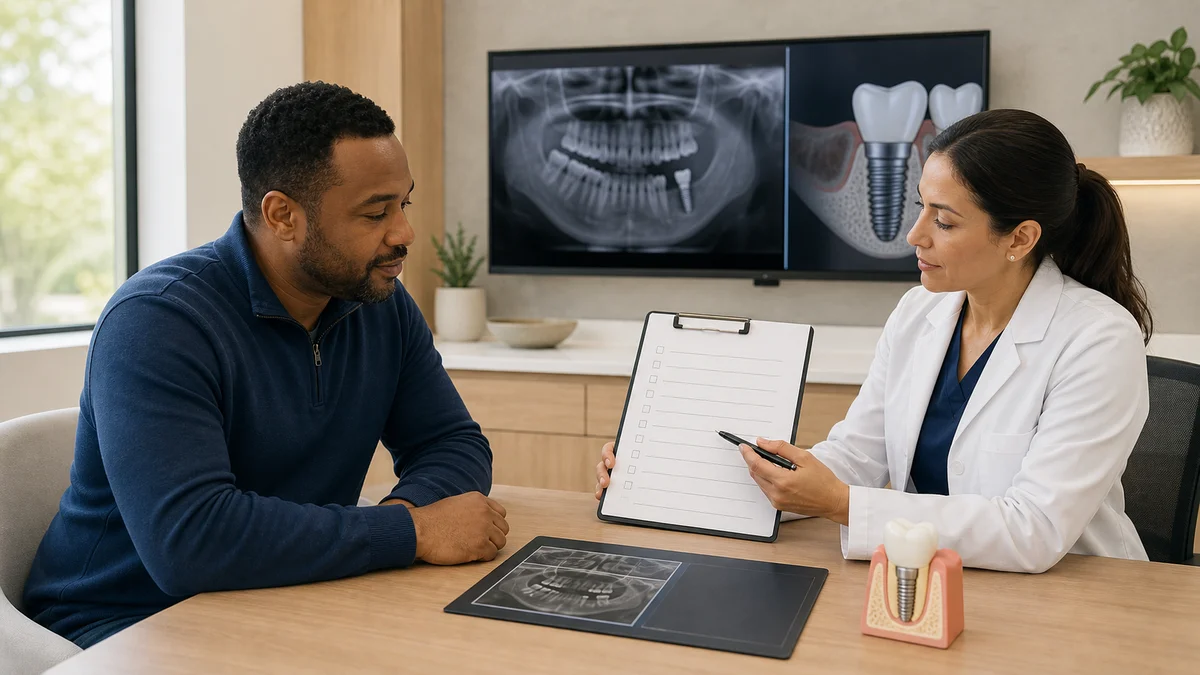
Quick answer: Medicaid may cover dental implants in limited circumstances, but there is no single nationwide adult rule. Coverage depends on your state, age or eligibility group, medical necessity, plan, provider network, and prior authorization. Confirm the exact implant, abutment, crown, imaging, and related procedures in writing before treatment begins.
People who search medicaid cover dental implants often want a simple yes or no. The accurate answer is conditional. Federal Medicaid rules require comprehensive dental benefits for eligible children and young people under 21 through the Early and Periodic Screening, Diagnostic and Treatment benefit, commonly called EPSDT. For adults, states generally decide whether to offer dental benefits and how broad those benefits will be. An implant can therefore be covered in one program, excluded in another, or approved only for a narrowly documented medical circumstance.
This guide explains how to check your own benefit without relying on an outdated state chart, an advertisement, or another member’s experience. It does not diagnose tooth loss or determine whether an implant is clinically appropriate. A licensed dentist must assess your mouth, health history, imaging, restorative options, and ability to maintain the result. The content is designed for review by Dentist Esma Çevrük Çakır and prioritizes patient safety, informed consent, and verifiable public sources.
Why the answer changes by state and member category
The federal Medicaid Dental Care page makes the central distinction clear: states must provide dental benefits to children enrolled in Medicaid and CHIP, while states have flexibility over adult dental benefits and face no federal minimum adult dental package. Dental services also appear as an optional benefit in the federal list of mandatory and optional Medicaid services. That is why a national search for medicaid cover dental implants cannot replace a current state policy check. The question “Can medicaid cover dental implants here?” begins with your enrollment state.
Even within one state, benefits may differ by age, pregnancy status, disability-related eligibility, former foster youth status, long-term care setting, or other coverage group. A state may administer dental care directly through fee-for-service Medicaid, through a managed care organization, through a separate dental plan, or through a combination. Each pathway can have its own provider directory and authorization workflow. Your red, white, and blue Medicare card, if you have one, does not answer your Medicaid dental question; people who are dually eligible must check each program separately. Ask whether medicaid cover dental implants for your specific member category, not for “adults” in general.
The correct starting point is the state where you are enrolled, not the state where you hope to receive care. When you ask whether medicaid cover dental implants, give member services your full plan name, member category if known, and the proposed procedure. Ask for the effective policy date because benefits, manuals, and program eligibility can change.
Does medicaid cover dental implants for adults?
Sometimes, but adult coverage is not automatic and is often narrow. New York’s Medicaid member page, revised in March 2026, lists medically necessary implants “in certain circumstances.” Its clinical guidance states that implant and implant-related services may be covered when medically necessary, with prior approval supported by the treating dentist. California’s July 2026 Medi-Cal Dental manual is more restrictive: implant services are benefits only when exceptional medical conditions are documented and medical necessity is approved in advance.
Those examples show why “my friend was covered” is weak evidence. New York and California do not create a nationwide rule, and another state may exclude implants from the general adult benefit. If a website says medicaid cover dental implants everywhere, treat that as an oversimplification. If it says Medicaid never covers them, that is also too broad. The applicable source is your current state plan or member handbook, interpreted for your eligibility group and delivery system. A reliable answer to “Can medicaid cover dental implants?” names the state and policy date.
Coverage is also procedure-specific. “Dental implant” may refer to implant placement, the abutment that connects the implant to the restoration, the crown or denture, bone grafting, anesthesia, imaging, extractions, provisional teeth, repairs, or removal. Approval of one code does not necessarily approve every related service. A safe verification request lists each proposed code and tooth or arch rather than asking only about “the implant.” This is how you test whether medicaid cover dental implants as a complete restoration or only one component.
What EPSDT means for members under age 21
EPSDT provides comprehensive and preventive care for Medicaid-enrolled children and young people under 21. Federal guidance says covered dental services must at least address pain and infection, restore teeth, maintain dental health, and include medically necessary orthodontic services. If screening identifies a condition requiring treatment, medically necessary services may need to be furnished even when the service is not listed in a state’s adult package. States still define medical necessity and use clinical review processes. Whether medicaid cover dental implants under EPSDT therefore requires an individualized review.
This protection does not mean every requested implant must be approved. A young person may still need documentation showing why the proposed service corrects or ameliorates a condition and why a less intensive covered alternative is inadequate. Prior authorization, specialist records, imaging, growth considerations, and a complete restorative plan may be required. Families searching medicaid cover dental implants for a member under 21 should explicitly ask the plan to review the request under EPSDT rather than under the ordinary adult dental benefit.
Age cutoffs can interact with treatment timing. Implant treatment may involve growth assessment and staged restorative care, so the clinical plan should not be accelerated merely because of an approaching birthday. Ask the dentist and plan how authorization, active treatment, and follow-up are handled if eligibility or age category changes during care. The question “Will medicaid cover dental implants after the member turns 21?” should be resolved before staging treatment.
Medical necessity is more than a preference for a fixed tooth
“Medically necessary” is a defined coverage standard, not a synonym for “helpful” or “preferred.” The dentist generally must document the diagnosis, missing teeth, function, health conditions, anatomy, prior treatment, prognosis, and alternatives. A reviewer may ask why a covered removable denture, bridge, or other functional option would not adequately address the member’s condition. State criteria can be very specific.
California’s 2026 criteria illustrate the documentation level. The manual identifies exceptional situations such as destructive oral cancer treatment, severe jaw atrophy that cannot support conventional prostheses, certain skeletal deformities, or traumatic destruction where remaining structures cannot support a conventional prosthesis. The manual requests complete records such as radiographs, scans, operative reports, photographs, or diagnostic casts when relevant. This is an example, not a checklist that binds other states. It shows why medicaid cover dental implants only after specific evidence in some programs.
New York’s guidance takes a different approach but still requires the dentist to explain medical necessity and why other covered functional alternatives will not correct the condition. Therefore, a search for medicaid cover dental implants should lead to a documentation conversation, not a promise. The clinical record must be truthful and individualized. A provider should never exaggerate a diagnosis merely to obtain payment.
A 12-step decision table for checking your benefit
Use the following table before committing to treatment. It converts the broad question “Will medicaid cover dental implants?” into questions that member services and the dental office can answer. Record the date, representative, reference number, policy link, and exact wording. A phone call is useful, but written authorization and the formal notice control the decision.
| Step | Question to verify | Evidence to keep |
|---|---|---|
| 1. Enrollment | Is my Medicaid coverage active on the planned service date? | Eligibility confirmation and date |
| 2. Program | Am I in fee-for-service, managed care, or a separate dental plan? | Plan name and member handbook |
| 3. Category | Which age or eligibility group determines my dental benefit? | Member-services response |
| 4. Benefit | Are implant services a covered benefit for my group? | Current policy section |
| 5. Codes | Which implant, abutment, crown, graft, imaging, and anesthesia codes are proposed? | Itemized treatment plan |
| 6. Necessity | What medical-necessity criteria apply? | Clinical criteria or manual |
| 7. Alternatives | Must other covered functional options be tried or ruled out? | Dentist’s documented comparison |
| 8. Network | Are the surgeon, restorative dentist, facility, and laboratory eligible providers? | Current directory plus office confirmation |
| 9. Authorization | Who submits prior authorization, and may treatment begin before approval? | Submission receipt and status |
| 10. Limits | Do frequency, replacement, anatomical, or service limits apply? | Written limitation language |
| 11. Cost | Can the provider bill me for a denied, noncovered, or out-of-network service? | Program rule and any valid agreement |
| 12. Appeal | What are the plan appeal and state fair-hearing deadlines? | Notice of action and appeal instructions |
Prior authorization: what approval does and does not mean
Prior authorization is a review before a service is furnished. The dental provider usually submits the request with procedure codes, narrative, imaging, periodontal information, restorative plan, alternatives, and other records required by the state or managed care plan. California explains that providers use prior authorization so Medi-Cal can determine whether specified medical, pharmacy, or dental services meet program rules. New York also instructs members that their Medicaid-enrolled dentist submits prior approval when necessary. This review decides whether medicaid cover dental implants under the submitted facts and codes.
Do not schedule surgery based only on a front-desk statement that medicaid cover dental implants. Ask whether the authorization is pending, approved, partially approved, modified, or denied. Obtain the authorization number, approved codes, tooth positions, provider, service location, validity dates, and conditions. An authorization for imaging is not an authorization for implant placement. Approval of placement is not automatically approval of the abutment and final crown.
Prior authorization also is not a clinical guarantee. Anatomy, infection, healing, medication use, tobacco exposure, periodontal health, and maintenance can affect candidacy and outcome. A dentist may revise the plan after examination or during care. Any material change should be clinically explained, consented to, and rechecked with the plan before an uncovered service is performed whenever rules permit.
Network status and provider enrollment can decide payment
A clinically suitable treatment can still be unpaid if the provider or site is not eligible under your program. Medicaid coverage usually depends on care from a Medicaid-enrolled provider; managed care may add a narrower network. Implant treatment can involve more than one professional: an oral surgeon or periodontist, a restorative dentist, an imaging center, an anesthesia provider, and a laboratory. Verify each role. Even when medicaid cover dental implants, the wrong provider pathway can prevent payment.
The federal Medicaid contact directory says members should contact their state agency to check claims and find Medicaid or CHIP providers. Member services can also tell you whether a referral is required. Before relying on a directory, call the office and provide your exact plan name. Directories can lag behind changes, and “accepts Medicaid” may not mean the office accepts your managed care product or currently accepts new patients.
Ask the office whether it will submit all required codes and whether it will wait for a written determination. When discussing whether medicaid cover dental implants, distinguish “we accept your card” from “we are enrolled and authorized for this service.” Keep names, dates, and reference numbers, but do not share more personal health information than necessary through an insecure channel.
Every component needs its own coverage check
A dental implant restoration is a sequence, not one object. A typical plan may include diagnostic examination, two-dimensional or three-dimensional imaging when clinically indicated, extraction, site preservation or grafting, implant placement, healing components, abutment, provisional restoration, definitive crown or implant-supported denture, and follow-up. Not every patient needs every component. Coverage can differ across the sequence. Ask whether medicaid cover dental implants from diagnosis through the definitive restoration.
For example, the plan might approve an implant for an exceptional medical condition but require separate review of bone grafting. A crown may use a different benefit category from surgical placement. Sedation may be covered only when specific criteria are met. If you ask only “Does medicaid cover dental implants?,” you can miss a major uncovered stage. Request an itemized plan with CDT codes and plain-language descriptions.
- Diagnostic examination and necessary radiographs
- Tooth extraction and management of active disease
- Bone or soft-tissue procedures, only when clinically indicated
- Implant placement and healing components
- Abutment and final crown, bridge, or denture
- Anesthesia or facility services, when justified
- Maintenance, repairs, and replacement limitations
The dentist should also explain non-implant alternatives, including their benefits, limitations, maintenance, and expected impact on adjacent structures. Coverage criteria may ask why a conventional prosthesis cannot provide function. An informed decision considers clinical suitability and patient preferences even when Medicaid covers only one option.
What documentation can strengthen a legitimate request?
A complete request makes it easier for the reviewer to apply the correct rule. Missing or poor-quality records can cause delay or an administrative denial. The exact documentation differs by state, but common elements include current diagnostic images, tooth charting, periodontal findings, medical history, medication list, description of functional impairment, prior treatment, and a restorative plan. The provider should connect each record to the published medical-necessity criteria. Complete evidence helps reviewers decide when medicaid cover dental implants under the controlling rule.
When state rules ask why alternatives are inadequate, a conclusory sentence may not be enough. The record should explain the patient-specific limitation: anatomy, disease, intolerance, trauma, resection, functional inability, or another supported factor. The purpose is not to make the case sound dramatic. It is to give a reviewer accurate evidence. Searches for medicaid cover dental implants cannot generate that evidence; it comes from a proper examination.
- Ask the provider which policy version and criteria it is using.
- Confirm that submitted images are current and labeled correctly.
- Include relevant specialist or physician records only when required and authorized.
- Keep a copy of the request, attachments, submission date, and tracking number.
- Respond promptly if the plan asks for additional information.
- Do not alter records or submit unsupported statements.
If coverage is denied: read the reason before appealing
A denial can mean different things. The service may be excluded, the member may be in a category without the benefit, the provider may be out of network, required authorization may be missing, records may be incomplete, or the reviewer may find that medical-necessity criteria were not met. The remedy depends on the reason. Resubmitting the same packet is unlikely to fix a policy exclusion, while an administrative omission may be corrected with the missing information. The notice should explain why medicaid cover dental implants was not established for that request.
Federal Medicaid resources explain that members must receive written information about fair-hearing rights when benefits or services are denied, suspended, terminated, or reduced. Procedures and deadlines vary by state. Managed care members may first need to use the plan’s appeal process before requesting a state fair hearing. The notice should identify the reason, rule, deadline, and available review path.
If a denial says medicaid cover dental implants only under limited criteria, compare the cited rule with the clinical record. Ask the dentist whether the request accurately addressed every element. An appeal should use patient-specific evidence and the current policy, not general claims that implants are better. For urgent health needs, the notice may describe an expedited process, but urgency must be genuine and supported.
Billing and private-pay agreements require caution
Medicaid member billing protections are governed by state rules and provider participation agreements. A participating provider generally cannot simply convert a covered service into private pay to bypass authorization or program payment. California’s 2026 provider handbook, for example, explains restrictions on billing eligible members for covered services and describes limited conditions for a private agreement after a service is denied as noncovered or not medically necessary. Other states may use different language and processes. Billing rules still matter when medicaid cover dental implants only after approval.
Before signing any financial agreement, ask whether the service is covered, denied, noncovered, or pending; why Medicaid is not being billed; and whether the agreement meets state requirements. Never assume that because medicaid cover dental implants in some circumstances you will owe nothing. Also do not assume a denial automatically makes every charge valid. Call member services or the state Medicaid agency if the explanation is unclear.
A legitimate estimate should separate each service, identify who will perform it, and state the conditions that could change the plan. Avoid pressure to pay a large nonrefundable amount before authorization. Do not finance treatment you do not yet understand. Price does not establish quality, and a higher fee cannot guarantee integration, comfort, or longevity.
Clinical suitability remains separate from insurance coverage
Insurance approval is not a diagnosis. Implant planning may require evaluation of active decay, gum disease, bone volume, bite forces, hygiene, smoking or nicotine exposure, diabetes control, medications, radiation history, and other medical factors. Some risks can be reduced or managed; others may favor a different restoration. Only the treating clinicians can advise you after examination. A finding that medicaid cover dental implants does not prove that an implant is safest for you.
Patients should receive an explanation of benefits, alternatives, foreseeable risks, stages, healing time, maintenance, and what happens if integration or restoration fails. Claims of “guaranteed” success are not medically responsible. Even when medicaid cover dental implants, the patient still needs preventive care and long-term maintenance. Peri-implant disease, mechanical complications, and changes in surrounding teeth or tissues can require future treatment.
Redent Klinik provides general information about multidisciplinary dental planning on the Redent Klinik English homepage. This is not a substitute for your state Medicaid manual, an authorization decision, or an in-person diagnosis.
Questions to ask member services and the dental office
Use precise language. Start with, “For my current eligibility group and plan, can medicaid cover dental implants when medically necessary?” Then provide the proposed codes and ask for the controlling benefit section. If the representative cannot interpret a code, ask which dental administrator or plan handles it. Request accessible language services if needed. Repeat “Does medicaid cover dental implants under this exact code?” for every major component.
- Is implant placement a benefit for my age and eligibility group?
- What written medical-necessity criteria apply today?
- Are abutments, crowns, dentures, grafting, and imaging reviewed separately?
- Which providers and facilities are in network and enrolled for these codes?
- Is a referral or prior authorization required, and who submits it?
- What documents must accompany the request?
- What are the authorization validity dates and treatment deadlines?
- What notice will I receive if only part of the plan is approved?
- How do I appeal, and what is the filing deadline?
- What follow-up, repair, or replacement services are covered?
For a written treatment-plan review, you may use the Redent Klinik contact page. If you are asking about Medicaid payment, independently verify provider enrollment, network status, and authorization with your state program or plan before care.
Frequently asked questions
Does medicaid cover dental implants in every state?
No. Federal Medicaid guidance says states choose adult dental benefits, so rules differ. Some states exclude adult implants, some cover them only in narrow medical circumstances, and some use group-specific rules. Check the current state manual and your managed care or dental plan. Do not rely on a national list without verifying its effective date. A state-specific answer explains when medicaid cover dental implants under the active policy.
Can medicaid cover dental implants when dentures do not work?
Possibly, if your state includes implant services and its medical-necessity criteria are met. Some policies require the dentist to explain why a conventional prosthesis cannot restore function. Discomfort alone may not satisfy a state’s standard. The provider should document anatomy, prior attempts, functional problems, and clinically appropriate alternatives accurately.
Does prior authorization guarantee that everything is paid?
No. Approval may be limited to named codes, providers, sites, dates, and conditions. Eligibility must usually remain active, and the claim must match the authorization. Ask whether medicaid cover dental implants, abutments, crowns, grafts, imaging, and anesthesia under separate codes. Keep the written determination and verify any change before treatment.
Are dental implants automatically covered under EPSDT?
No service is automatically appropriate for every member. EPSDT gives Medicaid-enrolled people under 21 broad medically necessary dental protections, but the state defines medical necessity and may require prior authorization and records. Ask for an EPSDT review and have the dentist explain how the requested service corrects or ameliorates the diagnosed condition.
Can I use any dentist if medicaid cover dental implants?
Usually not. The dentist generally must be enrolled in Medicaid, and a managed care or dental plan may require an in-network provider. The surgeon, restorative dentist, facility, imaging center, and anesthesia provider can have separate status. Verify each participant directly with the plan and office before care begins.
What if only the implant is approved but not the crown?
Do not start an incomplete plan without understanding how function will be restored. Ask the provider and plan to identify which component was denied, the reason, alternatives, and appeal rights. Implant placement, abutment, and final restoration can be separate benefits. A safe plan addresses the complete restorative sequence and maintenance.
Can I appeal a Medicaid dental implant denial?
Often yes, but the route and deadline depend on your state and whether coverage is fee-for-service or managed care. Read the written notice immediately. It should explain plan appeal or fair-hearing rights. Ask the provider for the submitted record, obtain the cited policy, and address the actual denial reason with truthful clinical evidence. The appeal should show why medicaid cover dental implants under the cited criteria.
Will Medicaid pay for an implant done before approval?
Do not assume it will. When prior authorization is required, treatment performed before approval may not be payable except under specific emergency or program rules. Implant placement is usually planned, not emergency care. Confirm authorization, approved codes, provider, site, and dates in writing before proceeding.
Bottom line: verify the rule, the code, and the complete plan
The most accurate answer to “Does medicaid cover dental implants?” is: sometimes, under the member’s current state rules and often only after detailed review. Children and young people under 21 have EPSDT protections; adult dental benefits remain state-specific. New York’s current policy allows medically necessary implants in certain circumstances, while California’s 2026 manual limits implant benefits to documented exceptional medical conditions. Neither example predicts another state’s decision. Only the current program can confirm whether medicaid cover dental implants for you.
Confirm active eligibility, member category, delivery system, current policy, every procedure code, provider network status, medical-necessity documentation, and prior authorization. Keep the written approval or denial, and use the stated appeal process if the decision appears inconsistent with the policy or record. This evidence-based approach turns a vague medicaid cover dental implants search into a safer, reviewable care decision without promising coverage or a clinical result.
Official and clinical sources
- Medicaid.gov — Dental Care: federal child, EPSDT, CHIP, and adult coverage framework
- Medicaid.gov — Mandatory and Optional Medicaid Benefits
- Medicaid.gov — Early and Periodic Screening, Diagnostic and Treatment
- Medicaid.gov — Official state Medicaid contacts
- Medicaid.gov — Understanding Medicaid Fair Hearings
- New York State Department of Health — Medicaid Member Dental Benefits, revised March 2026
- New York State Department of Health — Dental implant clinical criteria guidance
- California Medi-Cal Dental — July 2026 Manual of Criteria
- California DHCS — Prior Authorization Overview
- American Dental Association — professional dental information
- World Health Organization — Oral Health fact sheet