
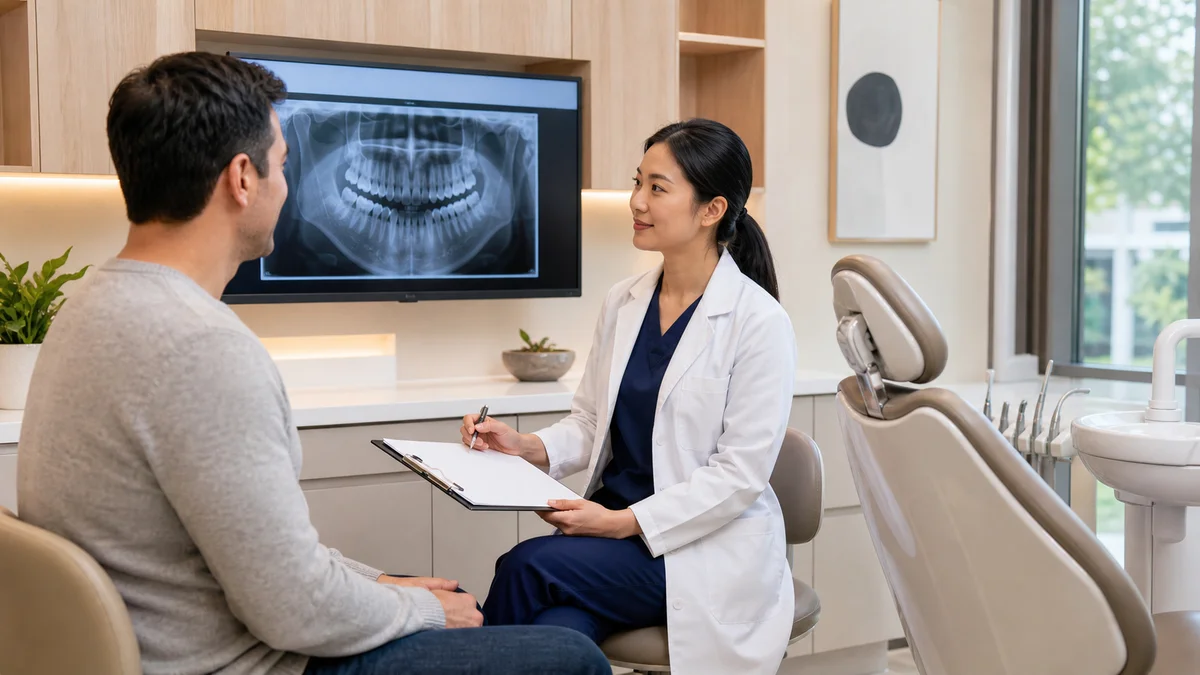
If you searched “teeth dentist near me,” shortlist licensed practices that fit your clinical need, location, hours, communication preferences, and insurance or payment situation. Then call to verify credentials, emergency arrangements, accessibility, written estimates, and how the team explains options. Online proximity and ratings can start a search, but they cannot replace an individual dental assessment.
Typing teeth dentist near me into a search bar is often the first step toward relief, prevention, or a more confident smile. It is not, however, the name of a dental specialty. The phrase usually means that you want a trustworthy dentist who can examine your teeth, explain what is happening, and coordinate appropriate care without making the journey unnecessarily difficult. The best local choice is therefore not automatically the closest pin, the loudest advertisement, or the office with the most polished before-and-after gallery.
This guide turns a teeth dentist near me search into a structured, patient-safe decision. It explains how to match the practice to your needs, verify information, compare access and costs, recognize urgent symptoms, and prepare for a first visit. It is educational rather than diagnostic. Only a dentist who reviews your history and examines you can advise whether you need preventive care, a restoration, gum treatment, root canal therapy, an extraction, orthodontic assessment, an implant consultation, or another service.
Treat teeth dentist near me as a starting query, then make the final decision from verified facts.
1. Define what your teeth dentist near me search actually needs to solve
Start with the reason for your appointment. A routine examination, a chipped tooth, bleeding gums, a missing tooth, jaw discomfort, and a child’s first visit are different needs. A general dentist can assess and manage many common problems and may coordinate referrals. Some situations are better directed to a pediatric dentist, periodontist, endodontist, oral and maxillofacial surgeon, orthodontist, prosthodontist, or another appropriately trained clinician.
Before comparing a teeth dentist near me result, write one sentence about your main concern and note how long it has been present. Include pain, swelling, fever, trauma, bleeding, a loose adult tooth, difficulty chewing, or changes that have not healed. This does not create a diagnosis. It simply gives the receptionist enough context to schedule an appropriate type of visit and to tell you whether the practice can help.
- Preventive need: an examination, hygiene review, personalized home-care advice, or recall planning.
- New symptom: sensitivity, localized pain, a fracture, gum changes, an ulcer, or a bite change.
- Restorative or replacement goal: evaluation of a damaged, heavily restored, or missing tooth.
- Access need: an evening appointment, step-free entry, language support, anxiety-sensitive care, or coordination around a medical condition.
- Urgent concern: significant swelling, uncontrolled bleeding, facial trauma, or symptoms affecting breathing or swallowing.
A useful dental office should be willing to say when another setting or specialist is more appropriate. That honesty is more meaningful than a directory label. If your teeth dentist near me search is driven by an emergency, skip routine comparison and use the urgent-care guidance later in this article.
2. Choose a dental home, not only a convenient appointment
The American Dental Association’s patient guidance describes the value of a “dental home”: an ongoing relationship where records, prevention, treatment planning, and referrals can be coordinated over time. Continuity helps a team notice changes rather than treating every visit as an isolated event. That is why the right teeth dentist near me option should work for routine follow-up as well as today’s concern.
Location still matters. A theoretically excellent plan is less useful if transport, parking, work hours, caregiving, or mobility barriers make follow-up unrealistic. Check the actual journey at the time you would normally travel. Ask whether appointments are commonly delayed and how the office handles cancellations. Convenience supports adherence, but it should sit beside clinical fit, communication, and verifiable professional standing.
Look beyond a single procedure. If the practice recommends treatment, who will provide maintenance? Who reviews gum health, restorations, appliances, or implants later? What happens if the clinician is unavailable? A strong response to a teeth dentist near me inquiry explains continuity, records, and aftercare in plain language.
For that reason, assess each teeth dentist near me candidate as a potential long-term care partner, not merely an open appointment slot.
3. Build a sensible shortlist from more than one channel
Search engines are useful for discovery, not final verification. Start with three to five practices that appear relevant, then cross-check them. The ADA suggests resources such as its Find-A-Dentist tool, local dental societies, and recommendations from people you trust. Your physician or pharmacist may also know established local referral pathways. If you are moving, your current dentist may be able to transfer records and suggest questions for the new office.
For each teeth dentist near me candidate, record the dentist’s full name, practice address, telephone number, website, stated services, and the source of the information. Sponsored placement only shows that advertising was purchased. A profile badge, rating, or social-media following does not establish licensure, competence for a particular procedure, or suitability for your medical needs.
Keep the same notes for every teeth dentist near me listing so that advertising style does not distort the comparison.
Be cautious when several websites repeat exactly the same promotional copy or route to a call center that will not name the treating dentist. A genuine practice should be able to identify the clinician responsible for your assessment. If you are considering care at Redent Clinic, use the same verification questions in this guide rather than treating any clinic’s own website as independent proof.
4. Verify the dentist and the practice before relying on reviews
Licensure is a baseline check. In the United States, look up the clinician through the relevant state dental board or official professional licensing portal. Check that the name and license status match the person who will treat you, and read what the status means on that board’s site. Rules and public records vary by jurisdiction, so a directory entry should never be substituted for the official regulator.
A teeth dentist near me profile may use terms such as “implant expert,” “cosmetic specialist,” or “advanced dentistry.” Marketing language does not necessarily identify a formally recognized specialty. Ask what training and recent experience are relevant to the proposed procedure, who will perform each step, and whether a specialist consultation is reasonable. A good clinician can describe scope and limitations without promising a result.
Verification should therefore follow the named clinician behind a teeth dentist near me result, not just the practice brand.
Reviews can reveal recurring themes about communication, scheduling, or billing, but they are incomplete evidence. Clinical details are rarely available, negative experiences may lack context, and unusually perfect patterns can be manipulated. Read across platforms and dates. Give more weight to verifiable credentials, a careful examination, informed consent, and the quality of answers you receive.
5. Use a decision table to compare local dental options
It is easier to compare a teeth dentist near me shortlist when every practice is judged on the same criteria. Do not assign a score until you have called or checked an official source. A blank or vague answer is information in itself.
| Decision factor | What to verify | Reassuring sign | Pause and ask more |
|---|---|---|---|
| Clinical fit | The practice assesses your type of concern and refers when indicated | Clear scope and referral pathway | Every problem is sold the same solution |
| Professional standing | Clinician identity and current license through the official regulator | Names are provided before booking | The treating dentist cannot be identified |
| Access | Travel, hours, physical access, language, and emergency arrangements | Specific accommodations are explained | Needs are dismissed or assumed |
| Communication | Benefits, risks, alternatives, uncertainty, and no-treatment option | Questions and second opinions are welcomed | Pressure to decide immediately |
| Costs | Network status, itemized estimate, likely stages, and payment terms | Written assumptions and possible changes | A headline price without an examination |
| Continuity | Records, review intervals, maintenance, and after-hours contact | A named team and follow-up process | No plan after the procedure |
The table is not a diagnostic tool, and no single column guarantees quality. It protects against choosing a teeth dentist near me result solely because it ranks first. Clinical decisions should follow an individual assessment, not a generic online package.
Update the table after speaking with each teeth dentist near me practice.
6. Ask the first phone call questions that expose practical fit
A short call can eliminate uncertainty before you share extensive personal information. Say why you are calling, whether you have urgent symptoms, and what support you need. The receptionist may not give clinical advice, but should explain scheduling, who provides care, and when a clinician needs to triage the concern.
For every teeth dentist near me candidate, consider asking:
- Which dentist would assess this concern, and is that clinician accepting new patients?
- What type of appointment should I book, and how much time is reserved?
- How are urgent problems handled during and outside office hours?
- Can the practice accommodate mobility, sensory, communication, or language needs?
- How are records and dental images requested from a previous practice?
- How will you confirm insurance network participation and expected patient responsibility?
- Are written estimates and alternatives discussed before non-urgent treatment begins?
- If specialist input is needed, how are referrals and follow-up coordinated?
Notice whether the response is precise and respectful. A team does not need to diagnose over the phone to be helpful. It should avoid guarantees, recognize emergencies, protect privacy, and tell you what the first visit can reasonably accomplish.
Use the call to decide whether the teeth dentist near me option can meet your practical needs before you book.
7. Understand insurance language before assuming coverage
“We accept your insurance” and “we are in network” are not identical. A practice may submit claims for an out-of-network patient while the plan applies different fees, deductibles, annual limits, waiting periods, frequency rules, exclusions, or prior-authorization requirements. Confirm participation with both the practice and the insurer using the clinician’s name and service location.
When a teeth dentist near me listing displays an insurance logo, treat it as a lead to verify rather than a coverage promise. Ask for the procedure codes used in a written estimate when available, then ask the plan how those codes may be processed. A pre-treatment estimate from an insurer can still be conditional; it is not necessarily a guarantee of payment.
Record who confirmed the network information and when, because a teeth dentist near me directory may not reflect the latest contract status.
Children and adults may have different public-benefit eligibility and covered services. In the United States, Medicaid dental benefits for adults vary by state, while children’s benefits follow different requirements. Use current government and plan sources because rules can change. Do not delay urgent evaluation solely while waiting for a coverage answer.
Insurance verification belongs in every teeth dentist near me comparison when benefits affect access.
8. Compare costs without trusting a fixed online price
Dental costs depend on diagnosis, tooth position, materials, imaging needs, disease complexity, clinician involvement, laboratory work, sedation if appropriate, follow-up, and local systems. A fixed quote from a teeth dentist near me advertisement may omit necessary stages or assume a straightforward case. An ethical estimate should follow enough assessment to define the proposed care.
Ask for an itemized written plan that distinguishes urgent care from elective or deferrable care. It should describe the proposed treatment, reasonable alternatives, known limitations, anticipated number of visits, and what could change the estimate. Ask whether temporary work, laboratory charges, maintenance, or removal of an existing restoration are included. Compare like with like; two totals may represent different scopes.
Financial consent is part of informed decision-making, but it does not replace clinical consent. You should have time to understand material risks, expected benefits, alternatives, and the option of no treatment when delay is clinically reasonable. A second opinion can be valuable for extensive or irreversible care. Avoid financing decisions you do not understand, and review cancellation and refund terms before paying.
Compare the complete care plan behind each teeth dentist near me estimate rather than comparing headline numbers alone.
9. Know the evidence-based lower-cost care routes
If affordability is the main reason for your teeth dentist near me search, official routes may widen your options. The U.S. National Institute of Dental and Craniofacial Research explains that dental schools and dental hygiene schools may offer supervised care at reduced cost. It also directs patients to federally funded health centers, Medicaid and CHIP information, clinical trials, and other programs, with eligibility and services varying.
Health Resources and Services Administration-funded health centers provide primary care that can include dental services and adjust fees based on income and family size. Availability, waiting time, and treatment scope differ by center, so use HRSA’s official finder and call the site directly. Community health centers are not limited to people with insurance.
Be skeptical of social-media posts or ads that claim a federal research institute will pay for implants or provide direct financial assistance. NIDCR specifically warns about fraudulent advertisements making such claims. A legitimate teeth dentist near me pathway should identify the actual program, eligibility rules, provider, and official contact details without demanding unusual payment or identity information.
An official program finder can be more useful than repeatedly refreshing a commercial teeth dentist near me search when affordability is the main barrier.
10. Evaluate infection prevention and diagnostic imaging responsibly
Dental practices should follow current infection-prevention standards, including hand hygiene, appropriate personal protective equipment, safe injection practices, sterilization of reusable instruments, environmental cleaning, and processes for dental unit water. You do not need to inspect every technical detail, but the team should answer reasonable questions about sterilization and safety without defensiveness.
For a teeth dentist near me first visit, dental radiographs should be prescribed based on an individual’s history, examination, symptoms, age, disease risk, and available previous images—not taken at an automatic fixed interval for everyone. Bring or authorize transfer of recent images where appropriate. The dentist should explain why a particular image may change diagnosis or care.
More technology is not automatically better. Digital scans, cameras, and three-dimensional images can be useful when clinically indicated, but equipment should support a reasoned assessment. Ask what question a test is intended to answer and whether alternatives exist. Pregnancy, previous radiation exposure, medical conditions, or inability to tolerate a procedure should be discussed with the dental team rather than used for self-diagnosis.
A credible teeth dentist near me consultation connects every recommended image or test to a patient-specific clinical question.
11. Make communication, anxiety support, and accessibility part of quality
A technically appropriate treatment is not truly accessible if you cannot understand the explanation or safely use the facility. Tell the office about language preferences, hearing or vision needs, neurodivergence, mobility limitations, dental anxiety, a strong gag reflex, or a history that affects consent and comfort. Ask what accommodations are actually available rather than assuming from a website icon.
During a teeth dentist near me consultation, the clinician should use plain language, invite questions, and check understanding. You may ask for written information, a pause signal, breaks, or a support person where policy and privacy rules allow. Sedation is not the only anxiety strategy and is not suitable for everyone; options require individualized medical and dental assessment.
Respect includes pronouncing your name correctly, not shaming you for delayed care, explaining before touching, and obtaining permission. If you feel rushed, pressured, mocked, or unable to decline, pause non-urgent treatment. For irreversible or extensive care, an environment that supports questions is a safety feature, not a luxury.
Communication quality can distinguish a suitable teeth dentist near me practice from one that is convenient but not workable for you.
12. Recognize marketing and consent red flags
A polished teeth dentist near me page can still contain warning signs. Be cautious when the message guarantees painless care, a lifetime result, an exact treatment before examination, or a dramatic discount that expires immediately. Dentistry involves biological variation, maintenance, and uncertainty. Responsible clinicians can discuss likely outcomes and limitations without promising perfection.
- A diagnosis or complex procedure is declared from a photograph or chat alone.
- The practice will not name the treating clinician or allow credential verification.
- You are discouraged from asking about alternatives, material risks, or a second opinion.
- A large payment or financing agreement is demanded before a meaningful assessment.
- Only idealized cases are shown, without explaining that results vary and images may be selected.
- The office cannot describe after-hours support, records access, or follow-up responsibilities.
- Personal health information is requested through an insecure public channel without explanation.
One awkward interaction does not prove misconduct, but patterns deserve attention. If something seems unsafe, stop and seek another licensed professional or the relevant regulator. In an emergency, prioritize timely clinical care rather than investigating marketing claims.
No teeth dentist near me promotion should pressure you to surrender the right to ask questions or decline non-urgent care.
13. Prepare for the first visit and a useful shared decision
Bring identification requested by the office, insurance information if relevant, a medication list, allergies, medical conditions, prior dental records or images, and the questions that matter most to you. Mention anticoagulants, diabetes, heart conditions, immune suppression, pregnancy, implanted devices, previous reactions, tobacco or nicotine use, and any clinician advice that may affect dental care. Do not stop prescribed medication unless the appropriate prescriber and dental clinician advise it.
At a teeth dentist near me first visit, expect a health-history review and an examination appropriate to your concern. Gum measurements, dental charting, bite assessment, soft-tissue examination, and images may be considered, but not every component is necessary at every visit. Ask what the findings mean and what uncertainty remains.
Before accepting treatment, try the “teach-back” test: explain in your own words what problem is being addressed, the recommended option, important benefits and risks, alternatives, likely maintenance, time, costs, and what happens if you wait. If the explanation cannot be repeated clearly, ask again. A thoughtful clinician should welcome clarification.
Apply the same teach-back standard to every teeth dentist near me consultation on your shortlist.
For international or planned care, discuss who will handle complications and maintenance after you return home. Obtain copies of records, images, material or implant details when relevant, and the treating clinician’s contact information. The Redent Clinic contact team can explain its own appointment logistics, but individualized suitability still requires a clinical assessment.
14. Know when “near me” should mean urgent care now
Do not spend hours comparing routine teeth dentist near me listings if you have trouble breathing or swallowing, rapidly spreading facial or neck swelling, uncontrolled bleeding, major facial trauma, or other symptoms that may threaten the airway or general health. Seek emergency medical services according to local guidance. A dental office can advise on many urgent dental problems, but some conditions require a hospital setting.
Contact a dentist promptly for significant tooth pain, swelling, fever associated with dental symptoms, a knocked-out or displaced permanent tooth, a broken tooth with pain, or trauma. Handle an avulsed permanent tooth by the crown rather than the root, avoid scrubbing it, and seek immediate professional instructions. Management depends on the injury and the patient; primary teeth are handled differently.
For less severe symptoms, call and describe the onset, location, swelling, fever, trauma, bleeding, medicines taken, and medical conditions. Avoid placing aspirin directly on gum tissue and do not use leftover antibiotics. Antibiotics do not correct every cause of dental pain and require professional judgment. If symptoms worsen while you wait, seek urgent reassessment.
In an urgent teeth dentist near me call, clear symptom details are more useful than trying to name your own diagnosis.
15. Reassess the relationship after the first appointment
Your choice is not final simply because you attended once. After the appointment, ask whether the teeth dentist near me result matched the facts you verified. Did the clinician listen, examine before recommending, explain findings and uncertainty, discuss alternatives, document consent, and provide a realistic follow-up plan? Did the financial conversation match the written estimate?
Minor scheduling friction can happen in any health service. Focus on the safety and communication pattern. If you need to change practices, request a copy or transfer of records under applicable rules and ask how pending treatment should be managed. Do not abandon urgent or time-sensitive care without arranging an alternative.
The aim is an ongoing dental home where prevention, early assessment, maintenance, and referrals are coordinated. That relationship matters more than winning a one-time search ranking. Revisit your shortlist if your needs, insurance, location, accessibility, or confidence changes.
A successful teeth dentist near me choice remains appropriate only while the relationship continues to meet your safety, access, and communication needs.
Frequently asked questions about finding local dental care
Is the first teeth dentist near me result usually the best?
No. Ranking can reflect advertising, search optimization, distance, or platform data rather than your clinical needs. Use the first page to build a shortlist, then verify the treating clinician, official license status, scope, access, costs, and emergency arrangements. The best fit is the practice that can safely assess you and support follow-up.
Should I choose the closest dentist or the most experienced one?
There is no universal formula. Routine preventive care benefits from practical access and continuity, while a complex procedure may justify specialist expertise or a longer journey. Ask what experience is relevant to your actual condition after assessment. Distance, health needs, support, follow-up, and the ability to manage complications all matter.
Can a teeth dentist near me give an exact price by phone?
A practice can usually explain consultation fees, common ranges, or payment policies, but a reliable total for treatment often requires examination and sometimes diagnostic imaging. Ask for an itemized written estimate after assessment. Confirm what it includes, what might change it, insurance assumptions, laboratory costs, follow-up, and alternatives. Avoid interpreting a promotional starting price as your final cost.
How do I check whether a dentist is licensed?
Use the official dental board or professional regulator for the place where treatment will occur. Search the dentist’s full legal name and compare the practice location and current status. Read the regulator’s definitions and contact it if the record is unclear. Commercial directories, review platforms, and clinic badges are not equivalent to an official license lookup.
Do online reviews prove that a dental clinic is safe?
No. Reviews can highlight themes about courtesy, communication, waiting time, or billing, but they cannot reveal a complete clinical record or reliably prove safety. Look for patterns across time, then prioritize official credentials, individualized assessment, transparent consent, infection-prevention processes, and your direct experience of how questions are handled.
What if I have no dental insurance?
Ask practices about written estimates and staged care, then check official resources such as HRSA-funded health centers, dental schools, dental hygiene schools, state or local programs, Medicaid or CHIP eligibility, and charitable clinics. Services and eligibility vary. Be cautious of ads claiming federal grants will pay for implants; verify any program through its official government or institutional website.
What records should I transfer to a new dentist?
Ask the new practice what it needs. Useful records may include recent dental images, charting, treatment notes, periodontal measurements, laboratory or appliance information, implant details, medication and allergy information, and the date of the last examination. Transfer rules and fees vary. Keeping copies can support continuity, but new findings may still require updated assessment.
When should a tooth problem go to an emergency department?
Seek emergency medical help for breathing or swallowing difficulty, rapidly spreading face or neck swelling, uncontrolled bleeding, major facial trauma, or signs of serious systemic illness. Call a dentist promptly for dental pain, swelling, trauma, or a displaced permanent tooth. When uncertain, describe symptoms to an appropriate local emergency or clinical triage service.
Bottom line: turn proximity into a safer decision
A teeth dentist near me search is most useful when it leads to verification and conversation. Define your need, shortlist several practices, check the treating clinician through an official regulator, and confirm practical access, insurance language, written estimates, safety processes, referral pathways, and aftercare. Make urgent symptoms the priority and use official lower-cost routes when finances are a barrier.
No checklist can guarantee a particular clinical outcome. It can, however, help you notice whether a practice supports informed, individualized care. The strongest teeth dentist near me choice should leave you knowing who will treat you, why an assessment or test is proposed, what options exist, what follow-up involves, and whom to contact if the situation changes.
Save this teeth dentist near me checklist and revise it as your needs change.
Sources and further reading
- American Dental Association MouthHealthy: How to Choose a Dentist
- American Dental Association: professional and public oral-health resources
- National Institute of Dental and Craniofacial Research: Finding Dental Care
- Health Resources and Services Administration: Get Affordable Health Care
- HRSA: Find a Health Center
- Centers for Disease Control and Prevention: Summary of Infection Prevention Practices in Dental Settings
- World Health Organization: Oral health fact sheet