
Quick answer: A Medigma implant price is not the same as the total fee for an implant-supported tooth. The complete proposal may include diagnostics, the implant fixture, abutment, surgery, grafting, temporary teeth, final restoration, anesthesia, and follow-up. Ask for the exact system, component list, clinical rationale, exclusions, warranty terms, and total treatment pathway in writing.
Searching medigma implant price may lead to a product figure, a clinic package, or a distributor listing. Those numbers answer different questions. A dental implant fixture is one medical-device component; the tooth you use also requires clinical planning, surgery, a compatible prosthetic connection, laboratory work, and a crown, bridge, or denture. Preparatory care and follow-up can add further stages. A headline figure is therefore meaningful only when its scope is defined.
This patient guide explains how to compare a medigma implant price without assuming that one brand, one design, or one advertised amount is right for every person. It draws a clear line between manufacturer documentation and an individualized treatment recommendation. It does not diagnose candidacy, select a device, or guarantee a result. Those decisions belong to a qualified clinician who has examined you, reviewed appropriate records, and discussed reasonable alternatives and material risks.
1. What Does “Medigma Implant Price” Actually Mean?
A medigma implant price can mean the wholesale or retail cost of a sterile implant fixture, the clinic’s fee for surgically placing it, or the combined cost of an implant-supported restoration. In everyday advertising, these meanings are sometimes blended. Before comparing any numbers, ask the seller or clinic to name the service and every included component.
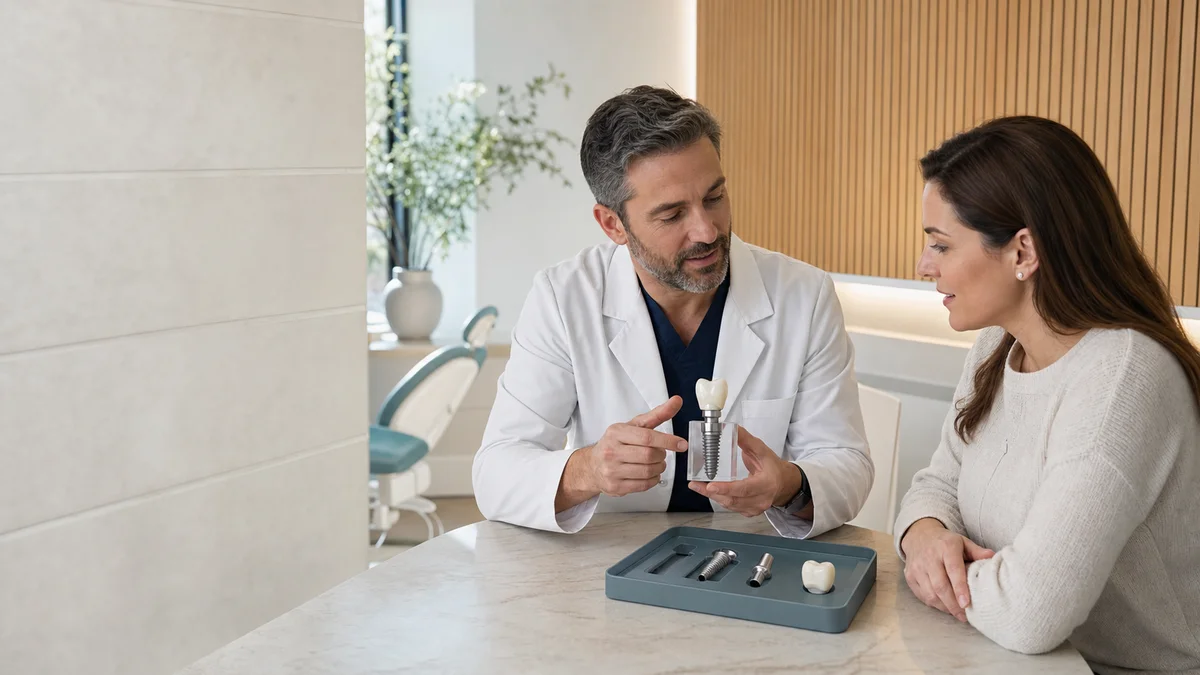
The U.S. Food and Drug Administration describes a dental implant system as an implant body placed in the jaw, an abutment that connects through the gum, and a prosthetic tooth or teeth supported by the system. The FDA also advises patients to ask what brand and model will be used and to keep that information. This structure is useful for reading a quote: “implant” alone may not include the abutment or visible restoration.
- Device-only amount: may refer to the implant fixture and cover screw, not clinical care.
- Surgical fee: may cover placement but omit imaging, anesthesia, grafting, or restorative work.
- Implant-plus-crown offer: may include a fixture, abutment, and crown but exclude preparation and maintenance.
- Full treatment proposal: may combine records, surgery, provisional care, laboratory work, final teeth, and selected follow-up.
- Full-arch package: may describe multiple implants and a temporary prosthesis while leaving the final material or later conversion separate.
The safest medigma implant price comparison places like-for-like treatment plans side by side. If two proposals contain different restorations or clinical assumptions, the totals should not be treated as competing prices for the same product.
2. What the Manufacturer Currently Documents
Medigma Biomedical GmbH’s official website states that the company develops, manufactures, and distributes dental implant systems, restorative components, and surgical and prosthetic tools. Its current public documentation identifies several implant families and connection approaches. The manufacturer’s published instructions and safety-resource area should be the starting point for current product-specific information—not an anonymous marketplace description.
A responsible medigma implant price review should consult the manufacturer’s Summary of Safety and Clinical Performance, which lists implant families including Mars™, FixTite™, Fix-a-Dent™, Fix Konisch™, Grand Konisch™, and Fix-1™. It describes internal-hex, conical-hex, and conical-star platforms across different families. These are not interchangeable labels. Diameter, length, connection, component availability, and intended use must match the individual plan and the manufacturer’s current instructions.
A medigma implant price should therefore identify more than the brand. Ask for the product family, implant dimensions, connection, abutment or multi-unit component, final restoration, and product reference information. Do not infer that every Medigma fixture uses the same prosthetic parts or clinical protocol.
Manufacturer facts versus treatment promises
Technical documentation can explain what a device is, its intended purpose, available connections, materials, sterilization state, warnings, and instructions. It does not prove that a specific patient will achieve a particular result or settle a medigma implant price for treatment. Marketing terms such as “immediate,” “minimally invasive,” or “high stability” must be interpreted by the treating clinician in the context of anatomy, bone, bite, health, and the exact instructions for use. They are not a universal promise of same-day final teeth or complication-free healing.
3. Which Components Should Appear in the Quote?
A transparent medigma implant price proposal should separate manufacturer components from professional and laboratory services. At a minimum, it should show the number of implant fixtures, cover or healing components, abutments, prosthetic screws, and final teeth. If a bridge or full-arch prosthesis is planned, the quote should state how many implants support it and whether the restoration is fixed or removable.
Ask whether temporary teeth are included in the medigma implant price. A provisional crown or denture can require its own design, material, adjustments, and replacement policy. Also ask whether the final prosthesis is screw-retained, cement-retained, or removable and why that design was selected. The answer may affect laboratory work, retrievability, maintenance, and cost.
A component checklist for a Medigma implant price
- Product family, connection type, diameter, length, and reference number
- Sterile implant fixture and cover screw or healing component
- Abutment, multi-unit component, attachment, or titanium base as applicable
- Prosthetic and abutment screws, including expected spare-part access
- Temporary crown, bridge, or denture during healing
- Final crown, bridge, overdenture, or fixed full-arch restoration
- Laboratory design, material, shade, verification, and remake terms
- Implant identification card or written system record for the patient
If a clinic cannot identify the planned connection or components before surgery, ask how restorative planning has been coordinated. The final tooth design should guide implant positioning; the device choice should not be isolated from the prosthetic goal.
4. Why the Device Is Only One Part of the Total
Even a precisely stated medigma implant price does not capture the clinical pathway. The total may include an examination, periodontal assessment, radiographs or three-dimensional imaging when justified, digital scans, surgical planning, anesthesia, implant placement, sutures, postoperative reviews, impressions or scans, laboratory stages, final insertion, bite adjustments, and maintenance guidance.
Some patients also need an extraction, infection management, ridge preservation, bone augmentation, sinus-related procedures, soft-tissue treatment, or disease stabilization. None of these should be assumed. When recommended, the clinician should show the finding, explain the objective and alternatives, describe how it changes timing and risk, and itemize the additional fee.
A low medigma implant price may simply exclude professional time and the restoration. A higher proposal may be more complete—or may contain optional services. The number alone cannot establish value. Scope, diagnosis, clinician competence, materials, laboratory quality, aftercare, and access to compatible parts all matter.
5. How Clinical Complexity Changes the Estimate
A reliable medigma implant price follows an examination because anatomy and health influence the plan. The clinician may evaluate the amount and shape of bone, gum and soft-tissue conditions, neighboring teeth, restorative space, bite, clenching or grinding, oral hygiene, smoking or nicotine use, medicines, diabetes control, prior radiation, allergies, and healing history. Additional medical coordination may be appropriate for some patients.
The FDA notes that overall health can influence candidacy and healing, that smoking may affect healing, and that complications can include infection, injury to nearby structures, altered sensation, difficulty cleaning, component loosening, or implant failure. These risks do not predict what will happen to one reader. They show why the cheapest device-only option is not a substitute for risk assessment and a maintainable restorative plan.
Questions when grafting or another procedure is proposed
- What examination or imaging finding supports this recommendation?
- Is the step essential, optional, or one of several reasonable approaches?
- What material and technique are planned, and who will perform it?
- Will it occur before, during, or after implant placement?
- How does it affect the temporary tooth, healing time, and total quote?
- What are the material risks and the alternative if I decline?
These questions keep a medigma implant price discussion tied to your diagnosis rather than to a standardized sales package.
6. Internal Hex and Conical Connections: Why the Name Matters
Medigma’s public resources describe product families with different prosthetic connections. A clinician may have valid reasons for selecting one system or family, but a patient should not try to choose a connection from marketing language alone. Implant position, available bone, restorative design, component inventory, clinician familiarity, and laboratory workflow all contribute to selection.
For a medigma implant price comparison, record the exact family and connection. This information matters if a screw loosens, a crown needs removal, a denture attachment wears, or you relocate and another clinic must identify compatible parts. “Medigma” by itself may be insufficient for future servicing.
Ask whether the restorative dentist and laboratory have access to the appropriate authentic components and current libraries. Mixing unapproved third-party components can create fit, mechanical, regulatory, and warranty questions. The manufacturer’s warranty page states that using third-party products not distributed through Medigma with its systems voids manufacturer warranty obligations. Your clinic should explain its component policy before treatment.
7. How to Read Medigma’s Material and Sterilization Information
The current manufacturer safety summary describes Medigma implant bodies and compatible abutments as made from Ti-6Al-4V ELI alloy and offered in different lengths and diameters. It says implants are supplied sterile after gamma irradiation, while abutments are supplied non-sterile and require cleaning and steam sterilization by the clinician before use. It also describes the implants, abutments, and respective screws as single-use.
These are manufacturer-documentation statements, not a reason to self-select a device or handle sterile components. A medigma implant price quote should include appropriate clinical handling and should not pass sterilization responsibility to the patient. Ask how the clinic checks packaging integrity, expiration, lot information, and correct component matching.
Inform the clinician about known allergies or prior reactions to medical devices or metals. The FDA explains that most dental implant systems use titanium or zirconium oxide and that safety evaluation includes biocompatibility testing. Individual questions should be assessed by qualified healthcare professionals; an internet article cannot determine material suitability.
8. Warranty: What It Covers and What It Does Not
The manufacturer’s public warranty page says Medigma will replace a Medigma-manufactured implant or abutment for a stated lifetime period, subject to its conditions. Crucially, it also says the limited warranty does not cover surgical procedures, materials, tools, or accessories. A component-replacement policy is therefore not the same as free retreatment and is not a guarantee that an implant will succeed.
When evaluating a medigma implant price, separate three layers: the manufacturer’s component warranty, the clinic’s professional-service policy, and the laboratory or restoration policy. Ask who pays for imaging, removal, grafting, surgery, anesthesia, temporary teeth, laboratory work, travel, and the new restoration if a component is replaced. Request the conditions and exclusions in writing.
| Quote or warranty item | Question to ask | Why it matters |
|---|---|---|
| Implant fixture | Exact family, dimensions, reference, and quantity? | Identifies the medical device and compatible pathway |
| Abutment and screws | Authentic component, connection, and replacement access? | Compatibility affects restoration and future servicing |
| Manufacturer warranty | Eligibility, exclusions, claim process, and product covered? | May replace only a component, not clinical treatment |
| Clinic policy | What professional services are included if a problem occurs? | Surgery, diagnostics, and follow-up can exceed device value |
| Restoration policy | What covers the crown, bridge, denture, screws, or repairs? | The visible teeth have separate materials and wear |
| Maintenance conditions | Are hygiene visits, records, or protective devices required? | Conditions can determine whether a policy applies |
9. Temporary Teeth and Timing Can Change Value
Some medigma implant price marketing emphasizes immediate placement or immediate loading. Medigma’s manufacturer documentation describes immediate loading as possible only when good primary stability and appropriate occlusal loading are achieved. That is a conditional technical statement, not an assurance that every patient can receive a fixed tooth immediately.
A complete medigma implant price should specify the temporary phase. Ask whether you will receive no temporary tooth, a removable appliance, a temporary fixed crown, or a full-arch provisional prosthesis. Clarify how many adjustments, repairs, or replacements are included and which diet or loading limitations apply. The final restoration may require later scans, try-ins, or laboratory work.
The FDA notes that healing after implant placement may take several months or longer. Timelines vary by site, procedure, health, implant stability, and individual healing. Avoid treatment plans that promise an exact biological deadline without contingencies.
10. Comparing a Single Tooth With Full-Arch Treatment
A single implant-supported crown, an implant bridge, a removable overdenture, and a fixed full-arch prosthesis are different medigma implant price scenarios. The number of missing teeth does not necessarily equal the number of implants. The prosthetic design, implant distribution, bite forces, hygiene access, anatomy, and repair strategy determine the plan.
Never compare a single-unit medigma implant price with a per-arch marketing figure as if they were equivalent. For full-arch care, ask how many implants are planned, whether the advertised price includes the final prosthesis, what material the temporary and final teeth use, when conversion occurs, and what future wear components may need replacement.
Full-arch quote questions
- How many implants are planned, at which sites, and why?
- Is the temporary prosthesis fixed or removable?
- Is the final prosthesis included, and what material is specified?
- Are extractions, bone reduction, grafting, anesthesia, and laboratory verification included?
- How will the patient clean underneath the prosthesis?
- What happens if an implant cannot be loaded or is not integrated?
- Who handles repairs, screw replacement, relining, or remake?
A fair medigma implant price comparison must normalize all of these variables.
11. Insurance and Financing Need Separate Verification
A medigma implant price insurance contribution is plan-specific. Dental benefits may exclude implants, contribute to selected components, apply an alternate benefit, impose a waiting period, or limit reimbursement through deductibles and annual maximums. A clinic estimate of benefits is helpful but is not always a payment guarantee. Ask for procedure codes and a pre-treatment estimate, then confirm network status and benefit rules directly with the insurer.
Financing does not change the underlying medigma implant price; it changes when and how you pay. Compare the cash price, amount financed, annual percentage rate, term, fees, promotional interest conditions, late-payment consequences, and total of payments. Ask what happens to the financing contract if treatment is delayed, changed, transferred, or stopped.
- Separate the clinical contract from the credit agreement.
- Confirm whether funds are disbursed by phase or all at once.
- Read refund and cancellation terms before signing.
- Budget for maintenance, travel, time away from work, and possible repairs.
- Do not let a monthly-payment deadline replace informed consent.
12. Local Care and Treatment Abroad Require the Same Scope
A medigma implant price may vary across clinics and countries because professional fees, laboratory costs, taxes, distribution, regulatory requirements, facility expenses, and follow-up structures differ. Geographic variation does not by itself prove better or worse care. Compare identical clinical specifications and the complete care pathway.
If travel is involved, include flights or ground transport, accommodation, companion expenses, time off, return visits, currency terms, and a contingency budget. Verify who manages postoperative concerns after you return home and whether compatible components and trained clinicians are accessible locally. No clinic should promise that another dentist will service its work without prior agreement.
Patients comparing an international option can review Redent Klinik’s English information and use the Redent Klinik contact page to request a case-specific assessment and itemized scope. Remote communication can begin planning, but a final diagnosis and definitive quote depend on appropriate clinical evaluation.
13. Long-Term Records and Component Traceability
Your medigma implant price should include traceable care rather than an anonymous component. Keep the treatment plan, consent documents, imaging reports, invoices, medication information, implant brand and product family, dimensions, reference and lot information, surgery date, and restorative component details. The FDA specifically recommends asking which brand and model is used and retaining that information. Records are valuable if you move, change dentists, or require future maintenance.
A medigma implant price should not buy an anonymous fixture. Ask for an implant identification card or equivalent written record. Confirm that the clinic will add the device details to your chart and that you can obtain copies of your records. Do not rely only on a verbal brand name or a photo of packaging.
14. Red Flags in Brand and Price Advertising
Be cautious when a medigma implant price advertisement presents the brand as proof of universal success, says one system fits every patient, promises painless or risk-free surgery, guarantees a lifetime clinical result, or refuses to itemize the abutment and restoration. Also question pressure to pay before examination, vague substitute-brand clauses, or an “unconditional warranty” that is not supplied in writing.
- A device price presented as the complete treatment price
- No product family, connection, dimensions, or component list
- Manufacturer marketing language treated as a personal outcome guarantee
- Third-party components used without disclosure or compatibility explanation
- No written temporary-tooth or final-restoration specification
- No aftercare, emergency, or maintenance pathway
- Before-and-after photographs described as a prediction of your result
A trustworthy medigma implant price conversation gives you time to ask questions, obtain records, consider alternatives, and seek another qualified opinion.
15. A Safe Decision Process
- Complete a clinical examination and appropriate imaging.
- Ask for the diagnosis, alternatives, material risks, and expected maintenance.
- Obtain an itemized plan naming the exact Medigma family and components.
- Separate device, surgical, restorative, anesthesia, laboratory, and follow-up fees.
- Read manufacturer, clinic, and restoration warranty terms independently.
- Verify insurance and financing in writing.
- Keep implant identification and treatment records.
- Choose based on safety, maintainability, communication, and total value—not price alone.
This sequence turns a medigma implant price search into an informed healthcare decision rather than a product-shopping exercise.
Frequently Asked Questions About Medigma Implant Price
Is there one official Medigma implant price?
No universal patient treatment amount appears in the manufacturer resources reviewed for this medigma implant price guide. A distributor may price a device, while a clinic prices professional treatment and a restoration. Country, component family, quantity, surgery, laboratory work, preparation, and follow-up can all differ. Request a dated, written proposal for your exact case.
Does the Medigma implant price include the crown?
Not necessarily. “Implant” may mean only the fixture placed in bone. The abutment and crown, bridge, or denture can be separate. Ask the clinic to name every component and service, including temporary teeth, laboratory stages, final restoration, screws, and follow-up. Never infer inclusion from the headline alone.
Are all Medigma implant systems the same?
No. The manufacturer’s current documentation lists multiple families and connection designs. A treating clinician must select a specific system, size, and restorative pathway based on the case and current instructions. Patients should retain the exact product identification because brand name alone may not identify compatible future components.
Does Medigma’s warranty cover replacement surgery?
The manufacturer’s public warranty says it replaces qualifying Medigma-manufactured implants or abutments under stated conditions, while excluding the costs of surgical procedures, materials, tools, and accessories. Clinic and laboratory policies may differ. Ask in writing who pays for every clinical and restorative step if a component requires replacement.
Can I choose an implant brand by price alone?
No. Brand and price do not determine candidacy or guarantee an outcome. The clinician must consider diagnosis, anatomy, health, restorative design, component access, experience, hygiene, and maintenance. Discuss reasonable alternatives and confirm why the proposed system is suitable for your individual plan.
What should I do if my Medigma implant feels loose or painful?
Contact a dental professional promptly. A loose restoration, loose screw, infection, bite issue, or implant problem requires clinical assessment; an article cannot identify the cause. The FDA advises patients to tell their dental provider if an implant feels loose or painful. Severe swelling affecting breathing or swallowing warrants emergency assessment.
Can a clinic substitute another brand after I pay?
Any material change should be explained before placement, documented, and included in informed consent. Ask the clinic’s substitution policy before payment. If the planned system changes, request the reason, exact replacement product, regulatory status, component availability, warranty implications, and updated quote. Do not accept an unidentified implant.
What matters more than the fixture price?
Beyond the medigma implant price, diagnosis, treatment planning, surgical execution, restorative design, laboratory accuracy, hygiene access, compatible components, complication management, and long-term maintenance all affect value. The fixture is important, but it works within a clinical and prosthetic system. Compare the entire pathway and the people responsible for it.
Final Takeaway: Buy a Defined Treatment, Not an Undefined Number
The most useful answer to medigma implant price is an itemized, case-specific plan. It should identify the exact device family and components, explain why they fit the diagnosis, separate surgery from restoration, state temporary and final stages, disclose exclusions, and describe follow-up and warranty responsibilities. A universal figure without these details is not a dependable basis for consent.
Diş Hekimi Esma Çevrük Çakır will review this guide for evidence-aware, patient-safety-focused language. That review does not create a dentist-patient relationship, diagnose any reader, recommend Medigma for a particular case, or replace an examination by a qualified clinician.
Sources and Further Reading
- Medigma Biomedical GmbH: About the Manufacturer
- Medigma Biomedical GmbH: Instructions for Use and Safety Resources
- Medigma: Summary of Safety and Clinical Performance
- Medigma Biomedical GmbH: Warranty Terms
- U.S. Food and Drug Administration: Dental Implants—What You Should Know
- American Dental Association
- World Health Organization: Oral Health Fact Sheet