
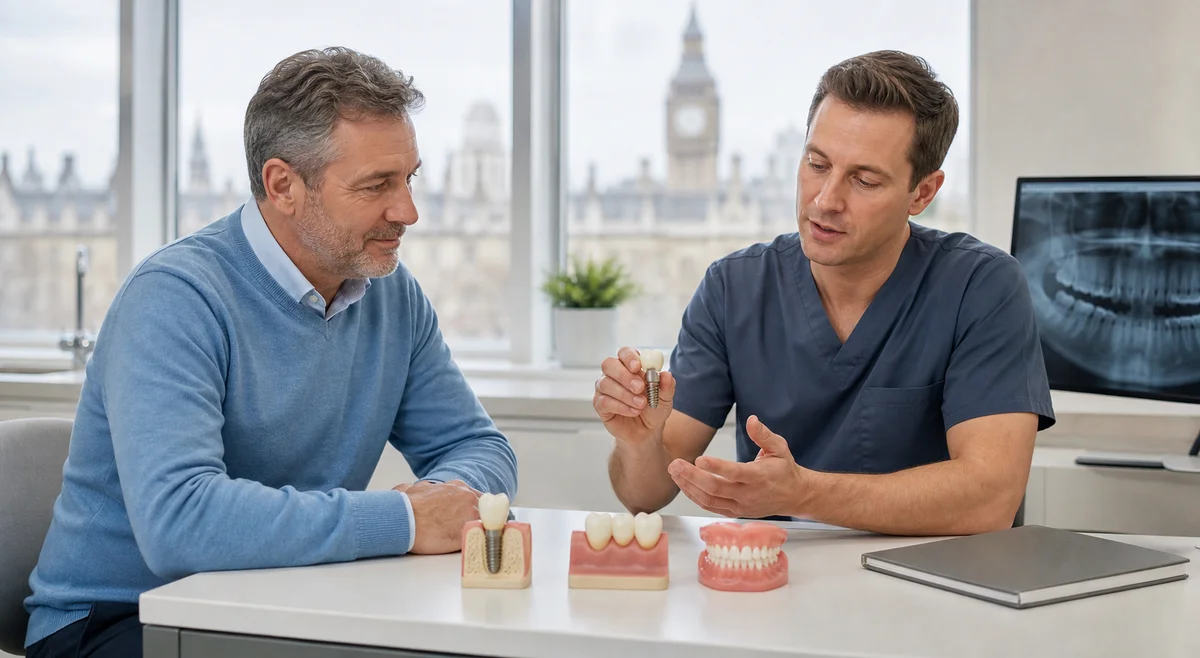
Low cost dental implants UK searches can lead to dramatically different offers because an “implant” price may describe only the fixture, the surgical appointment or a complete restored tooth. Assessment, imaging, extraction, grafting, abutment, temporary tooth, final crown and aftercare may appear in separate fees. The safest way to reduce avoidable expense is to compare the same clinical scope, not choose from a headline alone.
This guide explains NHS limits, private quote structure, legitimate ways to control cost, alternatives to a single-tooth implant, finance questions, provider checks and treatment-abroad planning. It does not diagnose suitability or promise a price. Only an examination with appropriate records can establish whether implants are reasonable and which stages your mouth actually needs.
Quick answer: low cost dental implants UK options should still include proper assessment, a written itemised plan, traceable components, qualified clinicians and realistic aftercare. Compare the implant, abutment and restoration together; ask about conditional grafting, temporary teeth and maintenance; consider bridges or dentures; and treat finance or overseas packages as complete-cost decisions rather than discounts.
1. What low cost dental implants UK should mean
Lower cost should mean removing avoidable or unsuitable expense while preserving necessary clinical steps. It may come from comparing several itemised plans, choosing a restoration that meets rather than exceeds your needs, arranging appointments efficiently or selecting a reasonable alternative. It should not mean skipping examination, disease control, consent, component records or follow-up.
The General Dental Council does not set private dental fees and states that private prices vary between practices. The Competition and Markets Authority advises patients to shop around, understand costs before agreeing and ask about alternative treatments that may be cheaper. A reliable low cost dental implants UK comparison therefore starts with transparent information rather than a national “correct” price.
A higher fee does not guarantee success, and a lower fee does not prove unsafe care. Value depends on whether the plan answers the clinical problem, identifies risks, uses suitable materials and provides continuity if circumstances change. In every low cost dental implants UK review, ask which clinician owns the overall plan when surgery and the final tooth are delivered by different people.
Be cautious with “from,” “per implant” and “complete smile” language. A “per implant” figure can omit the visible crown, while a “full arch” offer can describe a temporary restoration rather than the definitive one. Turn every low cost dental implants UK advertisement into a written list of included, excluded and conditional items before paying.
2. NHS access and low cost dental implants UK expectations
NHS guidance says implants are usually available privately. In rare circumstances they may be provided through the NHS, such as for people unable to wear dentures following specific conditions including mouth cancer or an accident. Specialist services apply referral and eligibility criteria. Receiving free NHS dental treatment or qualifying for help with NHS charges does not automatically fund a private implant.
Ask an NHS dentist which clinically necessary alternatives are available and whether your circumstances might justify a specialist referral. A referral is not approval, and waiting for a funding decision should not delay treatment of pain, infection or active disease. Keep NHS and private parts clearly separated in any mixed low cost dental implants UK plan.
NHS low-income help applies to eligible NHS charges, not automatically to privately purchased implants. This distinction matters when planning low cost dental implants UK. If a provider suggests that a private implant will be reimbursed, verify the claim directly with the responsible NHS body before relying on it.
A bridge or denture may be clinically appropriate even when an implant is technically possible. NHS services are intended to provide care needed to keep the mouth healthy, but the specific option depends on assessment and commissioning arrangements. Your dentist should explain benefits, limitations, costs and whether each proposed element is NHS or private.
3. The 11 cost layers in low cost dental implants UK plans
Use the following list to decode low cost dental implants UK quotes. Not every patient needs every stage, but every provider should be able to state which items apply and whether their fees are included.
- Consultation and diagnosis: dental and medical history, examination, bite assessment, photographs and initial records.
- Imaging: suitable radiographs and, where justified, three-dimensional cone-beam CT imaging and reporting.
- Disease control: management of decay, infection, gum disease and hygiene before elective surgery.
- Extraction: removal of a remaining tooth, socket care and reviews where needed.
- Bone or soft-tissue management: graft material, membranes, sinus procedures or gum grafting when clinically indicated.
- Implant placement: implant fixture, local anaesthetic, sterile surgery, sutures and routine surgical review.
- Digital or guided workflow: planning software, laboratory design and surgical guide if recommended.
- Temporary tooth: removable, bonded or implant-supported provisional restoration where suitable.
- Abutment: standard or customised connector between the implant and visible restoration.
- Definitive restoration: crown, bridge or overdenture component, laboratory work, fitting and bite adjustment.
- Aftercare: early reviews, hygiene maintenance, future imaging when justified and repair arrangements.
Ask what happens if the implant does not integrate, a temporary tooth breaks, a graft needs longer or the definitive restoration requires a remake. These events may occur despite appropriate care. A transparent low cost dental implants UK plan explains financial responsibility without presenting a biological result as guaranteed.
4. Decision table for comparing low cost dental implants UK
This table helps make competing low cost dental implants UK offers comparable. It is not a clinical recommendation or a clinic ranking.
| Area | Minimum detail to request | Useful question | Common uncertainty |
|---|---|---|---|
| Assessment | Exam, records, imaging and diagnosis | Which records are included and why are they needed? | Extra or repeated scans |
| Surgery | Fixture, placement, anaesthetic and reviews | Who places the implant and provides urgent care? | Complex extraction or grafting |
| Restoration | Abutment, temporary and final tooth | Is the advertised fee a restored tooth or fixture only? | Custom parts and laboratory remakes |
| Timing | Expected stages and healing intervals | What could add visits or delay the final tooth? | Extra leave, travel or temporary restoration |
| Aftercare | Included reviews and long-term maintenance | When do routine visits become separately chargeable? | Hygiene, repairs and replacement parts |
| Change control | Written revision and consent process | Will added treatment be approved before it begins? | Unplanned surgery or different restoration |
Label each cell “included,” “excluded,” “conditional” or “unclear.” Do not count an unclear item as free. If two plans use different numbers of implants or replace different numbers of teeth, their totals do not represent the same treatment. A fair low cost dental implants UK decision compares both scope and clinical reasoning.
5. Eleven safer ways to reduce total cost
Cost control is most effective before treatment starts. The following low cost dental implants UK strategies can improve transparency without assuming that a particular procedure is suitable.
- Stabilise disease early: treating decay and gum inflammation before they worsen may prevent a more complex sequence.
- Request at least two complete plans: compare diagnosis and scope, not just totals.
- Ask about all alternatives: bridge, denture, repair, monitoring or no immediate replacement may be reasonable in some cases.
- Separate essential from optional: ask why each material, technology or upgrade changes the clinical result.
- Confirm component inclusion: fixture, abutment and final restoration should not be confused.
- Plan temporary teeth: avoid a late fee by deciding how the gap will be managed during healing.
- Coordinate visits: where clinically appropriate, sensible scheduling may reduce travel and time away from work.
- Review payment timing: staged payments should match actual stages rather than requiring the whole estimate too early.
- Understand guarantee terms: written limits are more useful than vague lifetime language.
- Protect maintenance: budgeting for hygiene and reviews may help detect problems before repair becomes extensive.
- Avoid urgency marketing: take time to read the plan, consent and credit terms.
None of these steps means selecting an inferior material or fewer implants without clinical justification. The aim of low cost dental implants UK planning is to pay for care that is necessary, understood and maintainable, not to remove safeguards.
6. Alternatives that may change the low cost dental implants UK calculation
A missing tooth can sometimes be managed with a conventional bridge, adhesive bridge, removable partial denture or observation. Each option affects neighbouring teeth, cleaning, comfort, repair, longevity and future choices differently. A complete low cost dental implants UK discussion should compare these options because the lowest initial fee may not be the lowest long-term burden.
For several missing teeth, one implant per tooth is not always necessary. In selected designs, implants can support a bridge or stabilise a removable overdenture. The number and position must follow anatomy, load, span, hygiene access and restorative design. Do not reduce implant numbers purely to achieve a low cost dental implants UK headline.
Keeping a restorable natural tooth may sometimes be preferable to extraction and replacement, while a tooth with a poor prognosis may not justify repeated procedures. A dentist should explain the evidence, uncertainty and likely maintenance for both preservation and replacement. A second opinion can be particularly valuable when the alternatives are irreversible.
Doing nothing immediately can be a legitimate option in some stable situations, but it has consequences. Teeth may move, bone can change and chewing or appearance may be affected. The decision requires individual assessment rather than a generic cost comparison.
7. Diagnosis, grafting and timing are not optional extras
Appropriate imaging helps assess neighbouring roots, available bone and anatomical structures. A cone-beam CT is useful when clinically justified, but more imaging is not automatically better. Ask what question the scan answers, who reports it and whether it is included in the low cost dental implants UK estimate. Record the answer beside every low cost dental implants UK quote you compare.
Bone grafting describes different procedures. A small defect around an implant, socket preservation, ridge augmentation and sinus graft are not equivalent. Ask about the purpose, material, healing period, alternatives and fee. It is reasonable for an initial estimate to be conditional if the clinician explains what finding would trigger the change.
Immediate implant placement, immediate temporary teeth and immediate definitive teeth are different concepts. Some patients can receive selected stages on the same day, but infection, bone, implant stability, bite and aesthetic demand affect suitability. Fewer calendar visits do not prove safer care or a lower complete cost.
Guy’s and St Thomas’ NHS guidance describes implant care as a staged process that can include assessment, grafting, placement and restoration. Biological healing cannot always be compressed to fit work or travel. Build a time range, not a guaranteed date, into your low cost dental implants UK plan.
8. Written estimates, deposits and price changes
GDC standards require clear information and a written treatment plan before care starts. The plan should state proposed treatment, give a realistic indication of cost and identify NHS, private or mixed elements. If a low cost dental implants UK plan changes, the estimate should be reviewed and an updated written version provided.
Ask whether each charge is fixed, estimated, conditional or a range. The CMA’s current private-dentistry advice stresses clear upfront pricing and alternatives. General UK price-transparency guidance also warns against adding mandatory fees late in a purchasing journey. For low cost dental implants UK, request the total known price and a clear description of variables before committing.
Read deposit, cancellation, refund and laboratory terms. Custom components may create costs once ordered, but the policy should explain when that happens. A deposit should not prevent you from pausing after a significant diagnostic change or from asking why extra treatment is necessary.
Keep copies of the signed plan, consent, receipts, radiographs, photographs, implant labels and correspondence. These records support continuity if you move, change dentist or need maintenance years later.
9. Finance and monthly payment plans
A monthly figure is not the treatment price. Ask for the cash price, deposit, amount borrowed, term, interest rate, representative APR where applicable, fees, total repayable, late-payment consequences and refund process. In a low cost dental implants UK comparison, measure total repayment against total treatment scope, not another provider’s deposit.
From 15 July 2026, the Financial Conduct Authority regulates certain third-party deferred-payment credit arrangements, often described as Buy Now Pay Later. The FCA explains that coverage depends on how the credit is provided; some supplier-provided arrangements remain outside that regime. Check the lender and agreement rather than assuming every dental instalment plan has identical protections.
Credit can spread cash flow but increases financial commitment. A safe low cost dental implants UK choice remains affordable after rent, bills and essential spending. Do not use an urgent clinical decision or limited-time discount as a reason to accept borrowing you do not understand.
Ask what happens to the credit agreement if treatment changes, is delayed or is cancelled. Clinical consent and credit consent are separate. If repayment is difficult, contact the lender promptly and use independent support such as MoneyHelper rather than ignoring missed payments.
10. Check the clinician, practice and continuity
Every UK dental professional providing treatment must be appropriately registered with the General Dental Council. Search the register for each clinician. Registration confirms legal status but not specific experience, so a low cost dental implants UK check should also identify who plans, places and restores the implant and who covers each stage if a team is involved.
Healthcare inspection is devolved. In England, the Care Quality Commission publishes provider details and inspection reports for dental services. Other UK nations have their own inspectorates. The CMA’s UK guidance links to the appropriate services. A responsible low cost dental implants UK check uses the regulator for the country where treatment will occur.
- Verify the treating professionals on the GDC register.
- Check the practice with the relevant national healthcare inspectorate.
- Ask who is responsible for the overall treatment plan.
- Confirm indemnity, complaints and out-of-hours arrangements.
- Request the implant system and component traceability record.
- Agree how records will be shared with your regular dentist.
Online reviews may reveal communication patterns but cannot confirm diagnosis or competence. Be cautious when reviews make identical claims, omit the final restoration stage or focus only on hospitality. Regulatory records and a complete written plan carry more weight.
11. UK versus treatment abroad
Treatment abroad can be an option, but the complete comparison includes consultation, diagnostics, all implant components, temporary and final teeth, flights, accommodation, time off work, translation, insurance, aftercare and return travel if complications occur. Put these items beside the equivalent low cost dental implants UK pathway; currency conversion and card fees can also change the total.
The GDC advises people considering overseas dental care to research the local regulator, verify qualifications, receive a qualified assessment, consult their own dentist and ask about complications, aftercare, complaints and insurance. The FCDO notes that standard travel insurance does not normally cover planned elective treatment and official assistance with a commercial dispute may be limited.
Compare an overseas pathway with the whole low cost dental implants UK pathway, not with a fixture-only UK advertisement. Ask whether the overseas final restoration is fitted after adequate healing, how emergency advice works after returning and whether a UK dentist has agreed to maintenance. An independent UK clinician is not automatically responsible for another provider’s active plan.
- Verify the clinic, clinician and regulator in the destination country.
- Obtain records and component details in a usable language.
- Budget for every expected and possible return trip.
- Check insurance exclusions for planned dental treatment.
- Understand complaint jurisdiction and remedial-care terms.
- Do not shorten healing solely to match a holiday itinerary.
12. Maintenance is part of low cost dental implants UK
Implants do not decay, but plaque-related inflammation can affect the surrounding tissues. Crowns, bridges, screws and denture attachments can also wear or loosen. Daily cleaning, risk-factor management and professional review belong in every low cost dental implants UK pathway, not as optional extras after the final tooth is fitted.
Long-term appointments may include examination, gum measurements, hygiene care, bite assessment, radiographs when justified and attention to components. Ask what is included during initial aftercare and what later care usually costs. A durable low cost dental implants UK budget includes maintenance and possible repairs.
Smoking, poor plaque control, previous gum disease, uncontrolled diabetes and heavy bite forces may affect risk. The individual discussion should avoid guarantees and explain what you can do to reduce preventable problems. Do not conceal medical information to protect an advertised price.
Contact a dentist promptly for increasing pain, swelling, discharge, persistent bleeding, movement, a changed bite, trauma or concerning numbness. Never tighten an implant component or apply household glue. Early assessment may keep a small maintenance issue from becoming more extensive.
13. Red flags in low cost dental implants UK advertising
Price-led advertising becomes risky when it removes context or creates pressure. Pause when a provider offers a definitive plan without examination, guarantees a biological outcome, refuses to name the treating dentist or cannot explain who supplies the final crown.
- A countdown discount that expires before you can review consent.
- A “complete” fee that does not name the abutment or final restoration.
- Routine extraction or grafting added without diagnosis or written reason.
- No GDC registration details or unclear practice location.
- No written urgent-care, complaint or refund process.
- A lifetime guarantee with no maintenance conditions or exclusions.
- Finance promoted through monthly payments without total repayable.
- Claims that every patient is suitable or can finish on the same timetable.
A careful low cost dental implants UK provider should welcome questions, explain uncertainty and allow time to decide. Seeking another opinion is reasonable when the recommended number of implants, need for grafting or long-term responsibility remains unclear.
14. Consultation checklist
Use the same questions at each consultation. Consistent answers turn low cost dental implants UK research into a meaningful clinical and financial comparison.
- What diagnosis supports an implant, and what alternatives are reasonable?
- Which health or dental factors change my individual risk?
- Which radiographs or scans are required, and are they included?
- Is extraction, bone grafting or gum treatment expected or conditional?
- Does the fee include implant, abutment, temporary and final tooth?
- Who performs each stage, and how can I verify registration?
- Which implant system is proposed, and will I receive its records?
- How many visits are expected and what could extend treatment?
- What happens clinically and financially if integration fails?
- How are plan changes explained and approved?
- Which reviews are included and when do maintenance fees begin?
- Who provides emergency and out-of-hours advice?
- What are the cash price and total credit repayment?
- Which deposit or laboratory payments are refundable?
Low cost dental implants UK: frequently asked questions
Can low cost dental implants UK be priced online?
An online figure can show a provider’s usual starting structure, but it cannot confirm your total. Gum health, bone, imaging, extraction, grafting, bite, restoration design and medical history may change the plan. Use online prices to form questions, then request an individual written estimate after assessment.
Can I get a dental implant free on the NHS?
Implants are usually private. NHS provision is uncommon and subject to defined clinical criteria, sometimes following conditions such as mouth cancer or an accident when dentures cannot be worn. Financial eligibility for free NHS dentistry does not itself create eligibility for an implant.
Is the cheapest implant brand the best way to save?
Brand price alone does not determine value. Appropriate diagnosis, placement, restoration design, traceability and maintenance are essential. A well-supported system may make future parts easier to obtain, but suitability depends on the full plan. Ask why the proposed system fits your case.
Do I need one implant for every missing tooth?
Not always. In selected cases, implants can support a bridge or stabilise a removable denture. The number and position depend on bone, load, span, cleaning access and restorative design. Reducing implant numbers purely for price can create an unsuitable plan.
Will dental finance make treatment cheaper?
Finance changes payment timing, not necessarily total cost. Compare cash price, deposit, interest, fees and total repayable. Check whether the lender and agreement are regulated and what happens if treatment changes. Borrowing should remain affordable alongside essential living costs.
Are dental schools a guaranteed low-cost route?
No. Teaching services have their own referral, educational and clinical criteria, and they are not a general discount pathway for every implant case. Availability, supervision and waiting times vary. Treat any opportunity as a formal clinical service, not an assumed entitlement.
Is overseas care always less expensive than UK treatment?
No. Add travel, accommodation, leave, insurance, translation, aftercare and possible return visits. Compare regulation, records, components and complaint routes as well as price. A lower starting figure can still produce a higher or less predictable complete pathway.
Where can I request an individual assessment?
Read about the stages and planning principles on Redent Clinic’s dental implant page. You can use the Redent Clinic contact page to ask what records are needed for a consultation. Any remote discussion remains preliminary until a dentist examines you.
Conclusion: make affordability compatible with safety
A sensible low cost dental implants UK decision compares complete, clinically equivalent pathways. Confirm diagnosis and alternatives; separate implant, abutment and restoration; identify conditional grafting and temporary teeth; verify clinicians; understand finance; and budget for maintenance. NHS support is exceptional rather than a general discount route.
Take time to review the written plan and seek another opinion when material points remain unclear. Affordability matters, but an incomplete low price can be more costly if it omits necessary stages or continuity. The best value is care you understand, can maintain and can access if something changes.
Official and clinical sources
- NHS — Dental treatments and dental implant availability
- NHS — Dental services, plans and private treatment disclosure
- Competition and Markets Authority — Choosing and paying for dental care
- Competition and Markets Authority — UK private dental services market study
- General Dental Council — Dental costs
- General Dental Council — Written plans and cost communication
- Care Quality Commission — Find a dentist and inspection reports
- Guy’s and St Thomas’ NHS Foundation Trust — Implant stages, risks and maintenance
- Financial Conduct Authority — Deferred-payment credit and consumer protections
- General Dental Council — Going abroad for dental treatment
- American Dental Association — Professional and patient oral-health resources
- World Health Organization — Oral health fact sheet