
Quick answer: minor invisalign before and after images may illustrate small changes in spacing, rotation or alignment, but they cannot confirm that your bite, roots and gums are suitable. A safe comparison needs a clinical assessment, consistent photographs, a defined treatment goal, disclosure of attachments or enamel reduction, and a written retention plan. A digital preview is a planning aid, not a guaranteed outcome.
Searching for minor invisalign before and after examples usually begins with a practical question: can a subtle concern be improved without fixed braces or a long, complex course of treatment? The visible issue may be one rotated incisor, a small space, mild crowding or movement after previous orthodontics. Yet the smallest-looking change can still affect contacts between upper and lower teeth, gum support, tooth roots and long-term stability.
This guide explains how to read galleries and simulations without mistaking them for a diagnosis. Invisalign is a brand of clear-aligner treatment; “clear aligner” is the broader appliance category. The word “minor” is not a universal clinical classification and does not tell a clinician which teeth must move, how roots should respond or whether the bite needs correction. Only an appropriate dental and orthodontic assessment can establish suitability.
The information below is educational and does not replace an examination. Seek prompt dental advice if you develop severe or increasing pain, marked swelling, bleeding that does not settle, a loose tooth, gum recession, a tray that cuts tissue, or a new bite problem. Do not skip prescribed stages, alter trays or attempt tooth movement on your own.
1. What minor invisalign before and after images can show
A well-made series can document visible alignment from similar angles. It may show a space closing, a front tooth becoming less rotated, an irregular incisal edge looking more even, or a previous orthodontic relapse being corrected. A sequence taken throughout treatment can also help patients understand attachments, refinement trays and the transition to retainers.
However, minor invisalign before and after photos show surfaces, not the whole biological system. They usually do not reveal root position, bone levels, active gum disease, cavities between teeth, jaw relationships or the force plan used to produce movement. They may also hide whether the “after” picture was taken immediately after treatment, after cosmetic contouring or whitening, or after a period of stable retention.
- Potentially visible: front-tooth alignment, small spaces, rotations, symmetry and smile-line changes.
- Usually not visible: root angulation, bone support, posterior bite contacts, gum-pocket findings and joint symptoms.
- Needs disclosure: attachments, elastics, interproximal reduction, restorative work, whitening, contouring and refinement trays.
- Needs time context: start date, end of active movement, retainer stage and length of follow-up.
Use minor invisalign before and after as an illustration of what happened in one documented case. Do not use it as a promise that the same appliance, schedule or number of trays will produce the same result for you.
In other words, minor invisalign before and after is most useful when it answers a defined question rather than selling a universal transformation.
2. “Minor” describes appearance, not necessarily complexity
A front tooth may look only slightly displaced but require careful root movement, space creation or changes to neighboring teeth. A tiny gap can be related to tooth size, missing teeth, gum architecture, a frenum, tongue habit or the way upper and lower teeth meet. Mild crowding may also coexist with a deeper bite or crossbite that is difficult to see in a smiling photograph.
The British Orthodontic Society says clear aligners are commonly used for mild-to-moderate irregularity, mild spacing and selected crowding, while more complex movements may require additional techniques or fixed appliances. That means minor invisalign before and after should be interpreted through the diagnosis, not by counting how many millimeters the smile appears to change.
Common concerns that may look minor
- a slightly rotated or tipped front tooth;
- a small gap between upper incisors;
- mild lower-incisor crowding;
- relapse after braces or previous aligners;
- one tooth appearing longer because of its position;
- a small midline discrepancy;
- a cosmetic concern that is actually caused by tooth shape rather than position.
Some of these concerns may be suitable for limited aligner treatment; others may be better addressed with monitoring, restorative care, gum treatment, fixed orthodontics or a more comprehensive plan. A responsible clinician should explain both the achievable change and what limited treatment deliberately leaves uncorrected.
Labeling a gallery minor invisalign before and after does not establish which of those options was clinically appropriate.
3. How to assess minor invisalign before and after photos fairly
Photography can exaggerate or minimize a change. Camera distance, lens, head position, lip posture, lighting, dryness and magnification all matter. A bright “after” photo may look more impressive because the teeth are whiter or the image is sharper, even when alignment changed only slightly. Compare like with like.
| Photo check | More useful evidence | Reason for caution |
|---|---|---|
| View and scale | Same front, side and biting views at similar magnification. | Different angles can conceal rotation, overjet or an open contact. |
| Lighting and color | Consistent exposure and no undisclosed whitening. | Brighter teeth can create the impression of a larger orthodontic change. |
| Lip and head position | Neutral, repeatable posture. | A wider smile or tilted head changes what is visible. |
| Treatment details | Attachments, elastics, enamel reduction and refinements disclosed. | The tray alone may not have produced every visible change. |
| Timing | “After” date and retention follow-up stated. | An immediate finish does not demonstrate long-term stability. |
| Whole bite | Clinical records in addition to smile photos. | A pleasant front view can coexist with unwanted bite contacts. |
When a gallery presents minor invisalign before and after, look for multiple views and a plain description rather than dramatic language. The most ethical presentation acknowledges individual variation and avoids claiming that one patient’s response predicts another person’s outcome.
For a fair minor invisalign before and after review, note any change in camera position before judging the size of the dental change.
4. A digital preview is not the same as an achieved result
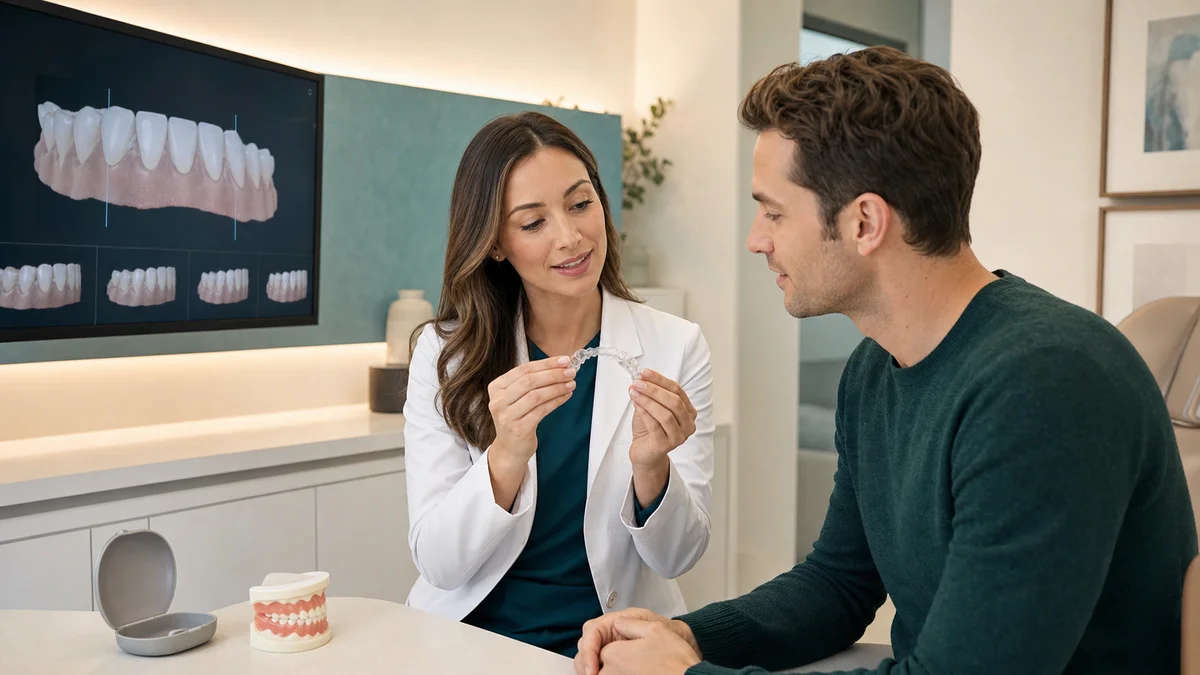
Clear-aligner planning software can display staged tooth positions and an intended endpoint. It helps the clinician review movement, attachments and sequencing, and it helps the patient discuss goals. But the animation is a proposed plan. Teeth move within living tissues, and the actual response can differ from the programmed path.
Align Technology’s own SmileView material describes its output as a computer-generated simulation and states that actual results may vary. Therefore, a simulated minor invisalign before and after must not be presented as a guarantee. Ask which parts are a visualization, which are measured records and how progress will be checked.
A planned minor invisalign before and after sequence should always remain distinguishable from photographs of an achieved result.
Questions to ask about the simulation
- Which movements are essential for health and which are mainly cosmetic?
- Does the plan change the bite or only align selected front teeth?
- Where are attachments, elastics or enamel reduction proposed?
- What will be measured if a tooth does not track as expected?
- What alternatives exist if the planned endpoint cannot be reached safely?
- Does the quoted fee include refinement scans and additional aligners?
5. Records needed before a minor aligner plan
A scan or impression records tooth surfaces, but it is not a complete oral-health assessment. Planning may also require medical and dental history, examination of teeth and gums, bite evaluation, photographs and imaging when clinically indicated. The type and timing of radiographs should be individualized; more imaging is not automatically better.
The American Dental Association and American Association of Orthodontists emphasize professional assessment and supervision. A clinician needs to identify decay, active gum disease, root or bone concerns, missing teeth, previous dental work and bite problems before prescribing movement. A safe minor invisalign before and after pathway starts with these records, not with an app-generated smile image.
Ask which records support the proposed minor invisalign before and after endpoint and why each one is clinically relevant.
Why gum and bone health matter
Orthodontic force acts through the tissues around tooth roots. Inflamed gums, reduced bone support or poor plaque control may change risk and timing. A tooth that appears crooked may also have recession or thin gum tissue that needs careful assessment. Treatment may need to pause while oral disease is managed.
6. What the treatment plan should define
A limited plan needs a clearly limited objective. It should say which teeth are intended to move, what bite changes are accepted, what remains unchanged and how the final position will be retained. “Straighten the front teeth” is not enough if the route creates unwanted contacts or moves teeth outside a safe biological envelope.
Ask for a plain-language explanation of your minor invisalign before and after goal. You should understand the role of every planned step, including any alternatives. Informed consent means having an opportunity to ask questions about benefits, limitations, risks, likely outcomes and what happens if you are unhappy or the plan changes.
A written minor invisalign before and after objective makes it easier to distinguish a refinement from an unplanned change in scope.
Limited alignment versus comprehensive correction
Limited treatment may intentionally prioritize a defined cosmetic or relapse concern. Comprehensive orthodontics considers the whole bite and may involve more teeth or a longer course. Neither label is automatically better. The appropriate choice depends on diagnosis, goals, risk and informed acceptance of trade-offs.
7. Attachments, enamel reduction and elastics
Many clear-aligner cases use small tooth-colored attachments to help the tray grip and express specific movements. Some require elastics. Interproximal reduction, sometimes called IPR, removes a carefully planned small amount of enamel between selected teeth to create space or improve shape and contact. These are clinical procedures, not details to discover after treatment starts.
A gallery showing minor invisalign before and after should disclose relevant additions because they affect appearance, consent and comparison. Ask which teeth may receive attachments, why IPR is considered, how much is planned, what alternatives exist and whether these steps are included in the fee.
Without that disclosure, minor invisalign before and after may wrongly imply that removable trays acted without any supporting procedure.
Does “minor” mean no attachments?
No. The visible size of the problem does not determine the biomechanics. A small rotation may still need an attachment, space or refinement. Conversely, some very limited movements may need fewer auxiliaries. Your own plan—not a marketing category—should provide the answer.
8. Wear, tracking and refinements
Aligners are removable, so treatment depends partly on wearing and changing them as prescribed. Removing them too often, advancing without approval or wearing a poorly fitting tray can prevent planned movement. Follow the schedule from the treating clinician rather than copying a timetable from social media.
“Tracking” describes how closely the teeth and attachments fit the intended tray position. A small gap between tray and tooth can sometimes signal that movement is not following the plan, but patients should not diagnose the cause themselves. Contact the treating team for instructions. The NHS and BOS both stress following professional advice and maintaining oral hygiene during orthodontic treatment.
Refinements are additional planned stages after reassessment and often a new scan. They are not necessarily a sign of failure, but they affect time, cost and expectations. When studying minor invisalign before and after, check whether the stated tray count includes refinements or only the first series.
Progressive minor invisalign before and after records are more informative when they identify the first series and each refinement separately.
9. Realistic timing for minor invisalign before and after
There is no safe universal timetable based only on a photo. Timing depends on the movements required, biological response, tray fit, wear, appointments, oral health and whether refinement is needed. A case that looks minor can take longer if roots need controlled movement or the bite must be protected.
Do not treat a rapid minor invisalign before and after story as a benchmark. Ask for a range and the assumptions behind it. A responsible estimate should explain what may delay completion, when a rescan is considered and how progress is clinically reviewed.
The duration attached to one minor invisalign before and after case is a historical fact about that patient, not your treatment schedule.
What should be included in a timeline?
- records and oral-health preparation;
- delivery and fit review;
- active aligner stages and monitoring;
- possible refinement records and trays;
- attachment removal and final records;
- retainer delivery, fit and follow-up.
10. Risks that a smile photo cannot show
Orthodontic treatment can involve temporary soreness and may create hygiene challenges. Potential unwanted outcomes include gum irritation or recession, decay or white-spot changes, root shortening, loss of vitality in a previously damaged tooth, incomplete movement, bite changes and relapse. The relevant risks and their likelihood depend on the individual case.
A polished minor invisalign before and after image cannot establish that these issues were absent. Ask how baseline gum findings, tooth vitality, roots and bite contacts will be assessed, and how the clinician will respond to unexpected changes. Keep seeing your general dentist as advised during orthodontic treatment.
Risk information should therefore sit beside every minor invisalign before and after discussion, even when the visible movement appears small.
When should you contact the treating team?
- a tray is persistently painful, sharp, cracked or will not seat;
- an attachment breaks or an elastic cannot be worn as directed;
- gum swelling, bleeding or recession appears or worsens;
- a tooth feels loose, changes color or becomes very sensitive;
- the bite suddenly feels different or chewing becomes uncomfortable;
- you lose trays or accidentally skip a stage.
Do not trim, heat, reshape or force an aligner unless the clinician specifically instructs you. If severe swelling, difficulty swallowing or breathing, facial trauma or uncontrolled bleeding occurs, seek urgent care.
11. Oral hygiene during clear-aligner treatment
Clear trays cover tooth surfaces for much of the day. Food debris and fermentable drinks trapped under a tray can increase concern for enamel and gum health. Brush and clean between teeth as advised, clean trays using the method recommended for the material, and avoid hot water that may distort plastic. Follow professional advice about eating and drinking with aligners.
The ADA emphasizes individualized home care and regular dental oversight during orthodontic treatment. In a credible minor invisalign before and after case, the “after” should represent healthy tissues as well as straighter teeth. Whiter lighting must not distract from redness, plaque, recession or new enamel spots.
Healthy-looking gums strengthen a minor invisalign before and after record only when clinical findings confirm what the photograph seems to show.
Attachments need extra attention
Edges around attachments can retain plaque. Ask for a demonstration of brushing and interdental cleaning around them. If gums bleed repeatedly or an attachment creates a rough area, inform the treating practice rather than waiting until the final visit.
12. Retainers are part of the result
Teeth can move again after active orthodontic treatment. Retainers help hold the corrected positions while tissues adapt and may be recommended long term. The NHS notes that stopping retainer wear is likely to allow some movement and that positional changes can continue through life. Retention is therefore not an optional footnote to a gallery.
Any minor invisalign before and after comparison should state whether the “after” result is before or after a period of retainer use. Ask which retainer type is proposed, when it will be delivered, how often it should be worn, how it is cleaned, who checks it and what replacement costs may apply.
A long-term minor invisalign before and after follow-up is more meaningful when retainer wear and any relapse are reported honestly.
Relapse after earlier treatment
If teeth moved after braces or aligners, the new plan should explore why. A retainer may have been lost, broken or no longer fitted, but natural changes and bite forces also matter. Simply repeating movement without a sustainable retention plan can repeat the same problem.
13. Cost and contract questions
Price depends on diagnosis, records, appliance system, number of arches, appointments, auxiliaries, refinements and retention. Insurance rules vary by policy and jurisdiction. Avoid a fixed online price that is offered before anyone has assessed oral health and treatment needs.
When comparing minor invisalign before and after offers, request a written itemization. Confirm whether the quoted amount covers examination, records, attachments, IPR, elastics, emergency visits, rescan, refinements, replacement trays, retainers, retainer reviews and taxes. Ask what happens financially if aligners are not clinically suitable after in-person assessment.
Price claims beside minor invisalign before and after images are not comparable unless the clinical scope and included services are the same.
| Decision point | Useful written answer | Red flag |
|---|---|---|
| Diagnosis | Teeth, gums and bite assessed with justified records. | Treatment approved from a selfie alone. |
| Goal | Movements, limitations and accepted compromises defined. | “Perfect smile” without a clinical endpoint. |
| Supervision | Named, licensed clinician and direct contact route. | Only a sales or customer-service contact is available. |
| Extras | Attachments, IPR, elastics and refinements disclosed. | Tray fee presented as the full treatment fee without detail. |
| Problems | Clinical review and escalation process explained. | Advice is limited to uploading another selfie. |
| Retention | Retainer type, wear, replacement and review stated. | No retention plan until after payment or completion. |
14. Remote planning and treatment abroad
Digital communication can make preliminary review convenient, especially for patients considering dental travel. It can organize goals and existing records, but it cannot confirm every clinical finding. The General Dental Council’s patient guidance says informed consent requires direct interaction so patients can ask questions; this interaction may be remote, but the necessary information and professional accountability still matter.
Before traveling for a minor invisalign before and after plan, clarify which steps require in-person assessment, who prescribes treatment, how tracking is monitored, how attachments or IPR are performed, and who handles urgent issues at home. Ask whether a local dentist must check health during the course and how records are shared.
A cross-border minor invisalign before and after pathway also needs a practical plan for lost trays, broken attachments and retainer replacement after returning home.
You can review the English-language Redent Klinik overview and use the Redent Klinik contact page to ask how records and appointments are organized. A remote document review is not a final diagnosis, and travel should not be booked on the assumption that an aligner plan is guaranteed.
15. A 14-point minor invisalign before and after checklist
Use this checklist before accepting a treatment proposal or judging a gallery. Mark each item as documented, unclear or not applicable.
- Identity: Is the “before” and “after” the same patient and are images presented with consent?
- Consistency: Are angle, scale, lighting and posture reasonably comparable?
- Diagnosis: Are the tooth, gum and bite findings explained?
- Records: Were scans, photos and any clinically indicated imaging obtained?
- Objective: Is the limited treatment goal defined in measurable terms?
- Limitations: Is it clear what will not be corrected?
- Plan: Are tooth movements and bite effects reviewed by the treating clinician?
- Auxiliaries: Are attachments, elastics and IPR disclosed?
- Wear: Are tray wear, change and cleaning instructions individualized?
- Monitoring: Is there a clinical route for poor tracking or symptoms?
- Refinement: Are additional scans and aligners included or separately charged?
- Endpoint: Will final records assess more than the front-view smile?
- Retention: Is a durable retainer plan included?
- Accountability: Is a named clinician responsible throughout?
If several answers are unclear, do not let an attractive minor invisalign before and after image rush the decision. Ask for clarification or seek an independent orthodontic opinion.
Frequently asked questions about minor invisalign before and after
Can minor Invisalign treatment fix one crooked tooth?
Sometimes, but moving one visible tooth may require space and coordinated movement of neighboring teeth. The clinician must also check the root, gum support and bite. A photograph alone cannot determine whether isolated movement is safe or stable.
How many trays are shown in minor invisalign before and after cases?
There is no clinically meaningful standard number. Tray count depends on the prescribed movement, staging, fit and possible refinements. Compare treatment goals and records rather than assuming another patient’s tray count applies to you.
Does a small gap always close with clear aligners?
No. The cause, tooth proportions, gum architecture, bite and stability matter. A gap may close orthodontically but leave shape differences that require discussion of restorative alternatives. It may also reopen without appropriate retention.
Are minor invisalign before and after simulations accurate?
They can be useful planning visualizations, but they are not guaranteed predictions. Actual tooth response may differ, and refinements may be needed. Ask the clinician to separate proposed digital positions from achieved clinical records.
Will I need attachments for a minor case?
Possibly. Attachments depend on the type of movement rather than how small the concern looks. Your treatment plan should show their location and purpose before you consent.
Is interproximal reduction always required?
No. It is one possible way to create limited space or adjust contacts. If proposed, the clinician should explain where, why, how much, alternatives and relevant risks. Do not perform any enamel alteration yourself.
Can clear aligners change my bite?
Yes, intended or unintended bite changes can occur because moving teeth changes their contacts. That is why examination, whole-arch planning and monitoring matter even when the visible goal concerns only front teeth.
What if the aligner does not fit?
Contact the treating team and follow its instructions. Do not force the tray, jump ahead or reshape it with heat. Poor seating may relate to wear, a broken attachment, incomplete movement or another issue that needs assessment.
Do the results last permanently?
No clinician should promise permanent unchanged alignment. Teeth can move throughout life, and retainers are used to reduce relapse. Long-term stability depends on the case, retainer wear, oral health and follow-up.
Can I choose treatment from social-media photos?
Use photographs to identify questions, not to diagnose yourself. A clinical assessment should compare clear aligners with suitable alternatives and explain why the recommended option fits your health and goals.
What should the “after” record include?
Useful final records include consistent photographs and an assessment of alignment, bite, gum condition and the treatment objective. When indicated, other clinical records may be needed. Retainer fit and follow-up should also be documented.
Who reviews this patient information?
This article is prepared for clinical review by Dentist Esma Çevrük Çakır. It provides general education and does not diagnose candidacy, prescribe a tray sequence or predict an individual outcome.
Clinical review: This evidence-led patient guide is prepared for review by Dentist Esma Çevrük Çakır for orthodontic plausibility, clear risk communication and patient safety. Personal treatment decisions require medical and dental history, a clinical examination and appropriate records.
Conclusion: judge the process, not only the picture
A responsible minor invisalign before and after comparison is transparent about diagnosis, photographic conditions, adjunctive procedures, timing, refinements and retention. It shows one patient’s documented journey without implying that the same endpoint is available to everyone.
Before deciding from any minor invisalign before and after example, ask whether the proposed movement protects the bite, roots, gums and enamel; confirm who supervises treatment; and obtain a written plan for monitoring, costs and retainers. The best “after” is not simply a straighter front view—it is an outcome that has been safely planned, clinically checked and realistically maintained.
Sources and further reading
- British Orthodontic Society: Clear aligners
- NHS: Orthodontic treatments and retainers
- American Association of Orthodontists: Clear aligners
- American Association of Orthodontists: At-home orthodontics considerations
- American Dental Association: Braces and orthodontic supervision
- American Dental Association: Direct-to-consumer dental services policy
- General Dental Council: Informed consent for remote aligner care
- Invisalign: Treatment results and image disclosures
- American Dental Association
- World Health Organization: Oral health fact sheet
Sources checked 31 July 2026. Manufacturer material is used only to clarify the status of simulations and image disclosures; clinical suitability should be assessed independently by a qualified dental professional.