
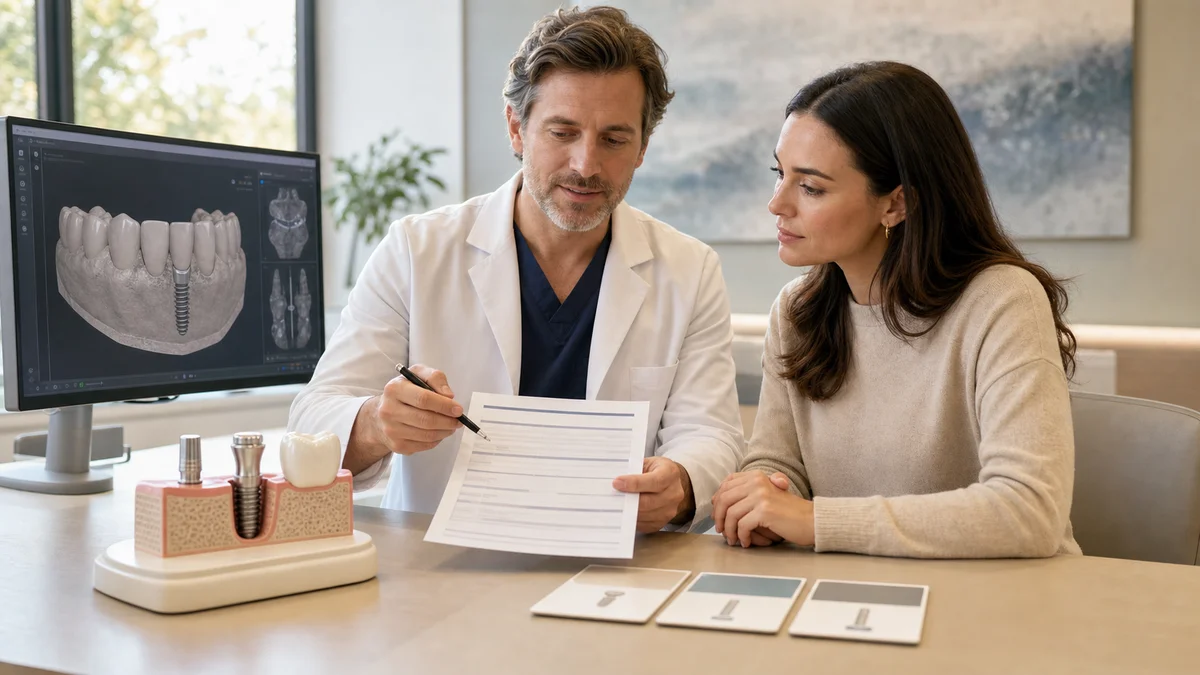
People who ask what is the approximate cost of dental implants are usually looking for a usable budget, not a vague statement that “it depends.” The difficulty is that an implant is not one interchangeable product. The final plan may include diagnostic imaging, disease control, surgery, a manufactured implant body, an abutment, a crown or larger prosthesis, temporary teeth, follow-up, and long-term maintenance. A headline amount that omits several of those parts can look economical while giving an unreliable picture of the total commitment.
Quick answer: What is the approximate cost of dental implants? A responsible estimate comes only after examination and imaging define the number of sites, bone and gum needs, restoration type, materials, anesthesia, provisional teeth, follow-up, and maintenance. Compare itemized complete-treatment quotes, not implant-placement fees alone, and confirm insurance and financing terms in writing.
This guide shows how to turn the question what is the approximate cost of dental implants into a structured comparison without promising a universal figure. It is educational, not a diagnosis or personal quotation. Your medical history, oral examination, radiographs or three-dimensional imaging when clinically justified, and a discussion of alternatives must come first. The evidence and patient-safety language will be reviewed by Diş Hekimi Esma Çevrük Çakır.
1. Why “what is the approximate cost of dental implants” has no single honest number
The phrase “a dental implant” may describe only the fixture placed in bone, or it may be used loosely for an entire restored tooth. Those are different scopes. The U.S. Food and Drug Administration explains that an implant system includes an implant body and an abutment and may include an abutment fixation screw; the system then supports an artificial tooth such as a crown, bridge, or denture. If one quote covers the fixture only and another includes the definitive restoration, comparing the totals is not meaningful.
Geography, laboratory work, clinician time, facility standards, implant system, anesthesia, and the complexity of the missing-tooth pattern also affect a quotation. More importantly, biological needs are not known from a photograph or a message. Bone volume, gum condition, active infection, bite forces, nearby anatomy, smoking, diabetes control, medicines, and the restorability of remaining teeth can change the recommended sequence. That is why the safest answer to what is the approximate cost of dental implants begins with scope rather than a price range.
A remote conversation can help organize questions, explain records, or describe a clinic’s process, but it cannot confirm candidacy. A written estimate should follow a clinical assessment and should separate known charges from possible additions. Any cost presented before that point should be labeled preliminary and should never be treated as a guaranteed final amount.
2. What is the approximate cost of dental implants when “implant” is clearly defined?
When you ask what is the approximate cost of dental implants, first ask the provider to define the unit being priced. A complete single-tooth restoration usually involves a surgical component below the gum and a restorative component above it. The implant body replaces the root function; the abutment connects the implant to the visible restoration; and the crown is the tooth-shaped part used for appearance and chewing. Each can involve different materials, appointments, clinicians, and laboratory processes.
A larger plan may use implants to support a bridge or removable denture rather than one crown per implant. A full-arch fixed prosthesis is another distinct design. The number of missing teeth does not automatically equal the number of implants, and adding implants without considering hygiene access, biomechanics, anatomy, and repairability is not necessarily better. The correct design is individualized.
- Implant body: the medical device placed in the jawbone.
- Abutment and fixation components: the connection between the implant and the prosthesis.
- Definitive restoration: a crown, bridge, removable overdenture, or fixed full-arch prosthesis.
- Provisional restoration: a temporary tooth or appliance used during a healing or transition phase when clinically appropriate.
- Professional services: diagnosis, planning, placement, restorative care, reviews, and maintenance.
Ask whether the estimate includes all five categories. This simple definition prevents a low placement-only fee from being mistaken for the answer to what is the approximate cost of dental implants.
3. What is the approximate cost of dental implants for each restoration type?
There is no sensible way to compare a single crown with an implant-supported bridge, a removable overdenture, or a fixed full-arch restoration. They solve different problems and require different prosthetic components. The answer to what is the approximate cost of dental implants is therefore linked to the treatment endpoint, not merely to the number of fixtures.
| Possible treatment endpoint | What the quotation should identify | Important decision question |
|---|---|---|
| Single implant crown | Implant body, abutment, crown, temporary option, imaging, placement, and reviews | Can the natural tooth be predictably restored instead? |
| Implant-supported bridge | Number of implants, number of bridge units, connector design, provisional bridge, and hygiene access | How will the bridge be cleaned and repaired? |
| Removable overdenture | Implants, attachment components, denture, relines, replacement inserts, and maintenance schedule | Who will service worn attachments? |
| Fixed full-arch prosthesis | Extractions if indicated, implants, provisional and definitive prostheses, materials, sedation, and contingency plan | Are provisional and definitive teeth both included? |
| Conventional bridge or denture alternative | Complete non-implant option, expected maintenance, and effects on adjacent teeth | Does this alternative meet the patient’s priorities with less treatment? |
Do not assume that the most complex endpoint is the best endpoint. A clinician should explain the benefits, limitations, hygiene requirements, repair pathway, and alternatives. The lowest total is not automatically the safest choice, but greater complexity is not automatically superior either.
4. What is the approximate cost of dental implants after diagnosis and imaging?
A defensible answer to what is the approximate cost of dental implants starts with a diagnosis. The examination should evaluate the missing-tooth site, remaining teeth, gums, bite, space for a restoration, oral hygiene, and relevant medical history. Imaging may include conventional dental radiographs and, when justified, three-dimensional imaging to assess bone and nearby anatomical structures. The type of imaging should be based on clinical need rather than used automatically.
The planning fee may cover records, photographs, digital scans, radiographs, a diagnostic wax-up or virtual setup, and coordination between surgical and restorative clinicians. Ask which records are included, whether copies will be provided, and whether additional imaging could be needed. If a second opinion is sought, transferable records can reduce needless repetition while the receiving clinician still decides what is diagnostically adequate.
The clinician should also decide whether an existing tooth can be saved. Endodontic treatment, periodontal care, a crown, a conventional bridge, or a removable prosthesis may be reasonable alternatives in some situations. “Implant” should not be the default answer before the diagnosis is clear. This is an important clinical and financial safeguard when evaluating what is the approximate cost of dental implants.
5. What is the approximate cost of dental implants with site preparation?
Active decay, gum disease, infection, or an unstable bite may need attention before or alongside implant treatment. The National Institute of Dental and Craniofacial Research describes periodontal disease as an infection of the tissues supporting teeth and notes that radiographs can help show bone loss. Treating disease is not an optional “upgrade”; it can be part of creating a healthier environment for any restoration.
Site preparation varies widely. An extraction may be straightforward or complex. A socket may heal without grafting, or a clinician may recommend a bone augmentation procedure based on the proposed implant position and anatomy. In the upper back jaw, sinus-related planning may be relevant. Soft-tissue procedures may be considered to improve hygiene access or tissue stability. None of these should be assumed from a marketing package.
- Ask which preparatory procedures are confirmed now and which are only possible.
- Ask what clinical finding would trigger a contingent procedure.
- Ask whether biomaterials, membranes, fixation devices, and post-operative reviews are included.
- Ask what happens to the estimate if implant placement must be delayed.
- Ask whether a temporary tooth is available during healing and what limitations it has.
When someone asks what is the approximate cost of dental implants, these conditional items are often the difference between an attractive headline and a realistic total-care budget.
6. What is the approximate cost of dental implants across surgical and restorative phases?
Implant treatment can involve one clinician or a coordinated team. Placement, bone or soft-tissue procedures, anesthesia, restorative design, laboratory fabrication, and maintenance may be billed by different providers. The answer to what is the approximate cost of dental implants must therefore show who is responsible for each phase and whether all professional fees are in one estimate.
The surgical phase may include placement, cover screws or healing abutments, post-operative checks, suture removal when needed, and later exposure of a buried implant. The restorative phase may include impressions or digital scans, bite records, trial stages, an abutment, the definitive prosthesis, delivery, occlusal adjustments, and early review. If the quote says “implant included,” ask which of these steps the word covers.
Coordination also matters when care is delivered across locations. Determine who handles an urgent problem, who evaluates healing, and who makes restorative adjustments. A treatment plan is incomplete if responsibility disappears after placement.
7. What is the approximate cost of dental implants with different treatment sequences?
“Same-day teeth” is often used as a broad marketing phrase. It may refer to placing an implant immediately after extraction, attaching a temporary restoration on the day of surgery, or delivering a provisional full-arch prosthesis. These are different decisions. Suitability depends on anatomy, primary stability, infection control, bite forces, patient behavior, and prosthetic design.
The FDA notes that healing of the implant body may take several months or longer. That does not mean every patient follows the same schedule. A temporary restoration may be used during healing, but it has limitations and is not necessarily the definitive tooth. The quotation should state whether the temporary component is fixed or removable, what happens if the planned immediate approach is not possible, and whether conversion or replacement fees are included.
For what is the approximate cost of dental implants to be answered honestly, the estimate should show the planned sequence and a fallback pathway. A delayed plan is not automatically inferior; it may be selected to manage biological or mechanical risk. No ethical provider can guarantee integration or a complication-free timeline.
8. What is the approximate cost of dental implants with documented systems and materials?
Materials and systems influence laboratory workflow, component availability, and future servicing. The FDA advises patients to ask what brand and model of implant system is used and to retain that information. A clinic should be able to document the implant system, size, position, and relevant component details in the patient record. This traceability can matter if a screw, abutment, or prosthetic component needs service later.
The definitive restoration may use different ceramics, metals, polymers, or combinations. Material selection should consider the site, available space, bite, appearance, repair strategy, and clinician-laboratory workflow. A more expensive material is not automatically the right choice, and a single material name does not predict clinical success.
When researching what is the approximate cost of dental implants, request the material and system description in writing. Also ask whether custom abutments, special components, a surgical guide, additional laboratory stages, or replacement screws are part of the estimate. A lifetime “warranty” should never be confused with a biological outcome guarantee; read exclusions, maintenance conditions, travel requirements, and who pays associated clinical or laboratory costs.
9. What is the approximate cost of dental implants in a complete-treatment quote?
A strong estimate distinguishes included, contingent, and excluded items. This structure makes what is the approximate cost of dental implants answerable without pretending that every variable is known before treatment. Ask each provider to complete the same table so the comparison is based on like-for-like scope.
| Quote line | Status to request | What to clarify in writing |
|---|---|---|
| Consultation and records | Included / excluded | Examination, scans, radiographs, planning, and copies of records |
| Disease control | Confirmed / separate | Decay, periodontal treatment, infection management, and stabilization |
| Extraction or site preparation | Confirmed / contingent | Procedure, biomaterials, reviews, and trigger for added treatment |
| Implant placement | Included | Implant body, placement, healing component, guidance, and checks |
| Anesthesia or sedation | Included / optional / separate | Type, provider, facility, monitoring, and time assumptions |
| Temporary teeth | Included / not planned | Fixed or removable, duration, repairs, and replacement limits |
| Abutment and definitive prosthesis | Included | Number of units, material, laboratory stages, and adjustments |
| Complication management | Defined / excluded | Urgent access, additional imaging, removal, replacement, and fees |
| Maintenance and repairs | Scheduled / separate | Professional cleaning, examinations, radiographs, parts, relines, and repairs |
Obtain both the treatment plan and the financial agreement. The clinical plan explains what is recommended and why; the financial agreement explains payment timing, change orders, cancellations, refunds, and exclusions. These documents should be consistent.
10. What is the approximate cost of dental implants after insurance?
Insurance does not produce one universal answer. Dental plans differ in networks, covered services, deductibles, coinsurance, waiting periods, annual limits, missing-tooth provisions, frequency limits, and how they treat implant-related codes. The American Dental Association describes multiple plan types, including PPO, DHMO, indemnity, direct reimbursement, point-of-service, discount, and allowance-based arrangements. The rules of the actual contract matter more than a general statement that a clinic “accepts insurance.”
Ask the dental office for the procedure-code list and submit a predetermination when appropriate, but do not treat it as a payment guarantee. ADA guidance explains that eligibility, remaining benefits, plan maximums, and timing can affect the final payment even after a preauthorization or predetermination. Confirm benefits close to the planned service date and keep the insurer’s written response.
- Is the surgeon, restoring dentist, facility, and laboratory arrangement in network?
- Which implant, grafting, abutment, and prosthetic services are covered or excluded?
- Are there waiting periods, replacement clauses, or frequency limitations?
- How are alternative benefits calculated if the plan pays only toward a different restoration?
- What annual maximum and deductible remain on the expected service dates?
- Will treatment span plan years, and could benefits change between phases?
The patient portion of what is the approximate cost of dental implants should be calculated only after these variables are reviewed. Even then, it is an estimate, not a promise by the insurer.
11. What is the approximate cost of dental implants under Medicare or Marketplace rules?
For Original Medicare, the official Medicare site states that in most cases Medicare does not cover routine dental services or items such as dentures and implants. It may cover certain dental services directly linked to specified covered medical treatment or under limited inpatient circumstances. A medically necessary dental service connected to covered care is not the same as routine implant coverage, so patients should verify the exact rule for their situation.
HealthCare.gov explains that adult dental coverage is not an essential health benefit in the Marketplace, and health plans do not have to offer it. Separate dental plans may be available when purchasing a Marketplace health plan, and waiting periods can apply for adults. Read the plan’s service list and timing rules rather than assuming a Marketplace badge answers what is the approximate cost of dental implants.
Medicare Advantage, Medicaid, employer plans, union benefits, veterans’ benefits, and other programs have their own eligibility and coverage rules. Contact the responsible administrator and request written information. This article cannot determine personal entitlement or coverage.
12. What is the approximate cost of dental implants after financing?
A small monthly figure can make a large treatment plan feel manageable while concealing interest, fees, or a long repayment period. The Consumer Financial Protection Bureau warns that medical credit cards and financing plans vary; some use deferred-interest promotions. If the promotional balance is not fully paid by the deadline, or if terms are breached, interest may be charged in ways that materially increase the total repayment.
Before financing changes the answer to what is the approximate cost of dental implants, obtain the agreement and identify the cash price, amount financed, annual percentage rate, whether the rate is fixed or variable, total of payments, term, late fees, processing charges, and consequences of missed payments. Confirm whether interest is deferred or truly waived. Do not sign while sedated, distressed, or without time to read the documents.
- Compare the full repayment amount with the clinic’s cash or staged-payment price.
- Ask whether a deposit is refundable if the clinical plan changes.
- Check when the lender pays the provider and how refunds are handled.
- Confirm whether future repairs or maintenance would require separate financing.
- Consider an independent financial adviser for a significant credit commitment.
Clinical consent and credit consent are separate decisions. Financing approval does not establish that treatment is suitable, urgent, or likely to succeed.
13. What is the approximate cost of dental implants with a contingency plan?
Dental implants can improve chewing and support crowns, bridges, or dentures, but they are medical devices placed surgically. The FDA lists possible complications such as injury to nearby structures, altered bite, screw loosening, implant loosening, infection, difficulty cleaning, nerve effects, and the possibility of further surgery. Smoking may impair healing, and overall health influences candidacy and healing. These are reasons for individualized assessment and informed consent, not reasons to assume a bad outcome.
A transparent plan explains what happens if an implant cannot be placed as planned, does not integrate, becomes infected, or needs removal. Ask which clinical services, materials, anesthesia, temporary teeth, and laboratory remake fees would be charged. Also ask what the clinic’s policy covers and what it excludes. The answer to what is the approximate cost of dental implants should include a reasonable contingency reserve, but no provider can predict every complication or guarantee a result.
Urgent symptoms after treatment should be assessed promptly. Increasing swelling, fever, uncontrolled bleeding, breathing or swallowing difficulty, severe or worsening pain, persistent numbness, or a loose implant-related component warrants contact with the treating team; emergencies require local urgent care. This is safety guidance, not a remote diagnosis.
14. What is the approximate cost of dental implants including long-term care?
The purchase date is not the end of implant care. The FDA recommends regular cleaning of implants and surrounding teeth, ongoing dental visits, and prompt evaluation if an implant feels loose or painful. Professional maintenance intervals are individualized. A bridge or full-arch prosthesis must allow practical cleaning; a design that looks impressive but cannot be maintained may create future clinical and financial problems.
Components can wear or require service. Overdenture attachments may need replacement; dentures may need relining; screws can loosen; crowns or larger prostheses can chip, fracture, or wear; and bite changes may require adjustment. Natural teeth and gums still need preventive care. Ask who provides maintenance, what instruments or home-care aids are recommended, and whether the clinic can source compatible parts.
For a meaningful answer to what is the approximate cost of dental implants, create a multi-year care category in the budget even when the initial quotation does not include future visits. This is not a prediction that repairs will occur. It is prudent planning for a restoration used every day.
15. What is the approximate cost of dental implants when travel is included?
Travel can affect costs through transportation, accommodation, time away from work, companion expenses, extra visits, and the possibility of returning for adjustments. Local care can also involve significant variation in scope and fees. The correct comparison is the complete pathway from diagnosis through definitive restoration and maintenance.
If considering care in Türkiye or another country, ask who will review healing at home, how records will be shared, what happens if the schedule changes, whether the definitive restoration requires a later trip, and how urgent problems are managed. Confirm professional credentials, clinic standards, informed-consent documents, implant traceability, language support, and complaint pathways. No destination or clinic can eliminate biological risk.
Patients exploring Redent Klinik can review the English patient information hub and use the contact page to ask what records are useful for an initial conversation. A remote review may help organize the next steps, but only an appropriate clinical examination can confirm treatment and answer what is the approximate cost of dental implants for one person.
16. What is the approximate cost of dental implants in a trustworthy advertisement?
Price advertising is not automatically misleading, but it should define the service. Be cautious when a promotion uses urgency, guarantees, or one-size-fits-all language. A responsible clinic allows questions and documents both inclusions and exclusions.
- A price is presented before examination as the guaranteed final total.
- The term “implant” is used without stating whether the abutment and final crown or prosthesis are included.
- Extractions, grafting, anesthesia, provisional teeth, imaging, or follow-up are hidden in small print.
- There is no discussion of saving treatable teeth or considering non-implant alternatives.
- The provider promises painless treatment, permanent success, or a complication-free result.
- The implant system, materials, clinician responsibilities, or laboratory are not documented.
- Financing is promoted by monthly payment without clear total repayment and deferred-interest terms.
- Travel packages omit continuity, emergency access, and return-visit responsibilities.
A trustworthy answer to what is the approximate cost of dental implants is usually less dramatic: it is an itemized, conditional estimate connected to a clinical plan and informed consent.
17. What is the approximate cost of dental implants using a 14-point checklist?
Use this checklist with every clinic. It converts what is the approximate cost of dental implants from a search-engine question into a patient-specific planning process.
- Confirm the diagnosis and why implant treatment is being considered.
- Ask whether the tooth can be preserved and review non-implant alternatives.
- Define the final restoration: crown, bridge, overdenture, or fixed full arch.
- List the number and locations of proposed implants.
- Identify the examination, imaging, scans, and planning records included.
- Separate confirmed disease control, extraction, and site preparation.
- Label grafting or other additions as confirmed or contingent and state the trigger.
- Describe anesthesia, sedation, facility, and monitoring fees.
- Identify temporary teeth, limitations, repairs, and replacement conditions.
- Specify implant system, abutments, restorative material, and traceability records.
- State surgical, restorative, laboratory, and follow-up professional fees.
- Obtain insurer predetermination while recognizing it is not a guarantee.
- Compare financing by total repayment and review cancellation or refund rules.
- Plan maintenance, urgent access, repairs, and continuity before treatment begins.
Once the same fourteen lines are completed for each option, differences become visible. One plan may cost more because it includes a definitive prosthesis, sedation, or grafting; another may be genuinely less complex; a third may simply omit essential steps. The goal is not to choose the largest or smallest figure but to choose an understandable plan that fits the diagnosis and the patient’s priorities.
18. What is the approximate cost of dental implants? Frequently asked questions
What is the approximate cost of dental implants for one tooth?
It cannot be responsibly reduced to one universal figure. A single-tooth plan may include examination, imaging, extraction or site preparation, the implant body, surgical care, an abutment, a temporary tooth, the definitive crown, and follow-up. Ask for every line in writing and confirm which items are contingent. Compare a complete implant-crown pathway with realistic alternatives, including preservation of the natural tooth when feasible.
What is the approximate cost of dental implants for a full arch?
A full-arch quotation depends on the remaining teeth, number and position of implants, whether extractions or grafting are indicated, anesthesia, provisional teeth, definitive prosthesis design and material, laboratory stages, maintenance, and repair pathway. A “per implant” amount cannot describe the full prosthetic plan. Confirm whether both provisional and definitive restorations are included.
Why do dental implant estimates differ so much?
They may describe different treatments. One might include only placement; another may include imaging, site preparation, implant components, custom restorative work, a temporary restoration, anesthesia, and follow-up. Clinician expertise, laboratory workflow, location, facility standards, materials, and complexity also differ. Reformat each estimate into the same scope table before judging the total.
Does the advertised implant price include the crown?
Never assume it does. Ask whether “implant” means the implant body alone or the complete restored tooth. The written estimate should separately name the implant body, abutment, crown or prosthesis, temporary restoration, laboratory work, professional services, and reviews. If those terms are absent, the advertisement does not answer what is the approximate cost of dental implants.
Will dental insurance change what is the approximate cost of dental implants?
Some plans may contribute to certain services, while others exclude or limit them. Network rules, waiting periods, deductibles, annual maximums, alternative benefits, missing-tooth clauses, frequency limits, and eligibility dates can change the patient portion. Request a predetermination and verify benefits, but remember that preauthorization or an estimate is not a guarantee of payment.
Does Medicare cover dental implants?
Official Medicare guidance says that in most cases Medicare does not cover routine dental care or items such as dentures and implants. Limited dental services may be covered when directly linked to specified Medicare-covered medical treatment or in certain inpatient circumstances. Check the exact facts with Medicare or the relevant plan administrator rather than assuming routine coverage.
Can a dentist answer what is the approximate cost of dental implants without an examination?
A clinic can explain typical components or give a clearly labeled preliminary indication, but it cannot confirm a personal treatment plan from a message alone. Examination, medical and dental history, and appropriate imaging are needed to assess candidacy, anatomy, disease, restoration design, and alternatives. A final quotation before adequate assessment deserves caution.
Are bone grafting and temporary teeth always required?
No. Their need depends on anatomy, disease, implant position, treatment sequence, appearance, and function. Some patients may not need grafting; others may need different site-development procedures. A temporary tooth may be fixed, removable, or not advisable during a phase of healing. The estimate should label these items as confirmed, contingent, or not planned.
Does the lowest quote answer what is the approximate cost of dental implants?
Not necessarily, but a higher quote is not automatically better either. Value depends on diagnosis, complete scope, clinician and laboratory responsibilities, safety standards, materials, documentation, urgent access, maintenance, and repairability. The key is whether the quotation describes a suitable, understandable plan and whether excluded or contingent costs are transparent.
How should financing be compared?
Compare the total repayment, not only the monthly installment. Check the annual percentage rate, fixed or variable terms, fees, promotional deadline, deferred-interest conditions, late-payment consequences, credit reporting, refund process, and whether future maintenance is separate. Consider independent advice before accepting a significant credit obligation.
What records should I keep after implant treatment?
Keep the treatment plan, consent documents, invoices, radiographs or scan reports, implant system and component information, restoration material details, clinician contacts, maintenance instructions, and relevant laboratory records. The FDA specifically advises patients to ask for the implant brand and model and retain the information. Good records help future providers source compatible parts and understand prior care.
What is the approximate cost of dental implants over the long term?
The long-term budget includes more than initial placement and restoration. Allow for individualized examinations, professional cleaning, imaging when indicated, hygiene aids, attachment or screw service, relines, adjustments, and possible repair or replacement of prosthetic components. No schedule or restoration lifespan can be guaranteed, so ask for a maintainable design and a clear local service pathway.
19. What is the approximate cost of dental implants? The safest way to get an answer
The practical answer to what is the approximate cost of dental implants is not a universal number. It is a complete, itemized, conditional estimate built after diagnosis. It should name the treatment endpoint, show all clinical and laboratory phases, distinguish confirmed from possible procedures, document insurance assumptions, disclose financing terms, and include maintenance and continuity.
Bring the fourteen-point checklist to consultations and ask each provider to explain why every line is present. Take time to read the clinical consent and financial agreement. Seek a second opinion when the diagnosis, alternatives, scope, or payment terms remain unclear. Good planning cannot remove all risk, but it can reduce preventable surprises and support a more informed decision.
20. What is the approximate cost of dental implants? Sources and further reading
- U.S. Food and Drug Administration: Dental Implants—What You Should Know
- Medicare: Dental service coverage
- Centers for Medicare & Medicaid Services: Medicare dental coverage
- HealthCare.gov: Dental coverage in the Marketplace
- American Dental Association
- American Dental Association: Types of dental plans
- American Dental Association: Pre-authorizations and predeterminations
- Consumer Financial Protection Bureau: Medical credit cards and payment plans
- National Institute of Dental and Craniofacial Research: Periodontal disease
- World Health Organization: Oral health fact sheet
Source pages and benefit rules can change. They were checked for this patient guide on 31 July 2026. Verify current coverage and clinical recommendations with the relevant authority and treating professionals.