
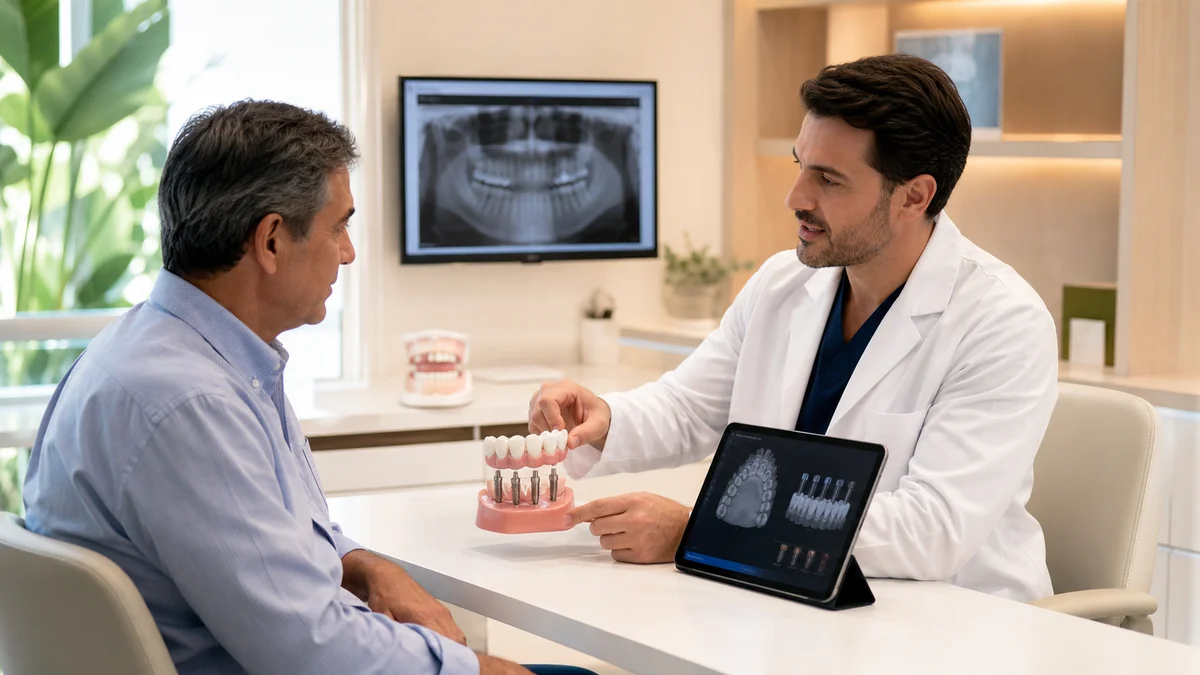
Quick answer: Non removable dentures cost cannot be reduced to one universal figure. The total depends on whether treatment uses natural teeth or implants, how many teeth are replaced, diagnostics, disease control, surgery, grafting, provisional teeth, final materials, laboratory work and aftercare. Compare itemised written plans with the same clinical scope, not headline prices alone.
A search for non removable dentures cost often begins with a practical wish: replace missing teeth with a restoration that the patient does not take out at night. The phrase is not a precise diagnosis or one standard product, however. It may describe a conventional bridge supported by natural teeth, an implant-supported bridge replacing several teeth, or a fixed complete prosthesis replacing an entire arch. Those options differ in complexity, biological requirements and long-term maintenance.
This distinction matters before comparing quotes. A lower number may exclude imaging, preparatory treatment, temporary teeth, grafting, anaesthesia, laboratory components or maintenance. A higher number may include services the other proposal leaves unlisted. An ethical estimate therefore follows examination and planning; it does not promise a fixed price or a guaranteed result before the clinician understands the mouth. The Redent Clinic English information pages can help patients prepare for a consultation, but only an individual assessment can define suitability.
What “non removable dentures cost” means clinically
In everyday language, “non-removable denture” usually means a fixed dental prosthesis. The patient cannot remove it for routine cleaning, although a dentist may be able to remove a screw-retained implant prosthesis for servicing. Fixed does not mean permanent, indestructible or maintenance-free. Artificial teeth, screws, veneering materials, supporting implants and natural abutment teeth can all require monitoring or repair.
The American Dental Association’s patient resource describes a fixed bridge as a restoration that replaces missing teeth and is attached to surrounding teeth for support. Implant bridges attach artificial teeth to implant support rather than relying only on adjacent natural teeth. A full-arch fixed implant prosthesis applies the same broad principle across an edentulous or soon-to-be edentulous arch, but its design is more complex. This is why non removable dentures cost must be tied to a named treatment design.
Fixed bridge supported by natural teeth
A tooth-supported bridge may replace one or a few missing teeth. Supporting teeth are prepared to receive retainers, and the artificial tooth or teeth span the gap. The condition of those supporting teeth, their roots, the gums, the bite and the length of the span affect whether this is reasonable. Cost can include examinations, radiographs when indicated, core build-ups, root canal treatment if genuinely necessary, temporaries, laboratory fabrication and follow-up.
Fixed bridge supported by implants
Dental implants are devices placed surgically in the jawbone to support crowns, bridges or dentures. The FDA notes that candidacy and healing depend in part on overall health, and that smoking may affect healing. Implant planning may include three-dimensional imaging when clinically indicated, surgical guides, bone or soft-tissue procedures, components connecting the implants to the prosthesis, temporary teeth and a final bridge.
Fixed complete or full-arch prosthesis
A fixed full-arch restoration replaces all teeth in one jaw and is secured to implants. The number and position of implants are individual planning decisions, not a package number that can safely be chosen from an advertisement. Bone quality, anatomy, bite forces, available restorative space, opposing teeth, hygiene access and the desired final material all influence design. Consequently, non removable dentures cost for a full arch cannot be inferred from the price of a single implant.
1. Define the restoration behind non removable dentures cost
The first step in understanding non removable dentures cost is checking the treatment name and scope. “Fixed teeth,” “permanent dentures” and “smile in a day” are marketing phrases rather than complete specifications. A written plan should say whether support comes from teeth, implants or a combination; whether the proposal covers one tooth, a segment or a full arch; and whether the prosthesis is screw-retained or cement-retained when that choice is relevant.
For a meaningful non removable dentures cost comparison, ask each provider to identify the teeth being treated, the planned implant sites, the provisional restoration and the final restoration. If several options are clinically acceptable, the advantages, limits and maintenance implications of each should be explained. The least expensive option is not automatically the safest, and the most expensive material is not automatically necessary.
- What is the exact diagnosis and which teeth are missing or non-restorable?
- Is the restoration tooth-supported, implant-supported or mixed?
- Does the plan cover one unit, a bridge segment or a complete arch?
- Is the quoted prosthesis provisional or final?
- Who can remove it for maintenance, and under what circumstances?
2. Diagnostic planning within non removable dentures cost
Diagnosis is part of treatment, not an optional sales step. A comprehensive assessment may include medical and dental history, examination of teeth and gums, bite analysis, photographs, conventional radiographs and, when justified, three-dimensional imaging. Digital scans or impressions help establish restorative space and prosthesis design. Tests should be selected for the patient rather than bundled automatically.
When comparing non removable dentures cost, establish whether consultation, imaging, digital planning, study models and a written report are included. A cheap surgical line item may not include the restorative planning needed to position implants for usable teeth. Implant placement and prosthesis design must be coordinated; implants positioned without the final restoration in mind can create cleaning, speech, appearance or bite problems.
Why a second opinion may change the estimate
Clinicians may reasonably propose different designs when several options are defensible. A second opinion can clarify whether remaining teeth are maintainable, whether grafting is required, whether a removable implant overdenture is a better risk-benefit choice, and whether the proposed timeline is realistic. It should not be used merely to obtain a predetermined implant count or to bypass treatment of active disease.
3. Preparatory care within non removable dentures cost
Active gum disease, untreated decay, infection, failing restorations or uncontrolled oral hygiene can change the sequence and prognosis. Preparatory care may involve periodontal treatment, fillings, root canal therapy, extraction of teeth that cannot predictably be retained, or management of an existing denture during healing. Each item should have a clinical reason.
A complete non removable dentures cost estimate distinguishes essential preparatory care from elective enhancements. Patients should ask why a tooth is considered non-restorable and whether alternatives exist before consent to extraction. Once a tooth is removed, the decision is irreversible. No responsible article or remote photograph can decide that question.
- Periodontal assessment and disease control before definitive restoration.
- Decay management and review of existing crowns or bridges.
- Extraction rationale for every proposed tooth removal.
- Management of infection and healing before or during implant treatment.
- A plan for eating, speaking and appearance during the transitional phase.
4. Implant and surgical drivers of non removable dentures cost
For implant-supported treatment, the surgical portion is influenced by the number and distribution of implants, anatomical constraints, surgical complexity, the need for guides, and whether procedures are staged. Bone grafting or sinus-related procedures are not required for everyone. When proposed, the plan should explain the indication, material, expected healing process, alternatives and additional risks.
The FDA advises patients to discuss benefits, risks and candidacy, and to keep the brand and model of their implant system for their records. It also lists possible complications such as damage to surrounding structures, infection, implant loosening or failure, screw loosening, bite problems, cleaning difficulty and nerve-related symptoms. These risks do not mean every implant fails; they mean non removable dentures cost should include informed consent and realistic contingency planning.
Is sedation or general anaesthesia included?
Many implant procedures can be performed with local anaesthesia, while some patients may be offered sedation or, in selected settings, general anaesthesia. These are separate clinical decisions with their own assessment, personnel, facility and recovery requirements. A quote should specify the type of anaesthesia, who provides it and what monitoring is included. Sedation should never be presented as a substitute for appropriate diagnosis.
5. Provisional teeth within non removable dentures cost
A reliable non removable dentures cost estimate treats temporary teeth as a genuine clinical stage. A provisional bridge or denture may protect healing tissues, preserve appearance and allow the team to evaluate speech, tooth position, bite and hygiene access. It may need adjustment or replacement during healing. “Immediate fixed teeth” can be appropriate for selected patients, but immediate loading is not synonymous with completed healing or a final prosthesis.
Ask whether the non removable dentures cost proposal includes a same-day or later provisional, how long it is intended to serve, which foods or forces must be limited, and how many adjustments are covered. If implants cannot safely support an immediate fixed provisional, the alternative may be a removable temporary. That possibility should be discussed before surgery, not discovered afterward.
6. Materials and laboratory scope in non removable dentures cost
Fixed prostheses can use different frameworks, ceramics, polymers or combinations. Material choice interacts with restorative space, bite forces, repairability, weight, appearance, opposing teeth and laboratory technique. A brand name alone does not establish quality or suitability. The design, manufacturing process, fit and clinical execution matter as much as the raw material.
For a fair non removable dentures cost comparison, the written plan should identify the final prosthesis type and broad material category, whether a framework is used, whether the laboratory work is included, and what happens if the bite or appearance requires modification before final acceptance. Ask whether diagnostic wax-ups, try-ins, shade appointments and delivery adjustments are part of the fee.
Screw-retained versus cement-retained
Screw retention can permit professional retrieval in some designs, while cement retention may be selected for other clinical reasons. Neither is universally superior. Implant position, appearance, available space, component design and maintenance strategy influence the decision. A retrievable prosthesis is still non-removable by the patient and still requires daily cleaning.
7. Aftercare and maintenance in non removable dentures cost
Fixed teeth require lifelong maintenance. The patient must clean around the bridge, under pontics or prosthetic teeth, and around implant or tooth supports using tools suited to the design. Professional reviews monitor tissues, bite, screws, materials and hygiene. The FDA recommends regular visits and careful cleaning around implants and surrounding teeth, and advises reporting looseness or pain promptly.
Maintenance affects lifetime value, so non removable dentures cost should not stop on delivery day. Clarify the included review period, routine hygiene fees, expected professional removal if appropriate, radiographic monitoring when indicated, repair fees and emergency arrangements. A “warranty” may cover only specific technical events and never guarantees biological success.
- Scheduled reviews during healing and after final delivery.
- Instructions and tools for cleaning under the fixed prosthesis.
- Bite checks and management of clenching or grinding risk.
- Fees for professional cleaning, screw replacement, repair or relining.
- A clear contact route for pain, swelling, movement or fracture.
8. Compare non removable dentures cost with a decision table
| Quote component | What should be written | Why it changes the total | Question to ask |
|---|---|---|---|
| Diagnosis | Examination and indicated imaging | Defines anatomy, disease and options | Which records are included? |
| Preparatory care | Gum care, restorations or extractions | Varies with oral health | Why is each procedure needed? |
| Implant surgery | Implant sites, components and surgical stages | Complexity and device count differ | Which system and components are planned? |
| Grafting | Site, material, purpose and timing | Not every patient needs it | What is the alternative? |
| Temporary teeth | Fixed or removable provisional and adjustments | May be a separate restoration | What will I wear during healing? |
| Final prosthesis | Design, units, retention and material | Laboratory and component scope varies | Is this the definitive bridge? |
| Anaesthesia | Local anaesthesia, sedation or other arrangement | Personnel and facilities differ | Who provides and monitors it? |
| Aftercare | Reviews, hygiene, repairs and exclusions | Long-term needs continue | What is included after delivery? |
This table turns non removable dentures cost from a headline into a scope comparison. Two totals are comparable only when they refer to similar diagnoses, restorations, time points and aftercare. Currency conversion alone cannot correct a missing temporary bridge, omitted graft, different final material or unlisted maintenance.
9. Suitability, risks and alternatives in non removable dentures cost
Implant-supported fixed treatment is not automatically suitable for everyone. Overall health, healing capacity, smoking, periodontal condition, bone anatomy, medications, previous radiation, bite forces and ability to clean can affect planning. Some factors can be managed; others may shift the balance toward a different design. The assessment should involve relevant medical coordination when needed.
The correct non removable dentures cost discussion includes alternatives. Depending on the case, these may include preserving and restoring teeth, a conventional fixed bridge, individual implant crowns, a removable partial or complete denture, an implant-retained removable overdenture, or staged treatment. A removable solution is not automatically inferior; it may offer easier hygiene, simpler repair or a more appropriate risk profile for some patients.
Fixed versus implant-retained removable dentures
An implant-retained overdenture can feel more stable than a conventional removable denture but is still removed by the patient for cleaning. A fixed complete prosthesis stays in the mouth for daily cleaning and may require more complex hygiene access. These options use different components and laboratory designs, so a price comparison that calls both “implant dentures” is incomplete.
10. Insurance and travel variables in non removable dentures cost
Coverage varies by country, payer, age, diagnosis, plan design and whether treatment is considered routine dental care, medically connected care or elective private treatment. In the United States, HealthCare.gov notes that adult dental coverage is not a mandatory essential health benefit, and plans can have waiting periods, deductibles and service limits. CMS explains that original Medicare generally excludes routine replacement of teeth, with narrow exceptions when dental services are inextricably linked to covered medical care. Individual documents control.
For non removable dentures cost, request procedure codes and a written predetermination where available, but remember that an estimate is not a guarantee of insurer payment. Ask about annual maximums, waiting periods, missing-tooth clauses, implant exclusions, frequency limits, deductibles and whether the final prosthesis is coded separately from surgery.
Cross-border treatment adds travel, accommodation, time away from work and return-visit logistics. It also requires clarity about who handles complications, component records, interim care and maintenance at home. A lower clinic quote can become less attractive if repeat travel or locally unavailable components are overlooked. The clinical plan should lead the travel schedule, not the reverse.
Financing is not the same as affordability
A monthly payment can make a large total look smaller. Compare the full financed amount, interest, fees, deposit, cancellation terms and what happens if the plan changes after surgery. Do not sign financing before understanding the treatment scope and refund policy. A credit decision should remain separate from clinical consent.
11. Recognise red flags in non removable dentures cost
A trustworthy plan acknowledges uncertainty. Healing, anatomy and tissue response cannot be guaranteed. Red flags include a universal implant count without examination, pressure to extract teeth immediately, a permanent-lifetime promise, refusal to identify implant components, a single-line price with no provisional stage, or dismissal of maintenance. Extremely white catalogue images do not demonstrate an individual outcome.
When evaluating non removable dentures cost, pause if important questions are treated as obstacles to a sale. Patients should receive time to review benefits, material risks, alternatives and the consequences of doing nothing. Consent remains a process and can require more than one conversation.
- No diagnosis or imaging review before a definitive surgical promise.
- No explanation of why existing teeth should be removed.
- No written distinction between temporary and final teeth.
- No named implant system or component record.
- No plan for cleaning, repairs or urgent problems.
- Guaranteed success, guaranteed lifespan or pressure to decide immediately.
Non removable dentures cost across the treatment timeline
A fixed rehabilitation can span several stages. First come assessment and disease control. Surgery may follow if implants are used, with a healing period that can take months or longer according to individual circumstances. A temporary restoration may be used during this phase. After integration and tissue maturation, restorative records, try-ins and final fabrication take place. Delivery is followed by adjustment and maintenance.
Viewing non removable dentures cost across this timeline helps prevent cash-flow surprises. The quote should state when each payment is due and which stage triggers it. It should also explain what happens if grafting becomes necessary, an implant is not stable enough for immediate loading, or the final plan must change for safety.
Frequently asked questions about non removable dentures cost
Are non-removable dentures the same as dental implants?
No. An implant is the support placed in bone; the visible prosthesis can be a crown, bridge or denture. A fixed bridge can also be supported by natural teeth. The phrase non removable dentures cost therefore needs a diagnosis and named restoration before it has financial meaning.
How many implants are needed for fixed full-arch teeth?
There is no safe universal number for every jaw. Implant distribution depends on anatomy, bone, prosthetic design, bite, restorative space and risk factors. The clinician should justify the layout from records and explain contingency options. More implants do not automatically guarantee a better outcome, while too few or poorly positioned supports may compromise design.
Can I always receive fixed teeth on the same day?
No. Immediate placement or loading can be considered only when clinical conditions allow. Primary stability, bone, bite, systemic factors and the provisional design all matter. A same-day provisional is not necessarily the final prosthesis, and diet or function may be restricted during healing.
Does the lowest quote usually exclude anything?
It may or may not. The only way to know is to compare written scopes. Check diagnostics, extractions, grafts, implant components, temporary teeth, final materials, anaesthesia, laboratory work, reviews and repairs. Do not assume an item is included because another clinic includes it.
Why can two plans for non removable dentures cost differ so much?
They may address different diagnoses or use different designs, numbers of units, provisional stages, materials and maintenance packages. Geography and laboratory arrangements also affect fees. A clinically appropriate comparison asks whether both plans preserve the same teeth and manage the same disease, not simply whether the totals match.
Can a fixed implant bridge be removed?
The patient does not remove it for routine use. Some screw-retained designs can be professionally retrieved for servicing, while other restorations may be less readily retrievable. Removal can still involve time, components and risk, so it should not be portrayed as effortless.
How do I clean under fixed dentures?
Cleaning depends on the design and may involve specialised floss, interdental brushes, water irrigation or other tools recommended by the dental team. Daily cleaning and professional maintenance are essential. If the contour cannot be cleaned, that is a design and health concern rather than a cosmetic inconvenience.
Do fixed dentures last for life?
No restoration can be guaranteed for life. Biological complications, gum or bone disease, decay around supporting teeth, implant problems, screw loosening, material wear, fracture and bite changes can require maintenance or replacement. Long-term outcome depends on many patient and treatment factors.
Will insurance cover non removable dentures cost?
Coverage is plan-specific. Some policies exclude implants, limit prosthetic services, impose waiting periods or pay only a percentage up to an annual maximum. Obtain a written predetermination where possible and confirm whether surgical, restorative and temporary stages are assessed separately.
Should healthy teeth be removed to lower the total?
Extraction is irreversible and should follow diagnosis, prognosis assessment and informed discussion of alternatives. A package price is not a clinical reason to remove maintainable teeth. If the rationale is unclear, seek an independent second opinion before treatment.
What records should I keep?
Keep the diagnosis, treatment plan, consent documents, radiographs or access instructions, implant brand and model, component information, laboratory details, final prosthesis description, maintenance schedule and invoices. These records can be important if another professional later provides care.
Final non removable dentures cost checklist
Before deciding, confirm that the written plan connects diagnosis, design, timeline and total scope. It should distinguish what is known now from what might change after healing. The total non removable dentures cost should be transparent enough to protect health as well as budget.
- I understand which teeth are being preserved, treated or removed and why.
- I know whether support comes from teeth, implants or both.
- I can identify the temporary and definitive prostheses in writing.
- I know which imaging, grafting, anaesthesia and laboratory services are included.
- I have discussed realistic risks, alternatives and the option of no treatment.
- I know how to clean the restoration and what maintenance will cost.
- I have checked insurance terms and financing totals independently.
- I know who will manage complications and how component records are stored.
The most useful answer to non removable dentures cost is not a promotional number. It is an itemised, clinically justified plan that lets the patient compare like with like. For an individual assessment, patients can use the Redent Clinic English contact page. No online guide can confirm implant candidacy, extraction need or a final fee without examination.
Official sources and clinical references
- American Dental Association
- ADA MouthHealthy – Bridges and fixed partial dentures
- American Dental Association – Denture care and maintenance
- U.S. Food and Drug Administration – Dental implants: benefits, risks and patient questions
- NHS – Dentures and fixed alternatives
- Guy’s and St Thomas’ NHS Foundation Trust – Dental implant treatment stages
- Centers for Medicare & Medicaid Services – Medicare dental coverage rules
- HealthCare.gov – Adult dental coverage and plan variables
- World Health Organization – Oral health fact sheet
This evidence-based patient guide is intended for clinical review by Dentist Esma Çevrük Çakır. It provides education, not an individual diagnosis, treatment plan, fixed price, insurance decision or outcome guarantee.