
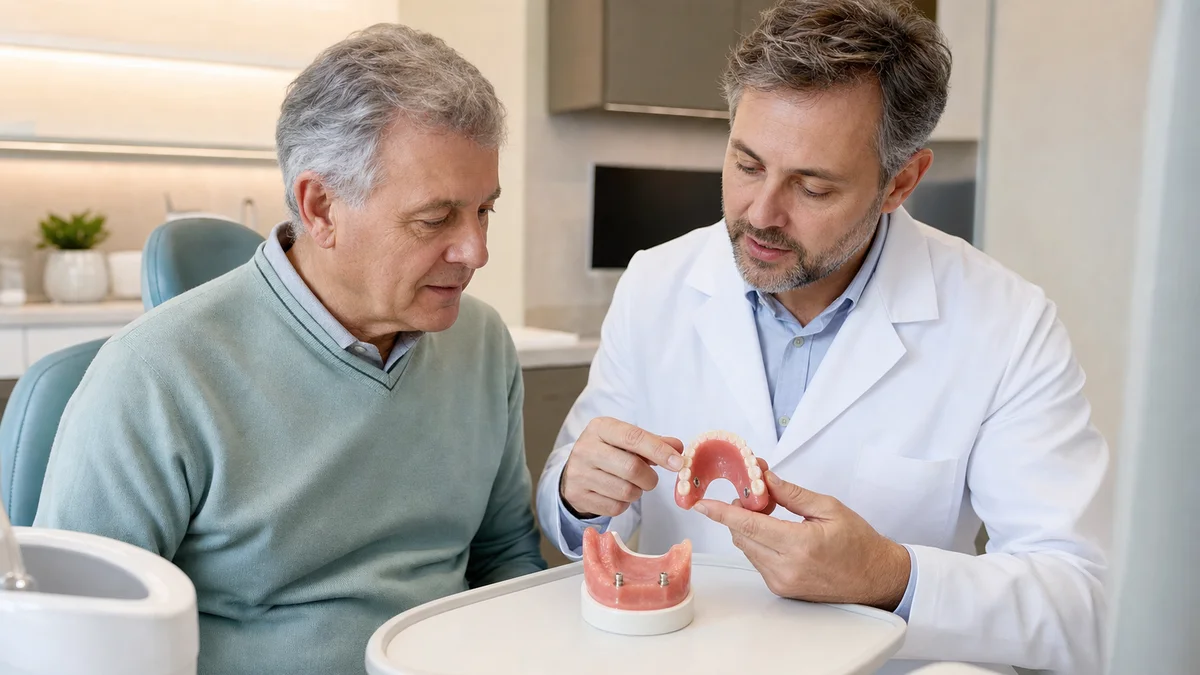
Quick answer: The magnetic dental implants cost usually refers to an implant-retained removable overdenture that uses magnetic attachments—not a “magnetic implant” placed in bone. A complete quote may include assessment, imaging, implants, abutments, magnets and keepers, the denture, surgery, possible grafting and maintenance. Only an examination can confirm suitability and a personal total.
People searching for magnetic dental implants cost often imagine a special implant made from a magnet. In most clinical uses, the implant in the jaw is a conventional endosseous dental implant. The magnetic assembly is part of the attachment system that helps retain a removable overdenture: a magnet is incorporated into the prosthesis and connects with a compatible keeper or abutment associated with the implant.
This distinction matters financially. A search result may quote only an attachment, a single implant or a denture conversion, while a patient may need diagnosis, multiple implants, healing components, a new prosthesis and continuing maintenance. Two offers that use the word “magnetic” can therefore describe different scopes. A useful magnetic dental implants cost comparison starts by asking what device, arch, denture and clinical stages are actually included.
This article does not give a universal price, diagnose suitability or promise that magnets will provide the best retention for one person. Evidence compares magnetic, stud, bar and other attachment systems, but the right choice depends on anatomy, dexterity, prosthetic space, existing components, hygiene and maintenance access. The content is intended for review by Dentist Esma Çevrük Çakır and places informed consent ahead of a headline fee.
What “magnetic dental implants” usually means
A removable implant overdenture replaces multiple or all teeth in an arch and is taken out by the patient for cleaning. Implants can improve its retention and stability compared with a conventional tissue-supported denture. Attachments provide the connection. Common categories include stud or low-profile attachments, bars, telescopic designs and magnets. The attachment selection changes the prosthetic design and the magnetic dental implants cost.
In a magnetic system, the denture normally contains a sealed magnetic unit and the implant side provides the corresponding keeper or attachment surface. Magnetic attraction helps position and retain the prosthesis. The system still depends on denture base fit, support from oral tissues where designed, appropriate implant placement, a balanced bite and the patient’s ability to clean it. Magnets do not turn a removable denture into a fixed bridge.
- Implant body: the component surgically placed in the jaw.
- Implant abutment or keeper: the connection selected for the attachment system.
- Magnetic assembly: the matching component housed within the removable denture.
- Overdenture: the custom-made removable prosthesis containing replacement teeth and denture base.
- Maintenance pathway: reviews, hygiene, relining, attachment service and repairs.
Some older sources also discuss tooth-root-retained magnetic overdentures, where keepers are placed on retained roots rather than implants. That is a different treatment. When researching magnetic dental implants cost, ask the dentist to write whether the proposed supports are implants, retained roots or a combination. Terminology should never hide the clinical design.
Why magnetic dental implants cost has no fixed answer
The attachment itself is only part of the total. Fees can include professional assessment, radiographs or scans, implant surgery, the implants, abutments, attachment housings, impressions or digital records, laboratory manufacture, denture teeth, adjustments and follow-up. A clinic’s magnetic dental implants cost also reflects local staffing, facility and laboratory costs.
The starting point varies greatly. One patient may already have compatible, healthy implants and a serviceable overdenture that can be assessed for conversion. Another may be fully edentulous and need new implants plus a newly designed denture. A third may have an old magnetic system with unknown components that requires identification before repair. Those are not equivalent price questions.
Number of arches also matters. The upper and lower jaws have different anatomy and prosthetic considerations. A two-implant mandibular overdenture cannot be treated as a universal template for every lower jaw, and it should not be assumed to apply to the upper jaw. An individual magnetic dental implants cost requires examination, appropriate imaging and a written design.
11 factors that shape magnetic dental implants cost
1. Existing denture conversion or a new prosthesis
Adapting a suitable denture can involve incorporating attachment housings and adjusting fit and bite, but not every denture has adequate space, strength, tooth position or base condition. A worn, unstable or poorly fitting prosthesis may need replacement. A conversion-only advertisement should not be compared with the magnetic dental implants cost of a new, fully designed overdenture.
2. The number and distribution of implants
Implant number and position depend on the arch, bone, prosthesis, loading plan and clinician’s assessment. More implants add surgical and component costs, but more is not automatically better. The correct question is whether the proposed number supports the intended design. Confirm whether the magnetic dental implants cost is per implant, per attachment or for the complete arch.
3. Examination, records and imaging
The dentist should review oral symptoms, denture history, medical conditions, medicines, allergies, smoking or vaping, hygiene and expectations. Clinical photographs, radiographs, scans or models may be indicated. The US Food and Drug Administration advises patients to discuss risks and candidacy and keep the implant brand and model. These diagnostic services are part of safe magnetic dental implants cost planning.
4. Extractions and disease control
Some patients already have healed edentulous arches. Others may have teeth that are maintainable, questionable or indicated for extraction after assessment. Decay, periodontal disease or infection may need treatment first. No article can decide which teeth should be removed. Extractions, socket care and healing visits can change the magnetic dental implants cost, so ask for the diagnosis and alternatives before irreversible care.
5. Bone and soft-tissue procedures
Bone volume, sinus anatomy, nerve position and soft-tissue condition influence implant planning. Some patients do not require augmentation, while others may be advised to consider a graft or a different design. Grafting must not be assumed from a price page. Ask whether it is confirmed, contingent, included or excluded from the magnetic dental implants cost.
6. Attachment system and component compatibility
Magnetic systems are not necessarily interchangeable. The clinician and laboratory need the correct implant connection, abutment or keeper, magnetic housing and dimensions. Legacy parts can be difficult to identify or obtain. Ask for the manufacturer and product details and keep them. Component availability can influence both immediate magnetic dental implants cost and future repair options.
7. Denture material, framework and laboratory work
Prosthetic space, acrylic thickness, reinforcement, tooth setup, bite and attachment housing positions need careful design. Some dentures require a framework or additional laboratory procedures. The cost of a small magnet is not a substitute for the laboratory fee needed to make a cleanable, durable overdenture. Request a description of the final prosthesis in the magnetic dental implants cost quote.
8. Loading and temporary denture plan
Some implants can be considered for early or immediate loading in selected circumstances, while others require healing before the attachment is activated. Suitability depends on clinical and mechanical findings and cannot be guaranteed in advance. Ask what denture you will use during healing and what happens if the planned timeline changes. Additional adjustments can affect the magnetic dental implants cost.
9. Anaesthetic, sedation and medicines
Local anaesthetic is commonly used for implant placement. Sedation requires an individual assessment, trained personnel, monitoring and recovery arrangements and may be billed separately. Prescribed medicines and facility services can vary. Never assume sedation is necessary or included in the magnetic dental implants cost; ask for an itemised explanation.
10. Follow-up, relines and attachment service
Oral tissues and dentures change over time. A removable overdenture may require adjustment, reline, repair or tooth replacement. Attachment performance can also change because of wear, corrosion, loss of retention, misalignment or damage, depending on the system. The long-term magnetic dental implants cost should include a credible maintenance schedule rather than treating every later visit as unexpected.
11. Travel and continuity of care
Patients who travel for treatment should include transport, accommodation, time away from work, companion costs and possible return visits. They should also identify who will service the specific attachment system at home. A lower treatment fee may not remain the lower total magnetic dental implants cost if components are unavailable locally or an extra journey is needed.
Decision table for comparing complete quotations
Use the same headings for every provider. If an item cannot be decided until examination or surgery, it should be labelled contingent rather than silently excluded. This table helps normalise magnetic dental implants cost without pretending that one design suits every patient.
| Decision point | What the written quote should state | Why it changes the comparison |
|---|---|---|
| Clinical scope | Upper or lower arch, existing teeth, implant number and denture type | Separates a conversion from a complete surgical and prosthetic pathway |
| Diagnostics | Examination, imaging, scans, models and planning | Shows whether the plan is based on the patient rather than a generic package |
| Surgery | Implant placement, extractions, possible grafting, anaesthetic and medicines | Reveals patient-specific additions |
| Attachments | Manufacturer, keepers or abutments, magnetic units and housings | Confirms compatibility and what the attachment fee covers |
| Overdenture | Conversion or new denture, material, framework, teeth and try-ins | Distinguishes a component quote from a complete magnetic dental implants cost |
| Timeline | Healing stages, provisional denture and alternative loading plan | Clarifies visits without guaranteeing biological healing |
| Aftercare | Reviews, hygiene, relines, repairs, urgent pathway and records | Shows responsibility after delivery |
| Payment | Total, exclusions, contingencies, currency and finance charges | Shows the full amount rather than an entry price |
Magnetic versus stud, bar and other attachments
Attachment selection is a clinical and prosthetic decision, not a contest between marketing labels. Reviews of implant-overdenture attachments compare magnets with stud, ball, bar and telescopic systems across retention, survival, patient satisfaction, biological outcomes and maintenance. The evidence does not establish one attachment as best for every patient. The relevant magnetic dental implants cost must be weighed with function, dexterity and service needs.
Magnets may be considered when a patient benefits from lower insertion and removal force or guidance into position, but actual retention depends on the product, number, alignment and prosthetic design. Some studies report lower retention for magnets than some stud designs, while different attachments have their own maintenance patterns. An average from a study should not be used to predict one person’s experience.
Stud attachments can offer strong retention in a compact form, but inserts may wear and need replacement. Bars can splint implants and provide retention but require restorative space, laboratory work and cleaning access. Telescopic designs have other technical demands. A lower magnetic dental implants cost does not automatically make magnets preferable, and a higher alternative cost does not automatically make another system superior.
Ask the dentist to demonstrate how each realistic option is inserted, removed and cleaned. Consider hand strength, vision, coordination, caregiver support and sensitivity to retention force. The best value is the system a patient can use and maintain safely, with parts and professional support available.
Benefits and limitations to discuss
A magnetic attachment can provide a self-seating effect and may transmit less resistance to some lateral movement, depending on the system and prosthesis. Its compact form can be useful in selected designs. These are possible design features, not guaranteed patient outcomes. The magnetic dental implants cost should include a clinician’s explanation of why those features matter in the proposed case.
Limitations can include lower retentive force than some alternatives, corrosion or seal-related concerns in certain designs, space requirements, component wear and difficulty sourcing legacy parts. Modern products vary, so the generic word “magnet” is not enough. The provider should identify the system, show how it is protected for oral use and explain the maintenance protocol.
- Can the patient remove and reinsert the denture without excessive force?
- Does the denture have sufficient support, fit and space for the housings?
- Are the implants aligned and positioned for the proposed attachment?
- Can the patient or caregiver clean around the abutments and inside the denture?
- Are replacement components available to the treating and maintenance teams?
- What signs of wear, looseness, corrosion or damage require review?
The answers should be documented before the magnetic dental implants cost is accepted. A device can only be good value when it is clinically suitable and serviceable.
MRI, scans and magnetic dental attachments
Patients should always tell healthcare professionals and imaging staff about dental implants and magnetic attachments. The FDA notes that dental implants can distort or interfere with some MRI or X-ray images, although it reports no known adverse events from MRI or X-ray procedures on its patient page. A magnetic attachment adds a product-specific question that should be answered from the current manufacturer instructions and imaging facility policy.
Do not remove, modify or replace an attachment yourself before a scan. Give the imaging team the manufacturer, model and implant record and let the dental and radiology professionals decide what is needed. Compatibility, artefact and removal instructions can differ between products. Keeping records is therefore part of the long-term value behind magnetic dental implants cost.
If the original records are missing, a dentist may need to examine the prosthesis and retrieve previous notes or radiographs. Identification can take time and may not always be certain. This is another reason to request component labels at delivery and keep them with medical information.
Clinical suitability and implant risks come first
Implant surgery carries potential risks that include infection, injury to neighbouring structures, altered sensation, implant failure and difficulty cleaning, as described by the FDA. Prosthetic complications can include a loose or damaged component and a denture that no longer fits or functions as intended. Those risks are not unique to magnets, but they explain why magnetic dental implants cost cannot be the first or only decision criterion.
Medical conditions, medicines, smoking, periodontal health, bone, oral hygiene and the ability to attend follow-up can affect advice. A condition does not automatically mean implants are impossible; it may change the sequence or require coordination with another healthcare professional. Only a qualified clinician who has examined the patient can assess individual risk.
Alternatives may include a conventional complete denture, an implant overdenture with another attachment, a fixed implant-supported bridge or no immediate treatment, depending on the case. Each option has trade-offs in surgery, removability, hygiene, stability, repairability and expense. A safe magnetic dental implants cost discussion presents those alternatives without pressure.
Magnetic dental implants cost in the UK and abroad
NHS guidance says implants are generally available privately and only sometimes provided through the NHS in limited circumstances, such as certain patients who cannot wear dentures following mouth cancer or an accident. An NHS assessment does not create a universal magnetic dental implants cost, and attachment selection is a clinical matter rather than a guaranteed NHS entitlement.
Private fees vary between practices. Patients should ask whether a quote covers the implants, attachments, a new overdenture, temporary dentures, laboratory work and follow-up. If NHS and private care are mixed, the dentist should explain which elements belong to each route and provide a written treatment plan.
Overseas providers may have different operating and laboratory costs. Compare the entire pathway, not a converted component fee. Include travel, accommodation, additional visits, currency charges and maintenance after returning home. Verify clinician registration, facility standards, records and the process for complaints in the country of treatment.
Patients can review Redent Klinik’s dental implant information and request an individual assessment, but this article does not imply that a magnetic attachment is routinely offered or appropriate. The treating dentist must confirm the available system and a personal magnetic dental implants cost in writing.
Budgeting for maintenance, not just placement
A removable overdenture requires daily cleaning of the prosthesis, gums, tongue and implant abutments. The denture should be handled according to professional instructions. Regular reviews can identify inflammation, wear, fractures, loss of fit or attachment problems before they become more complex. Maintenance is an expected part of magnetic dental implants cost, not evidence that the original treatment necessarily failed.
Ask how often the clinic anticipates review, which hygiene services are included initially and what later care is chargeable. Clarify the difference between relining the denture, servicing an attachment, replacing a worn component and treating a biological complication. These events involve different skills and fees.
If financing is used, compare the cash total with the amount repayable, interest rate, deposit, term and fees. A low monthly payment can reflect a long borrowing period. Insurance policies may exclude implants or attachments, apply limits or require authorisation. Do not subtract an assumed reimbursement from the magnetic dental implants cost until the payer confirms it.
Red flags in a magnetic implant advertisement
A low price is not automatically unsafe and a higher fee is not proof of quality. Concern arises when the provider cannot explain what the term means, avoids clinical assessment or uses a novelty claim to pressure payment. Pause when a final magnetic dental implants cost is promised before the arch, implants and denture have been assessed.
- Household-magnet imagery or claims that the implant body itself is a powerful magnet without identifying the device.
- No distinction between a magnetic attachment, implant abutment and complete overdenture.
- A quote that omits implant surgery, the denture, laboratory work or maintenance.
- Guaranteed retention, healing, lifespan or freedom from repairs.
- No manufacturer, model, component labels or MRI-related product information.
- No written discussion of stud, bar, conventional denture or other reasonable alternatives.
- No named clinician, registration, aftercare pathway or urgent contact.
Marketing should not turn a removable prosthesis into a “permanent magnetic smile” promise. The denture remains removable, tissues still need care and components may require service. Honest limitations make the magnetic dental implants cost easier to judge.
Frequently asked questions about magnetic dental implants cost
Are magnetic dental implants actually magnetic?
Usually the implant body in bone is a conventional dental implant. The magnetic unit is part of the attachment system within the removable overdenture and connects with a compatible keeper or abutment. Confirm the exact design because terminology varies. The magnetic dental implants cost should identify both the implants and attachments.
Are magnetic overdentures fixed or removable?
They are generally removable by the patient. Magnets improve retention or positioning but do not make the denture a fixed bridge. The patient must remove and clean it as instructed. Ask for a demonstration before treatment and make sure the magnetic dental implants cost includes hygiene education and early adjustments.
Is a magnetic attachment cheaper than a bar?
It may involve different components and laboratory work, but there is no universal answer. Implant number, prosthetic space, existing denture, new framework, clinical fees and maintenance all matter. Compare complete designs at the same follow-up stage. A component-only magnetic dental implants cost cannot be compared with a complete bar-overdenture plan.
Do magnetic attachments have enough retention?
Retention depends on the specific product, number and position of attachments, denture design, tissue support and clinical circumstances. Research shows that attachment systems have different retention and maintenance patterns. No online article can predict whether magnetic retention will satisfy one patient; the dentist should demonstrate realistic expectations.
How many implants are needed?
There is no count that applies to every arch and patient. Anatomy, bone, arch, prosthetic design, loading and risk assessment all influence the recommendation. Ask why the proposed number is appropriate and whether the magnetic dental implants cost covers each implant, abutment and attachment.
Can my current denture be converted?
Possibly, if it has adequate fit, tooth position, base condition, bite, strength and space for the housings. Some dentures need reinforcement or replacement. A dentist and laboratory must assess it. Do not assume that a conversion price represents the full magnetic dental implants cost for a new patient.
Do magnets wear out or need replacement?
Maintenance depends on the product and clinical environment. Attachment performance can change through wear, seal damage, corrosion, misalignment or denture changes. The clinic should explain inspection and replacement policies. No responsible provider can guarantee zero maintenance, and later service may affect the lifetime magnetic dental implants cost.
Are magnetic attachments safe for MRI?
Tell the imaging team and dentist about the implant and magnetic attachment and provide the exact product details. MRI conditions and image artefact can be product-specific. Do not remove or modify components yourself. The imaging facility and dental professional should follow the current manufacturer instructions.
What records should I keep?
Keep the treatment plan, consent information, implant brand and model, attachment manufacturer and model, component labels, relevant images, denture design, maintenance instructions, invoices and emergency contacts. These records can reduce uncertainty if another clinician later services the system and improve the practical value of the magnetic dental implants cost.
How do I request a personal quotation?
Start with a dental assessment and provide a complete health, medicine and denture history. Appropriate examination and imaging should identify the arch, bone, implant sites and prosthetic needs. Ask for confirmed and contingent services in writing. The Redent Klinik contact page can be used to request an assessment pathway, but remote information is not a diagnosis.
Questions to ask before choosing a system
Bring questions to the consultation and keep the answers with the written plan. This turns a broad magnetic dental implants cost search into an informed clinical decision:
- What exactly is magnetic in the proposed system?
- Are the supports implants, retained roots or both?
- Which alternative attachments are realistic, and why is this one recommended?
- Can my existing denture be used safely, or is a new prosthesis needed?
- Which manufacturer and model will be placed, and will I receive component labels?
- Which diagnostics, surgery, attachments, laboratory stages and reviews are included?
- What could change after examination or during healing, and how will added services be approved?
- How will I insert, remove and clean the denture?
- What maintenance, relines or component replacement may be expected?
- Who manages urgent problems and future repairs if I live elsewhere?
- What information must I give an MRI or other imaging provider?
- What is the total payable under any finance agreement?
The most useful estimate is not the smallest attachment price; it is the clearest, clinically appropriate pathway. A complete magnetic dental implants cost should define the implants, attachment system, denture, contingency services and aftercare. That transparency supports safer comparison without claiming certainty about healing, retention or lifespan.
Sources and clinical references
- US Food and Drug Administration — Dental Implants: What You Should Know
- NHS — Dental treatments, including dental implants
- Guy’s and St Thomas’ NHS Foundation Trust — Dental implants overview
- National Library of Medicine — Systematic review of mandibular implant-overdenture attachment systems
- National Library of Medicine — Clinical outcomes of bar and magnetic attachment systems
- National Library of Medicine — Randomised study of magnet and stud attachments
- American Dental Association — Oral-health information and professional resources
- World Health Organization — Oral health fact sheet
This educational article is intended for review by Dentist Esma Çevrük Çakır. It does not diagnose a condition, replace an examination, provide a fixed fee, select an attachment system or guarantee treatment results.