
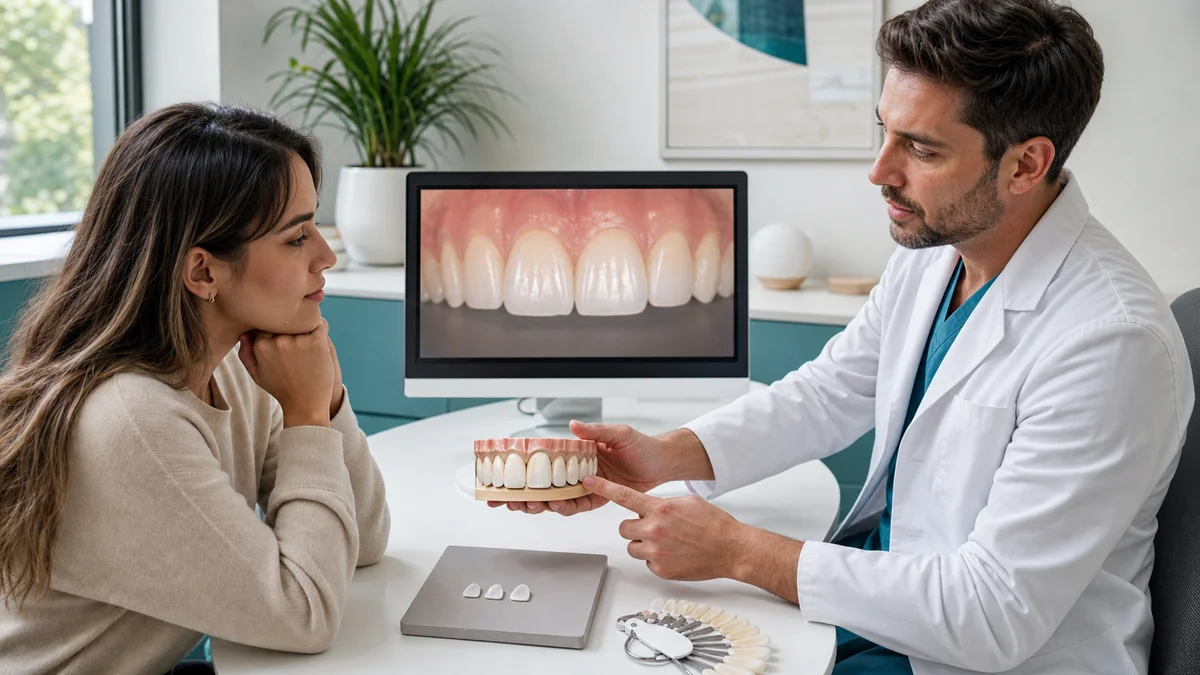
Quick answer: Porcelain veneers may be a good option when healthy front teeth need durable changes to colour, contour or proportion and sufficient enamel can be preserved for bonding. They are not automatically best for active disease, major tooth-position problems, weak or heavily restored teeth, uncontrolled grinding or unrealistic expectations. Compare whitening, bonding, orthodontics, repair, crowns and no treatment first.
The search phrase porcelain veneers best option sounds as though one material can win for every smile. Dentistry does not work that way. A porcelain veneer is a custom ceramic facing bonded to the front and sometimes the sides of a tooth. It can change visible colour, contour, length, surface and apparent alignment, but it cannot cure gum disease, move roots, rebuild every badly weakened tooth or guarantee a permanent cosmetic result.
The safer question is conditional: “Are porcelain veneers the smallest predictable treatment that solves this patient’s diagnosed problem while preserving maintainable tooth structure?” Ten clinical tests help answer it. A single failure does not always rule veneers out, but it should change the design, sequence, alternative or consent discussion. Photographs alone cannot complete these tests.
This guide is educational and does not diagnose an individual smile. Veneer preparation and bonding are irreversible when tooth structure is removed. Final suitability requires an examination, appropriate records, a discussion of reasonable alternatives and informed consent with a licensed dentist.
Test 1: Does the Goal Match What a Veneer Can Change?
Begin by naming the concern tooth by tooth. “I want a better smile” is not a clinical target. A patient may dislike staining, a small chip, uneven edges, a gap, short teeth, crowding, exposed roots, old restorations or the way gums frame the teeth. Different causes need different solutions even when they look similar in a selfie.
The American Dental Association’s MouthHealthy guidance describes veneers as custom coverings that can improve the appearance of chipped, stained, crooked or misshapen teeth and mask selected gaps. It also stresses that veneer treatment is not reversible and should be provided by a licensed dentist. The indication must therefore be specific enough to justify an irreversible step.
Goals veneers can address visually
- Selected colour changes that cannot be managed adequately by a more conservative route.
- Local shape, proportion, length or symmetry differences.
- Small chips or surface defects after their cause and structural significance are assessed.
- Some spaces or mildly irregular visible contours when the roots and bite are acceptable.
Goals that require another diagnosis first
- Pain, sensitivity, swelling, decay, cracks or failing fillings.
- Major crowding, protrusion, open bite, crossbite or root-position problems.
- Active gum inflammation, recession or unstable periodontal support.
- Severely weakened teeth that may need broader structural coverage.
A veneer may eventually be part of care after disease control or orthodontics, but it should not be used as a decorative cover over an unresolved problem.
Test 2: Are Teeth and Gums Healthy Enough for Elective Treatment?
Elective ceramic work should begin in a stable, cleanable mouth. The dentist should assess decay, cracks, existing restorations, pulp and root health, gum condition, plaque control and the supporting bone where indicated. Bleeding gums can distort impressions or scans and make margins difficult to evaluate. Recession can later expose a visible junction between veneer and root.
If active disease is found, treatment pauses while the cause is managed. This is not a delay in cosmetic care; it is the foundation of it. A beautiful laboratory result cannot compensate for an unhealthy tooth or unstable gum line.
Records that may be appropriate
Clinical photographs, bite records, digital scans or impressions, sensitivity testing and radiographs selected for a diagnostic purpose can inform the plan. Not every patient needs every record. The key is that records answer clinical questions rather than create a sales presentation.
Test 3: Can Enough Enamel Be Preserved for Reliable Bonding?
Porcelain veneers gain important adhesive advantages when bonded predominantly to sound enamel. Existing fillings, decay, erosion, wear, previous preparation and tooth position can reduce the enamel available. A heavily restored tooth may need a different design or treatment because the veneer cannot recover missing internal strength simply by covering the front.
The dentist should map where the planned margin and bonding surface will lie. Ask for the anticipated amount and location of tooth preparation, not only the label “minimal prep.” A preparation can be conservative in one area and deeper in another because a tooth projects, rotates or contains an old restoration.
Why “no-prep” is not automatically reversible
Some cases can accept very little or no conventional reduction, but many still require surface conditioning, contour adjustment or margin finishing. Adding ceramic without space can produce bulky teeth, over-contoured gums or an altered bite. No-prep is a design choice for selected anatomy, not a universal upgrade and not proof that the biological starting point can be fully restored later.
Test 4: Is the Colour Problem Suitable for Ceramic Masking?
Porcelain can modify colour while reproducing translucency and surface texture, but masking has limits. A very dark underlying tooth may require more opaque ceramic or greater thickness, which can affect light behaviour and tooth preparation. A single dark tooth may also need investigation for trauma, pulp changes, previous root canal treatment or internal discolouration.
Professional whitening may be a more conservative first step for general external or age-related colour concerns. If whitening is planned, it is usually completed and allowed to stabilise before the final veneer shade is selected. Existing restorations do not whiten like natural enamel, so their relationship to the new colour needs planning.
Ask for a layered colour plan
- What is the starting shade and cause of discolouration?
- Can whitening, cleaning or internal treatment address the cause?
- How much masking is required from the ceramic and cement together?
- Will the proposed brightness remain believable beside untreated teeth, skin and gums?
“The whitest shade” is not an objective clinical endpoint. The patient and dentist should agree on a range that accounts for opacity, surface detail and surrounding teeth.
Test 5: Is the Concern Position or Shape?
Veneers can change the apparent outline of mildly irregular teeth, but they do not move roots. Covering a tooth that is substantially rotated or protruded may demand aggressive reduction on one side and overbuilding on the other. Orthodontic movement can often create a more conservative restorative position, even when a small veneer or bonding procedure is still planned afterward.
Clear aligners and braces address tooth position and bite; veneers address visible surfaces. For gaps, the plan should consider root angulation, midline, tooth proportions and gum papillae. Simply widening front teeth to close space can create unnatural proportions or food-trapping contacts.
A position-first checkpoint
Ask the dentist to show what preparation is required with and without orthodontic movement. A short orthodontic phase is not always necessary or sufficient, and veneers are not always excessive. The comparison should reveal the biological trade-off rather than assuming that a faster visual change is the better option.
Test 6: Does the Tooth Need a Veneer, Repair or Broader Coverage?
A veneer mainly covers the visible front surface. A crown covers much more of the tooth. Composite bonding can repair a local chip or alter contour directly. An onlay or other partial restoration may protect a different area. The correct design follows the remaining tooth structure and loading, not the patient’s preferred material name.
A small defect may be treated with polishing, enamel reshaping or local composite rather than a full facing. A tooth with extensive structural loss, a large filling or a significant crack may need a plan that protects more than its front. Conversely, crowning a sound tooth solely for appearance can remove more tissue than a veneer. Diagnostic classification comes before preparation.
Decision Table: When Is Each Path More Plausible?
| Primary finding | More conservative path to assess | When porcelain veneers may enter discussion | Reason to pause veneers |
|---|---|---|---|
| General colour concern | Cleaning and professional whitening | Persistent colour or combined shape change after diagnosis | Unexplained dark tooth or unrealistic opacity target |
| Small chip or contour defect | Smoothing or composite bonding | Multiple surfaces need durable laboratory-controlled contour | Crack or structural weakness has not been assessed |
| Crowding or rotation | Orthodontic treatment | Residual shape or colour concern after position is improved | Preparation would be deep to disguise root position |
| Heavily restored or weak tooth | Structural assessment and suitable direct or indirect restoration | Only if remaining tissue and loading support a veneer design | Broader coverage or disease treatment is required |
| Healthy tooth and minor aesthetic preference | Monitoring or no irreversible treatment | After informed consent when the benefit justifies enamel change | Pressure, uncertain goal or inability to accept future replacement |
Test 7: Can the Bite Protect Thin Ceramic?
Veneers are thin restorations exposed to repeated biting, chewing and parafunctional forces. The dentist should examine how front and back teeth meet at rest and during jaw movement. Edge-to-edge contacts, deep bite, crossbite, absent back-tooth support and certain movement patterns can concentrate force on ceramic edges.
Grinding or clenching does not automatically rule out every veneer plan, but it changes risk, material, design and protective strategies. Signs can include wear facets, muscle symptoms, fractures and a history of broken restorations. A night guard may be discussed after placement, but it does not erase an unfavourable design or uncontrolled habit.
Function belongs in the mock-up
Aesthetic previews often focus on a front photograph. The trial design should also be checked during speech, gentle biting and jaw movements. Tooth length that looks attractive in a static image may interfere with function. Any plan that adds length or changes canine guidance needs a functional review.
Test 8: Are Gum Levels and Emergence Profiles Stable?
Veneers meet the tooth near the gum, so margin placement and contour influence cleanability and appearance. Over-contoured restorations can trap plaque and irritate tissues. Very deep margins can be difficult to monitor. Existing recession, uneven gum levels or short clinical crowns may need periodontal assessment before the final ceramic design.
Sometimes the apparent tooth-size problem is primarily a gum-frame issue. Gum treatment, orthodontic movement, restoration or a combination may be considered. Soft tissues need time to stabilise before definitive scans when their position is being changed. The plan should state who coordinates this phase.
Test 9: Has the Result Been Previewed Without Calling It a Guarantee?
A diagnostic wax-up or digital design can translate goals into proposed tooth dimensions. A removable or temporary mock-up may allow the patient to assess length, speech, lip support and general appearance before preparation. These tools improve communication, but they remain simulations. Ceramic translucency, gum response and real-world lighting can differ.
What a useful preview should answer
- How many teeth genuinely need treatment for the planned symmetry?
- Will untreated teeth remain proportionate in the smile?
- Does proposed length affect speech or functional movement?
- Can contours be achieved without excessive reduction or bulk?
- Which features are certain design choices and which remain biological variables?
Before-and-after photographs from other patients cannot predict an individual result. Lighting, lens, editing, lip posture and case selection can alter impressions. Use them to discuss style, not to create a guarantee.
Test 10: Is the Patient Ready for Irreversibility and Replacement?
Porcelain veneers are not lifetime natural enamel. They may chip, debond, develop margin changes or require replacement, and the tooth beneath can still develop decay or pulp problems. The timing cannot be guaranteed. A younger patient potentially carries a longer lifetime of maintenance and repeated intervention, which deserves explicit discussion.
The patient should understand what happens if one veneer fails, whether a single unit can be matched later, how records are retained and what a replacement might require. A quoted warranty has terms and exclusions; it is not the same as a biological guarantee. The UK General Dental Council’s consent standard requires relevant options, risks, costs and guarantee conditions to be explained and treats consent as ongoing communication rather than a one-time signature.
What “Porcelain” Should Mean on the Treatment Plan
“Porcelain veneer” is often used broadly for ceramic laminate restorations. Different ceramic families, fabrication methods, thicknesses and surface treatments can behave differently. The most expensive material name is not automatically the correct choice. The dentist and laboratory should select a system for the preparation, colour target, available thickness, bonding substrate and bite.
Ask for the exact material, manufacturer documentation where available, laboratory details and a record of shade. The ADA review of indirect restorative materials explains that indirect restorations are fabricated from impressions or digital records and that material selection involves clinical properties and evidence. Material quality matters, but design and bonding execution remain inseparable from it.
The Clinical Path From Consultation to Bonding
Diagnosis and design
The first phase establishes health, goals, bite, tooth structure and alternatives. Records support a diagnostic design. The patient receives an itemised plan that identifies each tooth, intended material, expected preparation, provisional phase, realistic risks and maintenance.
Preparation and provisional review
If treatment proceeds, teeth are prepared according to the agreed design and definitive records are made. Temporary veneers may protect teeth and preview contours while the laboratory fabricates ceramic. Temporaries are not an exact representation of final optical properties, but they can reveal speech, length, contour or bite concerns before bonding.
Try-in and final placement
At try-in, the dentist evaluates fit, margins, contacts, colour and patient acceptance under appropriate conditions. The teeth and ceramic are conditioned according to the material system, then bonded and excess cement removed. Bite and movement contacts are checked. The patient should be able to pause if the appearance or consent has materially changed before irreversible final bonding.
When Porcelain Veneers Are Less Likely to Be the Best Option
- Active decay, gum disease, infection or unexplained symptoms remain untreated.
- The main issue is root position or a significant bite discrepancy.
- There is too little suitable enamel or too much structural loss for the proposed design.
- Grinding, edge loading or another force problem is uncontrolled and not incorporated into planning.
- A local repair, whitening or no treatment could meet the goal with less irreversible change.
- The patient expects no preparation, no maintenance, permanent whiteness or guaranteed longevity.
- The provider is unlicensed, skips diagnosis or offers placement without direct dental supervision.
The ADA warns that veneer services from unlicensed individuals can expose patients to infection, nerve damage and treatment over unhealthy teeth. Verify the treating dentist’s registration through the relevant official regulator, especially when a service is advertised through social media or a non-clinical “technician.”
Comparing a Quote Without Reducing Care to Price Per Tooth
An itemised quote should identify the teeth, diagnostic records, mock-up, temporaries, laboratory, ceramic, bonding, reviews and what happens if the plan changes. A low per-tooth price can exclude necessary stabilisation, provisional care or follow-up. A high price does not prove conservative preparation or better consent.
The phrase porcelain veneers best option should be the conclusion of a tooth-by-tooth assessment, not the opening line of a quote. Ask which findings support that conclusion and which lower-intervention choices were rejected for documented reasons.
Compare the same clinical scope and ask who performs each step. Confirm whether gum treatment, whitening, bite guard, repairs, travel, accommodation and home follow-up are separate. Do not choose more veneers merely to reach a package threshold. The correct number is the smallest number that achieves a coherent, maintainable result after alternatives are assessed.
Planning Veneer Care Abroad
Travel compresses diagnosis, laboratory work, provisional review and bonding into a limited itinerary. Ask how much time exists to assess the temporaries, make laboratory changes and review the bite after bonding. The return flight should not be the clinical deadline.
Obtain photographs, radiographs, scans, laboratory and material records, shade information and the final treatment chart. Clarify how sensitivity, fracture, debonding or bite concerns will be assessed after returning home and whether a local dentist is expected to provide care. Warranty language should explain location, travel cost and exclusions.
Patients considering care in Istanbul can review Redent Klinik’s English clinic overview and use the contact page to share their goals and existing records. Remote photographs can start a conversation but cannot confirm the porcelain veneers best option decision before examination.
Porcelain Veneers Best Option: Frequently Asked Questions
Are porcelain veneers the best option for stained teeth?
Sometimes, but the cause and depth of colour matter. Cleaning, professional whitening or treatment of an internally dark tooth may be more appropriate. Veneers can mask selected discolouration, although severe darkness may require opacity or thickness that changes aesthetics and preparation.
Are porcelain veneers the best option for crooked teeth?
They can visually camouflage mild irregularity, but they do not move roots or correct the jaw relationship. If substantial preparation would be needed to disguise a rotated or protruding tooth, orthodontics may preserve more structure and improve function. Some patients use both treatments in sequence.
Are porcelain veneers stronger than composite bonding?
They have different materials, fabrication, repairability and preparation profiles. Porcelain can offer laboratory-controlled form and optical properties, while composite can be applied directly and may be more conservative for local changes. Strength cannot be judged without the tooth, bond, thickness and bite.
Do porcelain veneers require shaving the teeth?
Many cases require some controlled preparation; the amount varies by tooth position, colour, existing restorations and design. “Minimal” and “no-prep” are not standard quantities. Ask the dentist to show where reduction is expected and why adding ceramic without it would or would not be appropriate.
Are no-prep veneers reversible?
Do not assume complete reversibility. Surface conditioning, enamel adjustment, bonding and later removal can change the tooth even when conventional preparation is limited. No-prep designs can also be bulky when there is insufficient space. Suitability needs examination and a diagnostic design.
Can porcelain veneers be placed over fillings?
Existing restorations must be assessed for size, location, integrity and bonding implications. Small stable restorations may be manageable, while extensive fillings can reduce suitable enamel and indicate another restorative design. Decay or leaking restorations should not simply be covered.
How many porcelain veneers should I get?
There is no standard smile number. It depends on which teeth show during natural expression, colour relationships, symmetry, goals and the health of each tooth. Treating more sound teeth solely for package uniformity increases irreversible intervention and future maintenance.
How long do porcelain veneers last?
No clinician can guarantee an exact lifespan. Tooth structure, bond, design, bite, habits, injury, hygiene and maintenance influence outcomes. Plan for review, possible repair or replacement and continued natural changes in gums and adjacent teeth.
Can porcelain veneers develop cavities underneath?
The ceramic itself does not decay, but natural tooth structure at and around its margins can. Daily brushing with fluoride toothpaste, interdental cleaning, dietary risk control and dental reviews remain necessary. New sensitivity, a rough margin, looseness or pain needs assessment.
What proves porcelain veneers are the best option for me?
No single photograph or sales claim proves it. A defensible recommendation shows a specific goal, healthy foundations, preservable enamel, suitable bite and contours, a realistic preview, understood alternatives and acceptance of irreversible preparation and future maintenance.
Bottom Line: “Best” Must Be Earned Tooth by Tooth
Porcelain veneers can be an excellent conservative ceramic restoration for selected healthy teeth when colour, shape and proportion are the real concerns and bonding conditions are favourable. They become less compelling when disease, tooth position, structural weakness, gum instability or force problems dominate.
A porcelain veneers best option decision is therefore conditional: it must remain convincing after health, enamel, position, function, alternatives and long-term replacement have all been considered.
The highest-quality plan does not start with a material or a package. It passes each tooth through the ten tests, compares smaller interventions and documents the irreversible trade-off. That is how “best option” becomes a clinical conclusion rather than an advertisement.