
Quick answer: porcelain veneers are usually better when teeth are mostly healthy and the main goal is to improve color, shape, spacing, or small chips. Dental crowns are usually better when teeth are weakened, heavily filled, cracked, badly worn, or significantly damaged and need broader protection. Therefore, porcelain veneers or dental crowns which is better depends on whether your priority is cosmetic refinement or structural restoration. A veneer covers mainly the visible front surface, while a crown surrounds most or all of the prepared tooth. That distinction is the starting point when asking porcelain veneers or dental crowns which is better.
The clearest way to answer porcelain veneers or dental crowns which is better is to identify the condition of each tooth. For stubborn discoloration, minor gaps, uneven edges, or modest shape concerns, veneers may preserve more natural tooth tissue while creating a controlled cosmetic change. For large fillings, deep decay, major fractures, severe wear, or teeth that have undergone root canal treatment, crowns may provide more suitable coverage. Both options can look natural, but they are not interchangeable.
For a smile makeover, porcelain veneers or dental crowns which is better may appear to be a question of appearance alone. In reality, suitability also depends on enamel, gum health, existing dental work, tooth position, and bite forces. Veneers generally rely on dependable bonding to enamel, so teeth with limited enamel or extensive fillings may not be ideal candidates. Crowns can rebuild compromised teeth, but they usually require more preparation. Choosing a crown for a healthy tooth may remove more tissue than necessary, while choosing a veneer for a weak tooth may provide insufficient protection.
Relate the choice to your own situation with this practical guide:
- Healthy teeth with cosmetic concerns: when considering porcelain veneers or dental crowns which is better, veneers may be appropriate if an examination confirms healthy enamel, gums, and a stable bite.
- Weak, cracked, heavily restored, or root-canal-treated teeth: in the comparison of porcelain veneers or dental crowns which is better, crowns may be more suitable because they provide broader coverage.
- Different problems across several teeth: porcelain veneers or dental crowns which is better may have a different answer for each tooth. A combined plan or another treatment may be recommended.
- Pain, swelling, significant sensitivity, or a suspected fracture: arrange a dental assessment promptly instead of selecting a cosmetic restoration from photographs or price lists.
An online image cannot reliably settle porcelain veneers or dental crowns which is better. A dentist may need to assess decay, cracks, old fillings, enamel thickness, gum condition, tooth vitality, bone support, and the way your teeth meet. X-rays may be advised when clinically necessary. This evaluation does not guarantee a diagnosis or a specific treatment, but it helps identify whether a tooth can safely support a veneer, needs a crown, or requires another form of care first.
Your bite can change the answer to porcelain veneers or dental crowns which is better. Clenching, grinding, a deep bite, or uneven pressure may increase the risk of chipping, fracture, loosening, or wear. A dentist may discuss orthodontic treatment, bite adjustment, or a protective night guard as part of the plan. Neither veneers nor crowns are permanent or damage-proof; both need good oral hygiene, appropriate home care, and routine dental reviews.
Timing and cost should also be considered. The process may include treatment planning, tooth preparation, digital scans or impressions, temporary restorations, laboratory work, and a fitting visit. If you have cavities, gum inflammation, infection, or unstable bite problems, these may need treatment first. When researching porcelain veneers or dental crowns which is better, remember that final costs depend on the number of teeth, materials, laboratory requirements, complexity, and any preliminary procedures. A responsible clinic cannot guarantee a final price before an examination and personalized treatment plan.
Sometimes the best response to porcelain veneers or dental crowns which is better is neither option. Professional whitening may improve color, composite bonding may repair small chips, and orthodontic treatment may correct crowding or spacing without covering the teeth. Gum treatment may also be necessary before cosmetic work. The American Dental Association offers general oral-health information, but educational guidance cannot replace an individual dental examination.
A professional consultation is especially important before treating several teeth or whenever you have pain, sensitivity, bleeding gums, visible cracks, large old fillings, previous root canal treatment, substantial wear, or a history of grinding. During an evaluation at Redent Klinik, the dentist can compare porcelain veneers or dental crowns which is better for each tooth and explain possible alternatives, limitations, timing, and cost factors. The goal should be to preserve healthy tissue where reasonably possible while supporting comfortable function and realistic aesthetic expectations.
In practical terms, porcelain veneers or dental crowns which is better can be summarized simply: veneers generally suit structurally healthy teeth that need cosmetic improvement, while crowns generally suit teeth that need fuller restoration or protection. Your final recommendation may include veneers, crowns, both, or neither, depending on the findings. No online article can confirm the correct option without examining your teeth. The safest way to resolve porcelain veneers or dental crowns which is better is to match the restoration to the condition of the tooth rather than choosing by appearance alone.
Practical next step: write down whether your main concern is appearance, tooth strength, pain, old dental work, or a combination of issues. Then arrange an examination before comparing materials or committing to treatment. You can request a personalized review through the Redent Klinik Contact Page. A useful consultation should clarify porcelain veneers or dental crowns which is better for your situation and explain why the recommended approach fits your oral health, timing, and budget.
Porcelain Veneers or Dental Crowns Which Is Better for Cost?
The direct answer: neither treatment is automatically the cheaper or better-value option for every patient. When deciding porcelain veneers or dental crowns which is better for your budget, the most important question is not only the fee per tooth. You also need to consider how much tooth structure is healthy, whether preliminary treatment is required, how many teeth are involved, and which option is more appropriate for long-term function. Veneers may be cost-effective for healthy teeth needing mainly cosmetic changes, while crowns may offer better value when a tooth needs substantial rebuilding or protection.
Porcelain Veneers or Dental Crowns Which Is Better: Initial Cost Factors
The price of either treatment can vary according to the material selected, laboratory work, dentist experience, the complexity of preparation, digital scanning or impressions, temporary restorations, and the number of appointments. This is why a clinic should not promise a final figure before examining your teeth. In the question of porcelain veneers or dental crowns which is better, a low advertised price may not include diagnostic records, temporary teeth, gum treatment, root canal care, bite management, or replacement of old restorations.
Veneers often involve the visible teeth in the smile zone, so the total cost can rise when several teeth are treated together for symmetry. A single crown may cost more than one veneer in some clinics because it uses more material or requires more extensive preparation, but that does not mean the complete crown plan will always cost more. If you are comparing porcelain veneers or dental crowns which is better, ask for an itemized treatment plan rather than comparing only one headline price.
Porcelain Veneers or Dental Crowns Which Is Better: When Veneers May Offer More Value
Veneers may provide better value when teeth are structurally sound and the main concerns are discoloration, uneven shape, small gaps, minor chips, or proportions that affect the smile. In this situation, choosing crowns solely because they appear stronger could mean removing more natural tooth tissue than necessary. For a patient with healthy enamel and stable bite forces, the answer to porcelain veneers or dental crowns which is better may favor veneers because they can address cosmetic goals with a more conservative preparation.
However, veneers are not automatically economical. If your teeth are crowded, severely rotated, affected by active gum disease, or exposed to heavy grinding, you may first need orthodontic care, periodontal treatment, or a protective night guard. These additional steps can change the overall budget. When evaluating porcelain veneers or dental crowns which is better, include the cost of creating a stable foundation, not just the ceramic restorations themselves.
Porcelain Veneers or Dental Crowns Which Is Better: When Crowns May Be the Smarter Investment
Crowns may represent better value when teeth contain large fillings, have significant fractures, are badly worn, or need comprehensive coverage after root canal treatment. Placing a veneer on a tooth that cannot reliably support it may lead to complications and further treatment. In those cases, the practical answer to porcelain veneers or dental crowns which is better may favor a crown, even if its initial fee is higher, because the restoration is selected for the tooth’s structural needs.
This does not mean every root-canal-treated or heavily filled tooth automatically requires a crown. The remaining tooth structure, location in the mouth, bite pressure, and existing restoration all matter. A dentist must evaluate these details before recommending treatment. Cost should support the clinical decision, not replace it. If you are asking porcelain veneers or dental crowns which is better because one option is currently discounted, pause and confirm whether that treatment is actually suitable for the tooth.
Porcelain Veneers or Dental Crowns Which Is Better: Looking Beyond the Upfront Price
The long-term cost includes maintenance, possible repairs, replacement, professional cleaning, checkups, and management of grinding or gum problems. Veneers and crowns can both chip, loosen, wear, or eventually need replacement. Their service life differs from person to person and cannot be guaranteed. Oral hygiene, bite forces, diet, smoking, gum health, and routine dental care can influence outcomes. Therefore, porcelain veneers or dental crowns which is better should be judged by expected suitability and maintenance requirements rather than by the lowest immediate fee.
Porcelain Veneers or Dental Crowns Which Is Better: Questions to Ask Before Accepting a Quote
- Does the estimate include examination, X-rays when needed, scans or impressions, temporary restorations, laboratory fees, and follow-up visits?
- Will any fillings, gum treatment, root canal treatment, orthodontics, or bite protection be needed first?
- How much natural tooth structure is expected to be removed for each option?
- What happens if a veneer or crown chips, becomes loose, or requires replacement?
- Is the plan based on each tooth individually, or is the same restoration being proposed for every visible tooth?
These questions help you compare complete treatment plans and evaluate porcelain veneers or dental crowns which is better without treating price as the only deciding factor. They also reveal whether the recommendation considers oral health as well as appearance. When discussing porcelain veneers or dental crowns which is better, a responsible dentist should explain why each tooth is suitable for a veneer, crown, or alternative such as whitening, bonding, orthodontics, or a filling. The most expensive option is not necessarily the best, and the least expensive option may become costly if it does not match the clinical need.
Porcelain Veneers or Dental Crowns Which Is Better: Making a Budget-Conscious Decision
Start by separating essential treatment from elective cosmetic treatment. A cracked or decayed tooth may need prompt care, while changes to color or shape can often be planned more flexibly. Then ask whether treatment can be phased without compromising your oral health. Some patients may treat damaged teeth first and consider cosmetic work later. For others, coordinated treatment may produce a more predictable bite and appearance. This is another reason porcelain veneers or dental crowns which is better cannot be answered accurately from a price list alone.
Consider how many teeth genuinely need treatment. A smile concern involving one discolored tooth may require a different approach from widespread wear affecting the full bite. Treating every visible tooth with the same restoration may not be necessary or appropriate. A dentist may recommend veneers for some healthy front teeth, crowns for structurally weakened teeth, and no restoration at all for teeth that can be improved through whitening, bonding, or orthodontic movement. This individualized approach can help avoid unnecessary treatment and provide a more meaningful answer to porcelain veneers or dental crowns which is better.
You should also ask how the proposed treatment could affect future care. Both veneers and crowns generally involve an ongoing commitment because prepared teeth may need restoration maintenance or replacement later. A lower initial cost does not remove that long-term responsibility. Before choosing porcelain veneers or dental crowns which is better, make sure you understand recommended cleaning routines, review intervals, possible repair limitations, and whether a night guard may be advised.
Financing or phased payment options can make treatment easier to plan, but affordability should not pressure you into selecting a restoration that is unsuitable. Ask for written details about what is included, how payments are scheduled, and whether additional procedures could alter the estimate. Final costs depend on examination findings, treatment complexity, materials, and laboratory requirements. They should not be presented as guaranteed before a complete clinical assessment.
Redent Klinik can prepare a personalized estimate after reviewing your teeth, goals, medical history, and available diagnostic information. The evaluation may include photographs, scans, bite assessment, and X-rays when clinically indicated. You can use the Redent Klinik Contact Page to request information about the consultation process and which dental records may be useful before your appointment.
Your next check: compare the total treatment plan, the amount of healthy tooth tissue preserved, any preliminary procedures, maintenance expectations, and the reason each restoration is recommended. Request professional advice before making a decision if you have pain, sensitivity, cracks, large fillings, root-canal-treated teeth, gum problems, grinding, or plans to restore several teeth. A clinical examination is the appropriate next step when porcelain veneers or dental crowns which is better cannot be decided confidently from your symptoms, photographs, or budget alone.
Porcelain Veneers or Dental Crowns Which Is Better for You?
The direct answer: veneers are generally more suitable when teeth are healthy and the main goal is to improve color, shape, spacing, or symmetry. Crowns are generally more suitable when teeth are weakened, extensively filled, cracked, severely worn, or in need of broader protection. The right answer to porcelain veneers or dental crowns which is better depends on the condition of each tooth, not only on the smile you want to create.
Porcelain Veneers or Dental Crowns Which Is Better for Healthy Teeth?
If your teeth have strong enamel, limited previous dental work, healthy gums, and a stable bite, porcelain veneers may be the more conservative option. A veneer usually covers the visible front surface and part of the biting edge rather than surrounding the entire tooth. For stubborn discoloration, small gaps, uneven lengths, worn edges, or minor chips, porcelain veneers or dental crowns which is better may lean toward veneers after an examination confirms that the teeth can support dependable bonding.
Healthy-looking teeth are not always suitable for veneers. Old fillings, hidden cracks, enamel loss, early decay, or gum inflammation may not be obvious in a mirror or photograph. Veneers usually depend on having enough sound enamel, so porcelain veneers or dental crowns which is better cannot be decided from appearance alone. A dentist may need to assess enamel thickness, existing restorations, gum health, tooth position, and the way your upper and lower teeth meet. For this reason, answering porcelain veneers or dental crowns which is better requires more than simply choosing the restoration that appears thinner or more cosmetic.
Porcelain Veneers or Dental Crowns Which Is Better for Damaged Teeth?
A crown may be more appropriate when a tooth has lost substantial structure or needs coverage beyond its front surface. This can include teeth with very large fillings, extensive decay, significant fractures, severe wear, or certain root-canal-treated teeth. In these circumstances, porcelain veneers or dental crowns which is better may favor crowns because the purpose is not merely to improve appearance; it is also to rebuild and protect the remaining tooth.
That does not mean every damaged tooth automatically requires a crown. A filling, onlay, composite repair, or another conservative restoration may sometimes be considered. The amount and location of remaining tooth structure, the force placed on the tooth, and the condition of its nerve and supporting tissues all influence the recommendation. When comparing porcelain veneers or dental crowns which is better, ask why full coverage is being proposed and whether a less extensive option could reasonably address the same problem.
How Your Bite and Daily Habits Affect Suitability
Your bite can change the answer to porcelain veneers or dental crowns which is better. Clenching, grinding, nail biting, chewing ice, or using teeth to open packaging can place extra stress on ceramic restorations. A deep bite, edge-to-edge bite, or uneven tooth contact may also increase the possibility of chipping, loosening, or accelerated wear. Neither veneers nor crowns are unbreakable, and their service life cannot be guaranteed.
If you grind your teeth, a dentist may discuss orthodontic treatment, bite management, or a protective night guard. In some cases, correcting tooth position first may make a more conservative restoration possible later. Therefore, porcelain veneers or dental crowns which is better is partly a question of whether the forces in your mouth can be managed and whether you are prepared to follow maintenance advice.
Signs That Veneers May Be Worth Discussing
- Your teeth are mostly intact and your concerns are primarily cosmetic.
- You want to change color, shape, proportions, small spaces, or minor edge damage.
- There appears to be enough healthy enamel for bonding, subject to a clinical assessment.
- Your gums are healthy, and active decay or infection has already been addressed.
- Your bite is stable, or grinding and clenching can be appropriately managed.
These signs may support a veneer consultation, but they do not confirm candidacy. When deciding porcelain veneers or dental crowns which is better, the dentist should also consider gum levels, tooth alignment, enamel quality, and the size of the desired change. If your goal requires a major alteration, orthodontics, whitening, bonding, or gum treatment may preserve more natural tooth tissue.
Signs That Crowns May Be Worth Discussing
- A tooth contains a large filling or has lost a substantial amount of structure.
- There is a significant crack, fracture, or severe pattern of wear.
- A root-canal-treated tooth may need additional protection based on its condition and location.
- The tooth needs major reshaping as well as structural rebuilding.
- A previous restoration has failed or no longer provides adequate support.
These conditions can make crowns more suitable, but professional evaluation remains essential. A crack can vary in depth and direction, and root-canal-treated front and back teeth may face different chewing forces. The decision about porcelain veneers or dental crowns which is better should therefore be made tooth by tooth rather than by applying one treatment to the entire smile. In every comparison of porcelain veneers or dental crowns which is better, structural suitability should take priority over choosing a treatment solely because of its appearance or popularity.
When Neither Treatment Should Be the First Step
Sometimes the safest answer to porcelain veneers or dental crowns which is better is to postpone both options until another issue is addressed. Active gum disease, untreated decay, infection, unstable bite forces, or inconsistent oral hygiene can undermine restorative treatment. Significant crowding may be better managed with orthodontics first. Surface staining may improve with professional whitening, while small chips or gaps may respond to composite bonding.
This matters because veneers and crowns usually create an ongoing maintenance commitment. Prepared teeth may eventually require repair or replacement, and neither treatment prevents future decay or gum problems. When asking porcelain veneers or dental crowns which is better, also ask whether your goals can be reached with less tooth preparation and what care will be required afterward.
How to Make the Decision Personal
Separate your concerns into two groups: appearance and tooth health. Note whether you are mainly concerned about color, shape, spacing, or symmetry, and whether you also have pain, sensitivity, fractures, large fillings, or previous root canal treatment. This distinction makes the discussion of porcelain veneers or dental crowns which is better more focused and helps prevent cosmetic preferences from overshadowing structural needs.
During a consultation, ask which teeth are considered healthy, which are compromised, and why each restoration is recommended. A mixed plan may be appropriate: veneers on sound front teeth, crowns on weakened teeth, and alternatives for others. A thorough assessment should turn porcelain veneers or dental crowns which is better from a general online comparison into a tooth-specific treatment discussion. Redent Klinik can provide a personalized evaluation after reviewing your dental history, bite, gums, enamel, existing restorations, and treatment goals. Information about arranging an assessment is available through the Redent Klinik Contact Page.
Your next check: look for pain, sensitivity, cracks, large fillings, gum bleeding, tooth grinding, or previous root canal treatment. Request professional advice before choosing treatment if any of these apply, if several teeth are being considered, or if a proposed plan requires substantial tooth preparation. The most reliable answer to porcelain veneers or dental crowns which is better comes from matching each restoration to the health, function, and long-term needs of the individual tooth.
Porcelain Veneers or Dental Crowns Which Is Better for the Treatment Process?
The direct answer: veneers often involve a more conservative preparation because they usually cover the front surface of a tooth, while crowns generally require preparation around most or all of the tooth. For readers comparing porcelain veneers or dental crowns which is better, the main procedural difference is therefore the amount and location of tooth preparation. However, the easier or shorter procedure is not automatically the right one. When deciding porcelain veneers or dental crowns which is better, the treatment process should match the health of the tooth, the amount of enamel available, the extent of damage, and the change you want to achieve.
Porcelain Veneers or Dental Crowns Which Is Better for Planning?
Before choosing porcelain veneers or dental crowns which is better, a dentist should assess your teeth, gums, bite, existing fillings, and oral-health history. Photographs, digital scans, impressions, or X-rays may be recommended when clinically appropriate. The dentist may also discuss your preferred tooth shape, color, and level of cosmetic change. This planning stage matters because veneers and crowns are usually irreversible once meaningful tooth preparation has taken place.
Any active decay, gum inflammation, infection, or unstable bite problem may need attention first. Whitening may be completed before restorations when untreated natural teeth will remain visible, because porcelain does not whiten in the same way as enamel. If you grind or clench, the plan may include bite management or a protective night guard. These preliminary steps can affect both timing and cost, so the answer to porcelain veneers or dental crowns which is better should not be based only on the number of appointments advertised. A sound comparison of porcelain veneers or dental crowns which is better must include everything needed to make the mouth healthy and stable before porcelain is placed.
Porcelain Veneers or Dental Crowns Which Is Better During Tooth Preparation?
Veneer preparation is generally limited mainly to the front and edge of the tooth. Some cases require very little reduction, while others need more space to correct color, position, or shape. “No-preparation” veneers are not suitable for everyone and can appear bulky if used where additional material cannot be accommodated. In the comparison of porcelain veneers or dental crowns which is better, veneers may be preferable when sufficient healthy enamel remains and a conservative cosmetic change is possible.
Crown preparation usually involves reshaping the tooth on several surfaces so that the restoration can fit over it. This may be appropriate when a tooth has a large filling, extensive damage, severe wear, or insufficient structure for a veneer. Local anesthesia is commonly used during preparation, although individual experiences and clinical needs vary. If you are concerned about how much tooth tissue will be removed, ask the dentist to explain the planned reduction for each option before deciding porcelain veneers or dental crowns which is better.
What the Preparation Difference Means for You
If your teeth are healthy and your concern is mainly cosmetic, preserving more enamel may be an important advantage of veneers. If a tooth is already weakened, broader crown coverage may be more appropriate even though preparation is more extensive. The key is not to select the least invasive procedure in isolation, but to select the least invasive procedure that can reasonably meet the tooth’s structural and cosmetic needs. This distinction is central to deciding porcelain veneers or dental crowns which is better.
Porcelain Veneers or Dental Crowns Which Is Better for Temporaries?
After preparation, the dentist usually records the shape and position of the teeth with a digital scan or conventional impression. This information is sent to a dental laboratory or used in an in-clinic production system, depending on the treatment method. Shade, translucency, surface texture, and proportions may also be recorded. When asking porcelain veneers or dental crowns which is better, consider the quality of planning and laboratory communication rather than focusing only on how quickly the restorations can be made.
Temporary restorations may be placed while the final veneers or crowns are being produced. Temporaries can protect prepared teeth and provide a preview of approximate shape, but they may feel different from the final porcelain. You may be advised to avoid very hard, sticky, or strongly pigmented foods during this stage. When considering porcelain veneers or dental crowns which is better, ask how temporary restorations will protect your teeth and what restrictions will apply. Temporary veneers can be more delicate, while temporary crowns may occasionally loosen. Contact the clinic if a temporary restoration breaks, comes off, causes persistent discomfort, or affects your bite.
Porcelain Veneers or Dental Crowns Which Is Better for the Fitting Appointment?
At the fitting visit, the dentist checks the restorations for fit, color, shape, contact with neighboring teeth, and bite. You may be asked to review the appearance before final bonding or cementation. Veneers are commonly bonded to prepared enamel and tooth structure using adhesive techniques. Crowns may be bonded or cemented depending on their material, preparation design, and clinical requirements. The technical steps differ, but the answer to porcelain veneers or dental crowns which is better still depends more on suitability than on which attachment method sounds stronger.
When comparing porcelain veneers or dental crowns which is better, the fitting visit is your opportunity to review both appearance and function. Do not feel pressured to approve a cosmetic result without understanding what can and cannot be adjusted. Minor refinements may be possible at the fitting stage, while major changes could require laboratory modification or remaking the restoration. Ask to assess the tooth length, symmetry, shade, speech, and bite. A careful fitting appointment can help reduce avoidable concerns, although no procedure can guarantee a particular aesthetic or functional outcome.
Porcelain Veneers or Dental Crowns Which Is Better for Treatment Time?
The timeline varies with the number of teeth, preliminary treatment, laboratory schedule, healing needs, and complexity of the case. Both veneers and crowns may require more than one appointment, especially when custom laboratory-made porcelain is used. Same-day options may exist in selected cases, but speed should not replace appropriate diagnosis, preparation, and bite assessment. When comparing porcelain veneers or dental crowns which is better, ask for a realistic sequence rather than a guaranteed completion date.
Gum treatment, root canal care, extraction, orthodontics, implant treatment, or extensive bite reconstruction can lengthen the overall plan. Travel patients should also allow for evaluation, fitting, possible adjustments, and follow-up rather than assuming every case can be completed within a fixed number of days. Redent Klinik can explain the likely appointment sequence after reviewing your records and examination findings. You can begin that discussion through the Redent Klinik Contact Page.
Porcelain Veneers or Dental Crowns Which Is Better for Recovery?
For anyone researching porcelain veneers or dental crowns which is better, aftercare should be treated as part of the procedure rather than an afterthought. Mild temperature sensitivity, gum tenderness, or awareness of the bite can occur after preparation or placement, although experiences differ. These symptoms should generally improve, but persistent pain, increasing sensitivity, swelling, a high bite, movement, or difficulty chewing should be professionally assessed. In deciding porcelain veneers or dental crowns which is better, remember that both options require daily cleaning, careful flossing, and routine dental reviews.
Avoid using restored teeth to bite hard objects or open packaging. If grinding is suspected, wear a night guard when advised. Porcelain itself does not decay, but the natural tooth at the restoration margin can still develop decay, and gums can become inflamed without effective plaque control. Veneers and crowns can also chip, loosen, or eventually require replacement. Their longevity varies and should not be presented as guaranteed.
How to Choose Based on the Procedure
When deciding porcelain veneers or dental crowns which is better based on the procedure, begin with the condition of the tooth rather than the advertised speed of treatment. Choose veneers for procedural reasons only when the teeth are healthy enough for reliable bonding and the desired change can be achieved conservatively. Consider crowns when a tooth needs broader rebuilding or protection and a veneer would not address the underlying weakness. If several teeth are involved, a mixed plan may be more appropriate than using one restoration everywhere. The most useful answer to porcelain veneers or dental crowns which is better may therefore differ from tooth to tooth.
Your next check: ask how much tooth structure will be removed, whether temporary restorations are required, how many appointments are realistically expected, what preliminary care is needed, and how the bite will be evaluated. Request professional advice before treatment if you have pain, swelling, cracks, large fillings, root-canal-treated teeth, gum disease, significant wear, or grinding. A personalized examination is essential when porcelain veneers or dental crowns which is better cannot be determined safely from photographs or a remote price estimate.
Porcelain Veneers or Dental Crowns Which Is Better for Risks?
The direct answer: neither option is risk-free. The safer choice is usually the restoration that matches the condition of the tooth. Veneers may preserve more natural structure when enamel is healthy, but they can chip, loosen, or look bulky in unsuitable cases. Crowns can protect substantially weakened teeth, although they normally require more preparation and may increase the possibility of sensitivity. Therefore, porcelain veneers or dental crowns which is better should be decided by balancing tooth preservation with the protection genuinely required.
Porcelain Veneers or Dental Crowns Which Is Better for Preserving Teeth?
Veneers cover mainly the front surface and sometimes the biting edge, so they commonly require less reduction than crowns. For healthy teeth needing changes in color, proportion, small gaps, or minor chips, porcelain veneers or dental crowns which is better may favor veneers. Preserving enamel matters because veneers generally bond most dependably to sound enamel.
Less preparation does not mean no preparation. Even a thin veneer may require irreversible enamel reduction, and the prepared tooth will probably continue to need a restoration in the future. “No-preparation” veneers suit only selected cases; without adequate space, they may create bulky contours or difficult-to-clean areas. When comparing porcelain veneers or dental crowns which is better, ask how much enamel would be removed and whether the planned result can be achieved without overbuilding the teeth.
Crowns surround most or all of a prepared tooth. Although this involves more reduction, it can be appropriate when a tooth is heavily filled, severely worn, cracked, or substantially weakened. Choosing a veneer only to avoid crown preparation may not be conservative if the tooth cannot support it. In that situation, porcelain veneers or dental crowns which is better may favor a crown because structural protection is the priority.
Porcelain Veneers or Dental Crowns Which Is Better for Sensitivity?
Temporary sensitivity to temperature, sweets, or pressure can occur after either procedure. Preparation, bonding, cementation, gum irritation, or a bite that needs adjustment may contribute. Crowns often require more reduction, so the nerve may face greater stress, particularly when deep decay, a large filling, or a crack already exists. This does not mean crown treatment will automatically lead to root canal care, but the possibility should be discussed when deciding porcelain veneers or dental crowns which is better.
Veneers can also cause sensitivity, especially when preparation extends beyond enamel or the tooth was sensitive beforehand. Mild symptoms may settle, but persistent throbbing, swelling, night pain, worsening sensitivity, or pain when biting requires assessment. An online answer to porcelain veneers or dental crowns which is better cannot identify whether discomfort reflects short-term irritation, an inflamed nerve, decay, a crack, or an uneven bite.
Chipping, Fracture, and Loosening Risks
Porcelain is durable under appropriate conditions, but it is not unbreakable. Veneers may chip or detach when enamel is limited, bonding is compromised, or excessive pressure falls on the front teeth. Crowns can also chip, loosen, fracture, or conceal damage in the underlying tooth. Grinding, clenching, chewing ice, biting pens, and opening packaging with teeth increase the risk for both treatments.
If you have a deep bite, an edge-to-edge bite, missing back teeth, or previous broken restorations, porcelain veneers or dental crowns which is better may depend on whether those forces can be controlled. A dentist might discuss orthodontics, replacement of missing teeth, bite management, or a protective night guard. Selecting the restoration that sounds stronger does not correct the cause of repeated damage.
How to Reduce the Risk of Damage
- Report grinding, clenching, jaw discomfort, and previous fractures before treatment.
- Avoid biting hard objects or using restored teeth as tools.
- Wear a professionally recommended night guard when advised.
- Attend reviews so bite changes, loose margins, and early chips can be assessed.
- Maintain effective brushing, interdental cleaning, and professional care.
Porcelain Veneers or Dental Crowns Which Is Better for Decay and Gums?
Porcelain does not decay, but the natural tooth beside or beneath a restoration can. Plaque, frequent sugar intake, dry mouth, smoking, and ineffective cleaning may increase this risk. Gums may also become inflamed when margins are difficult to clean or porcelain is over-contoured. For that reason, porcelain veneers or dental crowns which is better partly depends on margin design, gum health, and your ability to maintain daily oral hygiene.
A veneer margin commonly extends around the front and sides, whereas a crown margin generally continues around the whole tooth. Exact designs vary. A crown does not make a tooth immune to future decay, and a veneer does not guarantee healthy gums because it covers less surface. Before choosing porcelain veneers or dental crowns which is better, ask where the margins will sit, how to clean them, and whether gum disease or decay must be treated first.
Aesthetic, Bite, and Fit-Related Risks
Both treatments can look natural, but appearance depends on shade, translucency, shape, preparation, and laboratory work. A restoration may appear too opaque, bright, long, or bulky when expectations and limitations are not clearly discussed. Gum recession can also reveal a visible edge over time. When assessing porcelain veneers or dental crowns which is better, crowns may mask severe underlying discoloration more effectively, while veneers may be more conservative when the base color and tooth structure are suitable.
Speech and bite can feel different after several front teeth are altered. Persistent chewing difficulty, speech changes, or the feeling that one tooth touches first should be reviewed. A diagnostic preview, temporary trial, model, or digital design may help communicate the intended result, but none guarantees an exact outcome. When asking porcelain veneers or dental crowns which is better, find out how appearance and bite will be checked before and after final placement.
Porcelain Veneers or Dental Crowns Which Is Better Long Term?
Veneers and crowns may function for many years in suitable cases, but neither is permanent. Chipping, wear, gum changes, decay, trauma, or bite changes can eventually make repair or replacement necessary. A failed veneer may sometimes be repaired, rebonded, replaced, or converted to a crown, depending on the remaining tooth. A failed crown may require replacement, rebuilding, root canal treatment, or another solution if the tooth can no longer be restored.
These are possibilities rather than predicted outcomes. Still, future maintenance matters when deciding porcelain veneers or dental crowns which is better. A healthy tooth should not receive extensive preparation without a sound reason, while a damaged tooth should not receive a limited restoration that fails to address its weakness. The appropriate answer to porcelain veneers or dental crowns which is better can differ from tooth to tooth, making a mixed plan more suitable than one treatment across the entire smile.
How to Choose the Lower-Risk Option
Veneers may offer the more reasonable balance when teeth are healthy, sufficient enamel remains, cosmetic changes are moderate, gums are stable, and bite forces are controlled. Crowns may offer the more reasonable balance when teeth need substantial rebuilding or protection. Alternatives such as whitening, composite bonding, orthodontics, an onlay, or gum treatment may reduce unnecessary preparation. This is why porcelain veneers or dental crowns which is better should be answered after assessing tooth structure, enamel, restorations, gums, and bite.
Redent Klinik can review these factors and explain the benefits, limitations, and alternatives relevant to each tooth. A personalized assessment may involve photographs, scans, bite evaluation, and X-rays when clinically indicated. Information can be requested through the Redent Klinik Contact Page, although a final recommendation depends on examination and treatment planning rather than photographs or a remote estimate alone.
Your next check: note any sensitivity, large fillings, root canal treatment, gum bleeding, grinding, previous restoration failures, or fractured teeth. Ask how much tooth structure would be removed, where margins would sit, how bite forces will be managed, and what may be required if the restoration later fails. Request professional advice promptly for persistent pain, swelling, a visible crack, a loose restoration, or difficulty biting. The most responsible answer to porcelain veneers or dental crowns which is better is the option that treats the tooth’s actual condition while avoiding unnecessary preparation wherever reasonably possible.
Porcelain Veneers or Dental Crowns Which Is Better Than Other Options?
The direct answer: veneers and crowns are not always the first or most conservative solution. Whitening, composite bonding, orthodontics, gum treatment, fillings, and onlays may address certain concerns while preserving more natural tooth structure. Therefore, porcelain veneers or dental crowns which is better should be answered only after asking whether either treatment is necessary. The right decision depends on whether your main concern is color, shape, alignment, gum position, or structural damage.
Porcelain Veneers or Dental Crowns Which Is Better Compared With Whitening?
Professional whitening may be worth discussing when teeth are healthy and the main concern is generalized yellowing or surface discoloration. Whitening changes natural enamel without covering it, so it is usually more conservative than veneers or crowns. When researching porcelain veneers or dental crowns which is better, whitening may be the appropriate first step if you are satisfied with your tooth shape, alignment, and condition.
Whitening cannot correct every problem. It may not predictably improve deep internal discoloration, fractures, uneven shapes, large fillings, or existing restorations that no longer match. Veneers, crowns, and fillings also do not whiten like natural enamel. A dentist may recommend whitening before porcelain treatment so untreated teeth and new restorations can be coordinated. In this situation, porcelain veneers or dental crowns which is better depends on whether color alone needs attention or whether structure and shape must also be restored.
Porcelain Veneers or Dental Crowns Which Is Better Compared With Bonding?
Composite bonding can repair small chips, close limited gaps, and reshape uneven edges, often with little or no enamel reduction in suitable cases. It may require less treatment time and a lower initial cost than laboratory-made porcelain. For a minor cosmetic concern, the answer to porcelain veneers or dental crowns which is better may be neither, because bonding could provide a reasonable change while retaining more natural tissue.
Composite can stain, wear, lose polish, or chip, particularly under heavy bite forces. It is often repairable, but periodic maintenance may be needed. Veneers may offer different color stability and surface characteristics, while crowns may be required when a tooth needs major rebuilding. When comparing bonding with porcelain veneers or dental crowns which is better, consider the size of the change, bite pressure, maintenance expectations, and amount of sound enamel.
Porcelain Veneers or Dental Crowns Which Is Better Compared With Orthodontics?
Orthodontic treatment may be a better starting point when crowding, rotation, protrusion, spacing, or bite imbalance causes the concern. Braces and clear aligners move teeth instead of covering them. Treatment generally takes longer than placing restorations, but it may preserve healthy enamel. If you are asking porcelain veneers or dental crowns which is better because teeth appear crooked, ask whether orthodontic movement could correct the underlying problem more conservatively.
Orthodontics does not change deep tooth color or replace missing structure. After alignment, selected teeth may still benefit from whitening, bonding, veneers, or crowns. However, some patients find that alignment alone meets most of their goals. The answer to porcelain veneers or dental crowns which is better may also change after orthodontics because less preparation could be required and bite forces may be distributed more favorably.
When an Orthodontic Opinion Is Particularly Useful
- Several teeth are crowded, rotated, tilted, or protruding.
- Your upper and lower teeth do not meet evenly.
- Veneers would require substantial reduction to make teeth appear straighter.
- You prefer to preserve healthy enamel and can accept a longer treatment timeline.
Could a Filling, Inlay, or Onlay Be Better?
A damaged tooth does not always require a full crown. Depending on the location and amount of remaining healthy structure, a dentist may discuss a filling, inlay, onlay, or another partial-coverage restoration. These options rebuild selected areas while preserving stronger parts of the tooth. Here, porcelain veneers or dental crowns which is better may not describe all realistic choices because a veneer may not protect the damaged area and a crown may be more extensive than necessary.
Partial restorations are not suitable for every crack, cavity, or heavily weakened tooth. Extensive decay, limited support, a fracture beneath the gum, or strong bite forces may change the recommendation. X-rays, a clinical examination, and sometimes removal of an old filling are needed before the tooth can be assessed properly. When deciding porcelain veneers or dental crowns which is better, ask whether a partial restoration could meet the structural need and what limitations it would have. A careful discussion of porcelain veneers or dental crowns which is better should include these intermediate choices instead of presenting veneers and full crowns as the only possibilities.
When Gum Treatment Should Come First
Gum inflammation, recession, uneven gum levels, or a gummy smile can affect tooth appearance. Periodontal care, improved plaque control, or carefully planned gum contouring may need to come before porcelain treatment. Placing restorations while gums are inflamed can complicate margin placement, impressions, cleaning, and long-term appearance. For this reason, porcelain veneers or dental crowns which is better should usually be decided after gum health has been evaluated and stabilized.
Gum contouring is not appropriate for everyone. Bone levels, root coverage, tooth proportions, and recession risk must be considered, and healing may be required before final restorations. Ask whether your concern comes primarily from the teeth, gums, or both. This can prevent unnecessary preparation and make the comparison of porcelain veneers or dental crowns which is better more relevant to your situation.
When Neither a Veneer Nor a Crown Is Suitable
If a tooth has a severe fracture, extensive decay, inadequate support, or another serious problem, neither option may be suitable. Extraction and replacement choices, such as an implant-supported crown, bridge, or removable solution, might then be discussed. These are not routine alternatives for healthy teeth and should not be chosen merely for convenience. A professional examination is necessary before concluding that a tooth cannot be restored.
Photographs and remote estimates cannot provide a final answer to porcelain veneers or dental crowns which is better. Damage beneath a large filling or existing crown may not be visible, and symptoms do not always reveal the extent of a problem. Clinical tests and imaging may be needed before a dentist can explain realistic options, timing, risks, and cost factors. Pain, swelling, a draining gum spot, or a tooth that feels loose should be assessed rather than treated as a cosmetic concern.
Porcelain Veneers or Dental Crowns Which Is Better for a Conservative Plan?
Start by defining the exact problem. Ask about whitening for color, bonding for a small chip or gap, orthodontics for alignment, and partial restorations for localized damage. Veneers may suit healthy front teeth needing broader cosmetic changes, while crowns may suit teeth requiring comprehensive rebuilding. The most useful answer to porcelain veneers or dental crowns which is better is generally the treatment that meets the clinical need while removing the least reasonable amount of healthy tissue.
A conservative plan does not always mean selecting the treatment with the smallest restoration. A limited veneer may be unsuitable for a tooth with extensive damage, while a full crown may be unnecessarily aggressive for a healthy tooth with a small cosmetic concern. In some cases, the plan may combine orthodontics, whitening, bonding, veneers, and crowns across different teeth. This tooth-by-tooth approach makes the answer to porcelain veneers or dental crowns which is better more accurate than applying one procedure to the entire smile.
Compare the complete plan rather than only the advertised fee per tooth. A treatment with a lower initial cost may require more maintenance, while a more extensive option may be unnecessary. Final costs depend on examination findings, materials, laboratory work, the number of teeth, and preliminary care, so they cannot be guaranteed before treatment planning. When budgeting for porcelain veneers or dental crowns which is better, request an itemized estimate that explains diagnostic appointments, temporary restorations, laboratory work, follow-up care, and any treatment required first.
Redent Klinik can review your goals and explain whether whitening, bonding, orthodontics, partial restorations, veneers, crowns, or a combined approach may be appropriate. The recommendation may depend on enamel quality, remaining tooth structure, gum health, existing restorations, and bite forces. You can request a personalized review through the Redent Klinik Contact Page, although a final treatment decision normally requires a clinical examination and appropriate treatment planning.
Your next check: identify whether your concern is mainly color, shape, alignment, gum position, pain, or lost tooth structure. Ask how much healthy tissue each option would remove, what maintenance may be required, and whether treatment can be staged. Request professional advice if you have pain, swelling, a crack, loose dental work, bleeding gums, large fillings, root canal treatment, or plans to alter several teeth. A clinical examination is the safest way to determine porcelain veneers or dental crowns which is better or whether a more conservative alternative should come first.
Porcelain Veneers or Dental Crowns Which Is Better for Financing?
The direct answer: the better treatment is not necessarily the one with the lowest monthly payment or the smallest initial fee. When deciding porcelain veneers or dental crowns which is better, financing should make an appropriate treatment plan manageable rather than influence you toward unnecessary or unsuitable dental work. Veneers may represent better value for structurally healthy teeth requiring cosmetic improvement, while crowns may be the more sensible investment when teeth need substantial rebuilding or protection. A personalized examination is required before a clinic can explain the complete cost, available payment arrangements, and realistic treatment sequence.
Porcelain Veneers or Dental Crowns Which Is Better for Your Total Budget?
Start by comparing the complete treatment cost rather than the advertised price per tooth. An estimate may be affected by the number of teeth, selected materials, laboratory requirements, complexity of preparation, temporary restorations, diagnostic records, and follow-up care. Preliminary treatment such as fillings, gum therapy, root canal care, orthodontics, or bite management may also change the final amount. This means porcelain veneers or dental crowns which is better cannot be decided responsibly from a promotional price alone.
Veneers are often planned across several visible teeth to create balanced color and proportions. Even when the fee for one veneer appears manageable, treating six, eight, or more teeth can increase the overall budget considerably. Crowns may be recommended for fewer teeth if only particular teeth are structurally damaged. However, a person with widespread wear, large restorations, or several weakened teeth may require a more extensive crown plan. In the comparison of porcelain veneers or dental crowns which is better, the number of teeth that genuinely require treatment may have a greater financial effect than the difference between the individual restoration fees.
What a Complete Estimate May Include
- Clinical examination and treatment planning
- Photographs, scans, impressions, or X-rays when clinically indicated
- Diagnostic previews, models, or smile-design records when appropriate
- Tooth preparation and local anesthesia where required
- Temporary veneers or crowns
- Dental laboratory and material costs
- Fitting, bonding, cementation, and bite adjustments
- Recommended reviews or protective appliances
Not every patient will need every item, and clinics may structure estimates differently. Ask what is included before comparing plans. When researching porcelain veneers or dental crowns which is better, a written and itemized estimate can help you distinguish between the restoration price and the total cost of completing treatment safely.
Should Financing Affect the Treatment You Choose?
Financing can help distribute the cost, but it should not determine whether a healthy tooth receives a veneer or a crown. A low monthly payment may make extensive treatment appear more affordable, yet the biological commitment remains the same. Both procedures can involve irreversible tooth preparation and future maintenance. Therefore, the decision about porcelain veneers or dental crowns which is better should be made before selecting the payment method.
For example, choosing a crown instead of a veneer because the crown is included in a discounted package may result in more tooth preparation than the clinical situation requires. Conversely, selecting a veneer because it has a lower advertised fee may be unsuitable if the tooth is extensively filled or fractured. In either case, financial convenience should not replace a tooth-by-tooth assessment. The best-value answer to porcelain veneers or dental crowns which is better is generally the option that addresses the actual problem without unnecessary treatment.
Porcelain Veneers or Dental Crowns Which Is Better for Phased Treatment?
Phased treatment may be useful when several teeth need care but the full plan does not fit your immediate budget. Essential treatment is normally prioritized before elective cosmetic changes. A tooth with active decay, pain, infection, or a significant fracture may require attention before healthy teeth are treated for color or shape. This approach can make the question of porcelain veneers or dental crowns which is better easier to manage financially because urgent structural needs are separated from optional aesthetic goals.
A phased plan must still be coordinated carefully. Treating only some front teeth can affect color matching, symmetry, temporary restorations, and bite relationships. Delaying one part of a complex rehabilitation may also influence another part. Ask whether treatment can be divided into stages without creating functional or aesthetic compromises. When evaluating porcelain veneers or dental crowns which is better, request a clear explanation of which procedures should be completed together and which can reasonably wait.
Questions to Ask About Phasing
- Which teeth require treatment for health or function rather than appearance?
- Can damaged teeth be stabilized before cosmetic treatment begins?
- Will delaying part of the plan affect the bite, color match, or final design?
- Could whitening, bonding, or orthodontics reduce the number of porcelain restorations needed?
- Will temporary restorations be needed between treatment stages?
How to Compare Payment Plans Responsibly
Before accepting financing, review the deposit, installment schedule, payment dates, administrative charges, interest where applicable, and the clinic’s policies for changes or cancellations. Ask whether laboratory work must be paid for before treatment begins and what happens if examination findings change the original plan. Final fees should not be presented as guaranteed before the relevant clinical assessment has been completed.
It is also important to understand whether financing covers only the veneers or crowns or includes related care. Preliminary gum treatment, root canal treatment, orthodontics, night guards, medication, accommodation, or travel may be separate expenses. A realistic answer to porcelain veneers or dental crowns which is better should consider the full financial commitment, including care before and after restoration placement.
Do not focus only on the length of the payment period. Smaller installments spread over a longer period may appear easier to manage, but you should still examine the total amount payable. Make sure the schedule is comfortable alongside routine dental care and possible future maintenance. Neither veneers nor crowns are permanent, and both may eventually require repair or replacement. Financial planning should therefore include a reasonable allowance for reviews, cleaning, bite protection, and unforeseen dental needs.
Can Dental Insurance Help With Veneers or Crowns?
Coverage varies according to the insurer, policy, country, clinical reason, and required documentation. Cosmetic veneers are often treated differently from crowns placed to restore damaged teeth, but no general statement can confirm what a particular policy will pay. Before deciding porcelain veneers or dental crowns which is better, contact your insurer directly and request written clarification of exclusions, annual limits, waiting periods, preauthorization requirements, and reimbursement procedures.
A crown recommended for structural reasons may still be subject to limitations, while a veneer may not be covered when its purpose is mainly aesthetic. Ask the dental clinic for the treatment codes, clinical notes, or estimate your insurer requires. Insurance approval should not be interpreted as proof that a treatment is the only suitable option, and lack of coverage does not automatically mean that treatment is inappropriate. Clinical suitability and financial coverage are separate questions.
Consider Long-Term Maintenance, Not Only Today’s Fee
The long-term value of treatment depends on suitability, oral hygiene, bite forces, gum health, habits, and regular dental care. Veneers and crowns can chip, loosen, wear, or require replacement. Natural tooth structure around their margins can still develop decay. Grinding or clenching may make a protective night guard advisable. For this reason, porcelain veneers or dental crowns which is better should be compared using both the initial treatment plan and the expected maintenance responsibilities.
A more conservative veneer may be financially and biologically sensible for a healthy tooth, but only when there is enough enamel and the bite is suitable. A crown may involve a greater initial commitment yet be more appropriate for a heavily damaged tooth. On the other hand, whitening, composite bonding, orthodontics, an onlay, or a filling may meet your needs with a different cost and maintenance profile. Asking about alternatives helps ensure that porcelain veneers or dental crowns which is better is not treated as a choice between only two options.
How to Prepare for a Financing Consultation
Before contacting a clinic, list the teeth that concern you and separate symptoms from cosmetic preferences. Note pain, sensitivity, fractures, old fillings, previous root canal treatment, gum bleeding, grinding, and any restorations that have failed. Also identify whether your main goal is a color change, improved alignment, repair of damage, or a complete smile redesign. This information helps the dentist assess porcelain veneers or dental crowns which is better for your situation before discussing how the plan might be financed.
Redent Klinik can explain possible treatment stages and provide a personalized estimate after suitable clinical assessment and treatment planning. The final cost may depend on examination findings, the number of teeth, materials, laboratory work, and any preliminary procedures. You can request information about consultations and available planning steps through the Redent Klinik Contact Page. Remote photographs may help begin the conversation, but they may not be sufficient for a final diagnosis, guaranteed quote, or definitive treatment recommendation.
Your next check: request an itemized estimate, confirm what the payment arrangement includes, compare the total payable amount rather than only the monthly installment, and ask whether treatment can be phased safely. Seek professional advice before committing financially if you have pain, swelling, cracks, large fillings, root-canal-treated teeth, active gum problems, severe wear, or plans to treat several teeth. The most responsible financial answer to porcelain veneers or dental crowns which is better is the option supported by an individual examination, a clear clinical reason, and a payment plan you can manage without being pressured into unnecessary care.
Porcelain Veneers or Dental Crowns Which Is Better? FAQs
The direct answer: veneers are usually more appropriate for healthy front teeth that need cosmetic improvement, while crowns are usually considered when teeth need substantial rebuilding or protection. However, porcelain veneers or dental crowns which is better can have a different answer for each tooth. The following questions will help you identify which factors matter before you request a personalized dental assessment.
Porcelain Veneers or Dental Crowns Which Is Better for a Natural Look?
Both can look natural when the shade, translucency, shape, surface texture, and gum line are planned carefully. Veneers are often chosen for visible teeth because they can refine color and proportions while preserving more of the underlying tooth. Crowns can also look highly natural and may mask severe discoloration, large fillings, fractures, or missing tooth structure more effectively. When deciding porcelain veneers or dental crowns which is better for appearance, ask to see how the proposed restoration will match untreated teeth. Photographs, scans, temporary restorations, or a diagnostic preview can support communication, although they cannot guarantee an exact final result.
Porcelain Veneers or Dental Crowns Which Is Better for Preserving Tooth Structure?
Crowns generally require more preparation because they cover most or all of the visible tooth. Veneers usually cover the front surface and sometimes the biting edge. For a healthy tooth with enough enamel, porcelain veneers or dental crowns which is better may favor a veneer because it can be more conservative. A veneer may be unsuitable, however, when a tooth has a major crack, extensive decay, a very large filling, or too little enamel for dependable bonding.
The least extensive procedure is not automatically the safest procedure. If a tooth needs broad structural support, a limited veneer may not address the underlying weakness. Before deciding porcelain veneers or dental crowns which is better, ask the dentist to explain how much tissue would be removed, which surfaces would be covered, and why that level of preparation is necessary.
Porcelain Veneers or Dental Crowns Which Is Better for Durability?
No single lifespan applies to every veneer or crown. Material, preparation, bonding, oral hygiene, gum health, diet, smoking, clenching, grinding, and bite forces can all affect longevity. Either restoration may chip, loosen, wear, develop decay at its margin, or eventually require replacement. Therefore, porcelain veneers or dental crowns which is better should not be decided from a promised number of years.
A well-selected veneer may be preferable to an unnecessarily extensive crown on a healthy tooth. A crown may be more suitable for a weakened tooth, but it does not make that tooth immune to future problems. When comparing porcelain veneers or dental crowns which is better, focus on suitability, maintenance, and preservation of healthy structure rather than longevity claims alone.
Porcelain Veneers or Dental Crowns Which Is Better for a Damaged Tooth?
A crown is more likely to be considered when a tooth has lost substantial structure, contains a large filling, is severely worn, or has a significant fracture. In these situations, porcelain veneers or dental crowns which is better may favor a crown because rebuilding and protection are more important than changing only the front surface.
Not every damaged tooth requires a crown. A filling, composite repair, inlay, onlay, or another partial restoration may preserve more healthy tissue in selected cases. The location of decay, direction of a crack, nerve condition, and bite pressure all influence the recommendation. Pain, swelling, pain when biting, or a visible fracture should be assessed promptly rather than treated as a cosmetic issue.
Porcelain Veneers or Dental Crowns Which Is Better for Discolored Teeth?
If healthy teeth are generally yellow or stained, professional whitening may be worth considering before either restoration. For discoloration that does not respond predictably to whitening, porcelain veneers or dental crowns which is better may favor veneers when enamel and tooth structure are sound. Crowns may be considered when severe discoloration is combined with extensive fillings, damage, or a need for major rebuilding.
Porcelain and existing fillings do not whiten like natural enamel. If only some teeth will be restored, whitening may be completed first so the final ceramic shade can be coordinated with neighboring teeth. A dentist should also investigate unusual discoloration because it can have several causes. This assessment is important before answering porcelain veneers or dental crowns which is better for color alone.
Porcelain Veneers or Dental Crowns Which Is Better for Teeth Grinding?
Grinding and clenching can increase the chance of chipping, loosening, fracture, wear, or discomfort with both treatments. A crown is not automatically protected from excessive force, and a veneer is not automatically unsuitable. In this situation, porcelain veneers or dental crowns which is better depends on tooth position, remaining enamel, bite relationships, previous fractures, and whether the forces can be managed.
A dentist may discuss orthodontic treatment, replacement of missing back teeth, bite management, or a protective night guard. Report morning jaw fatigue, headaches, flattened tooth edges, or repeated restoration breakage. Treating the cause of excessive pressure may be as important as selecting the restoration.
Can Veneers and Crowns Be Used Together?
Yes. Healthy teeth with cosmetic concerns may receive veneers, while weakened or heavily restored teeth may need crowns. Other teeth may require only whitening, bonding, orthodontics, or no treatment. A mixed plan often gives a more accurate response to porcelain veneers or dental crowns which is better than placing the same restoration on every visible tooth.
Combined treatment needs careful shade, shape, margin, and bite coordination. Ask why each tooth has been assigned a particular option and whether a more conservative alternative is available. A responsible plan should separate cosmetic preferences from structural requirements.
Porcelain Veneers or Dental Crowns Which Is Better for Treatment Time?
Both procedures commonly involve an examination and planning visit, preparation with a scan or impression, temporary restorations when required, and a fitting appointment. The exact sequence depends on the number of teeth, laboratory method, gum health, bite complexity, and preliminary care. When comparing porcelain veneers or dental crowns which is better for timing, do not assume the fastest treatment is the most appropriate.
Gum treatment, whitening, orthodontics, root canal care, or healing may need to occur first. Same-day options may be available in selected cases, but suitability cannot be confirmed from an advertised timeline. Patients planning dental travel should leave time for assessment, fitting, adjustments, and follow-up.
Porcelain Veneers or Dental Crowns Which Is Better for Comfort?
Local anesthesia is commonly used when preparation could cause discomfort. Temporary sensitivity, gum tenderness, or awareness of the bite can occur after either procedure. Because crowns normally involve preparation around more of the tooth, some patients assume they will always cause more sensitivity, but the existing condition of the tooth also matters. In the discussion of porcelain veneers or dental crowns which is better, tell the dentist about current sensitivity, dental anxiety, previous difficult treatment, and relevant medical concerns.
Persistent throbbing, worsening pain, swelling, a high bite, or pain when chewing requires professional review. These symptoms cannot be diagnosed reliably through photographs or general online guidance.
Porcelain Veneers or Dental Crowns Which Is Better for Cost?
Neither option is consistently cheaper in every case. Costs may depend on the number of teeth, materials, laboratory work, diagnostic records, temporary restorations, complexity, and any care required beforehand. Veneers may be placed across several smile-zone teeth, while crowns may be limited to damaged teeth or used more extensively in complex restorative treatment.
For a realistic comparison of porcelain veneers or dental crowns which is better, request an itemized estimate. Ask whether examinations, clinically indicated X-rays, scans, temporaries, laboratory fees, follow-up visits, and bite protection are included. Final prices should not be guaranteed before an examination and treatment plan.
Porcelain Veneers or Dental Crowns Which Is Better for Your Final Choice?
Begin by identifying whether your concern is cosmetic, structural, or both. If a tooth is mostly healthy and you want to improve color, shape, spacing, or a minor chip, veneers or a more conservative alternative may be considered. If a tooth is weakened, cracked, heavily filled, or severely worn, a crown may be more appropriate. The answer to porcelain veneers or dental crowns which is better must also account for your gums, bite, habits, maintenance expectations, treatment timing, and budget.
What to Check Before Agreeing to Treatment
- How much healthy enamel and tooth structure remain?
- How much preparation is proposed for each tooth?
- Could whitening, bonding, orthodontics, a filling, or an onlay meet the same need?
- Are decay, gum inflammation, and bite problems under control?
- How will grinding or clenching be managed?
- What does the written estimate include, and what could change it?
- What maintenance or future replacement may be required?
Information from the American Dental Association can help you prepare questions, but general guidance cannot replace a clinical assessment. Redent Klinik can review your concerns, dental history, available records, and treatment goals before discussing whether veneers, crowns, a combined plan, or another option may be suitable. You can request an evaluation through the Redent Klinik Contact Page.
Your next check: note any pain, swelling, sensitivity, cracks, large fillings, bleeding gums, grinding, previous root canal treatment, or repeated restoration failure. Request professional advice before selecting treatment if any of these apply, if several teeth are involved, or if substantial preparation is proposed. The most reliable answer to porcelain veneers or dental crowns which is better comes from a tooth-by-tooth examination and a plan that clearly explains benefits, limitations, alternatives, timing, risks, and individualized cost factors.
Porcelain Veneers or Dental Crowns Which Is Better: Your Next Step
The direct answer: veneers are generally the better starting point when your teeth are structurally healthy and you want to improve their color, shape, spacing, or proportions. Crowns are generally more appropriate when teeth are weakened, heavily filled, cracked, severely worn, or in need of broader restoration. However, the safest answer to porcelain veneers or dental crowns which is better comes from a tooth-by-tooth examination rather than a general preference for one procedure.
Your next step should be to separate what you want to change from what your teeth clinically need. A cosmetic concern such as discoloration or uneven edges may be suitable for veneers, bonding, whitening, or orthodontics. A structural concern such as a fracture, large filling, or significant loss of tooth tissue may require a crown or another restorative option. When deciding porcelain veneers or dental crowns which is better, treatment should address the underlying problem while preserving as much healthy tissue as reasonably possible.
Porcelain Veneers or Dental Crowns Which Is Better for Your Main Concern?
Begin by identifying your primary reason for seeking treatment. If your teeth feel comfortable and function well but you dislike their color, shape, length, or small spaces, veneers may be worth discussing. They commonly cover the front surface of teeth and may require less preparation than crowns. In this situation, porcelain veneers or dental crowns which is better may favor veneers, provided that there is enough healthy enamel, your gums are stable, and your bite is suitable.
If your concern involves pain, cracks, large existing restorations, severe wear, or teeth that have undergone root canal treatment, crowns may be more relevant. Crowns cover most or all of a prepared tooth and can rebuild structure that a veneer would not adequately replace. Even so, not every damaged tooth automatically needs full coverage. A filling, bonding procedure, inlay, or onlay may sometimes be considered. A professional assessment is therefore necessary before concluding porcelain veneers or dental crowns which is better for a damaged tooth.
Use This Simple Decision Guide
- Mainly color concerns: ask whether professional whitening should be tried before porcelain restorations.
- Small chips or limited gaps: ask whether composite bonding could provide a more conservative solution.
- Crowding or rotated teeth: ask whether orthodontic treatment could improve alignment without covering healthy teeth.
- Large fillings or significant fractures: ask whether a crown, onlay, or another restorative treatment would provide suitable support.
- Several different concerns: ask whether a mixed plan could use veneers, crowns, bonding, or no treatment on different teeth.
This guide can help organize your questions, but it cannot establish a diagnosis. Photographs may show color and alignment, yet they cannot reliably reveal decay beneath fillings, enamel thickness, nerve health, gum support, or the direction of a crack. This is why porcelain veneers or dental crowns which is better should not be decided only from before-and-after images, online packages, or remote price estimates.
What Should Happen During a Professional Evaluation?
A suitable consultation should review your dental and medical history, current symptoms, previous treatment, expectations, and long-term priorities. The dentist may assess your enamel, gums, existing restorations, tooth vitality, jaw relationship, and bite forces. Photographs, scans, impressions, or X-rays may be recommended when clinically indicated. These findings help determine porcelain veneers or dental crowns which is better for each tooth and whether another treatment should be completed first.
The dentist should also explain how much tooth preparation may be required. Veneers are often more conservative, but the amount of reduction varies according to tooth position, discoloration, and the desired shape. Crowns normally involve preparation around more surfaces, which may be justified when a tooth needs comprehensive rebuilding. When discussing porcelain veneers or dental crowns which is better, ask to understand not only what is recommended but why that level of preparation is appropriate.
Questions to Take to Your Appointment
- Which teeth are healthy, and which teeth have structural problems?
- Why is a veneer, crown, or alternative recommended for each tooth?
- How much natural enamel and tooth structure would remain?
- Are there signs of decay, gum disease, grinding, or bite imbalance?
- Could whitening, bonding, orthodontics, a filling, or an onlay meet the same goal?
- Will temporary restorations be needed, and how many visits are expected?
- What maintenance, reviews, or protective appliances may be advised?
- What does the written estimate include, and what findings could change it?
Clear answers to these questions can make the choice between porcelain veneers or dental crowns which is better easier to understand. You should be able to see how the proposed treatment relates to the condition of your teeth rather than being offered the same procedure for every visible tooth without explanation.
Do Not Let Price Alone Decide the Treatment
Cost is an important part of treatment planning, but a low fee does not make a procedure suitable. Veneers may appear less extensive, yet a plan involving many visible teeth can create a significant total cost. Crowns may cost more per tooth in some situations, although they may be limited to teeth that genuinely need structural rebuilding. When comparing porcelain veneers or dental crowns which is better, request a complete estimate that includes planning, temporary restorations, laboratory work, fitting, and any preliminary treatment.
Final costs can depend on the number of teeth, materials, laboratory requirements, complexity, diagnostic records, and care required before the restorations are placed. For example, gum treatment, root canal treatment, fillings, orthodontics, or a night guard may affect the overall plan. A responsible clinic should explain these variables rather than guarantee a final price before examination. Financing can make treatment easier to manage, but it should support an appropriate plan rather than encourage unnecessary preparation.
Consider Timing and Long-Term Maintenance
Both veneers and crowns may require several stages, including assessment, preparation, scans or impressions, temporary restorations, laboratory production, fitting, and follow-up. Additional care may lengthen the process. If you are arranging treatment around work or travel, ask for a realistic schedule rather than assuming a fixed number of days. The decision about porcelain veneers or dental crowns which is better should not be based only on which option appears faster.
Long-term maintenance also matters. Veneers and crowns can chip, loosen, wear, or eventually need replacement. Natural teeth around restoration margins can still develop decay, and gums still require daily plaque control. Clenching and grinding may increase stress on both treatments, so a night guard may be discussed. When evaluating porcelain veneers or dental crowns which is better, consider whether you can maintain effective brushing, interdental cleaning, routine reviews, and any recommended bite protection.
When Should You Seek Advice Promptly?
Aesthetic treatment can often be planned without urgency, but certain symptoms should not be delayed. Request a dental assessment if you have persistent pain, swelling, pain when biting, increasing sensitivity, bleeding gums, a visible crack, a loose restoration, or a tooth that has changed color unexpectedly. These symptoms may require diagnosis and treatment before veneers or crowns are discussed. In such cases, porcelain veneers or dental crowns which is better is not the first question; identifying and managing the dental problem comes first.
You should also seek professional advice before treating several teeth, changing your bite, replacing multiple old restorations, or accepting a plan that requires substantial preparation of apparently healthy teeth. A second professional opinion may be useful when you do not understand why treatment is being recommended or when proposed options differ significantly.
Porcelain Veneers or Dental Crowns Which Is Better for a Personalized Plan?
For a healthy tooth with a primarily cosmetic concern, veneers may offer a more conservative route. For a weakened tooth requiring broader support, a crown may be the more appropriate option. For a small chip, discoloration, or alignment concern, another treatment may preserve more natural tooth structure. The most responsible answer to porcelain veneers or dental crowns which is better may therefore include veneers on some teeth, crowns on others, and alternatives elsewhere.
Redent Klinik can review your goals, symptoms, dental history, existing restorations, gum health, and bite before discussing possible treatment options. Photographs and existing dental records may help with an initial conversation, but final suitability, timing, and cost normally depend on an appropriate clinical assessment. You can request information about arranging a personalized evaluation through the Redent Klinik Contact Page.
Your final next step: write down your main concerns, note any pain or previous dental treatment, and collect recent records or X-rays if available. At your consultation, check how much healthy tooth tissue will be preserved, whether alternatives have been considered, how your bite will be managed, and what the complete treatment plan includes. Request professional advice before committing if you have symptoms, large fillings, cracked teeth, gum problems, severe wear, grinding, or plans to restore multiple teeth. The clearest answer to porcelain veneers or dental crowns which is better is the option supported by examination findings, realistic expectations, and a treatment plan designed for your individual oral health.
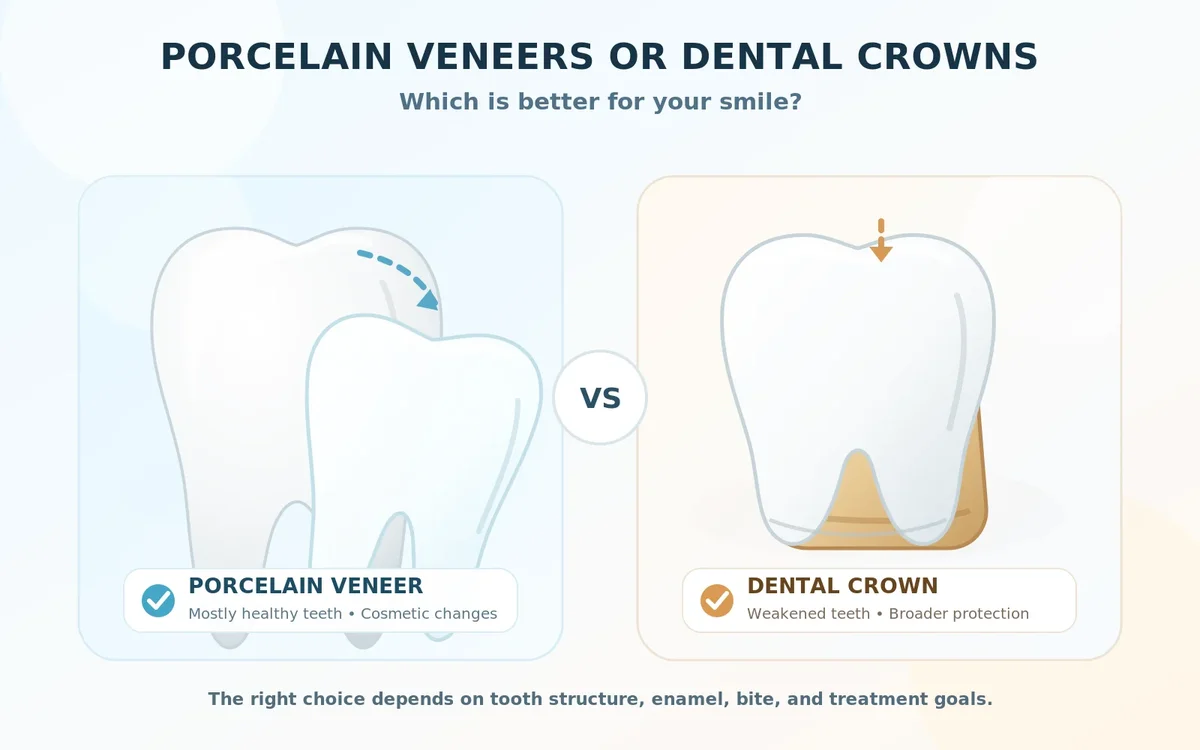
Porcelain Veneers or Dental Crowns Which Is Better for Long-Term Results?
The direct answer: veneers may be the better long-term choice for structurally healthy teeth that need mainly cosmetic improvement, while crowns may be more appropriate for teeth that require broader rebuilding or protection. Neither restoration lasts forever, and no dentist can guarantee an exact lifespan. When deciding porcelain veneers or dental crowns which is better, long-term success depends less on choosing the restoration that sounds strongest and more on matching the treatment to the tooth, controlling bite forces, maintaining healthy gums, and attending regular dental reviews.
Porcelain Veneers or Dental Crowns Which Is Better for Longevity?
Both veneers and crowns can provide many years of service in suitable cases, but their performance varies from person to person. The quality and quantity of remaining tooth structure, preparation design, ceramic material, bonding or cementation, oral hygiene, diet, smoking, gum health, and grinding habits can all affect the outcome. This means the answer to porcelain veneers or dental crowns which is better cannot be reduced to a fixed number of years from an advertisement or online comparison.
A veneer bonded mainly to sound enamel may perform well when the tooth is healthy and bite forces are controlled. A crown may be more dependable when a tooth is extensively filled, fractured, severely worn, or otherwise weakened. However, placing a crown on a healthy tooth does not automatically improve longevity, because it generally requires more preparation. Likewise, using a veneer on a structurally compromised tooth may leave important areas insufficiently protected. The practical answer to porcelain veneers or dental crowns which is better is the option that provides enough coverage without removing more healthy tissue than reasonably necessary.
Porcelain Veneers or Dental Crowns Which Is Better for Maintenance?
Daily care is similar for both treatments. You should brush carefully with fluoride toothpaste, clean between the teeth, and follow the review schedule recommended by your dentist. Porcelain itself does not develop decay, but the natural tooth at the restoration margin still can. Plaque accumulation can also contribute to gum inflammation, bleeding, recession, and unpleasant breath. For this reason, porcelain veneers or dental crowns which is better should include a discussion of how easy the proposed margins will be to clean. In practical terms, porcelain veneers or dental crowns which is better also depends on whether you can maintain the restoration consistently at home.
Veneers usually have margins around the front and sides of the tooth, while crown margins generally continue around the entire prepared tooth. The exact position depends on the case. A well-designed restoration should support practical cleaning, but home care remains essential. When comparing porcelain veneers or dental crowns which is better, ask the dentist or hygienist to show you how to floss around the restorations and whether interdental brushes, water flossers, or other aids are appropriate for your mouth.
Habits That Can Shorten the Life of Either Option
- Grinding or clenching without recommended bite protection
- Chewing ice, pens, hard sweets, or other non-food objects
- Using front teeth to open packages or cut materials
- Frequent sugar intake combined with inadequate plaque control
- Smoking or neglecting professional gum care
- Ignoring a loose restoration, changing bite, or persistent sensitivity
These habits do not mean treatment will necessarily fail, but they can increase stress on both the porcelain and the supporting tooth. If you have repeatedly chipped fillings or restorations, the question of porcelain veneers or dental crowns which is better should include an assessment of why the damage keeps occurring. A stronger-looking restoration alone may not solve a bite problem or uncontrolled grinding.
How Grinding and Bite Forces Affect the Decision
Grinding, clenching, an edge-to-edge bite, a deep bite, missing back teeth, or uneven tooth contact can place excessive pressure on veneers and crowns. Veneers may be vulnerable when heavy force falls on their edges, while crowns can also chip, loosen, or fracture under repeated stress. Therefore, porcelain veneers or dental crowns which is better may depend on whether the bite can be stabilized before or after treatment. For a patient with heavy bite forces, porcelain veneers or dental crowns which is better cannot be decided responsibly without examining the contacts between the teeth.
A dentist may discuss orthodontics, replacement of missing teeth, bite adjustment in selected cases, or a protective night guard. A night guard is not a guarantee against damage, and it must be worn and reviewed as advised. If you wake with jaw fatigue, notice flattened tooth edges, or have a history of broken restorations, mention this during the consultation. These details can materially change the answer to porcelain veneers or dental crowns which is better.
Porcelain Veneers or Dental Crowns Which Is Better as Gums Change?
Gums can recede or change position over time because of periodontal disease, aggressive brushing, thin gum tissue, smoking, tooth movement, or natural aging. Recession may expose the edge of a veneer or crown and create a visible color difference near the gum line. It may also increase sensitivity or make cleaning more demanding. When considering porcelain veneers or dental crowns which is better, healthy and stable gums should be established before final restorations are made.
If your gums bleed, feel tender, or have recently changed position, periodontal assessment may need to come first. Placing porcelain while gum inflammation is active can affect impressions, scans, margin accuracy, and the final appearance. In some cases, gum treatment or healing time may be recommended before deciding porcelain veneers or dental crowns which is better. This can extend the timeline, but it may create a healthier foundation for treatment.
What Happens If a Veneer or Crown Needs Repair?
Minor porcelain damage can sometimes be polished or repaired with composite material, depending on its location and extent. A loose veneer may occasionally be rebonded if the restoration and underlying tooth remain suitable. A damaged crown may sometimes be repaired, but replacement may be necessary when there is significant fracture, decay, poor fit, or a problem beneath it. The available solution depends on clinical findings, so porcelain veneers or dental crowns which is better should include a realistic conversation about future repair and replacement. Before treatment, ask how porcelain veneers or dental crowns which is better would affect the options available if a restoration later fails.
Replacing either restoration may require further treatment. The dentist must remove the old restoration, evaluate the remaining tooth, treat decay or other problems when present, and determine whether the tooth can support a similar restoration. A tooth that previously carried a veneer may later need another veneer or, in some circumstances, a crown. A crowned tooth may require rebuilding, root canal treatment, or a different plan if substantial damage has occurred. These are possibilities rather than guaranteed outcomes, but they matter when comparing porcelain veneers or dental crowns which is better over the long term.
Porcelain Veneers or Dental Crowns Which Is Better for Future Flexibility?
Veneers often preserve more tooth structure, which may leave more options for future treatment when they are placed on suitable teeth. Crowns usually involve greater reduction but may be necessary to restore teeth that already have limited strength. The most conservative plan is not always the one with the smallest restoration; it is the plan that meets the clinical need without unnecessary preparation. This principle should guide every discussion of porcelain veneers or dental crowns which is better. It also explains why porcelain veneers or dental crowns which is better may have a different answer for neighboring teeth in the same smile.
Alternatives may offer even greater flexibility. Whitening can address generalized color concerns, composite bonding can repair limited chips or spaces, orthodontics can improve alignment, and an inlay or onlay may rebuild selected areas of a damaged tooth. If one of these options can meet your goals, the answer to porcelain veneers or dental crowns which is better may be neither. Ask what would happen if you delayed treatment, chose a more conservative option, or treated only the teeth with a clear clinical need.
How to Compare Long-Term Value and Cost
Long-term value includes more than the initial fee. Consider diagnostic appointments, temporary restorations, laboratory work, follow-up visits, professional cleaning, a possible night guard, future repairs, and eventual replacement. Final costs depend on examination findings, materials, complexity, and additional care, so they should not be guaranteed before treatment planning. A complete comparison of porcelain veneers or dental crowns which is better should separate immediate treatment fees from possible long-term maintenance. When evaluating porcelain veneers or dental crowns which is better, request an itemized estimate and ask which maintenance costs are included or separate.
A lower upfront fee may not represent better value if the treatment is poorly matched to the tooth. At the same time, a more expensive or extensive treatment is not automatically more durable. A healthy tooth should not receive a crown solely because it is perceived as stronger, and a compromised tooth should not receive a veneer solely because it appears less costly. The most sensible answer to porcelain veneers or dental crowns which is better combines biological suitability, realistic maintenance, and a budget you can manage.
Plan the Decision Tooth by Tooth
You may not need the same restoration across your entire smile. One healthy tooth may be suitable for a veneer, another with a large filling may require a crown, and a third may improve with bonding or no treatment. A mixed approach can preserve healthy tissue while addressing structural problems appropriately. This is why porcelain veneers or dental crowns which is better is often best answered separately for each tooth rather than through a package-based decision. A clinic evaluating porcelain veneers or dental crowns which is better should be able to explain the reason for every proposed restoration.
Redent Klinik can review your enamel, remaining tooth structure, existing restorations, gums, bite, symptoms, and cosmetic goals before discussing long-term options. Photographs and dental records may help with an initial conversation, but final suitability and cost generally depend on a clinical examination and personalized treatment planning. This individualized review is what turns porcelain veneers or dental crowns which is better from a general search question into a clinically relevant decision. You can request information through the Redent Klinik Contact Page.
Your next check: look for gum bleeding, recession, sensitivity, old fillings, cracks, repeated chipping, grinding signs, or a bite that feels uneven. Ask how much healthy tooth structure each option preserves, how the margins should be cleaned, whether a night guard is advisable, and what repair or replacement may involve. Request professional advice before treatment if you have pain, swelling, loose dental work, a visible fracture, active gum problems, or plans to restore several teeth. The most reliable long-term answer to porcelain veneers or dental crowns which is better is the restoration supported by a tooth-specific examination, realistic expectations, and a maintenance plan you are prepared to follow.
Disclosure: this page may contain affiliate links. We may earn a commission if you use them, at no extra cost to you.