
Quick answer: For a medically suitable patient who wants fixed teeth, stronger stability, and less movement while eating or speaking, All on 6 dental implants are often the better option. Dentures may be better when the priorities are a lower initial cost, faster treatment, or avoiding surgery. The most accurate answer to all on 6 dental implants or dentures which is better depends on your bone level, gum health, medical history, budget, timeline, and willingness to maintain the restoration.
The main difference is simple: an All on 6 restoration is usually a full-arch bridge supported by six implants, while a conventional denture rests on the gums and is removed for cleaning. Therefore, all on 6 dental implants or dentures which is better is not just a question about appearance. It is also about stability, surgery, healing, maintenance, and how you prefer to manage treatment costs.
If your current denture moves, causes sore spots, limits food choices, or affects your confidence when speaking, implant-supported teeth may offer a meaningful improvement. A fixed bridge does not depend on suction or denture adhesive in the same way as a removable denture. For readers asking all on 6 dental implants or dentures which is better because movement is their main problem, implants commonly have the advantage. However, implant teeth still require careful cleaning underneath, professional reviews, and possible future repair.
Dentures remain a valid choice for people who do not want surgery, have medical limitations, need a quicker removable solution, or cannot currently manage the higher starting cost of implant treatment. A well-made denture can restore appearance and basic function, although retention varies between patients, particularly in the lower jaw. When affordability and a non-surgical approach matter most, the answer to all on 6 dental implants or dentures which is better may favor dentures.
| Decision Factor | All on 6 Dental Implants | Dentures |
|---|---|---|
| Stability | Usually fixed and more resistant to movement | Removable and may shift during eating or speaking |
| Treatment | Requires surgery and a planned healing process | Usually avoids implant surgery |
| Initial Cost | Generally higher and dependent on clinical needs | Generally lower, with future adjustments possible |
| Maintenance | Cleaned in the mouth and professionally reviewed | Removed for cleaning and may need relining |
When deciding all on 6 dental implants or dentures which is better, cost should be compared carefully. All on 6 treatment may include extractions, three-dimensional imaging, implant surgery, temporary teeth, laboratory work, and a final bridge. Dentures generally cost less initially, but relining, repair, and replacement can add future expense. No responsible clinic can guarantee a final price before an examination. When researching all on 6 dental implants or dentures which is better, request a written plan that explains what is included and what could change after imaging or clinical assessment.
For all on 6 dental implants or dentures which is better, your health and anatomy may determine which option is realistic. Active gum disease, uncontrolled diabetes, heavy smoking, certain medications, severe grinding, previous radiation to the jaw, or significant bone loss can affect implant healing and long-term risk. These factors do not always rule out implants, but they require individual assessment. This is why all on 6 dental implants or dentures which is better cannot be decided safely from a photograph, an online package, or a price list alone.
Timing also matters when evaluating all on 6 dental implants or dentures which is better. Some patients may receive temporary fixed teeth on or soon after implant placement, but immediate loading is not suitable for everyone. Bone quality, implant stability, infection, and bite forces must be checked first. Other patients need gum treatment, grafting, extractions, or a healing period. Dentures can often be completed sooner, although several adjustment appointments may still be required. If you have travel, work, or family deadlines, discuss them while comparing all on 6 dental implants or dentures which is better.
A professional consultation is needed before removing remaining teeth, choosing an implant package, or replacing a poorly fitting denture. Seek prompt dental advice if you have swelling, persistent pain, infection, bleeding gums, loose teeth, numbness, or difficulty eating. A proper assessment may include an oral examination, gum evaluation, bite analysis, medical-history review, and three-dimensional imaging. General information from the American Dental Association can support your research, but it cannot determine all on 6 dental implants or dentures which is better for your mouth.
For your own situation, focus on priorities. If you want fixed teeth, accept surgery, are clinically suitable, and can maintain careful daily cleaning and regular reviews, All on 6 may be the stronger match. If you prefer to avoid surgery, need a lower initial investment, or feel comfortable removing the teeth for cleaning, dentures may suit you better. In some cases, an implant-retained removable overdenture offers a useful middle ground. That alternative is another reason all on 6 dental implants or dentures which is better should be answered through a complete treatment comparison.
Redent Klinik can assess your scans, oral health, medical history, expectations, and preferred timeline before recommending a fixed or removable solution. A personalized evaluation should explain risks, maintenance, temporary teeth, expected appointments, and cost variables without unrealistic promises. If you are deciding all on 6 dental implants or dentures which is better, you can request an individual assessment through the Redent Klinik Contact Page.
Practical next step: Write down your three main priorities, such as stability, cost, treatment speed, appearance, or avoiding surgery. Then book a comprehensive examination and ask whether any natural teeth can be saved, whether six implants are actually indicated, whether grafting is expected, and what temporary teeth would be used. Compare the written options side by side. This will give you the clearest personal answer to all on 6 dental implants or dentures which is better.
All on 6 Dental Implants or Dentures Which Is Better for Cost?
Direct answer: Dentures usually have the lower initial cost, while All on 6 dental implants generally require a larger upfront investment because they involve surgery, implants, laboratory work, and a fixed full-arch restoration. However, the least expensive option at the beginning is not automatically the most suitable or economical option over time. When considering all on 6 dental implants or dentures which is better, compare the complete treatment journey rather than relying only on the first price you see.
Your final decision should reflect what you can comfortably afford, how much stability you expect, whether you are willing to undergo surgery, and how you feel about future maintenance. A conventional removable denture may be the practical choice when your immediate budget is limited or you need a non-surgical replacement for missing teeth. All on 6 treatment may offer better value for a suitable patient who strongly prefers fixed teeth and is prepared for the associated treatment, cleaning requirements, and long-term professional reviews.
Why All on 6 Dental Implant Costs Are Usually Higher
All on 6 treatment is not a single product with one universal price. It is a multi-stage clinical and laboratory process. When patients ask all on 6 dental implants or dentures which is better from a cost perspective, they should first understand what an implant quotation may include. Depending on the individual case, the treatment plan may involve consultations, diagnostic records, panoramic or three-dimensional imaging, removal of failing teeth, six implant fixtures, surgical materials, sedation or anesthesia options, temporary teeth, laboratory stages, and a final full-arch bridge.
Additional procedures may be recommended when there is insufficient bone, active infection, gum disease, or an unsuitable bite. These procedures can affect both cost and timing. Some patients may not need grafting, while others may require preparatory care before implants can be placed safely. This is why an advertised starting price cannot reliably predict your final treatment cost. A clinician must examine your mouth and review appropriate imaging before providing an individualized estimate.
Materials Can Affect the Treatment Estimate
The material chosen for the temporary and final bridge may influence the total cost. Acrylic-based, composite, metal-reinforced, and zirconia restorations can have different laboratory requirements, aesthetic characteristics, repair considerations, and expected maintenance needs. More expensive does not always mean more appropriate for every patient. Your bite strength, available space, appearance goals, grinding habits, and implant positions should guide the material choice.
When comparing all on 6 dental implants or dentures which is better, ask whether the quotation includes both the temporary and final restoration. Also ask whether scans, extractions, medication, sedation, follow-up appointments, adjustments, and protective appliances are included. Two clinics may advertise different prices because their treatment packages contain different services, not necessarily because one provides better or worse care.
Why Dentures Usually Cost Less Initially
Traditional dentures do not normally require implant surgery, which makes their starting cost lower in most cases. Their fee may cover impressions or digital records, bite registration, trial stages, laboratory fabrication, fitting, and early adjustments. For someone who wants to replace missing teeth without surgery, dentures may provide a financially accessible route to restoring appearance and basic oral function.
However, deciding all on 6 dental implants or dentures which is better requires considering later expenses as well. The shape of the gums and jaw can change after tooth loss, particularly during the months following extractions. As a result, a denture may need adjustments, relining, repair, or eventual replacement. Denture teeth can wear, the base can fracture, and changes in fit can affect comfort. Adhesive products may also become an ongoing personal expense for some wearers, although a correctly assessed denture should not be planned around excessive adhesive use.
These future needs do not make dentures a poor choice. They simply mean that the lower initial fee should not be viewed as the entire lifetime cost. Dentures may still be the better financial decision when surgery is not desired, implant treatment is medically unsuitable, or the higher starting cost of a fixed restoration would create unreasonable financial pressure.
Compare Value, Not Just the Lowest Price
A useful way to assess all on 6 dental implants or dentures which is better is to compare cost with the functions you value most. If you are comfortable removing your teeth at night, cleaning them outside the mouth, and accepting the possibility of movement, a denture may meet your needs at a manageable cost. If movement, speech concerns, reduced biting confidence, or repeated denture discomfort significantly affect your daily life, paying more for implant-supported fixed teeth may feel justified—provided you are clinically suitable.
| Cost Area | All on 6 Dental Implants | Conventional Dentures |
|---|---|---|
| Initial treatment | Usually higher because surgery and implants are involved | Usually lower because implant surgery is not required |
| Diagnostic planning | May require three-dimensional imaging and detailed surgical planning | Usually requires examination, impressions, and bite records |
| Future maintenance | May include professional cleaning, bridge repair, screw replacement, or component maintenance | May include adjustments, relining, repair, adhesive products, or replacement |
| Time away from work | May involve surgical recovery and several planned appointments | Usually avoids surgical recovery but still requires fitting visits |
| Unexpected needs | Bone treatment, extractions, infection management, or additional restorative work may affect cost | Difficult jaw anatomy, immediate-denture changes, or repeated adjustments may affect cost |
Cost also includes time, travel, recovery, and maintenance. For example, implant treatment may require several clinical visits and a healing period before the final bridge is completed. Dentures may be delivered sooner in some cases, but new wearers often need adaptation and adjustment appointments. If you are considering treatment abroad, include flights, accommodation, possible return visits, and access to follow-up care in your comparison. The answer to all on 6 dental implants or dentures which is better may change when these indirect costs are included.
Be Careful With Very Low Advertised Prices
A low price should lead to careful questions rather than an immediate decision. Ask which implant system will be used, who will perform the surgery, what experience the team has with full-arch treatment, what type of final restoration is included, and how complications or repairs are handled. It is also important to understand whether the advertised amount applies only to straightforward cases.
When evaluating all on 6 dental implants or dentures which is better, avoid choosing a treatment solely because a package appears cheap. Removing teeth and placing implants are significant clinical decisions. Remaining natural teeth should be assessed carefully before extraction, and alternatives should be explained. A personalized treatment plan should describe expected stages, important risks, possible additional procedures, maintenance responsibilities, and realistic cost variables.
Which Option Is More Affordable for Your Situation?
Dentures may be the more affordable choice if you need the lowest initial expense, prefer to avoid surgery, or are uncertain about committing to implant treatment. They can also serve as a temporary solution while you improve your oral health, review medical conditions, or plan financially. A temporary denture does not necessarily prevent you from considering implants later, although ongoing bone changes may influence future treatment options.
All on 6 treatment may be financially reasonable when fixed teeth are a major priority, you are suitable for surgery, and you understand the need for daily cleaning and professional maintenance. However, implant-supported teeth are not maintenance-free or guaranteed to last indefinitely. Biological complications, wear, fractures, loosening, or changes in oral health can lead to future treatment costs. The most responsible answer to all on 6 dental implants or dentures which is better includes these possible expenses rather than focusing only on the day the teeth are fitted.
An implant-retained removable overdenture may also be worth discussing. It typically uses fewer implants than a fixed All on 6 bridge and may provide greater stability than a conventional denture. It remains removable for cleaning, and its clinical suitability and cost depend on the number of implants, jaw anatomy, attachment system, and restorative design. For some patients, this option creates a practical balance between stability and budget.
What to Check Before Accepting a Price
Before making a payment or booking treatment, request a written, itemized plan. Check whether the estimate includes examinations, imaging, extractions, temporary teeth, the final bridge or denture, anesthesia options, laboratory work, reviews, adjustments, and aftercare. Ask what circumstances could change the estimate and how future repairs are charged. Final costs should always depend on an examination and treatment planning rather than a guaranteed online figure.
Professional advice is especially important if you have gum disease, loose teeth, significant bone loss, uncontrolled medical conditions, heavy smoking habits, a history of jaw surgery, or persistent denture pain. A consultation is also necessary before deciding that all remaining teeth should be removed. Redent Klinik can review your oral condition, scans, goals, and preferred budget before explaining which options may be appropriate. You can request a personalized assessment through the Redent Klinik Contact Page.
Your next step: Obtain an itemized quotation for each suitable option and compare the total treatment, not just the headline fee. Confirm what is included, what maintenance may be needed, whether a removable implant overdenture is possible, and whether any natural teeth can be preserved. This cost-focused evaluation will help you reach a more realistic personal answer to all on 6 dental implants or dentures which is better.
All on 6 Dental Implants or Dentures Which Is Better for Your Needs?
Direct answer: All on 6 dental implants may be more suitable for someone who wants fixed teeth, has adequate oral and general health for surgery, and can commit to careful daily cleaning and regular dental reviews. Conventional dentures may be more suitable for someone who prefers a removable, non-surgical option, needs a lower initial cost, or has health or anatomical factors that make implant treatment less appropriate. Therefore, the answer to all on 6 dental implants or dentures which is better depends less on age alone and more on your bone condition, gum health, medical history, expectations, lifestyle, and ability to maintain the chosen restoration.
Suitability should be assessed before cost or appearance becomes the deciding factor. A treatment can look attractive in photographs but still be unsuitable for your mouth or daily habits. When comparing all on 6 dental implants or dentures which is better, the most useful question is not simply, “Which treatment is more advanced?” Instead, ask, “Which treatment can be planned safely, maintained realistically, and used comfortably in my situation?”
Who May Be Suitable for All on 6 Dental Implants?
All on 6 treatment may be considered for adults who have lost most or all of the teeth in one jaw, or whose remaining teeth have a poor prognosis after a complete professional assessment. The treatment generally uses six implants to support a full-arch fixed bridge. However, the presence of missing or damaged teeth does not automatically mean that six implants are necessary. Remaining natural teeth should be examined carefully before extraction is recommended.
For patients asking all on 6 dental implants or dentures which is better, implant-supported fixed teeth may be appealing when removable dentures move, affect speech, create repeated sore areas, or feel psychologically difficult to wear. A fixed bridge can provide greater stability than a conventional denture, but it also requires surgery, healing, detailed planning, and long-term maintenance. Being interested in fixed teeth is only the first part of determining suitability.
Bone Quantity and Bone Quality
Dental implants must be placed in positions where the jawbone can support them. The amount, shape, and quality of available bone can influence implant length, angle, distribution, and initial stability. A panoramic X-ray may provide useful preliminary information, but three-dimensional imaging is often required for detailed implant planning. The clinician may also need to evaluate nearby nerves, sinus spaces, previous extraction sites, and areas of infection.
Bone loss does not always exclude implant treatment. Some patients may still be candidates for angled implants, alternative implant positions, bone grafting, or another restorative design. Other patients may be advised to choose a removable solution because the surgery required for fixed teeth would be more complex than expected. This is why all on 6 dental implants or dentures which is better cannot be decided accurately from age, photographs, or a remote price quotation alone.
Healthy Gums and Infection Control
Active gum disease, untreated infection, and poor plaque control can increase the risk of complications around implants. Before All on 6 treatment, the dental team may recommend gum therapy, extraction of infected teeth, improved cleaning, or a period of monitoring. Implant-supported teeth are not protected from inflammation simply because they cannot develop decay in the same way as natural teeth. The gums and bone around implants still require consistent care.
If you have bleeding gums, persistent bad breath, loose teeth, swelling, pus, or recurring dental pain, request a clinical examination before deciding all on 6 dental implants or dentures which is better. These symptoms may indicate conditions that need attention before either a fixed bridge or a new denture is planned.
How General Health Affects Implant Suitability
Your medical history is an important part of implant planning. Diabetes control, immune conditions, bleeding disorders, previous radiotherapy involving the jaws, osteoporosis treatment, heart conditions, and medications that affect healing or bone metabolism may influence the treatment approach. These factors do not automatically mean that implants are impossible, but they may require additional information, coordination with your doctor, treatment modifications, or a different restorative option.
Smoking and nicotine use can also affect healing and long-term oral health. A clinician may discuss reducing or stopping tobacco use before surgery. When evaluating all on 6 dental implants or dentures which is better, be open about smoking, vaping, medication, previous operations, allergies, and existing medical diagnoses. Withholding information can make treatment planning less accurate.
Dental anxiety should also be considered. Some people are comfortable with several surgical and restorative appointments, while others strongly prefer to avoid surgery. Sedation options may be available in appropriate cases, but they have their own suitability requirements and costs. A removable denture may be the more realistic choice when the patient does not want an invasive procedure, even when implants appear technically possible.
Who May Be Better Suited to Conventional Dentures?
Conventional dentures may be appropriate for people who want to replace missing teeth without implant surgery. They may also suit patients who need a faster removable solution, have medical limitations, cannot commit to an implant treatment schedule, or prefer a lower initial financial commitment. For these patients, the answer to all on 6 dental implants or dentures which is better may reasonably favor dentures.
Dentures can restore facial support, appearance, speech, and some chewing function, but they have limitations. Their stability depends partly on the shape of the gums, saliva, muscle control, bite, and whether the denture replaces upper or lower teeth. Lower dentures are often more challenging to stabilize because there is less surface area and the tongue affects movement. Adjustments may be required as the gums change, particularly after recent extractions.
A patient who chooses dentures should be comfortable removing them for cleaning and following instructions about overnight wear. Manual dexterity, eyesight, memory, and access to support may affect the ability to clean and manage removable teeth. In some situations, a denture is easier for a caregiver to remove and clean than a complex fixed bridge. In other situations, a removable appliance may be misplaced or difficult for the patient to manage. Suitability is therefore personal rather than universal.
Can You Maintain Fixed Implant Teeth Properly?
Maintenance is one of the most important considerations in deciding all on 6 dental implants or dentures which is better. All on 6 teeth may be fixed in the mouth, but food and plaque can collect beneath the bridge. Cleaning may require an electric toothbrush, interdental brushes, specialized floss, an oral irrigator, or other tools recommended by the dental team. Professional cleaning and periodic examination are also necessary.
If hand movement is limited because of arthritis, neurological conditions, injury, or another health issue, cleaning beneath a full-arch bridge may be difficult. This does not automatically make implant treatment unsuitable, but the dental team should assess whether you or a caregiver can maintain the restoration. A design that looks attractive but cannot be cleaned effectively may create avoidable long-term problems.
Conventional dentures are removed for cleaning, which can make all surfaces easier to access. However, the gums, tongue, and any remaining teeth must still be cleaned. Dentures also require periodic fit checks because changes in the jaw can cause pressure points or movement. Neither option is maintenance-free, so the answer to all on 6 dental implants or dentures which is better should include an honest assessment of what you can manage every day.
Consider Your Bite, Grinding Habits, and Food Expectations
Strong clenching or tooth grinding can place additional pressure on implant components, bridges, denture teeth, and jaw joints. A clinician may examine tooth wear, facial muscles, jaw movement, and the available space for the restoration. A protective night appliance may be recommended in certain implant cases, although suitability depends on the design of the teeth and the opposing jaw.
Patients often choose implants because they expect to eat exactly as they did with healthy natural teeth. Implant-supported teeth can provide improved stability, but they are still artificial restorations and should be used responsibly. Very hard or damaging habits can increase the possibility of wear, chipping, fracture, or component loosening. Denture wearers may need to cut food into smaller pieces, chew on both sides, and adapt gradually.
When asking all on 6 dental implants or dentures which is better, explain what foods you currently avoid and what functional improvement you expect. This allows the clinician to determine whether your goals are realistic for a fixed bridge, conventional denture, or another solution.
Age Alone Does Not Decide Suitability
There is no single age at which every patient should choose dentures instead of implants. An older adult with stable health, manageable medical conditions, adequate bone, and good cleaning ability may be considered for implant treatment. A younger adult with uncontrolled disease, active infection, heavy smoking, poor oral hygiene, or unrealistic expectations may not be an appropriate immediate candidate.
For this reason, all on 6 dental implants or dentures which is better should be answered through a health-based evaluation rather than an age-based assumption. Recovery capacity, medication, independence, dexterity, treatment goals, and long-term access to dental care may be more relevant than the number of birthdays a person has had.
What If Neither Option Feels Completely Right?
The choice is not always limited to a fixed All on 6 bridge or a conventional denture. An implant-retained overdenture may provide a middle option. This type of denture attaches to implants for improved retention but remains removable for cleaning. It may use fewer implants than a fixed bridge, although the number and position depend on the jaw, bone, restorative design, and individual clinical findings.
Other possibilities may include preserving selected natural teeth, using a partial denture, placing an implant-supported bridge only in a specific area, or wearing a temporary denture while health or financial concerns are addressed. When discussing all on 6 dental implants or dentures which is better, ask the dentist to explain all reasonable alternatives, including the consequences of delaying treatment.
A Personal Suitability Checklist
Before choosing a treatment, consider the following questions:
- Do I strongly prefer fixed teeth, or am I comfortable removing a denture for cleaning?
- Am I willing and medically able to undergo implant surgery?
- Can I maintain detailed cleaning beneath a fixed bridge every day?
- Do I smoke, grind my teeth, or have a medical condition that may affect healing?
- Are my expectations about appearance, eating, treatment time, and maintenance realistic?
- Can I attend the necessary appointments and future professional reviews?
- Have my remaining natural teeth been assessed before extraction is considered?
- Have I been offered alternatives such as an implant-retained overdenture?
If several answers are uncertain, do not select treatment from an advertisement alone. Redent Klinik can review your oral health, available scans, medical information, expectations, and maintenance ability before discussing whether fixed or removable teeth may be appropriate. A personalized evaluation can be requested through the Redent Klinik Contact Page.
What to check next: Request professional advice if you have loose teeth, active gum problems, recurring infection, significant bone loss, uncontrolled medical conditions, heavy smoking habits, severe grinding, or difficulty cleaning your mouth. Before deciding all on 6 dental implants or dentures which is better, ask for an oral examination, appropriate imaging, a review of your medical history, and a clear explanation of every suitable alternative. The right choice should match both your clinical needs and your ability to maintain the result over time.
All on 6 Dental Implants or Dentures Which Is Better for the Treatment Process?
Direct answer: Dentures normally involve a shorter, non-surgical fitting process, whereas All on 6 dental implants require imaging, surgical placement, healing, temporary teeth, and a final fixed bridge. Dentures may be more practical when you want to avoid surgery or need a removable solution sooner. All on 6 may be more suitable when you are medically eligible, strongly prefer fixed teeth, and can commit to recovery and long-term reviews. When deciding all on 6 dental implants or dentures which is better, choose the process that fits your health and daily life, not simply the fastest advertised option.
What Happens Before Either Treatment Begins?
Both choices should start with a complete examination. The dentist may assess your gums, remaining teeth, bite, jaw shape, current denture, medical history, medication, smoking habits, and cleaning ability. X-rays are usually needed, and three-dimensional imaging is commonly considered for implant planning. The answer to all on 6 dental implants or dentures which is better may change if the assessment identifies infection, limited bone, active gum disease, or natural teeth that could reasonably be preserved.
Before agreeing to extractions, ask whether every remaining tooth has been evaluated and whether alternatives have been explained. A conventional denture, implant-retained overdenture, fixed bridge, or staged plan may be more appropriate in certain cases. No photograph or online package can confirm all on 6 dental implants or dentures which is better without clinical records and an individualized treatment plan.
The All on 6 Dental Implant Process
Planning and Preparation
Planning may include digital scans or impressions, photographs, bite records, and three-dimensional imaging. The team uses this information to consider implant positions, temporary teeth, final tooth shape, speech, bite, and cleaning access. Gum treatment, infection control, extractions, or bone procedures may be recommended before or during surgery. When researching all on 6 dental implants or dentures which is better, ask which preparatory treatments apply to you and how they may change the schedule or cost.
Implant Placement and Temporary Teeth
During surgery, six implants are placed in planned areas of the jaw using suitable anesthesia. Teeth with a confirmed poor prognosis may sometimes be removed during the same appointment. Temporary fixed teeth can be fitted immediately in selected cases, but this depends on implant stability, bone quality, infection, bite pressure, and general health. Anyone comparing all on 6 dental implants or dentures which is better should ask what temporary restoration will be used if immediate fixed loading is not advisable.
A temporary removable denture may be worn while the implants heal. This is why phrases such as “teeth in a day” need context: temporary teeth may be delivered quickly, but biological healing and the final bridge still take time. In deciding all on 6 dental implants or dentures which is better, check whether an advertised timeline refers to provisional teeth or completion of the entire treatment.
Healing and the Final Bridge
Swelling, tenderness, bruising, and a temporary soft-food period may follow surgery. The dental team should explain medication, cleaning, physical activity, and warning signs. Healing varies between patients, and temporary teeth may need adjustment as the gums change. The question all on 6 dental implants or dentures which is better should therefore include whether you can manage recovery, dietary changes, and scheduled follow-up visits.
Once healing and implant stability have been reviewed, records are taken for the final bridge. Tooth position, appearance, speech, bite, and access for cleaning should be assessed before fitting. Implant surgery is only one stage, so all on 6 dental implants or dentures which is better must also be judged by your willingness to clean beneath the bridge and attend professional maintenance appointments.
The Conventional Denture Process
Records, Trial Teeth, and Delivery
Denture treatment generally avoids implant surgery. The dentist records the gums and jaw relationship, selects tooth shape and shade, and may arrange a trial appointment to review appearance, speech, and bite. For patients who prioritize a non-surgical route, all on 6 dental implants or dentures which is better may favor dentures, provided they understand that fitting and adaptation still require several visits.
If extractions are necessary, an immediate denture can sometimes be prepared beforehand and inserted after the teeth are removed. It allows the patient to leave with replacement teeth, but the gums and bone change during healing. Adjustments, relining, or later replacement may be needed. When weighing all on 6 dental implants or dentures which is better, do not assume that an immediate denture will have its permanent fit on the first day.
Adaptation and Adjustments
New dentures can initially affect speech, saliva, chewing, and comfort. Softer food, smaller bites, and chewing on both sides may make adaptation easier. Sore areas should be adjusted professionally rather than filed at home. Dentures can be completed sooner than implant-supported teeth, but all on 6 dental implants or dentures which is better may still favor implants for a suitable patient who has repeatedly struggled with movement or lower-denture instability.
How Timing and Aftercare Should Influence Your Choice
Dentures may fit a limited schedule because they avoid implant healing, although records, trial stages, delivery, and adjustments still take time. All on 6 treatment usually involves more appointments and may require separate surgical and restorative phases. If you are travelling, all on 6 dental implants or dentures which is better also depends on how many trips are needed and who will provide urgent care, adjustments, and long-term reviews.
Active infection, inadequate bone, unstable gum health, uncontrolled medical conditions, smoking, or certain medications can delay or modify implant treatment. Recent extractions, severe jaw shrinkage, dry mouth, sensitive tissue, or an unusual bite may complicate denture treatment. These factors do not automatically exclude either choice, but they show why all on 6 dental implants or dentures which is better requires professional assessment rather than a guaranteed timeline.
Questions to Ask Before Choosing the Process
- Can any remaining natural teeth be treated and preserved?
- Will extractions and implant placement happen together or separately?
- What temporary teeth will I wear during healing?
- Could bone treatment be needed, and how would it affect timing?
- How many appointments or journeys are likely to be required?
- What eating, cleaning, and activity restrictions should I expect?
- Who will provide urgent care and long-term maintenance?
- Could an implant-retained overdenture provide a suitable middle option?
Use the answers to compare the complete process rather than surgery alone. Redent Klinik can review your scans, oral condition, medical information, travel plans, and expectations before outlining an individualized sequence of care. A consultation through the Redent Klinik Contact Page can help clarify all on 6 dental implants or dentures which is better for your circumstances without promising an identical schedule for every patient.
What to check next: Before arranging extractions, implant surgery, or an immediate denture, request a written plan covering preparation, temporary teeth, healing, final restoration, and aftercare. Seek prompt professional advice for swelling, fever, pus, persistent pain, uncontrolled bleeding, numbness, or difficulty swallowing. The safest answer to all on 6 dental implants or dentures which is better is the option whose complete process fits your clinical findings, responsibilities, and ability to attend follow-up care.
All on 6 Dental Implants or Dentures Which Is Better When Comparing Risks?
Direct answer: Neither option is completely risk-free. All on 6 dental implants involve surgical, biological, and mechanical risks, while conventional dentures are more likely to cause problems related to movement, pressure, fit, and gradual changes in the jaw. For a medically suitable patient who can maintain excellent oral hygiene, implant-supported fixed teeth may offer greater stability. For someone who needs to avoid surgery or cannot manage implant aftercare, dentures may be the safer practical choice. The answer to all on 6 dental implants or dentures which is better depends on which risks are most relevant to your health, habits, anatomy, and expectations.
Risks Associated With All on 6 Dental Implants
All on 6 treatment usually requires the placement of six implants in the jaw, sometimes together with extractions and temporary teeth. Possible early complications include pain, swelling, bruising, bleeding, infection, delayed healing, and temporary difficulty eating. There may also be a risk of injury to nearby anatomical structures, such as nerves or sinus areas, depending on the planned implant positions. Careful imaging and surgical planning can help reduce these risks, but no clinician should describe implant surgery as entirely predictable or free of complications.
When comparing all on 6 dental implants or dentures which is better, consider your medical history as well as your dental condition. Poorly controlled diabetes, immune conditions, certain medications, heavy smoking, previous radiotherapy involving the jaws, and untreated gum disease may affect healing. These factors do not automatically rule out implant treatment, but they can alter the treatment plan or make a removable option more appropriate. A dentist or implant clinician may need information from your physician before recommending surgery.
Implant Integration and Healing Concerns
An implant needs to become stable within the surrounding bone. In some cases, an implant may not integrate as expected or may lose stability during healing. If this happens, the affected implant may need additional treatment, replacement, or a change in the bridge design. Immediate temporary fixed teeth can also place pressure on healing implants, so bite control, food restrictions, and follow-up appointments are important.
Patients comparing all on 6 dental implants or dentures which is better should ask whether immediate fixed teeth are appropriate for their bone quality and implant stability. A temporary removable denture may sometimes be the safer option during healing. Receiving provisional teeth quickly does not mean the biological healing process is complete, and the final bridge is normally planned only after the dental team has reviewed the implants and surrounding tissues.
Inflammation and Infection Around Implants
Inflammation can develop around implants when plaque accumulates beneath the bridge. Early gum inflammation may cause redness, bleeding, tenderness, swelling, or bad breath. More advanced disease can involve loss of supporting bone. This is one of the most important issues for readers asking all on 6 dental implants or dentures which is better, because fixed implant teeth still require detailed daily cleaning.
Cleaning may involve an electric toothbrush, interdental brushes, specialized floss, an oral irrigator, or other tools recommended for the bridge design. A person who cannot clean beneath the restoration consistently may face a higher risk of inflammation. In that situation, a removable denture or implant-retained overdenture may be easier to maintain, particularly when manual dexterity, eyesight, memory, or caregiver support is limited.
Mechanical Problems With a Fixed Bridge
Implant-supported bridges can experience wear, chipping, fracture, loosening of screws, or damage to restorative components. Grinding, clenching, very hard foods, an unbalanced bite, or insufficient space for the bridge can increase mechanical stress. Some problems may be repaired, while others may require laboratory work or replacement of part of the restoration.
All on 6 teeth can feel stable, but they are not identical to natural teeth and are not maintenance-free. When deciding all on 6 dental implants or dentures which is better, include the possibility of future professional cleaning, bite adjustments, component replacement, and restorative repairs rather than focusing only on the initial appearance.
Risks and Limitations Associated With Dentures
Conventional dentures avoid implant surgery, but they have their own risks and limitations. A new or poorly fitting denture can create sore areas, rubbing, ulcers, chewing difficulty, speech changes, gagging, or reduced confidence. Dentures may move when eating or speaking, especially in the lower jaw, where there is less surface area for support.
For some patients, the answer to all on 6 dental implants or dentures which is better favors dentures because avoiding surgery is the priority. However, choosing dentures means accepting that their fit may change. After teeth are removed, the gums and supporting jaw can alter over time. Adjustment, relining, repair, or eventual replacement may therefore be needed.
Pressure, Irritation, and Sore Areas
Denture pressure can injure soft tissue if the appliance is unstable or worn despite repeated pain. A small pressure point may need a professional adjustment, while widespread movement may indicate that the fit or bite requires a more complete review. Increasing the amount of denture adhesive is not always an appropriate solution for a denture that has become significantly loose.
Do not attempt to reshape a denture with household tools or repair it with general-purpose glue. Home alterations can change the bite, damage the material, introduce unsuitable substances into the mouth, or make professional repair more difficult. If a denture becomes painful, cracked, unstable, or difficult to insert, request dental advice.
Cleaning and Oral Infection Risks
Dentures need to be removed and cleaned according to professional instructions. The gums, tongue, palate, and any remaining teeth must also be cleaned. Wearing a denture continuously, particularly overnight when removal has been recommended, may increase irritation and create conditions in which fungal problems can develop. Dry mouth can make denture wearing more difficult because it reduces lubrication and may increase friction.
When assessing all on 6 dental implants or dentures which is better, consider which cleaning routine you can follow reliably. Dentures provide access to all appliance surfaces after removal, while fixed implant bridges avoid daily removal but require careful cleaning beneath the restoration. Neither option eliminates the need for oral hygiene and regular dental examinations.
Which Risk Profile Fits Your Situation?
A useful way to approach all on 6 dental implants or dentures which is better is to compare the risks you can realistically manage. Implant treatment may be reasonable when you are suitable for surgery, can follow healing instructions, do not have uncontrolled risk factors, and are willing to clean beneath a fixed bridge every day. Dentures may be more appropriate when surgery presents an unacceptable concern, when medical conditions require a conservative approach, or when you prefer a restoration that can be removed for cleaning.
Your daily habits matter as well. Smoking or nicotine use, inconsistent oral hygiene, frequent missed appointments, and heavy teeth grinding may increase concerns around implant treatment. Denture-related problems may be more likely when the appliance is worn continuously, cleaned inadequately, altered at home, or used despite persistent soreness. Being honest about these habits allows the dental team to recommend a more realistic option.
| Risk Area | All on 6 Dental Implants | Conventional Dentures |
|---|---|---|
| Surgery | Includes surgical healing and possible operative complications | Normally avoids implant surgery |
| Cleaning | Requires detailed cleaning beneath a fixed bridge | Removed for cleaning, but the gums and mouth still require care |
| Stability | Usually more stable when treatment and healing are successful | May move, rub, or lose retention as supporting tissues change |
| Long-Term Concerns | Inflammation, bone loss, component wear, or bridge damage may occur | Sore areas, relining needs, fracture, wear, or replacement may occur |
| Personal Habits | Smoking, poor hygiene, and grinding can increase complications | Continuous wear, poor cleaning, and excessive adhesive use can create problems |
Warning Signs That Need Professional Assessment
Whether you already have implants or wear dentures, do not ignore persistent pain, increasing swelling, pus, fever, uncontrolled bleeding, a persistent bad taste, numbness, exposed implant components, or a loose bridge. Denture wearers should request advice for ulcers that do not improve, repeated sore spots, white or red patches, sudden loss of fit, cracks, or unexplained changes in the mouth.
These symptoms do not confirm a particular diagnosis, but they require professional examination. Before deciding all on 6 dental implants or dentures which is better, tell the clinician about all medications, previous implant problems, gum disease, smoking or vaping, teeth grinding, allergies, and medical conditions. Also ask which complications are more relevant to your case and how they would be managed.
How to Reduce Avoidable Treatment Risks
- Complete a clinical examination and appropriate imaging before treatment.
- Treat active gum disease or infection before the definitive restoration is provided.
- Give the dental team a complete medical and medication history.
- Follow cleaning, food, smoking, medication, and recovery instructions carefully.
- Attend planned reviews even when the teeth feel comfortable and stable.
- Ask whether grinding or clenching requires additional bite management.
- Confirm who will manage urgent concerns, repairs, and long-term maintenance.
- Discuss removable implant overdentures if fixed teeth create cleaning or surgical concerns.
Redent Klinik can assess your oral condition, scans, medical information, existing dentures, cleaning ability, and expectations before discussing the relative risks of fixed and removable treatment. A personalized review through the Redent Klinik Contact Page can help clarify all on 6 dental implants or dentures which is better for your circumstances without presenting either option as universally safe or suitable.
What to check next: Ask for a written explanation of the surgical, biological, mechanical, and maintenance risks associated with every suitable option. Request professional advice before implant treatment if you have uncontrolled medical conditions, active infection, severe gum disease, heavy smoking habits, previous jaw treatment, or difficulty maintaining oral hygiene. Seek prompt care if you already have swelling, persistent pain, numbness, pus, a loose implant bridge, or a denture sore that does not heal. The most responsible answer to all on 6 dental implants or dentures which is better is the option whose risks can be reduced, monitored, and managed within your real-life circumstances.
All on 6 Dental Implants or Dentures Which Is Better: What Are the Alternatives?
Direct answer: You may not have to choose only between a six-implant fixed bridge and a conventional removable denture. Implant-retained overdentures, fixed bridges supported by a different number of implants, partial dentures, treatment that preserves selected natural teeth, and staged rehabilitation can all be considered. When deciding all on 6 dental implants or dentures which is better, ask whether a less invasive, more affordable, or easier-to-clean alternative could meet your priorities without removing teeth unnecessarily.
The best alternative depends on how many healthy teeth remain, how much jawbone is available, whether you are suitable for surgery, how much stability you need, and what level of daily maintenance you can manage. A personalized examination is important because the most heavily advertised treatment is not automatically the most appropriate one. Before answering all on 6 dental implants or dentures which is better, a dentist should assess whether your remaining teeth can be preserved and explain all reasonable fixed and removable options.
Implant-Retained Overdentures as a Middle Option
An implant-retained overdenture is removable but attaches to implants for improved retention. It may reduce the movement often associated with conventional dentures while remaining easier to remove for cleaning than a fixed full-arch bridge. This can make it a useful alternative for people who want greater stability but do not necessarily need permanently fixed teeth.
For readers asking all on 6 dental implants or dentures which is better, an overdenture may offer a practical compromise when cost, cleaning ability, or surgical complexity is a concern. It commonly uses fewer implants than an All on 6 restoration, although the required number depends on the jaw, bone condition, attachment system, bite, and planned denture design. The lower jaw and upper jaw may require different approaches.
Who Might Prefer an Implant Overdenture?
An implant-retained overdenture may be worth discussing if your current denture moves but you are comfortable removing your teeth for cleaning. It can also be considered when a fixed bridge would be difficult to maintain because of reduced hand movement, limited vision, or reliance on a caregiver. Since the restoration can be removed, the implants, attachments, gums, and underside of the denture are usually more accessible for cleaning.
This option is not maintenance-free. Attachments can wear and may need replacement, the denture can require relining or repair, and the implants still need professional monitoring. When comparing all on 6 dental implants or dentures which is better, include these ongoing needs rather than viewing an overdenture as a permanent solution that will never require attention.
Could a Different Number of Implants Support Fixed Teeth?
Six implants are not automatically required for every full-arch restoration. Depending on bone availability, jaw size, bite forces, restorative space, implant distribution, and clinical preference, a fixed bridge may sometimes be supported by four, five, six, or more implants. The appropriate number cannot be selected from a standard package alone.
Patients researching all on 6 dental implants or dentures which is better often encounter terms such as All on 4, All on 5, or full-arch implant bridge. These labels describe general treatment concepts, but they do not replace individualized planning. More implants do not automatically guarantee a better result, while fewer implants do not automatically mean inferior treatment. Position, stability, bone support, bridge design, bite control, and maintenance access are all important.
When All on 4 May Be Discussed
An All on 4 approach may be considered when four well-positioned implants can support a planned full-arch restoration. Angled implants may sometimes be used to avoid anatomical areas or make better use of available bone. However, suitability depends on detailed imaging, bone quality, implant stability, opposing teeth, grinding habits, and the planned restorative material.
If cost is influencing your question about all on 6 dental implants or dentures which is better, ask whether fewer implants would genuinely be appropriate rather than simply cheaper. A responsible plan should explain why a specific number of implants is recommended, what happens if one implant does not integrate, and whether the final bridge design allows effective cleaning.
Preserving Selected Natural Teeth
Removing all remaining teeth is irreversible. Before choosing a full-arch implant bridge or complete denture, each tooth should be assessed for decay, gum support, mobility, infection, root condition, restorability, and strategic value. Some patients may be able to keep selected natural teeth and use a smaller bridge, partial denture, or combination of natural teeth and implants.
For someone asking all on 6 dental implants or dentures which is better, preserving treatable teeth may provide another path entirely. Natural teeth provide sensation through the periodontal ligament and may help support a more conservative restoration. However, saving teeth is not always predictable or appropriate when there is severe decay, advanced gum disease, repeated infection, fractures, or insufficient remaining tooth structure.
The decision should balance the likely benefits, limitations, treatment burden, and maintenance needs of preserving teeth against the consequences of extraction. Ask the dentist to explain which teeth have a favorable, uncertain, or poor prognosis. A second opinion may be valuable if removal of all remaining teeth has been recommended without a clear explanation.
Partial Dentures and Smaller Implant Bridges
If you still have several stable teeth, a partial denture may replace only the missing areas. Partial dentures are generally less invasive than full-arch implant treatment and can often be modified if additional teeth are lost, depending on the design. They remain removable and may use clasps, precision attachments, or other components for support and retention.
A smaller implant-supported bridge may also be possible when tooth loss affects only one section of the mouth. This avoids treating an entire arch unnecessarily. When evaluating all on 6 dental implants or dentures which is better, confirm whether your problem truly requires full-arch treatment or whether a localized solution could preserve more natural tissue and reduce treatment complexity.
Partial dentures and smaller bridges have their own limitations. Clasps may be visible, supporting teeth can require preparation, implants still require surgery, and future changes in the mouth may affect the design. The correct option should be based on the condition of the remaining teeth and the long-term restorative plan.
A Staged Treatment Plan
You may not need to complete every stage at once. A staged plan can begin with infection control, gum treatment, necessary extractions, and a temporary denture. Implant treatment can then be reconsidered after healing, medical stabilization, smoking reduction, or financial planning. This approach may be useful when immediate fixed treatment is not advisable.
For patients uncertain about all on 6 dental implants or dentures which is better, wearing a temporary or well-designed conventional denture can provide time to evaluate comfort, appearance, speech, and personal priorities. However, bone and gum changes after extractions may influence future implant planning, so delaying implants should be discussed with a clinician rather than assumed to have no consequences.
A staged plan may also spread treatment costs over time, but no clinic should guarantee that a specific future procedure will remain suitable. Oral conditions, medical health, bone volume, and treatment fees can change. Request a written explanation of which stages are essential, which are optional, and how delaying one stage may affect later choices.
Temporary Dentures During Healing
A temporary denture may be used after extractions or while implants heal. It can help maintain appearance and provide limited function, but it may require adjustments as swelling reduces and the gums change shape. Temporary dentures should not be judged by the same expectations as a definitive restoration.
When comparing all on 6 dental implants or dentures which is better, ask what you will wear between surgery and the final restoration. Some patients are suitable for immediate fixed provisional teeth, while others may need a removable temporary appliance. The temporary phase can influence eating, speech, work, travel, and social plans, so it should be explained before treatment begins.
How the Main Alternatives Compare
| Treatment Option | Main Advantage | Important Consideration |
|---|---|---|
| Implant-retained overdenture | More stable than a conventional denture and removable for cleaning | Attachments, denture fit, and implants require maintenance |
| Fixed bridge on fewer or more implants | Can be adapted to individual anatomy and restorative needs | The implant number must be based on imaging and clinical planning |
| Partial denture | May preserve usable natural teeth and avoid full-arch surgery | It is removable and depends partly on remaining teeth for support |
| Smaller implant bridge | Replaces a localized group of missing teeth | Requires suitable bone and implant surgery |
| Staged treatment | Allows health, healing, and financial concerns to be addressed gradually | Later suitability cannot be guaranteed before reassessment |
| Conventional complete denture | Non-surgical and usually has a lower initial cost | May move and require adjustments, relining, or replacement |
How to Decide Which Alternative Is Right for You
Start by identifying your most important goal. If fixed teeth are essential and you are suitable for surgery, ask which implant number and bridge design are supported by your examination and scans. If easy cleaning matters more than having a permanently fixed restoration, an implant overdenture may deserve serious consideration. If several teeth are maintainable, ask whether partial treatment could avoid unnecessary extractions.
The answer to all on 6 dental implants or dentures which is better may also depend on budget, but compare like-for-like quotations. Confirm whether each estimate includes imaging, extractions, temporary teeth, implants, attachments, the final restoration, reviews, adjustments, and laboratory fees. Final costs depend on examination and treatment planning, and additional procedures may change the estimate.
Redent Klinik can assess your remaining teeth, jawbone, bite, medical history, cleaning ability, and expectations before comparing fixed bridges, removable dentures, and implant-retained alternatives. You can request an individualized review through the Redent Klinik Contact Page. The purpose of the consultation should be to identify suitable options rather than direct every patient toward the same procedure.
What to check next: Before accepting full-arch treatment, ask whether any natural teeth can be preserved, why a particular number of implants is recommended, and whether an overdenture or staged plan could meet your needs. Request professional advice if you have loose teeth, gum disease, recurring infection, significant bone loss, medical conditions affecting healing, or difficulty cleaning your mouth. A complete examination, appropriate imaging, and a written comparison of alternatives will provide the most reliable personal answer to all on 6 dental implants or dentures which is better.
All on 6 Dental Implants or Dentures Which Is Better for Financing?
Direct answer: Dentures are usually easier to fund because they tend to have a lower initial cost, while All on 6 dental implants commonly require a larger financial commitment and a more detailed payment plan. However, choosing solely according to the smallest monthly payment can lead to the wrong treatment decision. When considering all on 6 dental implants or dentures which is better, first determine which options are clinically suitable, then compare their full costs, payment schedules, maintenance needs, and possible future expenses.
Financing can make treatment more manageable, but it does not change whether a procedure is appropriate for your oral health. A payment plan should support a suitable treatment decision rather than encourage you to accept unnecessary extractions, surgery, or a restoration you may struggle to maintain. Before deciding all on 6 dental implants or dentures which is better, request a personalized examination and a written treatment plan showing both required and optional services.
Compare the Total Treatment Cost Before Monthly Payments
A low monthly figure may look affordable while concealing a long repayment period, interest charges, administrative fees, or a substantial final payment. For that reason, compare the total amount repayable rather than focusing only on the monthly installment. Ask for the cash price, financed price, deposit, repayment term, interest rate, and any early repayment conditions in writing.
When assessing all on 6 dental implants or dentures which is better, confirm exactly what each treatment quotation includes. An All on 6 estimate may involve examinations, scans, extractions, implant surgery, anesthesia or sedation options, temporary teeth, laboratory stages, the final bridge, adjustments, and review appointments. A denture estimate may include impressions or scans, bite records, trial teeth, fitting, early adjustments, and possibly a later reline.
Final costs cannot responsibly be guaranteed before examination and treatment planning. Bone condition, infection, gum disease, remaining teeth, restorative materials, and medical considerations can alter the proposed treatment. A financing agreement should therefore be based on a sufficiently detailed plan rather than a general online price.
How Financing for All on 6 Treatment May Work
All on 6 treatment is sometimes paid in stages because the clinical process may include planning, surgery, temporary teeth, healing, and delivery of the final bridge. A staged payment schedule can be helpful when each payment corresponds to a clearly defined part of treatment. However, ask what happens financially if the treatment sequence changes or an additional procedure becomes necessary.
For patients asking all on 6 dental implants or dentures which is better, financing may make fixed teeth appear more accessible, but affordability should include long-term care. Implant-supported bridges require daily cleaning, professional reviews, and occasional maintenance. Restorative components can wear, loosen, chip, or require repair. These possible future costs may not be included in the original finance agreement.
Questions to Ask About an Implant Payment Plan
- Is the quoted amount the cash price or the total financed price?
- Are scans, extractions, temporary teeth, and the final bridge included?
- Does the plan cover bone treatment if it becomes necessary?
- When is each payment due, and which treatment stage does it cover?
- What happens if an implant cannot be loaded immediately?
- Are follow-up visits, adjustments, and routine maintenance included?
- Who pays for travel or additional appointments if treatment takes longer?
- What repairs or replacement components are excluded?
These questions help you assess all on 6 dental implants or dentures which is better without mistaking financing approval for clinical suitability. A lender may approve a payment amount, but only a qualified dental assessment can determine whether implant treatment is appropriate for your mouth.
Financing Conventional Dentures
Dentures generally require a smaller initial payment, so some patients can fund them without long-term borrowing. Clinics may still offer staged payments across the record-taking, trial, and fitting appointments. If teeth have recently been removed, ask whether the estimate includes adjustments or relining as the gums change during healing.
When comparing all on 6 dental implants or dentures which is better, remember that a lower starting cost does not mean there will be no future expenses. Dentures may need professional adjustments, repairs, relining, or replacement. Changes in the jaw and gums can gradually affect fit, while worn denture teeth can alter appearance or chewing efficiency.
Dentures may nevertheless be the more financially responsible choice when implant treatment would create excessive debt or when surgery is not desired. Selecting a suitable removable restoration now does not necessarily prevent a later discussion about implant-retained options, although future implant suitability cannot be guaranteed and should be reassessed clinically.
Could an Implant Overdenture Reduce the Financial Gap?
An implant-retained overdenture may be considered as a middle option between a conventional denture and a fixed All on 6 bridge. It attaches to implants for improved retention but remains removable for cleaning. Because it may use fewer implants and a removable restoration, its initial cost can sometimes be lower than that of a full fixed bridge.
For someone evaluating all on 6 dental implants or dentures which is better, an overdenture may provide a balance between affordability, stability, and maintenance access. However, it still involves implant surgery, and its attachments can wear or require replacement. The number of implants and the final cost depend on the jaw, available bone, bite, and restorative design.
Ask for separate written estimates for a conventional denture, implant-retained overdenture, and fixed bridge when all three are clinically reasonable. Comparing these options may reveal that the best financial solution is not simply the cheapest or most expensive treatment.
Consider Treatment Abroad Carefully
Treatment in another country may appear more affordable, but the headline price is only one part of the decision. Include flights, accommodation, local transport, time away from work, food during recovery, travel insurance conditions, and possible return visits. Also establish who will manage an urgent problem after you return home.
When asking all on 6 dental implants or dentures which is better in the context of overseas care, confirm how many journeys may be needed and whether the quotation covers both provisional and final teeth. A package described as full treatment may exclude bone procedures, sedation, medication, hotel costs, repairs, or additional visits. Request these details in writing before paying a deposit.
Do Not Finance Treatment Before Suitability Is Confirmed
Do not commit to a substantial loan before the clinic has reviewed your medical history, oral condition, appropriate imaging, and remaining teeth. The treatment plan may change if active infection, significant bone loss, uncontrolled gum disease, or other clinical concerns are identified. Any finance agreement should clearly explain cancellation terms and what happens if the original procedure cannot proceed as expected.
A consultation is particularly important before all remaining teeth are removed. When deciding all on 6 dental implants or dentures which is better, ask which teeth can be preserved, whether six implants are necessary, and whether a less extensive option could meet your needs. Irreversible treatment should not be chosen merely because financing has already been arranged.
Build a Realistic Long-Term Dental Budget
Your budget should extend beyond the fitting appointment. For implant treatment, allow for professional cleaning, routine examinations, imaging when indicated, hygiene products, and possible restorative maintenance. For dentures, consider adjustments, cleaning products, relining, repairs, and eventual replacement. Neither choice should be presented as requiring no future spending.
Use the following comparison when evaluating all on 6 dental implants or dentures which is better:
| Financial Factor | All on 6 Dental Implants | Conventional Dentures |
|---|---|---|
| Initial cost | Usually higher because surgery, implants, and a fixed bridge are involved | Usually lower because implant surgery is avoided |
| Payment timing | May be divided across planning, surgery, temporary teeth, and final restoration | May be divided across records, trial stages, delivery, and adjustments |
| Future maintenance | Professional cleaning, component maintenance, or bridge repair may be needed | Adjustments, relining, repair, or replacement may be needed |
| Indirect costs | Recovery time, travel, accommodation, and multiple visits may apply | Adaptation appointments and future fitting visits may apply |
| Financing risk | A longer loan may continue even if maintenance or repair costs arise | Borrowing may be smaller, but later replacement costs should be considered |
How to Make the Financial Decision
If fixed teeth are a major priority, you are clinically suitable, and the repayment plan remains comfortable after normal living expenses, financing All on 6 treatment may be reasonable. If the monthly commitment would create financial strain, a conventional denture or implant-retained overdenture may be a more sustainable choice. The answer to all on 6 dental implants or dentures which is better should protect both your oral health and your wider financial stability.
Redent Klinik can assess your oral condition and explain which fixed or removable treatments may be suitable before a detailed estimate is prepared. You can use the Redent Klinik Contact Page to request a personalized evaluation. Any proposed cost should remain subject to examination, imaging, treatment planning, and the services actually required.
What to check next: Request an itemized treatment plan, the total financed amount, interest and fees, payment dates, cancellation conditions, and a list of excluded services. Confirm whether temporary teeth, final teeth, aftercare, adjustments, and possible additional procedures are covered. Seek professional dental advice before signing a finance agreement if you have active infection, loose teeth, significant gum disease, medical conditions affecting healing, or uncertainty about preserving natural teeth. A clinically appropriate plan and a manageable repayment structure will provide the safest financial answer to all on 6 dental implants or dentures which is better.
All on 6 Dental Implants or Dentures Which Is Better? Frequently Asked Questions
Direct answer: All on 6 dental implants are often the stronger choice for a clinically suitable patient who wants fixed teeth, greater stability, and less movement during eating or speaking. Dentures may be the better choice for someone who wants to avoid surgery, needs a lower initial cost, prefers removable teeth, or has health factors that make implant treatment less suitable. The following answers address the most common questions people ask when deciding all on 6 dental implants or dentures which is better.
Are All on 6 Dental Implants More Comfortable Than Dentures?
All on 6 teeth may feel more stable because the bridge is attached to implants rather than resting only on the gums. This can reduce the movement, rubbing, and pressure that some denture wearers experience. Fixed implant teeth also avoid the need to remove the restoration every night, although the exact care routine depends on professional advice.
Dentures can still be comfortable when they are properly designed, fitted, and regularly reviewed. However, the gums and jawbone may change over time, which can affect retention and create sore areas. When asking all on 6 dental implants or dentures which is better for comfort, consider whether your main problem is denture movement, gum sensitivity, cleaning difficulty, or dissatisfaction with removable teeth. Persistent soreness, ulcers, or sudden changes in denture fit should be examined professionally.
Can You Eat Normally With All on 6 Teeth or Dentures?
All on 6 restorations generally provide greater chewing stability than conventional dentures, but they are not identical to healthy natural teeth. Patients may need a soft-food period after surgery, particularly while implants are healing and temporary teeth are being used. Even after the final bridge is fitted, very hard foods and damaging habits may increase the possibility of chipping, fracture, or component loosening.
Denture wearers often need to begin with softer foods, take smaller bites, and chew on both sides. Adaptation can take time, and lower dentures may be less stable than upper dentures. For someone comparing all on 6 dental implants or dentures which is better because of dietary limitations, implants may offer a functional advantage if surgery and maintenance are appropriate. Ask the clinician what eating restrictions apply during each treatment stage rather than assuming immediate unrestricted chewing.
Do All on 6 Dental Implants Look More Natural?
Both treatments can be designed to improve the appearance of the teeth and smile. All on 6 restorations may feel more natural to some patients because they are fixed, while dentures can replace both teeth and lost gum volume effectively. The final appearance depends on tooth position, shade, shape, lip support, gum display, available space, laboratory quality, and communication between the patient and dental team.
The answer to all on 6 dental implants or dentures which is better for appearance is therefore not automatically implants. A poorly planned fixed bridge may look bulky or create cleaning difficulties, while a carefully designed denture may provide excellent facial support. Ask to review tooth shape, shade, smile line, speech, and facial support during the trial or temporary stage whenever possible.
How Long Do All on 6 Implants and Dentures Last?
No responsible dentist can guarantee that either option will last for a specific number of years. Implant survival and bridge longevity depend on bone health, gum health, smoking, cleaning, bite forces, medical conditions, restorative materials, and regular maintenance. Even when implants remain stable, the bridge or its components may eventually require repair or replacement.
Dentures also experience wear and changes in fit. The denture teeth can wear, the base can fracture, and changes in the gums or jaw may require adjustment, relining, or replacement. When evaluating all on 6 dental implants or dentures which is better, compare expected maintenance rather than looking for a lifetime guarantee. Request regular reviews even when the restoration feels comfortable, because some problems are easier to manage when identified early.
Are All on 6 Dental Implants Painful?
Implant placement is performed with an appropriate form of anesthesia, but discomfort, swelling, bruising, tenderness, and temporary eating limitations can occur afterward. The amount of discomfort varies according to the number of extractions, surgical complexity, bone procedures, individual healing, and adherence to postoperative instructions.
Dentures avoid implant surgery, but they can still cause pressure points or sore areas during adaptation. Immediate dentures may require several adjustments as the extraction sites heal. When deciding all on 6 dental implants or dentures which is better, distinguish temporary surgical recovery from ongoing denture discomfort. Seek prompt professional advice for increasing swelling, fever, uncontrolled bleeding, pus, persistent numbness, severe pain, or difficulty swallowing.
Can Anyone Have All on 6 Dental Implants?
No. Interest in fixed teeth does not automatically make someone suitable for implant surgery. A clinician needs to assess available bone, gum condition, infection, bite, remaining teeth, smoking habits, medication, medical history, and ability to clean beneath the bridge. Conditions such as poorly controlled diabetes, active gum disease, heavy smoking, certain medications, or previous jaw radiotherapy may affect treatment planning.
These factors do not always exclude implants, but they may require additional assessment, preparation, or an alternative approach. The question all on 6 dental implants or dentures which is better should be answered after appropriate imaging and a complete medical review. Dentures, an implant-retained overdenture, or staged treatment may be more suitable when fixed full-arch treatment presents unnecessary risk or complexity.
Do All Remaining Teeth Need to Be Removed?
Not necessarily. Removing natural teeth is irreversible, so each remaining tooth should be assessed before full-arch treatment is recommended. Some teeth may be maintainable through gum treatment, root canal treatment, restorations, crowns, or other care. In suitable cases, selected natural teeth may support a partial denture or remain alongside smaller implant-supported restorations.
For readers asking all on 6 dental implants or dentures which is better because they have several loose or damaged teeth, the first step should be a prognosis for each tooth. Ask which teeth are considered maintainable, uncertain, or unsuitable for preservation and why. A second professional opinion can be useful before agreeing to the removal of all remaining teeth.
Which Option Is Easier to Clean?
Conventional dentures can be removed, giving direct access to the appliance, gums, tongue, and palate. This can make cleaning easier for some patients or caregivers. However, dentures still require a consistent routine, suitable cleaning products, and regular checks for changes in fit or oral tissue.
All on 6 bridges remain fixed in the mouth. Plaque and food can collect beneath the restoration, so cleaning may require interdental brushes, specialized floss, an oral irrigator, or other tools recommended by the dental team. When considering all on 6 dental implants or dentures which is better, think honestly about hand movement, eyesight, memory, motivation, and caregiver support. A fixed restoration may not be the best choice if it cannot be cleaned reliably.
Are All on 6 Dental Implants Always Better for Younger Patients?
Age alone does not determine the right treatment. A younger patient with active gum disease, poor oral hygiene, heavy nicotine use, uncontrolled medical conditions, or unrealistic expectations may not be ready for implant treatment. An older patient with stable health, suitable bone, good cleaning ability, and realistic goals may be considered for a fixed implant restoration.
The answer to all on 6 dental implants or dentures which is better should be based on health, anatomy, maintenance ability, personal preference, and long-term access to dental care rather than age alone. Patients should also consider whether they can attend future reviews and manage possible repairs or maintenance expenses.
What Is the Best Option if My Budget Is Limited?
A conventional denture usually has the lower initial cost and may be the most realistic immediate option when finances are restricted. An implant-retained overdenture may offer a middle ground by improving retention while remaining removable, although it still involves implant surgery and ongoing maintenance. A staged plan may also allow urgent disease or infection to be managed first while future options remain under review.
When comparing all on 6 dental implants or dentures which is better, do not judge affordability only by the deposit or monthly installment. Ask for the full cash price, total financed amount, possible interest and fees, services included, future maintenance, and likely travel expenses. Final costs depend on examination, imaging, treatment design, and any additional procedures required.
Can I Change From Dentures to All on 6 Implants Later?
Some denture wearers may later become candidates for implant-supported teeth, but future suitability cannot be guaranteed. Bone volume, gum health, medical conditions, smoking habits, medication, and time since tooth loss may influence the available options. Bone grafting or a different implant design may sometimes be discussed when the jaw has changed significantly.
If you currently choose dentures but may want implants later, mention this during treatment planning. The dentist can explain how extractions, healing, denture design, and timing may affect future possibilities. This is an important part of answering all on 6 dental implants or dentures which is better when budget or medical readiness makes immediate implant treatment difficult.
When Should You Book a Professional Consultation?
A consultation is needed before deciding to remove remaining teeth, place implants, replace a denture, or accept an online treatment package. Professional advice is especially important if you have loose teeth, bleeding gums, swelling, persistent pain, recurring infection, severe bone loss, poorly fitting dentures, grinding habits, dry mouth, or a medical condition that may affect healing.
Redent Klinik can assess your oral health, available scans, medical history, expectations, budget, and preferred timeline before comparing fixed and removable options. A personalized assessment can be requested through the Redent Klinik Contact Page. This evaluation should clarify all on 6 dental implants or dentures which is better for your circumstances without guaranteeing suitability, cost, or a specific outcome before examination.
What Should You Check Before Making the Final Decision?
- Whether any remaining natural teeth can be preserved.
- Whether your bone, gums, and medical health are suitable for implant surgery.
- What temporary teeth you would use during healing.
- How each restoration must be cleaned and professionally maintained.
- Which services are included in the written estimate.
- What additional procedures could change the cost or timeline.
- Whether an implant-retained overdenture or staged plan is suitable.
- Who will provide reviews, repairs, and urgent care after treatment.
Practical next step: Write down your priorities for stability, appearance, surgery, cleaning, timing, and cost. Bring that list, your medication details, and any recent dental records to a full clinical assessment. Request professional advice before making an irreversible decision, particularly if all remaining teeth have been recommended for extraction. A written comparison of suitable options will give you the clearest personal answer to all on 6 dental implants or dentures which is better.
All on 6 Dental Implants or Dentures Which Is Better: Your Final Next Step
Direct answer: The right choice is the option that is clinically suitable, financially manageable, and realistic for you to maintain. All on 6 dental implants may be the better fit when you want fixed teeth, accept surgery, have suitable oral and general health, and can clean beneath a full-arch bridge every day. Dentures may be the better fit when you prefer a removable solution, want to avoid surgery, or need a lower initial cost. To answer all on 6 dental implants or dentures which is better for your own circumstances, move from general online information to a personalized examination before making an irreversible decision.
Define What “Better” Means for You
Start by identifying your three most important priorities. These may include stability while eating, confidence when speaking, avoiding removable teeth, limiting surgery, controlling cost, simplifying cleaning, or completing treatment within a particular period. Your priorities turn all on 6 dental implants or dentures which is better from a broad comparison into a decision based on your daily life.
If fixed teeth and reduced movement matter most, All on 6 treatment may deserve closer consideration if your assessment supports it. If avoiding surgery and keeping the initial expense lower are more important, a conventional denture may be more realistic. When considering all on 6 dental implants or dentures which is better, remember that an implant-retained overdenture may offer a middle option by improving retention while remaining removable for cleaning.
Protect Natural Teeth Before Full-Arch Treatment
Removing all remaining teeth is permanent. Before accepting a complete denture or full-arch implant bridge, ask for a tooth-by-tooth assessment. The dentist should explain which teeth are maintainable, which have an uncertain outlook, and which are unlikely to be preserved. The answer to all on 6 dental implants or dentures which is better may change if useful natural teeth can support a partial denture, smaller bridge, or staged treatment plan.
A second professional opinion can be valuable when extraction of every remaining tooth has been recommended without a clear explanation. This does not automatically mean the first plan is inappropriate. It helps you understand why full-arch treatment is being proposed, what could be preserved, and which alternatives have been considered.
Request a Complete Clinical Assessment
A suitable consultation may include an oral examination, gum assessment, bite analysis, review of existing dentures or restorations, medical-history discussion, and appropriate imaging. Three-dimensional imaging is commonly considered when implant placement is planned. Findings involving infection, bone volume, gum health, grinding, medication, smoking, or healing can affect all on 6 dental implants or dentures which is better in your case.
Some concerns may need treatment before either definitive option begins. Gum therapy, infection control, extractions, medical coordination, or changes in oral-hygiene habits may be advised. No photograph, online package, or remote price estimate can determine all on 6 dental implants or dentures which is better with the same reliability as a clinical examination and suitable imaging.
Information to Bring to Your Consultation
- A current list of medications, supplements, allergies, and medical conditions.
- Recent dental X-rays, scans, treatment plans, and denture records when available.
- Details of previous implant, gum, extraction, or jaw treatment.
- A list of foods you avoid and problems you experience when speaking or chewing.
- Your preferred timeline, travel limitations, and realistic budget range.
- Your three main priorities and the concerns that could stop you from proceeding.
Complete information helps the clinician explain all on 6 dental implants or dentures which is better without making assumptions. It also makes discussions about surgery, recovery, cleaning, medical risk, and maintenance more relevant to your circumstances.
Compare Written Plans, Not Headline Prices
Ask for a written plan for every clinically reasonable option. Each plan should describe preparation, extractions if required, temporary teeth, surgery, healing, the definitive restoration, expected appointments, daily cleaning, professional maintenance, and possible future repairs. For all on 6 dental implants or dentures which is better, this side-by-side comparison is more useful than choosing the lowest advertised figure.
Confirm whether an implant estimate includes imaging, anesthesia or sedation options, implant components, temporary teeth, the final bridge, laboratory work, reviews, and adjustments. For dentures, check whether trial stages, post-extraction adjustments, relining, and follow-up appointments are included. Final costs depend on examination and treatment planning, so all on 6 dental implants or dentures which is better should never be decided from a guaranteed online price.
| Question | Why It Matters |
|---|---|
| Can any natural teeth be preserved? | Full-arch treatment should not begin before conservative options are considered. |
| Am I suitable for implant surgery? | Bone, gum health, medical history, habits, and medication can change the plan. |
| What will I wear during healing? | Temporary fixed or removable teeth can affect eating, speech, work, and travel. |
| Can I maintain the restoration? | Fixed bridges and removable dentures require different cleaning routines. |
| What is included in the estimate? | Different quotations may cover different materials, procedures, and aftercare. |
| Who handles complications or repairs? | Clear support arrangements are especially important when travelling for care. |
Consider Long-Term Maintenance and Access to Care
The question all on 6 dental implants or dentures which is better should include what happens after the teeth are fitted. A fixed implant bridge requires detailed cleaning beneath the restoration and regular professional review. Components may wear, loosen, chip, or require repair. Dentures must be removed and cleaned and may need adjustment, relining, repair, or replacement as the supporting tissues change.
If you are considering treatment abroad, identify who will provide routine maintenance and urgent care after you return home. Ask whether local clinicians can access the implant system, whether repairs require laboratory work, and whether return journeys may be necessary. Travel, accommodation, lost work time, and additional visits can influence all on 6 dental implants or dentures which is better as much as the initial quotation.
Know When to Pause Before Committing
Do not rush into treatment if the plan is unclear, if all remaining teeth are being removed without an understandable reason, or if you feel pressured to pay immediately. Pause when the clinic cannot explain temporary teeth, cleaning, possible complications, aftercare, or what happens if the proposed treatment changes. A responsible discussion of all on 6 dental implants or dentures which is better should describe limitations and maintenance as clearly as benefits.
Professional advice is particularly important if you have swelling, pus, persistent pain, loose teeth, bleeding gums, unexplained numbness, repeated denture sores, significant bone loss, uncontrolled diabetes, heavy nicotine use, or medication that may affect healing. These concerns do not establish a diagnosis or automatically exclude treatment, but they can change all on 6 dental implants or dentures which is better for you and should be assessed before a final decision.
Choose With Realistic Expectations
All on 6 dental implants can provide a stable, fixed restoration for suitable patients, but they are not natural teeth and cannot be promised to last forever. Dentures can restore appearance and useful function without implant surgery, but they may move and require adaptation or later adjustment. The most balanced answer to all on 6 dental implants or dentures which is better is the treatment whose benefits, compromises, maintenance, timing, and costs you understand and can accept.
There may also be another suitable path. Preserving selected teeth, choosing a partial denture, using an implant-retained overdenture, placing a smaller implant bridge, or completing care in stages may better match your health and priorities. Therefore, all on 6 dental implants or dentures which is better should be discussed as part of a complete range of options rather than as a forced choice between two treatments.
Arrange a Personalized Evaluation
Redent Klinik can review your oral condition, available scans, medical history, goals, travel plans, maintenance ability, and budget before explaining which options may be appropriate. You can request an individualized assessment through the Redent Klinik Contact Page. A consultation can clarify all on 6 dental implants or dentures which is better for your circumstances without guaranteeing suitability, timing, final cost, or treatment outcome before examination.
Your Final Decision Checklist
- Confirm that each remaining tooth has been assessed before extraction is accepted.
- Review your imaging, gum condition, bone availability, medical history, and healing risks.
- Ask what temporary teeth you will receive and how long each stage may take.
- Compare written estimates and check which services, materials, reviews, and repairs are excluded.
- Demonstrate the proposed cleaning routine and decide whether you can follow it consistently.
- Confirm who will provide routine maintenance, urgent advice, and restorative repairs.
- Request another opinion when an irreversible recommendation or major cost remains unclear.
Your final next step: Arrange a comprehensive dental consultation and take your priority list, medication information, and existing records with you. Ask for a written comparison of all suitable options, including the reason for each recommendation, treatment stages, temporary teeth, risks, cleaning requirements, aftercare, and factors that could alter the cost. Before deciding all on 6 dental implants or dentures which is better, check that you understand what will happen before, during, and after treatment, and seek further professional advice if any irreversible part of the plan remains uncertain.
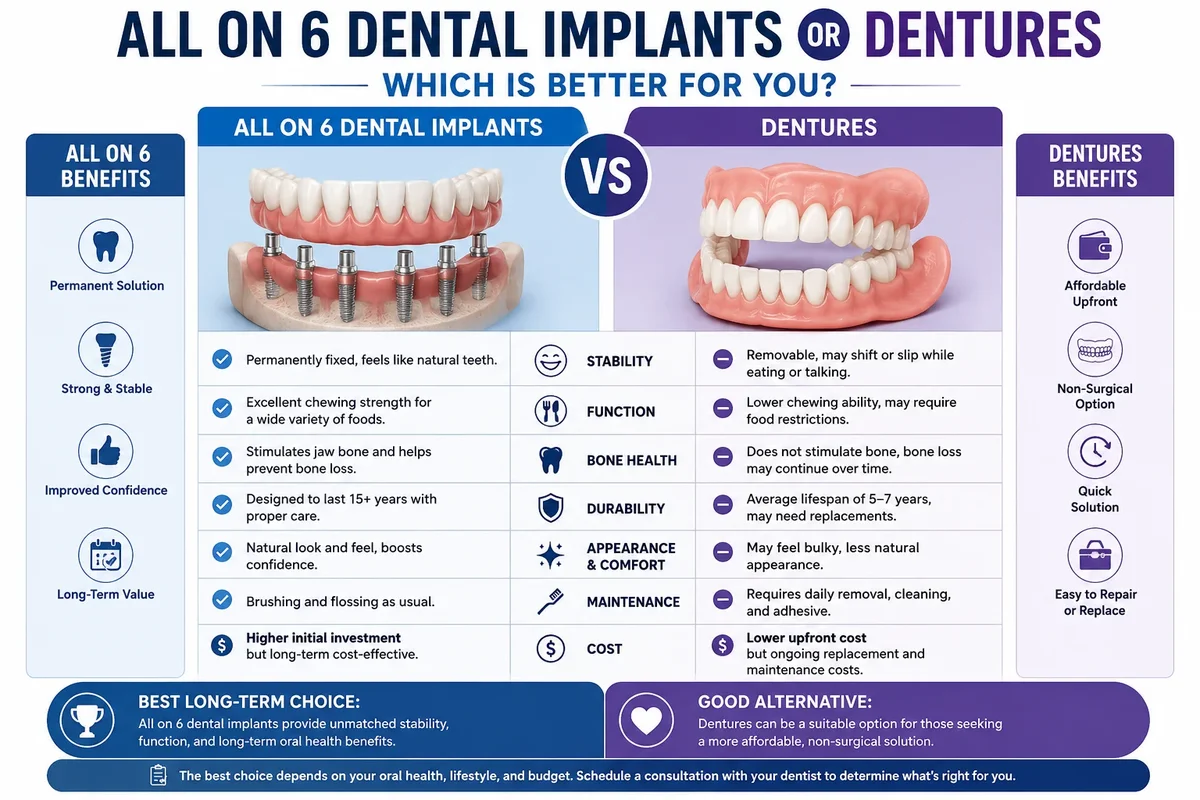
All on 6 Dental Implants or Dentures Which Is Better for Long-Term Maintenance?
Direct answer: All on 6 dental implants may be the better long-term option for a suitable patient who wants fixed teeth and can clean carefully beneath a full-arch bridge. Dentures may be better for someone who wants removable teeth, easier access for cleaning, a lower initial cost, or no implant surgery. When deciding all on 6 dental implants or dentures which is better, remember that neither treatment is maintenance-free. The right choice is the restoration you can clean correctly, review professionally, repair when needed, and afford over time.
How All on 6 Teeth Must Be Maintained
An All on 6 bridge remains fixed in the mouth, but plaque and food can collect where the restoration meets the gums. Daily care may require an electric toothbrush, interdental brushes, implant-safe floss, an oral irrigator, or tools selected for the individual bridge design. If you are researching all on 6 dental implants or dentures which is better, ask the dental team to demonstrate the full cleaning routine before treatment. Fixed teeth may feel convenient, yet cleaning beneath them can be more technique-sensitive than cleaning a removable denture.
Professional reviews are also necessary. The dentist or hygienist may examine the gums, implant areas, bite, bridge material, screws, and cleaning access. The recommended review schedule can vary according to gum history, smoking, diabetes control, plaque levels, grinding habits, and the design of the bridge. For this reason, all on 6 dental implants or dentures which is better should be judged partly by your willingness and ability to attend continuing care.
Biological Care Around the Implants
Implants do not develop cavities, but the tissues around them can become inflamed. Bleeding, swelling, tenderness, discharge, unpleasant taste, persistent bad breath, or changes in gum appearance need professional assessment. Poor cleaning, smoking, active gum disease, and certain medical factors may increase concern. When comparing all on 6 dental implants or dentures which is better, be honest about whether you can follow a detailed hygiene routine every day, even after the bridge feels comfortable and the treatment no longer feels new.
Repairs and Mechanical Maintenance
A fixed bridge can experience wear, chipping, fracture, screw loosening, or bite-related damage. Grinding, clenching, and very hard foods can place additional stress on the restoration. Some issues may be repaired or adjusted, while others may require laboratory work or component replacement. Anyone asking all on 6 dental implants or dentures which is better should understand that implant stability and bridge condition are separate matters: the implants may remain stable while the bridge still needs maintenance.
How Conventional Dentures Must Be Maintained
Dentures are removed for cleaning, allowing direct access to the appliance and oral tissues. This may be easier for people who cannot clean beneath a fixed bridge or who rely on a caregiver. The denture, gums, tongue, palate, and any remaining teeth all need regular care. For some readers considering all on 6 dental implants or dentures which is better, removable cleaning is a major advantage rather than an inconvenience.
The fit of a denture can change because the gums and jaw alter over time, especially after extractions. Adjustments, relining, repair, or eventual replacement may be needed. Increasing adhesive use is not always an appropriate answer to a denture that has become very loose. When deciding all on 6 dental implants or dentures which is better, include these future appointments and costs rather than comparing only the first treatment fee.
Signs That a Denture Needs Professional Review
Repeated sore areas, cracks, clicking, movement, speech changes, difficulty chewing, or sudden loss of retention should be assessed. Do not reshape a denture at home or repair it with household glue, because this can alter the bite, damage the material, and expose the mouth to unsuitable substances. In the discussion about all on 6 dental implants or dentures which is better, dentures avoid implant surgery but still require professional monitoring and responsible daily care.
Which Cleaning Routine Fits Your Daily Life?
The practical answer depends on your eyesight, hand movement, memory, motivation, work schedule, and access to help. All on 6 teeth do not need to be removed, but the area beneath the bridge must be cleaned carefully. Dentures are easier to inspect outside the mouth, but they must be removed, cleaned, and handled safely. Therefore, all on 6 dental implants or dentures which is better cannot be decided simply by assuming that fixed teeth are always easier.
If arthritis, a neurological condition, reduced vision, or another limitation affects cleaning, discuss this before treatment. A caregiver may need instruction, or a removable implant-retained overdenture may provide a useful middle option. When evaluating all on 6 dental implants or dentures which is better, choose a design that works with your real abilities rather than an ideal routine you may find difficult to maintain.
| Maintenance Factor | All on 6 Dental Implants | Conventional Dentures |
|---|---|---|
| Daily cleaning | Cleaning is required beneath the fixed bridge and around implant areas | The denture is removed, and the appliance and mouth are cleaned separately |
| Professional reviews | Reviews check the gums, bite, implants, screws, and bridge | Reviews check fit, oral tissues, bite, wear, and stability |
| Possible future treatment | May include hygiene care, bite adjustment, screw work, or bridge repair | May include adjustment, relining, fracture repair, or replacement |
| Cleaning access | The bridge remains in place, so cleaning can require specialized tools | All denture surfaces can be reached after removal |
| Common warning signs | Bleeding, swelling, bad taste, movement, chipping, or discomfort | Sores, looseness, cracks, pressure, clicking, or chewing difficulty |
How Maintenance Changes the True Cost
The initial quotation is only one part of the financial decision. All on 6 treatment may involve professional cleaning, examinations, hygiene tools, component maintenance, and restorative repairs. Dentures may require cleaning products, adjustments, relining, repairs, and replacement. When considering all on 6 dental implants or dentures which is better, request realistic information about maintenance categories, but avoid expecting a guaranteed lifetime cost. Final expenses depend on oral health, materials, habits, wear, and treatment design.
If you plan to receive treatment abroad, confirm who will provide care after you return home. Ask whether local clinicians can service the implant system, whether repairs require a return trip, and which aftercare services are included. For overseas patients, all on 6 dental implants or dentures which is better may depend as much on access to maintenance as on the original price.
What Happens if Your Health or Independence Changes?
A restoration that is manageable today may become harder to maintain after illness, reduced mobility, or changes in memory. Fixed implant teeth may require caregiver assistance or professional removal for more thorough cleaning in some circumstances. Dentures may be easier for a caregiver to clean, although they can also be misplaced or handled incorrectly. Long-term planning for all on 6 dental implants or dentures which is better should include how the restoration could be managed if your circumstances change.
This does not mean you should avoid implant treatment because of a possible future problem. It means the design and aftercare plan should be realistic. Ask whether the bridge allows adequate cleaning access, whether caregivers can be trained, and whether a removable alternative would provide a better balance between stability and maintainability.
Plan Aftercare Before Starting Treatment
Before choosing a clinic, ask who will provide routine reviews, urgent advice, hygiene treatment, denture adjustments, and bridge repairs. Confirm the expected follow-up schedule and which services are included in the original estimate. A clear aftercare plan makes the answer to all on 6 dental implants or dentures which is better more practical and reduces the chance of choosing a restoration that becomes difficult to support later.
Redent Klinik can review your oral health, cleaning ability, existing dentures, travel plans, and long-term expectations before discussing fixed and removable options. You can request an individualized assessment through the Redent Klinik Contact Page. Recommendations, treatment timing, and final costs should remain subject to clinical examination, appropriate imaging, and personalized planning.
Your Long-Term Maintenance Checklist
- Ask the dental team to demonstrate the complete daily cleaning routine.
- Confirm how often professional reviews may be recommended for your risk level.
- Check which repairs, relines, hygiene visits, or replacement components are excluded from the estimate.
- Ask who can service the restoration if you move or receive treatment abroad.
- Discuss smoking, grinding, diabetes, gum disease, dry mouth, and cleaning limitations openly.
- Consider an implant-retained overdenture if fixed bridge cleaning appears unrealistic.
- Seek advice if the restoration becomes painful, loose, cracked, swollen, or difficult to clean.
What to check next: Before making a final decision, confirm that you can perform the required cleaning, attend reviews, and budget for possible future maintenance. Request professional advice if you have bleeding or swollen gums, persistent denture sores, bridge movement, unpleasant taste, unexplained pain, damaged components, or difficulty cleaning. The most reliable personal answer to all on 6 dental implants or dentures which is better is the option you can maintain safely and consistently for the years ahead.
Disclosure: this page may contain affiliate links. We may earn a commission if you use them, at no extra cost to you.