
The quick answer: porcelain veneers improve the visible surfaces of natural teeth that are healthy enough to keep, while dentures replace teeth that are missing or cannot be predictably restored. In the porcelain veneers vs dentures decision, the key issue is therefore not which treatment is universally better. It is whether you need cosmetic improvement for existing teeth or replacement of lost teeth. If most of your teeth are present and your concerns involve staining, small chips, mild gaps, uneven shape, or worn edges, veneers may be considered. If several teeth are missing, very loose, or severely damaged, partial or complete dentures may be more relevant. This distinction is the fastest way to frame porcelain veneers vs dentures for your circumstances.
Understanding that difference can prevent an unsuitable choice. Veneers are thin, custom-made porcelain shells bonded to the front of selected teeth. They cannot fill an empty space where a tooth is missing, and they are not intended to cover active decay or advanced gum disease. Dentures are removable appliances that replace multiple teeth. A partial denture works around remaining teeth, while a complete denture replaces all teeth in an upper or lower arch. Because porcelain veneers vs dentures address different clinical needs, an examination is necessary before either can be recommended responsibly.
Consider your own starting point. When your teeth feel stable and chewing is comfortable, but you dislike their color, size, symmetry, or surface damage, the porcelain veneers vs dentures comparison usually leads toward a cosmetic assessment. Veneers may provide a more balanced appearance, but treatment often requires removal of a small amount of enamel. This means the decision should be made with long-term maintenance in mind. The cosmetic side of porcelain veneers vs dentures only makes sense when the supporting teeth are suitable. Veneers can chip, become worn, or eventually need replacement, especially when a person grinds their teeth, bites hard objects, or has an untreated bite problem.
When many teeth are absent or no longer functional, porcelain veneers vs dentures becomes a tooth-replacement discussion. Dentures can help restore appearance, speech, and chewing ability, although results vary with fit, jaw shape, muscle control, saliva, and healing. New dentures often require an adjustment period. They may initially feel bulky, affect pronunciation, or create tender areas that need professional adjustment. The gums and supporting bone can also change over time, so relining or replacement may eventually be needed. In practical terms, porcelain veneers vs dentures involves different expectations for comfort and adaptation. Persistent movement, pain, or sores should not be managed by altering a denture at home.
Age does not decide porcelain veneers vs dentures by itself. A younger adult with extensive tooth loss may need replacement teeth, while an older adult with sound teeth may be suitable for conservative cosmetic care. Dentists instead assess enamel thickness, cavities, gum health, tooth mobility, bite pressure, jawbone support, dry mouth, smoking, medications, and general health. Any infection or active gum disease will usually need attention before cosmetic or replacement treatment. Seek prompt dental care if you have swelling, severe pain, bleeding that continues, a broken tooth, loose teeth, difficulty swallowing, or a denture-related wound that does not heal.
Cost should also be compared carefully. The final cost of porcelain veneers vs dentures depends on the number of teeth involved, clinical findings, imaging, laboratory materials, temporary restorations, extractions, gum treatment, denture design, adjustments, and whether implants are part of the plan. Veneers are commonly planned per tooth, whereas dentures may be planned for part or all of an arch. Advertised prices may not include every stage of care. A reliable estimate cannot be guaranteed before an examination, diagnosis, and written treatment plan. For this reason, compare porcelain veneers vs dentures using complete treatment plans rather than headline fees.
Timing is another important difference. Veneer care may include consultation, photographs or digital scans, smile planning, tooth preparation, temporary veneers when appropriate, laboratory production, and final bonding. Denture care may involve impressions, jaw and bite records, trial stages, fitting, and follow-up adjustments. If teeth must be removed, an immediate denture may sometimes be placed soon afterward, but healing can change its fit. Comparing porcelain veneers vs dentures should therefore include the likely number of appointments, recovery needs, maintenance requirements, comfort expectations, and how quickly you need a functional result.
Neither option is automatically the right answer for every dental concern. Whitening, composite bonding, orthodontic treatment, crowns, bridges, dental implants, or implant-supported dentures may be more suitable. For example, a veneer cannot replace one missing tooth, while a crown may protect a tooth that is too structurally weak for a veneer. Someone who struggles with a loose removable denture may be assessed for implant support when health, bone availability, and budget permit. A good porcelain veneers vs dentures consultation should also review these alternatives rather than forcing a choice between only two treatments. The American Dental Association provides general oral-health information, but online education cannot replace an individual clinical evaluation.
A professional consultation is especially important when you are uncertain whether a tooth can be saved. The porcelain veneers vs dentures choice may change after X-rays, gum measurements, examination of existing restorations, bite assessment, and discussion of your priorities. Your dentist may find that some teeth can be preserved while others require a different form of restoration or replacement. This is why photographs, online quizzes, and another patient’s experience cannot provide a dependable diagnosis for your mouth.
At Redent Klinik, a personalized evaluation can help identify which teeth may be preserved, what preparatory treatment may be necessary, and whether another option would offer a more appropriate balance of appearance, function, maintenance, timing, and cost. The purpose of the consultation is not to assume that veneers or dentures are automatically necessary. It is to create a treatment plan based on your oral health, expectations, medical history, and clinical findings. You can request further information through the Redent Klinik Contact Page.
Quick Answer: Porcelain Veneers vs Dentures
The main difference is straightforward: porcelain veneers are used to improve the appearance of natural teeth that can remain in place, while dentures are used to replace teeth that are already missing or need to be removed. When comparing porcelain veneers vs dentures, the right decision depends first on how many usable teeth you have, how healthy those teeth and gums are, and whether your main concern is cosmetic appearance or missing-tooth function. Veneers are not a replacement for absent teeth, and dentures are generally not the first choice when healthy natural teeth only need cosmetic improvement.
Choose the Treatment Category That Matches Your Main Problem
If your teeth are present, reasonably strong, and free from uncontrolled decay or gum disease, but you are concerned about discoloration, minor chips, small gaps, uneven edges, or tooth shape, a veneer consultation may be appropriate. Porcelain veneers are thin restorations attached to the visible surfaces of selected teeth. They can change color, proportion, and symmetry, but they do not strengthen every type of damaged tooth. A tooth with a large filling, deep fracture, severe decay, or very limited enamel may require a crown or another treatment instead.
If you have several missing teeth, widespread tooth mobility, or teeth that cannot be maintained predictably, dentures may be considered. Partial dentures replace some missing teeth while using the remaining teeth for support. Complete dentures replace all teeth in an upper or lower arch. In practical terms, the porcelain veneers vs dentures decision is usually made by asking one question: are you improving teeth that can be preserved, or replacing teeth that are no longer present or restorable?
What Porcelain Veneers May Mean for Your Situation
Veneers may suit someone whose main priority is a more balanced smile and whose natural teeth have enough healthy enamel for bonding. They may also be relevant when whitening cannot adequately change internal discoloration or when small shape differences affect smile symmetry. However, veneers usually involve some degree of tooth preparation, and that change may be irreversible. They may eventually require repair or replacement, and they still depend on healthy gums, careful cleaning, and regular dental reviews.
Your bite also matters in a porcelain veneers vs dentures assessment. Teeth grinding, jaw clenching, edge-to-edge biting, or a deep bite can place extra pressure on veneers. A dentist may recommend bite management, orthodontic treatment, a protective night guard, or an alternative restoration. Veneers should not be selected only because they appear to offer a fast cosmetic result. The underlying teeth must be suitable, and your expectations should match what the treatment can realistically achieve.
What Dentures May Mean for Your Situation
Dentures may help restore visible teeth and improve chewing or speech after tooth loss, but they require adaptation. Removable dentures do not feel exactly like natural teeth. Their stability can depend on the shape of the gums, the amount of supporting bone, saliva levels, muscle control, denture design, and the condition of any remaining teeth. Some people need several adjustment visits after fitting, especially if pressure areas or sore spots develop.
The porcelain veneers vs dentures comparison also involves maintenance differences. Veneers are cleaned much like natural teeth, although special attention is needed around their margins. Dentures should usually be removed and cleaned as instructed, and the mouth must still be examined even when no natural teeth remain. Denture fit can change as the gums and jawbone change over time. Relining, adjustment, repair, or replacement may eventually be necessary.
Compare Cost Without Looking Only at the First Fee
There is no reliable universal price for porcelain veneers vs dentures. Veneer costs may depend on the number of teeth treated, material choice, laboratory work, temporary restorations, bite planning, and whether gum or restorative treatment is needed first. Denture costs may vary according to whether the appliance is partial or complete, the materials used, the number of remaining teeth, required extractions, healing time, adjustments, and whether implants are included for additional support.
Ask for a written plan showing what is included rather than relying on an advertised starting price. The lowest initial cost may not represent the lowest long-term cost if repairs, relines, replacements, preparatory procedures, or maintenance appointments are excluded. Final costs should be based on an examination and individualized planning; they should not be treated as guaranteed before your dentist evaluates your mouth.
Consider the Process and Timing
The treatment pathway differs significantly in porcelain veneers vs dentures. Veneer treatment may involve photographs, scans or impressions, smile planning, tooth preparation, temporary veneers, laboratory production, bonding, and follow-up. Denture treatment may involve impressions, bite records, trial fittings, tooth-shade selection, final placement, and adjustment visits. When extractions are required, the gums and bone may continue changing during healing, which can affect the fit of an immediate denture.
Tell your dentist about important deadlines, but do not allow an event date alone to determine treatment. Weddings, travel, work commitments, or social events may influence scheduling, yet biological healing and laboratory stages cannot always be shortened safely. A realistic comparison of porcelain veneers vs dentures should include appointment numbers, healing periods, temporary options, adaptation time, and follow-up care.
Do Not Overlook Risks and Alternatives
Potential veneer concerns include sensitivity, chipping, debonding, gum irritation, color mismatch, and the future need for replacement. Potential denture concerns include movement, reduced chewing efficiency, sore areas, speech changes, food collecting beneath the appliance, and changes in fit. Neither treatment is risk-free, and neither should be chosen without considering alternatives.
Alternatives may include whitening, composite bonding, orthodontics, crowns, bridges, dental implants, implant-supported bridges, or implant-supported dentures. For example, someone comparing porcelain veneers vs dentures because of one missing front tooth may actually need an implant or bridge for the gap and veneers only for selected neighboring teeth. Another person may benefit from preserving several natural teeth and using a partial denture rather than removing every tooth.
What to Check Before Making a Decision
Before choosing between porcelain veneers vs dentures, check whether your main concern is appearance, missing teeth, chewing, pain, looseness, or a combination of problems. Note any bleeding gums, sensitivity, broken restorations, tooth grinding, dry mouth, denture movement, or recurring infections. Also consider how comfortable you are with irreversible tooth preparation, removable appliances, maintenance appointments, and future replacement costs.
Request professional dental advice when teeth are loose, painful, badly broken, missing, or affected by swelling or persistent bleeding. You should also arrange an assessment when you are unsure whether existing teeth can be saved or when previous dental work keeps failing. A clinical examination, appropriate imaging, gum assessment, and bite evaluation are needed to compare porcelain veneers vs dentures responsibly. For a personalized discussion of suitability, treatment stages, alternatives, and estimated costs, you can visit the Redent Klinik Contact Page.
Cost Factors in Porcelain Veneers vs Dentures
The cost difference is not simply “expensive treatment versus affordable treatment.” In a porcelain veneers vs dentures comparison, the total fee depends on what your mouth needs before, during, and after the main procedure. Veneers are usually planned per tooth to improve natural teeth that can be preserved. Dentures are generally planned as partial or complete appliances that replace missing teeth. Because the treatments solve different problems, a useful porcelain veneers vs dentures cost comparison begins with diagnosis and suitability rather than an advertised starting price.
What Determines the Cost of Porcelain Veneers?
The number of teeth treated is one of the largest veneer cost factors. One veneer used to address a damaged front tooth creates a different plan from several veneers intended to improve broader smile symmetry. Material selection, laboratory work, digital planning, temporary restorations, bite complexity, and the detail required for a natural-looking result can also affect the estimate. This is why porcelain veneers vs dentures cannot be compared accurately using one online figure.
Preparatory care may change the veneer budget. Active decay, gum inflammation, old restorations, significant tooth wear, or grinding may need attention before cosmetic work begins. Whitening, orthodontics, bonding, crowns, or a protective night guard may sometimes be more appropriate or may form part of a wider plan. When reviewing porcelain veneers vs dentures, ask whether examinations, X-rays, scans, temporary veneers, laboratory fees, review visits, and any recommended protective appliance are included.
What Determines the Cost of Dentures?
Denture costs depend on whether the appliance is partial or complete, whether it replaces teeth in one arch or both, and which materials and retention methods are used. A partial denture requires assessment of the remaining teeth because they can affect support and stability. A complete denture may involve extractions, healing, impressions, bite records, trial fittings, placement, and adjustments. In the porcelain veneers vs dentures decision, dentures may appear less costly initially, but the comparison should include every clinically necessary stage.
If teeth must be removed, timing may affect the total expense. An immediate denture may sometimes be placed after extractions so visible gaps are avoided, but healing can change its fit. Relining, adjustment, or later replacement may be needed. Implant-supported dentures can provide additional stability for suitable patients, but imaging, surgery, healing, and restorative components add cost. These variables make porcelain veneers vs dentures highly individual, and no final amount should be assumed before assessment.
Long-Term Costs in Porcelain Veneers vs Dentures
A responsible porcelain veneers vs dentures comparison includes maintenance rather than focusing only on the first invoice. Veneers may eventually chip, debond, wear, or require replacement. The supporting teeth can still develop decay or gum problems, so examinations, professional cleaning, and careful home care remain important. Patients who grind their teeth may also need monitoring and a night guard when recommended.
Dentures have ongoing costs as well. They may need adjustment as the mouth changes, repair after damage, relining when the fit becomes loose, or replacement after significant wear. Cleaning products and review appointments may add recurring expenses. A moving or painful denture should be professionally assessed rather than tolerated or altered at home. When calculating porcelain veneers vs dentures, ask what follow-up is expected over several years and which services are included.
How Suitability Changes Porcelain Veneers vs Dentures Costs
The lowest-cost option is not automatically the right option. Veneers cannot replace missing teeth, and dentures are not usually the answer for healthy teeth with minor cosmetic concerns. A heavily restored or structurally weak tooth may need a crown rather than a veneer. One missing tooth may be better addressed with a bridge or implant than a removable appliance. Therefore, porcelain veneers vs dentures should be treated as a clinical decision first and a financial decision second.
Oral health can also change the treatment sequence. Gum care, fillings, root canal treatment, extractions, or bite management could be recommended before the final cosmetic or replacement stage. These procedures can increase the immediate budget, but omitting necessary care may weaken the overall plan. During a porcelain veneers vs dentures consultation, ask the dentist to separate essential health treatment from optional cosmetic enhancements so you can see what each part of the estimate is intended to achieve.
How to Compare Porcelain Veneers vs Dentures Estimates
Request an itemized estimate before accepting a porcelain veneers vs dentures plan. It should identify the proposed treatment, number of teeth or arches involved, restoration or appliance type, expected appointments, and planned follow-up. Ask whether temporary restorations, extractions, sedation, scans, laboratory work, adjustments, relines, or night guards are included. Also ask what findings could cause the estimate to change after treatment starts.
Be cautious with guaranteed prices offered before examination. A preliminary range may help with planning, but a final fee depends on clinical findings and the agreed design. A low headline price may exclude important stages, while a higher estimate may include more extensive planning and aftercare. The fairest porcelain veneers vs dentures comparison is between complete, like-for-like treatment plans, not isolated promotional figures.
Financing and Staged Treatment
When suitable care exceeds your immediate budget, ask about staged treatment or available payment arrangements. Some patients can address urgent disease first and postpone elective cosmetic work. Others may use a temporary tooth-replacement option while planning a longer-term solution. Financing may make care manageable, but it should not be used to justify a treatment that is not clinically appropriate. For porcelain veneers vs dentures, review the total payable amount, payment schedule, cancellation terms, and what happens if the clinical plan changes.
A personalized evaluation at Redent Klinik can clarify which option, if either, fits your dental condition and goals. After examining your teeth, gums, bite, medical history, and relevant imaging, the clinical team can explain likely stages and cost factors without treating an early estimate as a guaranteed price. You can request an assessment through the Redent Klinik Contact Page.
What to Check Before Making a Cost Decision
Before choosing porcelain veneers vs dentures, check whether each estimate includes diagnosis, preparatory treatment, temporary solutions, laboratory work, placement, adjustments, and follow-up. Consider how many natural teeth can be preserved, whether missing teeth need replacement, how long treatment may take, and what maintenance may be required later. Request professional advice if you have pain, swelling, loose teeth, bleeding gums, broken restorations, chewing difficulty, or an unstable denture. You should also seek clarification when two clinics recommend very different treatments, because that difference may reflect diagnosis and suitability rather than price alone. Use porcelain veneers vs dentures to organize your questions, but make the final decision only after a clinical examination and written treatment plan.
Who Is Suitable for Porcelain Veneers vs Dentures?
The right option depends first on whether your natural teeth can be preserved. In the porcelain veneers vs dentures decision, veneers are generally considered for people who still have stable teeth but want to improve color, shape, spacing, or symmetry. Dentures are designed for people with several missing teeth or teeth that may not be predictable to restore. Suitability is therefore based on oral health, function, and treatment goals—not age or appearance alone. This is the central distinction when assessing porcelain veneers vs dentures for your own situation.
Who May Be Suitable for Porcelain Veneers?
Porcelain veneers may be appropriate when the visible front teeth are present, reasonably strong, and have enough healthy enamel for bonding. They may be discussed for stubborn discoloration, small chips, uneven edges, mild gaps, minor shape differences, or worn surfaces. During a porcelain veneers vs dentures assessment, the dentist must also confirm that the teeth do not need a more protective treatment, such as a crown.
Healthy gums are important. Bleeding, swelling, active gum disease, untreated decay, or significant recession may need treatment before cosmetic work begins. Veneers cannot stabilize loose teeth, cover uncontrolled disease, or replace absent teeth. A deeply fractured tooth, a tooth with a very large filling, or one with limited enamel may need a different restoration. For this reason, porcelain veneers vs dentures cannot be decided reliably from smile photographs or an online description.
Factors That May Make Veneers Less Suitable
Heavy grinding, jaw clenching, nail biting, chewing ice, and certain bite patterns can place extra pressure on veneers. These factors do not always rule out treatment, but they may change the recommendation. Bite correction, orthodontics, a night guard, bonding, or crowns may be considered instead. The porcelain veneers vs dentures discussion should also include the fact that veneer preparation may be irreversible and that restorations can eventually chip, wear, debond, or require replacement.
A suitable veneer patient has realistic expectations and understands the alternatives. Whitening may address color alone, composite bonding may repair a small chip, and orthodontic treatment may improve spacing without reshaping several teeth. When porcelain veneers vs dentures is being considered mainly for cosmetic reasons, ask whether a more conservative treatment could achieve an acceptable result.
Who May Be Suitable for Dentures?
Dentures may be suitable when several teeth are missing or when remaining teeth have a poor outlook because of extensive decay, advanced gum disease, repeated fractures, or other clinical problems. A partial denture replaces selected teeth while preserving useful natural teeth. A complete denture replaces all teeth in an upper or lower arch. In porcelain veneers vs dentures, dentures become relevant when the primary need is tooth replacement rather than cosmetic surface improvement.
A denture patient should be prepared for an adjustment period. Removable teeth may improve appearance, speech, and chewing, but they do not feel exactly like natural teeth. Stability depends on jaw shape, gum condition, saliva, muscle control, and appliance design. Follow-up visits may be needed to address pressure areas, changes in fit, or movement. These practical differences are central to porcelain veneers vs dentures and should be weighed before treatment. A realistic porcelain veneers vs dentures decision should include comfort expectations as well as appearance.
Health and Lifestyle Factors for Denture Patients
Dry mouth, smoking, reduced hand dexterity, certain medications, and poorly controlled medical conditions can affect healing, comfort, cleaning, or the ability to manage a removable appliance. They do not automatically prevent treatment, but they should be discussed openly. During porcelain veneers vs dentures planning, the dentist may also assess whether implants could add denture support when health, bone condition, preferences, and budget make that option reasonable.
The condition of any remaining teeth also matters. Supporting teeth may need fillings, crowns, gum treatment, or other care before a partial denture is made. Healthy or maintainable teeth should not be removed simply to simplify cosmetic treatment. A careful porcelain veneers vs dentures assessment should identify which teeth can be kept and whether preserving them could improve support, sensation, or long-term function.
What If You Have Missing Teeth and Cosmetic Concerns?
Some people do not fit neatly into one category. You might have healthy but discolored front teeth and missing back teeth that affect chewing. In that situation, porcelain veneers vs dentures may not be an either-or choice. A combined plan could use a partial denture, bridge, or implants for missing teeth while whitening, bonding, crowns, or veneers are considered for selected visible teeth.
Combined treatment must be sequenced carefully because changing one part of the mouth can affect the bite, smile line, lip support, and design of the final restorations. Function and disease control usually need attention before cosmetic refinements. Ask which part of the porcelain veneers vs dentures plan is essential for health, which part is elective, and whether temporary options will be required between stages.
Does Age Determine Suitability?
Age alone does not decide porcelain veneers vs dentures. A younger adult with trauma or congenital tooth absence may need replacement teeth, while an older adult with stable natural teeth may be considered for conservative cosmetic care. More important factors include enamel quality, gum health, bone support, bite forces, medical history, hygiene ability, and long-term expectations.
Younger patients may benefit from especially conservative planning because irreversible restorations could require maintenance over many decades. Older patients may need additional review of dry mouth, medication effects, healing, dexterity, and existing dental work. No responsible clinician can confirm suitability for porcelain veneers vs dentures without examining the mouth and reviewing relevant health information.
How to Decide Which Assessment You Need
Before your appointment, identify your main concern: color, shape, gaps, missing teeth, chewing difficulty, looseness, pain, or several problems together. Consider whether you are comfortable with irreversible tooth preparation, whether you could manage a removable appliance, and how much ongoing maintenance you can accept. In a porcelain veneers vs dentures consultation, ask which teeth are healthy enough to preserve, what preparatory care is needed, and whether a less invasive alternative may work.
At Redent Klinik, a personalized evaluation can help distinguish cosmetic concerns from structural, bite-related, or gum problems. Depending on your needs, the assessment may include an examination, photographs, scans, X-rays, gum measurements, and bite analysis. A porcelain veneers vs dentures recommendation should reflect these findings rather than assumptions based only on age or photographs. You can request an appointment through the Redent Klinik Contact Page. A final recommendation and cost estimate should follow appropriate clinical evaluation rather than be treated as guaranteed in advance.
What to Check Before Choosing
Check whether your teeth are stable, whether your gums bleed or recede, whether you grind your teeth, and whether missing teeth affect speech or chewing. Request professional advice if you have loose teeth, persistent pain, swelling, recurring infection, broken teeth, unexplained bleeding, or a denture that moves or causes sores. You should also seek an examination before committing financially to porcelain veneers vs dentures. Before deciding between porcelain veneers vs dentures, ask a dentist to explain suitability, alternatives, risks, timing, maintenance, and personalized cost factors after assessing your individual condition.
Procedure and Timing: Porcelain Veneers vs Dentures
The treatment process differs significantly because veneers improve existing teeth, while dentures replace missing teeth. In a porcelain veneers vs dentures comparison, veneer treatment may take fewer clinical stages when the teeth and gums are already healthy. Denture treatment can require more adaptation and healing time, especially when extractions are necessary. Neither option should be rushed simply to meet a social event or travel date. Your actual timeline depends on oral health, laboratory work, the number of teeth involved, healing, and whether preparatory treatment is required.
What Happens Before Treatment Begins?
Both options should begin with a dental consultation rather than immediate treatment. The dentist may examine your teeth and gums, evaluate your bite, review your medical history, and take photographs, scans, impressions, or X-rays when clinically appropriate. This first stage of porcelain veneers vs dentures determines whether natural teeth can be maintained and whether conditions such as decay, infection, gum disease, or tooth grinding need attention first.
For veneers, the dentist assesses enamel quality, existing fillings, tooth position, gum level, and the forces placed on the front teeth. For dentures, the assessment focuses on missing teeth, the condition of remaining teeth, gum and bone support, jaw relationships, and whether extractions may be required. A personalized porcelain veneers vs dentures timeline should only be outlined after these findings are reviewed. An online photograph alone cannot establish the complete process or confirm how many appointments you will need.
The Porcelain Veneer Procedure
Planning the Shape, Color, and Number of Veneers
Veneer planning may include smile photographs, digital scans, impressions, shade selection, and a preview or diagnostic model. The purpose is to decide which teeth actually need treatment and whether the proposed changes will work with your smile, lips, gums, and bite. During this part of porcelain veneers vs dentures planning, ask whether whitening, orthodontics, or composite bonding could reduce the number of teeth that require veneers.
Some patients assume every visible tooth must be covered, but treatment should be limited to what is clinically and cosmetically appropriate. The dentist should also explain that porcelain cannot later be whitened in the same way as natural enamel. If whitening is part of the plan, it may be completed before the final veneer shade is selected.
Tooth Preparation and Temporary Veneers
At the preparation appointment, a controlled amount of tooth structure may be removed to create space for the porcelain and an appropriate bonding surface. The amount varies according to tooth position, enamel thickness, and the intended design. Some cases may require minimal preparation, but “no-prep” treatment is not suitable for every person. When considering porcelain veneers vs dentures, remember that veneer preparation can be irreversible and should not be accepted without discussing long-term maintenance.
After preparation, the dentist may take a detailed scan or impression for the dental laboratory. Temporary veneers may be placed while the final restorations are produced. Temporaries can help protect prepared teeth and provide a preview of general shape, although they may not have the exact appearance or strength of the final porcelain. Sensitivity or minor gum tenderness can occur, and any significant discomfort should be reported.
Fitting and Bonding the Final Veneers
At the fitting appointment, the dentist evaluates the veneers for shape, shade, margins, contact points, and bite. Adjustments may be made before the restorations are bonded. Once approved, the teeth and veneers are prepared with the appropriate bonding protocol, and the restorations are secured in place. A follow-up appointment may be recommended to check the gums, comfort, and bite. In practical porcelain veneers vs dentures timing, laboratory production often creates a waiting period between preparation and final placement.
The Denture Procedure
Planning a Partial or Complete Denture
Denture treatment begins by deciding whether a partial or complete appliance is appropriate. A partial denture replaces selected teeth and gains support from the remaining teeth and oral tissues. A complete denture replaces all teeth in an upper or lower arch. This stage of porcelain veneers vs dentures may also involve deciding whether damaged teeth can be restored or whether removal is being considered.
If natural teeth will support a partial denture, they may need fillings, gum care, crowns, or small adjustments before impressions are taken. Complete denture planning may require additional consideration of lip support, facial appearance, speech, bite height, and jaw position. These details can influence both the number of appointments and the final result.
Impressions, Bite Records, and Trial Stages
The dentist generally takes impressions or digital records of the mouth. More detailed impressions may then be required to capture the supporting tissues accurately. Bite records help establish how the upper and lower jaws meet, while trial stages allow the position, shape, and shade of the proposed teeth to be assessed before the denture is completed.
These trial stages are important in porcelain veneers vs dentures because dentures must replace not only visible teeth but also aspects of lost support and function. You may be asked to pronounce certain words, smile, and close your teeth together so the dentist can evaluate speech, appearance, and bite. Changes are generally easier to make during the trial stage than after the final appliance has been processed.
Extractions, Healing, and Immediate Dentures
If extractions are necessary, the timing becomes more complex. An immediate denture may sometimes be prepared before tooth removal and fitted soon after the extractions. This can provide a temporary appearance and some function during healing, but the fit may change as swelling reduces and the gums and bone reshape. Adjustments, temporary lining material, relining, or replacement may later be required.
Alternatively, a dentist may recommend allowing a period of healing before making the definitive denture. This can extend the overall porcelain veneers vs dentures timeline but may provide more stable tissues for the final impressions. The appropriate approach depends on the number of extractions, healing expectations, appearance needs, health considerations, and the treatment plan. Healing speed and final fit should never be guaranteed in advance.
How Long Does Adjustment Take?
Veneer patients may need time to become accustomed to small changes in tooth shape, speech, or bite, although major ongoing discomfort is not expected and should be assessed. Denture adaptation is often more involved. A new denture can initially feel bulky, and speaking or chewing may require practice. Tender areas can develop as the appliance settles against the gums.
Follow-up visits are therefore a normal part of denture care. The dentist can identify pressure points and make controlled adjustments. Do not file, bend, or repair a denture yourself because this can damage the appliance and worsen its fit. When comparing porcelain veneers vs dentures, include adaptation and review appointments in your schedule rather than treating placement day as the end of treatment.
What Can Delay Either Treatment?
Active gum disease, cavities, dental infections, unstable medical conditions, and unresolved bite problems may delay treatment. Laboratory revisions, healing after extraction, or the need for additional restorative work can also change the expected completion date. Smoking, dry mouth, certain medications, and inconsistent oral hygiene may affect comfort or healing and should be discussed with the clinical team.
Travel plans matter as well. Leaving immediately after fitting veneers or dentures may make it difficult to attend an adjustment appointment if sensitivity, bite concerns, or sore areas develop. A realistic porcelain veneers vs dentures schedule should leave time for review before long-distance travel, a wedding, or another important event.
How to Choose Based on Process and Timing
Choose veneers only when the teeth can be preserved and you are comfortable with preparation, temporary restorations, bonding, and future maintenance. Consider dentures when tooth replacement is the main need and you understand the possible extraction, healing, fitting, and adaptation stages. If your deadline is short, ask whether a safe temporary option is available rather than pressuring the dentist to skip necessary clinical or laboratory steps.
Redent Klinik can provide a personalized assessment of the likely sequence after reviewing your oral health, treatment goals, and relevant diagnostic records. Because each porcelain veneers vs dentures plan is different, appointment numbers and completion dates should be treated as estimates until the examination and treatment planning stages are complete. You can discuss availability, clinical stages, and travel considerations through the Redent Klinik Contact Page.
Risks and Limitations of Porcelain Veneers vs Dentures
Both treatments can improve appearance and function, but neither is risk-free or suitable for every dental problem. The most important point in a porcelain veneers vs dentures comparison is that veneers depend on healthy natural teeth, while dentures depend on healthy supporting tissues and an acceptable fit. Veneers may involve irreversible tooth preparation and can eventually need repair or replacement. Dentures may move, feel unfamiliar, or require adjustments as the mouth changes. Understanding these limitations helps you make a decision based on realistic expectations rather than appearance alone.
Risks and Limitations of Porcelain Veneers
Porcelain veneers are thin restorations bonded to the front surfaces of selected teeth. They may improve discoloration, minor chips, uneven shape, small gaps, or worn edges, but they cannot correct every structural or oral-health problem. When evaluating porcelain veneers vs dentures, remember that veneers do not replace missing teeth, stabilize loose teeth, or treat active decay and gum disease. Any underlying dental condition usually needs to be assessed and managed before cosmetic treatment begins.
Irreversible Tooth Preparation
One of the main veneer limitations is that a small amount of enamel may need to be removed to create space for the porcelain and achieve suitable margins. The amount varies between cases, but prepared enamel does not grow back. This means veneer treatment should be viewed as a long-term restorative commitment rather than a temporary cosmetic trial. Although minimal-preparation or no-preparation veneers may be discussed in selected cases, they are not appropriate for every tooth position, smile design, or bite.
Before choosing between porcelain veneers vs dentures, ask exactly how much preparation is expected and whether a more conservative option could address your concern. Whitening, orthodontics, enamel reshaping, or composite bonding may sometimes reduce or avoid the need for porcelain. A professional evaluation is particularly important when you are young, have thin enamel, or are considering treatment on several healthy teeth.
Sensitivity, Chipping, and Debonding
Temporary sensitivity to cold or pressure may occur after tooth preparation or bonding. Persistent sensitivity, pain when biting, or discomfort that worsens should be assessed because it may indicate an issue with the bite, bonding, tooth nerve, or another underlying condition. Veneers can also chip, crack, or detach, especially when exposed to heavy bite forces, tooth grinding, nail biting, ice chewing, or the use of teeth to open packaging.
In the porcelain veneers vs dentures decision, veneers may feel more similar to natural teeth because they are fixed in place, but this does not make them indestructible. A damaged veneer may need polishing, repair, rebonding, or replacement depending on the extent of the problem. The underlying tooth can still develop decay near the margins, so daily brushing, interdental cleaning, and regular examinations remain necessary.
Color and Cosmetic Limitations
Porcelain is resistant to many surface stains, but veneers cannot be whitened in the same way as natural enamel. If surrounding teeth change color over time, a mismatch may become noticeable. Gum recession can also expose the edge of a restoration or alter smile symmetry. This is one reason shade selection, gum health, and long-term maintenance should be discussed before treatment.
Veneers may improve visible tooth shape, but they cannot guarantee a perfectly symmetrical smile. Natural differences in gum position, facial structure, lip movement, tooth alignment, and bite can influence the outcome. A responsible porcelain veneers vs dentures consultation should explain what can realistically be changed and what may remain visible after treatment.
Risks and Limitations of Dentures
Dentures replace missing teeth, but removable appliances do not behave exactly like natural teeth or fixed restorations. Their stability may depend on jaw shape, gum condition, saliva, muscle coordination, appliance design, and the number and condition of remaining teeth. In a porcelain veneers vs dentures comparison, dentures may be the more relevant treatment when teeth are absent, but the patient must be prepared for adaptation and continuing maintenance.
Movement, Reduced Chewing Efficiency, and Speech Changes
A new denture may initially feel bulky or unfamiliar. Speaking clearly and chewing certain foods can require practice, and some movement may occur during eating or conversation. Complete lower dentures can be particularly challenging when there is limited bone support. Adhesive may sometimes be discussed, but repeated reliance on large amounts of adhesive can also indicate that the fit needs professional review.
Chewing efficiency with removable dentures may be lower than with stable natural teeth or some implant-supported options. Starting with softer foods, cutting food into smaller pieces, and chewing on both sides may help during adaptation. However, porcelain veneers vs dentures should not be judged only by how quickly someone adapts. Persistent instability, inability to eat comfortably, or repeated speech difficulties should be discussed with the dentist.
Sore Spots and Changes in Fit
Pressure areas may develop after a denture is fitted, especially during the first weeks or after extractions. These areas can cause tenderness or ulcers and may require controlled adjustment. Patients should not file, bend, heat, or repair a denture at home, as this can damage the appliance and make the fit worse.
The gums and supporting bone can change over time, particularly after tooth removal. As these tissues change, a denture may become loose and require adjustment, relining, rebasing, or replacement. This ongoing change is a major consideration in porcelain veneers vs dentures because veneers remain attached to natural teeth, while dentures rely on tissues that may gradually reshape.
Cleaning, Infection, and Remaining-Tooth Risks
Dentures must be cleaned regularly according to professional instructions. Plaque, food debris, and microorganisms can collect on the appliance and supporting tissues. Wearing dentures continuously without appropriate cleaning or rest may contribute to irritation or inflammation in some patients. Even when all natural teeth are missing, routine oral examinations remain valuable because the dentist can check the gums, tongue, bite, denture fit, and other oral tissues.
Partial dentures create additional considerations because the remaining teeth support or contact the appliance. Poor cleaning around clasps and supporting teeth may increase the risk of decay or gum problems. In porcelain veneers vs dentures planning, ask how the proposed denture will be cleaned, which teeth will provide support, and whether those teeth need treatment before the appliance is made.
Which Option Has the More Acceptable Risks?
There is no universal answer because the treatments address different needs. If your teeth are present, stable, and mainly affected by cosmetic concerns, the limitations of veneer preparation and future replacement may be more acceptable than removing healthy teeth or wearing a removable appliance. If multiple teeth are missing or cannot be restored predictably, dentures may provide a practical replacement option despite adaptation and maintenance requirements.
The safest way to compare porcelain veneers vs dentures is to identify which risks apply specifically to your mouth. A patient who grinds heavily may face a greater chance of veneer damage. A patient with significant bone loss or dry mouth may experience more denture instability or irritation. Someone with both cosmetic concerns and missing teeth may need a combined plan involving bonding, crowns, bridges, implants, a partial denture, or selected veneers rather than choosing only one category.
Alternatives That May Reduce Particular Risks
Alternatives to veneers may include professional whitening, composite bonding, orthodontic treatment, enamel reshaping, or crowns. Alternatives to removable dentures may include bridges, dental implants, implant-supported bridges, or implant-supported dentures when the patient’s health, bone condition, preferences, and budget allow. Each alternative has its own benefits, limitations, maintenance requirements, and possible complications.
General oral-health information from the American Dental Association can help you prepare questions, but it cannot determine whether a particular treatment is suitable for your teeth. A porcelain veneers vs dentures recommendation should follow an examination, appropriate imaging when needed, gum assessment, bite evaluation, and a review of your medical history.
When to Request Professional Advice
Seek prompt dental advice if you have severe or increasing pain, facial swelling, uncontrolled bleeding, a loose tooth, signs of infection, difficulty swallowing, or trauma involving the teeth or jaws. Contact a dentist if a veneer feels loose, cracks, creates a sharp edge, or causes persistent sensitivity. Denture wearers should request assessment for recurring sores, continuing movement, a broken appliance, difficulty eating, or a lesion that does not heal.
Redent Klinik can assess whether your concerns are primarily cosmetic, restorative, or related to missing teeth. The clinical team can explain the relevant risks, alternative treatments, likely maintenance, and personalized cost factors after reviewing your condition. You can request an evaluation through the Redent Klinik Contact Page. Any treatment recommendation or cost estimate should be based on individual examination and planning rather than treated as guaranteed in advance.
What to Check Before Making Your Decision
Before deciding on porcelain veneers vs dentures, check whether you have active decay, bleeding gums, tooth mobility, grinding, dry mouth, missing teeth, an unstable bite, or difficulty maintaining oral hygiene. Ask whether the proposed treatment is reversible, what may need repair or replacement later, how often follow-up is expected, and which alternative would preserve the most healthy tooth structure. Request professional advice whenever symptoms are present, when you are unsure whether teeth can be saved, or when the treatment plan involves extraction or irreversible preparation. The right porcelain veneers vs dentures decision is the option that addresses your actual dental condition while offering risks, maintenance, timing, and costs you understand and can reasonably manage.
Alternatives to Porcelain Veneers vs Dentures
You may not need to choose only between veneers and dentures. The best alternative depends on whether your concern is tooth color, shape, position, damage, or actual tooth loss. In a porcelain veneers vs dentures discussion, veneers improve the visible surfaces of existing teeth, while dentures replace missing teeth. Treatments such as whitening, composite bonding, orthodontics, crowns, bridges, dental implants, or implant-supported dentures may offer a better balance of tooth preservation, function, timing, maintenance, and cost. This makes porcelain veneers vs dentures a useful starting question rather than a forced two-option choice.
Alternatives When Your Natural Teeth Are Healthy
If your teeth are present and stable, start by asking whether a less invasive treatment can address the problem. The porcelain veneers vs dentures comparison can overlook conservative choices, particularly when the concern is cosmetic. A dentist should first identify whether the issue is discoloration, a small chip, spacing, crowding, wear, or a weakened tooth because each problem calls for a different approach. The safest porcelain veneers vs dentures pathway is usually the one that preserves healthy tissue while correcting the actual problem.
Professional Teeth Whitening
Within porcelain veneers vs dentures, whitening is the least restorative option when tooth shape and position are already acceptable.
Whitening may be suitable when the main concern is generalized staining and the teeth do not need major changes in shape or alignment. It cannot replace missing teeth, repair fractures, or change existing crowns and fillings, but it may reduce the number of veneers being considered. Results vary with the type of discoloration, enamel condition, and treatment method. As an alternative within porcelain veneers vs dentures planning, whitening is most relevant when color is the only meaningful concern.
When weighing whitening against porcelain veneers vs dentures, ask whether color alone is driving your decision. Whitening is usually more conservative than covering several teeth, although sensitivity may occur and some stains respond only partially. A dental examination is important before whitening if you have decay, gum recession, cracked teeth, or unexplained sensitivity.
Composite Bonding
Composite bonding uses tooth-colored resin to repair small chips, reshape edges, close selected gaps, or improve minor asymmetry. It often requires less tooth preparation than porcelain veneers and may be completed in fewer visits. It may also have a lower initial cost, although fees depend on the number of teeth, complexity, and treatment plan rather than a guaranteed price.
Bonding can stain, wear, or chip and may need maintenance sooner than porcelain in some cases. Within the porcelain veneers vs dentures decision, bonding may be a practical choice for limited cosmetic changes or for someone who wants to preserve more enamel. It is not a substitute for replacing missing teeth or strengthening a severely damaged tooth. In other words, porcelain veneers vs dentures should be widened to include bonding only when the underlying tooth is sound enough for a cosmetic repair.
Orthodontic Treatment
Clear aligners or braces may be more appropriate when crowding, rotation, spacing, or bite position is the main issue. Veneers can sometimes mask minor alignment concerns, but they do not move tooth roots or correct the bite. Orthodontic treatment may take longer, yet it can preserve healthy enamel and improve how the teeth meet.
For a person researching porcelain veneers vs dentures because the smile looks uneven, an orthodontic opinion may show that movement is more suitable than covering teeth. Whitening or limited bonding can sometimes follow alignment. Ask about treatment duration, retainers, gum health, and how existing restorations could affect the plan. This can make the porcelain veneers vs dentures decision more conservative when tooth position, rather than tooth damage, is the real issue.
Alternatives for Damaged but Restorable Teeth
Dental Crowns and Partial-Coverage Restorations
Within porcelain veneers vs dentures, crowns address structural weakness rather than a simple preference for a different color or shape.
A crown covers more of a tooth than a veneer and may be considered when the tooth is weakened by a large filling, fracture, root canal treatment, or extensive wear. It generally requires more preparation, so it should be recommended only when that level of protection is needed. In a porcelain veneers vs dentures assessment, crowns may preserve teeth that are too compromised for veneers but do not require removal.
Some back teeth may instead be restored with an inlay or onlay, which can rebuild a damaged area without covering the entire tooth. Fillings, root canal treatment, gum therapy, or combinations of procedures may also help retain natural teeth. This is why porcelain veneers vs dentures should never be treated as the only two options when teeth are damaged. A complete porcelain veneers vs dentures evaluation should ask whether the tooth can first be rebuilt and retained.
Alternatives When Teeth Are Missing
When tooth loss is the main concern, the porcelain veneers vs dentures discussion should shift from cosmetic coverage to replacement design. The number and location of missing teeth, the condition of neighboring teeth, bone support, medical history, and preference for fixed or removable care will guide the choice.
Dental Bridges
A dental bridge can replace one or more missing teeth by using neighboring teeth or implants for support. A conventional bridge may require preparation of adjacent teeth, while other designs have different indications. Compared with a removable denture, a bridge is fixed in place, but it is not suitable for every gap, bite, or supporting tooth.
When comparing a bridge with porcelain veneers vs dentures, check the condition of the neighboring teeth. A bridge may be reasonable if those teeth already need crowns, while preparing untouched healthy teeth may be less desirable. Cleaning beneath the replacement tooth is essential, and the long-term outlook depends partly on the supporting teeth and gums. A bridge can therefore sit between the usual porcelain veneers vs dentures choices when a limited gap needs a fixed solution.
Dental Implants
Within porcelain veneers vs dentures, implants address tooth absence rather than the visible surface of an existing tooth.
A dental implant can support a replacement tooth without relying on neighboring teeth in the same way as a conventional bridge. It may be considered for one missing tooth, several missing teeth, or support for a larger restoration. Suitability depends on bone volume, gum health, medical history, smoking, bite forces, hygiene, and healing capacity. Imaging and additional bone or gum procedures may sometimes be needed.
Implants may provide a fixed replacement option, but success cannot be guaranteed and ongoing care is required. Treatment may take longer than a removable denture, and costs vary with surgery, the number of implants, restoration design, and preparatory treatment. In the porcelain veneers vs dentures comparison, implants are especially relevant when missing teeth need replacement but the patient prefers to avoid a removable appliance.
Implant-Supported Dentures
An implant-supported denture may provide more retention than a conventional complete denture for suitable patients. Depending on the design, it may remain removable for cleaning or be fixed and maintained professionally. Bone availability, general health, hygiene ability, expectations, and budget all influence suitability.
This option still requires cleaning, review, and possible repair or component replacement. Surgery also introduces healing time and clinical risks. When considering implant support alongside porcelain veneers vs dentures, ask what will be removable, how it must be cleaned, how many stages are expected, and what long-term maintenance may cost. The porcelain veneers vs dentures comparison should also include whether you are willing and medically suitable to undergo implant surgery.
Can Different Treatments Be Combined?
Yes. Someone may need a bridge, implant, or partial denture for missing back teeth while using whitening, bonding, orthodontics, crowns, or selected veneers for visible front teeth. In this kind of porcelain veneers vs dentures case, treatment sequence matters because replacing teeth can change the bite, tooth proportions, lip support, and final smile design.
Active decay, infection, gum disease, and unstable teeth are usually addressed before elective cosmetic work. Temporary teeth may be used while tissues heal or while the final plan is developed. Ask the dentist to separate essential treatment from optional cosmetic stages so you understand the purpose, timing, risks, and estimated cost of each step.
How to Decide Which Alternative Fits You
Define the problem before selecting a procedure. For color, ask about whitening. For a small chip or gap, consider bonding. For crowding, request an orthodontic assessment. For a structurally weak tooth, discuss a crown or partial-coverage restoration. For missing teeth, compare bridges, implants, partial dentures, complete dentures, and implant-supported designs.
A useful porcelain veneers vs dentures consultation should compare how much natural tooth structure each option preserves, whether treatment is reversible, how long it may take, what healing or adaptation is expected, and what maintenance may be needed. The fastest treatment or lowest advertised fee is not automatically the best value. Final costs depend on examination findings, imaging, materials, laboratory work, preparatory care, and the agreed plan.
Redent Klinik can place porcelain veneers vs dentures in context with these alternatives and assess which treatment is more appropriate for your goals and oral condition. A personalized evaluation may include examination of the teeth and gums, bite analysis, scans, photographs, and imaging when clinically necessary. You can request further information through the Redent Klinik Contact Page. Recommendations, timelines, outcomes, and costs should remain individualized rather than guaranteed before assessment.
What to Check Before Choosing an Alternative
Before deciding on porcelain veneers vs dentures or an alternative, check which teeth can be preserved, whether decay or gum disease is active, whether grinding increases risk, and whether you prefer a fixed or removable replacement. Ask how much healthy tooth structure will be altered, how long treatment and healing may take, what routine care is required, and what may need repair or replacement later. Request professional advice if you have pain, swelling, loose teeth, bleeding gums, missing teeth that affect eating or speech, repeated restoration failure, or a denture that moves or causes sores. A clinical evaluation is also essential whenever a proposed plan involves extraction, surgery, or irreversible tooth preparation. Use porcelain veneers vs dentures to organize your questions, then let examination findings determine which alternative deserves serious consideration.
Financing Porcelain Veneers vs Dentures
Financing should make suitable dental care easier to manage; it should not persuade you to accept a treatment that does not match your needs. When comparing porcelain veneers vs dentures, start with the complete clinical plan and its estimated total cost. Veneers normally improve natural teeth that can be retained, whereas dentures replace missing teeth. Their fees are therefore calculated differently, and the least expensive quotation may not represent the most appropriate care. A responsible porcelain veneers vs dentures decision should consider diagnosis, included services, repayment terms, future maintenance, and whether another treatment could preserve more healthy tooth structure.
How to Compare Financing for Porcelain Veneers vs Dentures
Ask for a written estimate that separates every expected stage. A veneer plan may include an examination, photographs or scans, preparatory treatment, tooth preparation, temporary restorations, laboratory work, bonding, bite adjustments, and review visits. A denture plan may include extractions, healing appointments, impressions, bite records, trial fittings, the final appliance, adjustments, relining, or later replacement. Itemization makes porcelain veneers vs dentures easier to compare because it reveals whether two quoted prices actually include the same level of care.
Confirm whether the estimate covers one tooth, several teeth, one arch, or both arches. Ask whether imaging, temporary teeth, sedation, medications, laboratory upgrades, repairs, and follow-up appointments are included. Prices shown online may be preliminary and should not be treated as guaranteed. Final costs for porcelain veneers vs dentures depend on examination findings and the agreed treatment plan.
Compare the Total Payable Amount, Not Only the Monthly Figure
A low monthly payment can appear affordable while hiding a much larger total repayment. Before financing porcelain veneers vs dentures, check the deposit, interest rate, arrangement fee, repayment period, late-payment terms, and total amount payable. A longer agreement may reduce each installment but increase the overall cost. Make sure the payment remains manageable alongside housing, household bills, travel, and unexpected expenses.
Financing availability should not determine how many teeth are treated. If only one or two teeth require restoration, a full set of veneers may not be justified. If several natural teeth can be maintained, removing them for complete dentures may not be appropriate. The clinical choice in porcelain veneers vs dentures should remain based on tooth preservation, oral health, function, realistic expectations, and your ability to maintain the result.
Can Porcelain Veneers vs Dentures Be Completed in Stages?
Staged treatment may help spread costs, but it must be clinically safe. A dentist may first manage pain, infection, decay, or gum disease and then move to tooth replacement or elective cosmetic care. Organizing porcelain veneers vs dentures into urgent, functional, and cosmetic stages can clarify what requires prompt attention and what may reasonably wait.
Staging is not always suitable. Delaying treatment for an unstable tooth may allow further damage, while postponing replacement of missing teeth can sometimes prolong chewing difficulties. A temporary denture or provisional restoration may be possible during healing or financial planning, but it has its own limitations and costs. Ask how delaying each stage of porcelain veneers vs dentures could affect comfort, fit, oral health, and the final design.
Separate Essential Care From Optional Enhancements
Essential care may include infection control, fillings, gum treatment, or extraction of teeth that cannot be maintained. Functional care may restore chewing, speech, bite stability, or protection for weakened teeth. Optional care may focus mainly on shade, symmetry, or other cosmetic refinements. This distinction helps you direct available funds responsibly instead of assuming that every part of a porcelain veneers vs dentures proposal has equal urgency.
Insurance for Porcelain Veneers vs Dentures
Insurance coverage varies by policy. Cosmetic veneers may be excluded, while some denture-related treatment may qualify for partial reimbursement. Annual limits, waiting periods, replacement intervals, preauthorization rules, and network restrictions may still apply. Do not assume that porcelain veneers vs dentures will be covered until your insurer confirms the relevant benefits in writing.
Ask the clinic for procedure descriptions and an itemized estimate to submit for a benefit check. Confirm whether the insurer pays the clinic directly or reimburses you afterward. Insurance approval does not prove that treatment is clinically suitable, and lack of coverage does not prove that it is unnecessary. Coverage only changes how porcelain veneers vs dentures may need to be budgeted.
Review Payment Methods and Contract Terms
Possible payment methods may include savings, a credit card, a personal loan, third-party healthcare finance, or a clinic installment arrangement where available. Each has different interest, fees, eligibility rules, and consumer protections. Before signing an agreement for porcelain veneers vs dentures, identify who provides the credit and read the full contract rather than relying on a verbal summary.
Ask what happens if the clinical plan changes, a laboratory stage has already started, or you decide not to continue. Check cancellation charges, refund rules, early-repayment terms, and whether the finance agreement is linked to a particular procedure. Never sign blank forms or accept pressure to make an immediate financial commitment.
Maintenance Costs in Porcelain Veneers vs Dentures
The initial fee is only one part of the long-term cost. Veneers may eventually need polishing, repair, rebonding, or replacement, and the supporting teeth still require routine examinations and hygiene care. Patients who grind their teeth may be advised to use a protective night guard. Dentures may require adjustments, repair, relining, cleaning products, or replacement as the appliance and oral tissues change.
When budgeting for porcelain veneers vs dentures, ask for realistic maintenance guidance rather than an exact lifespan guarantee. Bite forces, oral hygiene, health changes, accidents, gum recession, and bone changes can influence future needs. A small maintenance reserve may help prevent an unexpected repair from becoming a financial crisis.
Calculate Travel-Related Costs When Treatment Is Away From Home
Patients considering treatment abroad or in another city should add transport, accommodation, meals, time away from work, companion expenses, and possible return appointments. Exchange-rate changes and international card fees may also affect the final amount. A package quotation for porcelain veneers vs dentures should state clearly which clinical and travel services are included.
Ask who will provide follow-up after you return home and what happens if a veneer fractures, a denture needs adjustment, or healing takes longer than expected. Remote advice cannot replace every in-person examination. Your porcelain veneers vs dentures schedule should leave room for appropriate reviews before long-distance travel.
Recognize Financial Warning Signs
Be cautious when porcelain veneers vs dentures is promoted with guaranteed results, lifetime promises, an exact final price without an examination, or pressure to pay immediately. Other warning signs include vague refund terms, no written treatment plan, unexplained increases in the number of teeth being treated, and credit documents that omit the total repayable amount. You should have enough information to understand both the clinical recommendation and the financial commitment before giving consent.
A personalized assessment at Redent Klinik can clarify whether veneers, dentures, a combined plan, or another option is appropriate before financing is considered. After examining your teeth, gums, bite, and relevant records, the clinical team can explain likely stages and provide an individualized estimate. You can request information through the Redent Klinik Contact Page. Any quotation or payment option should be confirmed directly and should not be regarded as a guaranteed final price before treatment planning.
What to Check Before Financing Treatment
Before financing porcelain veneers vs dentures, check the itemized treatment cost, deposit, interest or fees, monthly commitment, total payable amount, cancellation terms, and expected maintenance expenses. Confirm which services and follow-up visits are included, and ask whether urgent care should be completed before elective treatment. Request professional advice when you are unsure whether teeth can be saved, when a plan involves extraction or irreversible preparation, or when providers recommend very different options. Seek prompt dental care for pain, swelling, infection, loose teeth, persistent bleeding, or recurring denture sores. The right porcelain veneers vs dentures financial plan is one that supports clinically appropriate care without creating repayment terms you cannot reasonably manage.
Porcelain Veneers vs Dentures FAQ
The fastest way to understand porcelain veneers vs dentures is to decide whether you need to improve teeth that are still present or replace teeth that are missing. Porcelain veneers are thin restorations bonded to natural teeth that are healthy enough to keep. Dentures are removable appliances that replace several missing teeth or all teeth in an arch. The answers below explain what porcelain veneers vs dentures may mean for your appearance, comfort, cost, treatment time, and long-term care, while helping you recognize when a dental examination is necessary.
What Is the Main Difference Between Porcelain Veneers and Dentures?
In the porcelain veneers vs dentures comparison, veneers change the visible surfaces of existing teeth, while dentures replace absent teeth. Veneers may improve discoloration, small chips, minor gaps, uneven edges, or tooth proportions. They cannot fill an empty space or stabilize a tooth affected by advanced disease. Partial dentures replace some missing teeth, whereas complete dentures replace all teeth in the upper or lower arch. This is why porcelain veneers vs dentures is not a like-for-like cosmetic choice.
For your situation, first check whether the teeth causing concern are present and stable. If your main issue is cosmetic and the teeth can be preserved, veneers or a more conservative treatment may be discussed. If several teeth are missing, very loose, or not predictable to restore, dentures may be more relevant. A dentist must assess decay, gum health, enamel, bone support, and bite before porcelain veneers vs dentures can be compared responsibly.
Which Option Usually Costs Less?
There is no universal price answer for porcelain veneers vs dentures because the treatments are planned differently. Veneers are often priced per tooth, so the number of teeth, material, laboratory work, temporary restorations, and bite complexity can affect the estimate. Denture fees depend on whether the appliance is partial or complete, whether one or both arches are treated, the materials used, and whether extractions, relines, adjustments, or implants are included.
Compare itemized treatment plans rather than advertised starting fees. Ask whether examinations, imaging, preparatory care, temporary teeth, laboratory stages, placement, adjustments, and reviews are included. The most useful porcelain veneers vs dentures cost comparison is between complete plans that address the same clinical needs. A porcelain veneers vs dentures estimate should also show which future adjustments or maintenance services are excluded. Final costs should depend on an examination and agreed treatment plan, so they should not be treated as guaranteed beforehand.
Are Veneers More Comfortable Than Dentures?
Veneers are fixed to natural teeth and often feel more like part of the existing dentition after the bite has been checked. Dentures are removable and commonly require an adaptation period. A new denture may initially feel bulky, affect pronunciation, or move during chewing, particularly when gum and bone support is limited. However, comfort in porcelain veneers vs dentures varies by oral condition, appliance design, bite, muscle control, and individual adaptation.
Each treatment can also cause different problems. Veneer preparation may lead to temporary sensitivity, while a new denture may create pressure areas that need adjustment. The comfort side of porcelain veneers vs dentures should be judged after appropriate fitting and review, not only on placement day. Persistent pain, increasing sensitivity, a loose veneer, recurring sores, or a denture that repeatedly moves should be professionally evaluated. Do not file or repair a denture yourself, and do not ignore a sharp or detached veneer.
Can Veneers Replace Missing Teeth?
No. Veneers require an existing tooth to support them. If a tooth is missing, possible treatments include a bridge, dental implant, partial denture, complete denture, or implant-supported restoration. This is one of the clearest distinctions in porcelain veneers vs dentures: a cosmetic surface restoration cannot perform the job of a tooth-replacement appliance.
Some patients need a combined plan rather than a single option. Missing back teeth might be replaced with implants, a bridge, or a partial denture, while visible front teeth are treated with whitening, bonding, crowns, or selected veneers. In a combined porcelain veneers vs dentures plan, the replacement stage may need to be designed first because it can influence the bite, tooth proportions, and final smile. Careful sequencing makes porcelain veneers vs dentures more predictable as a coordinated plan.
Do Damaged Teeth Always Need to Be Removed for Dentures?
No. A damaged tooth may still be treatable with a filling, crown, onlay, root canal treatment, gum care, or another restorative procedure. Dentures become relevant when teeth are already absent or when teeth cannot be maintained predictably after a clinical assessment. Healthy or maintainable teeth should not be removed merely to simplify a cosmetic plan.
Before deciding on porcelain veneers vs dentures, ask which teeth can be saved, what saving them would involve, and what their likely maintenance needs are. Consider a second professional opinion when a recommendation involves removing several teeth, particularly if another clinician believes preservation may be possible. Extraction is irreversible, so the reasons, alternatives, risks, and expected function should be clear before consent. This preservation check is essential in any porcelain veneers vs dentures decision.
How Long Does Each Treatment Take?
Veneer treatment may involve consultation, photographs or scans, smile planning, tooth preparation, temporary veneers, laboratory production, bonding, and review. Denture treatment may involve impressions, bite records, trial fittings, final placement, and adjustment appointments. If extractions are needed, healing may extend the porcelain veneers vs dentures timeline and can change the fit of an immediate denture.
When comparing porcelain veneers vs dentures for timing, include preparation, laboratory work, healing, adaptation, and follow-up. Ask for a realistic treatment sequence rather than a guaranteed completion date. Weddings, travel, and work commitments can influence scheduling, but they should not cause necessary diagnostic, laboratory, or healing stages to be skipped. When treatment is away from home, leave time for review and clarify who will manage sensitivity, bite concerns, sore areas, or denture adjustments after you return.
How Long Do Veneers and Dentures Last?
No exact lifespan can be guaranteed for either option. Veneers may chip, wear, debond, or eventually require replacement, and the supporting teeth can still develop decay or gum problems. Dentures may wear, fracture, or become loose as the gums and jawbone change. They may require adjustments, relining, repair, or replacement over time.
The long-term porcelain veneers vs dentures decision should include oral hygiene, grinding, bite forces, smoking, dry mouth, general health, cleaning habits, and willingness to attend reviews. Ask what maintenance is expected, what is included in aftercare, and which warning signs require an earlier appointment. The lowest initial fee may not be the lowest long-term cost if essential maintenance is excluded. Long-term budgeting for porcelain veneers vs dentures should therefore include reviews, repairs, and possible replacement.
Which Option Looks More Natural?
Both can be designed to look natural, but they depend on different clinical factors. Veneer appearance is influenced by tooth position, enamel, gum level, shade matching, and the number of treated teeth. Denture appearance depends on tooth arrangement, base design, lip and facial support, jaw relationship, and the accuracy of trial stages.
Instead of asking which side of porcelain veneers vs dentures always looks better, ask which treatment correctly addresses your condition. The more convincing result is usually the one planned around your face, bite, oral health, and remaining teeth. A treatment may look attractive in photographs but still be unsuitable if it removes maintainable teeth, overloads the bite, or does not restore missing-tooth function.
Does Age Decide Which Treatment Is Suitable?
Age alone does not decide porcelain veneers vs dentures. An older adult with stable natural teeth may be considered for veneers or a conservative cosmetic alternative. A younger adult may need tooth replacement after trauma, developmental absence, severe disease, or another clinical problem. Enamel quality, gum health, bone support, bite, medical history, hygiene, and personal goals are more important than age alone.
Younger patients may benefit from especially conservative planning because irreversible restorations could require maintenance for many decades. Older patients may need additional review of dry mouth, medication effects, healing, manual dexterity, and existing dental work. These factors can change both suitability and the maintenance burden of porcelain veneers vs dentures. A dentist should therefore assess porcelain veneers vs dentures according to health and function rather than age-based assumptions.
Could Another Treatment Be More Appropriate?
Yes. Whitening may address color, composite bonding may repair small chips or gaps, orthodontics may correct alignment, and crowns may protect structurally weak teeth. Missing teeth may be replaced with bridges, implants, partial dentures, complete dentures, or implant-supported designs. A complete porcelain veneers vs dentures consultation should compare reasonable alternatives rather than presenting two treatments as the only choices.
The right alternative depends on how much healthy tooth structure can be preserved, whether surgery is appropriate, how quickly treatment is needed, and what maintenance you can manage. Information from the American Dental Association may help you prepare questions, but online guidance cannot determine which treatment is suitable for your mouth.
When Should I Arrange a Dental Consultation?
Arrange an assessment when you are uncertain whether teeth can be saved, when missing teeth affect chewing or speech, or when cosmetic concerns are leading you toward irreversible preparation. Seek prompt advice for facial swelling, severe or increasing pain, uncontrolled bleeding, loose teeth, signs of infection, dental trauma, difficulty swallowing, or an oral sore that does not heal. Denture wearers should also request review for fractures, continuing movement, persistent pressure areas, or sudden changes in fit.
Redent Klinik can assess porcelain veneers vs dentures in relation to your oral health, expectations, schedule, and budget. Depending on your needs, the evaluation may include an examination, photographs, scans, gum measurements, bite analysis, and imaging where appropriate. You can request a personalized evaluation through the Redent Klinik Contact Page. A personalized porcelain veneers vs dentures consultation should explain why each proposed stage is necessary. Recommendations, timelines, outcomes, and costs should remain individualized rather than guaranteed before treatment planning.
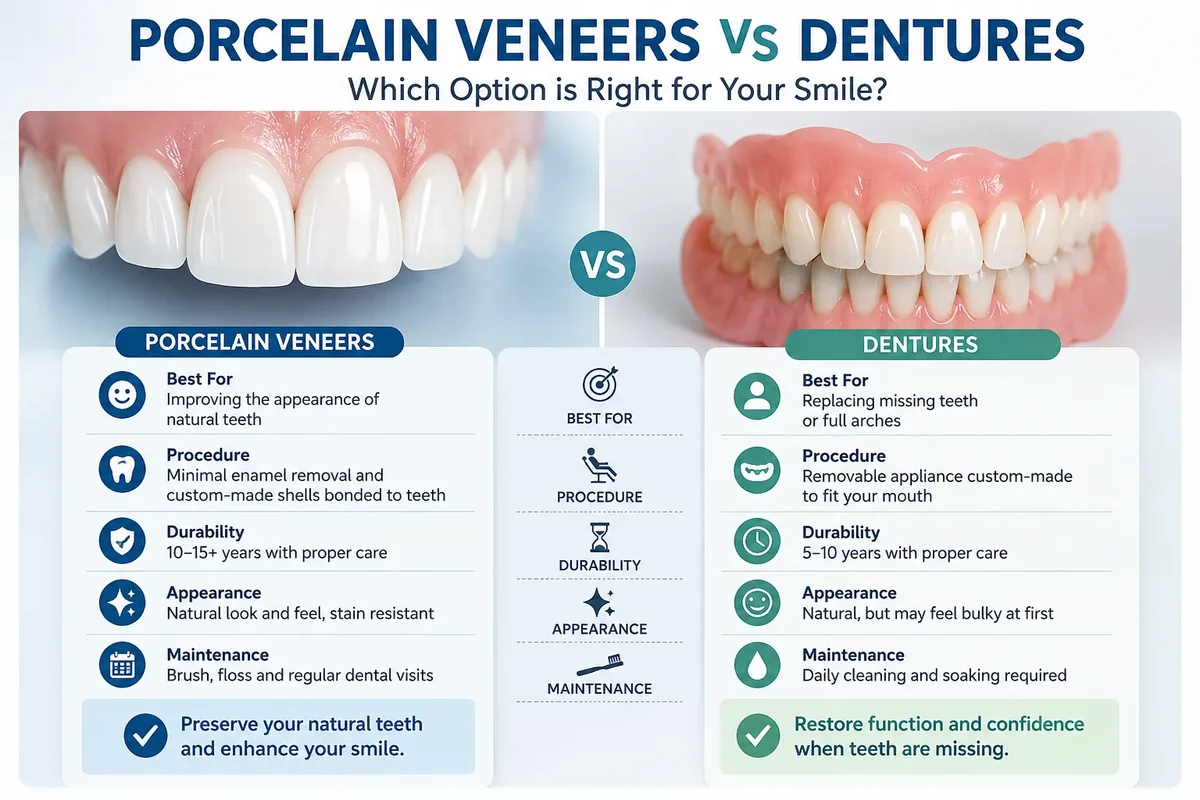
Final Next Step for Porcelain Veneers vs Dentures
Your next step is not to choose from photographs or prices alone; it is to confirm whether your natural teeth can be preserved and which treatment matches your functional and cosmetic goals. In the final porcelain veneers vs dentures decision, veneers are generally considered when existing teeth are healthy enough to remain but need changes in color, shape, proportion, or symmetry. Dentures are considered when several teeth are missing or when certain teeth may not be suitable for predictable restoration. A clinical examination turns general information into a plan that applies to your mouth.
Identify the Problem You Want to Solve
Before booking treatment, list your concerns in order of importance. These may include visible gaps, stained teeth, looseness, difficulty chewing, repeated breakage, discomfort, or problems with an existing denture. This matters because porcelain veneers vs dentures address different needs. Veneers do not replace missing teeth, while dentures are not normally required when stable natural teeth only need limited cosmetic improvement.
Use porcelain veneers vs dentures as a starting point for defining what you expect from treatment. Do you prefer a fixed result, or would you accept a removable appliance? Are you comfortable with irreversible tooth preparation? How important are speed, maintenance, appearance, chewing ability, and budget? These questions help a dentist determine whether porcelain veneers vs dentures is the right comparison or whether whitening, bonding, orthodontics, crowns, bridges, implants, or implant-supported dentures should be considered.
Arrange a Comprehensive Dental Evaluation
A useful consultation should assess more than the front of your smile. The dentist may examine your teeth, gums, bite, existing restorations, tooth mobility, jaw support, and oral hygiene. Photographs, scans, gum measurements, or X-rays may be recommended when appropriate. This information shows whether decay, infection, gum disease, grinding, or structural damage must be managed before porcelain veneers vs dentures can be planned responsibly.
Bring a current medication list, relevant medical information, and previous dental records when available. Mention dry mouth, smoking, grinding, allergies, previous treatment difficulties, or problems adapting to a denture. These factors may affect suitability, healing, comfort, and maintenance, and they can change the porcelain veneers vs dentures recommendation. No photograph-based opinion can replace this stage of a porcelain veneers vs dentures assessment.
Questions to Ask About Suitability
Ask which natural teeth can be saved and why. If veneers are proposed, ask whether the teeth have enough healthy enamel, how much preparation may be required, and whether your bite increases the risk of chipping or debonding. If dentures are proposed, ask whether a partial or complete appliance is being considered, which teeth will provide support, and what may affect stability.
In porcelain veneers vs dentures planning, also ask what could make either option unsuitable. Untreated decay, active gum disease, severe grinding, unstable teeth, limited bone support, dry mouth, and difficulty maintaining hygiene may change the plan. Comparing porcelain veneers vs dentures should not force you into one of two procedures. It should identify the treatment category that best matches your condition.
Compare Complete Treatment Plans
Request a written plan explaining the proposed stages, appointment sequence, alternatives, material choices, likely maintenance, and estimated costs. A veneer plan may include preparatory care, smile planning, tooth preparation, temporary veneers, laboratory work, bonding, and review. A denture plan may include extractions, healing, impressions, bite records, trial fittings, placement, adjustments, relining, or later replacement. These differences are central to porcelain veneers vs dentures.
Do not rely only on a headline fee or monthly payment. Ask what is included, what may cost extra, and which findings could change the estimate. Final fees depend on examination results and the agreed plan, so they should not be treated as guaranteed beforehand. A realistic porcelain veneers vs dentures comparison may also include travel, time away from work, temporary restorations, follow-up visits, repairs, and long-term care.
Review Risks and Alternatives
Veneers may involve irreversible enamel reduction and can eventually chip, wear, debond, or require replacement. Their supporting teeth can still develop decay or gum problems. Dentures may require an adaptation period and can move, create pressure areas, or become loose as oral tissues change. They may later need adjustment, repair, relining, or replacement. Understanding these limitations helps you evaluate porcelain veneers vs dentures without assuming either option will be maintenance-free.
Ask the dentist to explain reasonable alternatives. Whitening or bonding may be more conservative for limited cosmetic concerns. Orthodontics may suit alignment problems. Crowns may protect weakened teeth that are unsuitable for veneers. Bridges or implants may replace a smaller number of missing teeth without a conventional removable denture. In some cases, the most appropriate answer to porcelain veneers vs dentures is a combined or staged plan.
Make the Decision at the Right Pace
Before choosing porcelain veneers vs dentures, you should understand why treatment is recommended, what healthy tissue will be altered, what healing or adaptation may occur, and what future care may be necessary. Do not feel pressured to agree immediately because of a limited-time offer, travel deadline, or cosmetic event. Extraction and veneer preparation can be irreversible, so your questions should be answered before consent.
Consider another professional opinion when several teeth are proposed for removal, many healthy teeth would be prepared, two clinics recommend very different approaches, or the explanation does not match your concerns. A second opinion does not automatically mean the first plan is wrong. It may clarify the trade-offs within porcelain veneers vs dentures and support a more informed decision.
Use a Personalized Consultation as Your Next Step
A porcelain veneers vs dentures evaluation at Redent Klinik can assess whether your main need is cosmetic improvement, tooth preservation, tooth replacement, or a combination of these goals. A personalized evaluation can clarify suitability, expected stages, alternatives, risks, maintenance, and individual cost factors. Recommendations should follow examination and treatment planning rather than a guaranteed outcome or fixed price offered in advance.
Prepare by collecting recent records when available, noting your symptoms and priorities, and listing the questions you want answered. You can request information through the Redent Klinik Contact Page. Use the appointment to understand not only which side of porcelain veneers vs dentures may apply, but also why it is recommended and what alternatives remain.
What to Check Before You Proceed
Before making your final porcelain veneers vs dentures decision, check which teeth can be preserved, whether active disease must be treated first, how much tooth structure may be altered, whether the result will be fixed or removable, how many appointments are expected, and what future maintenance may involve. Confirm that you have received an itemized estimate and an explanation of alternatives, risks, timing, and follow-up care.
Request professional advice promptly if you have facial swelling, severe or increasing pain, uncontrolled bleeding, signs of infection, loose teeth, difficulty swallowing, dental trauma, or an oral sore that does not heal. Arrange a consultation if missing teeth affect eating or speech, an existing denture moves or causes recurring soreness, or cosmetic concerns are leading you toward irreversible treatment. The most appropriate next step in porcelain veneers vs dentures is a personalized evaluation that protects oral health first and then considers appearance, comfort, timing, and budget.
Disclosure: this page may contain affiliate links. We may earn a commission if you use them, at no extra cost to you.