
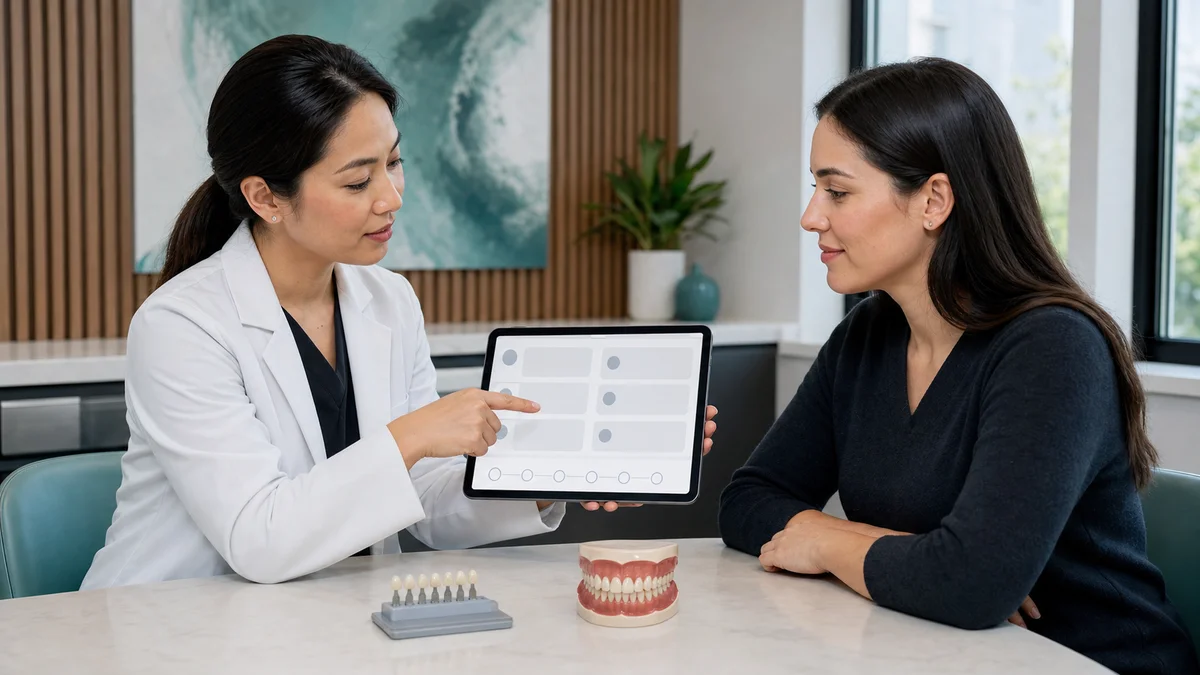
Quick answer: porcelain veneers reviews can reveal communication, comfort, follow-up and recurring service patterns, but they cannot prove your teeth are suitable or predict your result. Give more weight to traceable details about diagnosis, enamel preservation, bite, temporaries, consent and long-term care than to star scores or immediate “perfect smile” claims. Confirm credentials and obtain a tooth-by-tooth clinical plan.
Online reviews are often the first place people encounter a veneer clinic, a material name or a story about treatment abroad. They can be useful, especially when many independent patients describe the same practical strength or weakness. Yet they are also selective. A reviewer does not usually publish diagnostic records, preparation depth, gum measurements, bite findings, material batch, bonding substrate or years of professional follow-up. Even a sincere account can describe an experience accurately while offering little evidence that the same plan is appropriate for someone else.
Porcelain and other ceramic veneers are thin restorations bonded mainly to the visible surfaces of teeth. They may change colour, contour, proportion or the appearance of selected spacing and minor positional concerns. They do not move roots, treat active decay, cure gum disease or make a weak treatment plan safe. Some designs require enamel removal, and enamel does not regrow. That makes the decision different from buying a reversible consumer product.
This guide does not invent testimonials, rank clinics or turn a single study into a guarantee. It provides a repeatable way to read patient stories alongside official guidance and clinical research. It also explains the difference between a restoration that remains in place, a result that needs maintenance and an outcome the patient considers satisfactory. Final suitability requires a licensed dentist’s examination, appropriate records, informed consent and a realistic plan for future care.
1. What porcelain veneers reviews can and cannot tell you
Reviews are best at describing experience: whether options were explained, appointments felt rushed, temporaries were manageable, questions were answered and follow-up was available. They can flag patterns such as repeated complaints about unplanned changes, inaccessible aftercare or pressure to pay before diagnosis. These are meaningful signals when the accounts are detailed, recent, independent and consistent across platforms.
Reviews are weak at establishing clinical appropriateness. A five-star story cannot show that decay was removed, gum disease was stabilised, enamel was preserved, margins were cleanable or the bite was adjusted correctly. A one-star story cannot by itself prove negligence; discomfort, adaptation, unrealistic expectations, unrelated disease and complications can have several causes. The responsible response is to identify what evidence is missing and ask for it in consultation.
- Useful review evidence: dated sequence, specific communication, temporary phase, follow-up access and how a concern was handled.
- Weak review evidence: “best ever,” “pain-free forever,” “zero shaving,” “guaranteed lifetime” or an unexplained score.
- Clinical evidence: diagnosis, records, material and bonding plan, consent, documented maintenance and professional review.
- Your decision: based on your teeth and goals, not the reviewer’s appearance or treatment package.
2. Separate a testimonial, a documented case and research evidence
A testimonial is one person’s account. It may be genuine and valuable but is not controlled, and the writer may not know every technical detail. A documented clinical case can add standardised photographs, diagnosis, preparation design, materials, timing and follow-up, yet it still represents a selected patient. A cohort study follows a defined group; a systematic review synthesises multiple studies using stated criteria. Each level answers a different question.
Research can estimate patterns such as survival or complications across groups, but it cannot select the shade, preparation or number of veneers for an individual. Reviews can reveal lived experience that clinical survival statistics miss, including difficulty cleaning, food trapping or dissatisfaction with speech or function. A good decision uses both kinds of information without treating either as complete.
3. A 12-point scorecard for reading veneer reviews
| Review signal | Why it matters | What to verify | Weight |
|---|---|---|---|
| 1. A clear treatment date and timeline | Distinguishes an immediate impression from longer follow-up | When final veneers were fitted and when the review was written | Useful context |
| 2. The starting problem is described | Colour, wear, spacing and damage require different plans | Diagnosis and alternatives, not only the desired look | High value |
| 3. The reviewer names the actual treatment | “Veneers” is often confused with crowns or composite bonding | Tooth-by-tooth restoration type and material | High value |
| 4. Preparation is discussed | Enamel preservation influences bonding and irreversibility | Where enamel, dentine, existing fillings or crowns are involved | High value |
| 5. A mock-up or provisional phase is mentioned | Shows whether shape, speech and bite were tested before final cementation | What could still be changed and what was approved | Useful context |
| 6. The treating dentist is identifiable | Supports licence and professional-role checks | Official register, clinic address and who performed irreversible steps | Essential |
| 7. Risks and alternatives were explained | Positive consent is more than choosing a shade | Whitening, orthodontics, bonding, repair, monitoring or no treatment | Essential |
| 8. Gum health and cleaning are included | Margins must remain maintainable | Baseline health, daily care and maintenance interval | High value |
| 9. Bite and grinding are mentioned | Loading can affect chipping, fracture and comfort | Occlusal assessment and any protective appliance | High value |
| 10. A problem and its resolution are described | Response to complications may reveal more than a flawless story | Diagnosis, repair, replacement and who paid for travel or laboratory work | Very useful |
| 11. Follow-up extends beyond the fitting day | Immediate appearance does not show long-term margins or function | Months or years of documented review | High value |
| 12. The account avoids guarantees | Biology, habits and restorations change over time | Realistic maintenance and replacement expectations | Trust signal |
The scorecard is not a mathematical rating. An anonymous review can still contain useful questions, and a detailed review can still be sponsored or incomplete. Its purpose is to move attention from emotional intensity toward verifiable facts.
4. Begin with the clinical suitability gate
Before cosmetic planning, a dentist should evaluate decay, previous restorations, cracks, enamel quantity, gum health, recession, tooth position, bite and habits such as grinding or nail biting. Active disease needs treatment. Very thin enamel, extensive existing fillings, severe malposition, inadequate space or a heavily damaged tooth may change the restorative option.
A veneer covers mainly the front surface; a crown covers much more of the tooth. Marketing sometimes uses the word “veneer” for aggressive full-coverage preparations. A review that praises “24 veneers” without showing what each tooth received does not establish that the treatment was conservative. Ask for written terminology and a tooth map before consent.
5. Enamel preservation is more informative than “no-prep” marketing
The amount and location of preparation should be planned, not inferred from a slogan. Some teeth need space to avoid bulky contours; others can be treated with minimal preparation. “No-prep” does not mean universally reversible, risk-free or suitable. Even when little enamel is removed, bonding and margin placement create a restoration that will require future review.
A 2024 systematic review and meta-analysis found better reported survival and success when ceramic veneers were bonded predominantly to enamel than when severe dentine exposure was present, although the evidence included only six clinical studies and varied by substrate. That finding supports preservation but does not provide a personal guarantee. The clinician should explain expected enamel and dentine exposure tooth by tooth.
6. Understand survival, success and satisfaction
Survival often means the veneer remains in place, even if it has required polishing, repair or another intervention. Success may use a stricter definition with no unacceptable complication. Patient satisfaction describes the person’s view of appearance, comfort or function. These measures can diverge, which is why a headline survival percentage should not be treated as “problem-free for everyone.”
A 2025 systematic review and meta-analysis reported high pooled long-term survival for several ceramic groups, while technical, aesthetic and biological events varied and long-term zirconia evidence was not available. Study designs, materials, operators and follow-up were heterogeneous. A separate long-term clinical study of a small recalled patient group found that many veneers still present after nine to ten years had complications and that cleaning, function and food impaction affected some patient-reported outcomes. This single cohort should not be generalised to every veneer system, but it demonstrates why survival alone is not the whole story.
7. Read complication language precisely
Fracture, chipping, debonding, marginal discolouration, secondary decay, gum inflammation, sensitivity and need for endodontic treatment are different events. A small polishable chip is not equivalent to an irreparable tooth fracture. Debonding can involve the restoration, the bonding interface, tooth substrate or an underlying design issue. A review that says “my veneer failed” needs context before it becomes evidence.
- Technical event: chip, crack, fracture, debonding or surface wear.
- Biological event: decay, pulpal symptoms, gum inflammation or recession.
- Aesthetic event: colour mismatch, visible margin, contour concern or surface change.
- Functional event: bite discomfort, speech change, food trapping or cleaning difficulty.
- Service event: delayed response, unavailable records, unclear guarantee terms or travel burden.
Ask how the clinic defines repair, remake and failure. A limited commercial warranty may cover laboratory material but exclude decay, trauma, grinding, travel or professional fees. It is not the same as a health guarantee.
8. Material names do not replace a complete plan
Feldspathic porcelain, leucite-reinforced glass-ceramic, lithium disilicate and zirconia differ in optical properties, fabrication and bonding protocols. A brand or material name in a review does not prove it is ideal for another person. Thickness, shade change, substrate colour, enamel availability, preparation, laboratory quality and cementation protocol interact with material choice.
The 2025 meta-analysis did not find a simple long-term survival winner among all compared materials, and follow-up for zirconia was much shorter. Claims such as “strongest therefore best” overlook bonding and aesthetics. Ask why a material is recommended for each tooth and what evidence or limitations apply to the planned thickness and substrate.
9. Aesthetic satisfaction is more than whiteness
Natural appearance involves proportion, translucency, texture, value, edge character, symmetry with the face and harmony with gum levels. An extremely white result can receive enthusiastic immediate reviews while still being inappropriate for another patient. Camera exposure, editing, ring lights and screen settings change how colour appears online.
A diagnostic wax-up, digital design or intraoral mock-up can help discuss shape and approximate appearance. It is a communication tool, not a guaranteed preview of biological response or exact ceramic optics. Consent should include what can still be changed during try-in and what becomes difficult after final bonding.
10. Look for bite, speech and cleaning details
Reviews often focus on frontal photographs and ignore function. Veneer length and contour can affect speech, lip contact and guidance during jaw movement. Grinding, clenching, edge-to-edge bite, missing back-tooth support and habits such as biting pens can change loading. A night guard may be recommended for selected patients but cannot guarantee that ceramic will never chip.
Margins should be smooth and cleanable. Food trapping, persistent bleeding, floss shredding or inability to clean deserve assessment. The ADA advises brushing with fluoride toothpaste twice daily and cleaning between teeth; decay can still occur under or around a veneer. A review that mentions long-term cleaning and professional maintenance provides more useful context than a fitting-day selfie.
11. How to evaluate negative porcelain veneers reviews
Negative accounts should not be dismissed automatically, nor accepted as complete clinical verdicts. Look for repeated patterns across independent writers: pressure, changed treatment scope, missing records, inability to identify the treating dentist, absent follow-up or the same unresolved complication. Check dates because staff, ownership and protocols can change.
Separate dissatisfaction with appearance from urgent health symptoms and from administrative disputes. A clinic’s public response can reveal whether it protects confidentiality, invites appropriate private follow-up and avoids diagnosing online. Because healthcare privacy matters, a clinic may be unable to publish its full version of a case. Lack of a detailed public rebuttal is not proof that the complaint is accurate or false.
12. How to detect weak or manipulated review patterns
No single sign proves that a review is fake. Concern increases when many accounts appear in a short burst, repeat identical phrases, describe no clinical detail, focus on discounts, use stock imagery or exist only on a clinic-controlled page. Hidden incentives can shape both positive and negative posts. Look for disclosure when treatment, travel or accommodation was discounted in exchange for content.
- Compare several independent platforms and the clinic’s official information.
- Search the named dentist in the relevant official professional register.
- Check whether reviews distinguish veneers, crowns, composite bonding and implants accurately.
- Give more weight to longitudinal updates than immediate reactions.
- Do not send money or health records solely because a social-media account appears popular.
- Ask who holds your records and who provides emergency and long-term care.
The ADA warns patients about unlicensed “veneer technicians” who remove the dentist from diagnosis and care. Tooth preparation and bonding are healthcare procedures. A verified licence, accountable clinic and examination are basic requirements, not optional premium features.
13. Reviews for treatment abroad need a continuity lens
Travel can compress appointments and make immediate reviews unusually positive or stressful. Ask whether the reviewer describes pre-travel records, time for gum stabilisation, a provisional phase, days between preparation and bonding, return visits and responsibility after departure. A short trip may be adequate for one plan and unsafe for another.
Clarify who pays for flights, accommodation, local imaging, removal, repair or remaking if a concern arises. Find out whether a local dentist can obtain material, shade and cement information. Emergency care, routine maintenance and elective correction are different responsibilities. A “lifetime guarantee” is of limited practical value if exclusions or repeated travel make it inaccessible.
14. Turn reviews into consultation questions
Instead of asking a clinic to reproduce another person’s smile, use reviews to identify questions. Bring photographs only as preference references, not prescriptions. A clinician should be able to explain why your plan differs from a popular case.
- What diagnosis and goal support a veneer on each proposed tooth?
- Which teeth need no treatment, whitening, orthodontics, bonding, an onlay or a crown instead?
- How much enamel and dentine exposure is expected for every tooth?
- What material, thickness and bonding substrate are planned, and why?
- How will gum health, bite, grinding and speech be assessed?
- Can I review a mock-up or provisional result before irreversible final bonding?
- What counts as adjustment, repair, remake and failure?
- Who provides urgent care, maintenance and long-term records?
Patients can review the care philosophy at Redent Klinik and share relevant existing records through the contact page. Remote records can help organise a consultation, but images or reviews cannot replace an in-person examination before irreversible treatment.
15. Health symptoms are not review-shopping problems
Persistent pain, increasing swelling, trauma, a loose restoration, difficulty biting, a bad taste, gum bleeding that continues or a sudden change in the bite should be assessed by a dentist. Do not wait for more online opinions when symptoms are worsening. Difficulty breathing or swallowing and spreading facial or neck swelling can be emergencies requiring local emergency services.
If veneers are already present, avoid attempting to glue a loose piece at home. Keep any detached fragment safe, avoid chewing on the area and seek professional advice. A local dentist may need previous records, but urgent assessment should not depend on reaching the original clinic.
16. Frequently asked questions about porcelain veneers reviews
Are five-star porcelain veneers reviews reliable?
A star score can summarise experience but cannot show clinical suitability or long-term health. Read the dated detail, treatment description, follow-up and response to problems. Verify the dentist and obtain your own diagnosis.
How many reviews are enough to choose a veneer dentist?
There is no safe number. Review volume can be manipulated and small specialist practices may have fewer public posts. Combine independent patterns with credentials, examination quality, consent, records, conservative planning and aftercare.
Should I trust reviews that promise no tooth shaving?
No slogan applies to every tooth. Minimal or no preparation may be suitable in selected anatomy, while other teeth need controlled space to avoid bulky contours. Ask for a tooth-by-tooth preparation plan and its limitations.
Do high survival rates mean veneers will be problem-free?
No. Survival may include veneers that remain in place after repair or with complications. Success and patient satisfaction use different outcomes. Group estimates cannot guarantee an individual result.
Are porcelain veneers reversible?
Often they should be considered irreversible because preparation may remove enamel and the tooth will continue to need restoration. Even minimal-preparation designs involve bonding and future maintenance. Ask what will happen if a veneer is removed.
Can online photos verify a porcelain veneer review?
Photos can support that an appearance changed, but not prove identity, diagnosis, consent, material, health or durability. Lighting and editing can mislead. Standardised clinical records are more informative but still cannot predict your outcome.
What is the most useful detail in a negative review?
A specific timeline showing what happened, what the clinic assessed, how it responded and the eventual outcome is more useful than insults or vague claims. Repeated independent patterns deserve questions.
Should I choose the material most praised in reviews?
No. Material choice interacts with substrate, preparation, thickness, shade change, bite and bonding protocol. Ask why the recommended ceramic fits your teeth and what long-term evidence or uncertainty applies.
Can a commercial guarantee prove quality?
No. Read exclusions, duration, maintenance requirements, travel costs and who judges eligibility. A warranty is a contract, not a biological guarantee that decay, fracture, gum change or pulpal symptoms will not occur.
How do I verify a veneer provider?
Use the official professional register for the jurisdiction, confirm the clinic address and identify who will examine, prepare and bond the teeth. Avoid treatment by unlicensed technicians or remote-only sellers.
What should a long-term review mention?
Useful updates discuss comfort, bite, gum health, cleaning, chipping or repairs, colour, maintenance and access to care months or years after fitting. Immediate enthusiasm is real but cannot represent longevity.
17. Final perspective: use reviews as questions, not consent
The safest use of porcelain veneers reviews is to learn what to verify. Look beyond stars toward diagnosis, exact treatment, enamel preservation, credentials, temporaries, bite, cleaning, complications and long-term response. Compare patient experience with research while remembering that published studies also have limits and cannot design your smile remotely.
A responsible plan may recommend fewer veneers, a different material, orthodontics, whitening, bonding, repair or no cosmetic treatment. It should not promise a copy of another person’s result. Informed consent begins when the patient understands irreversible steps, alternatives, maintenance and uncertainty before treatment starts.
Sources
- American Dental Association MouthHealthy: Veneers and patient safety
- American Dental Association: Professional and public oral-health resources
- PubMed: 2025 systematic review and meta-analysis of ceramic veneer survival and complications
- PubMed: 2025 systematic review of reported complications in milled ceramic anterior veneers
- PubMed: 2024 systematic review and meta-analysis of ceramic veneers bonded to different substrates
- PubMed: Long-term clinical and patient-reported outcomes of ceramic veneers
- PubMed: 2024 systematic review of veneer preparation, cementation and periodontal status
- PubMed: Systematic review of porcelain laminate veneer survival evidence and heterogeneity
- World Health Organization: Oral health fact sheet