
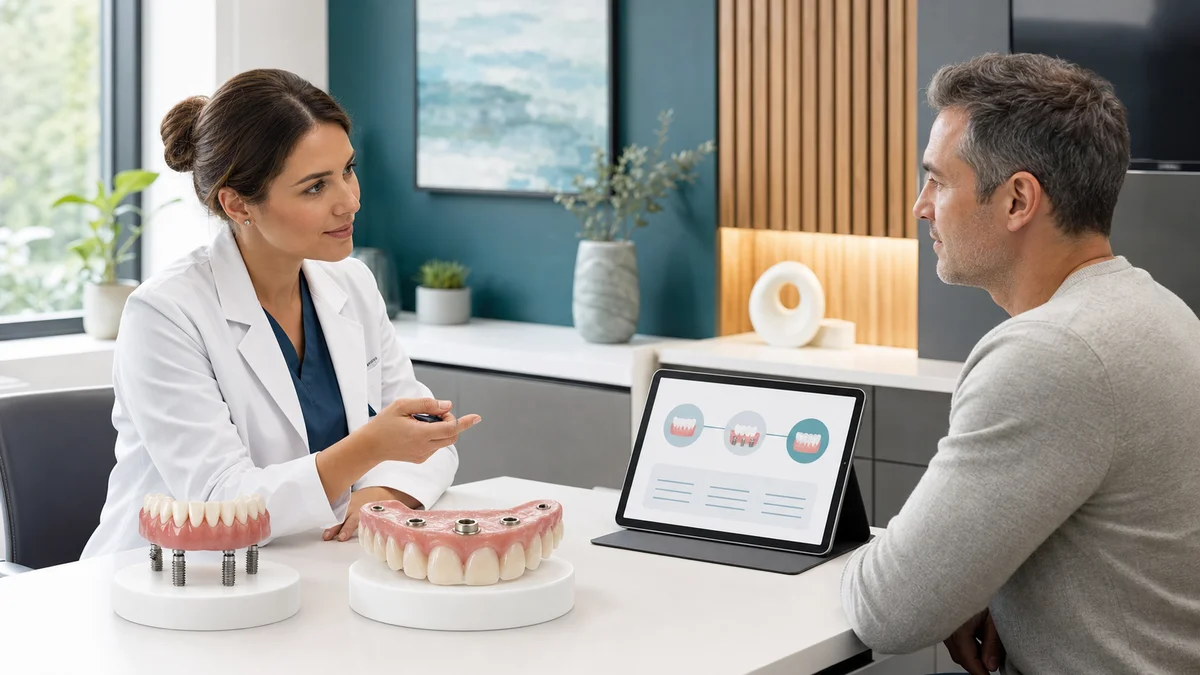
Searching how much does it cost to get full teeth implants sounds like a request for one number. Clinically, however, it is a request to define a complete rehabilitation. “Full teeth” might mean one arch or both arches. It might describe a fixed implant-supported bridge, a removable implant overdenture, or a temporary set of teeth worn during healing. Those pathways use different diagnostic, surgical, laboratory and maintenance resources, so an unexplained package total is not enough for a safe comparison.
This guide does not diagnose candidacy or promise a result. It shows how to read a proposal, identify omitted stages and ask questions that make two estimates comparable. A final plan should follow a clinical examination and the imaging your dentist considers justified. Existing teeth should not be removed merely to fit a package; preserving treatable teeth can be an important option and deserves explicit discussion.
1. What “Full Teeth Implants” Usually Means
A dental implant is a device placed in the jaw to support a restoration. The replacement teeth above it are a separate prosthetic structure. In full-arch care, a dentist may plan a bridge or denture supported by a selected number of strategically positioned implants. This does not automatically mean placing one implant beneath every replacement tooth. Implant number, position, dimensions and angulation are clinical decisions based on anatomy, bone, bite, restorative design and the chosen system.
The first question is therefore not “What is the package price?” It is “What exact prosthesis is being proposed for which arch?” A written plan should state whether the teeth are fixed or removable, whether the quoted restoration is temporary or final, who can remove it, what it is made from, and how it will be cleaned. It should also explain what happens if immediate fixed teeth are not clinically appropriate on the treatment day.
- One arch or two: an upper-only plan is not comparable with upper-and-lower rehabilitation.
- Fixed or removable: patient-removable overdentures and clinician-removable full-arch bridges have different components and care needs.
- Temporary or final: same-day teeth are often a provisional restoration, not necessarily the final laboratory prosthesis.
- Implant-supported or conventional: a complete denture without implants remains a legitimate alternative for some people.
- Immediate or staged: extraction, implant placement and loading may occur together only when the clinical conditions support that approach.
2. Why “How Much Does It Cost to Get Full Teeth Implants” Has No Single Answer
Two patients asking the same question may need very different care. One may already be without teeth, have a stable mouth and be considering a removable overdenture. Another may have painful or mobile teeth, active periodontal disease, complex extractions, reduced bone, a demanding bite and a preference for fixed teeth. Their totals cannot be responsibly predicted from the number of visible replacement teeth alone.
General health and healing capacity also matter. The FDA advises patients to discuss health conditions, medications and smoking because they may affect whether a person is a suitable candidate and how healing proceeds. A clinician should evaluate oral hygiene, active disease, available bone, restorative space, jaw relationships and the ability to attend follow-up. These are not administrative extras; they shape the proposed treatment and its risk profile.
Geography can affect professional, laboratory and facility costs, but location does not normalize the clinical scope. A lower headline in another country may exclude final teeth, additional visits, repairs at home or treatment if an implant cannot be loaded immediately. A higher estimate may still omit important elements. Compare inclusions, exclusions and contingencies first, then compare totals.
3. Choose the Prosthetic Pathway Before Comparing Totals
The final teeth are a major part of full-arch rehabilitation, not an accessory added after surgery. The restoration determines cleaning access, speech adaptation, lip support, repair strategy, laboratory workflow and how forces are distributed. The most expensive-looking pathway is not automatically best, and the least expensive is not automatically poor. The appropriate choice balances anatomy, health, function, hygiene ability, expectations and long-term serviceability.
| Pathway | How the teeth are retained | Useful question | Cost scope that must be clear |
|---|---|---|---|
| Fixed full-arch bridge | Attached to implants and normally removed only by a clinician | Can I clean every surface, and who removes it for service? | Temporary bridge, final bridge, framework, components, hygiene access and repair policy |
| Removable implant overdenture | Patient removes it; attachments connect it to implants | Which attachment parts wear and how are they replaced? | Denture, attachment system, housings or inserts, relines, adjustments and replacement parts |
| Conventional complete denture | Supported by oral tissues without implants | Will this meet my function and retention expectations? | Extractions if needed, immediate or final denture, relines, fit reviews and future remake |
| Staged implant plan without immediate fixed teeth | Implants heal before the definitive prosthetic stage | What will I wear during healing and why is staging advised? | Interim denture, surgical phase, healing reviews, second-stage care and final prosthesis |
Words such as “permanent,” “hybrid,” “full mouth” and “same-day” are used inconsistently in advertising. Ask the clinic to replace those labels with technical descriptions in the contract. The proposal should state the arch, retention type, implant system, temporary restoration, final restoration, materials, expected sequence and follow-up responsibility.
4. The 14-Line Full-Arch Quote Decoder
When asking how much does it cost to get full teeth implants, request a written estimate that addresses all fourteen lines below. A line can correctly be marked “not required” after assessment. What matters is that it is considered rather than silently omitted. Ask whether each amount is fixed, estimated, conditional or payable only if a stated event occurs.
- Consultation and health review: clinical examination, dental and medical history, medication review, goals and alternatives.
- Diagnostic records: appropriate radiographs, photographs, scans, impressions or bite records used for planning.
- Three-dimensional imaging when justified: whether cone beam CT is needed, who interprets it and whether a new scan is included.
- Disease control: management of active decay, gum inflammation, infection or other oral conditions before definitive care.
- Extractions: which teeth, whether any are complex, and what happens if an unexpected finding changes the procedure.
- Bone or soft-tissue procedures: the site, rationale, material and effect on timing if grafting is recommended.
- Local anesthesia, sedation and facility: the proposed method, monitoring, provider and any separate facility fee.
- Implant fixtures and surgical components: number planned, manufacturer, model family, cover screws or healing parts and placement.
- Immediate or interim teeth: what you will wear after surgery, whether it is fixed or removable, and its adjustment limits.
- Healing and review appointments: postoperative checks, suture care, implant assessment and the response to delayed healing.
- Final abutments or connectors: the components joining implants to the definitive prosthesis.
- Final prosthesis: design, framework, tooth material, shade process, try-ins, laboratory, delivery and remake conditions.
- Protective and hygiene support: cleaning instruction, recommended devices, bite protection if indicated and adjustment visits.
- Maintenance and contingency: recalls, professional cleaning, worn parts, repairs, travel, accommodation and responsibility after returning home.
A total without these definitions is not a complete answer. The clinic should identify services billed by another provider or laboratory and explain how changes are authorized. If a contingency cannot be priced in advance, ask for the event that triggers it, the decision maker, the likely treatment options and whether you may pause to review a revised consent and estimate.
5. Diagnosis and Imaging: The First Cost Layer
A safe plan begins with diagnosis, not a sales package. The clinician may need to assess tooth prognosis, gum condition, infection, bone volume, sinus or nerve proximity, jaw relationships, bite forces, smile display and restorative space. Not every person needs every test, and imaging should be clinically justified. However, a definitive surgical and prosthetic promise made without adequate assessment deserves caution.
Ask which records can be reviewed remotely and which decisions must wait for an in-person examination. A preliminary plan based on photographs or an older scan should be labeled preliminary. The written assumptions should include whether the records are current, whether teeth thought to be hopeless have been individually assessed, and whether the proposed prosthesis remains feasible if new findings appear.
Bone grafting is not an automatic add-on for everyone. When recommended, ask the site, purpose, material, alternatives and whether the graft changes the number of stages. Likewise, avoiding grafting is not inherently superior if it compromises the intended restorative position or cleansability. The plan should connect the surgical recommendation to the prosthetic goal.
6. Surgery, Implant Components and Anesthesia
The surgical portion may include extractions, site preparation, implant placement, grafting, sutures and postoperative reviews. The proposal should state who performs each procedure and the level of anesthesia or sedation anticipated. Sedation requires its own health screening, consent, monitoring and recovery arrangements. It should not be treated as a vague comfort upgrade.
An implant system includes more than the fixture in bone. Restorative connectors, screws, cylinders, attachments and healing components may be needed. Device records are important because future clinicians may need the manufacturer and model information to service the restoration. The FDA encourages patients to keep implant brand and model details. Ask whether you will receive an implant passport or equivalent written record after placement.
The advertised implant count is not a guarantee of what anatomy can safely receive. The final number and position should follow planning. A responsible consent process also explains what happens if stability is insufficient for immediate loading, if a site cannot accept the planned implant, or if the surgical findings require a staged approach.
7. Temporary Teeth Are Not the Same as Final Teeth
Many full-arch advertisements emphasize teeth provided on or soon after surgery. These are often provisional teeth designed for the healing phase. They may use a different material, contour or reinforcement than the definitive prosthesis. They may also require a modified diet and several adjustments. Ask whether “same-day” refers to extraction day, implant placement day or a later delivery appointment.
The estimate should name the interim restoration and its backup plan. If fixed provisional teeth cannot be fitted, will a removable denture be available? If a temporary fractures, who repairs it and on what schedule? Are adjustments during healing included? Does the final bridge require a separate payment after implant integration is assessed?
Immediate loading is a clinical decision, not a result that can be guaranteed before surgery. Bone quality, implant stability, bite, surgical findings and the ability to protect the restoration all matter. A clinic that presents immediate fixed teeth as unconditional is withholding an important contingency.
8. Final Prosthesis Design Can Change the Total
The definitive prosthesis may differ in framework, tooth material, surface finish, connection design and laboratory workflow. Material labels alone do not establish quality. Design accuracy, passive fit, bite, cleansability, repairability and communication between clinician and laboratory also matter. Ask to see the written specification rather than relying on a broad label such as “premium teeth.”
Clarify how many try-ins are planned, how shade and tooth position are approved, and whether the final teeth replace lost gum volume with prosthetic material. Ask what counts as a remake, an adjustment or a chargeable change requested after approval. The warranty wording, if offered, should identify exclusions, required maintenance, geographic limits and the remedy. No warranty can guarantee biological healing or eliminate the need for care.
For removable overdentures, ask which attachment system is proposed and which parts are expected to wear. For fixed bridges, ask how access for professional cleaning and screw service is managed. A restoration that cannot be maintained comfortably may create avoidable long-term burden even if its initial total appears attractive.
9. Maintenance, Repair and Biological Risk Belong in the Budget
Implants and prostheses require daily care and professional review. Cleaning difficulty, inflammation around implants, screw loosening, component wear, fracture, bite changes and implant failure are among the issues that may require attention. Risk is not proof that treatment is unsuitable, but it is a reason to plan follow-up and identify who will provide it.
- Ask how to clean under the prosthesis and which areas the dental team will monitor.
- Ask how often reviews are recommended for your risk profile and what those visits include.
- Request written implant and component records for future maintenance.
- Clarify the repair pathway for a loose screw, worn attachment, chipped tooth or fractured temporary.
- Identify a local clinician before travel if the treating clinic is abroad.
- Discuss smoking, grinding, hygiene limitations and relevant health changes honestly.
Symptoms such as increasing swelling, fever, uncontrolled bleeding, breathing or swallowing difficulty, persistent numbness, worsening pain, a mobile prosthesis or a changed bite should prompt timely professional advice. Emergency instructions should be written and usable after clinic hours. Do not delay urgent evaluation while waiting for a social-media reply or a routine travel date.
10. Insurance, Financing and Payment Milestones
Coverage is contract-specific. A dental plan may treat diagnostic, surgical and prosthetic services differently, apply exclusions or limits, require authorization, or pay only participating providers. An estimate or predetermination is useful but may not guarantee final payment. Ask the insurer about current eligibility, procedure-specific rules, annual or lifetime limits, waiting periods, network status and documentation requirements.
Financing changes when money is paid; it does not define whether a procedure is appropriate. Review the annual percentage rate, fees, deferred-interest conditions, total repayment, late-payment consequences and refund process. Payment milestones should correspond to treatment stages. Be cautious about paying the entire biological and prosthetic pathway before diagnosis, especially when later stages depend on healing.
For comparable proposals, request separate subtotals for diagnosis, preparatory care, surgery, interim teeth, final teeth and maintenance. Ask what is refundable if treatment is postponed or a planned stage becomes inappropriate. Get changes in writing before authorizing additional work.
11. Comparing Treatment Abroad Without Hiding Travel Costs
International care can be considered, but the comparison should include the complete care pathway. Travel, accommodation, companion needs, time away from work, repeat visits, laboratory delays, postoperative restrictions and unplanned return travel can affect the real total. A short trip should not force a biological timetable.
Ask how many visits are expected, the minimum stay for each stage, who provides urgent care between visits and how records are transferred. Clarify whether the final prosthesis is delivered during the first trip or after healing. Ask whether a local dentist can obtain compatible components and whether the overseas clinic will communicate directly if service is needed.
Patients considering an individualized review can consult the Redent Klinik English information hub and use the English contact page to ask which current records are needed for a preliminary assessment. Remote information remains preliminary until the clinical examination and appropriate imaging are complete.
12. Red Flags in a “Full Teeth Implants” Package
A low advertised total is not itself evidence of unsafe care, just as a high total is not proof of quality. The concern is an offer that prevents informed comparison or minimizes uncertainty. Pause when a seller will not identify the treating clinician, proposed restoration, component system, exclusions or aftercare plan.
- A final, nonrefundable package offered before adequate records and examination.
- Removal of all remaining teeth recommended without individual prognosis or discussion of preservation.
- Immediate fixed teeth described as guaranteed regardless of surgical findings.
- “Permanent teeth” advertised without distinguishing the provisional and definitive prostheses.
- Implant fixtures advertised while abutments, final teeth, anesthesia or follow-up are omitted.
- No written alternative if loading, grafting or the planned implant position is not feasible.
- No device record, component manufacturer, maintenance schedule or repair contact.
- Pressure to finance immediately or sign consent before questions are answered.
Good consent includes alternatives and the choice not to proceed. It also separates a preliminary estimate from the final diagnosis-based plan. You should have time to understand the likely benefits, limitations, material risks, stages, maintenance responsibilities and financial commitments.
13. A Seven-Step Method to Compare Two Full-Arch Quotes
- Confirm whether each proposal covers the same arch or arches.
- Match the retention type: fixed bridge, implant overdenture or conventional denture.
- Map every proposal to the fourteen lines in this guide and mark omissions.
- Separate temporary teeth from the final prosthesis and record both specifications.
- List conditional services and the clinical event that would activate each one.
- Add maintenance, repairs, financing and travel rather than comparing surgery alone.
- Review the normalized scope with a dentist who has examined you before deciding.
This method may reveal that the totals describe different treatments. It also makes clinical uncertainty visible without pretending every contingency can be predicted. A transparent estimate is not necessarily the lowest one; it is the one whose assumptions, stages and responsibilities you can understand.
14. Questions to Bring to the Consultation
Write down your priorities: fixed versus removable, cleaning ability, appearance, speech, travel limits, medical concerns and budget boundaries. Then ask the dentist to connect each recommendation to those priorities and to the examination findings.
- Which teeth, if any, can reasonably be preserved?
- What exact prosthesis is proposed for each arch, and can I remove it?
- Which part is temporary, which part is final, and when is each delivered?
- Why is the planned implant distribution appropriate for my anatomy and restoration?
- What could prevent immediate loading, and what would I wear instead?
- Which stages, components, scans, adjustments and reviews are excluded?
- Who handles maintenance and urgent problems after I return home?
- What written device, laboratory and treatment records will I receive?
Frequently Asked Questions About How Much Does It Cost to Get Full Teeth Implants
Does every missing tooth need its own implant?
No. A full-arch bridge or overdenture may be supported by a selected number of implants rather than one implant per replacement tooth. The appropriate number and position depend on anatomy, bone, bite, prosthetic design and the clinician’s assessment. An advertisement should not replace individualized planning.
Does a full-teeth implant package include both jaws?
Not necessarily. “Full teeth” and “full mouth” are sometimes used loosely. Ask whether the total is per arch or covers upper and lower arches, and whether the plan is identical for both. The contract should name every arch and every included stage.
Are same-day teeth the final teeth?
Often they are provisional teeth intended for healing, but terminology varies. Ask for the temporary and definitive restorations to be listed separately with their retention, material, delivery timing and adjustment policy. Immediate loading cannot be confirmed solely from an advertisement.
How much does it cost to get full teeth implants if bone grafting is needed?
There is no universal addition because graft type, site, material and timing differ. Grafting should be based on examination and appropriate imaging. Ask why it is advised, whether alternatives exist, whether it changes the treatment stages and how it is priced in the written estimate.
Is a fixed full-arch bridge always better than an implant overdenture?
No. Fixed and removable options have different hygiene, anatomical, functional, maintenance and financial implications. Some patients value fixed retention; others benefit from a removable prosthesis that is easier to clean or supports facial tissues differently. Suitability must be individualized.
Can a clinic give an exact full-arch price from photographs?
Photographs and existing records can support a preliminary estimate, but they may not show bone, infection, tooth prognosis, restorative space or bite adequately. A final diagnosis-based plan generally requires an examination and the imaging considered appropriate. Ask the clinic to label assumptions and possible changes.
What should happen if immediate fixed teeth are not possible?
The consent and estimate should describe a backup pathway before surgery. That may involve a removable interim prosthesis or staged loading, depending on the clinical findings. Ask how the alternative affects timing, follow-up and payment, and do not accept a guaranteed biological result.
What is the most commonly omitted cost?
There is no single omission in every quote. Common blind spots include the final prosthesis after temporary teeth, abutments or connectors, grafting, sedation, maintenance, repairs and repeat travel. The fourteen-line worksheet helps reveal which item is missing from a particular proposal.
Conclusion: Price a Defined Care Pathway, Not a Slogan
The safest answer to how much does it cost to get full teeth implants begins by defining the treatment. Confirm the arch, fixed or removable design, temporary and final teeth, diagnostic basis, surgical stages, components, maintenance and contingency plan. Only then can totals be compared meaningfully.
A full-arch decision is both biological and prosthetic. It should protect treatable teeth where reasonable, respect healing, provide a usable alternative if the original plan changes, and leave you with records and aftercare. Take an itemized proposal to your consultation and ask the clinician to explain every assumption in plain language.
Official Sources and Evidence Notes
- U.S. Food and Drug Administration: Dental Implants, What You Should Know
- U.S. Food and Drug Administration: Implants and Prosthetics
- MouthHealthy by the American Dental Association: Implants
- MouthHealthy by the American Dental Association: Dentures
- American Dental Association
- Cambridge University Hospitals NHS Foundation Trust: Dental Implants in Restorative Dentistry
- Leeds Teaching Hospitals NHS Trust: Dental Implants
- NHS: Dentures
- World Health Organization: Oral Health