
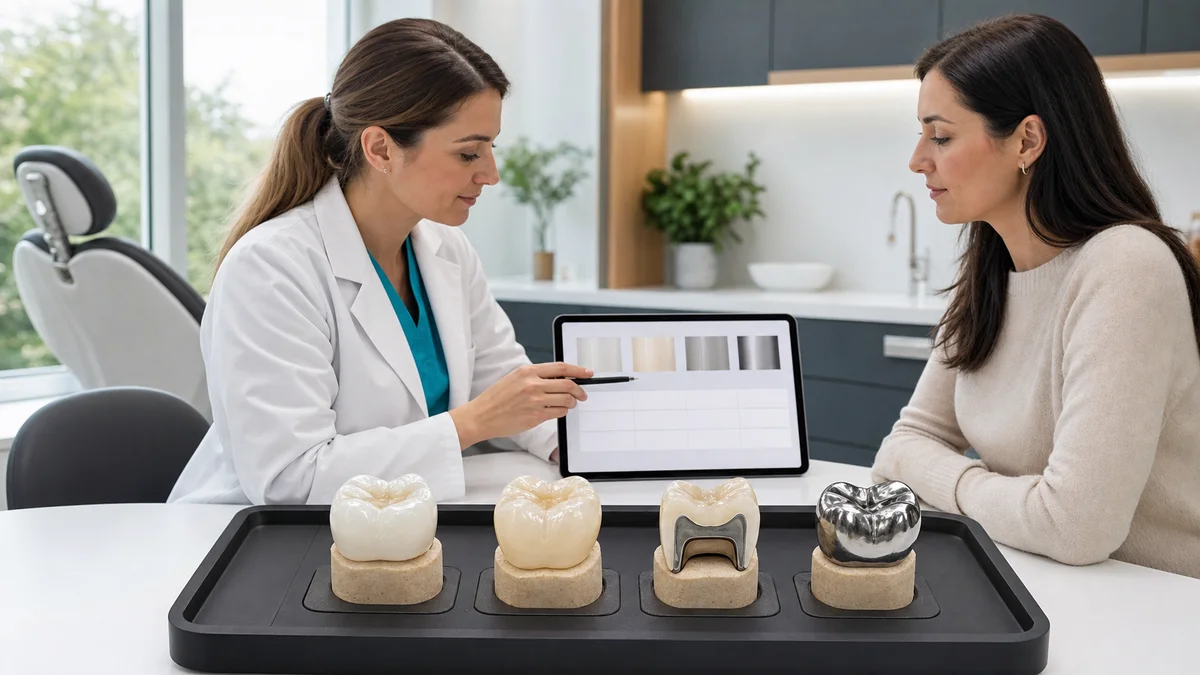
The phrase zirconia crowns vs dental crowns sounds like a comparison between two different treatments, but it contains a category error. A zirconia crown is already a dental crown. “Dental crown” describes the restoration: a cap that covers a prepared natural tooth or restores an implant. “Zirconia” describes one family of ceramic materials from which that restoration may be made. A useful comparison is therefore zirconia versus other crown materials and designs for a particular tooth.
This guide is educational and cannot select a crown for you. Material choice should follow a diagnosis, confirmation that full coverage is needed, assessment of the supporting tooth or implant, and a discussion of reasonable alternatives. No material guarantees a particular lifespan or appearance. A well-selected material can still fail if decay, preparation, fit, bite, cementation, hygiene or trauma creates an unfavorable environment.
1. Correcting the Zirconia Crowns vs Dental Crowns Comparison
A crown is a form, not a single substance. The NHS describes a crown as a cap that completely covers a real tooth and notes that crowns may be made from metal, ceramic, or porcelain fused to metal. The American Dental Association’s patient information explains that a crown may strengthen a tooth with a large filling, protect a weak tooth, restore a broken tooth, improve appearance, support a bridge or cover an implant.
Zirconia is a polycrystalline ceramic used in dentistry. Manufacturers supply different zirconia formulations and indications; zirconia is not one uniform product. A restoration may be milled as full-contour or “monolithic” zirconia, or zirconia may form a substructure with a more translucent veneering ceramic layered over selected surfaces. These designs do not behave identically, so the laboratory prescription matters as much as the broad material label.
When a clinic offers “ceramic crowns,” ask which ceramic. Glass ceramics, including lithium disilicate systems, differ from zirconia in optical behavior, surface treatment and bonding protocols. When a clinic offers “porcelain crowns,” ask whether that means an all-ceramic crown or porcelain fused to a metal substructure. Precise terminology prevents a marketing label from substituting for a clinical specification.
2. Confirm That the Tooth Needs a Crown Before Choosing Zirconia
Material selection comes after deciding how much restoration the tooth needs. A crown covers the tooth circumferentially and requires irreversible preparation. Depending on the defect, a direct filling, bonded onlay, partial crown, veneer, repair, monitoring or another conservative approach may preserve more healthy tissue. A severely weakened tooth may need full coverage, but a healthy tooth should not be reduced merely to obtain a material trend or a rapid cosmetic change.
The dentist should evaluate active decay, cracks, previous restorations, remaining walls, periodontal support, gum condition, pulp or root-canal status, bite, symptoms and the possibility of obtaining a predictable margin. A crown does not cure untreated gum disease or make an unrestorable tooth restorable. If the tooth has a questionable prognosis, clarify that before paying for a premium material.
- What diagnosis makes full coverage appropriate?
- Which alternatives would remove less tooth structure?
- Is the tooth vital, previously root treated, cracked or heavily restored?
- Is there enough sound tooth structure to retain and support the planned restoration?
- Can the margin be kept accessible for fit, cleaning and future examination?
- Will gum treatment, foundation restoration or orthodontic movement be needed first?
A crown on a natural tooth and a crown on an implant also require different planning. A natural tooth has periodontal ligament movement and can develop decay; an implant does not decay but has its own biological and mechanical considerations. The same visible zirconia material does not make those two restorations equivalent.
3. Decision Table: Match the Crown Family to the Clinical Question
The table below is a conversation tool, not a prescription. Properties vary by product, thickness, connector or core design, laboratory process, surface finish and clinical conditions. “Stronger” in a laboratory measurement does not automatically mean “better” for a particular tooth.
| Crown family | Typical design idea | Potential planning advantage | Question or limitation to discuss |
|---|---|---|---|
| Monolithic zirconia | Full-contour milled polycrystalline ceramic | Can provide a metal-free, high-strength restoration in suitable designs | Which zirconia formulation, translucency, thickness and surface finish are prescribed? |
| Layered zirconia | Zirconia substructure with veneering ceramic in visible areas | Allows optical characterization beyond a fully monolithic design | Where is ceramic layered, and how is chipping risk managed? |
| Glass ceramic or lithium disilicate | Translucent ceramic restoration, often adhesively bonded when indicated | May offer useful optical control in selected aesthetic situations | Is there adequate thickness, support and isolation for the chosen protocol? |
| Porcelain fused to metal | Metal substructure covered partly or fully by tooth-colored ceramic | Combines a metal framework with a veneered appearance and has a long clinical history | How will the metal, opacity, margin and veneering ceramic affect appearance and repair? |
| Full metal | Cast or milled metal crown without tooth-colored veneer | May be considered where appearance is less important and space is limited | Is the alloy documented, and are appearance or material sensitivities relevant? |
| Temporary resin or composite crown | Interim protection while diagnosis, healing or laboratory work continues | Allows provisional evaluation and protects the prepared tooth | How long is it intended to serve, and what restrictions apply? |
4. Factor One: Tooth Position and Aesthetic Demand
Front teeth and back teeth present different optical and loading challenges. A front crown may need to reproduce translucency, surface texture and color transitions while masking a dark foundation or metal post. A back crown may face greater chewing forces and less available vertical space. Neither location creates an automatic material rule, but it changes the priorities.
Modern zirconias are available in different translucency and strength categories, yet greater translucency should not be assumed to preserve every mechanical property of a more opaque formulation. Conversely, choosing the most opaque or highest-strength label may make color matching more difficult in a visible single-tooth restoration. Ask the dentist and technician which product and shade strategy suit the substrate and neighboring teeth.
Glass ceramics may be considered when optical blending and controlled bonding are priorities, provided the tooth, preparation and bite support the design. Porcelain-fused-to-metal may mask a dark foundation but can require management of opacity and the metal-ceramic transition. A material photograph or brand brochure cannot predict its appearance in your mouth because tooth color, cement, thickness, lighting and surface characterization interact.
5. Factor Two: Remaining Tooth Structure and Preparation Design
A crown relies on the prepared tooth or implant component beneath it. On a natural tooth, the amount, height and distribution of remaining sound structure affect retention and resistance. The finish line, taper, internal space, rounded transitions and material thickness must fit the selected system. A preparation created for one material may not be ideal for another.
Marketing claims that a certain crown is always “minimal prep” are too broad. The amount removed depends on the existing damage, required material thickness, occlusal space, aesthetic masking, margin design and whether a foundation restoration is needed. Sometimes the defect has already removed much of the tooth; sometimes aggressive elective reduction is the main risk. Ask the clinician to distinguish tissue lost to disease from tissue removed for the restoration.
A root-canal-treated tooth does not automatically require zirconia, and zirconia does not prevent future root or periodontal problems. The dentist must assess ferrule, core, post if relevant, cracks and restorability. If a crack extends unfavorably or the remaining tooth cannot support a predictable crown, changing the crown material may not solve the underlying prognosis.
6. Factor Three: Bite Forces, Space and Parafunction
Clenching, grinding, chewing pattern, missing teeth, opposing restoration and limited clearance can change the mechanical environment. A dentist may examine wear facets, muscle symptoms, mobility, fractures and how the teeth contact in different jaw movements. Material is only one part of this analysis; crown contour, thickness, support and bite adjustment are also important.
Zirconia is often selected for demanding posterior situations because certain formulations have high fracture resistance, but “unbreakable” is inaccurate. Crowns can fracture, chip, lose retention or be affected by problems in the supporting tooth. Layered designs may have a different complication pattern from monolithic ones. Glass ceramics and metal-ceramic systems also have design-specific indications and limitations.
A night guard may be recommended for selected patients, but it does not guarantee that a crown will never fail. Ask why protection is advised, when it should be worn and how its fit will be checked after restorative changes. Persistent jaw pain, rapid wear or repeated restoration fracture deserves diagnosis rather than repeated material substitution alone.
7. Factor Four: Opposing-Tooth Wear and Surface Finish
Patients sometimes hear that zirconia always destroys the opposing tooth. That statement is too absolute. Wear depends on the material formulation, roughness, polishing, glazing, bite, contact area and patient factors. A smooth, well-finished surface behaves differently from a rough surface created by adjustment and left inadequately polished.
If the dentist adjusts a ceramic crown, ask how the surface will be refinished according to the material manufacturer’s protocol. Glaze can be altered over time or during adjustment, while appropriate polishing aims to create a smooth functional surface. The opposing tooth should also be assessed, especially if it has wear, cracks, an implant restoration or another ceramic crown.
Surface management is a quality-control step, not a brand promise. Laboratory finish, clinical adjustment and maintenance all matter. A crown that feels high, catches during jaw movement or creates new discomfort should be reviewed rather than endured in the hope that the bite will simply adapt.
8. Factor Five: Bonding, Cementation and Moisture Control
Retention is not determined by material name alone. Preparation geometry, available enamel or dentin, surface treatment, primer, cement selection, isolation and curing protocol can all matter. Zirconia and silica-based glass ceramics do not use identical surface-conditioning steps. The clinician should follow a protocol compatible with the specific restoration and cement system.
Some crowns may be conventionally cemented when preparation and material requirements allow; others depend more heavily on adhesive bonding. A systematic review indexed in PubMed found that zirconia and lithium disilicate crowns showed broadly comparable survival and complication patterns across the included clinical literature, while also emphasizing limitations in evidence quality. This supports individualized protocol selection rather than a universal winner.
Moisture, blood or saliva contamination can complicate adhesive procedures. If the margin is deep or isolation is difficult, the dentist may need to manage the gum, modify the preparation, select another protocol or postpone definitive placement. Asking “Which cement is best?” without the preparation and material context is less useful than asking how the entire retention plan works.
9. Factor Six: Monolithic, Layered and Metal-Ceramic Designs
A monolithic crown is formed mainly from one restorative block through its contour. A layered crown uses a core or framework plus veneering material. Monolithic design can reduce the presence of a separate veneer interface, but may offer different optical possibilities. Layering can improve characterization in selected zones but introduces a veneering ceramic that can chip.
Porcelain-fused-to-metal is also layered: a metal substructure supports porcelain. It should not be dismissed as an outdated failure, nor assumed to be the best because it has a long history. Metal selection, framework design, ceramic support, margin position and aesthetic expectations affect suitability. If metal sensitivity is a concern, the alloy composition and medical history should be discussed rather than relying on the vague word “metal.”
The written laboratory prescription should identify the material and design. “Zirconia crown” is incomplete if it does not state the product family, monolithic or layered construction, shade plan and any special characterization. This documentation also helps if the crown later needs repair or replacement.
10. Factor Seven: Fit, Margins and Gum Health
Gum response is influenced by more than whether the crown contains metal. Margin fit, contour, emergence profile, surface smoothness, cement cleanup, cleaning access and existing periodontal health are important. Any material can contribute to inflammation if the restoration overhangs, traps plaque or prevents effective cleaning.
A crown margin can develop recurrent decay on a natural tooth even though the crown itself cannot decay. Daily brushing with fluoride toothpaste, cleaning between teeth and professional review remain necessary. Bleeding, swelling, persistent bad taste, food trapping or a new gap at the margin should be assessed.
Placing every margin far under the gum solely to hide it may create biological and maintenance challenges. Sometimes a deeper margin is clinically necessary, but the rationale should be explained. The dentist should balance appearance, sound tooth structure, isolation, periodontal tissue and future access.
11. Factor Eight: Color, Substrate and Shade Communication
A crown’s final color is produced by several layers: the underlying tooth or core, material opacity and thickness, cement shade, external stain or layering, and ambient light. A translucent crown over a dark substrate may not match an adjacent natural tooth without an appropriate masking strategy. A highly opaque crown may mask effectively but look less lifelike in certain situations.
Single front crowns can be especially demanding because the restoration must match neighboring enamel rather than an entire planned set. Clinical photographs, calibrated shade information and communication with the dental laboratory may be useful. A try-in can help evaluate appearance, but some cemented or bonded restorations cannot be removed predictably after final placement.
Whitening should generally be discussed before selecting the definitive crown shade because restorative materials do not whiten like natural enamel. If future bleaching is likely, the crown may not change with surrounding teeth. This is a planning issue, not a defect in zirconia or another ceramic.
12. Factor Nine: Repairability, Removal and Future Treatment
No crown should be described as lifetime or permanent in the sense of never needing service. A crown may need polishing, recementation, repair, root-canal access, removal or replacement. The ease and predictability of these procedures vary with material, thickness, cement and the reason for intervention.
Small veneering-ceramic chips may sometimes be polished or repaired, while larger structural problems may require replacement. Zirconia repair uses material-specific surface treatment; not every defect is a good repair candidate. Drilling access through a crown for root-canal treatment can alter its strength and may later require replacement. Removing a strong ceramic crown can also be time-consuming and may sacrifice additional tooth structure.
Ask how the proposed material would be managed if the pulp becomes symptomatic, the margin decays, the crown loses retention or the veneer chips. A serviceable design is valuable even when no problem is expected. The plan should protect the supporting tooth, not just optimize the initial crown.
13. Factor Ten: Laboratory, Traceability and Quality Control
Digital scanning and computer-aided manufacturing can support an efficient workflow, but “digital” does not automatically guarantee accuracy. Scanning, margin capture, design parameters, milling, sintering or crystallization, staining, polishing and clinical verification all influence the outcome. Same-day production and laboratory production each require quality control.
Request the exact material name and manufacturer in your record. FDA clearance documents for dental zirconia blocks show that specific products are intended for particular types of crowns and other restorations; that does not mean every block has every indication. The dentist and laboratory should use a product within its instructions and select design parameters compatible with the clinical case.
- Material manufacturer and product family
- Monolithic, layered or metal-ceramic design
- Shade and characterization instructions
- Natural-tooth or implant-supported indication
- Cementation or bonding system used
- Laboratory identity and remake conditions
- Date of placement and relevant radiographic or photographic records
14. Risks Shared by Zirconia and Other Dental Crowns
The material comparison should not obscure risks common to crown treatment. Tooth preparation can be followed by temporary sensitivity, pulpal symptoms or need for endodontic care in some cases. A crown can feel high, lose retention, fracture, chip or develop an open margin. Decay may occur at the edge of a crown on a natural tooth. Gum inflammation may develop when plaque, contour or cement interferes with tissue health.
Seek prompt dental advice for increasing pain, swelling, fever, a loose crown, a sudden bite change, trauma, a sharp fracture, difficulty swallowing or breathing, or signs that infection may be spreading. A detached crown should not be permanently glued at home. Keep it safe and contact a dentist; household adhesives can damage tissues and complicate treatment.
Before placement, informed consent should cover the diagnosis, alternatives, amount of tooth preparation, material and design, expected stages, meaningful risks, maintenance and cost. No clinician can guarantee that a crown will never chip, debond, discolor at the margin or need replacement.
15. Cost and Insurance: Compare the Whole Crown Episode
Material is only one component of cost. Examination, imaging when justified, foundation restoration, gum management, temporary crown, laboratory work, cementation, bite adjustment and follow-up may be separate or bundled. A low zirconia label may exclude necessary treatment; an expensive label may still be inappropriate for the tooth.
Ask for a written estimate that identifies the exact material and what happens if the tooth proves unrestorable, requires root-canal treatment or needs a different foundation. Insurance rules vary by plan, diagnosis, network, frequency limits and benefit status. A predetermination can clarify expected benefits but may not guarantee final payment.
Patients reviewing restorative options in Turkey can use the Redent Klinik English information hub to understand the clinic context and the English contact page to ask which current records are needed for a preliminary review. An online estimate remains provisional until examination and any necessary imaging confirm the diagnosis and scope.
16. A Practical Consultation Checklist
Use this sequence to turn zirconia crowns vs dental crowns into a clinically useful conversation:
- Ask what diagnosis requires a crown and whether a partial-coverage option is reasonable.
- Confirm the prognosis of the tooth, gum and root before choosing a material.
- Identify the location, visible aesthetic demands and underlying tooth color.
- Review bite, space, grinding, opposing teeth and any history of fractured restorations.
- Compare the exact zirconia formulation with named alternatives, not with “dental crowns” as a category.
- Clarify monolithic or layered design, preparation thickness and margin plan.
- Discuss surface treatment, cementation, isolation and polishing after adjustment.
- Request material traceability, laboratory details and written maintenance advice.
- Review likely complications, repair options and the plan if the tooth later needs root-canal access.
- Compare itemized totals only after the clinical scopes match.
Frequently Asked Questions About Zirconia Crowns vs Dental Crowns
Are zirconia crowns dental crowns?
Yes. Zirconia describes the ceramic material family, while dental crown describes the type of restoration. A meaningful comparison names another material or design, such as monolithic zirconia versus lithium disilicate, layered zirconia, porcelain-fused-to-metal or full metal.
Are zirconia crowns always stronger than other dental crowns?
No universal statement is safe. Strength varies among zirconia formulations and depends on thickness, design, processing, surface treatment and support. Clinical success also depends on the tooth, preparation, fit, bite, cementation and maintenance. Laboratory strength alone does not select the best crown.
Do zirconia crowns look more natural than porcelain crowns?
Appearance depends on the exact zirconia, monolithic or layered design, tooth position, substrate, thickness, shade and technician. Some translucent glass ceramics may offer optical advantages in selected cases, while zirconia can provide useful masking or strength. “Porcelain” should be defined before comparing.
Can zirconia crowns damage the opposing teeth?
Any restorative material can contribute to wear under unfavorable conditions. For zirconia, surface smoothness, polishing after adjustment, bite and patient factors are important. The dentist should check contacts and finish the surface according to the manufacturer’s protocol.
Is monolithic zirconia better than layered zirconia?
Not in every situation. Monolithic construction avoids a separate external veneer over much of the crown, while layering can provide additional optical characterization. The choice depends on location, appearance, material formulation, available space and mechanical demands.
Does a root-canal-treated tooth need a zirconia crown?
Not automatically. The tooth may need cuspal protection or full coverage, but material choice depends on remaining structure, ferrule, foundation, position, bite and aesthetic needs. Some root-treated teeth may require another restoration type, and some may not be predictably restorable.
Can a zirconia crown be repaired if it chips?
Some limited defects may be polished or repaired using a material-specific protocol, but repair suitability depends on location, size, cause and crown design. Structural fracture, recurrent decay, poor fit or repeated failure may require replacement.
How long does a zirconia crown last compared with other crowns?
No responsible exact lifespan applies to every patient. Published reviews show favorable performance for several ceramic and metal-ceramic crown types, with different complication patterns and evidence limitations. Tooth health, fit, bite, hygiene, habits, material design and follow-up influence service time.
Can zirconia crowns be whitened later?
No dental crown whitens like natural enamel. Bleaching may lighten neighboring natural teeth and create a mismatch. Discuss whitening before final shade selection and understand that a crown may need replacement if a major shade change is desired.
What exact information should be on a crown estimate?
Ask for the tooth number, diagnosis, material, monolithic or layered design, foundation and temporary care, laboratory stage, cementation, adjustments, exclusions and follow-up. “Zirconia” without the product and design is not a complete specification.
Conclusion: Compare Prescriptions, Not Category Labels
The correct lesson from zirconia crowns vs dental crowns is that zirconia belongs inside the dental-crown category. The decision is not zirconia versus an undefined crown. It is whether a specific zirconia formulation and design, or another named material, best fits a diagnosed tooth, available structure, bite, appearance, bonding environment and maintenance plan.
Start with tooth preservation and prognosis. Then compare exact material prescriptions, preparation requirements, surface and cementation protocols, optical goals, repair strategy and written cost scope. A dentist and laboratory can only make that comparison responsibly when they have adequate clinical information.
Official Sources and Clinical Evidence
- MouthHealthy by the American Dental Association: Crowns
- American Dental Association
- NHS: Dental Treatments and Crowns
- World Health Organization: Oral Health
- U.S. FDA 510(k): Dental Zirconia Pre-shaded Block
- U.S. FDA 510(k): High-translucency Zirconia Dental Material
- PubMed: Cement Type and Clinical Performance of Zirconia and Lithium Disilicate Crowns
- PubMed: Clinical Performance of Lithium Disilicate and Zirconia CAD/CAM Crowns
- PubMed: All-ceramic and Metal-ceramic Single Crown Outcomes