
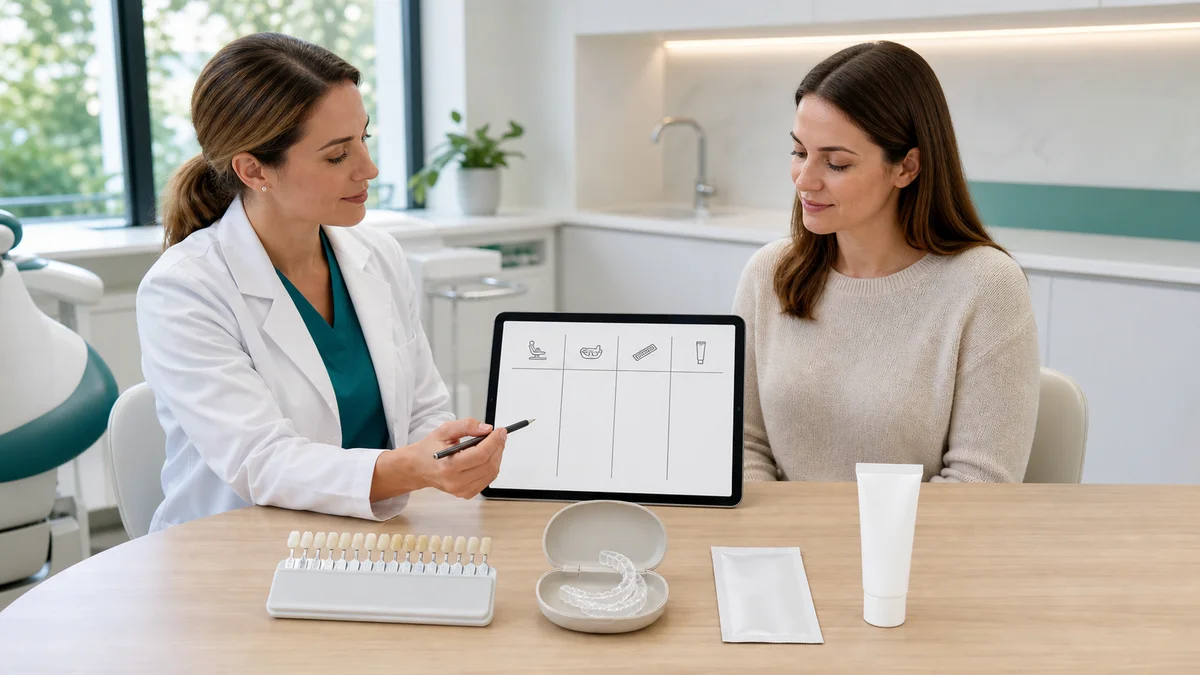
Quick answer: A useful teeth whitening comparison matches the method to the stain, oral health, sensitivity history, restorations, desired pace and ability to follow instructions. In-office whitening offers close clinical control, custom trays allow gradual dentist-supervised treatment, strips may lighten natural teeth when used correctly, and whitening toothpastes mainly remove surface stain. None guarantees a particular shade or permanent result.
Whitening options can look interchangeable when every package promises a brighter smile. They are not. Some products chemically bleach natural tooth structure; some mostly polish away external stain; some are fitted to your mouth; and some expose the gums to a one-size application. A fair comparison begins by identifying what the method actually does.
A teeth whitening comparison should also ask whether whitening is appropriate before discussing speed. Decay, leaking restorations, gum inflammation, exposed roots, cracks or one unusually dark tooth may need assessment first. Existing crowns, veneers, bridges, tooth-coloured fillings and implant crowns do not bleach like natural enamel, so a colour mismatch may become more obvious.
This guide compares professionally delivered in-office whitening, dentist-supervised custom trays, over-the-counter strips and whitening toothpastes. It does not diagnose the cause of discolouration or prescribe a product. The safest choice is the least intensive method that can realistically address the diagnosed stain while protecting oral tissues and preserving a maintainable result.
teeth whitening comparison starts with the type of stain
Tooth colour is influenced by enamel, the underlying dentine, age, habits, dental disease and restorative materials. The American Dental Association’s oral health topic on whitening separates discolouration into extrinsic stains on the surface and intrinsic changes within enamel or dentine. Many people have a mixture of both.
External stain can collect from tobacco, coffee, tea, red wine and other strongly pigmented foods or drinks. Plaque and calculus can also alter how light reflects from the teeth. Professional cleaning and good daily care may remove deposits and some stain without bleaching the internal colour. Whitening toothpaste can help with certain surface stains, but it does not necessarily make the natural tooth colour lighter.
Internal discolouration may be associated with ageing, developmental changes, trauma, previous pulp damage, some medications taken during tooth development or other causes. These patterns do not respond uniformly. A single dark tooth after trauma, for example, should not be treated as a routine full-mouth cosmetic concern without diagnosis.
Before choosing a method, ask:
- Is the colour change on the surface, within the tooth, or both?
- Is it generalised across the smile or limited to one tooth or one area?
- Are plaque, calculus, decay, gum inflammation or a leaking restoration contributing?
- Are visible teeth natural, restored, crowned, veneered or implant-supported?
- Is there a history of cold sensitivity, gum recession, cracks or recent dental work?
The answer may be cleaning, whitening, restoration, internal bleaching of a root-treated tooth, or no cosmetic treatment at all. Starting with stain diagnosis prevents the common mistake of escalating peroxide exposure when the target cannot respond.
Four whitening methods at a glance
| Method | What it mainly does | Control and pace | Best discussion point | Main limitation |
|---|---|---|---|---|
| In-office whitening | Chemically bleaches natural teeth with soft-tissue protection | Close clinical control; concentrated treatment in appointments | Useful when speed and direct supervision matter | Sensitivity can occur; the final shade is not guaranteed |
| Dentist-supervised custom trays | Gradually bleaches natural teeth with prescribed gel | Adjustable schedule at home with fitted trays | Useful when gradual control and future touch-up planning matter | Requires consistent, accurate use and safe gel storage |
| Over-the-counter strips | Uses a consumer peroxide system on contacted natural tooth surfaces | Self-directed course according to the label | Useful for suitable adults seeking a lower-entry, structured option | Fit, coverage and gum contact are less individualised |
| Whitening toothpaste | Mainly removes external stain through cleaning and abrasives | Slow, routine use as part of daily hygiene | Useful for surface stain control and maintenance | Usually does not bleach deeper intrinsic tooth colour |
This table is a decision map, not a ranking. In-office care is not automatically “best,” and a toothpaste is not a failed bleaching treatment when its purpose is stain removal. The correct question is whether the method’s mechanism matches the problem and whether its risks are acceptable for that person.
In-office whitening: closer supervision, concentrated visits
In-office whitening is performed in a dental setting after suitability has been assessed. The clinician isolates or protects the gums and other soft tissues, applies the whitening material and monitors comfort and tissue contact. Protocols vary by product and clinical judgement; the presence of a bright light or device does not by itself define quality.
The main practical advantage is control. The dentist can document the starting shade, identify visible restorations, protect sensitive areas, adjust exposure and stop if the tissues react. A person with a deadline may prefer fewer treatment sessions, but the biological response still varies. A single appointment cannot guarantee a particular shade.
Potential trade-offs include temporary sensitivity, short-lived gum irritation and the possibility that the colour change is less dramatic or less even than expected. Dehydration immediately after a long appointment can make teeth appear temporarily lighter, so final evaluation should not rely only on the chairside appearance. The colour should be reviewed after the teeth have rehydrated.
Ask what is included: examination, pre-treatment cleaning if needed, gum protection, the number of applications or appointments, sensitivity management, post-treatment review and any supervised home phase. “Laser whitening” is a marketing label in many settings; ask what agent and protocol are actually being used and why the activation method is appropriate.
Dentist-supervised trays: gradual whitening with adjustable control
Custom tray whitening uses closely fitted appliances made for the patient’s teeth and a dentist-provided gel. The schedule depends on the material, concentration, stain, sensitivity and clinician’s instructions. The NHS teeth whitening guidance, reviewed in August 2025, describes dentist-supplied home kits as fitted trays used gradually over a prescribed period.
The gradual pace can make it easier to pause, shorten wear or adjust frequency if sensitivity develops, but changes should be agreed with the clinician. A custom tray is intended to hold a controlled amount of gel against the target tooth surfaces while limiting unnecessary gum contact. More gel is not better; overfilling wastes product and can irritate tissues.
Trays may offer a practical route for future clinician-approved touch-ups because the appliance can sometimes be reused if it still fits and remains intact. Dental work, tooth movement, wear or changes in gum position may alter fit. The tray and gel should be inspected before another course rather than assumed to remain suitable indefinitely.
This option depends on adherence. The patient must use the correct gel, amount, schedule and storage, and keep the trays clean. Borrowing another person’s tray, mixing products or sleeping in a system not prescribed for overnight use changes exposure and may harm the gums or teeth.
Whitening strips: accessible, but fit is not personalised
Whitening strips are flexible carriers that place a peroxide-based product against accessible tooth surfaces. Their concentration, wear time and course vary, so the package instructions matter. A product should not be judged by a dramatic advertisement or by assuming that a stronger sensation means better bleaching.
For a suitable adult with healthy teeth and gums, a reputable strip used exactly as directed may lighten natural teeth. The American Dental Association explains that some whitening strips can qualify for the voluntary ADA Seal of Acceptance after the manufacturer provides evidence for safety and effectiveness under the programme’s requirements. The seal applies to the specific accepted product and claim, not to all strips.
Fit is the central compromise. Strips may not contact rotated teeth, recessed areas or the gumline evenly. They can overlap the gums or leave parts of the smile untreated. They also cannot diagnose a cavity, crack, active gum condition or restoration mismatch. Stop and seek dental advice if there is significant pain, persistent irritation or an unexpected localised colour change.
Do not stack strips, extend wear time, combine them with trays or use multiple whitening products in the same period unless a dentist specifically directs it. Total exposure matters. A missed application should not be “made up” by doubling the next one.
Whitening toothpaste: surface-stain care, not the same as bleaching
Whitening toothpastes commonly use cleaning agents and abrasives to reduce surface stain. Some may contain other whitening-related ingredients, but their everyday role differs from a peroxide bleaching course. The ADA’s updated toothpaste overview explains that abrasives can clean and physically remove external stain, while fluoride provides anti-caries benefit in accepted cavity-protection products.
A toothpaste may be a sensible first step when the concern is mild coffee or tea stain and oral health is stable. It may also help maintain cleanliness after professional whitening. Expectations should remain realistic: removing a film of external stain can reveal the existing tooth colour, but it does not necessarily bleach the internal shade.
More abrasive is not automatically more effective or safer. Aggressive brushing, hard brushes and frequent use of harsh powders can wear exposed dentine or contribute to sensitivity. Choose a fluoride toothpaste appropriate to your oral health and use gentle technique. If the product causes ongoing sensitivity or mouth irritation, stop and ask a dental professional.
Charcoal, lemon, vinegar, concentrated baking soda mixtures and other “natural” hacks should not be placed in the comparison as equivalent methods. The ADA notes insufficient evidence for measurable whitening benefit from charcoal with adequate safety, and acidic or abrasive experiments can damage surfaces without predictably bleaching teeth.
Teeth whitening comparison by nine decision factors
1. Which option best matches the stain?
Cleaning or a stain-removing toothpaste may be enough for external deposits. Peroxide-based strips, trays or in-office protocols chemically lighten responsive natural teeth. Developmental bands, white spots, grey discolouration, a traumatised tooth or a root-treated tooth may need a different plan. Diagnosis is more important than product strength.
2. How quickly is a visible change needed?
In-office care concentrates treatment into clinical appointments, while custom trays and strips distribute exposure over a home course. Faster does not guarantee a whiter or more stable endpoint. A deadline should include time for examination, sensitivity management, colour stabilisation and any restoration planning, not just the bleaching session.
3. How much professional control is appropriate?
In-office treatment has direct monitoring. Custom trays combine professional assessment with home use. Strips and toothpastes rely more heavily on self-selection and label adherence. A complex history, visible restorations, gum recession, prior strong sensitivity or an uneven colour concern increases the value of individual assessment.
4. What is the sensitivity history?
All peroxide bleaching approaches can cause temporary sensitivity. Concentration, contact time, fit, exposed dentine and individual response can influence symptoms. A clinician may modify the schedule or address existing sensitivity first. Self-medicating with painkillers or desensitisers solely to push through severe pain can hide a problem and is not a safe strategy.
5. Are crowns, veneers or fillings visible?
Bleaching changes natural tooth colour but not the shade of tooth-coloured restorations in the same way. A crown or filling that matched before treatment may appear darker afterwards. When replacement is being considered, the sequence and timing should be planned so the natural tooth colour can stabilise before the definitive restoration shade is selected.
6. Can the user follow the method accurately?
A theoretically effective product performs poorly when the tray is overfilled, the strip is placed unevenly or wear time is improvised. Custom trays and strips require consistent use. In-office treatment reduces home application steps but still needs aftercare. Choose a method whose instructions realistically fit the user’s routine and dexterity.
7. What is the total effort, not just the purchase price?
Compare examination, cleaning, treatment appointments, home-use time, replacement products, sensitivity care and future touch-ups. An inexpensive product that cannot reach the stain is poor value; an intensive treatment for removable surface stain may be unnecessary. No fixed total can be given without a personal plan and current clinic or retail conditions.
8. How will the result be measured?
Bathroom lighting and phone cameras can distort colour. A baseline shade record and consistent lighting improve comparison. The ADA’s 2025 home-use bleaching acceptance requirements emphasise validated colour measurement, controlled lighting and systematic safety reporting in product studies. Individual marketing photos are not equivalent evidence.
9. What is the maintenance plan?
Whitening is not permanent. Diet, tobacco, oral hygiene, ageing and the original stain influence recurrence. Maintenance may mean professional cleaning, reducing tobacco exposure, using a suitable fluoride toothpaste and occasional dentist-approved touch-ups. Continuous bleaching without reassessment is not a maintenance plan.
Who should pause before whitening?
A cosmetic treatment should not start over untreated disease. The dentist may recommend treating decay, gum inflammation, defective restorations, erosion, cracks or severe sensitivity first. A white spot or localised dark area may need diagnosis because bleaching can change the contrast rather than solve the underlying issue.
The NHS advises that whitening is not carried out for people aged 17 or younger and is not recommended during pregnancy or breastfeeding in its UK guidance. Rules and product availability vary by country, so local professional advice and product labelling apply. Full-arch cosmetic bleaching is also not a casual self-care decision for children or adolescents whose dentition is still developing.
Pause and arrange assessment if any of these apply:
- toothache, spontaneous pain, swelling, a broken tooth or a suspected cavity;
- bleeding, sore or receding gums, or active periodontal treatment;
- one tooth has suddenly darkened or changed after trauma;
- strong cold sensitivity, exposed roots or a history of whitening pain;
- visible crowns, veneers, bridges, implant crowns or large fillings in the smile zone;
- pregnancy, breastfeeding, young age or a medical concern relevant to the ingredients;
- an allergy or previous adverse reaction to a whitening product;
- plans for bonding, veneers or other colour-matched dental work.
A “no” today can mean “treat first and reconsider,” not a permanent ban. The sequence matters: healthy foundations, stain diagnosis, realistic shade planning and then the least intensive suitable method.
Sensitivity and gum irritation: what is expected and what is not?
Temporary tooth sensitivity and gum irritation are the most commonly reported adverse effects of vital tooth whitening in the ADA overview. Sensitivity may feel like brief responses to air, cold or sweet foods. Gum contact can cause soreness or temporary white patches. Symptoms should be discussed rather than normalised as proof that the product is working.
Risk may be influenced by peroxide concentration, contact time, application accuracy, tray fit, existing sensitivity and exposed tooth surfaces. Higher intensity is not automatically a better choice. A dentist can assess whether to reduce exposure, pause treatment, alter the protocol or address another dental condition.
Stop the product and contact a dental professional when pain is severe, localised, worsening, spontaneous or persists beyond the expected short period; when gum injury, ulceration or swelling develops; or when a tooth changes colour unexpectedly. Facial swelling, trouble breathing or swallowing, or signs of a serious allergic reaction require urgent medical help.
Do not use numbing products to conceal burning during application, and do not place gel directly on an aching tooth. Whitening is elective. Continuing through significant pain is never necessary to “finish the course.”
Restorations, implants and the order of cosmetic treatment
Natural enamel and dentine can respond to bleaching; restorative materials generally do not change colour in the same way. This includes composite fillings, porcelain or ceramic crowns, veneers, bridge units and implant crowns. The ADA explicitly warns that whitening may produce differences between natural teeth and tooth-coloured restorations.
When a front filling or crown already matches the current shade, whitening can make it look darker. Replacing it immediately after bleaching may also be premature because tooth colour can settle after treatment. The dentist should plan a suitable waiting and shade-matching interval based on the method and restoration.
Whitening before veneers or crowns is not automatically required. It may be considered when the patient wants lighter adjacent natural teeth, but it adds maintenance: natural teeth can darken again while ceramic shade remains stable. The long-term plan should explain how future touch-ups will maintain the match without repeatedly exposing tissues unnecessarily.
Implants themselves cannot be whitened, and bleaching does not alter the implant below the gum. The visible implant crown is a restoration and is subject to the same colour-matching limitation. If only one implant crown looks dark, applying more bleach to the surrounding teeth may worsen the mismatch.
How to compare claims, labels and evidence
Words such as “professional,” “natural,” “laser,” “enamel safe,” “peroxide free” or “instant” do not tell you whether a product is suitable. Look for a complete ingredient list, clear instructions, manufacturer contact, use restrictions, expiry information and evidence related to the specific product. Legal categories and concentration limits differ between countries.
The ADA Seal is voluntary. A product without it is not automatically unsafe, but the logo should never be copied or implied unless the exact product is accepted. The ADA’s 2025 category requirements expect home-use bleaching products seeking acceptance to provide product information and safety and efficacy evidence, including evaluation of hypersensitivity, gingival health and adverse events.
Online before-and-after images are weak comparison tools when lighting, camera exposure, lipstick, dehydration and editing are uncontrolled. Better questions are:
- Was the cause and baseline shade documented?
- Were all teeth natural, or were restorations excluded?
- Was colour measured under consistent conditions?
- How long after treatment was the final photograph taken?
- Were sensitivity, irritation and dropouts reported?
- Does the evidence concern this exact product and instructed use?
A testimonial can describe one person’s experience but cannot predict another person’s shade response or safety. Evidence-informed care combines research, clinical assessment and the patient’s preferences rather than treating any one of them as sufficient alone.
A practical whitening decision pathway
- Define the concern: Surface stain, general yellowing, uneven bands, one dark tooth or a restoration mismatch?
- Confirm health: Arrange examination and cleaning when disease, deposits or symptoms may be present.
- Map restorations: Identify every filling, veneer, crown, bridge and implant crown visible in the intended result.
- Set a realistic target: Ask for a healthier, natural improvement rather than a guaranteed shade.
- Choose control level: In-office monitoring, supervised trays or an appropriate consumer product.
- Plan sensitivity limits: Agree when to pause and whom to contact.
- Follow one protocol: Do not stack methods or extend exposure.
- Review after rehydration: Judge the settled colour, not only the immediate post-treatment appearance.
- Maintain, do not continuously bleach: Control surface stain and use touch-ups only after reassessment.
This pathway makes a teeth whitening comparison personal without turning it into a product prescription. The “winner” can differ for two people with the same starting shade because their gums, restorations, sensitivity, timeframe and habits differ.
Planning whitening with Redent Klinik
Redent Klinik can be approached for an individual dental assessment rather than a guaranteed colour promise. Useful information for a first discussion includes the main colour concern, previous whitening, sensitivity history, visible restorations, current symptoms, smoking or tobacco exposure and any planned cosmetic dental work.
Through the Redent Klinik contact page, patients can ask which records or photographs are helpful before a visit and what must be confirmed in person. Images can support an initial conversation but cannot reliably diagnose decay, cracks, gum disease or the internal cause of a dark tooth.
A suitable plan should name the method, product category, expected course, foreseeable limitations, sensitivity instructions, review point and maintenance approach. It should also explain that crowns, veneers, fillings and implant crowns will not bleach like natural teeth and whether any restoration work should be sequenced after colour stabilisation.
teeth whitening comparison frequently asked questions
Which teeth whitening method works fastest?
In-office protocols concentrate treatment into clinical appointments and may provide a visible change quickly. Speed varies with the stain, starting shade and protocol, and it does not guarantee the lightest or longest-lasting result. A safe timeline includes assessment, sensitivity planning and review after tooth rehydration.
Are custom trays better than whitening strips?
Not universally. Custom trays offer a personalised fit and dentist-supervised schedule, while a suitable strip is more accessible and simpler to purchase. The better option depends on oral health, stain pattern, coverage, sensitivity, adherence and local product regulation. Neither should be used over untreated disease.
Does whitening toothpaste actually whiten teeth?
It can reduce certain external stains and reveal the existing natural tooth colour. Most whitening toothpastes do not provide the same internal bleaching effect as peroxide strips, trays or in-office treatment. Choose a suitable fluoride toothpaste and avoid aggressive brushing or unverified abrasive powders.
Will whitening change crowns, veneers or fillings?
Whitening agents lighten responsive natural teeth but generally do not change the colour of tooth-coloured restorative materials in the same way. Existing restorations may look darker after treatment. Plan shade changes and any replacement restorations with a dentist before bleaching.
Is tooth sensitivity after whitening normal?
Short-lived sensitivity can occur with peroxide whitening, but severe, spontaneous, localised, worsening or persistent pain needs assessment. Do not extend exposure or combine products to push through symptoms. Pause according to the instructions and contact a dental professional.
Can I combine in-office whitening with strips at home?
Do not combine methods unless the treating dentist gives a coordinated protocol. Stacking products increases total exposure and can raise the risk of sensitivity or gum irritation without guaranteeing a better result. A planned in-office and supervised home sequence is different from unsupervised mixing.
Is charcoal a safe whitening alternative?
The ADA reports insufficient evidence that charcoal oral-care products provide measurable whitening benefit with adequate safety and effectiveness. Abrasive powders can remove surface material or stain without predictably bleaching the tooth. Use evidence-based products as directed and protect enamel and exposed dentine.
How long will whitening last?
There is no permanent or guaranteed duration. Diet, tobacco exposure, oral hygiene, age, original stain and touch-up habits influence recurrence. Professional cleaning and daily stain control may help. Repeated bleaching should follow reassessment rather than an automatic calendar.
Should I whiten before getting a crown or veneer?
Sometimes, if lighter adjacent natural teeth are part of the agreed plan. The colour should be allowed to stabilise before selecting the definitive restoration shade. Whitening also creates future maintenance needs because natural teeth may darken while the restoration’s shade remains relatively stable.
When should one dark tooth be checked?
A single tooth that darkens, especially after trauma or with pain, should be assessed before cosmetic bleaching. The cause may differ from general staining, and full-arch products may not address it. Treatment could involve monitoring, restoration, root-canal-related care or another diagnosis-specific option.
Final verdict: match the method to the problem
The most useful teeth whitening comparison does not crown one universal winner. In-office care offers direct clinical control; dentist-supervised trays provide gradual, adjustable home treatment; appropriate strips can offer a structured consumer route; and whitening toothpaste mainly manages surface stain. Each has a different mechanism, workload and limitation.
Use the teeth whitening comparison as a shortlist, then let examination findings decide whether cleaning, bleaching, restoration or no cosmetic intervention is the sensible next step.
Start with healthy teeth and gums, identify the stain, map visible restorations and set a natural target. Use one evidence-based protocol as directed, stop for significant symptoms and judge the settled shade rather than an immediate dehydrated appearance. A brighter result is only worthwhile when the mouth remains healthy and the colour can be maintained without constant bleaching.
The World Health Organization oral health fact sheet places prevention and treatment of oral disease within lifelong health. Cosmetic whitening should sit on top of disease prevention, fluoride toothpaste, effective cleaning and professional care, never replace them.