
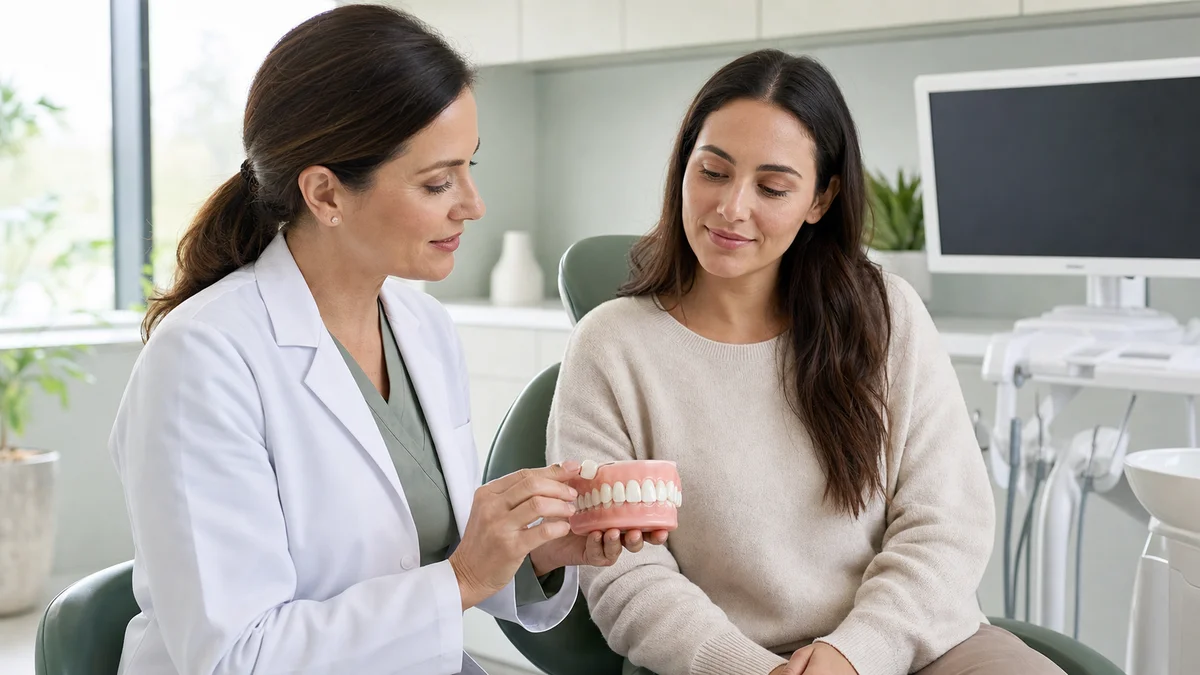
Quick answer: The porcelain veneers success rate is not one universal percentage. A 2021 systematic review estimated 95.5% cumulative survival at 10 years across 6,500 veneers, while a newer material-specific meta-analysis also reported high long-term survival. Survival only means the restoration remained in service under the study definition; chips, staining or repair may still occur. Enamel preservation, case selection, bite control and maintenance strongly influence personal outcomes.
Patients searching for a porcelain veneers success rate often want a simple answer to “How likely are they to last?” Published studies can help frame that decision, but a percentage without its follow-up period, ceramic type, failure definition and patient selection can be misleading. A veneer that remains attached for ten years may count as surviving even if it has needed polishing or a repair. Another study may classify the same event as a complication or loss of success.
The practical question is therefore wider than longevity. Are veneers indicated for the colour, shape or spacing concern? Can the preparation remain predominantly in enamel? Are decay and gum disease controlled? Does the bite expose the ceramic to high forces? Can the patient maintain the margins and accept that the treatment is usually irreversible and may require future replacement? This guide interprets current evidence without promising a personal result, inventing a statistic or replacing examination, photographs, bite analysis and appropriate radiographs.
1. Survival, success and satisfaction measure different outcomes
“Survival” commonly means that a veneer is still present and functioning at a stated time. It may allow repairable chips, minor marginal changes or aesthetic imperfections, depending on the study. “Success” is often stricter and may require no intervention, no unacceptable colour or contour change, no biological problem and no technical complication. “Patient satisfaction” measures perception and may remain high even when a clinician records a minor issue, or fall despite technically acceptable work if expectations were not aligned.
Studies also define failure differently. Some count only complete fracture, debonding that cannot be resolved, replacement or tooth extraction. Others include recurrent decay, a later need for root canal treatment, unacceptable margin changes, gingival problems, discolouration or any repair. This is why two apparently different percentages may not contradict each other: the studies may be counting different endpoints.
Always ask four questions when you see a rate:
- At what time? One-, five-, ten- and twenty-year estimates cannot be compared directly.
- What counted as failure? Replacement is different from a polishable chip.
- Which veneers? Material, tooth location, preparation and bonding substrate matter.
- Which patients and clinicians? Selection, operator experience, grinding and maintenance affect outcomes.
2. What current evidence says about porcelain veneers success rate
A 2021 systematic review of 25 clinical studies included 6,500 porcelain laminate veneers with at least three years of follow-up. Using time-to-event methods and four defined failure reasons, the authors estimated cumulative survival at 95.5% over ten years. Fracture was the most common failure category, followed by debonding. The authors cautioned that included studies varied in design, definitions and follow-up, and that later estimates became less certain as fewer veneers remained under observation.
A systematic review and meta-analysis published in 2025 evaluated different ceramic classes and reported pooled survival around a ten-year observation period of 96.13% for feldspathic ceramic, 93.70% for leucite-reinforced glass ceramic and 96.81% for lithium disilicate. The review found no simple survival difference that should be converted into a universal material ranking, although complication profiles differed. Zirconia veneers had short follow-up and small evidence volume, so their apparently high short-term survival should not be read as equivalent long-term proof.
These results support a reasonable statement: ceramic veneers can show high long-term survival in suitable clinical conditions. They do not support “your veneers have a 95% chance of lasting ten years.” A pooled study estimate combines selected cases, different patients, operators, preparations, materials and care systems. An individual tooth with extensive dentine exposure, active grinding, untreated gum disease or an unfavourable bite may not resemble the average study veneer.
Evidence beyond twenty years is limited and heterogeneous. Long observational periods naturally contain changes in materials, bonding systems, operator techniques and maintenance. It is more honest to use long-term data as a planning range and to discuss the likely replacement cycle than to advertise a fixed lifespan.
3. Evidence-reading table: which number answers your question?
| Published measure | What it can tell you | What it cannot tell you | Decision question |
|---|---|---|---|
| 10-year cumulative survival | How many restorations remained in service over time under stated criteria | Whether every veneer was complication-free or aesthetically unchanged | What exact events counted as failure? |
| Success without intervention | How often no repair or unacceptable event was recorded | Whether all patients were equally satisfied | Did minor polishing, repair or sensitivity count? |
| Material-specific pooled survival | How groups of a ceramic class performed across included studies | Which product or thickness is best for your tooth | Are follow-up and sample sizes comparable? |
| Single-clinic case series | Performance in one team’s protocol and selected population | What will happen in every clinic or broader population | How were patients selected and losses to follow-up handled? |
| Before-and-after gallery | Possible appearance immediately or at a selected review | Failure rate, maintenance burden or unshown outcomes | Are cases consecutive, dated and comparable to mine? |
| Commercial “lifetime” claim | Potential warranty wording if documented | Biological longevity or freedom from replacement | What is covered, excluded and required? |
The safest interpretation uses the study design and endpoint alongside the percentage. Kaplan–Meier or life-table analysis accounts for different observation times and censoring; a simple number of failed veneers divided by all veneers does not. Even time-to-event analysis becomes uncertain when only a small number remain under observation at later years.
4. Case selection can matter more than the advertised ceramic
Veneers are thin restorations bonded mainly to the front and sometimes biting edge of a tooth. They may be considered for selected colour, shape, proportion, surface defect or small spacing concerns. They are not a universal cover for any smile. The ADA advises treating decay and gum disease first because placing veneers on unhealthy teeth can worsen existing problems.
A complete assessment considers:
- the patient’s main concern and whether it is colour, position, shape, wear or a combination;
- tooth vitality, previous trauma, cracks, decay and existing restorations;
- the amount and distribution of enamel available for bonding;
- gum health, recession, tissue thickness, smile line and cleansability;
- tooth position, crowding, protrusion and whether orthodontics would reduce preparation;
- overbite, edge-to-edge contacts, guidance and available ceramic thickness;
- clenching, grinding, nail biting, chewing objects and sports risk;
- colour of the underlying tooth and the opacity needed to mask it;
- expectations about shade, symmetry, texture and natural variation;
- willingness to maintain, repair and eventually replace restorations.
If a tooth is substantially broken down, heavily filled or structurally weak, a veneer may not provide enough coverage. If the issue is mainly alignment, orthodontic treatment may preserve more enamel. If only colour is a concern, professional whitening may be more conservative. Selecting the least invasive treatment that meets the goal is part of improving the chance of long-term success.
5. Bonding to enamel versus dentine changes the prognosis
Enamel provides a predictable surface for adhesive bonding. Dentine has more organic content and fluid, and bonding to it is more technique-sensitive. A 2025 systematic review and meta-analysis of veneers bonded to different substrates concluded that enamel-bonded veneers had higher survival and success with fewer clinical complications than veneers bonded to dentine or teeth with existing composite restorations. The review included only six comparative clinical studies, so its percentages should still be interpreted with study limitations in mind.
This does not mean that any exposure of dentine guarantees failure. It means preservation and mapping of the bonding substrate are clinically relevant. Preparation should be driven by the tooth’s position, planned ceramic thickness, colour change and contour, not by a standard depth applied to every tooth. Mock-ups and guided reduction can help show where space is actually needed.
Existing composite restorations add another interface. Their age, size, bond, margin and replacement plan affect the surface receiving the veneer. Large old restorations can reduce the amount of continuous enamel and may indicate a different restoration. Ask the dentist to explain which parts of each preparation will be enamel, dentine or composite after the tooth is ready.
6. “No-prep” does not automatically mean no risk or reversible care
Some teeth can accept very thin veneers with little or no preparation, especially when adding volume to small or inward-positioned teeth. Other teeth would become bulky, overcontoured or difficult to clean if ceramic were added without making space. A marketing label cannot determine anatomy.
The ADA notes that veneer treatment is generally not reversible because enamel is removed to place a veneer. Even where no drilling is planned, bonding, margin placement, future removal and repeat restorations can create long-term commitment. A no-prep veneer may still change contour and gum access, and removing a strongly bonded restoration without affecting enamel can be difficult.
Conversely, “minimal preparation” should not be assumed to be harmless. Small enamel reduction is still irreversible. The plan should document baseline photographs and scans, proposed reduction, mock-up, margin location and future replacement considerations. If a patient is told the teeth will be untouched and can simply return to their original state, that claim deserves careful clarification.
7. Ceramic material is one variable, not the whole result
Porcelain veneers may be made from feldspathic ceramic, leucite-reinforced glass ceramic, lithium disilicate or other ceramic systems. Material choice affects optical properties, thickness, strength, laboratory workflow, surface treatment and repair strategy. The most translucent material may not mask a dark tooth; a more opaque restoration may need different design to avoid a flat appearance.
The 2025 material-focused meta-analysis found high long-term survival for feldspathic, leucite-reinforced and lithium-disilicate veneers, with material-specific differences in complication patterns. Zirconia data were shorter and more limited. It would be inappropriate to promote a material with a small short-term sample as “100% successful” or to choose solely from a pooled percentage.
The result depends on the full system:
- case selection and preparation remaining predominantly in enamel;
- ceramic type, thickness and design suitable for the optical and mechanical task;
- accurate impression or scan and laboratory fabrication;
- surface conditioning of both ceramic and tooth;
- isolation from saliva, blood and moisture during bonding;
- compatible adhesive and resin cement protocol;
- complete seating, removal of excess cement and margin finishing;
- careful bite adjustment and maintenance.
8. Bite forces, bruxism and habits influence fracture risk
Ceramics resist staining and wear but are brittle. Force direction, unsupported ceramic, tooth flexure and repeated overload can lead to cracks, chipping or complete fracture. The 2021 long-term review identified fracture as the most common absolute failure category and debonding as another frequent event. A separate systematic review found an association between sleep bruxism and anterior ceramic veneer failure, but it also highlighted limited data and high clinical heterogeneity.
Self-reported grinding is only one clue. Tooth wear, muscle symptoms, fractured restorations, partner reports and clinical assessment contribute to risk evaluation; sleep studies are not routine for every veneer patient. A protective occlusal appliance may be recommended in selected cases, but it cannot guarantee that a veneer will not break and is useful only if it is worn and reviewed.
Habits such as biting nails, opening packaging with teeth, chewing ice or pens and contact sports increase local risk. The ADA advises avoiding hard-object habits and using a mouthguard for activities that could injure the mouth. Behavioural advice should be specific, not a way to blame the patient for every technical problem.
9. Gum health, margins and contour affect biological success
A veneer can survive mechanically while the surrounding tissues are unhealthy. Overcontoured restorations, rough or overhanging margins, retained cement and inaccessible contacts can trap plaque and irritate gums. Margins placed very close to or below the gumline can be harder to inspect and maintain. Gum inflammation can also change tissue levels and expose margins over time.
Before treatment, bleeding, plaque, recession and periodontal support should be assessed and stabilised. If gum reshaping is proposed, the team should explain whether it is needed for health, access or aesthetics, how much tissue or bone is involved and how long healing should occur before final margins are recorded. A rushed impression before tissues are stable may compromise contour.
After placement, persistent bleeding, swelling, bad taste, floss shredding or a bulky feeling should be assessed. Good veneers should allow brushing and interdental cleaning. The goal is not only a symmetrical photograph but restorations that can coexist with healthy tissues.
10. Decay, sensitivity and root canal treatment can still occur
Veneers do not make teeth immune to disease. Decay can develop at exposed tooth surfaces or margins, especially with frequent sugar exposure, dry mouth, poor plaque control or leakage. The ADA recommends fluoride toothpaste twice daily and cleaning between teeth. Recall and radiographic selection should be based on individual risk, not a fixed cosmetic schedule.
Temporary sensitivity can occur after preparation and bonding. Persistent spontaneous pain, prolonged temperature pain, pain on biting or swelling requires examination. A tooth may later need root canal treatment because of pre-existing disease, trauma, extensive preparation, recurrent decay or another cause. Published veneer studies sometimes count later endodontic treatment as a failure and sometimes as a biological complication, which again changes the headline rate.
If root canal treatment is needed, access may sometimes be made through the veneer or from another surface, but the restoration can be damaged and may need replacement. This possibility should not be exaggerated, but it belongs in consent, particularly for teeth with large restorations, cracks, previous trauma or uncertain pulp health.
11. The clinical and laboratory process can prevent avoidable problems
Planning often begins with photographs, scans or impressions, bite records and a diagnostic design. A wax-up or digital plan can be transferred to a temporary mock-up so the patient and dentist evaluate length, speech, lip support and overall proportion before irreversible preparation. Digital design is a communication tool, not proof that the final biological result is safe.
During preparation, depth guides can limit unnecessary reduction. The dentist records the prepared teeth and the laboratory fabricates veneers to the agreed material and shade. Temporary veneers, if used, help protect teeth and test contours but may not have the exact colour or surface of the final ceramic.
At the bonding visit, each veneer should be checked for fit, contacts, colour and shape. Isolation matters because contamination can reduce bond quality. After surface treatment and bonding, excess cement is removed and margins are finished. The bite is checked in closing and movements. The patient should receive instructions about eating, sensitivity, cleaning and what to do if a veneer feels high or mobile.
12. Common complications and what “repair” can mean
Debonding: A veneer can detach intact. Rebonding may be possible after the tooth, restoration and cause are assessed. Repeated debonding can indicate insufficient enamel, contamination, bite overload, fit or material issues. Simply reattaching it without analysis may repeat the problem.
Chipping or fracture: A very small defect may be polished or repaired with composite. A large or structurally important fracture usually requires replacement. The underlying tooth should be checked for damage and the bite reviewed.
Marginal staining or roughness: Some changes can be polished; others indicate cement degradation, a gap or decay. Cosmetic stain and biological leakage are not the same diagnosis.
Gum inflammation or recession: Cleaning, residual cement, contour, margin position and periodontal status are reviewed. Treatment can range from hygiene measures and polishing to replacement or periodontal care.
Colour mismatch: Adjacent natural teeth can darken or whiten differently over time. Ceramic does not respond to bleaching like enamel. Whitening is usually planned before final shade selection when indicated, and replacement may be needed for a major mismatch.
Ask how the clinic defines repair versus replacement and which events are included in any written warranty. Commercial coverage can exclude grinding, trauma, missed maintenance, decay, travel and laboratory fees. It is not a biological guarantee.
13. Maintenance protects both the veneer and the tooth
Daily care includes brushing twice with fluoride toothpaste and cleaning between teeth. The patient should be shown which floss or interdental tool passes the contacts without trauma. Abrasive products should not be assumed safe simply because they are marketed for whitening; product selection can be discussed with the dental team.
Clinical reviews assess margins, plaque, gum response, decay risk, contacts, bite and ceramic surfaces. Radiographs are selected according to need and cannot directly show every ceramic problem. Professional polishing should use systems compatible with the ceramic to avoid creating rough surfaces.
A maintenance plan may include:
- an early review after bonding to check bite, sensitivity and tissue response;
- risk-based dental and periodontal examinations;
- professional hygiene and tailored home-care reinforcement;
- monitoring of grinding, wear and the fit of any protective appliance;
- photographs or scans when change needs to be compared over time;
- prompt review of a chip, movement, pain, bleeding or floss-catching margin.
14. Longevity is a replacement cycle, not a one-time purchase
Even a restoration that performs well for many years may eventually need repair or replacement. Removal can result in additional enamel or dentine loss, especially if the boundary between ceramic, cement and tooth is difficult to see. After repeated cycles, the tooth may need a thicker veneer, crown, root canal treatment or another solution depending on remaining structure.
This does not make veneers inherently inappropriate. It makes age, tooth condition and lifetime planning important. A very young adult receiving many veneers on healthy teeth may face more replacement cycles than an older patient treating established defects. The number of teeth should be based on a diagnostic goal, not a standard “smile package.”
Ask the dentist to describe the likely future pathway if one veneer fails, if several need colour matching, or if gums recede. Independent units are often more manageable than splinted cosmetic restorations, but every design has context. The financial plan should include consultation, diagnostics, temporaries, laboratory work, protective appliance, maintenance and possible repairs without offering a fixed universal price.
15. Conservative alternatives may meet the same goal
Veneers are one option among several. Alternatives depend on the diagnosis:
- Professional whitening: may address general colour without removing enamel, but cannot change shape and does not whiten existing restorations.
- Direct composite bonding: can add or reshape tooth-coloured material, often with less preparation and easier repair, but may stain or wear more and needs maintenance.
- Orthodontic treatment: can move crowded, rotated or spaced teeth and may reduce or remove the need for preparation, but requires time and retention.
- Enamel reshaping: may refine small edge or contour differences with very limited irreversible change.
- Crown or partial-coverage restoration: may be more appropriate when a tooth is already heavily restored or structurally weak, though it removes more tissue than a veneer.
- No treatment or monitoring: is valid when the issue is cosmetic and the patient does not accept irreversible care.
A combination can be most conservative: align teeth first, whiten, then use bonding or a small number of veneers for remaining shape differences. The “best” option is not automatically the one with the highest published survival; it is the one that meets the goal with acceptable biological cost and maintenance.
16. Red flags behind an impressive porcelain veneers success rate claim
Be cautious when a percentage is presented without the source, time point or failure definition. A clinic’s own rate may be useful only if it includes consecutive patients, a defined denominator, documented follow-up and an explanation of patients who could not be contacted. Testimonials and selected photographs cannot calculate survival.
Other warning signs include:
- guaranteed lifetime results or “zero failure” language;
- the same number and design of veneers recommended to every patient;
- no assessment of decay, gums, bite, grinding or tooth vitality;
- irreversible preparation begun before a diagnostic mock-up or informed consent;
- “no-prep” presented as always reversible or suitable for any tooth position;
- healthy teeth aggressively reduced to meet a rapid schedule;
- treatment by an unlicensed person or without a dentist’s diagnosis;
- pressure to pay before alternatives, risks and future replacement are explained.
The ADA specifically warns that veneers should be placed by a licensed dentist and that unlicensed services can risk infection, nerve injury and placement over unhealthy teeth. Verify professional registration through the relevant authority in the country where treatment will occur.
17. Questions that turn a percentage into a personal plan
- What diagnosis makes a veneer appropriate for each tooth?
- Could whitening, orthodontics or composite achieve the goal more conservatively?
- How much enamel will remain, and where will dentine or composite be exposed?
- Which ceramic and thickness are proposed, and why?
- How will colour, shape, speech and bite be tested before preparation?
- What is my decay, gum and grinding risk?
- Which complications count in the survival percentage you quoted?
- What follow-up period and patient population produced that number?
- How are chips, debonding, recession or later root canal treatment managed?
- What maintenance and protective appliance are expected?
- What parts of the fee and warranty are definite, conditional or excluded?
- What is the plan when the veneers eventually need replacement?
porcelain veneers success rate: frequently asked questions
What is the average porcelain veneers success rate at 10 years?
A 2021 systematic review estimated 95.5% cumulative survival at ten years across 6,500 veneers under its defined failure criteria. A 2025 material-specific meta-analysis also reported high pooled long-term survival. These are study estimates, not a personal guarantee, and “survival” can include restorations that had minor complications or repairs.
Does survival mean the veneer had no problems?
No. A surviving veneer may have needed polishing, repair or management of a minor issue, depending on the study definition. “Success” is often stricter and may require no intervention or unacceptable biological, technical or aesthetic event. Always check the endpoint.
How long do porcelain veneers last?
There is no fixed lifespan. Many selected veneers remain in service for a decade or longer, while others fail earlier. Material, enamel bonding, preparation, bite, grinding, hygiene, decay risk, technique and maintenance all matter. Evidence beyond twenty years is limited and heterogeneous.
Are porcelain veneers permanent?
They are permanently bonded restorations, but they are not guaranteed to last for life. Treatment is usually irreversible because enamel is removed, and replacement may require further tooth preparation. Patients should plan for future maintenance and replacement cycles.
Do no-prep veneers have a better success rate?
Not automatically. Preserving enamel can support bonding, but adding ceramic without space can create bulky contours or an unfavourable bite. “No-prep” describes an approach, not suitability. Tooth position, colour, planned shape and margin access must be assessed.
Which porcelain material has the highest success rate?
Recent reviews report high survival for several ceramic classes, with differences in complication patterns and evidence volume. A small short-term sample should not outrank robust long-term data. Optical needs, enamel, thickness, preparation, laboratory and bonding protocol all influence the choice.
Can veneers get cavities underneath?
Yes. Natural tooth remains at the margins and behind the veneer. Decay risk continues with plaque, frequent sugar exposure, dry mouth, leakage and inadequate fluoride care. Brushing with fluoride toothpaste, interdental cleaning and risk-based reviews remain essential.
Can a chipped porcelain veneer be repaired?
A small chip may sometimes be polished or repaired with composite. Large fractures, poor fit, repeated damage or an unacceptable aesthetic result can require replacement. The tooth, bite and reason for failure should be assessed before repair.
Does grinding mean I cannot have veneers?
Not necessarily, but bruxism can increase mechanical risk and may change design, material, tooth selection and the need for a protective appliance. A splint cannot guarantee against fracture. Existing wear and previous restoration failures should be part of consent.
When should I get a second opinion?
Consider one when many healthy teeth will be prepared, alternatives were not discussed, a lifetime result is guaranteed, the proposed number of veneers seems standardised, gum disease or grinding was ignored, or “no-prep” was described as risk-free and fully reversible.
Conclusion: use the rate to ask better questions, not predict your tooth
The evidence supports high long-term survival for ceramic veneers in well-selected conditions, but no single porcelain veneers success rate can predict an individual result. Survival is not the same as complication-free success, and both differ from satisfaction. Follow-up length, failure definition, ceramic type, bonding substrate and study design change the number.
Personal prognosis begins with healthy teeth and gums, a conservative indication, predominantly enamel bonding where feasible, realistic aesthetics, controlled bite risk and meticulous technique. It continues with fluoride care, interdental cleaning, risk-based reviews and prompt attention to chips, movement, pain or bleeding. The decision should include the irreversible nature of preparation and future replacement cycles.
Resources on Redent Klinik can help you prepare for an aesthetic dentistry consultation. For individual assessment, use the Redent Klinik contact page to ask which photographs, scans or dental records are useful. Online statistics cannot determine enamel thickness, bite, gum health or whether veneers are appropriate.
Sources
- PubMed: 2025 systematic review and meta-analysis of ceramic veneer survival and complications
- PubMed Central: Full text of the 2025 ceramic veneer meta-analysis
- PubMed: Long-term survival and complication rates of porcelain laminate veneers
- PubMed Central: Full text of the 10-year porcelain veneer systematic review
- PubMed: Ceramic veneers bonded to enamel, dentine and composite substrates
- PubMed: Sleep bruxism and ceramic restoration failure systematic review
- American Dental Association MouthHealthy: Veneers, risks, placement and care
- American Dental Association official website
- World Health Organization: Oral health fact sheet
Sources were checked in July 2026. Research estimates and clinical guidance may change; current evidence and an individual dental examination should guide care.