
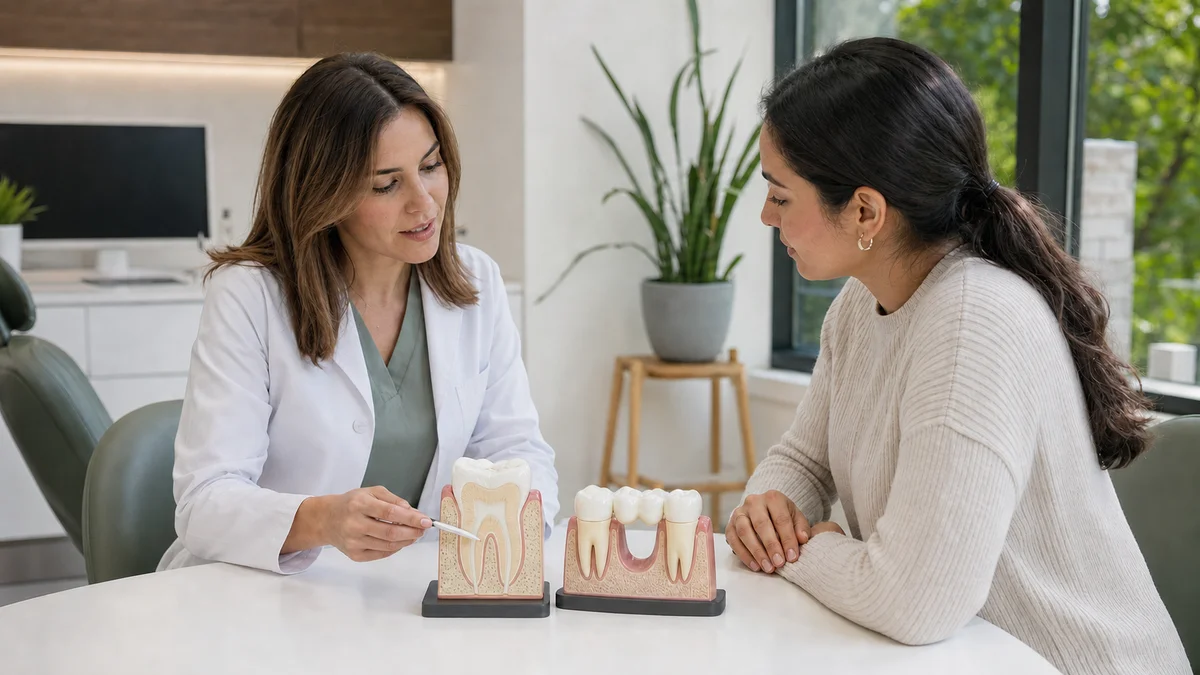
Quick answer: root canal or dental bridge which is better is not a like-for-like choice. Root canal treatment removes infected pulp to preserve a restorable natural tooth; a bridge replaces a tooth that is already missing or must be extracted. Saving the tooth is often considered first when structure, root, gum support and crack pattern are favourable. A bridge becomes relevant when retention is not predictable and its supports are suitable.
People who search root canal or dental bridge which is better are often deciding whether to treat a painful or infected tooth or remove it and fill the space. The wording makes the treatments sound interchangeable, but they solve different clinical problems. Root canal treatment is performed inside an existing tooth. A dental bridge uses an artificial tooth, called a pontic, to replace a missing tooth and is supported by neighbouring teeth or implants.
The real decision is usually “Can this tooth be predictably treated and restored, or is extraction and replacement more appropriate?” That answer depends on much more than infection alone. The dentist must assess the amount of sound tooth remaining, whether a crack extends into an untreatable area, periodontal support, root anatomy, decay below the gumline, previous treatment, bite forces and the condition of the adjacent teeth. This guide explains those trade-offs without diagnosing your tooth, promising how long a restoration will last or substituting for clinical tests and appropriate radiographs.
1. Why root canal and dental bridge are not direct substitutes
Root canal treatment, also called endodontic treatment, is designed to remove inflamed or infected pulp from inside a tooth. The canals are cleaned, shaped, disinfected, filled and sealed. The tooth then needs a durable coronal restoration, which may be a filling, onlay or crown depending on the remaining structure and tooth position. The treatment preserves the tooth root and the patient’s own periodontal ligament in the jaw.
A fixed dental bridge is used after a tooth is absent. In a conventional bridge, one or more neighbouring teeth are prepared for crowns that support the artificial tooth between them. A resin-bonded or adhesive bridge uses one or more wings bonded mainly to enamel and usually requires less tooth reduction. An implant-supported bridge is another category and does not rely on natural tooth abutments, but it involves implant assessment and surgery.
This difference changes the sequence. If the painful tooth is restorable, root canal treatment may allow it to remain and no missing-tooth bridge is needed at that site. If the tooth has a hopeless fracture, inadequate remaining structure or support that cannot be predictably managed, extraction may create a gap. Only then are a bridge, implant, removable denture, orthodontic space closure or accepting the space discussed as replacement options.
2. The first question: is the natural tooth restorable?
An infected pulp does not automatically make a tooth unrestorable. Root canal treatment can address disease inside the tooth, but it cannot correct every structural or periodontal problem around it. A technically excellent root filling will not rescue a tooth split vertically through the root, a tooth with decay extending too far below the gum or one with insufficient supporting bone to function.
Restorability assessment may include:
- how much sound enamel and dentine remains above the gumline;
- whether decay can be removed while leaving a sealable, maintainable margin;
- the location, direction and depth of any crack or fracture;
- root length, shape, resorption, perforation or previous procedural complications;
- periodontal probing, mobility, furcation involvement and bone support;
- whether enough tooth can encircle and support a crown or other restoration;
- the tooth’s position and value in the overall bite;
- opposing forces, clenching, grinding and available restorative space;
- the patient’s ability to clean the tooth and attend follow-up;
- medical factors, symptoms, preferences, time and financial constraints.
The examination can involve cold or electrical pulp tests, percussion, palpation, periodontal probing, bite tests, transillumination and selected dental radiographs. Three-dimensional imaging is not required for every tooth; it may be considered when conventional assessment does not answer a clinically important question. A patient should be told which finding drives the prognosis rather than only hearing “root canal” or “extraction.”
3. What root canal treatment can and cannot do
The NHS describes root canal treatment as removal of infection from inside a tooth, followed by cleaning and filling to reduce reinfection. Local anaesthetic is commonly used, and treatment may require two or more appointments. A temporary filling may be placed between visits. If the tooth has lost substantial structure, a crown or another cuspal-coverage restoration may be recommended after the canals are treated.
Potential advantages:
- preserves a restorable natural tooth and its root in the jaw;
- removes inflamed or infected pulp and can relieve the source of dental pain;
- avoids creating a missing-tooth space and avoids preparing adjacent teeth for a conventional bridge;
- may require less overall biological change than extraction plus replacement;
- allows chewing forces and sensation to continue through the natural tooth-support system;
- can sometimes be retreated or managed with endodontic surgery if disease persists.
Limitations and risks:
- complex, calcified or curved canals may be difficult to clean completely;
- instruments can separate, canals can be missed, or perforation and other complications can occur;
- infection or symptoms can persist or return, requiring reassessment, retreatment, surgery or extraction;
- the tooth may fracture if remaining structure is weak or the final restoration is delayed or inadequate;
- a crown, onlay, core or post may add visits, cost and its own restorative risks;
- root canal treatment cannot make an unrestorable crack, severe support loss or inaccessible decay predictable.
A root-filled tooth is not “dead” in the sense of being detached from the body. The pulp tissue is removed, but the tooth remains supported by living tissues around its root. It still requires brushing, interdental cleaning, decay prevention and regular review. Absence of sensitivity to cold after treatment is expected and does not mean that future disease around the tooth would be painless or impossible.
4. What a dental bridge can and cannot do
A dental bridge replaces one or more missing teeth with artificial teeth connected to retainers. According to the ADA’s MouthHealthy resource, fixed bridges are attached to surrounding teeth for support and can restore chewing, speech and appearance. The success of a tooth-supported bridge depends on a healthy, strong foundation and effective cleaning around the retainers and underneath the pontic.
Potential advantages:
- provides a fixed replacement that the patient does not remove each day;
- can restore the shape of the dental arch, appearance and chewing at a missing-tooth space;
- usually avoids implant surgery and an implant-healing phase;
- may be efficient when neighbouring teeth already need crowns or have suitable large restorations;
- offers conventional, cantilever, resin-bonded and implant-supported designs for different situations;
- can sometimes be completed while an implant is unsuitable because of anatomy, health, growth or preference.
Limitations and risks:
- a conventional bridge requires irreversible reduction of supporting teeth;
- supporting teeth can develop decay, pulp problems, gum disease, fracture or loss of retention;
- failure of one abutment may affect the entire connected restoration;
- the artificial tooth does not replace the missing root, and the ridge can change over time;
- cleaning beneath the pontic requires a threader, interdental brush or another demonstrated method;
- resin-bonded bridges preserve more tooth but may debond and are not appropriate for every bite or space;
- repair or removal can be more complicated than treating a single independent crown.
A bridge is not automatically a poor choice because it uses adjacent teeth, nor is it automatically simpler because it avoids surgery. Its biological cost is lower when an adhesive design is appropriate or when supporting teeth already require full coverage. It is higher when completely healthy neighbouring teeth must be heavily prepared to replace a tooth that could have been predictably retained.
5. root canal or dental bridge which is better: decision table
| Decision factor | Root canal pathway may be favoured when | Extraction and bridge pathway may be favoured when | Question to ask |
|---|---|---|---|
| Remaining tooth structure | Enough sound structure can support a sealed final restoration | Decay or fracture leaves the tooth unrestorable | What sound structure will remain after decay removal? |
| Crack pattern | The crack is limited and can be protected restoratively | A vertical root fracture or split makes retention unpredictable | Where does the crack end, and how was it identified? |
| Gum and bone support | Support is stable or treatable | Severe untreatable support loss compromises function | What are the pocket, mobility and bone findings? |
| Endodontic complexity | Canals are accessible or specialist treatment is reasonable | Complications make prognosis poor after specialist review | Would an endodontist change the prognosis? |
| Adjacent teeth | They are healthy and would otherwise remain untouched | They already need suitable crowns and can support the design | How much healthy tooth must be removed for the bridge? |
| Bite and span | The treated tooth can carry functional load after restoration | The bridge span and supports can tolerate the planned forces | How do grinding and the missing-tooth position affect risk? |
| Hygiene | The patient can maintain the tooth and crown margins | The patient can clean under the pontic and around retainers | Show me the exact daily cleaning technique. |
| Time and stages | Endodontic and final restorative appointments are acceptable | Extraction healing and bridge production fit the plan | What are all stages, including temporary care? |
| Future repair | The tooth can be monitored and retreated independently | Connected restoration risk is acceptable | If one component fails, what must be replaced? |
No single row determines the decision. A tooth may have favourable canal anatomy but inadequate structure, or excellent structure but a root fracture. Likewise, a bridge may look convenient but place an avoidable burden on healthy adjacent teeth. The plan should combine all findings and explain uncertainty.
6. Adjacent teeth often change the bridge calculation
The condition of neighbouring teeth is one of the most important differences between treatment pathways. If both adjacent teeth are intact, unrestored and healthy, preparing them for a conventional bridge removes sound enamel and dentine. This biological cost can make tooth preservation, an adhesive bridge or an implant worth discussing if the other criteria are favourable.
If adjacent teeth already have large fillings, fractures, severe wear or crowns that need replacement, incorporating them into a bridge may restore several problems in one plan. Even then, their roots, pulp status, periodontal support and alignment must be suitable. A heavily restored tooth does not automatically make a good bridge abutment.
Resin-bonded bridges usually need little or no preparation because a wing bonds to enamel, and they are often considered for selected short spaces, particularly in lower-load situations. Their conservative nature is a strength; debonding, metal or ceramic visibility and bite limitations are trade-offs. A debonded bridge should be assessed rather than repeatedly glued without investigating the cause.
7. The final restoration after root canal is part of the treatment
Comparisons often use the fee for root canal treatment alone and the fee for a completed bridge. That is not equivalent. After endodontic treatment, the tooth must be sealed and protected according to its remaining structure and function. Front teeth with conservative access and adequate structure may have different needs from molars that carry heavy forces and have lost cusps.
A core rebuilds missing internal structure. A post may be placed in a canal when needed to retain that core; it does not strengthen the root and should not be used automatically. A crown or onlay may protect vulnerable cusps and provide a durable coronal seal. Delaying the definitive restoration can allow leakage or fracture, so the timing and temporary precautions should be part of the original plan.
Ask whether the quoted root canal pathway includes:
- diagnostic tests and required radiographs;
- emergency opening or drainage if performed separately;
- root canal treatment and any specialist referral;
- temporary restorations between visits;
- core buildup and whether a post is expected;
- the final filling, onlay or crown;
- bite adjustment and protective night guard if indicated;
- clinical and radiographic follow-up;
- the response if symptoms or infection persist.
A low headline price can become misleading when the protective restoration is omitted. Conversely, not every root-treated tooth automatically requires the same crown design. The reason for the selected restoration should be explained in relation to the tooth.
8. Extraction is an irreversible treatment stage, not a neutral shortcut
When a tooth cannot be retained predictably, extraction can remove a source of infection, pain or repeated failure. However, the procedure creates a wound and a missing-tooth space. The gum and ridge change during healing, and the final replacement may need to wait or use a temporary solution. The extraction plan should address the root anatomy, proximity to nerves or sinuses, infection, medical history and whether ridge preservation is relevant to future treatment.
Possible short-term effects include bleeding, swelling, discomfort and temporary dietary limitations. Dry socket, infection, damage to adjacent structures or retained fragments are among the potential complications, depending on the tooth and procedure. Written postoperative instructions and an urgent contact route are part of safe care.
Before extraction, ask:
- which specific finding makes root canal treatment or restoration unpredictable;
- whether specialist endodontic or restorative review could change the prognosis;
- what happens if the space is not replaced;
- whether a temporary tooth is needed during healing;
- when a conventional or adhesive bridge can be planned;
- whether ridge changes could affect appearance or future implant options;
- the complete cost from extraction through final replacement and maintenance.
9. Pain, infection and urgent warning signs
Dental pain does not identify its own source. Deep decay, pulp inflammation, an abscess, a cracked tooth, gum disease, bite trauma and referred pain can overlap. Antibiotics or painkillers may temporarily change symptoms without removing diseased pulp or repairing a crack. A clinical examination is needed before choosing root canal treatment or extraction.
Contact a dentist promptly for persistent spontaneous pain, pain on biting, prolonged temperature sensitivity, swelling, a gum pimple, a broken tooth or a lost temporary restoration. Seek urgent care for rapidly increasing facial or neck swelling, fever with worsening dental infection, difficulty opening the mouth, swallowing or breathing, eye involvement, confusion or significant systemic illness. These signs should not wait for an online comparison or a routine appointment.
Do not place aspirin on the gum, use another person’s antibiotics or assume that pain stopping means an infection has healed. Pulp tissue can lose vitality while disease continues around the root. A clinician may need to establish drainage, perform root canal treatment or extract the tooth depending on restorability and severity.
10. Retreatment, surgery and bridge repair if the first plan fails
Neither pathway comes with a lifetime guarantee. A root-treated tooth can develop persistent or new disease because of untreated anatomy, leakage, fracture or other factors. Depending on the cause and remaining structure, options can include nonsurgical retreatment, endodontic surgery, repair of the coronal restoration, monitoring or extraction. An endodontist can help evaluate complex canals, previous treatment and whether another tooth-saving attempt is reasonable.
A bridge can debond, chip, fracture or develop decay and gum inflammation around an abutment. A simple debond may sometimes be recemented if the bridge and teeth are intact, but repeated loss of retention, hidden decay or fracture can require replacement. Because a conventional bridge connects multiple units, disease in one support can affect the whole prosthesis.
Ask about retrievability before treatment. Can a crown be accessed for retreatment without destroying it? Can the bridge be removed if one abutment develops a pulp problem? Is the material repairable? Who will manage complications if treatment was completed away from home? Honest planning includes a failure pathway without implying that failure is inevitable.
11. Cleaning and maintenance differ between the two choices
A root-treated tooth with a crown is usually brushed and cleaned between like other teeth, with extra attention to the crown margin and gum health. The tooth no longer responds to pulp sensitivity tests in the usual way, so regular examination and selected radiographs can identify changes that the patient may not feel. Decay can still affect exposed root or crown margins.
A fixed bridge requires cleaning around each retainer and beneath the artificial tooth. Standard floss cannot pass vertically through connected units, so a floss threader, super floss, interdental brush or water-flossing device may be demonstrated. The best tool depends on the space, bridge design, gums and dexterity. If plaque remains under the pontic or around the retainers, inflammation, bad taste, decay and support loss can develop.
Maintenance questions include:
- Which surfaces are most vulnerable to plaque and decay?
- Which device fits beneath this exact pontic?
- How often should clinical and radiographic review occur?
- What symptoms suggest leakage, fracture, debonding or recurring infection?
- Does smoking, dry mouth, diabetes or grinding change the recall plan?
12. Cost and time: compare complete pathways
There is no clinically responsible fixed answer to the cost of either pathway without an examination. Root canal complexity varies by tooth, number and shape of canals, previous treatment, specialist involvement and the final restoration. A bridge varies by span, design, materials, supporting teeth, temporary restoration, laboratory work and whether extraction or gum treatment is needed first.
Compare itemised pathways rather than one procedure line:
- Tooth-preservation pathway: diagnosis, endodontic treatment, temporary seal, core or post if needed, final crown/onlay/filling, follow-up and possible protective appliance.
- Bridge pathway: extraction, healing, temporary replacement if needed, preparation of abutment teeth, impressions or scans, provisional bridge, laboratory bridge, fitting, cleaning instruction and follow-up.
- Conditional costs: specialist care, retreatment, surgical extraction, ridge management, gum treatment, repair or remaking.
Time should also be compared honestly. Root canal treatment may take multiple visits plus final restoration. Extraction and bridgework can require healing before the tissue is stable enough for the definitive shape, although timing depends on the site and bridge design. A faster route is not automatically safer or less expensive over the life of adjacent teeth.
13. Alternatives beyond root canal and a conventional bridge
Some teeth with reversible or carefully selected pulp conditions may be candidates for vital pulp therapy rather than complete root canal treatment. This aims to preserve healthy pulp tissue and depends on diagnosis, contamination control, bleeding response, restorative seal and follow-up. It is not an at-home alternative and is not suitable for every infected or mature tooth.
If extraction is required, options can include:
- an adhesive bridge with minimal preparation in suitable bite and enamel conditions;
- a conventional tooth-supported bridge when abutments and span are favourable;
- a single dental implant after medical, anatomical and periodontal assessment;
- a removable partial denture, especially when several teeth are missing;
- orthodontic space closure in selected situations;
- accepting the space when function, stability and appearance allow it.
Implants avoid preparing neighbouring teeth but require surgery, adequate bone and healthy peri-implant maintenance. Removable dentures can replace several teeth with lower biological commitment but are removable and may affect comfort or adaptation. No replacement can be reasonable in selected posterior spaces but should be assessed for bite, drifting and function. The presence of an option does not make it appropriate for every patient.
14. root canal or dental bridge which is better for shared decision-making?
The best plan is the least invasive approach that has a reasonable chance of meeting the patient’s health and functional goals. When a tooth is restorable, saving it often avoids extraction and preparation of neighbouring teeth. When structural, periodontal or fracture findings make retention unpredictable, a well-planned extraction and replacement may be more responsible than repeated procedures with little useful prognosis.
Use these questions at the consultation:
- What is the exact pulpal, root and restorative diagnosis?
- Is the tooth restorable after all decay and weak structure are removed?
- Is there a crack, and where does it extend?
- What are the gum, mobility and bone-support findings?
- Would endodontist or restorative specialist review change the options?
- What final restoration is needed after root canal treatment?
- If the tooth is removed, which bridge design is proposed and why?
- How much healthy adjacent tooth must be prepared?
- What are all stages, conditional costs and maintenance needs?
- What happens if the first treatment does not achieve the goal?
- How will success be checked clinically and radiographically?
A second opinion is especially valuable before extraction when the tooth may be restorable, when a vertical fracture has not been clearly demonstrated, when healthy neighbouring teeth will be prepared, when previous endodontic treatment might be retreated, or when the financial presentation compares incomplete and complete pathways.
root canal or dental bridge which is better: frequently asked questions
Can a dental bridge treat an infected tooth?
No. A bridge replaces a missing tooth; it does not remove infected pulp from the tooth being considered. The infected tooth must first be assessed for root canal treatment or extraction. If it is extracted, a bridge may later replace the resulting gap.
Is saving a natural tooth always better?
Saving a restorable tooth is often considered first, but not every tooth can be retained predictably. A vertical root fracture, severe inaccessible decay, inadequate structure or untreatable support loss may make extraction more appropriate. The key is a documented tooth-specific prognosis.
Does a root canal always need a crown?
Not automatically. The need and design depend on tooth position, remaining walls, lost cusps, cracks and bite forces. Many posterior teeth need cuspal protection, while a conservatively accessed front tooth may have different restorative needs. The final seal and fracture protection are part of planning.
How many appointments does root canal treatment take?
The NHS notes that treatment often takes two or more appointments, though timing varies with the tooth, infection, previous care and clinical protocol. A final restoration can require additional visits. Emergency pain relief is not necessarily the completed treatment.
Does a conventional bridge damage adjacent teeth?
It requires irreversible shaping of supporting teeth, which is a biological trade-off rather than automatic damage. Risks include decay, pulp complications, gum problems and fracture. The trade-off may be more acceptable when those teeth already need crowns; it is greater when they are intact.
Is an adhesive bridge less invasive?
Usually, because it bonds mainly to enamel with minimal preparation. It can be useful for selected short spaces and bite conditions. However, it may debond and is not suitable for every location, span or force pattern. Design and case selection matter.
What if a root canal fails?
The tooth should be reassessed for the cause. Depending on structure and findings, options can include nonsurgical retreatment, endodontic surgery, repair of the restoration, monitoring or extraction. Failure does not automatically mean extraction, but repeated treatment must have a reasonable prognosis.
What if one tooth under a bridge fails?
Because the units are connected, disease in one abutment can affect the entire bridge. Treatment may require access through the bridge, removal, repair or replacement, depending on material and cause. Ask about retrievability before choosing the design.
Which option is cheaper?
Costs cannot be compared responsibly without complete plans. Root canal treatment may also need a core and crown; the bridge pathway may include extraction, temporary replacement, preparation of adjacent teeth and laboratory work. Compare all stages, conditional care and long-term repair rather than headline fees.
When should I request an endodontist opinion?
Consider specialist review for uncertain diagnosis, difficult anatomy, a cracked tooth, previous root canal treatment, persistent disease, procedural complications or before extracting a tooth that might be saved. An endodontist assesses tooth-preserving options but still considers restorability and periodontal support.
Conclusion: decide whether the tooth can be saved before replacing it
The answer to root canal or dental bridge which is better begins with restorability. Root canal treatment treats disease inside a tooth and aims to preserve it; a bridge restores a gap after the tooth is missing. A favourable root canal pathway requires a treatable canal system, sufficient structure, manageable cracks, adequate periodontal support and a protective final restoration. A favourable bridge pathway requires a justified extraction or existing gap, healthy supports, a suitable span and a realistic cleaning plan.
Ask to see the findings that make the tooth predictable or unpredictable. Compare the complete cost and time of endodontic treatment plus restoration with extraction plus temporary and final replacement. Include the biological effect on adjacent teeth, maintenance, possible retreatment and what happens if a component fails. Neither treatment should be sold as permanent or guaranteed.
You can use educational material on Redent Klinik to prepare for a restorative or endodontic consultation. For an individual assessment, the Redent Klinik contact page can help you ask which radiographs and previous treatment records to bring. Online guidance cannot determine cracks, pulp status, support or restorability.
Sources
- NHS: Root canal treatment
- NHS England: Dentistry care pathways guidance, July 2026
- American Association of Endodontists: Saving your natural tooth
- American Association of Endodontists: Treatment options guide
- American Dental Association MouthHealthy: Root canals
- American Dental Association MouthHealthy: Bridges
- Leeds Teaching Hospitals NHS Trust: Dental bridges
- American College of Prosthodontists: Bridges
- American Dental Association official website
- World Health Organization: Oral health fact sheet
Sources were checked in July 2026. Clinical guidance and pages may change; current professional recommendations and an individual examination should guide treatment.