
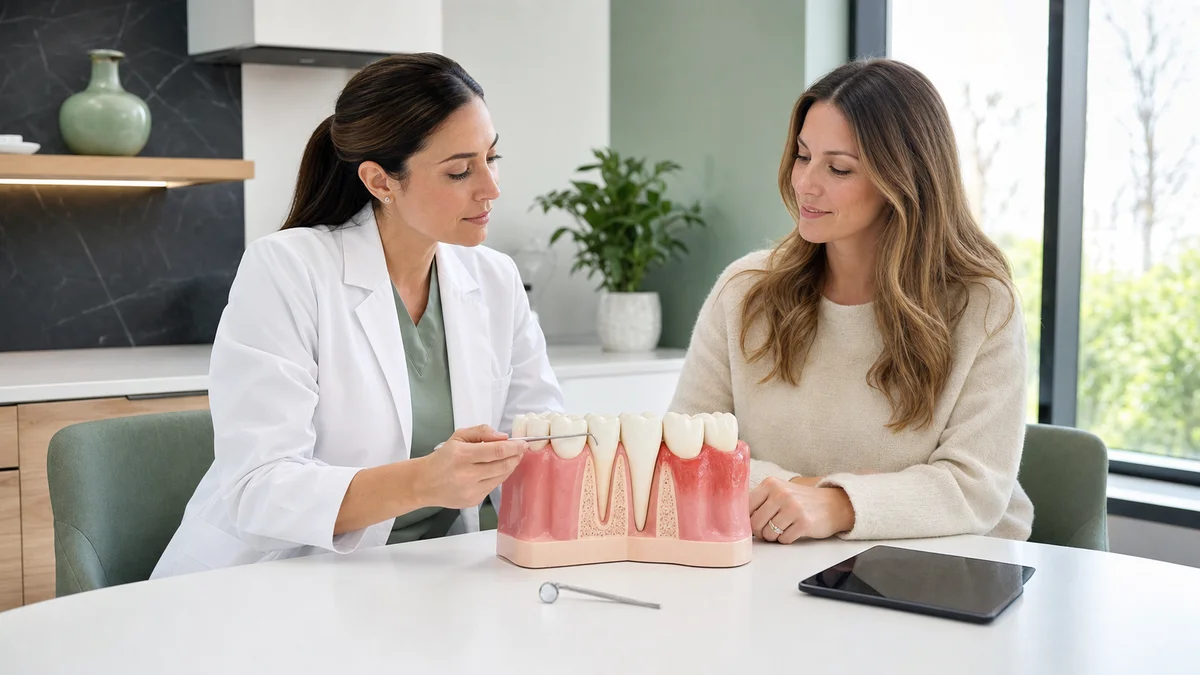
Quick answer: gum disease treatment pros and cons depend on whether the problem is reversible gingivitis or periodontitis with support loss. Home care and professional cleaning are least invasive; deep cleaning can control infection without surgery; surgery may improve access or repair selected defects but adds recovery and cost. Antibiotics are selective adjuncts, not routine substitutes. Every option needs reassessment and ongoing maintenance.
Searching for gum disease treatment pros and cons often means you have been offered a “deep cleaning,” periodontal surgery, medication, or a maintenance programme and want to understand what each step can realistically do. The central point is that gum disease is not one uniform diagnosis. Gingivitis is inflammation limited to the gums and can usually be reversed when plaque is controlled. Periodontitis involves destruction of the tissues and bone that support teeth. Lost support is not simply brushed back into place, but professional treatment can often slow or halt further damage and help patients keep teeth functioning.
A useful comparison therefore begins with the diagnosis, not the name or price of a procedure. The same treatment can be appropriate for one area of the mouth and insufficient or unnecessarily invasive for another. A clinician should record inflammation, pocket depths, recession, mobility, plaque, bleeding, bone levels and risk factors before explaining the plan. Treatment is then delivered in steps, followed by reassessment. This guide describes benefits, limitations and trade-offs without diagnosing an individual, promising a result or replacing an in-person periodontal examination.
1. Start by separating gingivitis from periodontitis
Gingivitis commonly causes red, swollen or bleeding gums without the attachment and bone loss that define periodontitis. Plaque is a bacterial biofilm that can be disrupted by brushing and cleaning between teeth. If it remains, it can mineralise into calculus, which cannot be removed with a toothbrush and requires professional instruments. Gingivitis is generally reversible when the cause is controlled, although bleeding should not be ignored or treated only with cosmetic products.
Periodontitis is a chronic inflammatory condition in which the supporting tissues around teeth have been damaged. Pockets may deepen, gums can recede, teeth may become mobile or shift, and chewing can become uncomfortable. The condition may progress quietly; absence of pain does not prove that the gums and bone are healthy. The CDC notes that periodontitis cannot be reversed in the same way as gingivitis, but it can be slowed and managed with professional treatment and daily care.
This distinction changes the meaning of every advantage and disadvantage. A routine professional cleaning may be enough for gingivitis but not for deep deposits under the gums in periodontitis. Conversely, surgery would be an excessive first response to mild inflammation that has not received effective plaque control. Ask the clinician to state the diagnosis, extent and severity before discussing a procedure.
2. What should a periodontal assessment include?
A periodontal assessment is more than looking for pink or red gums. A dentist, dental hygienist or periodontist may use a small periodontal probe to measure the space around each tooth and record bleeding. They assess plaque and calculus, gum recession, tooth mobility, furcation involvement where roots divide, bite forces, restorations that trap plaque and areas that are difficult to clean. Dental radiographs may be selected to evaluate bone levels and other causes of symptoms.
Medical history matters because smoking, diabetes, certain medicines, hormonal changes and other systemic factors can influence disease or healing. The clinician should ask about previous periodontal treatment, family history, daily oral care and the pattern of dental attendance. A complete medication list is important; patients should not stop prescribed medicines on their own before dental treatment.
A sound baseline gives treatment a measurable goal. Depending on the case, the plan may aim to reduce bleeding, improve plaque control, reduce pocket depth, make root surfaces more maintainable, stabilise mobile teeth, manage discomfort and preserve function. Some deep pockets may close with non-surgical care, while others remain and need further discussion. A promise that every pocket will reach the same number or that lost bone will always regrow is not realistic.
Before agreeing to treatment, ask for:
- the diagnosis in plain language, including whether gingivitis or periodontitis is present;
- which teeth and surfaces are affected, rather than only a whole-mouth label;
- the main examination and radiographic findings supporting that diagnosis;
- risk factors that can be changed and those that cannot;
- the goal of each proposed step and how success will be measured;
- reasonable alternatives, including the consequence of monitoring or delaying treatment;
- the reassessment date and possible next step if inflammation remains.
3. Gum disease treatment pros and cons at a glance
| Option | Main potential benefit | Main limitation or burden | When it may enter the plan |
|---|---|---|---|
| Personalised home care | Controls daily plaque with no surgical recovery | Requires consistent technique; cannot remove calculus | Every stage, before and after professional treatment |
| Professional preventive cleaning | Removes accessible deposits and supports gingivitis control | May not treat deep root surfaces in periodontitis | Gingivitis, prevention and supportive care |
| Scaling and root planing | Non-surgical removal of deposits below the gumline | Temporary sensitivity or soreness; deep/complex sites may persist | Common initial treatment for periodontitis |
| Local antimicrobial adjunct | Delivers medication to a selected pocket | Not a substitute for mechanical cleaning; evidence and cost vary | Selected persistent sites after diagnosis |
| Systemic antibiotics | May help selected active or specific infections | Adverse effects and antibiotic resistance; not routine for all cases | Specific indications alongside local treatment |
| Periodontal access surgery | Improves visibility and cleaning of deep, complex areas | More recovery, cost and possible recession/sensitivity | Residual disease after non-surgical treatment and reassessment |
| Regenerative procedure | May rebuild support in carefully selected defect shapes | Not suitable or predictable for every defect | Selected intrabony or furcation defects |
| Recession/root coverage procedure | May protect an exposed root or improve tissue form | Donor-site discomfort or incomplete coverage | Selected recession after inflammation is controlled |
| Supportive periodontal therapy | Detects recurrence early and maintains treatment gains | Ongoing appointments and lifelong daily effort | After active treatment, at risk-based intervals |
The table is a conversation tool, not a prescription. Several options can be used in sequence, and different sites in the same mouth may need different care. Extraction and tooth replacement can also become part of a plan when a tooth cannot be predictably maintained, but removal should follow a tooth-specific prognosis and discussion of alternatives rather than a blanket assumption that implants are immune to gum-like disease.
4. Home care and professional cleaning: benefits and limits
The first treatment phase usually focuses on disrupting plaque every day and removing professional deposits from accessible surfaces. The clinician may demonstrate a powered or manual toothbrush technique, interdental brushes, floss or another device chosen for the spaces and the patient’s dexterity. Fluoride toothpaste helps protect teeth from decay; a separate rinse may be advised for a specific reason, but mouthwash does not mechanically remove attached plaque or calculus.
Advantages: This phase is conservative, improves the conditions for any later procedure and gives the patient direct control over a major disease trigger. Better home care can reduce inflammation and bleeding, makes professional treatment more effective and helps show which areas remain diseased despite good plaque control. It is essential whether treatment is non-surgical or surgical.
Limitations: A toothbrush and interdental cleaner cannot remove hardened calculus. Generic advice such as “brush better” is inadequate if the patient has not been shown which areas are being missed and what tool fits each space. Physical disability, crowded teeth, poorly contoured restorations, dry mouth or limited access can make daily cleaning more difficult and may require adaptation.
A standard preventive cleaning is not interchangeable with scaling and root planing. It may remove deposits above and around the gumline and support gingivitis control, but deeper periodontal pockets can require instrumentation of root surfaces below the gums. Ask which procedure is being recommended and what clinical finding separates it from routine cleaning.
5. Scaling and root planing: the usual non-surgical starting point
Scaling and root planing, sometimes called deep cleaning or subgingival instrumentation, removes plaque, calculus and contaminated deposits from tooth and root surfaces beneath the gumline. It may be completed by area over more than one visit and can involve local anaesthetic. The goal is not to scrape away healthy root unnecessarily; it is to create a cleaner, biologically compatible surface and allow inflammation to settle.
Potential advantages: It treats the cause at affected root surfaces without a surgical incision. The ADA’s evidence-based guideline found a moderate benefit for scaling and root planing as initial non-surgical care for chronic periodontitis, with benefits judged to outweigh potential harms. Many patients show less bleeding and shallower pockets after healing, and some do not require surgical treatment. It also provides information about tissue response before a more invasive decision is made.
Potential disadvantages and limitations: Treatment can cause temporary tenderness, bleeding or root sensitivity. As swelling reduces, pre-existing recession or spaces between teeth can become more visible; this often reflects the reduction of inflamed tissue rather than treatment “damaging” the gum. Very deep pockets, root grooves, furcations and complex defects can be difficult to instrument completely without direct access. One session cannot compensate for continued plaque accumulation or smoking.
Reassessment is essential. Several weeks after treatment, the clinician records plaque, bleeding and residual pockets again. Improvement supports a maintenance plan; persistent deep or bleeding sites may need repeated local care, specialist assessment or surgery. Moving directly from deep cleaning to a permanent conclusion without recording healing misses a key decision point.
6. Antibiotics and antiseptics: selective adjuncts, not replacements
Antiseptic rinses, locally delivered antimicrobials and systemic antibiotics are different interventions. A rinse may be prescribed for a limited period to support plaque control when mechanical cleaning is temporarily difficult. A local product can place medication in a selected pocket. A systemic antibiotic circulates throughout the body and may be considered for particular disease patterns, acute spread or other defined clinical indications.
Potential advantage: In selected cases, an antimicrobial adjunct can help manage active or persistent infection alongside professional cleaning and daily plaque control. Local delivery can focus treatment on a specific site, while systemic therapy may be appropriate when the condition is not confined to a surface that instruments can reach.
Potential disadvantages: Medication does not remove calculus, correct an inaccessible restoration or teach effective home care. Systemic antibiotics can cause gastrointestinal symptoms, allergic reactions, interactions and other adverse effects. Unnecessary use contributes to antibiotic resistance. The ADA’s antibiotic stewardship guidance emphasises using the right antibiotic only when needed, at the right dose and duration. “Just in case” prescribing is not a harmless shortcut.
Ask what exact diagnosis supports the prescription, what mechanical treatment accompanies it, what side effects and interactions are relevant, and what improvement will be checked. Do not use leftover antibiotics, share a prescription or stop a course differently from the prescriber’s instructions. Severe swelling, fever, spreading infection, swallowing difficulty or breathing difficulty requires urgent professional assessment rather than self-treatment with an old prescription.
7. Periodontal surgery: access, pocket reduction and regeneration
Surgery is generally considered after initial therapy and reassessment when sites remain too deep, inflamed or anatomically complex to maintain predictably. It is not one procedure. Access surgery lifts the gum carefully so the clinician can see and clean root surfaces and bone defects. Pocket-reduction or resective approaches reshape tissue or bone in selected situations to improve maintainability. Regenerative procedures may use membranes, graft materials or biologic agents in defect shapes where rebuilding support is considered possible.
Potential advantages: Direct access can improve cleaning of deep deposits and complex root anatomy. Reducing residual pockets may make professional and home maintenance more effective. In carefully selected defects, regenerative treatment may improve attachment or bone support beyond cleaning alone. Surgery can also create a more maintainable architecture when non-surgical treatment has reached its limit.
Potential disadvantages and burdens: Surgery adds anaesthesia, postoperative instructions, time, expense and a healing period. Swelling, discomfort, bleeding, bruising, root sensitivity and more visible recession can occur. Teeth may look longer or spaces may become more noticeable after inflammation and pocket depth reduce. Regeneration is not equally predictable in all defect shapes and is affected by plaque control, smoking, diabetes and adherence to follow-up.
The decision should be site-specific. Ask which pockets remain, whether they still bleed, what the radiograph and anatomy show, why another non-surgical approach is unlikely to be enough, and whether the aim is access, pocket reduction or regeneration. A named biomaterial or laser does not replace this explanation.
8. Lasers and other adjunctive technologies: where uncertainty matters
Lasers may be marketed as painless, bloodless or able to eliminate the need for conventional treatment. The American Academy of Periodontology notes that controlled studies have found similar results for laser treatment compared with certain other non-surgical options, including scaling and root planing alone. The ADA guideline also describes uncertainty or low-certainty evidence for several adjunctive approaches. This does not mean all laser use is ineffective; it means the specific device, protocol, comparator and clinical goal must be examined rather than assuming that “laser” is automatically superior.
Possible advantages: Certain devices may assist tissue management, debridement or patient comfort in selected hands and indications. A clinician familiar with the technology can explain how it fits into conventional plaque control and root-surface treatment.
Limitations: Device fees can raise cost, protocols vary and a technology label can obscure the core work of diagnosis, mechanical deposit removal, risk control and maintenance. Patients should be cautious of claims that one device permanently cures periodontitis or regrows all lost bone. Ask for the treatment goal, evidence for that exact use, alternatives without the device and how results will be measured.
9. Recession treatment and soft-tissue grafting
Gum recession exposes part of a root and can be associated with sensitivity, a higher risk of root decay, difficult cleaning or aesthetic concern. Recession is not always a sign of active periodontitis; brushing trauma, tooth position, thin tissue and previous inflammation can contribute. Active inflammation and plaque control should be addressed before cosmetic or protective grafting is considered.
Soft-tissue grafting or other root-coverage procedures may increase tissue thickness, reduce sensitivity, protect a vulnerable site or improve appearance. Tissue can be taken from another area of the mouth or, in selected protocols, an alternative material may be used. The exact procedure depends on recession shape, interdental support and local anatomy.
Potential advantages: Selected sites can gain tissue volume, protection and partial or complete root coverage. A thicker tissue zone may be easier to maintain and more resistant to further trauma.
Potential disadvantages: A donor site can add discomfort, and complete coverage cannot be guaranteed. Colour or contour may differ during healing, sensitivity may not disappear entirely, and recurrence is possible if the original cause continues. The benefit should be weighed against monitoring, desensitising strategies and changes in brushing technique.
10. Tooth extraction: when keeping a tooth may no longer be predictable
Periodontal treatment aims to preserve natural teeth when they can be maintained with acceptable health and function. However, a tooth with extreme support loss, uncontrolled infection, severe mobility, an untreatable fracture or a combined problem may have a poor prognosis. Extraction can remove a source of infection or discomfort and simplify a broader rehabilitation plan, but it is irreversible.
Potential advantage: Removing a hopeless tooth may allow diseased tissue to heal and prevent repeated treatment that has little chance of providing useful function. It can be coordinated with a removable denture, bridge or implant plan when appropriate.
Disadvantages: Tooth loss changes function and can require replacement, additional surgery, cost and maintenance. Implants can develop peri-implant inflammation and are not immune to plaque-related disease. A decision to remove multiple teeth should include a tooth-by-tooth prognosis, the alternatives, the expected consequence of retention, and the full replacement pathway rather than only the extraction fee.
11. Maintenance is treatment, not an optional cleaning package
After active periodontal care, supportive periodontal therapy is used to maintain the gains and identify recurrence early. The visit is risk-based, not merely a cosmetic polish. The team reviews medical and smoking status, measures selected or full periodontal sites as indicated, checks plaque and bleeding, removes deposits, reinforces home care and evaluates teeth, implants and restorations.
The EFP explains that long-term success depends on daily oral hygiene and regular professional care. Follow-up intervals are commonly personalised according to disease severity, residual pockets, smoking, diabetes, plaque control and previous progression. A fixed interval advertised to everyone may not match an individual’s risk.
Advantages: Maintenance can detect renewed inflammation before obvious pain or mobility, supports home-care technique and protects the investment in active treatment. It provides a repeated record of stability or change.
Disadvantages or burdens: It requires lifelong attendance, time and cost. Some patients interpret the end of surgery or deep cleaning as a cure and stop attending, which removes an important protective layer. A maintenance plan should state the suggested interval, what will be assessed, expected fees and when specialist review would be triggered.
12. Smoking, diabetes and other risk factors can change the balance
Smoking is a major modifiable risk factor for periodontal disease and can make treatment less successful. It can also suppress visible bleeding, so gums may look quieter while disease remains active. Smoking cessation support is therefore part of periodontal treatment, not a moral judgement or an unrelated lifestyle lecture. The benefit extends beyond the mouth.
Diabetes and periodontal health can influence each other. Poor glucose control is associated with more frequent or severe gum problems and can impair healing. Patients should tell the dental team about diabetes, medications and recent control information; the dentist may coordinate with the medical clinician when appropriate. Periodontal treatment does not replace diabetes care, and no dental procedure should be promised to control blood glucose by itself.
Stress, dry mouth, medicines with oral side effects, limited dexterity, nutrition and grinding can also affect symptoms, cleaning or treatment planning. These factors do not mean that care will fail, but they may change timing, maintenance intensity, the suitability of surgery or the need for additional support.
13. Recovery, discomfort and visible changes after treatment
After non-surgical treatment, temporary tenderness, bleeding and sensitivity to cold can occur. As inflamed gums shrink, roots or spaces between teeth may become more visible. This can concern patients who expected the gums to “grow back,” but reduced swelling can be part of healing. The clinician should distinguish expected short-term effects from signs that require review.
After surgery, the instructions may include protecting the site, adjusting brushing temporarily, using a prescribed rinse, taking medicines exactly as directed and returning for suture removal or review. Recovery varies with procedure and health. Patients should receive written information on eating, cleaning, work, exercise, smoking and whom to contact outside normal hours.
Contact the treating team if pain or swelling is increasing rather than settling, bleeding cannot be controlled, a dressing or suture creates concern, a medicine causes a reaction or the bite feels suddenly different. Seek urgent care for rapidly spreading swelling, fever with worsening oral infection, difficulty swallowing or breathing, or other severe symptoms. Online recovery timelines cannot safely replace an examination.
14. Gum disease treatment pros and cons for a shared decision
A high-quality consent discussion explains not just what a treatment does, but what it cannot promise. It includes the alternative of delaying or declining treatment and the likely consequences of each choice. Costs should be itemised by phase: assessment, non-surgical treatment, reassessment, possible surgery and maintenance. A low initial fee can be misleading if reassessment or long-term care is excluded.
Use this checklist during the consultation:
- What is my diagnosis, stage or severity, and which sites are active?
- What evidence shows attachment or bone loss rather than gingivitis alone?
- What is the goal of this exact procedure for this exact area?
- What are the likely benefits, common short-term effects and important risks?
- What happens if I start with the least invasive option?
- How and when will healing be reassessed?
- What finding would make surgery, medication or specialist referral appropriate?
- Which parts of the cost are definite, conditional or excluded?
- What daily care and risk-factor changes are required from me?
- What maintenance interval is suggested and why?
Second opinions are particularly useful when the diagnosis is unclear, many teeth are proposed for extraction, surgery is recommended without documented reassessment, antibiotics are offered as the only treatment, or a branded device is described as a guaranteed cure. A second opinion should review the original records where possible and still include an independent examination.
15. Common treatment myths that can distort the decision
“Bleeding means I should stop cleaning.” Bleeding commonly reflects inflammation, although technique and other conditions matter. Avoiding the area allows plaque to remain. Ask for gentle, specific instruction and an examination rather than scrubbing harder or abandoning interdental cleaning.
“A mouthwash cures gum disease.” A rinse may be useful for a defined period or indication, but it does not remove calculus or replace mechanical plaque disruption and professional treatment. Long-term use of some products can have side effects and should be discussed with a clinician.
“Deep cleaning always damages gums.” Root sensitivity, recession and visible spaces can appear after inflamed tissue shrinks. That does not mean every outcome is desirable or that technique is irrelevant, but the expected tissue change should be separated from unsupported claims of universal harm.
“Surgery is a failure of cleaning.” Initial therapy and reassessment are used to identify areas that remain inaccessible or active. Surgery can be a planned second step for particular anatomy, not evidence that the first phase was pointless.
“Extraction and implants permanently solve gum disease.” Implants require plaque control and professional monitoring and can develop peri-implant disease. Removing maintainable teeth without a clear prognosis can replace one lifelong maintenance need with another.
Gum disease treatment pros and cons: frequently asked questions
Can gum disease be completely cured?
Gingivitis is generally reversible when plaque and calculus are controlled. Periodontitis involves support loss that is not simply reversed, but its progression can often be slowed or halted with professional treatment, risk-factor control, effective home care and ongoing maintenance. Stability rather than a one-time “cure” is the realistic long-term goal.
Is deep cleaning painful?
Local anaesthetic can be used to improve comfort during scaling and root planing. Temporary soreness, bleeding or sensitivity may follow. Experience varies by inflammation, pocket depth, area treated and individual sensitivity. Ask what pain control is planned and which symptoms should prompt a call.
How soon should gums be reassessed after treatment?
The timing depends on the treatment and healing, but reassessment is commonly planned after several weeks rather than immediately. The clinician should repeat relevant plaque, bleeding and pocket measurements before deciding that maintenance, further non-surgical care or surgery is appropriate.
Are antibiotics necessary for every gum infection?
No. Antibiotics are selective adjuncts for defined indications, not routine substitutes for plaque control and removal of deposits. Unnecessary use can cause adverse effects and contributes to resistance. The prescriber should explain the diagnosis, benefit, risks, dose, duration and accompanying local treatment.
Is laser gum treatment better than scaling and root planing?
Not automatically. Professional sources report similar results for some laser protocols compared with established non-surgical care, while evidence for several adjunctive uses remains uncertain. Ask about the exact device, indication, evidence, added cost and how the result will be measured.
Will receding gums grow back after deep cleaning?
Deep cleaning controls deposits and inflammation; it does not promise that lost tissue will regrow. Swollen gums may shrink during healing, making recession more visible. Selected recession sites may be candidates for grafting, but complete root coverage is not guaranteed and requires a separate assessment.
When is periodontal surgery worth considering?
Surgery may be considered when deep, bleeding or anatomically complex sites remain after effective home care, non-surgical treatment and reassessment. The clinician should identify the exact site, purpose, expected benefit, alternatives, recovery and factors that affect predictability.
Can a loose tooth become firm again?
Mobility can improve when inflammation and traumatic bite forces are controlled, but the outcome depends on remaining support and other causes. Severe support loss may not be reversible. A tooth-specific prognosis is needed before promising stabilisation or recommending extraction.
How often is periodontal maintenance needed?
The interval is based on individual risk, disease severity, residual pockets, smoking, diabetes, plaque control and previous progression. Many programmes use more frequent visits than routine preventive care, but there is no single interval for everyone. The reason for the schedule should be documented and reviewed.
When should I ask for a periodontist referral?
Referral can be helpful for advanced or rapidly progressing disease, complex defects, persistent pockets, significant mobility, regenerative or mucogingival procedures, uncertain prognosis or when initial treatment has not produced the expected response. Patients can also request a specialist opinion before irreversible treatment.
Conclusion: compare the sequence, not just the procedure name
The most useful way to evaluate gum disease treatment pros and cons is to compare a complete sequence: diagnosis, personal risk control, daily plaque management, professional treatment, measured reassessment and supportive care. Home care is essential but cannot remove calculus. Scaling and root planing offers a non-surgical first approach but may not resolve every deep or complex site. Surgery can improve access or support selected regenerative goals but carries more recovery and uncertainty. Medication and technology are adjuncts with specific indications, not universal shortcuts.
Ask for site-specific findings and realistic goals before accepting irreversible treatment. Make sure the plan explains common side effects, important risks, alternatives, cost by phase and what will happen if the first step does not achieve the target. Long-term stability depends on shared work between the patient and clinical team; no procedure can replace daily care and risk-based maintenance.
Educational resources from Redent Klinik can help you prepare questions about periodontal and restorative care. For an individual assessment, use the Redent Klinik contact page to ask which records may be needed. Online information cannot determine your diagnosis or replace examination, periodontal measurements and appropriate radiographs.
Sources
- National Institute of Dental and Craniofacial Research: Periodontal (Gum) Disease
- U.S. Centers for Disease Control and Prevention: About Periodontal Disease
- NHS: Gum disease symptoms and treatment
- European Federation of Periodontology: Gum disease treatment
- American Academy of Periodontology: Non-surgical treatments
- American Dental Association: Nonsurgical treatment of periodontitis guideline
- American Dental Association: Antibiotic stewardship
- American Dental Association official website
- World Health Organization: Oral health fact sheet
Sources were checked in July 2026. Clinical recommendations and web pages can change; current professional guidance and an individual examination should guide care.