
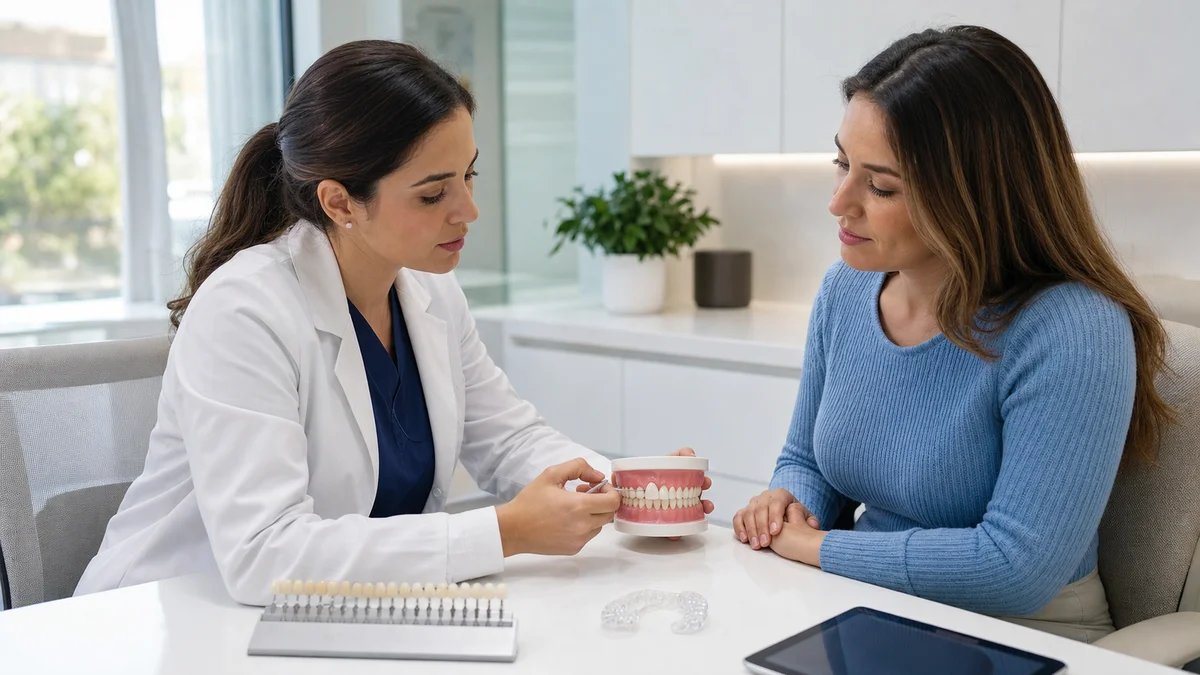
teeth whitening vs veneers: the quick answer
Quick answer: teeth whitening vs veneers compares two different cosmetic paths. Whitening changes the shade of suitable natural teeth without covering them. Veneers are bonded facings that can change color, shape and proportion, usually with some irreversible tooth preparation. Healthy teeth and gums, the cause of discoloration, existing restorations, bite and long-term maintenance should guide the decision.
When patients compare teeth whitening vs veneers, the most conservative appropriate treatment should be considered first. Whitening may be enough when the main concern is the color of healthy natural teeth. Veneers may be discussed when selected teeth also need a planned change in shape, proportion, surface or resistant discoloration. They are not interchangeable products, and neither should be chosen from photographs alone.
A dental examination comes before an elective cosmetic plan. Decay, cracks, leaking fillings, gum inflammation, recession, tooth wear, previous trauma and bite problems can affect both safety and appearance. A single dark tooth may need a vitality or root assessment rather than general bleaching. A chipped tooth may need simple bonding rather than a veneer. A patient with several crowns or fillings may need a coordinated shade plan because those materials do not whiten like natural enamel.
The most important differences are biological cost and scope. Whitening is generally the less invasive option because it aims to lighten tooth structure. Veneers place a new material over the visible surface and often require enamel removal. That additional capability can be useful in selected cases, but it introduces an irreversible restorative cycle, laboratory or chairside work, and future repair or replacement needs.
Decision 1: define the problem before choosing a procedure
“I want a brighter smile” can describe several different concerns. Teeth may have surface stains from tobacco, coffee, tea or other pigmented foods and drinks. Their internal color may change with age, development, medication exposure, trauma or changes inside a tooth. Existing fillings, crowns and veneers can create mismatched shades. Shape, spacing, wear and position can also make a smile look darker even when color is not the only issue.
Professional cleaning can reduce some external deposits, but cleaning and bleaching are different treatments. Whitening uses peroxide-based agents to change tooth color. It cannot rebuild a chipped edge, close every gap, lengthen a worn tooth or correct root position. Veneers can alter the visible color and contour of selected surfaces, but they do not treat decay, gum disease or an unstable bite.
Questions that clarify the real goal
- Is the concern general tooth color or one isolated dark tooth?
- Are the teeth healthy but stained, or are they chipped, worn or misshapen?
- Are visible crowns, fillings, bridges or implants part of the smile?
- Is crowding or spacing contributing to the appearance?
- Would cleaning, whitening or bonding meet the goal with less intervention?
- Is the desired shade realistic for the patient’s natural features?
A useful consultation turns a broad wish into specific findings. It should also separate a health need from an optional aesthetic preference. That distinction helps the patient compare risks, costs and maintenance without feeling pushed toward the most extensive option.
Decision 2: understand what whitening can and cannot change
The American Dental Association explains that whitening agents commonly use hydrogen peroxide or carbamide peroxide. The chemistry breaks colored compounds into smaller forms so the overall color appears lighter. Delivery can involve professionally applied in-office gel, a dentist-supplied custom tray used at home, or an over-the-counter product suitable for that patient.
Whitening response varies. Yellow-toned natural teeth may respond differently from brown, gray, developmentally altered or traumatized teeth. The ADA also notes that whitening does not change the color of tooth-colored restorations. Crowns, veneers and fillings may therefore look darker after the surrounding natural teeth become lighter.
Whitening is not permanent. Diet, smoking, oral hygiene, aging and the original cause of discoloration influence how the shade changes over time. Touch-up treatment may be possible, but it should follow the prescribed method rather than repeated unsupervised exposure. A promise of a guaranteed shade or permanent result is not credible.
Whitening may be considered when
- Natural teeth are healthy and the main concern is their shade.
- Decay, cracks, gum disease and significant sensitivity have been assessed.
- The likely response of the discoloration has been discussed.
- Visible restorations and the possibility of shade mismatch are documented.
- The patient accepts natural variation, temporary sensitivity and future maintenance.
The NHS advises that a dentist should check the teeth and gums before whitening. This assessment matters even when a product is marketed as mild, natural or “peroxide free.” Acidic household ingredients, abrasive powders and unregulated kits can damage surfaces or irritate tissues without delivering a controlled result.
Decision 3: understand what a veneer changes
A veneer is a thin facing bonded to the visible surface of a tooth. It may be made from porcelain or a tooth-colored resin system, depending on the technique and clinical plan. A veneer can mask selected discoloration and alter contour, length, width, surface texture or the appearance of a small gap. It covers a surface; it does not make the underlying tooth immune to decay, fracture or gum disease.
The NHS describes veneers as new facings used to disguise a discolored or chipped tooth and notes that the front of the tooth is drilled away a little for some veneers, while not every design requires the same preparation. The ADA’s patient information similarly describes veneers as thin shells and explains that enamel removal is generally needed to accommodate them.
Terms such as “no-prep,” “minimal-prep” and “prepless” are not guarantees of zero biological change or universal suitability. A veneer added without enough space can look bulky, affect the gum contour or alter the bite. Some teeth can accept very conservative additions; others need reduction to create a natural contour. The actual preparation should be shown and consented to before treatment.
Because enamel does not grow back, most veneer pathways should be treated as irreversible even if the restoration is thin. A veneer can chip, debond, stain at margins or eventually need replacement. Replacing it may require further tooth preparation. This does not make veneers inappropriate, but it makes the decision different from a temporary color treatment.
Decision 4: compare teeth whitening vs veneers side by side
This table summarizes their usual roles. It is a planning aid, not a diagnosis. Individual teeth within the same smile may need different solutions.
| Decision point | Teeth whitening | Veneers |
|---|---|---|
| Main purpose | Lighten suitable natural tooth structure | Cover a visible surface to change selected color, shape or proportion |
| Tooth preparation | Usually no drilling of healthy enamel | Often some irreversible enamel preparation; amount varies |
| Effect on restorations | Does not predictably whiten crowns, veneers or fillings | Creates a new restoration with a selected shade |
| Shape or spacing change | Does not change shape, root position or true spacing | Can alter visible contour or mask small selected spaces |
| Common limitations | Variable response, temporary sensitivity, relapse of color | Biological cost, fracture or debonding risk, future replacement |
| Maintenance | Hygiene, stain control and professionally guided touch-ups | Hygiene, margin review, bite protection when indicated, repair or replacement |
| Typical cost structure | Assessment, whitening method, trays or visits, possible touch-ups | Planning, preparation, provisional stage, laboratory or chairside work, reviews |
If color is the only concern and whitening is clinically suitable, veneers may remove healthy tissue without adding a necessary benefit. If a tooth has a shape defect, a substantial restoration mismatch or discoloration unlikely to bleach satisfactorily, whitening alone may not meet the goal. A dentist should explain how each finding connects to the recommendation.
Decision 5: protect healthy tooth structure
Minimally invasive dentistry is not simply choosing the treatment with the shortest appointment. It means preserving sound tissue while achieving a realistic health and appearance goal. Whitening often sits earlier on that ladder because it can change color without covering the tooth. Direct composite bonding may sit between whitening and porcelain veneers for selected edge, shape or space corrections.
Veneer preparation should be driven by the desired final contour, existing tooth position, material thickness, color masking need and bite. A tooth that already projects forward may require more reduction than a tooth that sits inside the planned contour. Very dark color may need more masking space. Teeth with large fillings, cracks or reduced structure may need a different restorative design entirely.
Ask to see the intended change through photographs, a diagnostic design, mock-up or provisional stage when appropriate. These tools can improve communication, but they are not a guarantee that the mouth will reproduce a digital simulation exactly. Gum shape, lip movement, material behavior and biology still influence the result.
Conservative questions before veneer preparation
- Could professional cleaning or whitening address the concern first?
- Would direct bonding correct the selected area with less tissue removal?
- Is orthodontic treatment more appropriate for a position or bite problem?
- How much enamel is expected to be removed from each tooth?
- What happens if I choose no cosmetic treatment now?
- How would a repair or future replacement affect the tooth?
Decision 6: review whitening risks and limitations
The most commonly reported whitening effects are temporary tooth sensitivity and gum irritation. Sensitivity can be influenced by peroxide concentration, contact time, existing restorations and individual response. The dentist may modify the schedule, exposure or product and may suggest an evidence-based desensitizing approach. Significant or persistent symptoms require review rather than stronger or more frequent applications.
Whitening gel that escapes an ill-fitting tray can irritate soft tissues. In-office techniques use protection around the gums, but short-term irritation can still occur. A cracked tooth, exposed root, leaking filling or untreated decay may react differently and should be assessed before bleaching.
Uneven color is another limitation. White spots may appear more noticeable during early treatment, and a single traumatized tooth can respond differently from neighboring teeth. Existing restorations can remain unchanged. The final shade should be allowed to settle before replacing a visible filling or selecting the color of a definitive veneer.
DIY mixtures containing acidic fruit, vinegar, charcoal or abrasive powders are not conservative just because they are sold as natural. The ADA reports insufficient evidence for reliable safe whitening from several promoted home methods and describes concerns about abrasion or ineffective results. Professional advice is especially important when the cause of discoloration is unknown.
Decision 7: review veneer risks and the restorative cycle
Veneers can provide controlled color and contour, but they create restoration-related risks. Tooth preparation can lead to sensitivity. Deeper reduction may bring treatment closer to the pulp, and some teeth may later require root canal care. The probability depends on the starting tooth, preparation, trauma history and other factors; no online percentage can predict an individual outcome.
The restoration can chip, crack, wear, debond or develop a visible margin. Decay can occur at the edge if plaque control, diet or margin integrity becomes unfavorable. Gum inflammation or recession may expose an edge and alter the appearance. Clenching, grinding, nail biting or using teeth to open objects can increase mechanical demands.
Porcelain and resin-based veneers have different repair, polish, staining and wear characteristics. Material choice should be tied to the case rather than to a universal claim that one is best. A night guard may be recommended for some patients, but it cannot guarantee that a veneer will never fracture.
The ADA has warned the public about unlicensed “veneer techs,” emphasizing that procedures altering teeth, gums or jaws without dentist supervision can cause irreversible harm. Veneers require diagnosis, infection control, material knowledge, bite assessment and a plan for complications. A low price or fast social-media result does not replace professional accountability.
Decision 8: sequence whitening and veneers correctly
When both treatments are appropriate, whitening is commonly considered before the final veneer shade is selected. Natural teeth can be lightened first, then allowed to stabilize. The veneer can subsequently be matched to the settled surrounding shade. If whitening is performed after a veneer is fitted, the veneer itself will not lighten predictably and a mismatch may develop.
The exact interval between whitening and adhesive veneer treatment is decided by the dentist. Tooth sensitivity, the whitening protocol, shade stability and bonding considerations all matter. Patients should not schedule a fixed cosmetic deadline based only on a general online timeline.
Disease control always comes before the cosmetic sequence. Active decay, gum inflammation, unresolved pain or an unstable bite may require treatment first. If orthodontics is needed to place teeth inside a safer restorative contour, that may precede whitening and veneers. A coordinated plan can be longer, but it may preserve more tooth structure and produce a more maintainable result.
A typical combined planning sequence
- Comprehensive examination and diagnosis
- Control of decay, gum disease and urgent problems
- Orthodontic or bite management when indicated
- Professionally supervised whitening of suitable natural teeth
- Shade-settling and reassessment period chosen by the dentist
- Final veneer design, preparation, shade selection and placement
- Maintenance, photographs and future review schedule
Decision 9: compare total cost, not a headline price
The cost difference in teeth whitening vs veneers reflects their different scope. Whitening expenses can include examination, cleaning or disease treatment first, custom trays, in-office applications, sensitivity management, reviews and later touch-ups. Over-the-counter products may cost less initially but are not equivalent to every professional protocol.
Veneer costs can include photographs and scans, diagnostic design, mock-ups, tooth preparation, provisional restorations, laboratory work, material selection, bonding, bite adjustment and follow-up. The number of teeth is only one factor. Existing fillings, gum contour, severe discoloration, bite complexity and replacement of old restorations can change the plan.
Ask whether an estimate covers every planned stage, including provisionals, laboratory changes, a night guard if indicated, repairs, hygiene appointments and future replacement. Veneers should not be described as a one-time lifetime purchase. Whitening should not be sold with a guaranteed duration or exact final shade.
Questions to ask about fees and financing
- Which examination, records and health treatments are included?
- Is the quote per tooth, per arch or for a complete defined plan?
- Are temporary restorations, remakes and reviews included?
- What maintenance or replacement costs are not included?
- Does insurance classify the treatment as cosmetic or clinically necessary?
- What are the interest, cancellation and refund terms of financing?
Coverage varies by policy and jurisdiction. Cosmetic whitening and veneers are frequently excluded or privately funded, while a veneer with a documented restorative need may be treated differently. Insurer approval does not prove suitability, and refusal does not determine the clinical diagnosis. Obtain written information from both provider and insurer.
Who may be suitable and who should wait?
A person with healthy natural teeth, healthy gums and a generalized shade concern may be suitable for whitening. Someone with selected discoloration, shape defects, small chips or proportion concerns may be considered for veneers after conservative alternatives are discussed. Suitability is tooth-specific; one smile can contain teeth that need no treatment, whitening, bonding and a veneer in different areas.
Elective treatment should usually wait when there is untreated decay, active gum disease, unexplained pain, significant sensitivity, an unassessed crack, poor plaque control or an unstable bite. Pregnancy and breastfeeding may affect whether elective whitening is postponed, depending on local guidance and the clinician’s judgment. Age and legal rules around whitening also vary by jurisdiction.
Heavy grinding, severe tooth wear, very limited enamel or unrealistic expectations may make veneers less suitable or require additional planning. A patient who wants an opaque, identical row of extremely white teeth should discuss how that goal affects tissue removal, material thickness, speech, bite, gum health and long-term maintenance.
How existing fillings, crowns and veneers change the plan
Whitening changes natural teeth but not the shade of most restorative materials. A visible filling that matched before treatment may look darker afterward. A crown or old veneer may also become mismatched. The dentist should map these restorations before whitening and explain whether replacement might be desired after the new shade settles.
Replacing every restoration is not automatically necessary. The visibility, condition, margin, tooth health and patient priorities matter. A restoration may be polished, repaired or left alone if the difference is acceptable. Replacement removes additional material and introduces its own risks.
Whitening cannot be used to lighten an existing veneer from the front. In some situations, color from the underlying tooth influences the final appearance, but attempts to change it require individual assessment. Do not apply high-strength gel around restoration margins without professional direction.
Maintenance after whitening or veneers
Both paths need ordinary preventive care: brushing with fluoride toothpaste, interdental cleaning, a diet that limits frequent sugar exposure and professional reviews based on risk. Whitening patients may also choose to reduce tobacco and frequent strongly pigmented drinks. Extreme “white diets” are not a substitute for evidence-based hygiene.
Veneer margins need careful cleaning. Floss or an appropriate interdental aid should pass without shredding or catching. The dentist should examine the margins, gums, bite and restoration surface over time. A chipped edge, looseness, persistent sensitivity or a change in the way teeth meet deserves review.
Neither treatment stops natural aging. Natural teeth may darken while a veneer retains its original body shade; gums can recede; adjacent teeth can move; and materials can wear. Maintenance planning should anticipate change rather than promise permanence.
Alternatives worth comparing first
Professional cleaning may be enough when external deposits are the main issue. Whitening may address generalized color without changing shape. Direct composite bonding can repair selected chips, edges or small shape discrepancies with less preparation in some cases, although it has its own wear, stain and repair profile.
Orthodontic treatment can move roots and teeth rather than disguising crowding or spacing with wider veneers. It takes time and requires retention, but it may reduce the amount of restorative contour change needed. A crown may be more appropriate than a veneer for a heavily restored, cracked or structurally weakened tooth, though it generally requires more circumferential preparation.
Internal whitening may be considered for a root-treated discolored tooth in selected circumstances. Resin infiltration or other conservative techniques may help particular enamel marks. Accepting the natural appearance and choosing no elective treatment is also a valid option. Informed consent should include that choice.
Warning signs and when to seek care
Stop whitening and contact the dental team if sensitivity becomes significant, gum irritation persists, or one tooth develops marked pain. A new dark tooth, swelling, a bad taste, a loose restoration or pain on biting needs assessment rather than cosmetic masking.
After veneers, contact the clinic for persistent pain, a change in bite, a sharp fractured edge, movement, gum swelling or a visible gap at the margin. Do not glue a veneer back with household adhesive. Keep a detached restoration safely and ask the clinic for instructions.
Rapidly spreading facial or neck swelling, fever with worsening oral swelling, difficulty breathing or swallowing, severe trauma and uncontrolled bleeding need urgent dental or medical attention. Cosmetic treatment should never delay care for infection or airway symptoms.
Preparing for a cosmetic consultation
Bring a medication list, dental history and information about sensitivity, trauma, grinding, smoking and previous whitening. Photographs can show what you like, but another person’s result cannot be reproduced as a guarantee. Ask the dentist to identify which features come from color, shape, position, gum level and lighting.
At Redent Klinik, as with any responsible dental provider, patients can ask for a diagnosis-linked explanation of whitening, veneers and more conservative alternatives. The plan should state which teeth are included, what preparation is expected, how shade will be chosen and what future care is likely.
- What is causing the color or shape concern?
- Are my teeth and gums healthy enough for elective treatment?
- Which option preserves the most healthy tooth structure?
- Can I see the intended veneer contour before irreversible preparation?
- How will existing restorations affect the final shade?
- What complications, maintenance and alternatives should I understand?
For an individualized assessment, use the Redent Klinik contact page. This educational comparison cannot determine candidacy, price, material, preparation depth or outcome without an examination.
Frequently asked questions
1. Which is less invasive, teeth whitening or veneers?
Whitening is generally less invasive because it changes the color of suitable natural teeth without placing a facing or usually drilling enamel. Veneers often require irreversible preparation. However, whitening is not suitable for every discoloration, and the least invasive appropriate option depends on diagnosis.
2. Can whitening make veneers lighter?
No predictable change in veneer material should be expected. Whitening affects natural tooth structure, not porcelain or most resin restorations. If natural teeth become lighter, existing veneers may look darker by comparison. A dentist should plan shade changes before replacing or adding visible restorations.
3. Should I whiten before getting veneers?
When both are indicated, whitening is commonly completed first so the surrounding natural teeth reach a settled shade before the definitive veneers are matched. The dentist chooses the interval and bonding sequence. Existing sensitivity, gum health and other treatment may change the timing.
4. Are no-prep veneers completely reversible?
The label does not guarantee reversibility. Some additive designs use little or no drilling, but bonding, contour changes and later removal can still affect the surface. They can also look bulky when there is insufficient space. Ask what will happen to each specific tooth, not only what the product is called.
5. How long do whitening and veneers last?
Neither has a guaranteed lifespan. Whitening fades or changes with habits, aging and the original stain. Veneer service depends on material, preparation, bonding, bite, hygiene and accidents. Veneers may need repair or replacement, while whitening may need professionally guided touch-ups.
6. Can veneers fix crooked teeth?
Veneers can alter the visible contour and may mask very limited irregularity, but they do not move roots or correct an underlying bite. Masking significant crowding can require excessive preparation or bulky restorations. Orthodontic treatment should be discussed when position is the primary problem.
7. Do veneers cause sensitivity?
Some patients experience sensitivity after preparation or bonding. Risk varies with enamel thickness, preparation depth, existing cracks, previous restorations and pulp health. Persistent or severe pain needs assessment. No clinician can guarantee that a prepared tooth will never become sensitive or need further treatment.
8. Is professional whitening safe for sensitive teeth?
Some sensitive teeth can be whitened with an individualized protocol, but the cause of sensitivity should be assessed first. The dentist may alter concentration, exposure time or frequency. Cracks, decay, exposed roots and leaking restorations may need treatment or may make whitening unsuitable.
9. Is teeth whitening vs veneers cheaper in the long term?
Whitening usually has a lower initial biological and financial cost, but it may need touch-ups. Veneers have higher planning and restorative costs and can require repair or replacement. A useful comparison includes disease treatment, existing restoration changes, maintenance and the value of preserving healthy enamel.
10. What is the safest first step?
Arrange a dental examination and explain the exact color, shape or position concern. Ask for the diagnosis, conservative alternatives, risks, expected tooth preparation, sequence, written estimate and maintenance plan. Do not begin unregulated whitening or irreversible veneer work without assessment by a licensed dental professional.
Final perspective
The practical answer to teeth whitening vs veneers is to match treatment scope to the diagnosed problem. Whitening can conservatively lighten suitable natural teeth. Veneers can address selected color and contour concerns but usually commit the tooth to an irreversible restorative pathway. More capability does not automatically mean a better first choice.
A patient-safe plan controls disease, identifies the cause of discoloration, compares conservative alternatives, sequences whitening before final restorative shade selection when appropriate, and plans for maintenance. It avoids guaranteed shades, fixed lifespans, unlicensed treatment and unnecessary removal of healthy enamel.
Sources
- American Dental Association – professional and patient oral-health reference.
- ADA whitening oral-health topic – whitening mechanisms, suitability, restoration limits and adverse effects.
- ADA MouthHealthy teeth whitening – patient guidance on variable response and restorations.
- ADA MouthHealthy ways to improve a smile – whitening, veneers, bonding and orthodontic alternatives.
- ADA warning about unlicensed veneer services – patient-safety risks of irreversible treatment without licensed supervision.
- NHS teeth whitening guidance – assessment, treatment routes and side effects.
- NHS dental treatments guide – patient overview of whitening and dental veneers.
- General Dental Council tooth-whitening leaflet – professional assessment and registered-provider guidance.
- World Health Organization oral health fact sheet – international oral-disease prevention context.