
The quick answer: root canal financing options can help you spread the cost of treatment instead of paying the full amount at once. Depending on the clinic, your insurance coverage, and your credit or payment eligibility, you may be able to use a dental payment plan, third-party healthcare financing, a credit card, employer-linked health funds, or a combination of insurance and monthly payments. The best choice is usually the one that allows you to receive necessary care promptly while keeping the total repayment amount, interest, fees, and monthly installment within a realistic budget.
For your own situation, start by separating two questions: Does the tooth need urgent professional care? and How can the treatment be paid for safely? A painful or infected tooth should not be managed only as a financial problem. Delaying an evaluation may allow inflammation or infection to worsen, which can reduce treatment choices and sometimes increase the complexity and overall cost of care. Root canal financing options are therefore most useful when they help you make a timely, informed decision rather than encouraging you to postpone an examination.
A root canal is generally considered when the soft tissue inside a tooth becomes inflamed, infected, or irreversibly damaged. Symptoms can include persistent toothache, prolonged sensitivity to hot or cold, pain when biting, swelling, gum tenderness, or a darkened tooth. However, these signs do not confirm that you need root canal treatment. Similar symptoms can occur with cracks, gum problems, deep decay, or other dental conditions. You need a dental consultation, examination, and usually diagnostic imaging before a treatment plan or final estimate can be provided. This clinical confirmation should come before you select root canal financing options because the diagnosis determines what services may need to be funded.
Once the dentist confirms the diagnosis, ask for a written treatment plan that explains the tooth being treated, the expected procedure, whether a crown or another restoration may be needed afterward, and which services are included in the estimate. This matters because root canal financing options should be compared against the complete likely treatment pathway, not only the fee for cleaning and sealing the canals. For example, a back tooth may require a protective restoration after treatment, and the final cost can vary according to tooth type, case difficulty, materials, imaging, specialist involvement, and individual clinic policies. A clear treatment scope makes root canal financing options easier to compare on equal terms.
Common root canal financing options include in-house installment arrangements, third-party medical or dental finance providers, personal credit products, and insurance-supported payment. An in-house plan may offer simple scheduling and direct communication with the clinic, but you should confirm the required deposit, installment dates, late-payment rules, and whether treatment must be completed before the balance is fully paid. Third-party financing may provide longer repayment periods, although approval, interest, promotional terms, and fees can depend on the applicant. Credit cards can be convenient, but carrying a balance may make treatment more expensive over time. Before choosing among root canal financing options, check whether applying creates a hard credit inquiry or any obligation to borrow.
Dental insurance may reduce the amount you need to finance, but coverage is not always equal to the full treatment cost. Check your deductible, annual maximum, waiting periods, exclusions, network requirements, and the percentage covered for endodontic treatment and the final restoration. When insurance contributes, root canal financing options may only need to cover your remaining patient share. You can also review general oral-health information from the American Dental Association, while remembering that your insurer and treating dentist are the appropriate sources for information about your specific benefits and clinical needs.
When comparing root canal financing options, focus on the total repayment cost rather than the monthly payment alone. A low installment can appear affordable while extending repayment long enough to create substantial interest. Ask for the annual percentage rate, total repayable amount, administrative charges, early-payment rules, missed-payment consequences, and whether a promotional interest-free period changes if a payment is late. A fair comparison of root canal financing options should use the same treatment estimate and repayment period wherever possible. Select a payment that leaves sufficient room for essential living expenses, emergencies, and possible follow-up dental care.
Your treatment timing also affects the decision. Seek prompt dental advice if you have facial swelling, fever, spreading pain, trauma, or rapidly worsening symptoms. Difficulty swallowing or breathing requires urgent medical attention and should not wait for a financing application to be finalized. For less severe symptoms, book an examination soon and explain any cost concerns at the beginning. A clinic can often discuss diagnostic steps, treatment priorities, and available root canal financing options before you commit to the complete treatment plan. Ask whether root canal financing options can be reviewed while urgent diagnostic care is arranged, rather than delaying the assessment itself.
Root canal financing options may be suitable when treatment is recommended, you want to preserve the tooth where clinically appropriate, and paying the entire amount at once would place excessive pressure on your budget. They may be less suitable when the repayment terms are unclear, the interest is unaffordable, or the proposed financial plan does not include all likely treatment stages. Your monthly payment should remain manageable even if an unexpected household expense occurs.
You should also ask the dentist about clinically appropriate alternatives. Depending on the condition of the tooth, these might include restorative treatment, monitoring in selected circumstances, extraction, or extraction followed by tooth-replacement planning. Not every alternative will be suitable for every patient, and choosing an extraction solely because its initial fee appears lower may overlook future replacement costs. The least expensive immediate option is not necessarily the least expensive long-term choice, so compare likely health outcomes, maintenance needs, treatment duration, and total projected expenses.
Redent Klinik can discuss treatment planning and payment questions after a personalized dental evaluation. You can use the Redent Klinik Contact Page to request information about consultation availability and the payment arrangements currently offered. During that conversation, ask which root canal financing options may apply to your proposed treatment and what documentation is required. Any estimate should remain provisional until a dentist has examined the tooth, reviewed the necessary imaging, and confirmed the treatment plan.
Practical next steps: arrange a dental examination, request a complete written estimate, check your insurance benefits, and compare at least two root canal financing options using the total repayment amount rather than the installment alone. Write down the interest rate, fees, deposit, payment schedule, and services covered by each of the root canal financing options you are considering. If you have facial swelling, fever, severe or rapidly worsening pain, or difficulty swallowing or breathing, seek urgent professional care instead of waiting for routine financing decisions.
Root Canal Financing Options and Treatment Cost Factors
The direct answer: the amount you may need to finance depends on which tooth requires care, how complex the case is, who performs the procedure, and whether additional treatment is needed before or after the root canal. Root canal financing options can make the patient portion more manageable, but they should be compared only after you receive a personalized examination and a written estimate. An advertised starting price may not represent the complete cost of restoring and protecting your tooth.
For practical decision-making, focus on the total treatment plan rather than asking only, “How much is a root canal?” The root canal procedure may be just one part of care. Your plan could also include an examination, diagnostic X-rays or three-dimensional imaging, temporary restoration, medication when clinically appropriate, a core buildup, and a permanent filling or crown. Root canal financing options are most useful when the repayment amount reflects all expected stages, reducing the chance of an unexpected bill later.
How Tooth Location Affects Root Canal Financing Options
The type and location of the affected tooth can significantly influence treatment complexity. Front teeth usually have fewer canals, while premolars and molars may contain several canals with more complicated anatomy. A back tooth can therefore require additional clinical time, imaging, equipment, or specialist expertise. This does not mean every molar will be expensive or difficult, but it explains why one person’s estimate may differ from another person’s estimate even when both are receiving root canal treatment.
When reviewing root canal financing options, confirm that the estimate identifies the specific tooth and explains whether the quoted amount is based on an uncomplicated case. Ask what could change the estimate after treatment begins. For example, narrow, curved, calcified, or previously treated canals may require additional work. Knowing how these factors will be handled helps you decide whether a payment plan provides enough financial flexibility without borrowing substantially more than necessary.
Which Services Should Root Canal Financing Options Cover?
A complete estimate should make clear which services are included and which are billed separately. Ask whether the fee covers the initial consultation, imaging, local anesthesia, the root canal procedure, temporary sealing, follow-up visits, and the final restoration. In some cases, the dentist performing the root canal may not be the same professional who places the permanent crown. You may therefore receive separate estimates from a general dentist, an endodontist, or a restorative dentist.
Before accepting root canal financing options, check whether the agreement can cover both the endodontic treatment and the recommended restoration. A root canal may remove infected or inflamed tissue, but the tooth may still need structural protection afterward. Delaying the final restoration could expose the tooth to leakage, fracture, or new contamination, depending on its condition and location. Ask your dentist how soon the permanent restoration should be completed and include that timing in your financial planning.
Retreatment, Specialist Care, and Additional Costs
A previously treated tooth may require root canal retreatment rather than a first-time procedure. Retreatment can be more involved because the dentist may need to remove existing filling materials, posts, crowns, or other restorations before accessing the canals. Some cases may also require an endodontic surgical procedure or referral to a specialist. These possibilities are not relevant to every patient, but they can affect the amount covered through root canal financing options.
If your dentist recommends specialist care, ask why the referral is appropriate and whether it changes the expected cost, treatment time, or prognosis. Specialist involvement may be recommended for complex anatomy, difficult access, previous treatment failure, dental trauma, or other clinical factors. Do not choose or reject specialist care based on price alone. The more useful question is whether the recommended approach offers an appropriate balance of tooth preservation, predictability, risk, and overall expense in your individual case.
Insurance and Root Canal Financing Options
Dental insurance may pay a percentage of eligible treatment, but the remaining balance depends on your policy. Deductibles, annual limits, waiting periods, exclusions, network restrictions, and coverage categories can all affect your out-of-pocket amount. A plan may cover the root canal at one percentage and the crown at another. It may also calculate benefits using an insurer-defined allowable fee rather than the clinic’s full charge.
Ask the clinic for a pre-treatment estimate when possible, but remember that an insurer’s estimate is not always a guarantee of payment. Claims may be adjusted after the insurer reviews treatment records and policy limitations. Root canal financing options can sometimes be used for the expected patient portion, although you should ask what happens if the final insurance contribution is higher or lower than predicted. Ideally, the agreement should explain whether your balance or monthly payments will be adjusted.
Comparing the True Cost of Root Canal Financing Options
The smallest monthly installment is not automatically the least expensive choice. A longer repayment period may lower each payment while increasing the total interest paid. Compare the deposit, annual percentage rate, administrative charges, repayment duration, late fees, and total amount repayable. Also check whether an interest-free promotion becomes interest-bearing if the balance is not cleared by a specific date.
Use a simple affordability test before selecting root canal financing options: after paying the installment, can you still cover housing, food, utilities, transport, medication, and a reasonable emergency allowance? If the answer is uncertain, ask whether the clinic offers a different deposit, shorter treatment stages, or another payment structure. Do not agree to a plan that depends on consistently using additional credit for basic expenses.
It is also worth comparing the financial consequences of treatment delay. Postponing care does not always lead to a more complicated outcome, but dental infection, decay, cracks, or structural weakness can progress. A tooth that might initially be treatable could later require more extensive care or extraction. If pain has temporarily stopped, this does not necessarily mean the underlying problem has resolved. A dentist must assess the tooth to determine the appropriate timing.
Making a Personalized Cost Decision
Redent Klinik can review the affected tooth, discuss the proposed stages of care, and provide an individualized estimate based on examination findings. You can contact the clinic through the Redent Klinik Contact Page to ask about consultation arrangements and currently available root canal financing options. Availability, approval requirements, and repayment terms may vary, so request written details before committing to treatment or credit.
What to check next: request an itemized treatment plan showing the root canal, imaging, temporary care, final restoration, and follow-up services. Confirm what insurance is expected to cover, then compare root canal financing options by total repayment cost rather than monthly payment alone. Request prompt professional dental advice if you have persistent pain, swelling, fever, pain when biting, drainage, trauma, or worsening sensitivity. Facial swelling, difficulty swallowing, or difficulty breathing requires urgent medical or dental attention and should not be delayed while you compare payment arrangements.
Who Is Suitable for Root Canal Financing Options?
The direct answer: root canal financing options may be suitable for someone whose dentist has recommended treatment, who wants to preserve the affected tooth when clinically appropriate, and who would find a single upfront payment difficult to manage. Suitability is both clinical and financial. The tooth must first be assessed to determine whether root canal treatment is a reasonable option, and the proposed repayment plan must fit your budget without interfering with essential household expenses.
You should not apply for financing based only on tooth pain or an online symptom checklist. Pain, sensitivity, swelling, or discomfort when biting can have several causes, including decay, a crack, gum disease, an old restoration, or inflammation inside the tooth. A dentist usually needs to examine the area and review appropriate imaging before confirming whether root canal treatment should be considered. Root canal financing options become relevant after you understand the likely diagnosis, treatment stages, expected timing, and alternatives.
Clinical Suitability Should Be Confirmed First
A root canal is generally used to remove inflamed or infected tissue from inside a tooth, clean the canal system, and seal the space. However, not every painful or damaged tooth is suitable for this approach. The dentist will consider how much healthy tooth structure remains, whether the tooth can be restored, the condition of the surrounding bone and gums, the presence of cracks, and the expected long-term function of the tooth.
If the tooth is restorable and has adequate support, preserving it may be a reasonable goal. In that situation, root canal financing options may help you proceed without paying the complete treatment cost immediately. If the tooth has a severe fracture, extensive structural loss, poor periodontal support, or another condition that limits its restorative outlook, the dentist may discuss extraction or other alternatives instead. Financing should support an appropriate clinical plan rather than persuade you to fund treatment that has not been properly evaluated.
Ask the dentist to explain the expected benefits, limitations, and uncertainties in language you understand. No responsible clinician can promise that every treated tooth will remain problem-free indefinitely. Individual healing, tooth anatomy, restoration quality, biting forces, oral hygiene, and follow-up care can all affect the result. Before comparing root canal financing options, make sure you understand why treatment is being recommended and what will be required to protect the tooth afterward.
Financial Suitability for Root Canal Financing Options
From a financial perspective, a payment plan may be appropriate when the monthly installment is predictable and affordable. Start by reviewing your income, regular bills, existing debts, and emergency expenses. A financing agreement should not leave you unable to pay for rent, food, utilities, transport, medication, or other necessary care. Root canal financing options should reduce immediate financial pressure, not create a larger problem over the repayment period.
Check the total amount repayable, not just the advertised monthly figure. A low installment may be attached to a long repayment term, interest charges, account fees, or penalties for missed payments. Compare the deposit, annual percentage rate, repayment length, administrative costs, and early-payment conditions. Some root canal financing options may include promotional interest-free periods, but you should confirm what happens if the balance is not paid by the promotional deadline.
Questions to Ask Before Applying
Before submitting an application, ask whether eligibility depends on a credit assessment, income evidence, residency status, a guarantor, or a minimum treatment amount. Confirm whether applying affects your credit record and whether approval creates an immediate obligation to borrow. You should also ask whether the financing amount can be adjusted if the final treatment plan changes after examination or if insurance pays a different amount than originally estimated.
Root canal financing options may be less suitable when the terms are unclear, the interest rate is unaffordable, or the agreement covers only the root canal procedure while excluding the final restoration. In many cases, a treated tooth will require a permanent filling, core buildup, crown, or another form of protection. Ask whether the payment arrangement includes the entire expected care pathway and whether separate providers will issue separate bills.
When Timing Influences Suitability
Financing decisions should be made carefully, but certain symptoms require prompt professional attention. Persistent pain, swelling, fever, drainage, trauma, or rapidly worsening sensitivity should be assessed without unnecessary delay. Facial swelling, difficulty swallowing, or difficulty breathing may require urgent medical or dental care. Do not wait for approval of root canal financing options before seeking urgent assessment when symptoms are severe or spreading.
If your symptoms are stable, arrange a consultation and discuss financial concerns early. A clinic may be able to separate the diagnostic visit from the full treatment plan, explain which stages are time-sensitive, and clarify when payment is required. This allows you to compare root canal financing options using an actual clinical estimate rather than borrowing an arbitrary amount based on general online prices.
Comparing Treatment With Appropriate Alternatives
Suitability also depends on how root canal treatment compares with other clinically appropriate choices. In some cases, the alternatives may include monitoring, replacing a restoration, periodontal treatment, extraction, or extraction followed by a tooth-replacement plan. Each option can involve different costs, treatment times, maintenance needs, and effects on chewing or appearance.
Do not assume extraction is automatically the least expensive long-term choice simply because its initial fee may be lower. Replacing a missing tooth with an implant, bridge, or removable appliance can involve additional procedures and future maintenance. Conversely, it may not be sensible to use root canal financing options to preserve a tooth that cannot be predictably restored. Ask the dentist to compare the complete likely costs and clinical implications of each realistic option.
Getting a Personalized Suitability Assessment
Redent Klinik can assess the tooth, discuss whether root canal treatment appears appropriate, and explain the expected stages before you make a payment decision. You can use the Redent Klinik Contact Page to request information about consultation availability and currently offered root canal financing options. Any estimate or payment discussion should remain subject to examination findings, diagnostic imaging, treatment planning, and applicable approval requirements.
What to check next: confirm that the tooth has been professionally examined, ask whether it can be restored after treatment, and request a written estimate covering both the root canal and the final restoration. Compare root canal financing options by total repayment amount, interest, fees, flexibility, and monthly affordability. Request professional dental advice promptly for persistent pain, swelling, fever, drainage, trauma, or worsening symptoms, and seek urgent care for facial swelling or difficulty swallowing or breathing.
How Treatment Works With Root Canal Financing Options
The direct answer: root canal treatment usually involves an examination, diagnostic imaging, removal of inflamed or infected tissue from inside the tooth, cleaning and sealing of the canals, and placement of a suitable final restoration. Root canal financing options may allow these costs to be divided into manageable payments, but the payment schedule should match the actual stages of treatment. Before agreeing to financing, ask which procedures are included, when each payment is due, and whether the final filling or crown is part of the quoted plan.
Understanding the process helps you make a better financial and clinical decision. You should know what happens at each visit, whether treatment is likely to require one or more appointments, and what additional care may be needed afterward. The exact process can vary according to the tooth, the number and shape of its canals, previous dental work, the condition of the surrounding tissues, and whether specialist care is recommended. A dental examination is therefore necessary before root canal financing options can be matched to a reliable treatment estimate.
Diagnosis Before Choosing Root Canal Financing Options
The first stage is a professional assessment. Your dentist will usually ask about your symptoms, examine the tooth and gums, test how the tooth responds to pressure or temperature, and review appropriate dental images. These steps help distinguish problems inside the tooth from conditions such as gum disease, a cracked restoration, bite-related discomfort, or pain referred from another area.
This assessment is important because tooth pain alone does not confirm that root canal treatment is required. It may also reveal whether the tooth has enough remaining structure to be restored after treatment. Before comparing root canal financing options, ask the dentist to explain the likely diagnosis, the reason for the recommendation, the expected number of appointments, and any realistic alternatives. You should not borrow for a procedure until you understand why it is being proposed.
What Happens During Treatment With Root Canal Financing Options?
At the treatment appointment, the area is normally numbed with local anesthesia. The dentist then creates an opening in the tooth to reach the internal canal system. Inflamed, infected, or damaged tissue is removed, and the canals are carefully shaped and cleaned. Disinfecting solutions may be used to reduce bacteria and remove debris from areas that instruments cannot easily reach.
After cleaning, the canals are filled and sealed with materials intended for endodontic treatment. Depending on the clinical situation, the dentist may complete the procedure in one visit or place a temporary material and continue at another appointment. A temporary filling may protect the access opening between visits. Root canal financing options should clearly state whether a second appointment, additional imaging, temporary materials, or follow-up care would create separate charges.
Many patients are concerned about discomfort during the procedure. Local anesthesia is used to make treatment more manageable, although individual experiences vary. Some tenderness after treatment can occur, particularly when biting, and the dentist may provide personalized aftercare instructions. Severe pain, increasing swelling, fever, or symptoms that worsen rather than settle should be reported promptly. Financing arrangements should never prevent you from contacting the clinic when professional review is needed.
Temporary Care and Root Canal Financing Options
If a temporary filling is placed, follow the dentist’s instructions about eating and oral hygiene. Avoid putting unnecessary pressure on the treated tooth, particularly if it has lost substantial structure. A temporary restoration is not always intended to function as a long-term solution. Ask how soon you should return and whether the next stage has already been included in your root canal financing options.
Missing a follow-up visit can expose the tooth to fracture, leakage, or renewed contamination, depending on its condition. When reviewing a payment plan, check that installment dates will not force you to delay a clinically recommended appointment. A useful agreement supports the planned sequence of care rather than covering the first procedure while leaving the final restoration financially out of reach.
Final Restoration and Root Canal Financing Options
After the canals have been treated, the tooth generally needs a permanent restoration. The appropriate choice may be a filling, core buildup, crown, or another restorative solution. The recommendation depends on the location of the tooth, the amount of healthy structure remaining, existing restorations, bite forces, and the risk of fracture. Back teeth often experience substantial chewing pressure, but the correct approach must be decided individually.
Ask whether the permanent restoration is included in the same estimate as the root canal. In some clinics, the endodontic procedure and crown are quoted separately, and they may even be completed by different clinicians. Root canal financing options that appear affordable at first can become less useful if they cover only cleaning and sealing the canals. Request an itemized plan showing the cost and expected timing of every stage.
You should also confirm what happens if the treatment plan changes. Complex anatomy, hidden canals, a crack, an existing post, or difficulty removing previous materials may only become fully apparent during care. These findings do not occur in every case, but they can affect the procedure, referral needs, or final cost. Root canal financing options should explain whether the financed amount can be adjusted and whether additional approval would be necessary.
Planning Appointments Around Root Canal Financing Options
Treatment timing should be based primarily on clinical need. Persistent pain, swelling, drainage, pain when biting, or prolonged temperature sensitivity should be assessed soon. Facial swelling, fever, difficulty swallowing, or difficulty breathing may require urgent dental or medical attention and should not be delayed while waiting for payment approval.
For non-emergency care, ask the clinic for a written schedule showing the assessment, treatment appointment, follow-up, and final restoration. Compare this schedule with the deposit and installment dates. Root canal financing options are more practical when payments are predictable and when treatment can proceed according to the dentist’s recommended timeline. Do not assume that a very long gap between stages is clinically acceptable without asking the treating professional.
Redent Klinik can provide a personalized assessment and explain how the expected treatment stages relate to available payment arrangements. You can request information through the Redent Klinik Contact Page. Any proposed timeline, estimate, or financing arrangement should be confirmed after examination, diagnostic planning, and review of the tooth’s restorative needs.
What to check next: ask how many appointments may be needed, what each visit includes, whether temporary care and the final restoration are covered, and when payments become due. Compare root canal financing options using the complete treatment pathway rather than the root canal procedure alone. Request professional dental advice promptly if symptoms persist or worsen, and seek urgent care for spreading swelling, fever, difficulty swallowing, or difficulty breathing.
Risks to Consider With Root Canal Financing Options
The direct answer: root canal financing options can make recommended treatment easier to manage, but they do not remove the clinical or financial risks involved in the decision. Before signing an agreement, confirm that the tooth has been examined, understand the possible limitations of treatment, and calculate the total amount you may repay. The right choice should support timely dental care without committing you to unclear fees, unaffordable installments, or a plan that excludes an essential final restoration.
There are three risk areas to review: the risk of delaying care, the possible complications or limitations of treatment, and the cost of borrowing. These risks are different for every patient. A dentist must assess the tooth, surrounding tissues, existing restorations, and diagnostic images before explaining what is most relevant to you. Root canal financing options should be considered only alongside that personalized clinical advice.
Delaying Care While Comparing Root Canal Financing Options
Waiting may seem financially sensible when discomfort is mild or comes and goes, but reduced pain does not always mean the underlying problem has resolved. Decay, inflammation, infection, cracks, or leakage around an old restoration may continue to affect the tooth. Possible consequences can include increasing pain, swelling, loss of tooth structure, a more complex procedure, or a reduced chance of restoring the tooth. None of these outcomes can be predicted from symptoms alone, which is why an examination should come before a long search for root canal financing options.
Persistent toothache, pain when biting, prolonged sensitivity, gum swelling, drainage, or a darkening tooth should be discussed with a dentist promptly. Fever, spreading facial swelling, or rapidly worsening symptoms require urgent professional assessment. Difficulty breathing or swallowing should be treated as an emergency rather than a routine financing issue. In these circumstances, ask whether diagnostic or urgent care can begin while root canal financing options are being reviewed.
Possible Treatment Limitations and Root Canal Financing Options
Root canal treatment is intended to clean and seal the internal canal system, but no dental procedure has an identical outcome for every person. Tooth anatomy can be complex, and some canals may be extremely narrow, curved, calcified, or difficult to locate. Other possible concerns include persistent infection, a crack that was not visible initially, instrument separation, perforation, leakage, or fracture of weakened tooth structure. These possibilities do not mean treatment is unsuitable, but they should be included in an informed discussion before you select root canal financing options.
Ask the dentist about the condition of the tooth, whether specialist treatment may be appropriate, and how the tooth will be restored afterward. A treated tooth may require a permanent filling, core buildup, crown, or another protective restoration, depending on its location and remaining structure. If the final restoration is delayed or excluded from the plan, the tooth may remain more vulnerable. Root canal financing options should therefore be compared using the full expected pathway rather than the canal procedure alone.
Unexpected Outcomes and Root Canal Financing Options
Some tenderness after treatment can occur, and temporary sensitivity does not automatically indicate a complication. However, severe pain, increasing swelling, fever, a bite that feels unusually high, loss of a temporary filling, or symptoms that return after improving should be reported to the treating clinic. Depending on the findings, additional care might include an adjustment, further imaging, retreatment, endodontic surgery, restorative treatment, or extraction. The appropriate response depends on examination findings, not on a general online description.
Before agreeing to root canal financing options, ask how unplanned care would be billed. Confirm whether follow-up visits are included, whether retreatment has a separate fee, and whether the financing amount can be adjusted if the treatment plan changes. Avoid assuming that every future procedure will be covered by the original agreement. Written clarification is especially important when more than one dentist or specialist may be involved in your care.
Financial Risks in Root Canal Financing Options
A small monthly installment can be appealing, but it may conceal a long repayment period or a higher total cost. Review the annual percentage rate, deposit, account charges, late fees, repayment term, and total amount repayable. Some promotional plans may charge little or no interest for a defined period but apply different terms if the balance is not cleared on time. Compare root canal financing options using the complete written agreement, not only the advertised installment.
Check whether the lender performs a credit assessment and whether missed payments could affect your credit record. Also determine whether early repayment is allowed without a penalty. A realistic installment should leave room for housing, food, utilities, transport, medication, existing debt, and unexpected expenses. Root canal financing options are less suitable when the payment depends on using additional credit to meet normal living costs.
You should also check when the financial obligation begins. Some agreements may start when an application is approved, while others may begin when treatment is scheduled or performed. Ask whether cancellation fees apply if the dentist later changes the treatment plan. Do not sign incomplete documents, and do not rely solely on a verbal description of the repayment terms.
Insurance Shortfalls in Root Canal Financing Options
Insurance may reduce your out-of-pocket cost, but a pre-treatment estimate is not always the same as a final benefit payment. Deductibles, annual maximums, waiting periods, network rules, exclusions, and separate coverage levels for the root canal and crown may change the patient balance. Ask what happens if the insurer pays less than expected and whether your repayment schedule will be recalculated.
An itemized estimate should identify examinations, imaging, anesthesia, the root canal procedure, temporary care, specialist fees when relevant, and the permanent restoration. If one of these items is missing, request clarification before comparing root canal financing options. Final costs cannot be confirmed responsibly until the dentist has examined the tooth and completed appropriate treatment planning.
It is also important to avoid borrowing more than the expected patient balance without a clear reason. A larger approved amount may appear convenient, but interest and fees can increase the total repayment cost. Ask whether funds are paid directly to the clinic, whether unused credit remains available, and whether you will be charged for the approved amount or only the amount actually used.
Comparing Alternatives With Root Canal Financing Options
A sound decision also considers clinically appropriate alternatives. Depending on the diagnosis, these could include a different restorative procedure, monitoring in selected circumstances, extraction, or extraction followed by tooth replacement. Extraction may have a lower initial fee in some situations, but future replacement with a bridge, implant, or removable appliance can add cost, treatment time, and maintenance. Conversely, financing treatment may not be sensible if the tooth cannot be predictably restored.
Ask the dentist to compare likely benefits, limitations, timing, maintenance, and total expected costs for each realistic option. General patient information from the American Dental Association can help you prepare questions, but it cannot replace a diagnosis. Use root canal financing options to support the treatment choice made after clinical evaluation, not to determine which treatment is recommended.
Choosing no immediate treatment is also a decision with possible consequences. Ask what may happen if you wait, how quickly the condition should be reviewed, and which symptoms would make treatment more urgent. A dentist may sometimes advise that a short planning period is reasonable, but that judgment must be based on your examination rather than financial preference alone.
Making a Safer Choice Among Root Canal Financing Options
Redent Klinik can assess the affected tooth, explain relevant treatment risks, and prepare a personalized plan before payment arrangements are discussed. The Redent Klinik Contact Page can be used to request information about consultations and currently available root canal financing options. Eligibility, repayment terms, and final treatment costs may vary according to the examination, treatment scope, and financing provider.
A safer decision combines clinical suitability with financial affordability. You should understand the diagnosis, the expected restoration, the treatment timeline, the alternatives, and the possible need for additional care. You should also know exactly how much will be financed, when payments begin, and what happens if treatment or insurance coverage changes. Do not feel pressured to accept root canal financing options before you have received answers to these questions in writing.
What to check next: obtain a diagnosis and itemized estimate, confirm whether the final restoration is included, and ask how complications, follow-up care, insurance changes, or additional treatment would be charged. Compare root canal financing options by total repayment cost, not monthly payment alone. Request prompt dental advice for persistent or worsening pain, swelling, drainage, fever, a damaged temporary restoration, or returning symptoms. Seek urgent care for spreading facial swelling or any difficulty breathing or swallowing.
Alternatives to Compare With Root Canal Financing Options
The direct answer: the main alternative to root canal treatment is usually extraction, but some teeth may be suitable for a different restorative or pulp-preserving procedure, while previously treated teeth may sometimes be considered for retreatment or endodontic surgery. The right choice depends on the diagnosis, remaining tooth structure, gum and bone support, symptoms, restorative outlook, and your priorities. Root canal financing options should be compared with the complete cost and likely consequences of every clinically reasonable alternative, not simply with the lowest initial fee.
For your own decision, first ask whether the tooth can be predictably restored and whether preserving it is consistent with your wider dental health. A dentist may need an examination, vitality testing, bite assessment, and appropriate imaging before giving a meaningful recommendation. Do not select an extraction, payment plan, or replacement procedure solely from an online price. Final costs depend on the examination and treatment plan, and root canal financing options are most useful when they support a choice that has already been assessed as suitable.
Root Canal Financing Options Versus Tooth Extraction
Extraction removes the affected tooth and may be appropriate when the tooth is severely fractured, cannot be restored, has inadequate periodontal support, or has another condition that makes preservation unrealistic. In other cases, root canal treatment may allow the natural tooth to remain in place. Neither route should be presented as automatically correct for every patient. Ask the dentist to explain the expected function of the tooth, the amount of sound structure left, the proposed final restoration, and the uncertainties associated with each option.
The initial extraction fee may appear lower than the amount covered by root canal financing options, but the comparison can be incomplete if the missing tooth will later be replaced. Depending on location, appearance, bite, neighboring teeth, bone condition, and personal preference, replacement choices may include a dental implant, bridge, or removable appliance. Each can involve separate procedures, healing periods, maintenance needs, and additional expense. Some patients may also choose not to replace a tooth, but that decision should follow professional advice about chewing, appearance, tooth movement, and the condition of the remaining dentition.
Comparing the Full Cost With Root Canal Financing Options
Request two itemized pathways when extraction is a realistic alternative. One should show the root canal procedure, temporary care, core buildup or filling, crown when recommended, and follow-up. The other should show extraction, any necessary site management, and the selected replacement option, including its expected stages. Compare these pathways with root canal financing options using total estimated treatment cost, expected number of visits, recovery time, maintenance, and repayment terms.
A lower upfront cost does not necessarily produce a lower long-term cost, but preserving a tooth is not always the most economical or clinically appropriate choice either. The useful question is which plan offers a reasonable balance of health, function, durability, treatment burden, and affordability in your case. Ask whether root canal financing options cover the final restoration and whether a separate agreement would be required if the treatment plan changes.
Less Extensive Care Before Root Canal Financing Options
Some teeth with early decay, a defective filling, or irritation that has not irreversibly damaged the pulp may be managed with a filling, an indirect restoration, a crown, or a pulp-preserving procedure. These approaches are not substitutes once the pulp is irreversibly inflamed or infected, and symptoms alone cannot distinguish the stages reliably. A dentist must assess the tooth before deciding whether less extensive treatment is appropriate.
If the dentist proposes a more conservative option, ask how likely it is to settle the current problem, what follow-up is required, and what signs would indicate that root canal treatment is still needed. Compare its current cost with the possibility of later treatment rather than assuming it will permanently avoid root canal financing options. Before choosing root canal financing options, confirm whether the conservative procedure would be included if further treatment becomes necessary. An appropriately conservative treatment may preserve more tooth structure, but it should not be used merely to postpone necessary care.
Retreatment or Surgery and Root Canal Financing Options
If the tooth has already received root canal treatment, the decision may be different. Persistent or returning symptoms can sometimes be evaluated for nonsurgical retreatment, in which existing root-filling materials are removed so the canals can be cleaned and sealed again. In selected situations, endodontic surgery may be discussed to address a problem around the root end. Extraction may remain another option when the tooth cannot be restored or when the expected benefits of further treatment are limited.
These procedures can vary considerably in complexity. Ask whether referral to an endodontist is recommended, whether an existing crown or post must be removed, and whether a new restoration will be required afterward. Root canal financing options for a first-time procedure may not automatically cover retreatment, surgery, or replacement of previous dental work. Obtain a revised written estimate before agreeing to additional care.
Delaying Treatment Instead of Root Canal Financing Options
Doing nothing may feel like a temporary financial alternative, especially when pain improves, but a quiet tooth is not necessarily a healthy tooth. Inflammation, infection, decay, or a crack may continue without constant symptoms. Delay can sometimes lead to worsening pain, swelling, loss of tooth structure, or fewer restorative choices. The likelihood and timing cannot be determined without an examination.
Ask the dentist whether a short planning period is clinically reasonable and which warning signs require faster action. Persistent pain, pain when biting, prolonged temperature sensitivity, drainage, swelling, fever, or trauma should prompt professional assessment. Facial swelling, rapidly spreading symptoms, difficulty swallowing, or difficulty breathing requires urgent care and should not wait while you compare root canal financing options.
Choosing Between Alternatives and Root Canal Financing Options
Start with a written diagnosis and at least one complete treatment plan. Where more than one reasonable approach exists, ask for the benefits, limitations, timing, likely maintenance, and itemized estimated cost of each. Then compare root canal financing options by deposit, annual percentage rate, repayment period, administrative charges, late-payment consequences, and total amount repayable. A small monthly payment can be misleading when it is attached to a long term or substantial interest.
Insurance may change the amount you need to finance, but coverage for a root canal, crown, extraction, bridge, or implant can differ. Confirm deductibles, annual limits, waiting periods, exclusions, and network requirements. A pre-treatment benefit estimate may help with planning, although it should not be treated as guaranteed payment. Review root canal financing options using both the expected balance and a reasonable higher-balance scenario. Make sure root canal financing options remain affordable if the insurer contributes less than expected.
Redent Klinik can examine the tooth and discuss preservation, extraction, or other clinically appropriate approaches before you make a financial commitment. You can use the Redent Klinik Contact Page to ask about consultation availability, treatment planning, and currently offered root canal financing options. General oral-health resources from the American Dental Association may help you prepare questions, but personalized advice must come from the dental professional who evaluates your tooth.
What to check next: ask whether the tooth is restorable, what the final restoration would involve, and whether extraction would create a need for replacement. Request itemized estimates for every realistic pathway and compare total treatment and repayment costs rather than the first appointment alone. Confirm exactly what root canal financing options include, when payments begin, and how changes to the plan are handled. Request professional advice promptly for persistent or worsening symptoms, and seek urgent care for spreading swelling, fever with facial symptoms, difficulty swallowing, or difficulty breathing.
How to Compare Root Canal Financing Options
The direct answer: compare root canal financing options by reviewing the total amount repayable, monthly installment, interest rate, fees, approval conditions, and the dental services included. The most suitable plan is not automatically the one with the smallest monthly payment. It is the arrangement that supports timely care, covers the expected treatment pathway, and remains affordable alongside your essential living expenses.
Begin with a dental examination and a written, itemized estimate. Root canal care may include diagnostic imaging, the endodontic procedure, temporary treatment, follow-up, and a permanent filling, core buildup, or crown. Costs can vary with the tooth involved, case complexity, restorative needs, clinician, and treatment plan. Root canal financing options should therefore be based on your individual estimate rather than a general online price.
Before selecting root canal financing options, confirm that the estimate includes every stage the dentist currently expects you to need. A plan that appears affordable may be incomplete if it covers the root canal procedure but excludes the restoration required to protect the tooth afterward.
Calculate the Amount You Actually Need to Finance
Ask the clinic to separate expected charges for consultation, imaging, treatment, specialist involvement when required, and the final restoration. Subtract any confirmed insurance contribution, savings, deposit, or eligible health-account funds. The remaining patient balance is the amount you may need to finance. Comparing root canal financing options before establishing this figure can lead to unnecessary borrowing or a plan that pays for only the first stage of care.
Insurance estimates can help with planning, but they may not guarantee the final benefit. Deductibles, annual maximums, waiting periods, network rules, and different coverage levels for a root canal and crown may change your balance. Ask how root canal financing options would be adjusted if the insurer pays more or less than expected. The best root canal financing options provide a clear process for recalculating the balance instead of leaving you with an unexpected lump-sum payment.
Compare In-House Payment Plans
Some clinics provide payment arrangements directly. These may require a deposit followed by scheduled installments, and they can simplify communication because treatment and payment are handled by the same organization. Terms differ, however. Ask about interest, administrative fees, automatic-payment requirements, missed-payment penalties, and whether care can proceed before the balance is paid in full.
In-house root canal financing options may be practical when the payment schedule matches the clinical schedule. They may be less suitable if they cover only cleaning and sealing the canals while leaving the final restoration due as an immediate separate payment. Confirm whether temporary care, follow-up visits, a core buildup, and a crown or filling are included. Request the terms in writing and check what happens if treatment changes for clinical reasons.
Review Third-Party Healthcare Financing Carefully
Third-party providers may offer longer repayment periods or introductory rates. Eligibility can depend on credit history, income, residency, and other criteria. Before applying, ask whether the application creates a hard credit inquiry, whether approval obligates you to use the funds, and whether payment is made directly to the clinic. Compare root canal financing options using the annual percentage rate and total repayment amount, not only the promotional headline.
Check Promotional and Deferred-Interest Terms
Some root canal financing options advertise low or zero interest for a limited period. Read the conditions closely. Standard interest may begin after the promotion, or deferred interest may be added if the entire balance is not cleared by a specified date. Confirm what happens after a late payment, whether early repayment is permitted without a fee, and what monthly amount would clear the balance before the promotion ends.
Consider Credit Cards, Loans, and Available Savings
A credit card may provide quick access to funds, but carrying the balance can increase the total cost. Check the purchase rate, introductory period, minimum-payment rules, and realistic payoff date. Paying only the minimum can extend repayment considerably. When credit cards are among your root canal financing options, calculate a fixed installment that clears the balance within a defined and affordable period.
A personal loan may offer fixed installments, although rates and fees vary. Review origination charges, early-settlement rules, total repayable amount, and whether the loan is secured or unsecured. Avoid placing essential assets at unreasonable risk. Root canal financing options should help manage dental costs without creating avoidable instability in your household finances.
Using savings can avoid interest, but emptying an emergency fund may leave you vulnerable to rent, utility, transport, medical, or household expenses. A partial upfront payment combined with financing may reduce both the amount borrowed and total interest. Where applicable, verify whether eligible HSA or FSA funds can cover part of the dental treatment and what documentation or reimbursement deadlines apply.
Use a Monthly Affordability Test
List your reliable income, essential bills, existing debts, and irregular expenses. Add the proposed dental installment while leaving room for emergencies. A plan is not genuinely affordable if one unexpected expense would force you to miss a payment or use additional high-interest credit. Root canal financing options should reduce immediate pressure rather than create continuing financial strain.
Discard root canal financing options that require you to depend on further borrowing for food, housing, utilities, transportation, medication, or other essential costs. A manageable installment should still leave some flexibility in your budget after all necessary expenses have been paid.
Compare at least two plans using the same financed balance. Record the deposit, annual percentage rate, fees, monthly installment, number of payments, late-payment consequences, and total amount repayable. A plan with a lower installment may cost more overall because it runs for longer. This side-by-side method makes root canal financing options easier to assess than advertisements based on different repayment assumptions.
Match the Payment Plan to Treatment Timing
Financing should support the dentist’s recommended schedule. Delaying a needed procedure or final restoration solely to wait for a preferred payment arrangement may allow symptoms or structural problems to worsen. The likelihood and speed of progression differ between patients, so ask how much planning time is clinically reasonable. Root canal financing options should never prevent you from obtaining an urgent assessment.
Persistent pain, swelling, drainage, fever, pain when biting, or rapidly worsening sensitivity should be evaluated promptly. Facial swelling, difficulty swallowing, or difficulty breathing requires urgent medical or dental attention. Ask whether diagnostic or emergency care can begin while root canal financing options are being finalized.
Ask What Happens if the Treatment Plan Changes
Further examination or treatment may reveal complex anatomy, previous dental materials, a crack, or restorative limitations that affect the plan. Ask whether the financed amount can be increased or reduced, how refunds are handled, and whether additional approval would be needed. Reliable root canal financing options should explain these possibilities clearly rather than relying on verbal assurances.
For root canal financing options provided by an outside lender, confirm whether unused funds are returned, retained as available credit, or applied to the outstanding balance. You should also ask whether cancellation charges apply if the dentist concludes that a different treatment is more appropriate after further assessment.
Redent Klinik can review your clinical needs and explain currently available payment arrangements after a personalized assessment. You can use the Redent Klinik Contact Page to ask about consultation availability, documentation, and root canal financing options that may apply to proposed care. Treatment costs and financing eligibility cannot be confirmed until the relevant examination, planning, and approval steps are completed.
What to check next: obtain an itemized estimate, verify expected insurance benefits, and compare root canal financing options by total repayment rather than monthly payment alone. Confirm that the final restoration is covered, read every interest and fee term, and test the installment against your essential monthly expenses. Request professional dental advice when symptoms persist or worsen, and seek urgent care for spreading swelling, fever with facial symptoms, difficulty swallowing, or difficulty breathing.
Frequently Asked Questions About Root Canal Financing Options
The direct answer: root canal financing options can help divide an eligible treatment balance into scheduled payments, but approval, interest, fees, deposits, and covered services vary. Before choosing a plan, obtain a dental examination and an itemized estimate showing the root canal procedure, temporary care, follow-up visits, and final restoration. The answers below can help you prepare, but your dentist and financing provider must confirm what applies to your clinical and financial situation.
Can I Pay for a Root Canal in Monthly Installments?
Monthly installments may be available through an in-house clinic plan, a third-party healthcare lender, a credit card, or a personal loan. Some arrangements require a deposit before treatment, while others divide the approved balance over several months. Root canal financing options may also have minimum treatment amounts, credit requirements, or automatic-payment conditions.
Do not judge affordability by the monthly figure alone. Ask for the annual percentage rate, number of payments, administrative fees, late-payment charges, and total amount repayable. A smaller installment may result in a higher overall cost when the repayment period is longer. The right payment schedule should fit your budget without making essential expenses such as housing, food, utilities, transport, or medication difficult to cover.
Do Root Canal Financing Options Cover the Crown?
Some root canal financing options cover both the endodontic procedure and the final restoration, while others cover only the root canal itself. This distinction is important because a treated tooth may need a permanent filling, core buildup, crown, or another restorative solution. The appropriate restoration depends on the tooth’s position, remaining structure, existing dental work, and biting forces.
Ask for an itemized estimate that clearly identifies the restoration. If the root canal and crown will be completed by different clinicians, confirm whether both fees can be included in one agreement. A payment plan may not be practical if it funds the initial procedure but leaves an unaffordable amount due before the tooth can be permanently restored.
Can I Use Dental Insurance With Root Canal Financing Options?
Insurance and financing can often be used together. Your insurer may pay part of the eligible treatment cost, and root canal financing options may cover the remaining patient balance. However, coverage depends on your deductible, annual maximum, waiting period, network requirements, exclusions, and the percentage assigned to root canal treatment and restorative care.
A pre-treatment estimate can help with planning, but it may not guarantee the insurer’s final payment. Ask what happens if the benefit is lower or higher than expected. The clinic or lender should explain whether your financed balance and installments can be adjusted. Avoid borrowing the full treatment amount before checking whether an insurance contribution is likely to reduce your responsibility.
Can I Get Financing With a Limited Credit History?
Eligibility rules differ between providers. Some root canal financing options require a credit assessment, proof of income, residency documentation, or a guarantor. Other plans may focus on a deposit and a shorter repayment period. Approval should never be assumed, and an application may affect your credit record depending on the type of inquiry used.
Before applying, ask whether the provider performs a soft or hard credit check, whether an unsuccessful application creates a fee, and whether approval obligates you to accept the funds. Applying to several lenders within a short period may have financial implications, so compare published eligibility conditions first. Where possible, request a written explanation of the terms before authorizing a full application.
Are Interest-Free Root Canal Financing Options Really Free?
Some plans offer a promotional period with no interest, but the conditions require careful review. Interest-free root canal financing options may still include administrative charges, account fees, missed-payment penalties, or a required deposit. In deferred-interest agreements, interest may be added if the complete balance is not paid by the promotional deadline.
Calculate the monthly payment needed to clear the balance before the promotion expires. This amount may be higher than the minimum payment shown on the statement. Also confirm what happens if a payment is late and whether the standard interest rate then applies to the remaining balance or to the original financed amount. Do not rely only on an advertisement that highlights a low monthly cost.
Should I Delay Treatment Until Financing Is Approved?
You should not delay an urgent dental assessment while waiting for root canal financing options. Persistent pain, swelling, drainage, pain when biting, prolonged sensitivity, fever, or rapidly worsening symptoms should be evaluated promptly. Facial swelling, difficulty swallowing, or difficulty breathing may require urgent dental or medical attention.
For non-emergency situations, ask the dentist how much planning time is clinically reasonable. Some clinics may separate the diagnostic appointment from the full treatment cost or begin necessary urgent care while payment arrangements are reviewed. A reduction in pain does not necessarily mean that inflammation, infection, decay, or structural damage has resolved. Only an examination can establish the condition of the tooth and the appropriate timing.
What Happens if the Final Treatment Cost Changes?
A treatment estimate can change when further examination identifies complex canal anatomy, an existing post, a hidden crack, previous root canal materials, or a need for specialist care. These findings do not occur in every case, but root canal financing options should explain how changes are managed. Ask whether the financed amount can be increased or reduced, whether another credit review is required, and how unused funds are handled.
You should also confirm whether cancellation or adjustment fees apply if the dentist recommends a different treatment. Final costs cannot be guaranteed before examination and complete treatment planning. A written agreement should distinguish the estimated clinical charges from the finance provider’s interest and fees.
Can Root Canal Financing Options Be Used for Retreatment?
Some providers may finance retreatment or endodontic surgery, but eligibility and covered services vary. Retreatment can involve removing previous filling materials, posts, or restorations before the canals are cleaned and sealed again. Specialist evaluation may also be recommended. Root canal financing options designed for a first-time procedure may not automatically include these additional services.
Ask for a new estimate rather than assuming the original treatment price applies. The estimate should identify specialist fees, imaging, removal or replacement of an existing crown, the retreatment procedure, and the final restoration. Compare the expected benefit and cost of further tooth-preserving treatment with extraction and any proposed tooth replacement.
Is Extraction Cheaper Than Using Root Canal Financing Options?
Extraction may have a lower initial fee in some cases, but it is not always the least expensive long-term pathway. If the missing tooth will be replaced, an implant, bridge, or removable appliance may add procedures, appointments, and maintenance costs. Conversely, financing a root canal may not be appropriate when the tooth has insufficient structure, inadequate gum or bone support, or another condition that limits its restorative outlook.
Ask the dentist for itemized estimates for each clinically realistic choice. Compare root canal financing options with the complete extraction-and-replacement pathway, not extraction alone. Your decision should consider function, appearance, treatment time, maintenance, risks, and total estimated cost rather than focusing only on the first payment.
How Quickly Can Financing Be Arranged?
Application and approval times vary. Some root canal financing options may provide a decision after basic information is submitted, while others require identity documents, income evidence, a treatment estimate, or further review. A quick decision does not necessarily mean the plan offers the most favorable terms.
Before applying, obtain the correct estimated balance and confirm when treatment is expected to begin. Ask when repayment starts, when the clinic receives payment, and whether approval expires if treatment is postponed. For urgent symptoms, contact the dental clinic first rather than assuming that financial approval must be completed before any professional assessment can occur.
How Do I Choose the Best Root Canal Financing Options?
The most suitable root canal financing options are those that cover the necessary treatment stages, provide transparent written terms, and fit your realistic monthly budget. Compare plans using the same treatment balance and record the deposit, interest rate, fees, repayment period, monthly installment, total repayment amount, and missed-payment consequences.
Redent Klinik can provide a personalized evaluation and explain the expected treatment pathway before you make a financial commitment. You can use the Redent Klinik Contact Page to ask about consultation availability and currently offered root canal financing options. Availability and approval may depend on the planned treatment, documentation, and financing provider.
What Should You Check Before Making a Decision?
Check next: confirm the diagnosis, ask whether the tooth is restorable, obtain an itemized estimate, and verify whether the permanent restoration is included. Review insurance benefits and compare root canal financing options by total repayment cost rather than the advertised monthly installment. Request professional dental advice promptly if you have persistent or worsening pain, swelling, drainage, fever, trauma, or a damaged temporary restoration. Seek urgent care for spreading facial swelling, difficulty swallowing, or difficulty breathing.
Your Next Step With Root Canal Financing Options
The direct answer: arrange a dental examination, request an itemized treatment plan, and compare root canal financing options only after you know what the tooth may need. A suitable arrangement should cover the clinically recommended stages, clearly state the total repayment cost, and fit your monthly budget without delaying urgent care. You do not have to accept the first plan offered, but continuing pain, swelling, or worsening symptoms should not be left unassessed while you research payment methods.
Separate the decision into two parts. First, find out whether root canal treatment is appropriate and whether the tooth can be restored afterward. Second, decide how to pay for the recommended care. Root canal financing options should support a clinical decision rather than determine the diagnosis. A dentist may need to examine the tooth, review imaging, assess the gums and supporting bone, and discuss realistic alternatives before giving a meaningful estimate.
Book an Evaluation Before Applying
Start with a consultation instead of applying for an arbitrary amount of credit. Tooth pain can be associated with deep decay, inflammation inside the tooth, a crack, gum disease, a damaged restoration, or another condition. Symptoms alone cannot confirm that root canal treatment is necessary. Ask the dentist to explain the likely cause, whether the tooth appears restorable, how soon care is recommended, and what may happen if treatment is delayed.
The evaluation provides the details needed to compare root canal financing options accurately. Ask how many appointments may be required, whether specialist care could be appropriate, and what permanent restoration may be needed. A quoted root canal fee may not include a filling, core buildup, crown, or follow-up appointment. Root canal financing options that cover different services cannot be compared fairly by monthly payment alone.
Request a Complete Written Treatment Plan
Your estimate should identify the examination, imaging, endodontic procedure, temporary restoration, final restoration, and planned follow-up. It should also explain which amounts remain estimates. Final costs depend on examination findings, tooth anatomy, previous dental work, materials, specialist involvement, and the treatment ultimately provided, so responsible clinics should not promise one universal price. This level of detail makes root canal financing options easier to evaluate using the complete expected cost of care.
Once you know the expected patient balance, compare root canal financing options using that same figure. This avoids comparing one plan that funds only the root canal with another that also includes the crown. If insurance may contribute, ask about your deductible, annual maximum, waiting periods, network rules, and separate coverage for endodontic and restorative services. A benefit estimate can help with planning, but it is not necessarily a guarantee of final payment.
Use a Written Financing Checklist
For every offer, record the deposit, annual percentage rate, monthly installment, number of payments, administrative charges, late fees, early-repayment rules, and total amount repayable. Root canal financing options with a low monthly figure can cost more overall when the repayment period is long. Promotional or interest-free arrangements may be useful, but check when the offer ends and what happens if a payment is late or the balance remains after the deadline.
Confirm when repayment begins, how the clinic receives payment, and whether the financed balance can change. Ask what happens if insurance pays more than expected, the dentist revises the treatment plan, or another procedure becomes more appropriate. Transparent root canal financing options should explain refunds, unused funds, cancellation terms, and whether an additional approval process would be required.
Test the Payment Against Your Real Budget
A monthly payment is manageable only when it leaves enough for housing, food, utilities, transport, medication, existing debts, and unexpected expenses. Review several months of actual spending rather than an idealized budget. Root canal financing options may be unsuitable if the installment would force you to use additional high-interest credit for essential bills or remove your entire emergency allowance. The safest root canal financing options leave reasonable room for both normal expenses and unexpected costs.
A partial upfront payment may reduce interest, but avoid emptying savings that protect you from emergencies. Depending on your circumstances, you may be able to combine insurance benefits, eligible health-account funds, savings, and root canal financing options. Borrow only what is reasonably connected to the proposed treatment instead of accepting a larger credit amount simply because it is available.
Compare Clinically Reasonable Alternatives
When the dentist presents more than one appropriate approach, request the likely costs, timing, maintenance, and limitations of each. Extraction may carry a lower initial fee in some cases, but replacing the missing tooth with an implant, bridge, or removable appliance may create additional treatment and expense. Conversely, root canal financing options may not be sensible when a tooth cannot be restored or has a poor outlook because of a severe crack, inadequate support, or extensive structural loss.
Ask what preserving the tooth would involve, what restoration is recommended, and how each alternative could affect chewing, appearance, neighboring teeth, and future care. The right decision is not automatically the lowest first payment. It is the plan that provides an appropriate balance of clinical suitability, total expected cost, treatment burden, and realistic affordability. Root canal financing options should make that plan manageable rather than push you toward unnecessary borrowing.
Know When Financing Should Not Delay Care
Seek prompt dental advice for persistent or worsening toothache, pain when biting, prolonged sensitivity, swelling, drainage, fever, trauma, or a lost temporary restoration. Facial swelling, rapidly spreading symptoms, difficulty swallowing, or difficulty breathing may require urgent dental or medical attention. Do not wait for approval of root canal financing options before requesting an assessment in these situations.
When symptoms are stable, ask the dentist how much time is reasonable for comparing root canal financing options. A short planning period may be acceptable in some circumstances, but only a clinician who has examined the tooth can advise you about timing. A reduction in pain does not by itself confirm that the underlying problem has resolved.
Arrange a Personalized Discussion With Redent Klinik
Redent Klinik can evaluate the affected tooth, explain the proposed stages, and discuss payment arrangements that may currently be available. Use the Redent Klinik Contact Page to request a consultation and ask what information is needed to review root canal financing options. Ask whether root canal financing options can be adjusted if the final treatment scope or expected insurance contribution changes. Availability, eligibility, treatment timing, and final costs depend on the examination, services included, and any third-party provider’s requirements.
Prepare by bringing relevant dental records, insurance details, a symptom timeline, and information about previous treatment on the tooth. Ask for written answers about costs and credit terms. Before choosing among root canal financing options, you should understand why treatment is being considered, what the complete pathway includes, when each stage should occur, and the total amount you may repay.
Your Practical Decision Point
What to check now: confirm the diagnosis, whether the tooth is restorable, the recommended timing, the complete estimated cost, the likely insurance contribution, and every service covered by the agreement. Compare root canal financing options by total repayment rather than the advertised installment, and select only a payment that remains manageable after essential expenses. Request professional advice whenever symptoms persist, worsen, or return. Seek urgent care for spreading facial swelling, fever with facial symptoms, difficulty swallowing, or difficulty breathing. A personalized dental evaluation is the safest basis for choosing both the treatment and the way to finance it.
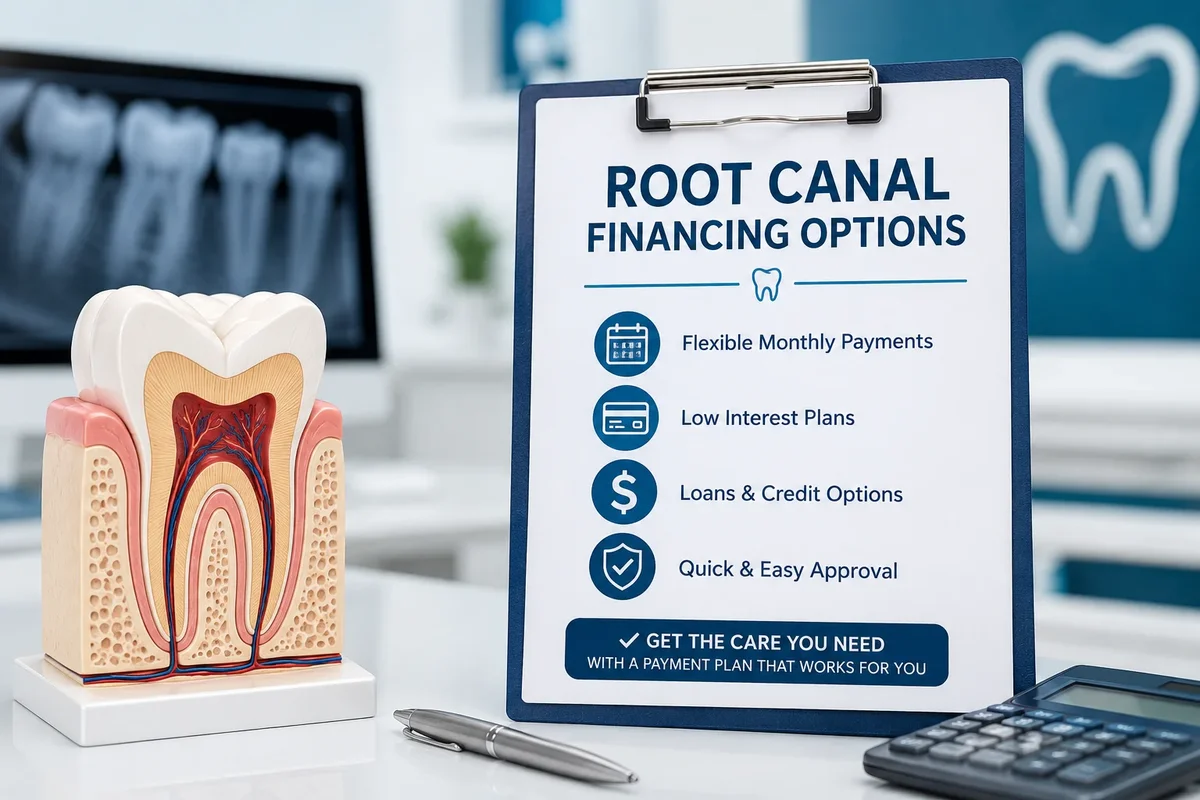
What to Prepare Before Choosing Root Canal Financing Options
The direct answer: before choosing root canal financing options, prepare your treatment estimate, insurance information, monthly budget, identification documents, and a written list of questions for the clinic or finance provider. This preparation helps you compare plans using the full expected cost of care instead of an incomplete advertised price. It also gives you a clearer basis for deciding whether to pay in full, use insurance, combine savings with installments, or apply for financing.
Your first priority should be confirming what treatment is being recommended and why. Tooth pain, sensitivity, swelling, or discomfort when biting can have more than one cause, so financing should not be arranged from symptoms alone. A dentist may need to examine the tooth, review appropriate imaging, and assess whether the tooth can be restored before providing a personalized plan. Root canal financing options are most useful after the clinical scope is reasonably clear, including whether a permanent filling, core buildup, crown, specialist visit, or follow-up care may be needed.
Gather Information Before Comparing Root Canal Financing Options
Ask for an itemized estimate rather than a single total with no explanation. The document should identify the examination, imaging, root canal procedure, temporary restoration, final restoration, and planned follow-up. If different clinicians will complete different stages, request the expected charges from each provider. Root canal financing options should be compared against the complete treatment pathway, because a plan that pays only for the root canal may still leave a significant restoration balance due later.
Also ask which figures are confirmed and which remain estimates. Final costs may change according to examination findings, tooth anatomy, previous dental work, materials, specialist involvement, and the treatment ultimately required. This does not mean that you cannot plan responsibly. It means that root canal financing options should include clear rules for handling reasonable changes, unused funds, additional services, or a lower final balance.
Prepare Documents for Root Canal Financing Options
Bring or submit your insurance card, policy details, identification, and any information the clinic requests for a benefit check. Ask about your deductible, annual maximum, waiting periods, network restrictions, and separate coverage levels for endodontic treatment and the final restoration. A pre-treatment estimate may help you calculate the likely patient balance, although it should not be treated as a guaranteed insurer payment.
When comparing root canal financing options, ask whether the application requires proof of income, residency, employment, bank details, or a credit assessment. Confirm whether the provider uses a soft or hard credit inquiry and whether approval creates an immediate obligation to borrow. Do not send sensitive financial documents through an unverified channel. Use the clinic’s or lender’s official submission process and ask how your information will be handled.
Build a Realistic Monthly Budget
List your reliable income and essential expenses, including housing, food, utilities, transport, medication, childcare, debt payments, and a reasonable emergency allowance. Then test the proposed installment against what remains. Root canal financing options may appear affordable when the monthly payment is viewed in isolation, but the plan is not suitable if it forces you to rely on additional credit for normal living costs.
Compare at least two repayment periods using the same financed amount. Record the deposit, annual percentage rate, monthly installment, number of payments, account fees, late-payment consequences, and total amount repayable. Longer root canal financing options can lower the monthly payment while increasing the overall cost. Shorter plans may reduce interest but create an installment that is too high. The better choice is the one that balances total cost with reliable monthly affordability.
Questions to Ask About Root Canal Financing Options
Before accepting a plan, ask exactly what it covers, when treatment can begin, when repayments start, and whether the final restoration is included. Ask what happens if insurance pays less than expected, the dentist changes the treatment plan, or specialist care becomes necessary. Transparent root canal financing options should explain adjustments, refunds, cancellations, early repayment, promotional periods, and missed-payment fees in writing.
You should also ask the dentist about timing. Some conditions require prompt care, while other cases may allow a limited period for planning. Only a clinician who has examined the tooth can advise you about a reasonable delay. Persistent pain, swelling, drainage, fever, trauma, or rapidly worsening symptoms should be assessed promptly. Facial swelling, difficulty swallowing, or difficulty breathing may require urgent dental or medical care and should not wait for the completion of root canal financing options.
Use a Consultation to Evaluate Root Canal Financing Options
A consultation is the time to connect the clinical plan with the financial plan. Ask whether preserving the tooth is considered appropriate, what restoration would be needed, what alternatives are realistic, and how each pathway could affect cost and future care. Extraction may have a lower initial fee in some situations, but replacement can add further procedures and expense. Conversely, financing treatment may not be sensible when the tooth cannot be predictably restored. Root canal financing options should support the treatment decision reached after this comparison, not replace it.
Redent Klinik can review the tooth, explain the expected stages of care, and discuss payment arrangements that may currently be available. You can use the Redent Klinik Contact Page to request a personalized evaluation and ask which documents are needed to review root canal financing options. General patient information from the American Dental Association may also help you prepare questions, but it cannot replace advice from the dentist who examines your tooth.
Your Final Preparation Checklist
What to check next: bring your insurance details, identification, treatment records when available, an itemized estimate, and a realistic monthly budget. Confirm that root canal financing options cover the root canal, any temporary care, the recommended permanent restoration, and follow-up services. Review the total repayment amount, interest, fees, payment dates, adjustment rules, and cancellation terms before signing. Request professional dental advice when symptoms persist, worsen, or return, and seek urgent care for spreading facial swelling, fever with facial symptoms, difficulty swallowing, or difficulty breathing.
Disclosure: this page may contain affiliate links. We may earn a commission if you use them, at no extra cost to you.