
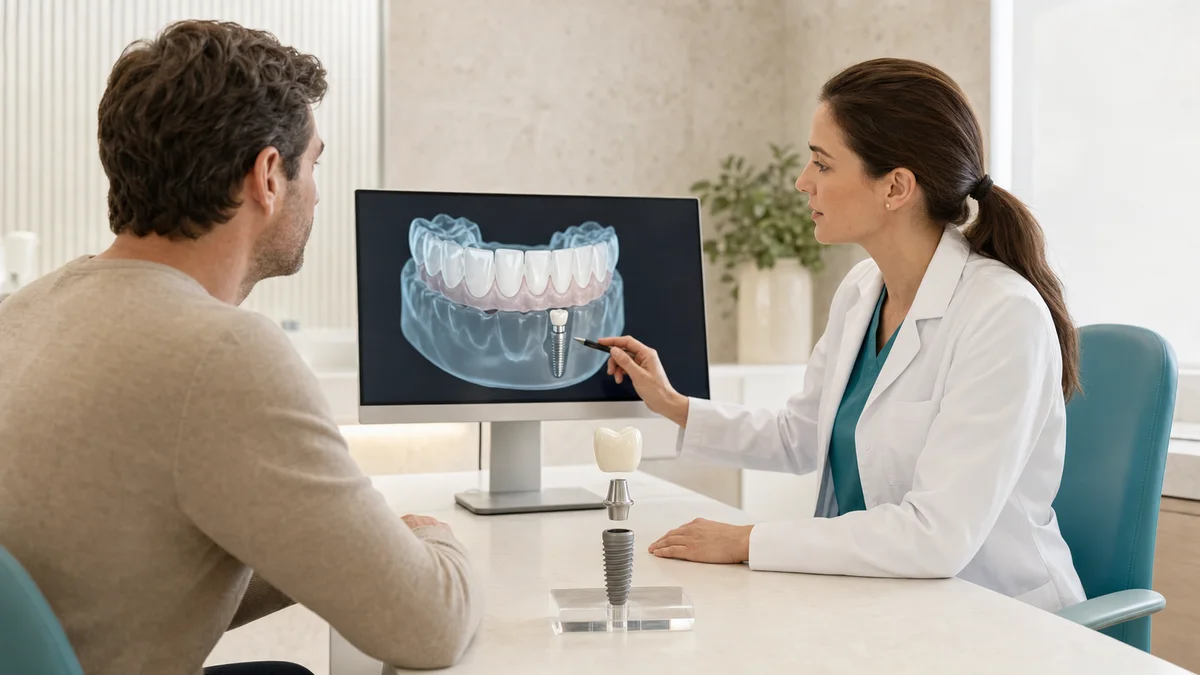
Quick answer: tooth screw implant cost is not the price of one metal part. A useful written quote separates the implant body, abutment, temporary and final tooth, imaging, laboratory work, anaesthesia, possible grafting, reviews, and maintenance. The safest comparison begins after an examination because bone, gum health, tooth position, and restoration design can change the plan.
The phrase tooth screw implant cost is commonly used by patients who want to replace a missing tooth, but it can hide an important distinction. The screw-shaped implant body sits in the jaw; an abutment connects that body to a crown, bridge, or denture; and the visible tooth is a separate restoration. A low headline figure may describe only one component, while a higher figure may include planning, surgery, a custom restoration, and follow-up. Comparing totals without comparing scope can therefore produce a misleading conclusion.
This guide explains how to read a quote without diagnosing your own mouth or treating an online price as a promise. It is designed for informed questions before a clinical consultation. Suitability, timing, material selection, the need for preparatory care, and the final fee all depend on an individual assessment. Patients considering care with Redent can review the clinic’s English-language treatment information and use the contact page to request a personalised assessment rather than relying on an advertised package.
1. What does tooth screw implant cost actually describe?
Tooth screw implant cost should describe a treatment pathway, not merely the threaded fixture shown in an advert. The US Food and Drug Administration describes a dental implant system as an implant body and an abutment, sometimes with an abutment fixation screw. The body is placed in the jawbone, while the abutment extends through the gum to support the artificial tooth. The crown, bridge, or denture supported by the system is another prosthetic component. That structure is why a quote for “the implant” can be incomplete even when the stated amount is technically accurate.
Patients may also use “tooth screw” to mean several different things: the implant body in bone, the small fixation screw inside an abutment, or a screw-retained crown. These are not interchangeable. A clinician should explain which component is proposed, why that design suits the site, and whether the final restoration is screw-retained or cement-retained. The choice is clinical and prosthetic; it should not be reduced to whichever label sounds less expensive.
For that reason, tooth screw implant cost should always be linked to a named component and a defined stage of care.
The three main components in plain English
- Implant body: the screw-shaped medical device placed in the jaw to act as an artificial root.
- Abutment: the connector between the implant body and the replacement tooth; it may be standard or customised.
- Final restoration: the crown, bridge, or denture that provides the visible tooth form and chewing surface.
When comparing tooth screw implant cost, ask whether all three are included and whether temporary components are separate. A quote that lists a body but omits the abutment and crown is not comparable with a complete single-tooth proposal.
2. Why an examination must come before a reliable price
A responsible estimate follows clinical and radiographic assessment. The dentist needs to understand why the tooth is missing or failing, whether active decay or gum disease is present, how much bone is available, where nerves and the sinus lie, and what the opposing bite does. General health, medicines, smoking, grinding, and previous dental treatment can also influence risk and sequencing. These details are not administrative extras; they determine whether implant treatment is appropriate and what the pathway may involve.
Cambridge University Hospitals explains that implant suitability depends on health, oral hygiene, stable teeth, the absence of active decay or infection, and adequate bone. It also notes that routine X-rays or, in selected cases, three-dimensional imaging may be advised. Consequently, tooth screw implant cost obtained before an assessment is best treated as an indicative starting point, not a final plan.
Information to bring to the consultation
- A current list of prescription medicines, supplements, allergies, and relevant medical conditions.
- Details of smoking or nicotine use, previous gum treatment, and any history of slow healing.
- Previous radiographs or implant records if available, including the manufacturer and model of an existing system.
- Your priorities for appearance, chewing, treatment time, removable versus fixed teeth, and travel.
- Questions about alternatives, risks, maintenance responsibilities, and what happens if the plan changes.
This information helps the clinical team estimate complexity and prevents a seemingly simple tooth screw implant cost comparison from ignoring relevant health factors.
A provisional tooth screw implant cost can become more precise only after these findings are reviewed together.
3. The core items that should appear in a written quote
A well-structured proposal lets a patient see what is included now, what is conditional, and what could be required later. It should identify the tooth or region, the intended restoration, the number of implant bodies, the expected stages, and any assumptions. It should also distinguish professional fees from laboratory and device components where practical. Clarity does not mean the treatment can never change; it means the patient can understand why a change might occur and how it would be authorised.
For a single missing tooth, the core tooth screw implant cost often relates to assessment, imaging, implant placement, an abutment, and a crown. However, temporary tooth replacement, guided surgery, extraction, grafting, sedation, or complex laboratory work may sit outside that core. Written wording matters more than a marketing label such as “complete” or “all inclusive.”
An itemised tooth screw implant cost also makes it easier to see which services are confirmed and which remain conditional.
Quote line items worth checking
- Initial examination, periodontal assessment, records, and treatment planning.
- Two-dimensional radiographs and whether three-dimensional imaging is included if clinically indicated.
- Extraction of the failing tooth, socket management, or preservation procedures.
- The implant body, cover screw or healing component, and surgical placement.
- Standard or custom abutment, impression or digital scan, and laboratory work.
- Temporary removable or fixed tooth, if one is planned during healing.
- Final crown, bridge unit, or denture attachment, including its material and design.
- Local anaesthesia, optional sedation, medicines, reviews, suture removal, and post-operative support.
- Maintenance visits, professional cleaning, and future repair or component replacement.
4. A decision table for comparing tooth screw implant cost
Use the table below to compare scope rather than choosing by the lowest total. The “why it matters” column is not a prediction that every item will be needed. It shows which unanswered questions can make two proposals appear similar when they are not.
| Quote area | What a clear proposal states | Why it changes comparison | Question to ask |
|---|---|---|---|
| Clinical scope | Tooth position, number of implants, and restoration type | One implant may support one crown or contribute to a larger bridge or denture plan | What exact replacement is this quote designed to provide? |
| Planning | Examination, radiographs, scan, photographs, and guide if used | Imaging and guided planning may be listed separately | Which records are included and which are conditional? |
| Implant system | Body, abutment, fixation components, and documented system identity | A fixture-only price omits the connection and tooth | Will I receive the brand, model, size, and batch records? |
| Bone and soft tissue | Whether grafting is expected, possible, or excluded | Additional surgery, materials, and healing time may change the pathway | What finding would trigger a graft or sinus procedure? |
| Temporary tooth | Type, duration, limitations, and replacement policy | The healing interval may require a separate appliance or provisional restoration | How will appearance and function be managed while healing? |
| Final tooth | Crown or bridge material, abutment type, laboratory, and fit appointments | The prosthetic phase can be a substantial part of the total | Is the final crown and all laboratory work included? |
| Aftercare | Reviews, urgent contact, hygiene visits, and maintenance exclusions | Long-term care continues after the crown is fitted | Which reviews are included and what is charged later? |
| Plan changes | Consent process and fees for additional or alternative treatment | Unexpected findings should not become unexplained charges | How will I approve a change before it is carried out? |
After completing the table, compare the same endpoint. A fixture-only tooth screw implant cost should not be ranked against a proposal that includes a custom abutment, final ceramic crown, reviews, and a documented contingency pathway.
The table turns tooth screw implant cost into a like-for-like scope check rather than a contest between headline numbers.
5. How implant number and replacement design affect the total
The number of missing teeth does not automatically equal the number of implants. One missing tooth may often be considered for one implant and one crown, while several missing teeth may be restored with an implant-supported bridge using fewer implant bodies than teeth. A full-arch fixed or removable design follows a different biomechanical and maintenance plan. The safe number and distribution of implants depend on anatomy, bone, bite, restoration space, and the proposed prosthesis.
This is why tooth screw implant cost cannot be multiplied mechanically by the number of gaps. The final restoration design may add bridge units, connectors, attachments, reinforcement, or a more complex laboratory workflow. Conversely, an implant may not be the preferred option for every missing tooth. A tooth-supported bridge, removable denture, orthodontic space closure, or accepting the space can be reasonable alternatives in selected circumstances.
A clinician should therefore calculate tooth screw implant cost from the proposed support pattern and restoration, not from tooth count alone.
Single crown versus bridge or denture support
The American Academy of Periodontology describes a single-tooth replacement as an implant plus a crown, with the implant replacing the root and the crown replacing the visible tooth. Bridge and denture cases involve different components and hygiene access. When asking about tooth screw implant cost, name the desired endpoint—single crown, short-span bridge, overdenture, or fixed full-arch restoration—so the answer is not based on the wrong treatment category.
6. Imaging, digital planning, and surgical guides
Imaging is selected according to clinical need. A conventional dental radiograph may answer some questions, while three-dimensional imaging may be advised for detailed assessment of bone dimensions and nearby structures. A digital scan records tooth and gum surfaces; photographs and bite records may help with prosthetic planning. In some cases, digital information is combined to design a surgical guide. None of these tools replaces clinical judgement.
A quote should say whether imaging is already available, included, referred elsewhere, or charged separately. It should also explain whether a guide is planned and why. The presence of advanced technology does not itself guarantee an outcome, while the absence of a guide does not automatically mean planning is inadequate. The effect on tooth screw implant cost should be interpreted alongside the reason for using the tool.
Clear imaging assumptions keep tooth screw implant cost transparent without presenting every available scan as mandatory.
Questions about scans and planning
- Which image is needed for my case, and what clinical question will it answer?
- Will the scan be taken at the clinic or at an external imaging centre?
- Is guide design and manufacturing included in the written estimate?
- Who reviews the images, and can I receive copies for my records?
7. Extraction, grafting, and sinus procedures
Some people already have a healed gap; others need a failing tooth removed. Placement may be immediate, early, or delayed depending on infection, bone, soft tissue, stability, and the restorative plan. These labels describe timing, not a promise of faster or better care. A clinician may also discuss socket preservation, bone augmentation, soft-tissue grafting, or a sinus-related procedure when anatomy requires it.
Grafting changes tooth screw implant cost because it can add material, surgery, monitoring, and healing time. The proposal should distinguish a graft expected from current records from one that is only a contingency. It should also explain the type of material in general terms, the donor source when relevant, alternatives, and material risks. A patient should not assume that every implant needs grafting, or that a scan can always predict every surgical finding.
Where grafting remains uncertain, tooth screw implant cost should show a conditional allowance or a clearly stated exclusion.
How to read a conditional graft allowance
A conditional allowance is more transparent when it states the trigger, estimated scope, and approval process. For example, the clinician may explain that final graft volume can be confirmed only after direct assessment of a defect. The patient should know whether the allowance is included in the total, shown as a range, or excluded pending a further decision. That makes tooth screw implant cost planning more realistic without pretending that uncertain anatomy is already known.
8. Standard versus custom abutments and crowns
The abutment connects the implant body to the final restoration. A prefabricated standard abutment may suit some positions, while a custom abutment may be selected to manage emergence, angulation, tissue contour, or restorative space. The crown may use different ceramic or metal-ceramic constructions, and it may be screw-retained or cement-retained. The best choice depends on access, aesthetics, retrievability, bite, and the implant position.
These choices can alter laboratory work and therefore tooth screw implant cost. A premium material name alone is not enough to judge value. Ask why the component is appropriate, how it will be cleaned, whether the restoration can be removed for repair, and whether the estimate includes all try-ins or adjustments. The clinician should also document the implant system so compatible components can be identified later.
The abutment and crown specification makes tooth screw implant cost meaningful to both the patient and the future maintenance team.
What “the crown is included” should mean
Clarify whether the final crown price includes the abutment, laboratory fee, digital or conventional impressions, temporary components, fit appointments, occlusal adjustment, and a review after insertion. If shade matching or additional aesthetic work is separate, it should be stated. A complete description prevents the visible-tooth phase from appearing unexpectedly after the initial tooth screw implant cost has been accepted.
9. Anaesthesia, sedation, medicines, and comfort planning
Implant placement is commonly carried out with local anaesthesia. Sedation may be considered for some patients after a separate assessment, but it adds clinical requirements, recovery instructions, escort arrangements, and fees. General anaesthesia is not a routine default for a straightforward implant and is associated with a different care setting. The appropriate option depends on the procedure, medical history, anxiety, and local regulation.
Ask whether local anaesthesia is included and whether sedation assessment, the sedation clinician, monitoring, facility charges, and prescribed medicines are separate. Avoid choosing a plan solely because it promises “pain-free” care; discomfort and recovery vary, and no ethical provider can guarantee an entirely sensation-free experience. A transparent tooth screw implant cost sets realistic expectations and explains whom to contact if pain, swelling, bleeding, numbness, looseness, or another concern develops.
10. Timing, temporary teeth, and travel-related costs
The implant body may require a healing period before it supports the final tooth. Immediate temporary restoration is possible only in selected circumstances and does not mean the final crown is completed on the day of surgery. Other pathways use a removable temporary tooth, an adhesive bridge, a healing component, or no temporary restoration in a non-visible area. The choice must protect the site and fit the treatment plan.
Timing affects tooth screw implant cost through the number of visits, temporary restorations, scans, impressions, and laboratory stages. Patients travelling for care should include transport, accommodation, time away from work, and the possibility of an unplanned review. A short advertised visit count may not include future maintenance or complications. Before booking, obtain a staged schedule with responsible clinicians and an emergency contact plan.
A staged schedule helps patients interpret tooth screw implant cost alongside time commitments and travel risk.
A practical visit map
- Assessment: examination, health history, imaging, alternatives, and preliminary plan.
- Preparation: hygiene, gum stabilisation, extraction, or grafting when clinically required.
- Implant placement: surgery and immediate post-operative instructions.
- Healing reviews: monitoring and management of the temporary tooth or healing component.
- Restorative records: scan or impression, bite and shade information, and laboratory prescription.
- Final tooth: fit, contact and bite checks, cleaning instruction, and documentation.
- Maintenance: ongoing reviews, hygiene care, and repair planning.
11. Maintenance is part of lifetime cost
Implants are not maintenance-free. The FDA advises regular cleaning, scheduled dental visits, and prompt contact if an implant becomes loose or painful. Cambridge University Hospitals similarly emphasises meticulous cleaning and long-term professional monitoring, noting that crowns, bridges, dentures, clips, or screws can wear and may require repair or replacement. An implant can be functioning while its prosthetic components still need care.
A realistic tooth screw implant cost conversation therefore covers more than placement. Ask about hygiene intervals, home-cleaning tools, radiographic monitoring, night guards when indicated, professional cleaning, screw tightening, crown repair, and replacement of worn attachments. These services should not be presented as guaranteed future needs, but their possibility belongs in informed budgeting.
Long-term tooth screw implant cost is easier to plan when maintenance responsibility is agreed before surgery.
Maintenance questions before treatment
- How will I clean under and around the proposed crown, bridge, or denture?
- How often will my individual risk profile be reviewed?
- Who provides maintenance if I live in another city or country?
- Which repairs are included during an initial review period, and which are chargeable?
- What records will help another dentist identify compatible components?
12. Insurance, finance, and payment schedules
Coverage differs by country, policy, diagnosis, provider network, waiting period, annual limit, and whether each procedure is classified as surgical, restorative, or cosmetic. A pre-authorisation is useful but is not always a payment guarantee. The insurer may assess the implant body, abutment, crown, graft, imaging, and sedation under different benefit rules. Patients should verify coverage directly and keep the written response.
When finance is offered, compare total repayable amount, interest, fees, deposit, instalment dates, cancellation terms, and what happens if the clinical plan changes. A monthly figure can make tooth screw implant cost look smaller while obscuring the total obligation. Do not sign a credit agreement before understanding both the treatment plan and the finance contract. Clinical consent and financial consent are related but separate decisions.
Finance should spread tooth screw implant cost only after the full repayable amount and clinical scope are understood.
A document checklist for benefits questions
- Itemised treatment plan with tooth numbers or regions and procedure descriptions.
- Diagnostic records requested by the insurer, shared only through an appropriate channel.
- Written pre-authorisation or benefit estimate with exclusions and validity dates.
- Clinic payment schedule, refund or cancellation terms, and a plan-change process.
13. Red flags in a tooth screw implant cost advertisement
Low pricing is not automatically unsafe, and higher pricing is not proof of better care. The concern is missing clinical context. Be cautious when an advert gives a universal final price before assessment, uses a countdown to pressure consent, promises lifelong success, dismisses alternatives, or will not identify what is included. Also question claims that everyone qualifies for immediate loading or that one scan eliminates all uncertainty.
A trustworthy tooth screw implant cost explanation welcomes questions about the clinician, implant records, material traceability, laboratory, infection control, emergency arrangements, maintenance, and complications. It does not use fear of bone loss or embarrassment to rush the decision. You should have time to read the plan, ask about reasonable alternatives, and seek another opinion if the implications remain unclear.
Pressure tactics are not a substitute for a complete tooth screw implant cost and consent discussion.
Stop and clarify before paying when
- The price covers “an implant” but the abutment and final tooth are not named.
- The number of implant bodies or the type of final restoration is uncertain.
- Grafting is described as both included and potentially extra without a trigger.
- No one explains follow-up responsibility after travel or after the crown is fitted.
- The provider refuses to supply an itemised plan or implant system record.
14. A 12-step way to compare proposals safely
- Confirm that each proposal addresses the same missing tooth or region.
- Check the number of implant bodies and the intended final restoration.
- Separate examination, imaging, surgery, abutment, and prosthetic fees.
- Identify extraction, grafting, soft-tissue work, and sinus-related contingencies.
- Ask how the temporary tooth will be managed during healing.
- Confirm the crown, bridge, or denture material and whether laboratory work is included.
- Review anaesthesia, sedation, medicines, and emergency contact arrangements.
- Compare visit numbers, healing assumptions, and travel implications.
- Request the implant brand, model, size, and traceability record after placement.
- Understand maintenance, repair, and replacement responsibilities.
- Read payment, finance, cancellation, and plan-change terms separately.
- Choose only after risks, benefits, alternatives, and uncertainties are clear.
Applying these steps turns tooth screw implant cost from a headline into a clinically meaningful comparison. The best-value plan is not necessarily the cheapest or most expensive; it is the one whose endpoint, assumptions, responsibilities, and exclusions you understand after an appropriate assessment.
A final tooth screw implant cost decision should follow that shared understanding, not precede it.
Frequently asked questions about tooth screw implant cost
Is tooth screw implant cost the same as a complete replacement tooth?
No. Tooth screw implant cost may refer only to the implant body, while a complete single-tooth pathway may also include an abutment, crown, planning, imaging, surgery, temporary tooth, reviews, and maintenance. Ask for each component in writing. If an advert uses “complete,” confirm exactly where the treatment starts and ends.
Why can two tooth screw implant cost quotes be very different?
They may describe different clinical endpoints or include different services. One may exclude the crown, custom abutment, imaging, grafting, sedation, temporary tooth, or reviews. The implant system, laboratory workflow, clinician responsibilities, and local operating costs may also differ. Compare itemised scope after an examination rather than assuming the lower figure represents the same care.
Does tooth screw implant cost include the crown?
Not automatically. Some proposals bundle the implant body, abutment, and crown; others list each separately. Ask whether the final crown, laboratory work, scans or impressions, fit visits, and adjustments are included. The crown is the visible prosthetic tooth, not the screw-shaped implant body in bone.
Will I definitely need a bone graft?
No. Grafting depends on the site, bone volume, defect shape, soft tissue, timing, and proposed restoration. Clinical examination and appropriate imaging help the clinician assess this. Even then, some details may be confirmed during treatment. The quote should state whether grafting is expected, conditional, or excluded and how you would approve a change.
Can a clinic confirm tooth screw implant cost from a photograph?
A photograph may support an initial conversation but cannot establish bone dimensions, gum health, bite, medical suitability, or nearby anatomy. It should not replace examination and radiographic assessment. A remote estimate can be useful for planning only when its assumptions and exclusions are clear and a final decision follows an in-person clinical review.
Is the most expensive implant system always better?
No single price or brand label determines suitability or outcome. The clinician must consider evidence, component compatibility, restorative design, anatomy, maintenance access, documentation, and experience with the system. Ask why a system is recommended, how records will be provided, and whether compatible components are likely to remain accessible for future care.
What should I do if the implant becomes loose or painful?
Contact the treating dental provider promptly and avoid trying to tighten or repair anything yourself. A loose crown, abutment screw, or implant body requires professional assessment, and these situations are not identical. Seek urgent medical or dental advice for rapidly increasing swelling, breathing or swallowing difficulty, uncontrolled bleeding, or other severe symptoms.
Can tooth screw implant cost be guaranteed for life?
A fixed treatment fee may have clearly written terms, but no ethical clinician can guarantee a biological device or restoration for life. Healing, disease, trauma, smoking, cleaning, bite forces, and component wear can affect future care. Ask for precise repair and review policies without interpreting them as a guarantee of clinical outcome.
Should I choose an implant instead of a bridge?
That decision depends on the missing-tooth site, adjacent teeth, bone, gum health, bite, preferences, maintenance, time, and risks. A bridge, removable denture, orthodontic option, or no replacement may be reasonable in selected cases. Ask the clinician to compare benefits, limitations, expected maintenance, and total pathway costs for the alternatives that fit your situation.
What records should I receive after implant placement?
Ask for documentation identifying the implant manufacturer, system, model, dimensions, placement site, and relevant batch or lot details, plus copies of the final treatment plan and important radiographs where available. FDA patient guidance specifically recommends asking which brand and model are used and keeping that information for future care.
Patient-safe conclusion
Tooth screw implant cost becomes useful only when it is attached to a defined clinical outcome. Separate the implant body from the abutment and final tooth; identify planning, temporary care, grafting contingencies, anaesthesia, laboratory work, reviews, and maintenance; then compare proposals that aim to deliver the same result. A personalised examination remains essential because a webpage cannot determine suitability or final scope.
This article is educational and does not provide a diagnosis, individual treatment recommendation, fixed fee, insurance decision, or outcome guarantee. A dentist should review your health history, mouth, imaging, preferences, and alternatives before treatment. The content is prepared for evidence-based review by Dentist Esma Çevrük Çakır, with patient safety and transparent consent as the priority.
Authoritative sources
- US Food and Drug Administration: Dental Implants — What You Should Know
- Cambridge University Hospitals NHS Foundation Trust: Dental implants in restorative dentistry
- NHS: What happens when you visit the dentist
- American Dental Association: professional oral-health authority
- American Academy of Periodontology: Single Tooth Dental Implants
- World Health Organization: Oral health fact sheet