
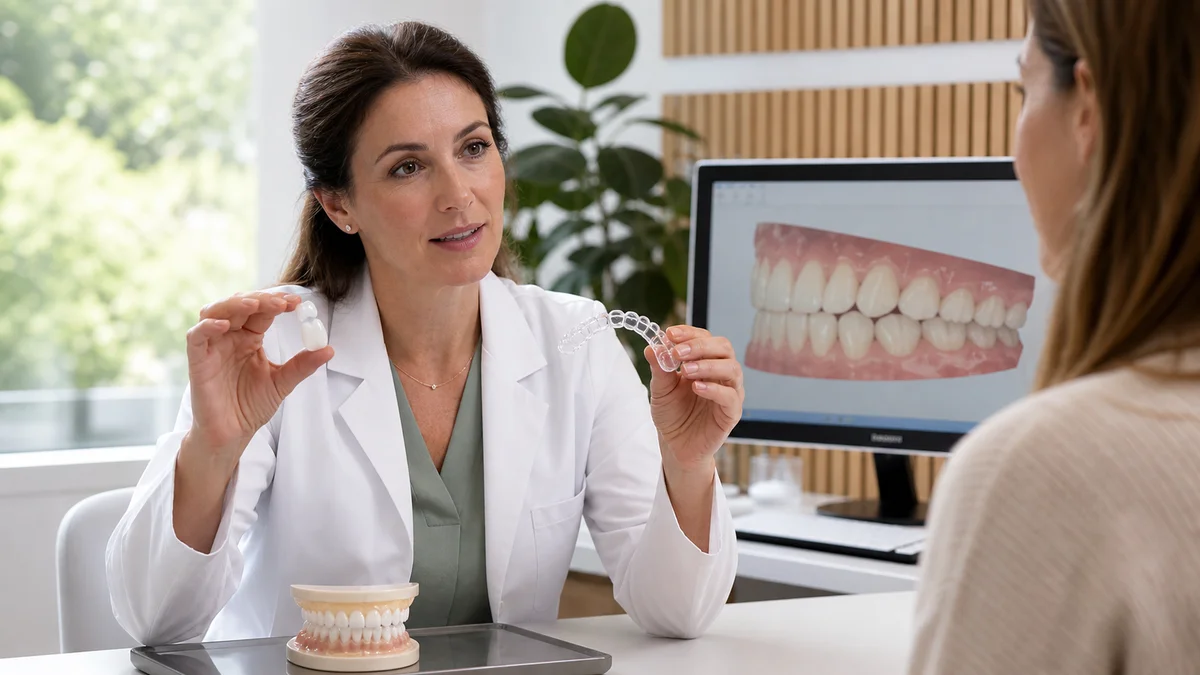
The search veneers or clear aligners which is better often assumes both treatments create the same smile by different routes. They do not. A veneer is a bonded restoration placed on the facial surface of a tooth. A clear aligner is an orthodontic appliance that applies controlled force to move teeth. One changes what a tooth looks like; the other changes where the tooth and root sit.
That distinction matters when a tooth is rotated, crowded, protrusive, short, worn, discolored or spaced. A veneer can camouflage a small positional irregularity, but heavy camouflage may require more enamel removal or create bulky contours. Aligners can improve position and space, but they cannot replace missing enamel, repair a large fracture or permanently change intrinsic color. The correct treatment begins with diagnosis rather than a preferred product.
This guide explains how to compare the two options without promising a perfect result. It does not diagnose photographs, guarantee treatment time or recommend irreversible preparation without examination. Tooth structure, gum health, roots, bite, wear, expectations and long-term maintenance can change the recommendation.
Veneers or Clear Aligners Which Is Better Starts With the Problem
Write down the exact concern before choosing a procedure. Is one tooth chipped? Are several teeth crowded? Does the bite cause traumatic contact? Is the color uneven? Are teeth small or worn? Is a dark tooth healthy, root-treated or decayed? Each finding points toward different diagnostics and sometimes different specialists.
If the primary issue is tooth position or malocclusion, orthodontic movement is generally the more direct biological tool. Clear aligners can move teeth gradually when the case is suitable and the patient wears them as prescribed. If the primary issue is shape, localized enamel defect, proportion or a color problem that does not respond appropriately to whitening, a veneer may be considered after conservative alternatives.
For veneers or clear aligners which is better, “both” can be a valid answer. Orthodontics can move teeth into a healthier, more symmetric position so that any later veneers are thinner, fewer or unnecessary. Conversely, a patient may finish aligners with one worn or malformed tooth that still needs additive bonding or a conservative veneer. Sequencing should be planned before either treatment starts.
- Alignment problem: crowding, spacing, rotation, protrusion or selected bite discrepancy.
- Surface problem: chip, wear, shape, proportion, texture or resistant discoloration.
- Health problem: decay, crack, gum disease, root disease or active erosion needing treatment first.
- Combined problem: position plus structural or color concern requiring coordinated care.
- Expectation problem: a requested result that may be biologically unrealistic or excessively destructive.
What Veneers Can Change and What They Cannot
Veneers are thin restorations bonded to the front and sometimes edge of teeth. Porcelain and direct composite are different approaches with different laboratory, repair, staining and preparation considerations. They may alter tooth width, length, contour, surface and color. They are not simply removable covers and should be planned as medical devices within a complete dental examination.
The American Dental Association’s patient guidance states that veneer treatment is not reversible when enamel is removed. Preparation varies by tooth position, material and desired change. A tooth already protruding may require more reduction to avoid a bulky result, while an inward-positioned or undersized tooth may permit a more additive design. “No-prep” is a case-dependent description, not a promise appropriate for every mouth.
A veneer does not move the root, improve the position of supporting bone or correct a true bite discrepancy. It can visually mask a mild rotation or close a small space by changing contour, but aggressive camouflage can create overhanging margins, plaque retention, unnatural width or excessive enamel loss. It also cannot make an unhealthy tooth safe without treating the underlying disease.
When deciding veneers or clear aligners which is better, ask how much tooth structure would be removed from each tooth, whether bonding is an alternative and how the proposed contours will be cleaned. A digital mock-up or temporary trial can help communicate shape, but it does not replace evaluation of enamel thickness, bite and gum response.
What Clear Aligners Can Change and Where They Have Limits
Clear aligners are a series of removable trays designed to move teeth through planned steps. Attachments may be bonded to teeth, elastic wear may be required and small amounts of interproximal enamel reduction may be proposed. Treatment depends on diagnosis, appliance fit, patient wear and professional monitoring.
The American Association of Orthodontists emphasizes that different appliances suit different movements and bite problems. Clear aligners can be effective for many adults, but they are not automatically the best tool for every rotation, root movement, vertical change or complex jaw relationship. Braces, additional appliances, surgery or limited restorative care may be more appropriate in selected cases.
Aligners do not rebuild missing tooth structure or cover color. They can create better positions for bonding, whitening, crowns or veneers, and they can redistribute space before replacing a missing tooth. They also require retention after active movement because teeth naturally shift over time. AAO guidance treats retainers as an essential part of preserving the result.
Veneers or clear aligners which is better should not be answered through a mail-order impression or selfie alone. Root health, bone, gum condition and impacted teeth may require in-person examination and imaging. ADA policy warns that unsupervised direct-to-consumer dental services can remove essential diagnostic and safety oversight.
Decision Table: Which Tool Matches Which Goal?
| Decision factor | Veneers | Clear aligners | Key question |
|---|---|---|---|
| Main action | Changes visible tooth surface | Moves teeth and roots | Is the problem structure or position? |
| Enamel | May require irreversible removal | No veneer preparation; other enamel reduction may be planned | How much enamel is altered and why? |
| Bite | Can modify surface contacts but not jaw/tooth-root position | Can address selected tooth and bite relationships | Is the bite diagnosis included? |
| Color | Can cover selected discoloration | Does not change tooth color | Would whitening or diagnosis come first? |
| Shape/wear | Can restore visible contour | Does not rebuild lost structure | Why did the wear occur? |
| Patient role | Hygiene and protection | Daily wear, tray care and appointments | Can the patient sustain the routine? |
| Long-term need | Repair or replacement over time | Retention and possible retainer replacement | Which maintenance is acceptable? |
Enamel Preservation Is a Major Decision Test
Natural enamel is valuable because predictable bonding is strongest when adequate enamel remains. Removing enamel cannot be reversed. Once a tooth is prepared for a veneer, it may need a restoration indefinitely, even if the first veneer later chips, debonds or is replaced. Future treatment can become more complex if additional structure is lost.
Clear aligners do not involve veneer preparation, but that does not mean orthodontics is completely noninvasive. Attachments are bonded and removed, interproximal reduction may be used, and tooth movement changes supporting tissues. Risks such as root shortening, gum recession, decay around attachments or unwanted movement should be discussed according to the case.
For a young patient with healthy, intact teeth and moderate crowding, veneers or clear aligners which is better often gives substantial weight to preservation. Orthodontic correction may avoid cutting multiple teeth, even if it takes longer. For an older tooth with existing large restorations, wear or shape defects, the balance can differ. Age alone does not decide; remaining tooth structure does.
Bite Correction Versus Cosmetic Camouflage
A smile photograph shows only part of occlusion. Overbite, overjet, crossbite, open bite, tooth inclinations and functional movements can influence wear and stability. A veneer may change where upper and lower teeth touch, but it cannot safely correct every bite problem by adding or subtracting surface material.
Camouflaging crowded teeth with veneers can make the front surfaces look straighter while roots remain rotated or crowded. If the tooth must be reduced heavily to fit the visual line, sensitivity or pulp concerns can increase. Bulky contours can also affect speech and gum health. The clinician should show the proposed preparation and final profile, not only a frontal simulation.
Aligners can move teeth to improve selected bite relationships, but a digital animation is a treatment plan rather than a guarantee. Tracking, biological response and patient wear can differ. Additional aligners, attachments or another appliance may be needed. Veneers or clear aligners which is better therefore requires a functional end point, not just even front edges.
Gum Health, Decay and Cracks Come Before Either Option
Inflamed gums can change shape and bleed during scanning, preparation or bonding. Active periodontal disease can make orthodontic movement risky and can compromise veneer margins. Stabilize disease first and reassess tissue levels before final aesthetic decisions. Gum recession may expose veneer margins or roots over time.
Decay, leaking restorations and cracks need diagnosis. A dark tooth may have a history of trauma, internal resorption, root treatment or decay; covering it without investigation can delay necessary care. Likewise, aligners can hide food and plaque against teeth when trays are placed after eating without cleaning.
Patients with acid erosion, reflux, eating disorders or grinding need cause-focused management. Veneers may restore selected surfaces but do not stop ongoing erosion or force. Aligners may improve position but do not replace lost enamel. Protective, medical or behavioral care may be necessary before and after cosmetic treatment.
- Treat active decay and infection before elective veneers or tooth movement.
- Stabilize gingivitis or periodontitis and establish maintainable hygiene.
- Investigate the cause of wear, fracture or discoloration.
- Evaluate roots, bone and impacted teeth before orthodontic movement.
- Plan whitening before final restorative shade selection when appropriate.
When Restorative Treatment May Come First
In the decision veneers or clear aligners which is better, some teeth cannot safely wait for elective orthodontics. Active decay, a significant fracture, failing root treatment or a painful restoration may require stabilization first. A temporary or conservative repair can protect the tooth while preserving the option of later orthodontics. A definitive veneer is often better delayed until final tooth position is known.
Existing veneers or crowns do not automatically prevent aligner treatment, but attachments may bond differently and restoration contours affect tray fit. A crown on a natural tooth can move with its root if the tooth and supporting tissues are suitable. An implant crown cannot move orthodontically because the implant is integrated with bone.
For veneers or clear aligners which is better, sequence matters: a veneer placed before movement may no longer fit contacts, bite or a retainer afterward. The written plan should identify temporary, transitional and definitive restorations and state when the final retainer will be scanned.
Twelve Decision Questions for the Consultation
- Main diagnosis: Is the concern position, surface, structure, color, bite or a combination?
- Gum and root health: Are tissues stable enough for movement or bonding?
- Enamel removal: How much preparation is expected on each tooth?
- Orthodontic scope: Which roots and bite contacts must move?
- Alternative: Could whitening, bonding, contouring or braces be more conservative?
- Sequence: Would aligners first reduce the number or thickness of veneers?
- Color plan: Should whitening precede final shade selection?
- Provisional plan: Will temporary restorations be needed?
- Compliance: Can the patient wear and clean aligners as prescribed?
- Retention: Which retainer and long-term schedule will maintain alignment?
- Repair pathway: How are chips, debonding or replacement managed?
- Total cost: Are refinements, retainers, whitening and future restoration included?
Appearance: Natural Proportion Versus Instant Uniformity
Veneers offer direct control over visible shape, surface texture and shade. That can help malformed or discolored teeth, but it can look artificial if every tooth becomes identical, opaque or too prominent. Natural teeth vary in translucency, texture, edge position and width.
Aligners preserve original tooth surfaces, so the final smile retains natural color, shape and imperfections unless separate treatment is performed. That may be exactly the conservative result a patient wants. Others may still choose whitening, edge bonding or replacement of old restorations after alignment.
Before deciding veneers or clear aligners which is better, request a realistic preview that acknowledges limitations. A mock-up can show added restorative volume; an orthodontic simulation can show planned movement. Neither is a guaranteed biological result, and neither substitutes for examining speech, bite and gum response.
Cost and Insurance: Compare Different Lifecycles
Veneers and aligners are often elective and may receive limited insurance benefits, but coverage varies by diagnosis and plan. A damaged tooth needing medically necessary restoration is not the same claim as cosmetic veneers. Adult orthodontic benefits may have age limits, lifetime maximums, waiting periods or exclusions.
Request separate written estimates. For aligners, include records, trays, attachments, refinements, emergency visits and retainers. For veneers, include mock-up, provisional restorations, laboratory, bonding, protective appliance and likely repair pathway. Do not compare one completed veneer fee with only the first aligner payment.
Veneers or clear aligners which is better also requires a long-term budget. Retainers can need replacement and teeth can relapse. Veneers can chip, stain at margins, debond or require replacement; underlying teeth can develop decay or sensitivity. No individual lifespan or future cost can be guaranteed.
- Submit both itemized plans for written insurance estimates.
- Ask whether adult orthodontics has a lifetime maximum.
- Check whether cosmetic exclusions apply to veneers.
- Clarify refinements, retainers and replacement trays.
- Clarify veneer repair, remake and laboratory terms.
- Compare total treatment and maintenance, not monthly payment alone.
Retention and Restoration Maintenance
Long-term veneers or clear aligners which is better planning must include retention: the AAO states that retainers are necessary for maintaining orthodontic results because teeth can move throughout life. A removable or fixed retainer may be prescribed. Skipping wear can allow relapse, and a damaged or ill-fitting retainer should be reviewed rather than forced.
Veneers require brushing with fluoride toothpaste, interdental cleaning and regular examinations. The ADA notes that cavities can still occur under or around a veneer. Avoid using veneered teeth to bite nails, packaging, ice or other hard objects. Report bite changes, sensitivity, a rough edge, movement or a chip.
For combination treatment, the retainer must fit the final restorations. A veneer placed after a retainer scan can make the appliance too tight or impossible to seat. Coordinate the final scan after restorative contours are stable, and never force a retainer over new veneers.
Direct-to-Consumer and Unlicensed Treatment Risks
The ADA discourages direct-to-consumer dental laboratory services that remove the dentist’s role in diagnosis, planning and safe management. This concern applies to aligners and veneers. Unsupervised movement can affect roots, gums and bite; unlicensed veneer placement can cover disease, damage enamel or create infection and nerve risks.
A scan or impression is not a complete examination. Confirm the identity and license of the dentist responsible for treatment, how radiographs and gum health are assessed, and how emergencies are handled. Teledentistry can support care, but patients still deserve transparent provider identity, costs, records and appropriate in-person services.
The decision veneers or clear aligners which is better should never be delegated to a sales quiz. Both are dental interventions with potential irreversible effects. Ask who accepts clinical responsibility from diagnosis through follow-up.
Comparing Treatment in Turkey
Turkey may have different treatment fees and schedules, but the same diagnostic standards matter. Compare preparation amount, veneer material, number of teeth, laboratory, aligner supervision, refinements, retention and aftercare. A package should not dictate that every visible tooth needs a veneer.
Redent Klinik’s English-language dental care page provides general information for international patients. Existing photographs, scans and questions can be shared through the English contact page. Remote review remains preliminary; final treatment requires clinical examination and appropriate records.
When asking veneers or clear aligners which is better abroad, clarify visit count and continuity. Orthodontic movement requires monitoring over time. Veneers require preparation, provisional care, laboratory work, bonding and bite review. A flight schedule should not force final delivery before fit and function are verified.
Arrange local follow-up where possible and obtain records, restorative material details and retainer files. Another clinic may charge separately and may recommend a different approach after examination. Include additional visits and future maintenance in the total comparison.
Red Flags That Suggest the Wrong Tool
- Healthy teeth are scheduled for major preparation without discussing orthodontics.
- Aligners are promised from photographs with no root or gum assessment.
- A digital preview is described as a guaranteed result.
- Active decay or periodontitis is ignored before cosmetic treatment.
- The veneer count comes from a package rather than tooth-by-tooth need.
- No retainer is included after orthodontic movement.
- Whitening sequence and restoration shade are not coordinated.
- Urgent payment pressure replaces informed consent.
- An unlicensed “veneer technician” performs irreversible work.
Before finalizing veneers or clear aligners which is better, a second opinion is reasonable when many intact teeth would be prepared, a bite problem is being masked restoratively, or the proposed orthodontic plan ignores structural damage. Bring existing records so the second clinician can compare diagnosis, enamel preservation and long-term maintenance.
Frequently Asked Questions
Are veneers faster than clear aligners?
They often involve fewer active appointments, but speed does not make them appropriate for a positional problem. Preparation is commonly irreversible, and gum stabilization, mock-ups, temporaries and laboratory adjustments take time. Aligners require biological movement and retention.
Do clear aligners damage enamel?
They do not require veneer preparation, but attachments are bonded and removed, and interproximal reduction may be planned. Poor hygiene while wearing trays can increase decay or gum risk. Professional planning, monitoring and cleaning are important.
Can I get veneers after clear aligners?
Yes, when a remaining shape, wear or color concern justifies restoration. Aligners can improve position and reduce the number or thickness of restorations. Whitening and bonding may also be considered. The final retainer should be made after restorative contours are complete.
Can aligners fix tooth color or chips?
No. Aligners move teeth but do not whiten enamel or replace missing structure. Whitening, smoothing, composite bonding or veneers may be considered after movement. Planning these steps in advance can improve space, shade sequence and retainer fit.
Can veneers correct an overbite?
Veneers can alter visible contour and surface contacts but do not reposition jaws or roots. Using added material to mask a significant bite discrepancy may create bulk or excessive force. Orthodontic or multidisciplinary assessment is appropriate.
Do I need retainers after clear aligners?
Yes, retention is an essential part of orthodontic care. Teeth continue to move over time, and retainers help preserve corrected positions. The prescribed type and wear schedule are individualized. Retainers can wear, warp, break or stop fitting and may need replacement.
Can veneers cover severely crooked teeth?
They can camouflage selected mild irregularities, but severe rotation or protrusion may require substantial reduction or create bulky contours. Root position and bite remain unchanged. Orthodontic movement before minimal restoration is often worth discussing.
Which option is more conservative?
It depends on the diagnosis. Aligners often preserve intact tooth surfaces when position is the main issue, although they still carry orthodontic risks. Additive bonding may be more conservative than a veneer for small defects. A heavily restored tooth may have a different balance.
Which option lasts longer?
They have different endpoints. Veneers are restorations that can chip, debond or require replacement. Aligner movement can remain stable with long-term retention, but teeth can relapse. Health, bite, habits, maintenance and treatment quality affect both; no lifetime can be guaranteed.
Conclusion: Match the Tool to the Diagnosis
The responsible answer to veneers or clear aligners which is better is problem-specific. Aligners are generally the direct tool for suitable tooth movement and selected bite correction. Veneers are a restorative tool for shape, surface or color concerns when conservative options are insufficient. They should not substitute for diagnosis or cover active disease.
Prioritize enamel preservation, healthy gums, a functional bite and realistic maintenance. Ask whether orthodontics can reduce or eliminate restorative treatment, and whether bonding can replace a veneer. A coordinated plan may take longer, but it can produce a result that is healthier, more repairable and less destructive.
Official Sources and Clinical References
- American Dental Association MouthHealthy: Veneers.
- American Association of Orthodontists: Orthodontic Treatment Myths — February 2026.
- American Association of Orthodontists: Adult Orthodontic Treatment Questions.
- American Association of Orthodontists: Retainers After Treatment — October 2025.
- American Dental Association: Direct-to-Consumer Dental Services Policy.
- American Dental Association.
- World Health Organization oral health fact sheet.
Sources reviewed July 13, 2026. Individual tooth structure, periodontal health, bite and product instructions vary; follow a licensed treating clinician’s current plan.
Disclosure: this page may contain affiliate links. We may earn a commission if you use them, at no extra cost to you.