
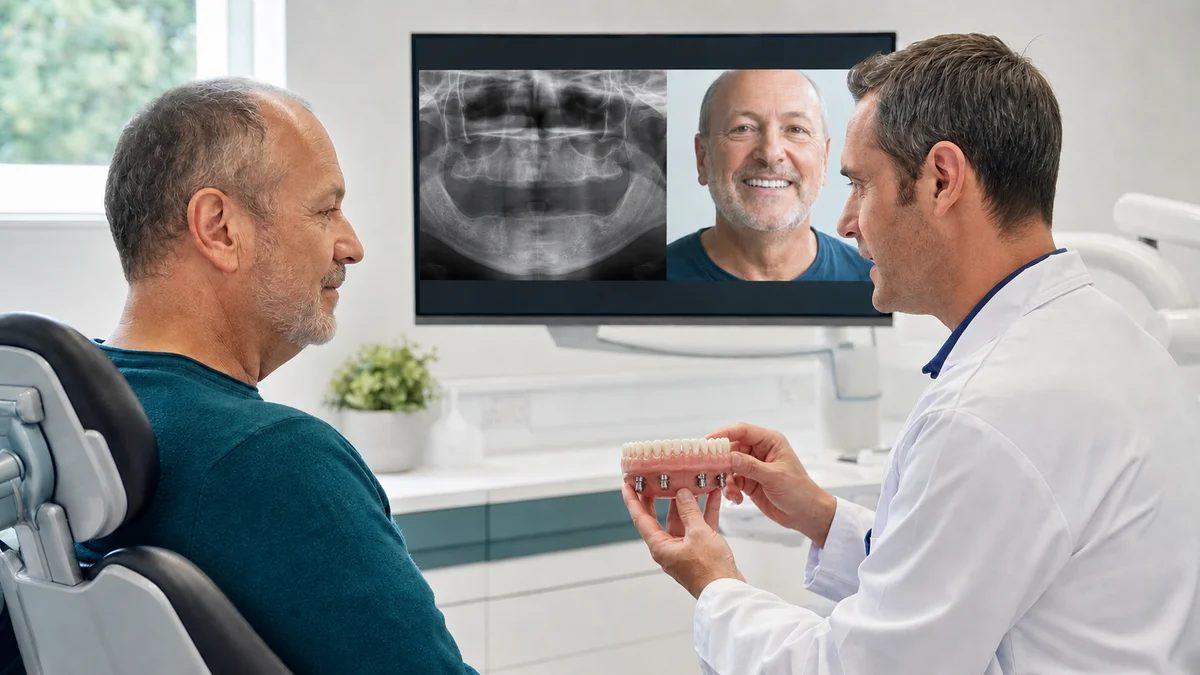
Short answer: all on 4 dental implants before and after images can illustrate changes in tooth display, facial support and smile design, but they cannot prove implant integration, comfort, hygiene access, bite stability or long-term success. A trustworthy comparison identifies the treatment stage, uses consistent photography and is interpreted alongside examination, three-dimensional imaging, medical history, risks, maintenance and realistic alternatives.
People searching all on 4 dental implants before and after usually want to know whether a fixed full-arch restoration could make eating, speaking and smiling feel more secure. Photographs can help explain a visible transformation, but the most important clinical outcomes are often invisible. The implants sit in bone, the prosthesis meets the gums, the bite distributes force, and the patient must be able to clean underneath the restoration. None of those facts can be confirmed by a front-facing smile alone.
This evidence-informed guide explains how to read before-and-after material without mistaking marketing for diagnosis. It separates the immediate temporary stage from the final prosthesis, outlines a realistic recovery pathway, and gives practical questions for a consultation. It does not determine whether four implants are appropriate for your jaw, recommend removing teeth, or promise a particular cosmetic or functional result.
1. What Does All-on-4 Mean Clinically?
All-on-4 is a treatment concept in which a complete fixed dental arch is supported by four implants. The front implants are generally placed more vertically, while the back implants may be angled to use available bone and reduce the length of the unsupported prosthesis. The exact plan varies with anatomy, implant system, restorative design and clinician judgment. “Four” is therefore a design description, not a guarantee that every patient should receive the same operation.
A full-arch implant restoration replaces the visible teeth and some of the missing gum volume. It does not reproduce natural tooth roots one by one. The prosthesis is connected to implant abutments, and its underside must be designed so the patient can clean it. Some patients may need more implants, bone or soft-tissue procedures, a removable implant overdenture, a conventional denture, or a tooth-preserving plan instead.
The U.S. Food and Drug Administration describes dental implants as medical devices placed surgically in the jaw. It advises patients to discuss general health, healing, smoking, benefits, risks and the specific implant system with their dental provider. These principles apply to a full-arch concept as much as to a single implant.
2. What All on 4 Dental Implants Before and After Photos Can Show
Well-made all on 4 dental implants before and after photographs can document visible changes when the conditions are comparable. They may show tooth length, smile width, midline, tooth shade, lip support, the amount of tooth displayed at rest and the relationship between the teeth and gums. Side views may help illustrate profile support, while retracted intraoral views can reveal more of the prosthetic transition than a social smile can.
Useful visual records may demonstrate:
- whether the final tooth proportions appear balanced rather than uniformly large;
- how the smile line relates to the prosthetic gum and natural lip movement;
- whether tooth color and surface texture look individualized in ordinary light;
- how much facial or lip support appears to have changed;
- whether the comparison uses the same head position, expression, lighting and camera distance;
- which arch was treated and whether the opposing teeth were also restored.
A photograph is strongest when its date and treatment stage are stated. An image taken on surgery day may show an immediate provisional bridge, not the definitive restoration. Swelling, anesthesia, lip posture and lighting can also change the apparent result. A responsible gallery should never imply that one patient’s appearance predicts another patient’s result.
3. What Before-and-After Images Cannot Prove
The limits of all on 4 dental implants before and after images matter more than their visual drama. An attractive smile image cannot establish whether implants have integrated with bone, whether inflammation is present, whether screws are stable or whether forces are distributed safely. It cannot show numbness, tenderness, speech adaptation, cleaning difficulty, food trapping or the patient’s experience when chewing.
Photos alone cannot verify:
- bone volume, implant position or proximity to nerves and sinuses;
- implant stability or the biological response around each implant;
- the accuracy and comfort of the bite during function;
- access for floss threaders, interdental brushes or a water irrigator;
- whether the prosthesis is provisional acrylic, definitive acrylic, composite or ceramic;
- how long the restoration has been in use or whether repairs were required;
- whether the photographed patient had the same diagnosis, habits or risk profile as you.
A high-quality clinical discussion therefore connects images with records: examination findings, periodontal charting, radiographs or three-dimensional imaging when indicated, photographs from several angles, diagnostic scans, medical history and a written plan. The visible result is one outcome among many, not the whole treatment.
4. The Real Before Stage: Diagnosis Before Tooth Removal
The “before” stage begins with diagnosis, not with a camera. Existing teeth should be evaluated individually and as a complete arch. Removing teeth is irreversible, so the question is not merely whether an implant bridge looks better. The clinician must determine whether teeth are missing, non-restorable, severely mobile, repeatedly infected or maintainable with periodontal, restorative or endodontic care.
A thorough assessment commonly considers:
- medical conditions, medications, allergies, previous surgery and healing history;
- smoking or nicotine exposure, diabetes control and other modifiable risks;
- gum disease activity, plaque control and the condition of remaining teeth;
- bone height, width and quality, plus nerve and sinus anatomy;
- jaw relationship, available restorative space, bite forces and grinding habits;
- lip mobility, speech, smile line, facial support and patient priorities;
- ability to clean and attend maintenance over the long term;
- alternatives, including preserving teeth, removable options or a different implant configuration.
If you are comparing all on 4 dental implants before and after cases, ask whether the original teeth were genuinely non-restorable and what alternatives were discussed. A complete consent process should explain why extraction is proposed, what could change during surgery, and what happens if immediate loading is not clinically safe.
5. Immediate Teeth Are Usually Provisional Teeth
“Teeth in a day” can be misunderstood. In selected cases, a fixed provisional restoration may be connected soon after implant placement. That does not mean biological healing is complete or the final bridge has been delivered. The implants still need time to heal, and the provisional prosthesis helps guide appearance, speech, bite and cleaning before the definitive design is manufactured.
Immediate loading depends on factors such as implant stability, bone conditions, force distribution and the planned prosthesis. If adequate stability is not achieved, the safer plan may involve a removable temporary restoration or a healing period before fixed loading. A change in plan is not automatically a failure; it can be a patient-safety decision based on findings during surgery.
When assessing all on 4 dental implants before and after claims, look for explicit labels such as “pre-treatment,” “day-of-surgery provisional,” “healing review” and “definitive prosthesis.” Without those labels, a viewer may incorrectly compare diseased natural teeth with a temporary bridge and assume the photograph represents the final texture, fit and bite.
6. A Realistic Before-to-After Timeline
Timelines differ between patients and arches. The following sequence is educational rather than prescriptive. Additional extractions, grafting, medical coordination, laboratory stages or treatment of complications can lengthen the process.
| Stage | What may happen | What can be assessed | What is not yet proven |
|---|---|---|---|
| Planning | Examination, records, imaging, scans, photographs and consent | Diagnosis, alternatives, anatomical limits and design goals | Final implant stability or exact healing response |
| Surgery day | Extractions if required, implant placement and possible provisional restoration | Initial stability, provisional fit and immediate safety | Osseointegration, mature gum contours or final bite |
| First days | Expected swelling, tenderness, hygiene instruction and diet modification | Wound condition, pain control and early warning signs | Long-term comfort or prosthesis durability |
| Early reviews | Suture review if applicable, provisional adjustments and hygiene coaching | Soft-tissue healing, cleaning access, speech and pressure areas | Complete biological integration |
| Healing months | Progressive clinical and radiographic review as indicated | Stability trends, tissue health, bite and provisional performance | Lifetime success |
| Definitive restoration | New records, try-ins, material selection and final bridge connection | Fit, appearance, speech, hygiene access and occlusion | Future absence of wear, screw or biological complications |
| Maintenance | Professional reviews, cleaning and component checks | Changes over time and need for preventive or repair care | A maintenance-free outcome |
The FDA notes that implant healing may take several months or longer. The duration for one person should not be inferred from another person’s social-media timeline. In all on 4 dental implants before and after evaluation, time is clinical data: a one-week image and a multi-year review answer very different questions.
7. Appearance: Teeth, Gums, Lips and Face
A full-arch prosthesis may replace both teeth and lost tissue volume. Tooth position can influence lip support, but more projection is not always better. Excessive bulk can affect speech, cleaning and comfort. Too little support may leave the lips under-supported. The right balance depends on anatomy, smile line and restorative space.
Natural-looking results usually avoid identical teeth arranged in a flat row. Dentists and technicians may plan subtle differences in tooth shape, incisal edge position, translucency and surface texture. The prosthetic gum, if present, should transition in a location that is compatible with the smile line and cleanability. Patients with a high smile line may need especially careful planning because the junction can become visible.
Ask to see all on 4 dental implants before and after records that include a relaxed face, full smile, profile and intraoral views. Filters, lipstick, changed facial hair, different expressions or a different camera angle can exaggerate perceived improvement. Consistency is a sign of documentation quality, not a guarantee of treatment quality.
8. Function: Bite, Chewing and Speech
Function cannot be judged from a still image. A provisional bridge may feel unfamiliar, and speech sounds can require adaptation or adjustment. The bite needs to be checked in several jaw movements, not only when the teeth first touch. The design must balance appearance with strength, available space, cleansability and the forces generated by the patient.
Early diet instructions are intended to protect healing and reduce overload. A fixed provisional restoration is not permission to test very hard or sticky foods. Patients should follow the specific diet, hygiene and medication instructions supplied by their treating team. Sudden bite changes, movement, fracture or increasing pain should be reported rather than ignored.
For a useful all on 4 dental implants before and after discussion, ask how chewing goals will be measured, how speech concerns are handled and how the opposing arch affects the design. Natural teeth, a removable denture and another fixed implant bridge each create different force and wear conditions.
9. Risks and Complications Behind a Good Photograph
Dental implants can improve chewing and appearance, but surgery and long-term device use involve risk. The FDA lists possible injury to nearby structures, sinus or jaw complications, altered bite, screw loosening, local or systemic infection, delayed healing, difficulty cleaning, untreated periodontal disease and nerve-related numbness. Implant or prosthetic failure can require additional treatment.
Full-arch restorations may also experience prosthetic wear, chipping, fracture, screw problems or a need to replace components. Biological concerns include inflammation around implants and progressive bone loss. The presence of a fixed bridge does not make the mouth immune to disease. Daily plaque control and professional maintenance remain essential.
A systematic review of the All-on-4 concept reported encouraging implant survival but also warned that the evidence was limited by study quality, follow-up and participant loss. Survival is not identical to complication-free success. An implant can remain present while the patient still needs treatment for inflammation, mechanical repair, speech, comfort or hygiene problems.
Do not let polished all on 4 dental implants before and after photography replace a written risk discussion. Ask the clinic how complications are detected, who manages them, what is included in follow-up and what costs might arise if a provisional or definitive component needs repair.
10. Hygiene and Maintenance Change the After Story
The “after” stage continues for as long as the restoration is in use. Patients usually need to clean above and beneath the bridge using tools selected for their anatomy and prosthesis. These may include a soft toothbrush, super floss or a threader, interdental brushes and an oral irrigator. Technique matters, and a hygienist or dentist should demonstrate access rather than simply provide a product list.
Maintenance visits may include review of symptoms, tissue health, plaque, bleeding, bite, screws, prosthetic surfaces and radiographs when clinically indicated. The bridge may sometimes need to be removed professionally for inspection or service, depending on design and findings. The schedule should be personalized according to disease history, home care, smoking, diabetes and other risks.
The NHS patient information from Guy’s and St Thomas’ emphasizes cleaning and regular dental care to lower implant complications. For all on 4 dental implants before and after, the most meaningful long-term “after” is not a single photograph. It is a series of healthy reviews showing that the restoration remains cleanable, functional and repairable.
11. How to Audit a Before-and-After Gallery
A gallery can support education when it is transparent. Use this audit before treating images as evidence:
- Confirm consent and authenticity: the clinic should use genuine, permission-based clinical records rather than stock photographs.
- Check the stage: identify provisional versus definitive restorations and the time elapsed after surgery.
- Compare like with like: lighting, angle, expression, camera distance and image quality should be similar.
- Look beyond the front smile: seek profile, retracted and occlusal views where appropriate.
- Identify the treated arch: determine whether one or both arches were restored and what opposes the bridge.
- Ask about function: photographs should be accompanied by discussion of bite, speech, cleaning and follow-up.
- Look for limitations: responsible communication states that individual anatomy and outcomes differ.
- Reject guarantees: no gallery can promise integration, absence of complications or a precise appearance.
Be cautious when every case has the same tooth shape, shade and smile, or when the “before” image is deliberately unflattering. Also question galleries that never show a gum transition, never state follow-up time and describe all patients as suitable for immediate fixed teeth.
12. All on 4 Dental Implants Before and After Decision Table
The table below turns visual interest into clinical questions. It is not a self-diagnosis tool.
| Decision area | Reassuring evidence | Reason to pause | Question to ask |
|---|---|---|---|
| Diagnosis | Tooth-by-tooth prognosis and alternatives documented | Extraction proposed from a photograph or online form | Which teeth are non-restorable, and why? |
| Anatomy | Appropriate imaging and restorative space assessment | One standard plan offered before examination | What anatomical limits affect implant number and position? |
| Immediate loading | Clear criteria and backup plan explained | Fixed same-day teeth guaranteed | What happens if stability is insufficient? |
| Appearance | Try-in process, lip support and smile line discussed | Shade and shape selected only from edited photos | Can provisional feedback influence the final design? |
| Hygiene | Cleaning access demonstrated and reviewed | Restoration described as maintenance-free | How will I clean beneath the bridge? |
| Complications | Biological and mechanical risks given in writing | Success claims presented without definitions or follow-up | Who manages repairs or inflammation? |
| Continuity | Records, implant details and review schedule provided | Unclear responsibility after travel or final fitting | What support is available after I return home? |
The best answer to all on 4 dental implants before and after is a documented pathway, not a dramatic pair of images. Suitability depends on diagnosis, anatomy, medical risk, restorative goals, maintenance capacity and informed patient preference.
13. Planning Treatment Abroad Without Losing Continuity
Patients considering treatment abroad should evaluate clinical continuity as carefully as travel and price. Full-arch treatment often involves multiple stages, and healing does not follow a flight schedule. Ask which records are supplied, who performs each stage, how many visits are expected, what happens if the plan changes during surgery and how urgent problems are handled after you return home.
A written plan should distinguish diagnostics, extractions, implants, temporary prosthesis, definitive prosthesis, sedation or anesthesia, medicines, laboratory work and follow-up. It should also state what is excluded. Low headline prices can be difficult to compare if one plan includes only the surgical phase and another includes long-term restorative work.
Redent Klinik provides information about whether All-on-4 dental implants may be worth considering and a broader guide to dental implants before and after. These resources can help you prepare questions, but a personalized examination is still required before deciding on irreversible treatment. You can also use the Redent Klinik contact page to request information about consultation records, timing and continuity of care.
14. Consultation Checklist for a Safer Comparison
Bring your medical information, medication list, previous dental records when available and a clear description of your goals. Instead of asking only to copy a photograph, ask the team to explain the trade-offs behind the proposed result.
- What is the diagnosis for each remaining tooth?
- Which non-implant and tooth-preserving alternatives are reasonable?
- Why are four implants proposed rather than another number or design?
- What imaging is necessary, and what does it show?
- What is the provisional restoration made from, and how long is it expected to be used?
- Which findings could prevent immediate loading?
- How will the final bridge support the lips without becoming difficult to clean?
- What symptoms are expected after surgery, and which require urgent contact?
- What maintenance, possible repairs and future replacement costs should be anticipated?
- Will I receive the implant brand, model, component and batch information for my records?
This checklist makes all on 4 dental implants before and after a conversation about health, function and long-term serviceability. It also gives the clinical team enough information to explain why your plan may differ from a case seen online.
Frequently Asked Questions About All on 4 Dental Implants Before and After
Are All on 4 dental implants before and after photos reliable?
They are useful illustrations when they are authentic, consistently photographed and labeled with treatment stage and follow-up time. They are not proof of suitability, implant integration, comfort or long-term success. Ask for clinical context, several views and an explanation of the provisional and definitive phases.
Will I receive the final teeth on the day of implant surgery?
Not necessarily. Selected patients may receive a fixed provisional restoration soon after placement if the clinical stability and restorative conditions are acceptable. The definitive bridge is usually planned after healing and evaluation. If stability is inadequate, delaying fixed loading can be the safer option.
Why can the temporary bridge look different from the final bridge?
The provisional restoration helps test tooth position, speech, bite, cleaning access and appearance while tissues heal. Feedback and clinical findings may lead to changes in tooth shape, shade, gum contour, material or occlusion before the final restoration is made.
How long does swelling last after All-on-4 surgery?
Swelling and tenderness vary with the person and the extent of surgery. Your treating clinician should explain the expected course and medication plan. Contact the clinic for increasing swelling, uncontrolled bleeding, fever, worsening pain, breathing or swallowing difficulty, persistent numbness, a loose restoration or any symptom identified as urgent in your instructions.
Can a beautiful smile photo mean the implants have integrated?
No. Integration occurs between implant and bone and requires clinical assessment over time, with imaging when indicated. A photograph can show the restoration but cannot establish implant stability, bone levels, tissue health or freedom from infection.
Can I eat normally immediately after fixed temporary teeth?
A fixed provisional bridge does not mean healing is complete. Patients commonly receive a modified diet and instructions intended to limit excessive force during early healing. Follow your own clinician’s advice because surgery, stability, bite and medical factors differ.
How often will an All-on-4 bridge need maintenance?
There is no universal interval. Reviews are personalized according to gum and implant health, plaque control, smoking, diabetes, grinding, prosthetic material and previous complications. Daily cleaning beneath the bridge and regular professional assessment are ongoing responsibilities.
Does a successful before-and-after case mean I am suitable?
No. Another patient’s result cannot determine your tooth prognosis, bone anatomy, medical risk, smile line or ability to maintain the restoration. Suitability requires an individual examination, appropriate records and a discussion of alternatives, risks and preferences.
Key Takeaway
All on 4 dental implants before and after material is most useful when it starts a careful clinical conversation. Photographs may show tooth display, smile design and facial support, but they cannot prove healthy integration, a stable bite, comfortable speech, easy cleaning or durable function.
Look for honest staging, consistent photography and long-term follow-up. Then ask for the diagnosis, imaging rationale, alternatives, loading criteria, prosthetic material, hygiene design, complication pathway and maintenance plan. A safe decision respects the value of restorable natural teeth and treats extraction as irreversible.
This evidence-informed patient guide is prepared for clinical review by Dentist Esma Çevrük Çakır. It does not replace an in-person diagnosis, imaging decision, surgical consent or personalized treatment plan.
Sources and Evidence Notes
- U.S. Food and Drug Administration: Dental Implants – What You Should Know
- Guy’s and St Thomas’ NHS Foundation Trust: Dental Implants
- PubMed: The All-on-Four Treatment Concept – Systematic Review
- PubMed: Consensus Statements and Clinical Recommendations on All-on-4
- American Dental Association: Evidence-Based Oral Health Information
- World Health Organization: Oral Health Fact Sheet
Sources were accessed for this educational review in July 2026. Evidence and guidance can change; individual treatment requires current clinical assessment.
Disclosure: this page may contain affiliate links. We may earn a commission if you use them, at no extra cost to you.