
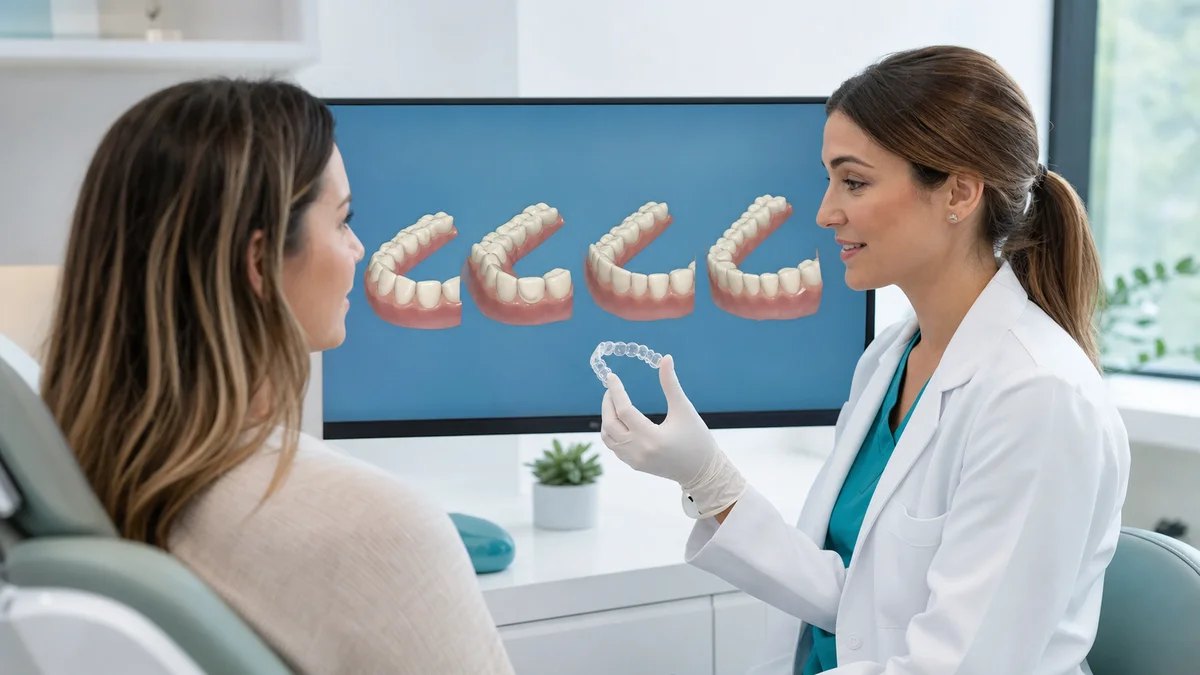
People searching invisalign pros and cons are often deciding between clear aligners, fixed braces and no treatment. Invisalign is a branded clear-aligner system, but the central clinical question is broader: can a removable sequence of custom trays safely produce the tooth and bite movements your diagnosis requires? Appearance matters, yet root position, gum health, bone support, bite function and patient cooperation matter more.
Clear aligners apply planned, gradual forces. A new tray represents another step toward the prescribed position; it is not simply a transparent cover. Attachments may be bonded to teeth, elastic bands may be requested, and small amounts of enamel between selected teeth may be reduced when clinically justified. The digital setup is a planning tool rather than a guaranteed forecast of exactly how biology will respond.
This patient guide presents benefits, limitations, safety questions and a practical decision table. It cannot determine eligibility from photographs, promise a treatment duration or replace examination and appropriate imaging. Invisalign is a registered brand; Redent Klinik does not imply that one commercial system is best for every patient. A clinician should compare suitable appliances and explain why a particular approach fits the diagnosis.
1. What Invisalign Does and Does Not Do
Invisalign treatment uses a prescribed series of removable plastic aligners to move teeth. The trays are manufactured from a digital plan and are changed according to the treating clinician’s schedule. The U.S. Food and Drug Administration explains that clear aligners are worn over teeth, are generally changed every one to two weeks as directed, and must be removed for eating, brushing and flossing. Individual protocols can differ.
Aligners may correct selected crowding, spacing, rotations and bite relationships. Their suitability depends on the size and direction of every required movement, root position, jaw relationship, erupted teeth, periodontal support and the patient’s ability to follow instructions. Some complex movements can require fixed braces, auxiliaries, extractions, temporary anchorage devices, restorative coordination or jaw surgery.
Clear aligners do not whiten teeth, rebuild worn enamel, replace missing teeth or cure gum disease. They cannot move an integrated dental implant. If a crown is attached to a natural tooth, the tooth may sometimes move with its root; an implant crown remains fixed in bone. These distinctions should be mapped before trays are ordered.
At this first stage, reviewing invisalign pros and cons means matching the appliance to a complete diagnosis rather than asking whether trays are popular. The same visible crowding can have different root, bone and bite conditions and therefore require different plans.
2. Invisalign Pros and Cons at a Glance
| Decision area | Potential advantage | Potential disadvantage | Question to ask |
|---|---|---|---|
| Appearance | Transparent trays are less noticeable than metal brackets | Attachments, elastics and tray edges may still be visible | What will my actual appliance setup include? |
| Removability | Trays come out for meals and cleaning | Removal creates opportunities to under-wear or lose them | Can I maintain the prescribed daily wear? |
| Hygiene | Normal brushing and interdental cleaning remain possible | Putting trays over unclean teeth can trap plaque and acids | What cleaning routine fits my risk level? |
| Diet | No bracket-related food restrictions while trays are out | Frequent snacks and drinks interrupt wear and cleaning | How will treatment fit my work and meal pattern? |
| Planning | Digital staging helps communicate intended movement | A simulation cannot guarantee biological tracking | Which movements are least predictable in my case? |
| Appointments | Some visits may be shorter than wire-adjustment visits | Monitoring is still necessary; refinements can add visits | How often will fit, gums, roots and bite be checked? |
| Comfort | No fixed wire or metal bracket | Pressure, edge irritation and attachment soreness can occur | Which symptoms are expected and which are urgent? |
| Retention | Final alignment can be maintained with prescribed retainers | Retention is long term and retainers need care or replacement | Is retention included in the written plan? |
A balanced review of invisalign pros and cons should never present removability as only a benefit. The same feature that makes meals and brushing easier transfers control to the patient. An excellent plan can underperform when trays are not worn, while perfect compliance cannot make an unsuitable movement predictable.
3. Advantage: A More Discreet Orthodontic Appliance
Clear trays are usually less conspicuous than conventional metal braces, which can be valuable for adults who speak publicly, work with clients or simply prefer a subtler appliance. There are no metal brackets across the front surfaces, and the aligner follows the shape of the teeth. That does not make treatment invisible.
Tooth-colored composite attachments may be placed on front or back teeth to help the aligner grip and deliver a planned force. Elastics can connect upper and lower arches. Saliva bubbles, staining, tray edges or the reflective surface can be noticeable at close range. Patients should ask to see a realistic example that includes attachments, not only a marketing photograph of a plain tray.
Speech can feel different initially because the tongue meets a new plastic surface. A mild temporary lisp may occur and often improves with adaptation, but the duration varies. Persistent speech difficulty, poor fit or a sharp edge should be assessed rather than accepted indefinitely.
4. Advantage: Removable Trays for Meals and Oral Hygiene
Because trays are removed for eating, there are no brackets that can break when chewing hard food and no wires that trap food. Patients can brush and clean between their teeth without navigating fixed hardware. This can make hygiene more familiar, but it does not automatically make the mouth healthier.
Teeth should be cleaned before aligners are reinserted when possible. Wearing a close-fitting tray after sugary or acidic food can keep that exposure near enamel. Frequent sipping can also reduce total wear time. Plain water is generally the simplest drink while trays are in, but the treating clinician’s product-specific guidance should be followed.
- Remove aligners for meals and drinks other than those permitted by your clinician.
- Brush with fluoride toothpaste and clean between teeth consistently.
- Clean trays with the recommended method and avoid very hot water that could distort them.
- Store trays in a protective case rather than a napkin, pocket or open surface.
- Continue routine dental examinations and professional cleaning during orthodontic care.
Active decay, uncontrolled gingivitis or periodontitis should be managed before elective movement. A removable appliance allows access for cleaning, but it cannot compensate for untreated disease or an inconsistent routine.
From a hygiene perspective, invisalign pros and cons are closely linked to behavior: removability permits thorough cleaning, while reinserting trays over plaque or frequent sugar and acid exposure can undermine that advantage.
5. Disadvantage: Wear Discipline Controls Progress
The FDA states that aligners commonly need to be worn about 22 hours each day, according to professional instructions. Exact wear advice may differ, but the principle is stable: insufficient wear can delay movement, cause a new tray not to seat and increase the likelihood of additional scans or refinement trays. Patients should not move to the next tray simply because a calendar date arrives if the treating clinician has advised otherwise.
Daily wear can be challenging for people who snack frequently, attend long social meals, travel constantly or have difficulty maintaining routines. Trays must be removed and stored, teeth need cleaning, and the appliance must be replaced promptly. Repeatedly leaving trays out for several hours can turn a theoretically convenient treatment into a frustrating one.
Before choosing from a list of invisalign pros and cons, simulate the routine for a week. Track meals, drinks, oral hygiene and the practical time available for wear. Honest self-assessment is safer than choosing an appliance only because it looks discreet.
6. Disadvantage: Not Every Movement Is Equally Predictable
Orthodontic movements differ. A small crown movement is not the same as controlling a root, uprighting a molar, correcting a large rotation or changing a significant vertical discrepancy. Some cases respond well to aligners alone; others need attachments, elastics, interproximal reduction, fixed braces, additional appliances or a combined approach.
The American Association of Orthodontists notes that clear aligners are among several appliance choices and that not every orthodontic problem can be treated successfully with every method. A responsible clinician should identify difficult movements before treatment and explain what would trigger a change in strategy.
Refinement trays are not automatically evidence of poor care. Teeth may track differently from the digital plan, and an updated scan can revise the remaining stages. However, patients deserve to know how many refinement rounds are included, whether additional fees apply and at what point another appliance would be recommended.
7. Attachments, Elastics and Enamel Reduction May Be Needed
A plain transparent tray is only one part of many aligner plans. Small composite shapes called attachments can provide purchase for rotations, extrusion or root control. They may feel rough when trays are out and can make removal more difficult at first. Their number, position and shape should reflect the required movements rather than a cosmetic promise.
Elastics may be used to influence upper-lower relationships. Success then depends on wearing both aligners and elastics as directed. Small spaces can sometimes be created by interproximal reduction, in which a measured amount of enamel is removed between selected teeth. The indication, amount, alternatives and possible sensitivity should be explained before consent.
The practical invisalign pros and cons therefore include the full prescribed system. Ask whether attachments will be visible, whether elastics are anticipated and whether enamel reduction or extraction is part of the plan. Consent should describe the actual treatment, not an idealized tray-only version.
8. Comfort Is Relative, Not Guaranteed
Many patients appreciate avoiding fixed brackets and protruding wire ends. Even so, orthodontic force can cause pressure or tenderness after a tray change. Aligners can rub cheeks, lips, gums or the tongue, and attachments can feel prominent. Mild short-lived discomfort may be expected, but severe, increasing or persistent pain needs review.
Do not cut, heat or aggressively reshape an appliance without instruction. A tray that does not seat, repeatedly lifts from a tooth, causes an ulcer or produces an unexpected bite change may need professional adjustment. Pain should not be used as proof that treatment is working.
Contact the treating team promptly for a loose tooth beyond what was explained, significant gum swelling, pus, fever, trauma, a broken attachment affecting fit, persistent numbness, severe pain, swallowing difficulty or an allergic-type reaction. Urgent local care may be required when traveling.
9. Oral Health Risks Still Require Monitoring
Orthodontic movement is a biological process. Potential concerns can include decay, white-spot lesions, gum inflammation, recession, loss of periodontal support, root shortening, unwanted movement, altered bite, temporary mobility and relapse. Individual risk depends on starting health, anatomy, force, treatment duration, hygiene, smoking, systemic conditions and monitoring.
Aligners cover tooth surfaces for much of the day. The ADA Forsyth Institute has reported ongoing research into how this covered environment may affect the oral microbiome, especially when gingivitis progresses. This does not mean aligners inevitably cause gum disease; it reinforces the need for plaque control and professional review.
Tell the clinician about medications, pregnancy, diabetes, bone conditions, previous orthodontics, jaw symptoms, gum disease and smoking or nicotine use. Radiographs should be prescribed according to clinical need, not taken automatically or omitted solely for convenience. A scan records tooth surfaces but cannot reveal every root, bone or disease finding.
10. Digital Simulation Is a Plan, Not a Promise
Three-dimensional software can show staged tooth positions and help the clinician communicate goals. It is useful for planning attachments, space and sequence. The animation is generated from programmed movements; it does not directly show how periodontal tissues, roots and patient behavior will respond over time.
Ask the clinician to show the roots and bite implications when available, not only a front-smile animation. The proposed final image may omit gum changes, restorative needs, tooth color, wear or the limits of jaw relationships. It should not be treated as a guaranteed cosmetic preview.
For informed consent, the digital review of invisalign pros and cons should identify both the intended correction and the movements that may require auxiliaries, additional trays or a change of appliance.
A high-quality discussion of invisalign pros and cons distinguishes the intended digital endpoint from the clinically achieved endpoint. Progress visits should check fit, tracking, tissue health and occlusion. If reality diverges from the setup, the plan may need revision rather than repeated reassurance.
11. Treatment Time Can Change
Advertised timelines are averages or examples, not personal commitments. Duration depends on the initial problem, number and complexity of movements, wear, lost trays, breakages, biological response, appointment attendance and refinements. Restorative or periodontal treatment can also change the sequence.
The FDA’s consumer information describes a broad aligner-treatment range, but an individual estimate should come from the treating clinician after diagnosis. Faster movement is not inherently better. Orthodontic force must respect supporting tissues, and attempts to accelerate movement without an appropriate indication can add risk.
- Ask for the estimated active phase and the assumptions behind it.
- Clarify how often trays change and who decides when to advance.
- Ask what happens when a tray is lost, damaged or no longer fits.
- Clarify whether refinement scans and replacement trays are included.
- Separate active treatment time from long-term retention.
12. Cost Means More Than the First Set of Trays
Price varies with diagnosis, case complexity, location, clinician time, records, brand, number of aligners and aftercare. Written estimates should identify examination, imaging, digital planning, attachments, interproximal reduction, elastics, refinement trays, emergency visits, retainers and follow-up. Whitening or restorative treatment should be listed separately.
Adult orthodontic insurance benefits may have waiting periods, age restrictions, exclusions, deductibles or a lifetime maximum. Cosmetic motivation does not necessarily mean the whole treatment is excluded, but coverage depends on the plan. A pre-treatment estimate is useful, though it is not a payment guarantee.
When comparing invisalign pros and cons with braces, compare complete plans addressing the same diagnosis. A low tray quote may exclude monitoring and refinements; a braces quote may include all adjustments and retention. Financing changes when money is paid, not the biological suitability or total obligation.
13. Retainers Are Part of the Treatment, Not an Optional Extra
Teeth can move after any orthodontic treatment. The FDA advises that a retainer follows active aligner treatment, and NHS orthodontic guidance warns that teeth can move toward their previous position when retainers are not worn as advised. The type and schedule are individualized, and long-term use is commonly necessary.
Retainers can wear, crack, distort or stop fitting. They should be stored safely, cleaned according to instructions and reviewed when damaged. Very hot water can deform some clear appliances. A retainer that suddenly feels tight can signal movement; forcing it without advice may be inappropriate.
The invisalign pros and cons calculation is incomplete without the cost and responsibility of retention. Ask how many retainers are provided, whether fixed or removable retention is proposed, how reviews work and what replacement costs. A straight result without a sustainable retention plan is unfinished care.
14. In-Person Diagnosis and Clinical Responsibility Matter
Mail-order or minimally supervised aligners can appear convenient, but an impression, scan or selfie is not a complete oral examination. The American Dental Association’s direct-to-consumer policy emphasizes the importance of diagnosis, informed consent, appropriate records and dentist responsibility. Teledentistry can support care; it should not erase accountability.
Patients should know the licensed dentist responsible for the diagnosis, treatment changes and emergencies. The plan should explain how gum health, decay, roots, bone and bite were assessed, how frequently clinical reviews occur and how records can be obtained. Sales staff should not make clinical eligibility decisions.
Red flags include guaranteed results from photographs, no named treating clinician, no periodontal assessment, refusal to provide records, pressure to pay before diagnosis, no plan for non-tracking teeth and no emergency pathway. Professional oversight remains important even when trays are delivered in batches.
15. Who May Be a Good Candidate and Who Needs Another Plan?
A potentially suitable patient has a diagnosis that the selected aligner system can manage, stable oral health, realistic expectations and the ability to maintain wear and hygiene. Adults and adolescents can be treated when development, erupted teeth and cooperation are appropriate. Age alone does not determine eligibility.
Another method or preliminary care may be better when there is untreated decay, active periodontal disease, insufficient wear capacity, a complex jaw discrepancy, impacted teeth, movements poorly suited to aligners or a need for multidisciplinary surgery. Some patients can use a hybrid plan, such as limited braces followed by aligners.
Personal priorities still matter. A patient-centered discussion of invisalign pros and cons should include appearance, speech, meal patterns, work travel, dexterity, budget and willingness to wear retainers, while keeping biological safety as the deciding boundary.
A clinical answer to invisalign pros and cons can therefore be “not yet” rather than yes or no. Stabilizing gum disease, restoring decay, extracting a hopeless tooth or coordinating an implant space may come first. Delaying trays until the mouth is ready can protect both health and investment.
Invisalign Pros and Cons Consultation Checklist
- Diagnosis: What tooth and bite problems are being treated?
- Alternatives: Why are clear aligners preferred over braces, observation or combined care?
- Records: Which examination, scans, photographs and radiographs support the plan?
- Limits: Which movements are least predictable and what is the backup strategy?
- Appliances: How many attachments, elastics or other auxiliaries are expected?
- Enamel: Is interproximal reduction or extraction proposed, and why?
- Wear: What daily wear and tray-change schedule is prescribed?
- Monitoring: How often will tracking, gums, roots and bite be assessed?
- Refinements: How many rescans or additional tray sets are included?
- Emergencies: Who responds to pain, loss, breakage or poor fit?
- Cost: Are records, visits, refinements and retainers included?
- Retention: Which retainer, wear schedule and replacement pathway are planned?
Redent Klinik offers general information for international patients on its English dental care page. You can use the English contact page to ask what records are needed for a preliminary review. Remote information cannot confirm suitability; final orthodontic decisions require examination and appropriate diagnostics.
Frequently Asked Questions About Invisalign Pros and Cons
Is Invisalign better than braces?
Neither is universally better. Aligners offer discretion and removability, while fixed braces do not depend on remembering to wear trays and may provide advantages for selected complex movements. Diagnosis, movement predictability, hygiene, lifestyle and patient preference should determine the appliance.
How many hours a day must Invisalign be worn?
The FDA describes typical clear-aligner wear as about 22 hours daily, but follow the schedule prescribed for your system and case. Consistently reduced wear can impair tracking and extend treatment. Remove trays according to instructions for eating and cleaning.
Can I eat while wearing clear aligners?
Aligners are generally removed for eating. Food can damage or stain trays and may become trapped near teeth. Ask what beverages are permitted; plain water is usually the simplest option. Clean teeth and trays as advised before reinsertion.
Does Invisalign hurt?
Pressure or mild tenderness can occur, especially after changing trays, and edges or attachments may irritate tissues. Severe, worsening or persistent pain is not something to ignore. Contact the treating clinician for poor fit, ulcers, swelling, unusual mobility or an unexpected bite change.
What happens if my teeth do not track?
The clinician may check wear, tray seating, attachments and the planned movement. An adjustment, temporary return to a previous tray, new scan, refinement series or different appliance may be appropriate. Do not skip ahead or alter trays without advice.
Will I need attachments with Invisalign?
Many plans use tooth-colored composite attachments to improve control. The number and visibility depend on the movements. Elastics or other auxiliaries may also be needed. Ask to review the planned setup before consenting rather than assuming treatment uses smooth trays alone.
Can Invisalign damage roots or gums?
All orthodontic movement has potential biological risks, including root shortening, gum recession or loss of support in susceptible patients. Starting periodontal health, anatomy, forces, hygiene and monitoring affect risk. A licensed clinician should assess and review these factors.
Do teeth stay straight after Invisalign?
Not automatically. Teeth can move throughout life and relapse after treatment. Retainers are prescribed to maintain the result and may be needed long term. Follow the individualized wear schedule and replace damaged or poorly fitting retainers promptly.
Can Invisalign move a dental implant?
No. An integrated implant is fixed in bone and does not move like a natural tooth. Adjacent natural teeth may sometimes be moved around an implant, but implant position and the final crown must be included in the orthodontic and restorative plan.
Conclusion: Decide From Diagnosis, Not Advertising
The most useful summary of invisalign pros and cons is that clear aligners exchange fixed hardware for patient-controlled treatment. They can be discreet, removable and compatible with familiar hygiene, but they demand disciplined wear, monitoring and retention. Attachments, elastics, enamel reduction or refinements may be part of real treatment.
Ask whether the required movements are predictable, what alternatives preserve health, how risks are monitored and who remains clinically responsible. Review the complete cost, including refinements and retainers. A thoughtful plan may recommend Invisalign, another aligner, braces, combined care or no immediate treatment. The best choice is the one that safely addresses the diagnosis and can be maintained over time.
Official Sources and Evidence Notes
- U.S. Food and Drug Administration: Braces Have Changed, From Metal to Tooth-Colored to Clear
- American Association of Orthodontists: Orthodontic Frequently Asked Questions
- American Association of Orthodontists: Clear Aligners
- American Dental Association: Direct-to-Consumer Dental Services Policy
- Nottingham University Hospitals NHS Trust: Retainers
- World Health Organization: Oral Health Fact Sheet
Sources reviewed July 13, 2026. Product instructions and individual clinical needs vary; follow the current plan of the licensed clinician responsible for your care.
Disclosure: this page may contain affiliate links. We may earn a commission if you use them, at no extra cost to you.