
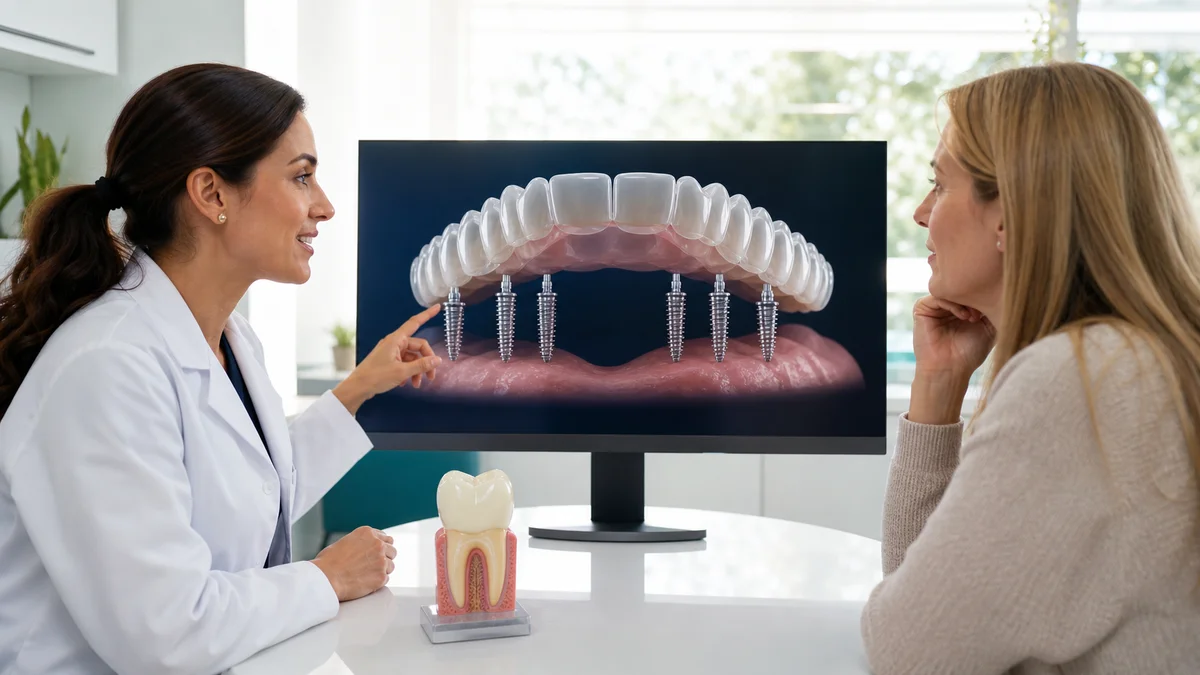
The question all on 6 dental implants or dental crowns which is better sounds like a comparison between two products, but the treatments solve fundamentally different problems. A dental crown is placed over a prepared natural tooth or an implant abutment. An All-on-6 restoration is a complete prosthetic dental arch supported by six implants placed surgically in the jaw. Choosing one can mean preserving teeth; choosing the other may mean extracting every remaining tooth in that arch.
That difference makes diagnosis more important than appearance, speed or package price. A heavily filled but maintainable tooth may benefit from a crown. A cracked, infected or severely periodontally compromised tooth may need a different plan. When most teeth are absent or have an unfavorable prognosis, a full-arch implant restoration may become a reasonable option. Six implants are not automatically necessary, sufficient or possible for every jaw.
This evidence-informed guide explains tooth prognosis, surgical implications, function, aesthetics, hygiene, complications, treatment time, costs and continuity. It cannot decide whether a tooth is restorable from a photograph and does not promise fixed teeth on the day of surgery. Extraction is irreversible, so uncertain or conflicting recommendations deserve careful review and sometimes an independent second opinion.
1. The Treatments Have Different Starting Points
A crown restores the visible part of an existing tooth. The dentist removes damaged or unsupported material, prepares the remaining tooth and bonds or cements a restoration over it. The American Dental Association explains that crowns can strengthen teeth with large fillings, protect weak teeth, restore broken teeth, improve selected shape or color concerns and also cover individual implants.
All-on-6 describes a full-arch design in which six implants support a fixed prosthesis replacing all teeth in an upper or lower arch. The restoration may also replace lost gum volume. Implant number, position and angle depend on bone, nerve and sinus anatomy, restorative space, opposing teeth, bite forces and clinician judgment. The term is a treatment concept, not a universal prescription.
When evaluating all on 6 dental implants or dental crowns which is better, begin with two separate questions: which natural teeth can be maintained, and what is the safest way to replace teeth that cannot? Crowns should not be used to hide untreated disease, and implants should not replace teeth that have a reasonable, maintainable prognosis solely for convenience.
2. All on 6 Dental Implants or Dental Crowns Which Is Better at a Glance?
| Decision factor | Dental crowns on natural teeth | All-on-6 full-arch restoration | Question to ask |
|---|---|---|---|
| Primary purpose | Restores individual existing teeth | Replaces a complete missing or non-restorable arch | Which teeth can be predictably saved? |
| Irreversibility | Requires tooth preparation | Requires surgery and usually extraction of remaining teeth | What tissue is removed, and why? |
| Support | Natural roots and periodontal ligament | Six implants integrated with jawbone | Is root, bone and gum support adequate? |
| Sensation | Retains natural tooth feedback when pulp and support permit | Lacks the same periodontal-ligament feedback | How may chewing feel different? |
| Cleaning | Each crown margin and contact is cleaned | The entire bridge and underside require specialized access | Can I clean the proposed design? |
| Failure pattern | One tooth or crown can fail independently | One implant or prosthetic problem can affect an arch-level design | How is repair handled? |
| Surgery | Usually no implant surgery for natural-tooth crowns | Implant surgery, possible grafting and healing | What medical and anatomical risks apply? |
| Maintenance | Decay, margins, roots, gums and bite require review | Peri-implant tissues, screws, prosthesis and bite require review | What is the lifelong maintenance plan? |
The table does not declare one winner because the biological starting conditions are different. In a mixed arch, the answer can also be neither extreme: periodontal care, root-canal treatment, selected crowns, bridges, partial dentures, individual implants or a staged combination may preserve more tissue.
3. Tooth-by-Tooth Prognosis Comes Before Extraction
A complete examination should identify decay, cracks, existing restorations, root-canal status, gum attachment, mobility, bone support, furcation involvement, crown-to-root relationship, position and strategic value. A tooth described as “bad” needs a specific diagnosis and a reasoned prognosis. Appearance alone cannot establish that it is hopeless.
The European Federation of Periodontology and American Academy of Periodontology have emphasized preserving natural teeth where possible and warned against unnecessary extraction for implants. Even advanced periodontal cases can sometimes be treated within a structured plan. Preservation is not always feasible, but it deserves serious consideration before irreversible removal.
- Ask for the diagnosis and prognosis of every remaining tooth.
- Separate currently symptomatic teeth from maintainable teeth.
- Ask whether periodontal, endodontic or restorative treatment could improve prognosis.
- Identify which findings make a tooth non-restorable rather than merely difficult.
- Compare preserving selected teeth with replacing the entire arch.
- Request an independent opinion if many functional teeth are scheduled for extraction.
For all on 6 dental implants or dental crowns which is better, the ethical threshold is especially important when one plan recommends several crowns and another recommends complete clearance. Different clinicians can reasonably weigh prognosis differently, but each should explain evidence, uncertainty, alternatives and expected maintenance.
4. When Dental Crowns May Be the More Conservative Choice
A crown may be considered when a natural tooth has insufficient structure for a filling, a large fracture, substantial wear, a large existing restoration or a need for protection after selected root-canal treatment. The root and surrounding tissues must still offer a reasonable foundation. A crown can improve form and function, but it cannot cure active gum disease or make a vertical root fracture predictable.
Preserving a natural tooth avoids implant surgery and maintains the periodontal ligament, which contributes sensory feedback. It also avoids converting an individual-tooth problem into a complete-arch prosthetic system. If one crowned tooth later needs treatment, other independent teeth may remain unaffected.
At this stage, all on 6 dental implants or dental crowns which is better is primarily a preservation question: if the roots, periodontal support and remaining structure offer a reasonable prognosis, restoring selected teeth can avoid unnecessary full-arch extraction.
Crowns are not noninvasive. Tooth structure is removed, and some teeth can develop sensitivity, pulp problems, recurrent decay, margin inflammation, fracture or loss of retention. A root-canal-treated tooth can still fracture or become reinfected. Crown treatment therefore needs a genuine indication, conservative preparation and a repair strategy.
5. When an All-on-6 Restoration May Be Reasonable
A full-arch implant restoration may be considered when an arch is already edentulous, when most teeth are missing, or when remaining teeth have a collectively poor prognosis that cannot be predictably stabilized. It can provide fixed support where a removable denture is unstable or unacceptable, provided anatomy, health, hygiene capacity and restorative design are suitable.
The FDA defines dental implants as medical devices placed surgically in the jaw to support crowns, bridges or dentures. It advises patients to discuss general health, smoking, healing, benefits, risks and the specific implant system with the treating provider. Those principles apply to six implants supporting one arch.
All-on-6 is not a rescue for every difficult mouth. Uncontrolled periodontal disease, poor plaque control, smoking, uncontrolled diabetes, severe grinding, insufficient bone, medication-related risk or inability to attend maintenance can change suitability. Bone grafting or a different prosthetic design may be needed, and some patients are safer with a removable option.
Conversely, all on 6 dental implants or dental crowns which is better may favor implant-supported replacement when an arch is already without teeth or when a documented majority of remaining teeth cannot be predictably restored and maintained.
6. Why Six Implants Are Not Automatically Better
More implants can increase support and create restorative options, but number alone does not determine success. Implants must be positioned where bone and prosthetic design allow useful force distribution and hygiene. Six poorly positioned implants do not outperform a well-diagnosed alternative simply because the number is larger.
Jaw size, bone quality, sinus location, nerve position and the intended bridge influence implant count. The clinician must also plan what happens if one implant does not integrate or later develops complications. Some designs can be modified; others may require a new prosthesis or additional treatment.
A sound review of all on 6 dental implants or dental crowns which is better asks why six implants are proposed for this particular arch. The answer should connect anatomy, restorative space, load, prosthesis material and contingency planning, not a standardized marketing package.
7. Surgery, Healing and Immediate Loading
Natural-tooth crowns commonly involve preparation, an impression or scan, a provisional restoration and final fitting. All-on-6 treatment adds surgery. It may involve extractions, implant placement, bone or soft-tissue procedures, sutures, medication and several stages of healing. The FDA notes that implant healing may take several months or longer.
Selected patients may receive a fixed provisional bridge soon after surgery when implant stability and restorative conditions are acceptable. “Same-day teeth” generally means a temporary prosthesis, not completed healing or the definitive bridge. If stability is inadequate, delaying fixed loading or using a removable temporary restoration can be the safer choice.
Ask what findings could change the plan during surgery, how pain and swelling are managed, which symptoms require urgent contact and who provides care after travel. A guarantee of immediate fixed teeth before surgery ignores clinical uncertainty.
8. Function and Bite Feel Different
Well-designed crowns can restore damaged tooth shape and distribute forces through natural roots. Individual natural teeth retain periodontal-ligament feedback, although previous root-canal treatment changes pulp sensation. Contacts between crowns must permit cleaning, and the bite should avoid destructive overload.
A full-arch implant prosthesis connects several implants and replaces multiple teeth as one structure. It can improve chewing compared with an unstable denture, but it does not reproduce natural teeth exactly. The absence of periodontal-ligament feedback can affect force perception, making bite design and review especially important.
Functionally, all on 6 dental implants or dental crowns which is better cannot be decided from a smile photograph. Bite contacts, jaw movement, opposing materials, speech and the patient’s adaptation must be included in the plan.
The answer to all on 6 dental implants or dental crowns which is better should include the opposing arch. Natural teeth, removable dentures, crowns and another implant bridge create different wear and force patterns. Grinding or clenching may require design changes, protective measures and more frequent maintenance.
9. Appearance, Lip Support and Prosthetic Gum
Crowns generally replace only visible tooth structure and emerge from natural gum contours. They can change shape, shade and proportion, but excessive preparation or bulky contours can harm tooth and gum health. A natural appearance depends on material, translucency, margin position, surrounding teeth and technician skill.
An All-on-6 bridge may replace both teeth and lost tissue. Pink prosthetic material can restore volume, and tooth position may influence lip support. That added volume must also be cleansable. A high smile line can expose the transition between natural gum and prosthetic gum, so the junction should be planned rather than hidden in photographs.
Digital previews and temporary restorations help communication but do not guarantee final biology or appearance. Ask to evaluate a relaxed face, full smile, profile, speech and cleaning access. Identical, overly white teeth are not a clinical measure of success.
10. Hygiene and Biological Risks
Crowned natural teeth remain vulnerable to plaque, decay at margins, root problems and periodontal disease. Daily brushing with fluoride toothpaste, interdental cleaning and professional reviews are necessary. A crown cannot protect a tooth from new disease when plaque and risk factors are uncontrolled.
Implants cannot develop tooth decay, but surrounding tissues can become inflamed. Poor hygiene, smoking, a history of periodontitis and other risk factors can contribute to peri-implant disease. The underside of a full-arch bridge must allow appropriate tools to pass without creating inaccessible plaque traps.
- For crowns, clean margins and contacts around every restored tooth.
- For All-on-6, clean around each implant and beneath the complete bridge.
- Use floss threaders, suitable interdental brushes or an irrigator only as instructed.
- Attend personalized periodontal or implant-maintenance appointments.
- Report bleeding, swelling, discharge, bad taste, mobility, fracture or bite changes.
- Address smoking, diabetes control and grinding as part of risk management.
Maintenance ability can decide all on 6 dental implants or dental crowns which is better. A technically impressive restoration that the patient cannot clean is not a durable solution.
11. Complications and Repair Pathways
Crown complications can include sensitivity, loss of vitality, recurrent decay, fracture, debonding, wear, gum recession, margin exposure, root fracture or failure of a previously treated root. Depending on the cause, the crown may be repaired, remade, root-treated or the tooth may eventually be extracted.
The FDA lists implant risks including injury to nearby teeth or tissues, sinus or jaw complications, altered bite, screw loosening, infection, delayed healing, difficulty cleaning, numbness and implant failure. Full-arch prostheses can also chip, wear, fracture or require screw and component replacement.
Risk should be described in terms of consequences, not only percentages. Ask whether a problem affects one tooth, one implant, the prosthesis or the entire arch; who diagnoses it; whether the bridge must be removed; how long repair takes; and what costs are excluded. “Lifetime” language should never substitute for a written maintenance and complication policy.
12. Treatment Time and Number of Visits
Selected crown treatment may be completed over a small number of visits after disease is stabilized, although complex reconstruction can take longer. Root-canal therapy, gum treatment, orthodontics, bite changes or laboratory trials can add stages. Rushing final crowns before gum levels and bite are stable can compromise the result.
All-on-6 commonly includes assessment, imaging, surgical planning, surgery, provisional restoration, healing reviews and manufacture of the definitive prosthesis. Guy’s and St Thomas’ NHS Foundation Trust describes implant care as a multi-stage process that can extend for months. Individual timing varies with grafting, healing and complications.
Travel dates should not dictate biological healing. When comparing all on 6 dental implants or dental crowns which is better abroad, ask how many visits are expected, what stage each visit completes and what happens if healing requires delay.
13. Cost Comparison Must Include the Full Lifecycle
Comparing a price per crown with a complete-arch implant package can be misleading. The crown plan may involve several individual teeth, foundation restorations, root-canal treatment, provisional crowns and periodontal care. The implant plan may include extractions, imaging, implants, grafting, sedation, provisional and definitive bridges, laboratory work and reviews.
Request itemized written plans with what is included and excluded. Determine whether repair, refinements, additional surgery, replacement temporaries, hygiene visits and long-term reviews are separate. Currency movement, travel and accommodation can affect international treatment cost.
Financially, all on 6 dental implants or dental crowns which is better requires comparing complete treatment lifecycles rather than one headline fee, because each option has different diagnostic, surgical, laboratory, repair and maintenance costs.
Neither treatment lasts forever without risk. Crowns may need repair or replacement, and the supporting tooth can fail. Implant components and prostheses can loosen, wear or need replacement, while biological complications can require treatment. Financing changes the payment schedule, not total risk or suitability.
14. Decision Path for All on 6 Dental Implants or Dental Crowns Which Is Better
- Control urgent disease: treat pain, infection and active inflammation.
- Record the baseline: complete examination, periodontal charting, photographs and indicated imaging.
- Assign tooth-level prognosis: restorable, questionable or non-restorable with reasons.
- Assess the arch: bite, restorative space, smile, function and strategic tooth distribution.
- Compare preservation: periodontal, endodontic, orthodontic and restorative alternatives.
- Assess replacement: removable dentures, bridges, individual implants and full-arch designs.
- Test maintenance: cleaning ability, risk factors, review access and repair pathway.
- Review consent: irreversible steps, uncertainty, complications, time and total costs.
- Seek another opinion: especially before extracting multiple maintainable teeth.
This pathway may produce a mixed plan rather than all crowns or complete extraction. The goal is not to preserve every tooth at any cost or to avoid implants categorically. It is to use the least destructive treatment that offers a reasonable, maintainable prognosis consistent with the patient’s informed priorities.
The final all on 6 dental implants or dental crowns which is better decision should therefore document why each tooth is preserved or removed, how the chosen design can be cleaned and what happens if one component later fails.
15. Planning Treatment Abroad and Continuity of Care
International treatment can involve different fees and scheduling, but clinical standards should remain clear. Before travel, ask who performs diagnosis, surgery and restoration; what credentials and responsibilities each clinician has; which implant system is used; and how records are transferred. Obtain device, component and laboratory details.
Remote review can help organize information but cannot confirm periodontal probing, mobility, cracks, occlusion or three-dimensional anatomy. A final plan should follow in-person assessment. Do not agree to extractions solely from a messaging conversation, filtered photographs or a package quote.
Redent Klinik provides general information about dental implants before and after, including what photographs cannot prove. You can use the English contact page to ask which records support preliminary review and how follow-up is organized. Personalized treatment requires clinical examination and informed consent.
16. Red Flags Before Choosing Either Plan
- Every remaining tooth is called hopeless without tooth-specific findings.
- Crowns are recommended on healthy teeth mainly to create instant uniformity.
- All-on-6 is guaranteed before examination or three-dimensional planning.
- Same-day provisional teeth are presented as completed healing.
- Periodontal disease, smoking or diabetes control is not discussed.
- No alternative involving tooth preservation or removable treatment is explained.
- The prosthetic gum and cleaning access are absent from the design discussion.
- There is no written plan for implant failure, fracture or crown complications.
- Payment pressure replaces a cooling-off period for irreversible extraction.
- The clinic will not provide records, implant details or responsible clinician names.
If these warning signs appear, pause the all on 6 dental implants or dental crowns which is better decision. A second opinion may confirm the first plan, reveal a more conservative option or clarify why extraction is justified.
Frequently Asked Questions
Are All-on-6 implants better than saving natural teeth with crowns?
Not automatically. Maintainable natural teeth generally deserve serious preservation consideration. All-on-6 may be appropriate when an arch is missing teeth or remaining teeth have a collectively unfavorable prognosis. Examination and tooth-by-tooth diagnosis are required before irreversible extraction.
Can crowns save every damaged tooth?
No. A crown needs adequate remaining structure, a treatable root and maintainable periodontal support. Vertical root fracture, severe non-restorable decay, uncontrolled infection or extreme support loss can make a tooth unsuitable. A crown cannot cure the underlying disease by covering it.
Do six implants mean the bridge cannot fail?
No. Implants may fail to integrate or later develop biological or mechanical complications. Screws and prosthetic materials can loosen, wear or fracture. Six supports can offer design advantages in selected anatomy, but number alone does not guarantee success.
Will I receive permanent teeth on the day of All-on-6 surgery?
Not necessarily. Selected patients may receive a fixed provisional restoration if stability and restorative conditions are acceptable. Healing is not complete that day, and the definitive bridge commonly follows later. A removable temporary may be safer if immediate loading criteria are not met.
Is All-on-6 easier to clean than individual crowns?
It is different, not inherently easier. Crowns need cleaning at each margin and contact. An All-on-6 bridge requires access around implants and beneath the full arch. The proposed shape should be demonstrated with the exact tools you can use.
Can dental crowns decay?
The crown material does not decay, but the supporting natural tooth can develop decay at or beneath a margin. Plaque, diet, dry mouth and margin quality affect risk. Fluoride, daily cleaning and regular examinations remain necessary.
How long do crowns and All-on-6 restorations last?
No individual lifespan can be guaranteed. Tooth condition, gum or implant health, bite, grinding, hygiene, smoking, materials, design and maintenance affect outcomes. Both plans can require repair or replacement, so discuss a long-term service pathway rather than a single number.
Should I get a second opinion before full-mouth extraction?
It is reasonable when several teeth are being removed, prognosis is uncertain, plans conflict or preservation options were not explained. Bring examinations and imaging so the second clinician can assess each tooth and compare maintenance, risks and alternatives.
Can I combine crowns and implants instead of choosing one?
Yes, selected patients may retain strategic natural teeth and replace only missing or non-restorable teeth. The design must account for tooth and implant behavior, bite and cleaning. A staged multidisciplinary plan may preserve more tissue than an all-or-nothing approach.
Conclusion: Preserve When Predictable, Replace When Necessary
The responsible answer to all on 6 dental implants or dental crowns which is better begins with prognosis. Crowns restore individual natural teeth; All-on-6 replaces a complete arch and introduces surgery, prosthetic gum, implant components and a different maintenance system. They are not interchangeable cosmetic upgrades.
Preserve natural teeth when they can be treated and maintained with a reasonable prognosis. Consider full-arch replacement when teeth are missing or cannot be predictably saved, after alternatives and irreversible consequences are understood. Ask for tooth-level evidence, a complete cost, a hygiene demonstration, a complication pathway and continuity of care. The best plan is the one that addresses disease while removing no more healthy tissue than necessary.
Official Sources and Evidence Notes
- U.S. Food and Drug Administration: Dental Implants – What You Should Know
- American Dental Association MouthHealthy: Crowns
- European Federation of Periodontology and American Academy of Periodontology: Preserving Natural Teeth
- Guy’s and St Thomas’ NHS Foundation Trust: Dental Implants
- American Dental Association: Evidence-Based Oral Health Information
- World Health Organization: Oral Health Fact Sheet
Sources reviewed July 13, 2026. Prognosis and implant suitability require current individual examination; this guide does not replace diagnosis or consent.
Disclosure: this page may contain affiliate links. We may earn a commission if you use them, at no extra cost to you.