
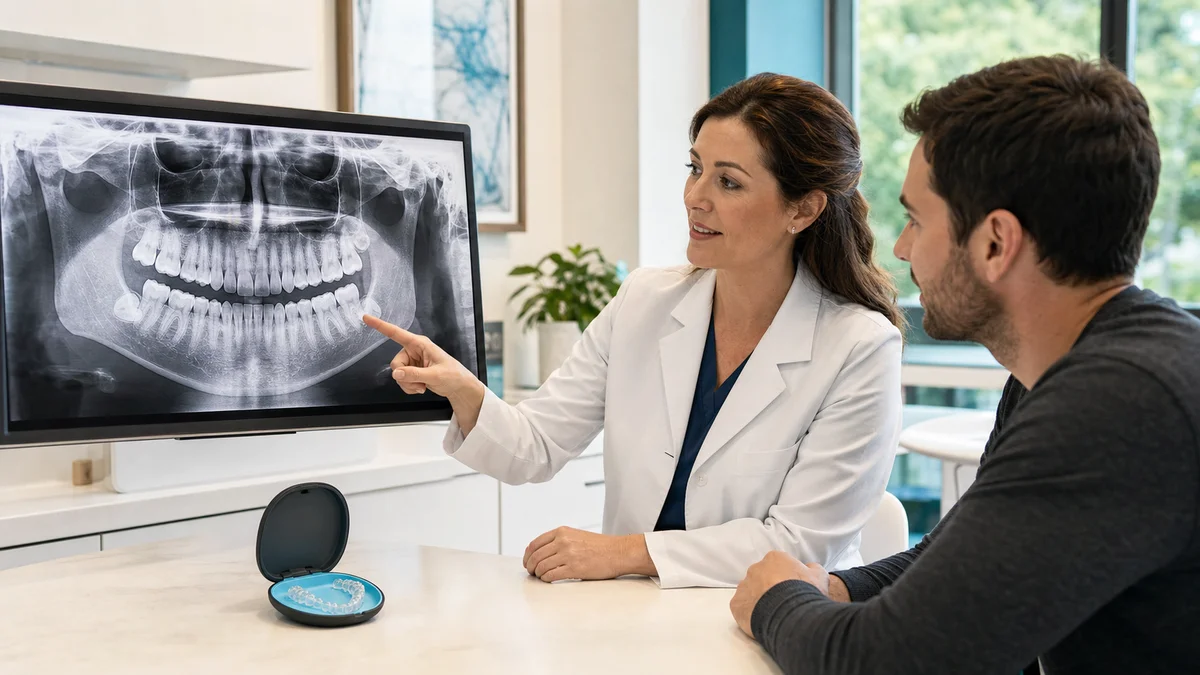
The search wisdom tooth removal vs invisalign often begins with two assumptions: that wisdom teeth push the front teeth crooked and that extraction might replace orthodontic treatment. Current patient guidance does not support that shortcut. Removing third molars creates a surgical wound at the back of the mouth; it does not actively move crowded incisors into alignment. Clear aligners apply controlled orthodontic forces, but they do not treat infection, decay, a cyst or another surgical problem around a wisdom tooth.
These treatments can be unrelated, sequential or coordinated. A healthy, fully erupted wisdom tooth may be monitored while aligner treatment proceeds. A repeatedly infected partially erupted tooth may need removal before or during orthodontics. A deeply impacted, disease-free tooth may be left in place if surgery would offer no clear benefit. The decision depends on symptoms, disease, anatomy, orthodontic goals and surgical risk, not simply the presence of a wisdom tooth on an X-ray.
This guide explains indications, myths, timing, risks, recovery, retainer planning and questions for a consultation. It cannot diagnose impaction from a photograph, prescribe extraction or guarantee that Invisalign suits a particular bite. Wisdom teeth sit near important structures, and orthodontic movements involve roots and bone; both require professional assessment and informed consent.
1. Wisdom Tooth Removal vs Invisalign: Different Problems, Different Treatments
Wisdom teeth, also called third molars, are the last teeth at the back of each arch. They may erupt normally, remain completely inside bone or gum, or emerge only partly. Impaction is a position, not automatically a disease. The NHS states that wisdom teeth are generally removed because they are causing problems such as pain, swelling, repeated gum infection, food trapping, decay, gum disease, abscess or a cyst.
Invisalign is a commercial clear-aligner system. Like other prescribed sequential aligners, it uses custom removable trays to move teeth gradually. The FDA describes clear aligners as plastic appliances worn over teeth and changed in stages under the direction of a dentist or orthodontist. They address malocclusion; they are not a medicine or surgical treatment for an infected third molar.
A clinically sound comparison of wisdom tooth removal vs invisalign therefore asks two independent questions. Does a wisdom tooth have disease or create a meaningful risk that justifies surgery? Does the patient have a tooth-position or bite problem that would benefit from orthodontics, and are clear aligners an appropriate appliance?
2. The Crowding Myth: Do Wisdom Teeth Push Front Teeth?
Front teeth can become more crowded over time for several reasons, including natural maturation, changes in the dental arches, tooth size and position, gum and bone conditions, previous orthodontic relapse and inconsistent retainer wear. It is tempting to blame the teeth erupting at the back, but timing does not prove that third molars are the cause.
A current NHS oral-surgery patient leaflet states that impacted wisdom teeth do not cause crowded front teeth and that removing them will not correct existing crowding. NICE guidance also advises against prophylactic surgery for healthy, disease-free impacted wisdom teeth because reliable evidence of patient benefit is lacking and surgery carries risk.
This means wisdom tooth removal should not be sold as a way to make incisors straight or prevent every future alignment change. When crowding is the concern, an orthodontic assessment should identify the actual tooth and arch relationships. If treatment moves the teeth, long-term retention is still necessary regardless of whether wisdom teeth are present.
For crowding alone, wisdom tooth removal vs invisalign is not a fair treatment contest: extraction does not straighten teeth, whereas aligners are designed to move teeth when the case is suitable.
3. Decision Table: Which Clinical Path Fits the Finding?
| Finding | Wisdom tooth approach | Orthodontic approach | Key question |
|---|---|---|---|
| Healthy, symptom-free impacted tooth | Often monitor rather than routine removal | Plan aligners according to the complete bite | What documented benefit would surgery add? |
| Repeated pericoronitis | Assess removal or another indicated surgical plan | Coordinate timing around healing | Can infection be stabilized before tooth movement? |
| Decay in wisdom tooth or adjacent tooth | Assess restorability, access and extraction indication | Do not use aligners to cover untreated disease | Which tooth is diseased and can it be restored? |
| Cyst, abscess or destructive lesion | Specialist assessment and disease-focused treatment | Usually defer elective movement until managed | What diagnosis does the imaging support? |
| Front-tooth crowding only | Extraction is not a straightening treatment | Evaluate aligners, braces or observation | What movements and space are actually needed? |
| Wisdom tooth near an important nerve | Compare monitoring, removal and possible coronectomy | Coordinate with the orthodontic plan | What is the nerve injury risk? |
| Relapse after previous braces | Do not assume third molars caused it | Assess retreatment and retainer history | Why did positions change, and how will they be retained? |
The right-hand column is not a self-diagnosis tool. A symptom-free tooth can still have disease visible clinically or radiographically, while pain near a wisdom tooth can originate from another tooth, muscle or joint. Diagnosis should precede extraction and orthodontic simulation.
4. When Wisdom Tooth Removal May Be Recommended
Removal may be appropriate when the expected benefit is greater than the surgical risk. Common reasons include untreatable decay, repeated or severe pericoronitis, abscess, cyst or tumor, disease affecting the adjacent second molar, periodontal destruction, resorption or interference with another necessary operation. The exact threshold depends on recurrence, severity, access for cleaning and anatomy.
One mild episode does not automatically establish the same plan as repeated infection. A fully erupted, functional and cleanable tooth may not need removal. A dentist or oral surgeon should explain what has been diagnosed, what happens if the tooth is monitored and why a particular procedure is recommended now.
- Location and angulation of the wisdom tooth
- Symptoms, recurrence and signs of infection
- Decay or gum damage on the wisdom tooth and second molar
- Relationship to the lower-jaw sensory nerves or upper sinus
- Presence of a cyst, resorption or other lesion
- Medical conditions, medicines, smoking and healing risk
- Patient preferences and ability to attend follow-up
In the wisdom tooth removal vs invisalign decision, an extraction indication should remain valid even if no aligner treatment were planned. Orthodontics may affect timing or access, but it should not invent disease where none exists.
5. When Monitoring May Be Safer Than Routine Surgery
NICE recommends that impacted wisdom teeth free from disease should not be removed routinely. The rationale is direct: there is no reliable evidence that preventive surgery benefits these patients, while every operation exposes them to complications. Monitoring generally means routine dental review and imaging only when clinically indicated.
Monitoring is an active plan, not neglect. The patient should understand symptoms that require assessment, whether cleaning is possible, how the adjacent second molar is protected and when review is due. Changes in pain, swelling, bad taste, opening, sensation or gum condition should be reported.
In a symptom-free case, the wisdom tooth removal vs invisalign discussion can reasonably lead to monitoring the third molar while independently evaluating whether orthodontic treatment is needed.
Age and anatomy can affect surgical difficulty, but they do not turn every symptom-free tooth into a mandatory extraction. The clinician should avoid vague predictions that a tooth “will definitely cause trouble” unless current findings support that conclusion.
6. When Invisalign or Another Orthodontic Appliance May Help
Clear aligners may be appropriate for selected crowding, spacing, rotations and bite relationships. The American Association of Orthodontists describes them as thin, custom trays that apply sequential pressure. Suitability depends on the required movements, roots, bone support, gum health, erupted teeth and patient cooperation.
Not every case is best treated with aligners. Fixed braces, elastics, attachments, interproximal enamel reduction, extraction of other teeth, temporary anchorage devices or jaw surgery may be more predictable for selected problems. A brand should not be chosen before the diagnosis and movement plan.
Orthodontically, wisdom tooth removal vs invisalign should focus on the required movements and available space rather than assuming that removal of the farthest-back tooth creates usable front space.
The FDA notes that aligners are removable for eating and cleaning and commonly require about 22 hours of daily wear according to professional instructions. Treatment ends with retention, not with the final active tray. Patients who cannot maintain wear may need another approach.
7. Does a Wisdom Tooth Need Removal Before Invisalign?
Not always. Healthy wisdom teeth can sometimes remain while aligner treatment proceeds. The orthodontist must know their position, whether they are erupted, whether disease is present and whether the treatment plan uses or moves nearby molars. A third molar does not automatically block aligner treatment.
Removal before aligners may be preferred when there is active or recurrent disease, when surgical access will be easier before attachments or trays, or when the tooth interferes with a planned movement or operation. The surgeon and orthodontist should agree on timing rather than give conflicting isolated instructions.
For wisdom tooth removal vs invisalign, “before” should be based on a practical clinical reason. If the wisdom tooth is healthy and irrelevant to the planned movement, unnecessary surgery can delay orthodontics and add avoidable recovery.
8. Can Wisdom Teeth Be Removed During Aligner Treatment?
Yes, selected extractions can be coordinated during treatment. The current tray may need adjustment or temporary pause because swelling, limited mouth opening and wound sensitivity can make insertion difficult. A tray edge should not traumatize the surgical site.
The orthodontist should advise which tray to wear, whether the change schedule pauses and when a new scan is needed. The oral surgeon should know about attachments, elastics and active tooth movement. Patients should not simply stop aligners for an undefined period or force a tray over painful tissues.
During active care, wisdom tooth removal vs invisalign becomes a timing and communication issue: the teams should protect the surgical site without allowing an avoidable loss of orthodontic progress.
Unexpected removal can change fit if the tray includes the wisdom tooth or if neighboring teeth move. Good coordination protects both healing and orthodontic tracking. Written instructions are especially useful when surgery and orthodontics occur at different clinics.
9. Surgery Risks Must Be Weighed Against the Benefit
Wisdom tooth extraction is common, but it is still surgery. The NHS lists possible dry socket, infection and injury to nearby nerves causing numbness or tingling of the lip, chin or tongue. Bleeding, swelling, bruising, jaw stiffness, pain and damage to adjacent structures can also occur. Individual risk depends on tooth position, roots, anatomy, health and surgical complexity.
Lower wisdom tooth roots may sit close to sensory nerves. When full removal creates a high nerve risk, a specialist may discuss coronectomy, which removes the crown while leaving roots. University College London Hospitals explains that this can reduce nerve injury risk in selected cases, although retained roots can later move or become infected and may need treatment.
Upper wisdom teeth can relate to the sinus, and difficult surgery can have additional risks. Consent should cover relevant anatomy, alternatives, expected recovery and what the clinician would do if findings change during the procedure.
10. Recovery and Aligner Wear Need a Shared Timeline
After extraction, discomfort and swelling are expected to vary. The NHS notes that swelling and pain often begin improving after the first days, although soreness and jaw stiffness can continue longer. Follow the treating team’s instructions for food, cleaning, medicines, smoking and emergency contact.
Do not let a rigid tray-change date override surgical healing. If opening is restricted, the tray does not seat, or the edge touches the wound, contact the orthodontic team. A short instructed pause may be preferable to damaging tissue, but an extended unplanned interruption can permit unwanted movement.
- Confirm which tray should be worn immediately before surgery.
- Ask when it can be safely reinserted after the procedure.
- Check whether any tray edge covers or irritates the extraction area.
- Clarify whether elastics or attachments change during recovery.
- Arrange review if the tray stops fitting after swelling decreases.
- Know who handles urgent surgical and orthodontic questions.
Coordinating wisdom tooth removal vs invisalign is therefore less about choosing one and more about protecting two biological processes: socket healing and controlled tooth movement.
11. Pain Is Not Enough to Diagnose the Source
Pain at the back of the jaw may come from pericoronitis, decay, a cracked second molar, gum disease, jaw-muscle strain, temporomandibular disorders or another cause. An impacted tooth seen on imaging may be incidental. Treatment should match the source of symptoms.
Similarly, discomfort while wearing aligners may relate to expected orthodontic pressure, a sharp edge, an attachment, poor tracking, gum inflammation or an unrelated wisdom tooth problem. Removing the aligner may temporarily reduce pressure but does not diagnose the cause.
Seek prompt assessment for severe or worsening swelling, fever, bad taste with increasing pain, uncontrolled bleeding, swallowing or breathing difficulty, spreading facial swelling, persistent numbness or inability to open the mouth. These findings need clinical triage rather than online comparison.
When symptoms are present, an online wisdom tooth removal vs invisalign comparison must never delay examination, because infection and surgical complications require diagnosis before elective tooth movement continues.
12. Space Creation Is an Orthodontic Decision
Removing a wisdom tooth creates a socket far behind the teeth commonly visible in the smile. It does not automatically make usable space at the front or cause incisors to uncrowd. Orthodontic space management may involve arch development within biological limits, interproximal reduction, movement of back teeth, extraction of different teeth or acceptance of a limited result.
The planned final positions should respect gum and bone boundaries. Digital simulations can show programmed movement but cannot guarantee how roots and tissues respond. Ask what space is required, where it comes from and which movements are least predictable.
When a clinician discusses wisdom tooth removal vs invisalign for crowding, request a clear map connecting each extraction and each tooth movement. If removing a third molar is proposed only to prevent front crowding, ask for the evidence and a specialist orthodontic opinion.
13. Retainers, Relapse and the Role of Wisdom Teeth
Teeth can shift after orthodontic treatment whether wisdom teeth are present, absent, erupted or impacted. Retainers help maintain corrected positions while tissues adapt and throughout later changes. A history of relapse commonly involves multiple factors, including reduced retainer wear.
Extracting wisdom teeth does not eliminate the need for retainers. The FDA and orthodontic guidance treat retention as a normal stage after active aligner therapy. Retainers can wear, distort, break or stop fitting and may need replacement.
A patient who notices crowding years after braces should have the bite, gum health and retainer assessed rather than assuming wisdom teeth are pushing. Forcing an old retainer or ordering unsupervised trays can damage teeth or mask disease.
14. Cost and Insurance Are Separate for Surgery and Orthodontics
Wisdom tooth surgery cost depends on the number of teeth, complexity, imaging, surgeon, facility, anesthesia or sedation and follow-up. Aligner cost depends on diagnosis, records, appliance system, number of stages, attachments, refinements, monitoring and retainers. One fee does not replace the other when both are indicated.
Dental or medical coverage varies by country and policy. A plan may cover medically indicated extraction differently from adult orthodontics. Waiting periods, deductibles, annual maximums, exclusions and prior authorization can apply. Ask insurers for written estimates using itemized clinical codes.
For an honest wisdom tooth removal vs invisalign budget, include lost work time, medicines, emergency care, replacement trays and retainers. Financing changes payment timing, not surgical indication or orthodontic suitability.
15. Consultation Checklist and Red Flags
- Diagnosis: What disease or orthodontic problem has been identified?
- Symptoms: Which finding explains pain or swelling?
- Imaging: Where are roots, nerves, sinus and adjacent teeth?
- Monitoring: What is the risk of leaving a healthy tooth in place?
- Surgery: What benefit justifies removal now?
- Alternatives: Is treatment, monitoring or coronectomy appropriate?
- Orthodontics: Which teeth must move and why are aligners suitable?
- Timing: Should surgery happen before, during or after active movement?
- Recovery: How will tray wear change while the socket heals?
- Retention: What long-term retainer plan maintains alignment?
- Responsibility: Which clinician handles each complication?
- Cost: Are imaging, surgery, refinements and retainers included?
Red flags include promising that wisdom tooth extraction will straighten the front teeth, recommending routine removal without disease or benefit, starting aligners over active infection, using only a selfie for diagnosis, guaranteeing a digital result, or providing no coordination between surgeon and orthodontic clinician.
A safe wisdom tooth removal vs invisalign plan names the responsible clinicians, documents separate indications and gives the patient a clear sequence for treatment, healing and retention.
Redent Klinik offers a detailed guide to Invisalign pros and cons, including wear, attachments, refinements and retention. You can use the English contact page to ask which records are needed for preliminary review. Final decisions require in-person examination and appropriate imaging.
Frequently Asked Questions About Wisdom Tooth Removal vs Invisalign
Will removing wisdom teeth straighten crowded front teeth?
No. Removal does not apply orthodontic force and does not move incisors into alignment. Current NHS patient information states that impacted wisdom teeth do not cause crowded front teeth. Existing crowding requires orthodontic diagnosis, and any corrected position still needs retention.
Must wisdom teeth be removed before Invisalign?
No. Healthy wisdom teeth can often be monitored during aligner treatment. Removal may be advised when disease, repeated infection, anatomical risk or a specific treatment objective justifies it. The surgeon and orthodontic clinician should coordinate timing.
Can Invisalign fix an impacted wisdom tooth?
Invisalign is not a treatment for infection, cysts or other disease around an impacted third molar. Clear aligners move selected teeth when planned by a clinician. Management of the wisdom tooth can involve monitoring, removal or another surgical option depending on diagnosis.
Can I wear aligners immediately after wisdom tooth surgery?
Follow individualized instructions. Swelling, limited opening or a tray edge near the wound may require adjustment or a short planned pause. Do not force a poorly fitting tray or independently stop treatment for a prolonged period; contact both teams.
Why might a surgeon recommend coronectomy?
When lower wisdom-tooth roots are close to important sensory nerves, removing only the crown and leaving the roots can reduce nerve injury risk in selected patients. Retained roots can later move or become infected, so risks and follow-up must be discussed.
Do symptom-free impacted wisdom teeth need removal?
Not routinely. NICE advises against operating on disease-free impacted wisdom teeth without a demonstrated benefit because surgery carries risk. Monitoring should include routine dental care and reassessment if symptoms or disease develop.
Can wisdom teeth cause aligners not to fit?
An erupting or changing tooth can affect local fit if it is included in the tray, but many other causes of poor tracking exist, including wear, attachment loss and movement differences. The clinician should inspect the tray and mouth before deciding on extraction or refinement.
How long after extraction can Invisalign treatment start?
There is no universal interval. Timing depends on surgical complexity, healing, symptoms, tray design and planned tooth movement. The surgeon and orthodontic clinician should agree on a safe start or restart point after examining the site.
Will wisdom tooth extraction prevent orthodontic relapse?
No guarantee exists. Teeth can shift for many reasons, and extraction does not replace retention. Follow the prescribed retainer schedule, obtain replacements when needed and seek assessment if teeth move or the retainer no longer fits.
Conclusion: Coordinate Diagnosis, Surgery and Tooth Movement
The clearest answer to wisdom tooth removal vs invisalign is that these treatments have different indications. Remove a wisdom tooth when diagnosed disease or another specific benefit outweighs surgical risk. Use Invisalign or another orthodontic appliance when a suitable tooth-position or bite problem requires controlled movement.
Do not remove healthy third molars solely to straighten or protect front teeth, and do not expect aligners to treat surgical disease. Ask for the diagnosis, imaging rationale, alternatives, nerve and healing risks, space plan, timing and retention strategy. When both treatments are needed, coordinated written instructions can protect recovery without losing orthodontic progress.
Official Sources and Evidence Notes
- NHS: Wisdom Tooth Removal
- National Institute for Health and Care Excellence: Guidance on Wisdom Tooth Removal
- Somerset NHS Foundation Trust / British Association of Oral Surgeons: Removing Wisdom Teeth
- University College London Hospitals NHS Foundation Trust: Coronectomy
- U.S. Food and Drug Administration: Clear Aligners and Orthodontic Treatment
- American Association of Orthodontists: Clear Aligners
- American Dental Association: Evidence-Based Oral Health Information
- World Health Organization: Oral Health Fact Sheet
Sources reviewed July 13, 2026. NICE has noted that its wisdom-tooth guidance is being updated; clinicians must apply current guidance with individual findings and patient preferences.
Disclosure: this page may contain affiliate links. We may earn a commission if you use them, at no extra cost to you.