
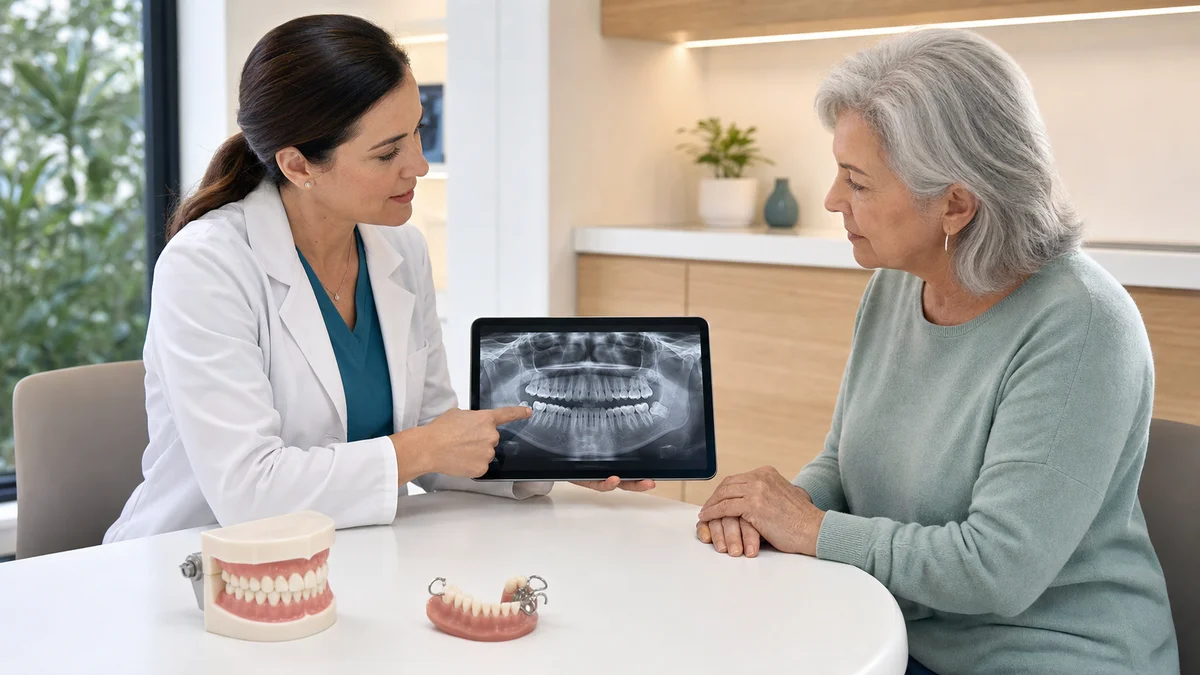
Searching wisdom tooth removal or dentures which is better can make two very different dental treatments sound like alternatives. They are not. Wisdom tooth removal treats a third molar that is diseased, damaging nearby structures or repeatedly causing problems. Dentures replace missing teeth to restore appearance and function. A person may need one, neither, or both as separate parts of a wider plan.
The useful question is not which treatment wins. It is whether a wisdom tooth should be retained or removed, whether other missing teeth should be replaced, and how any surgery and prosthetic care should be sequenced. This guide offers a safe framework for that discussion. It cannot diagnose pain, swelling or a denture problem online.
Why Wisdom Tooth Removal and Dentures Are Not Direct Alternatives
Wisdom teeth are the third molars at the back of the mouth. They may erupt fully, remain partly covered by gum or stay impacted in bone. A dentist evaluates their position, cleanliness, relationship to neighboring teeth and nearby anatomical structures. Removal is considered when the likely benefit of treating a problem outweighs surgical risk.
A denture is a removable prosthesis. A partial denture replaces some missing teeth, while a complete denture replaces all teeth in an upper or lower arch. Its purpose is restorative: it can help fill spaces, support appearance and improve chewing or speech for selected patients. It does not treat an infected socket, an impacted third molar, a cyst or damage to the tooth in front.
This distinction prevents two common misunderstandings:
- Keeping a diseased wisdom tooth does not become safe merely because a denture is available.
- Removing a wisdom tooth does not restore other missing front teeth or chewing teeth.
- A routine third-molar extraction usually does not create a space that needs a replacement tooth.
- Dentures may be planned around the removal of other non-restorable teeth, but that is a separate diagnosis.
When a patient has several concerns, a comprehensive examination allows the dental team to create one coordinated plan. That plan may preserve sound teeth, treat active disease, remove teeth that cannot predictably remain, allow tissues to heal and then provide an appropriate replacement.
Wisdom Tooth Removal or Dentures Which Is Better by Situation?
| Clinical situation | Likely pathway to discuss | Why |
|---|---|---|
| Healthy, functional wisdom tooth that can be cleaned | Monitoring may be appropriate | Removal is not automatically beneficial when a third molar is disease-free; regular review can detect change. |
| Repeated inflammation, non-restorable decay, abscess or cyst around a wisdom tooth | Wisdom tooth treatment, often including removal | The goal is to control pathology and protect nearby tissues, not to replace the tooth with a denture. |
| Missing front teeth or functional premolars and molars | Tooth-replacement assessment | A partial denture, bridge, implant or another plan may restore selected missing teeth. |
| All teeth in one arch are missing | Complete denture or implant-supported option assessment | The aim is to restore an edentulous arch, fit, comfort and function. |
| Several non-restorable teeth plus a problematic wisdom tooth | Coordinated extraction and replacement plan | Surgery, healing and denture design should be sequenced rather than chosen as competing treatments. |
| Lower wisdom tooth close to an important nerve | Specialist risk assessment | Further imaging, monitored retention, complete removal or a procedure such as coronectomy may be discussed. |
| Pain beneath an existing denture near the back of the mouth | Prompt dental examination | The cause could involve fit, pressure, infection, a retained tooth or another condition; guessing can delay care. |
The table describes questions to raise, not treatment recommendations for an individual. Symptoms, medical history, examination findings and radiographs can change the safest route. Treatment should also reflect the patient’s priorities after the clinician explains reasonable options, uncertainties and risks.
When a Wisdom Tooth May Need Removal
The current NHS wisdom tooth removal guidance lists problems such as pain and swelling, pericoronitis, food trapping, decay, gum disease, cyst formation and dental abscess. A poorly positioned third molar can also damage the second molar in front of it. These findings require clinical assessment; the presence of a wisdom tooth alone does not establish a need for surgery.
The National Institute for Health and Care Excellence guidance advises against routine removal of healthy, disease-free impacted wisdom teeth. Although that guidance is under review, its published recommendation remains an important reminder that every operation has potential harm. A patient with a retained tooth needs an appropriate monitoring plan rather than an assumption that no future problem can occur.
Reasons a dentist or oral surgeon may discuss intervention include:
- Decay that cannot be restored predictably;
- Repeated or significant infection around a partly erupted tooth;
- Abscess, cyst or another pathological change;
- Periodontal damage to the wisdom tooth or neighboring second molar;
- Resorption or other damage affecting the adjacent tooth;
- A third molar obstructing another necessary surgical or restorative procedure;
- Persistent symptoms that correspond to examination and imaging findings.
Not every episode of discomfort means extraction is inevitable. The dentist must identify the source. Jaw-joint pain, a cracked second molar, decay elsewhere, gum inflammation and muscular pain can be mistaken for a wisdom tooth problem. Removing a tooth that is not responsible for the symptoms may not relieve them.
When Monitoring a Wisdom Tooth May Be Reasonable
A fully erupted, functional, cleanable and disease-free wisdom tooth may remain in place. An asymptomatic impacted tooth may also be monitored when there is no disease and surgery would not offer a clear net benefit. Monitoring is an active plan, not neglect. It can include dental examinations, periodontal assessment and imaging when clinically indicated.
The American Association of Oral and Maxillofacial Surgeons patient information notes that retained third molars require professional review because lack of pain does not prove absence of disease. This position and the NICE approach use somewhat different health-system framing, but both support an individualized assessment rather than a one-size-fits-all rule.
A review plan may change if cleaning becomes difficult, a gum pocket deepens, decay appears, infection recurs or imaging shows damage. Patients should understand what symptoms require an earlier appointment and how often their dentist recommends reassessment.
What Dentures Treat and What They Cannot Treat
According to the NHS dentures guidance, dentures replace one or more missing teeth and can help with difficulties related to eating, speaking or appearance. A partial denture uses the remaining mouth for support and retention. A complete denture rests on the tissues of an arch with no natural teeth.
Dentures do not remove infection, cure gum disease or make a non-restorable tooth healthy. Active disease generally needs to be stabilized as part of the plan. Remaining teeth must be evaluated because their condition affects the design and prognosis of a partial denture. The gums, oral lining, jaw relationships, saliva, dexterity and expectations also affect comfort and function.
A removable denture is one replacement option. Depending on anatomy, health, preferences and resources, the dentist may also discuss a fixed bridge, dental implant, implant-supported denture, no immediate replacement, or a staged combination. There is no universally superior replacement. Each option has maintenance needs and limitations.
Do You Need a Denture After Wisdom Tooth Removal?
In routine care, an extracted wisdom tooth is generally not replaced. Third molars sit at the back of the dental arch, and removing one usually does not create a visible or functionally necessary gap that calls for a denture. Making a removable denture solely to replace a wisdom tooth would be unusual.
That answer can change only in exceptional anatomy or a broader restorative plan, which is why an examination still matters. A person may already have missing first or second molars, an unusual bite, or a prosthesis that interacts with the area. The dentist should assess the full arch rather than infer a rule from the tooth number alone.
If other teeth are removed at the same time, a partial or complete denture may be planned to replace those teeth. In that situation, the denture is not a substitute for wisdom tooth surgery. It is the restorative phase of a coordinated plan.
Assessment Before Wisdom Tooth Surgery
Planning begins with symptoms, dental and medical history, medicines, allergies, smoking or vaping, previous healing problems and the patient’s goals. The clinician examines the wisdom tooth, surrounding gum, neighboring teeth, mouth opening and signs of infection. Imaging helps show the tooth’s angle, root form, bone and relationship to important structures.
Lower wisdom-tooth roots may lie near the inferior alveolar nerve, and the lingual nerve also requires consideration during surgery. Upper third molars can be close to the maxillary sinus. The clinician should explain individual risks without using a generic percentage as though it applies to everyone.
For a lower tooth with a close nerve relationship, a specialist may discuss further imaging or an alternative such as coronectomy, where the crown is removed and roots are intentionally retained in selected cases. The recent University College London Hospitals guidance explains that this option may be considered when complete removal carries a higher nerve-injury risk. It is not suitable for every tooth.
What Recovery From Wisdom Tooth Removal Involves
The procedure may be performed with local anesthesia; sedation or general anesthesia may be considered for selected complexity or patient needs. The tooth may be removed whole or sectioned. Stitches may be placed. The actual plan depends on position and surgical access.
After removal, a blood clot forms in the socket and supports healing. Patients receive individualized instructions on bleeding control, cleaning, eating, activity and medicines. Follow the treating clinician’s advice because instructions can differ with the procedure, medical history and anesthesia.
Common temporary effects include pain, swelling, bruising, jaw stiffness and difficulty chewing. The NHS notes that symptoms should begin to improve, although the area may remain uncomfortable for longer after a difficult procedure. Avoid smoking because it can interfere with healing and increase complications. Do not exceed medicine directions, and ask a dentist, physician or pharmacist if a pain medicine may be unsuitable for you.
Wisdom Tooth Removal Risks and Urgent Warning Signs
Potential complications include bleeding, infection, dry socket, injury to neighboring teeth, sinus communication after some upper extractions, and altered sensation if a nearby nerve is affected. Numbness or tingling can be temporary but, rarely, may persist. The consent discussion should be specific to the tooth and proposed procedure.
Dry socket occurs when the protective clot is lost or breaks down before the socket heals. Increasing pain, unpleasant taste or bad breath several days after extraction warrants contact with the dental team. It is assessed and treated clinically; antibiotics are not automatically the answer.
Seek urgent dental advice for bleeding that does not stop with the instructed pressure, severe or worsening pain and swelling, fever, feeling unwell, pus or a bad taste associated with increasing symptoms. Severe swelling affecting breathing or swallowing, heavy uncontrolled bleeding or a serious facial injury requires emergency medical help. Local emergency routes differ by country, so use the service available where you are.
Types of Dentures and How Timing Changes the Choice
A conventional denture is usually designed after tissues have healed sufficiently for more stable records. An immediate denture is made before planned extractions and inserted at or soon after removal. It can reduce the time a patient is visibly without teeth, but its fit is less predictable because the mouth changes as the sockets and gums heal.
The NHS explains that immediate dentures commonly need adjustment or replacement as the mouth changes shape. Patients should budget time for reviews and understand whether relining, rebasing or a later definitive denture is included in their treatment agreement. No clinician can guarantee a perfect long-term fit from records made before extractions.
Common categories include:
- Acrylic partial denture: a removable option that can replace several teeth and may be used provisionally or definitively depending on the design.
- Metal-framework partial denture: a carefully designed removable prosthesis that may be thinner or more stable in selected mouths.
- Complete denture: a removable prosthesis replacing all teeth in an upper or lower arch.
- Immediate denture: a prosthesis prepared before extraction and fitted during the healing phase.
- Implant-supported or implant-retained denture: a removable or fixed design that uses implants for added support or retention when suitable.
Names alone do not decide suitability. The number and position of missing teeth, quality of remaining teeth, ridge form, space, bite, oral hygiene, medical factors and ability to attend maintenance visits all matter.
Planning Dentures When Teeth Also Need Extraction
When multiple teeth are non-restorable, the dentist should decide which teeth can contribute to the long-term plan and which should be removed. Preserving a tooth that has a poor prognosis can destabilize a new partial denture, while removing a maintainable tooth unnecessarily sacrifices natural support. This is a risk-benefit decision, not a race to an all-or-nothing solution.
Records may include photographs, radiographs, periodontal measurements, impressions or scans and jaw-relation records. The dental team discusses tooth shade, shape and position where relevant. A trial stage may be possible for conventional dentures, while immediate dentures involve more estimation because the teeth scheduled for removal are still present when the prosthesis is made.
If a wisdom tooth also needs surgery, its healing site, access and relationship to the planned denture should be considered. A new prosthesis must not place harmful pressure on a fresh wound. Instructions on when to insert, remove or adjust an immediate denture must come from the treating team.
Living Safely With Dentures
New dentures take practice. Speech and eating may feel different, and starting with manageable foods can help. Persistent pain is not something to tolerate indefinitely; pressure spots, instability and bite errors require review. Never grind or reshape a denture at home.
The American Dental Association’s MouthHealthy denture guidance recommends daily cleaning of dentures and the oral tissues. Denture material can be scratched by abrasive products, and heat can distort some appliances. Follow the dental team’s and product manufacturer’s directions.
Unless specifically advised otherwise, dentures are generally removed at night to rest the tissues and reduce risk. Clean the tongue, gums, palate and any natural teeth. Remaining teeth still need fluoride toothpaste, interdental cleaning as appropriate and professional review. A complete-denture wearer also needs periodic oral examinations because the clinician checks the tissues, fit and function, not only natural teeth.
Contact a dentist if a denture becomes loose, painful, damaged or difficult to use, or if the mouth develops persistent redness, ulceration, bleeding or unusual changes. Jawbone and gum contours can change over time, so a once-comfortable denture may later need adjustment or replacement.
How to Compare Benefits, Burdens and Long-Term Maintenance
Wisdom tooth removal has a surgical burden and a healing period, but when clearly indicated it addresses a source of disease or damage. Retaining a tooth avoids immediate surgery but requires monitoring and may leave a future risk that should be understood. The balance depends on present pathology, anatomy, age, health and patient preference.
Dentures avoid preparation of some fixed-restoration options and can replace multiple teeth, but they are removable appliances that need cleaning, adaptation and maintenance. Fit can change as tissues remodel. Bridges and implants have different surgical, biological, technical and financial considerations. None is maintenance-free.
A useful consent conversation covers:
- The diagnosis and what happens if no treatment is chosen now;
- Reasonable alternatives, including monitored retention where appropriate;
- Procedure-specific risks and uncertainties;
- Expected recovery, adaptation and review appointments;
- Which parts of the plan are provisional and which are definitive;
- Cleaning and long-term maintenance responsibilities;
- Total estimated fees and possible additional stages without promising a fixed final cost;
- What symptoms should trigger urgent contact.
A Practical Appointment Checklist
Bring a current medicine list, relevant health history, previous dental imaging if available, and the existing denture if one is causing trouble. Describe when symptoms started, what makes them better or worse, and whether there has been swelling, discharge, altered taste, numbness or difficulty opening the mouth.
Ask the dentist to show the findings on the radiograph or scan and identify which tooth is responsible. If replacement is proposed, ask which missing teeth the denture will replace and why those spaces need restoration. The treatment plan should make the sequence explicit.
- Confirm the diagnosis for each tooth and area.
- Identify teeth that can be restored and maintained.
- Discuss monitoring versus treatment for the wisdom tooth.
- Assess surgical complexity and referral needs.
- Define which missing teeth require replacement.
- Compare removable, fixed and implant-supported options where appropriate.
- Choose immediate or post-healing denture timing if extractions are planned.
- Document healing reviews, adjustments and definitive treatment stages.
At Redent Klinik, a consultation can coordinate surgical and restorative questions around one evidence-based plan. Patients arranging an assessment can use the Redent Klinik contact page and share available radiographs, medical information and details of any existing prosthesis. A remote review can organize questions, but final suitability requires an appropriate clinical examination.
Frequently Asked Questions
Wisdom tooth removal or dentures which is better for back-tooth pain?
Neither can be chosen safely from the location of pain alone. A dentist must identify whether the source is a wisdom tooth, neighboring molar, gum, jaw joint, denture pressure or another condition. Removal treats an indicated tooth problem; a denture replaces a missing tooth and does not cure an undiagnosed infection.
Will I need a denture after one wisdom tooth is removed?
Usually not. Third molars are generally not replaced after routine extraction. If other important teeth are missing or scheduled for removal, a separate tooth-replacement assessment may recommend a partial denture or another option. The design should be based on the entire arch.
Should every impacted wisdom tooth be removed?
No. NICE advises against routine removal of disease-free impacted wisdom teeth, while professional review and monitoring remain important. Removal may be appropriate when there is disease, repeated problems, damage or another clear indication. Individual anatomy and surgical risk must be considered.
Can a denture be fitted on the same day as tooth removal?
An immediate denture can be made before planned extractions and fitted during the same treatment phase. It is more relevant when visible or functional teeth are removed, not for an isolated wisdom tooth. Healing changes the mouth, so adjustments, relining or later replacement may be needed.
How long should I wait for a permanent denture after extraction?
There is no universal waiting period. Tissue remodeling, number and location of extractions, healing, health and the type of prosthesis affect timing. Some patients use an immediate denture while healing; others wait before definitive records. The dentist should explain review points rather than promise an exact date.
Can I wear my existing denture after wisdom tooth surgery?
Ask the treating dentist or surgeon before wearing it. If the appliance contacts or loads the surgical area, it may need adjustment or temporary non-use. Instructions depend on the denture design, extraction site and healing. Do not force a prosthesis into place over swelling or pain.
What is better than dentures for missing teeth?
A bridge or implant-supported restoration may be appropriate for some patients, but neither is automatically better. Remaining teeth, bone, gum health, medical factors, cleaning ability, surgery preferences, maintenance and finances shape the decision. Some patients benefit most from a well-designed removable denture.
What symptoms after wisdom tooth removal need urgent advice?
Contact the dental team for bleeding that does not stop as instructed, severe or worsening pain and swelling, fever, feeling unwell, discharge or a bad taste with increasing symptoms. Severe swelling affecting breathing or swallowing and heavy uncontrolled bleeding need emergency medical help.
Can dentures cause an infection near a wisdom tooth?
A poorly fitting or unclean denture can irritate tissues and contribute to oral inflammation, but symptoms near a wisdom tooth require examination. The cause may be pressure, pericoronitis, decay, fungal infection or another problem. Cleaning and adjustment help only after the cause is identified.
Is wisdom tooth surgery harder for a denture wearer?
Not necessarily, but the surgeon needs to know how the denture relates to the site and whether other teeth or tissues provide support. The appliance may need adjustment during healing. Surgical difficulty depends more directly on tooth position, roots, bone, nearby structures and health factors.
Final Answer: Choose by Diagnosis, Not by Treatment Name
The answer to wisdom tooth removal or dentures which is better is that neither is generally better because they solve different problems. A healthy wisdom tooth may be monitored. A diseased or damaging one may need treatment or removal. A denture replaces missing teeth when restoration is expected to improve function, appearance or both.
Most isolated wisdom tooth extractions do not require a replacement tooth. When several teeth need removal and replacement, surgical and prosthetic stages should be coordinated, with realistic expectations about healing and denture adjustment. A full examination, appropriate imaging and shared decision-making provide the safest route.
Official Sources and Further Reading
- NHS: Wisdom tooth removal
- NHS: Dentures
- NICE: Guidance on the extraction of wisdom teeth
- American Association of Oral and Maxillofacial Surgeons: Wisdom teeth
- University College London Hospitals: Wisdom tooth surgery and coronectomy
- American Dental Association MouthHealthy: Dentures
- American Dental Association
- World Health Organization: Oral health fact sheet
Sources reviewed July 2026. This article provides general education and does not replace a dental examination, diagnosis or personalized consent discussion.