
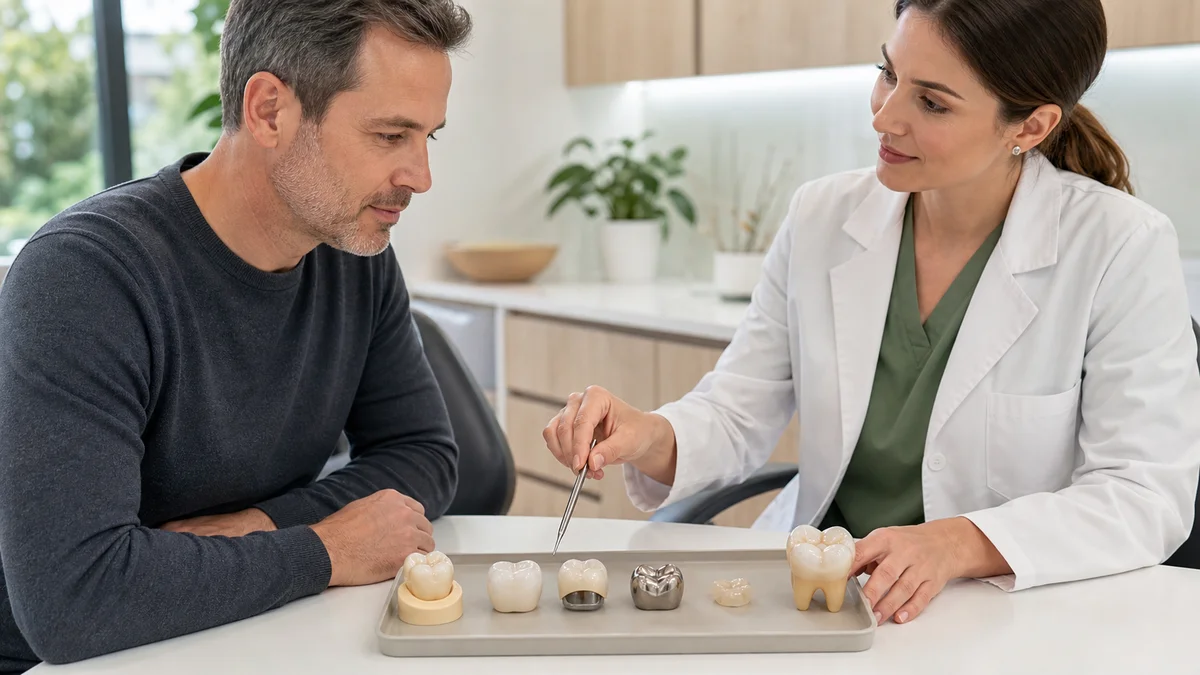
People searching for zirconia crowns alternatives are often asking two different questions. One is whether another full crown material could fit better. The other is whether the tooth needs a full-coverage crown at all. Those questions should be separated because a glass-ceramic crown, a metal-ceramic crown, an onlay, a direct composite restoration, and a veneer remove and replace different amounts of tooth structure.
Quick answer: Zirconia is not the only option and is not automatically best. Depending on the diagnosis, alternatives may include a direct composite restoration, an inlay or onlay, glass ceramic, porcelain fused to metal, a full metal crown, a veneer, repair of an existing restoration, or tooth replacement when the tooth cannot be restored. Choose coverage and material only after examining the tooth, bite, gums, and pulp.
This guide cannot determine which restoration your tooth needs. A dentist must examine the remaining tooth structure, decay, cracks, existing restorations, pulp and root condition, gum margins, bite, appearance goals, and ability to keep the field dry during bonding. No material is unbreakable, maintenance-free, or guaranteed to last for a specific person. A second opinion is reasonable before extensive irreversible preparation or extraction.
First divide zirconia crowns alternatives into two groups
A full crown covers most or all of the visible part of a prepared tooth. If a full crown is clinically justified, the material alternatives to zirconia include other ceramics, metal-ceramics, noble or base metal alloys, and selected resin-based indirect materials. These options generally solve the same coverage problem but differ in opacity, translucency, required thickness, bonding or cementation, laboratory method, repairability, wear behavior, and response to load.
A treatment alternative changes the amount or category of coverage. Direct fillings, inlays, onlays, overlays, veneers, fragment reattachment, and localized repairs may preserve more tooth structure in selected cases. They are not simply cheaper versions of a crown. They depend on the location and size of the defect, enamel available for bonding, cusp strength, moisture control, and functional load.
The American Dental Association overview of indirect restorative materials describes noble and base metal alloys, ceramics, resin-based composites, and metal-ceramics as distinct material categories. It emphasizes that composition, mechanical properties, processing, clinical indication, appearance, and cost all matter. That is a better starting point than assuming one advertised material fits every tooth.
- Same coverage, different material: another type of full crown replaces zirconia.
- Less coverage: a filling, inlay, onlay, overlay, or veneer treats a more limited defect.
- Repair rather than replacement: a small localized problem may be managed without remaking the whole restoration.
- Different treatment category: pulp treatment, orthodontics, whitening, or tooth replacement addresses another diagnosis.
Diagnosis before comparing zirconia crowns alternatives
A crown recommendation should be linked to a tooth-specific diagnosis. Ask which surfaces are damaged, how much sound enamel and dentin remain, whether one or more cusps are weakened, and whether a crack extends below the gum or into the root. Also ask whether decay or an old restoration can be removed and reassessed before the final coverage decision. Sometimes the exact restoration cannot be selected until unsupported tissue and decay are managed.
Symptoms do not reliably measure structural damage. A heavily compromised tooth may be quiet, while a small defect can be sensitive. Tests may include visual and tactile examination, bite evaluation, periodontal probing, pulp testing, and radiographs chosen for a clinical reason. Three-dimensional imaging is not routinely needed for every crown decision; its use should answer a specific anatomical or diagnostic question.
The reason for treatment also matters. A crown proposed to protect a cracked or extensively restored molar has a different objective from one proposed mainly to change the color of a structurally healthy front tooth. For cosmetic goals, whitening, orthodontics, bonding, contouring, or a limited veneer may sometimes preserve more tissue. The dentist should explain why the proposed coverage is proportionate to the problem.
- Amount and location of remaining sound tooth structure
- Whether enamel margins are available for reliable bonding
- Cusp thickness, cracks, and previous large restorations
- Pulp vitality, prior root canal treatment, and core support
- Gum health, margin location, and ability to clean the restoration
- Bite forces, grinding or clenching, and opposing materials
- Tooth position, shade needs, translucency, and available space
- Material sensitivities, medical history, hygiene, and preferences
Zirconia crowns alternatives decision table
This table organizes the consultation; it does not prescribe care. Some rows are material alternatives to a full zirconia crown, while others are less extensive treatment alternatives. Suitability depends on examination and design.
| Alternative | Coverage category | Potential reason to consider it | Important limitation to assess | Key consultation question |
|---|---|---|---|---|
| Direct composite | Localized direct restoration | Preserves tissue for a suitable small or moderate defect | Moisture control, defect size, wear, fracture, and shrinkage | Are the remaining cusps adequately supported? |
| Inlay, onlay, or overlay | Partial indirect coverage | Replaces damaged areas while retaining selected walls or cusps | Bonding surface, crack pattern, material thickness, and load | Which exact cusps need coverage, and why? |
| Glass-ceramic crown | Full coverage | Tooth-colored appearance and an adhesive option in selected cases | Material-specific thickness, fracture risk, and bite conditions | Why does this ceramic fit the site and preparation? |
| Porcelain fused to metal | Full coverage | Metal substructure with a tooth-colored ceramic exterior | Veneering ceramic chipping, opacity, margin appearance, alloy | Which alloy and ceramic design will be used? |
| Full metal crown | Full coverage | Durable cast material and potentially useful where appearance is secondary | Visible metal, alloy composition, sensitivity, and cost | Is the alloy documented and acceptable to me? |
| Resin-based indirect crown | Full coverage or long-term provisional | Repairability or interim use in a planned pathway | Wear, discoloration, fracture, and indication under load | Is this intended as definitive or provisional treatment? |
| Veneer or bonding | Facial or localized coverage | Selected cosmetic concerns with less circumferential preparation | Cannot replace missing structural support or treat every crack | Is the tooth structurally healthy enough for limited coverage? |
| Repair or monitoring | Minimal intervention | Localized defect or stable finding that does not justify replacement | Hidden decay, crack progression, bondability, and follow-up | What evidence shows repair or review is safe? |
| Extraction and replacement | Tooth removal | Only when the tooth cannot be predictably restored or retained | Irreversible loss, surgery, healing, replacement scope, and maintenance | Why is preserving the natural tooth not reasonable? |
1. Direct composite for a limited defect
Composite resin is placed directly in the tooth and shaped during the appointment. The FDA overview of treatment options for dental caries notes that composite can closely match tooth color and may permit minimal removal of healthy structure. It also identifies limitations: placement can be more demanding when moisture control is difficult, and durability may be lower in some situations with a greater risk of fracture or replacement.
Direct composite can be a sensible member of zirconia crowns alternatives when the defect is localized and the remaining cusps and walls are adequately supported. It is not a universal substitute for a full crown on a tooth with major structural loss. Large restorations experience more polymerization stress, wear, and functional loading, and the interface becomes more extensive.
Ask whether the dentist can isolate the tooth, where the margins will end, and whether any cusp requires coverage. Also ask how repairable the restoration is and what would trigger a later onlay or crown. A conservative first restoration can preserve future options, but undertreating a structurally weak tooth can also lead to fracture. The balance is diagnosis-specific.
2. Inlays, onlays, and overlays for partial coverage
An inlay fits within the cusps; an onlay covers one or more cusps; an overlay provides broader occlusal coverage while preserving selected axial walls. Terminology varies, so ask the dentist to mark the planned boundaries on an image or model. The key benefit is not the name but the possibility of replacing damaged structure without preparing every surface for a full crown.
Partial-coverage restorations may be made from glass ceramic, zirconia, metal, or resin-based materials. The material and preparation must work together. Bonded ceramics often depend on reliable adhesive isolation and sufficient material thickness. Cast metal may allow a different design but has a visible color. Zirconia itself can sometimes be used as an onlay, which shows why “crown versus zirconia” is the wrong comparison: coverage design and material are separate decisions.
For zirconia crowns alternatives, ask which cusps are cracked or undermined, which walls can safely remain, and whether the margins can be finished, bonded, and cleaned. A partial restoration is not automatically more conservative if it leaves a crack unprotected or requires an awkward preparation. Conversely, full circumferential preparation should not be chosen merely because it is familiar.
3. Glass ceramics when translucency and bonding matter
Glass ceramics include materials such as lithium disilicate and other glass-containing systems. They can provide translucency and tooth-colored appearance, and many designs are adhesively bonded. Their properties are not identical to zirconia. Strength, fracture behavior, etching and bonding protocol, minimum thickness, opacity, and indication differ by product family and restoration design.
A front tooth with high appearance demands may benefit from a material that transmits and reflects light differently from an opaque core. A posterior tooth may place greater emphasis on load, thickness, and opposing wear. Neither location produces an automatic answer. The dentist and laboratory should select the ceramic for the actual preparation, shade, substrate color, margin position, and bite.
The ADA notes that all-ceramic restorations can fracture or chip and that material-specific indications should guide use. That does not mean glass ceramics are unsafe; it means “tooth-colored” is not a single mechanical category. Ask why the chosen ceramic is suitable, how it will be bonded or cemented, and what happens if a chip, crack, or debonding occurs.
4. Porcelain-fused-to-metal crowns
A porcelain-fused-to-metal crown has a metal substructure covered with tooth-colored ceramic. It can combine support from the metal framework with a ceramic exterior. Design variables include the alloy, framework thickness, veneering ceramic, connector or coping form, margin, and space available for both layers.
Potential limitations include chipping of the veneering ceramic, an opaque core that affects light transmission, and a visible metal or dark margin if gums change or the design is not fully concealed. Metal sensitivity and alloy composition should be reviewed. The FDA guidance on dental noble metal alloys describes alloys used in cast crowns and in substructures for porcelain-fused-to-metal crowns and bridges.
PFM is one of the established material-based zirconia crowns alternatives, not an obsolete label that can be judged without its alloy and design. Ask for the material composition, laboratory documentation, aesthetic expectations, and repair pathway. A well-designed restoration is more informative than a material category alone.
5. Full metal crowns and the importance of alloy disclosure
Full metal crowns may use high-noble, noble, or base-metal alloys. They are usually considered where appearance is less important, commonly on posterior teeth, but patient preference and tooth position matter. Metal can provide durability at relatively thin sections in appropriate designs, although the exact preparation depends on the alloy, tooth, and laboratory method.
Do not treat “gold crown” as a complete specification. Dental alloys can contain several metals, and alloy classification, composition, cost, color, casting or milling, and sensitivity considerations differ. Patients with a history of contact allergy or previous reactions should tell the dentist. The dental laboratory prescription and material certificate can document what was used.
A full metal crown still requires clinically justified coverage and careful margins. It is not a way to avoid diagnosis, pulp risk, periodontal planning, or bite adjustment. Ask whether the tooth could accept partial cast coverage instead, whether the visible color is acceptable, and how the opposing tooth will be monitored.
6. Resin-based indirect crowns and provisional pathways
Laboratory or CAD/CAM resin-based composite restorations may be used for selected inlays, onlays, crowns, or longer-term provisional treatment. Potential attractions include repairability and an elastic response different from ceramics. Limitations may include wear, discoloration, fracture, surface changes, and reduced suitability under high stress, depending on the material and design.
The important question is whether the restoration is intended to be definitive or provisional. A provisional crown can protect a prepared tooth, test shape and bite, support gum management, or bridge a healing period. It should not be presented as the final restoration without clear disclosure. Ask how long it is intended to serve, what maintenance it requires, and which final treatment remains planned.
For people considering zirconia crowns alternatives because they grind their teeth, a softer or more repairable material does not automatically solve the cause or the load. The team should evaluate occlusion, parafunction, material thickness, restoration shape, and whether a protective appliance is indicated. No crown makes uncontrolled grinding harmless.
7. Veneers, bonding, whitening, and orthodontics for cosmetic concerns
If a tooth is structurally healthy and the concern is color, spacing, alignment, shape, or a limited enamel defect, a full crown may be disproportionate. Whitening changes color but does not repair cracks or replace missing structure. Orthodontics moves teeth but does not rebuild a broken cusp. Composite bonding can add or reshape limited areas. A veneer covers mainly the facial surface and cannot substitute for circumferential protection when the tooth is extensively weakened.
These options can also be sequenced. For example, orthodontic movement may improve tooth position before a conservative restoration, or whitening may establish a stable shade before matching a restoration. Sequencing should be planned before irreversible preparation. Existing fillings, crowns, or veneers do not whiten like natural tooth structure, so shade planning matters.
A veneer is not automatically “no-prep” or reversible. Preparation, enamel preservation, bonding surface, bite, and margin design differ. Ask how much tissue will be removed and why. If multiple healthy teeth are proposed for crowns mainly to create a fast cosmetic change, a second opinion can help compare less invasive pathways.
8. Repairing an existing zirconia crown instead of replacing it
Not every problem with an existing crown requires complete replacement. A dentist may be able to polish a rough area, adjust the bite, repair a selected ceramic or composite defect, recement a crown when appropriate, or monitor a stable finding. The feasibility depends on what failed and why, access, contamination, material, margin integrity, underlying decay, and the ability to create a durable bond.
Replacement is more likely when there is recurrent decay that cannot be managed through a limited approach, an open or inaccessible margin, a structural fracture, persistent loss of retention, an unacceptable fit, or disease beneath the restoration. Removing a crown also carries a risk of damaging the remaining tooth or discovering less structure than expected. Ask the dentist to distinguish the restoration problem from a tooth or gum problem.
When discussing repair among zirconia crowns alternatives, request a realistic description of scope and uncertainty. A small repair may preserve tissue and time but may not recreate the strength or appearance of a new restoration. A complete replacement may address more defects but requires new preparation and laboratory work. No repair should be promised as permanent.
9. Extraction and tooth replacement only when preservation is not reasonable
Extraction is not a crown material alternative; it removes the tooth. It may be considered when a tooth has a non-restorable fracture, inadequate remaining structure, severe periodontal support loss, uncontrolled disease, or another prognosis that makes retention unreasonable. Cost or convenience alone should not turn a restorable tooth into an extraction recommendation.
After extraction, options may include no immediate replacement in selected situations, a removable partial denture, a tooth-supported bridge, or an implant-supported restoration. Each creates a new treatment pathway with its own surgery, preparation, maintenance, and repair needs. An implant crown also needs a restorative material, so choosing extraction does not eliminate the material question.
Ask what evidence makes the tooth non-restorable, whether specialist assessment would change the decision, and what happens if replacement is delayed. Obtain an itemized plan that includes extraction, site management, provisional tooth, final replacement, follow-up, and maintenance. Seek urgent dental care for spreading swelling, fever, breathing or swallowing difficulty, uncontrolled bleeding, significant trauma, or rapidly worsening symptoms.
Root canal treatment is not a crown material alternative
Root canal treatment manages inflamed or infected pulp inside a tooth. It does not rebuild missing cusps or replace a crown. The American Association of Endodontists explains that after root canal treatment the tooth is restored with a crown or filling for protection. The final restoration depends on the tooth, amount of remaining structure, crack pattern, location, and functional load.
A vital tooth should not receive root canal treatment merely to make crown preparation easier. Conversely, a tooth needing pulp treatment should not be covered without addressing the diagnosis. Ask whether the pulp is healthy, which tests support that judgment, and how the planned restoration protects remaining tissue. Posts and cores are separate decisions; a post retains a core in selected cases but does not strengthen every root-treated tooth.
Compare complete costs, not material labels
There is no responsible fixed price for zirconia crowns alternatives without an examination. The complete episode may include diagnosis, imaging, decay removal, pulp or periodontal treatment, core buildup, provisional restoration, laboratory work, final cementation or bonding, bite adjustment, follow-up, and maintenance. One quote may include these stages while another names only the final material.
Ask for an itemized written plan and identify confirmed, optional, and contingent procedures. Insurance may classify materials differently, apply an alternate benefit, require predetermination, or limit replacement frequency, but plan rules vary. Verify current benefits directly and remember that authorization is not a diagnosis or a guarantee of payment.
For international comparisons, include records, travel, temporary care, return visits, emergency access, laboratory remakes, and local maintenance. Redent Klinik is in Turkey. Patients can review the Redent Klinik English website and use the Redent Klinik contact page to ask what records and in-person assessment would be required. Remote communication cannot determine candidacy or guarantee a final plan.
Longevity depends on design, tooth, and maintenance
Material is only one part of restoration survival. Remaining tooth structure, preparation geometry, bonding or cementation, laboratory quality, margin fit, gum health, bite, grinding, diet, hygiene, and professional review all affect outcomes. A strong crown can still fail through decay at its margin, loss of retention, fracture of the tooth, pulp disease, periodontal problems, or excessive load.
The World Health Organization oral health fact sheet emphasizes prevention and common modifiable risk factors. Brush with fluoride toothpaste as advised, clean between teeth, attend risk-based reviews, and discuss tobacco use, sugar exposure, dry mouth, and grinding. A night guard may be considered for selected patients but does not guarantee that a restoration or tooth will not fracture.
Ask how the chosen material will be maintained and repaired, whether its surface can be polished after adjustment, and what symptoms require review. Persistent pain, a change in bite, movement, a sharp edge, swelling, bleeding around a margin, or a lost restoration should not be ignored. Avoid chewing on a loose temporary or trying to glue a crown at home with household products.
Questions to ask before choosing a restoration
- What diagnosis requires treatment, and can you show me the affected structure?
- Does the tooth need full coverage, partial coverage, a direct repair, or monitoring?
- Which zirconia crowns alternatives are clinically reasonable for this exact tooth?
- How much sound enamel and dentin will each option remove?
- What material, brand family, alloy, or ceramic class will be documented?
- How will the restoration be bonded or cemented, and can the tooth be isolated?
- How do my bite, grinding, opposing teeth, and appearance goals affect the choice?
- What is included in the quote, and which procedures are contingent?
- How is a chip, debonding, decay, sensitivity, or fracture managed?
- What records will I receive, and who provides maintenance or urgent care?
Frequently asked questions about zirconia crowns alternatives
What is the most conservative alternative to a zirconia crown?
There is no universal answer. For a limited defect, monitoring, a direct composite, an inlay, or an onlay may preserve more tissue. If the tooth has extensive structural loss or cracks, full coverage may still be appropriate. The most conservative safe option is the least extensive treatment that predictably addresses the diagnosed problem.
Is lithium disilicate better than zirconia?
Neither material is automatically better. They differ in translucency, mechanical behavior, bonding protocol, thickness requirements, and indications. The decision depends on tooth position, preparation, substrate color, available space, bite, appearance goals, and laboratory design. Ask why the selected ceramic suits the actual clinical conditions.
Can an onlay replace a zirconia crown?
An onlay may replace a full crown when the defect and crack pattern allow selected walls and cusps to remain safely. It requires suitable margins, material thickness, bonding or cementation, and load management. It should not be used merely to avoid a crown if weakened structure would remain unprotected.
Are porcelain-fused-to-metal crowns still a valid option?
They can be appropriate in selected cases. A metal framework supports an external ceramic layer, but opacity, margin appearance, alloy composition, available thickness, and veneering ceramic chipping should be considered. Request material documentation and compare the design with all-ceramic and full-metal options.
Is a full metal crown safer for a heavy bite?
A metal crown may be useful in selected high-load posterior situations, but no material removes the need to diagnose grinding, design the preparation, adjust the bite, and monitor the opposing tooth. Alloy composition, appearance, thickness, and sensitivity history also matter. Individual examination is required.
Can composite bonding replace a zirconia crown on a front tooth?
Bonding may suit a localized enamel defect, small fracture, spacing, or shape concern when the tooth is structurally sound. It cannot provide the same circumferential support as a crown for major tissue loss or certain cracks. Moisture control, bite, color, repair expectations, and remaining enamel influence suitability.
Can a chipped zirconia crown be repaired?
Some localized defects may be polished or repaired, depending on whether the chip involves veneering ceramic or the zirconia framework, the location and cause, access, contamination, and margin integrity. Repair has limitations. A dentist should check the tooth, crown fit, bite, and underlying disease before choosing repair or replacement.
Does a root canal mean I must choose zirconia?
No. Root canal treatment addresses the pulp, while the restoration protects and rebuilds the tooth. Coverage and material depend on remaining structure, tooth position, cracks, core, bite, and appearance. Zirconia, another crown material, or a different restoration may be considered after a tooth-specific assessment.
Should I replace a sound crown only because it is not zirconia?
Material name alone is not a reason to replace a functioning restoration. Replacement removes more tooth structure and can reveal or create new risks. Ask about fit, decay, cracks, gum health, function, appearance, and symptoms. Monitoring may be more appropriate when the crown and tooth are stable.
Which zirconia crowns alternatives cost less?
Fees vary by diagnosis, material, laboratory, provider, location, and additional treatment. A direct restoration may involve a smaller scope in a suitable tooth, but it is not interchangeable with full coverage. Compare complete itemized pathways, longevity uncertainties, repairability, insurance rules, and preservation of tooth structure rather than headline fees.
Conclusion: choose coverage before choosing material
The safest way to compare zirconia crowns alternatives is to decide first how much of the tooth needs restoration. If full coverage is justified, glass ceramic, metal-ceramic, full metal, and selected resin-based systems offer different balances. If less coverage is sufficient, a direct restoration, inlay, onlay, veneer, or repair may preserve more tissue.
Ask for the diagnosis, preparation boundaries, material class, bonding or cementation plan, complete cost, maintenance route, and alternatives in writing. Preserve a restorable tooth when reasonably possible, but do not under-protect a tooth simply to avoid a crown. The right plan is proportionate to the defect and realistic about function, appearance, uncertainty, and long-term care.
Authoritative sources
- American Dental Association: Materials for Indirect Restorations
- American Dental Association: Caries Management Clinical Practice Guidelines
- U.S. Food and Drug Administration: Treatment Options for Dental Caries
- National Institute of Dental and Craniofacial Research: Dental Fillings
- U.S. Food and Drug Administration: Dental Noble Metal Alloys Guidance
- American Association of Endodontists: What Is a Root Canal?
- American Dental Association
- World Health Organization: Oral Health Fact Sheet