
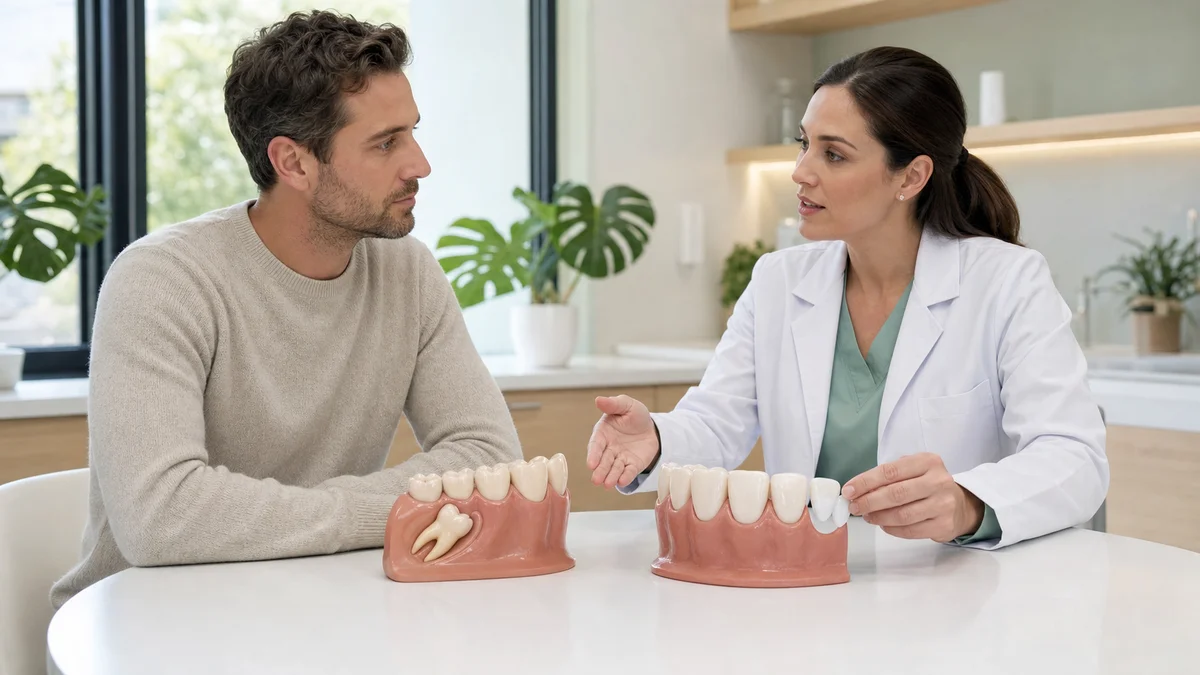
Typing wisdom tooth removal or veneers which is better into a search engine creates a comparison between two procedures that normally solve different problems. Wisdom tooth removal is an extraction considered for a third molar at the back of the mouth when diagnosis supports it. A veneer is a cosmetic or restorative facing placed on the visible surface of a tooth, usually near the front of the smile. One cannot substitute for the other.
Quick answer: Neither procedure is generally “better.” Wisdom tooth removal may be appropriate for a diseased, repeatedly infected, impacted, or damaging third molar; a problem-free wisdom tooth may instead be monitored. Veneers may improve selected front-tooth color, shape, spacing, or surface defects when teeth and gums are healthy. Compare each option with its own alternatives after an examination, not with each other.
This article is educational and cannot diagnose an impacted tooth, decide whether surgery is needed, or confirm veneer candidacy. Wisdom tooth symptoms, nerve position, decay, gum health, enamel, bite, and appearance goals require a clinical examination and appropriate imaging. Both extraction and veneer preparation may be irreversible. Outcomes, recovery, appearance, comfort, and longevity cannot be guaranteed.
Why wisdom tooth removal or veneers which is better is a category error
Third molars, commonly called wisdom teeth, are the last teeth at the back of each dental arch. They may erupt normally, remain partly covered by gum, or become impacted in bone or against another tooth. Management aims to protect health, manage disease or symptoms, and prevent documented damage when the expected benefits justify surgical risks.
Veneers are thin facings bonded to the visible surface of selected teeth. They can change apparent color, contour, proportion, and limited spacing or surface form. They do not remove infection around a wisdom tooth, create room for an impacted third molar, treat a cyst, or repair decay on the back of a second molar. Likewise, removing a wisdom tooth does not whiten, reshape, or cover the front teeth.
A useful consultation replaces “Which procedure wins?” with two questions:
- Health question: Does a wisdom tooth have disease, symptoms, or a documented risk that justifies treatment now?
- Appearance question: Do healthy front teeth have a concern that a veneer can address more appropriately than whitening, bonding, orthodontics, monitoring, or another option?
- Sequencing question: If both needs exist, which problem should be stabilized first and how will one treatment affect the other?
Decision table: two procedures, two different clinical jobs
The table shows why the answer to wisdom tooth removal or veneers which is better is diagnosis-dependent rather than competitive.
| Decision point | Wisdom tooth removal | Veneers | What must be confirmed |
|---|---|---|---|
| Primary purpose | Remove a third molar when a justified health indication exists | Change the visible surface of selected teeth | The exact diagnosis and patient goal |
| Typical location | Very back of the upper or lower arch | Usually visible front or smile-zone teeth | Which tooth is actually causing the concern |
| Type of intervention | Extraction, sometimes surgical | Bonded facing, with preparation varying by case | Amount of tissue changed and reversibility |
| Common reasons | Repeated infection, decay, abscess, cyst, gum disease, or damage | Selected color, shape, small chip, proportion, or surface concern | Evidence that the procedure addresses the problem |
| Reason to monitor | Problem-free tooth that can be reviewed safely | Healthy tooth when treatment is unnecessary or goals are uncertain | Review interval and warning signs |
| Main alternatives | Active surveillance, treatment of a neighboring problem, selected coronectomy | Whitening, bonding, orthodontics, contouring, or no treatment | Benefits, risks, and limits of each alternative |
| Recovery and maintenance | Wound healing and postoperative review | Ongoing hygiene, bite review, and possible future repair or replacement | Who provides urgent and long-term care |
| Urgency | May be urgent with spreading infection, severe swelling, or uncontrolled bleeding | Usually elective after health and function are stable | Whether symptoms require prompt assessment |
1. Confirm whether the wisdom tooth has a treatment indication
The NHS guidance on wisdom tooth removal explains that wisdom teeth may need removal when lack of space or partial eruption contributes to pain, swelling, pericoronitis, food trapping, decay, gum disease, a cyst, or dental abscess. It also states that a wisdom tooth not causing problems will usually be left in place and monitored during routine checks.
This distinction prevents surgery from becoming automatic. Impaction is a description of position, not by itself a universal command to extract. The National Institute for Health and Care Excellence guidance does not support routine prophylactic removal of pathology-free impacted third molars. Local standards and individual circumstances vary, but the central patient-safety lesson is clear: identify the indication and compare it with the risks of treatment and monitoring.
Ask the dentist to show the tooth, neighboring second molar, surrounding bone, and any disease on the available records. Recurrent gum inflammation around a partly erupted tooth, decay that cannot be restored, damage to the adjacent tooth, a cystic change, or infection creates a different decision from an asymptomatic, cleanable tooth with no detected pathology.
2. Use examination and imaging for the wisdom tooth decision
A wisdom tooth assessment commonly includes symptoms, medical history, mouth opening, gum condition, eruption status, decay, periodontal findings, and the condition of the tooth in front of it. Radiographs may show angulation, depth, roots, adjacent structures, decay, and other findings. Imaging should be selected for a reason; more imaging is not automatically safer or better.
For a lower wisdom tooth, the relationship of the roots to the inferior alveolar nerve may influence consent and surgical planning. Upper wisdom teeth may be assessed in relation to the sinus and surrounding bone. Two-dimensional imaging may answer many questions, while three-dimensional imaging may be considered when it is expected to change management. Ask what the image is intended to clarify.
A final recommendation may involve a general dentist or an oral and maxillofacial surgeon depending on complexity, health, anatomy, and local practice. Verify the clinician’s license and role. If referral is suggested, ask which finding makes specialist assessment useful rather than assuming that referral means extraction is already decided.
3. Compare extraction with monitoring and selected surgical alternatives
Active surveillance is not the same as ignoring a tooth. It should include an agreed review schedule, oral hygiene around the area, assessment of the adjacent tooth and gums, and instructions about symptoms that require earlier care. Monitoring can be reasonable only if the area can be reviewed and the patient can return when needed.
Some problems may be treated without immediate extraction. The dentist may manage local inflammation, improve cleaning access, treat decay in an adjacent tooth, or reassess after an acute episode settles. Antibiotics are not a permanent substitute for managing a dental source and should not be expected for every episode. The correct plan depends on examination.
When a lower wisdom tooth is very close to a nerve, a specialist may discuss coronectomy in selected cases. In that procedure, the crown portion of the wisdom tooth is removed while roots are intentionally retained to reduce nerve risk. The University College London Hospitals patient guidance explains why this may be considered when nerve proximity makes complete removal riskier. It is not suitable for every tooth and can require follow-up.
4. Understand wisdom tooth removal risks and recovery
Wisdom tooth removal may be a simple extraction or a surgical procedure involving an incision, bone removal, tooth sectioning, and stitches. Complexity depends on position, roots, bone, mouth opening, and other factors. Anesthesia options and their risks should be discussed separately from the extraction itself.
Expected short-term effects can include pain, swelling, bruising, jaw stiffness, and difficulty chewing. Complications can include dry socket, infection, bleeding, injury to nearby teeth or restorations, and temporary or persistent altered sensation when nerves are affected. Upper-tooth complications can differ from lower-tooth complications. Personal risk cannot be inferred from a general percentage online.
Postoperative instructions should cover pain control, eating, cleaning, smoking, alcohol, activity, medications, bleeding, and when to call. The NHS notes that smoking can increase infection risk and describes urgent review for bleeding that does not stop, severe or worsening pain and swelling, bad taste with fever, or feeling unwell. Follow the instructions from the treating team because they reflect the actual surgery and medical history.
5. Confirm what veneers can and cannot change
The American Dental Association’s MouthHealthy veneer information describes veneers as coverings for the front of teeth and distinguishes porcelain from composite pathways. Veneers may be considered for selected discoloration, shape differences, small chips, limited spacing, or surface concerns. They do not remove a third molar and do not treat active decay, gum disease, infection, severe structural loss, or a major bite discrepancy.
Before veneers, the dentist should examine teeth and gums, review the bite, identify existing restorations, and determine whether sufficient enamel and sound structure are available. Photographs, scans, and a diagnostic preview may help communicate shape, but they do not prove biological suitability. A digital design is a planning aid, not a result guarantee.
When people ask wisdom tooth removal or veneers which is better because they feel general dental discomfort, they should not assume veneers will protect unhealthy teeth. Pain, swelling, temperature sensitivity, biting pain, bleeding gums, or a bad taste needs diagnosis. Covering the visible surface without addressing disease can delay appropriate care.
6. Treat veneer preparation as an irreversible decision
Veneer preparation ranges from minimal enamel modification to more substantial reduction, depending on tooth position, color, material, desired contour, and existing restorations. “No-prep” is not a guarantee of zero alteration or future reversibility. Even when little tissue is removed, bonding, margins, added contour, and future replacement should be understood.
The ADA warns the public against unlicensed “veneer technicians” and states that unsupervised dental treatment can cause damage. Diagnosis, decay control, gum assessment, tooth preparation, bonding, and bite adjustment require licensed dental care. Ask who will perform each stage and verify professional credentials through the relevant licensing authority.
Potential issues include sensitivity, gum irritation, an overcontoured appearance, color mismatch, chipping, fracture, debonding, decay at margins, and bite changes. Teeth and gums continue to age around restorations. A veneer may need repair or replacement later, and removal can affect the supporting tooth. Consent should include reasonable alternatives and the option of no cosmetic treatment.
7. Compare veneers with tooth-preserving alternatives
Alternatives are selected by the cosmetic or structural concern. Professional whitening may improve eligible natural-tooth discoloration but does not change shape or fillings. Composite bonding may repair a small chip, add contour, or close a limited space with a different maintenance and staining profile. Orthodontic treatment moves teeth rather than masking position. Enamel contouring can make small changes when safe. Sometimes no treatment is the most conservative choice.
A crown is not simply a stronger veneer. It covers more of a prepared tooth and may be appropriate for extensive damage, but it generally removes more tissue. A veneer should not be expanded into a crown merely to make cosmetic treatment faster. Conversely, a veneer should not be used when the tooth lacks the support needed for limited coverage.
- Color concern: assess cause, whitening eligibility, restorations, and shade stability.
- Small chip or shape concern: compare smoothing, bonding, fragment repair, and veneer.
- Spacing or alignment: compare orthodontics with additive or masking options.
- Large filling or crack: determine structural support before discussing cosmetic coverage.
- Healthy tooth with uncertain goal: preview, pause, or choose no irreversible treatment.
8. If both procedures are relevant, sequence health before elective cosmetics
A patient can independently need wisdom tooth care and want veneers. That does not make the procedures alternatives. If there is active infection, significant pain, or an urgent surgical issue, health stabilization generally takes priority over elective cosmetic treatment. The treating clinicians should coordinate medical history, medications, recovery, and scheduling.
After wisdom tooth surgery, allow the surgical team to assess healing before beginning unrelated elective procedures. Mouth opening, swelling, chewing comfort, medication use, and the ability to tolerate longer appointments may affect timing. There is no universal waiting period; the appropriate interval depends on surgical complexity, healing, and the proposed veneer workflow.
If a wisdom tooth is being monitored and has no current disease, veneers do not necessarily need to wait solely because that tooth exists. However, a comprehensive exam should still document the third molars and the overall bite. Ask whether planned orthodontics, bite changes, or future oral surgery could alter the veneer design or sequencing.
9. Use one informed-consent checklist for two separate decisions
The ADA principle of patient autonomy says patients should be informed of proposed treatment and reasonable alternatives in a way that supports meaningful participation. Apply that process separately to surgery and cosmetic restoration. A consent signature should follow a conversation, not replace it.
- What exact diagnosis or cosmetic concern is being treated?
- What happens if I monitor or choose no treatment now?
- What are the reasonable alternatives and their limitations?
- Which parts of the procedure are irreversible?
- What risks are specific to my anatomy, health, tooth structure, and bite?
- Who performs treatment, manages complications, and provides follow-up?
- What records, imaging, material details, and instructions will I receive?
- What is included in the written cost and what may be added?
Cost comparison: do not put unlike treatment scopes in one column
There is no clinically meaningful universal price answer to wisdom tooth removal or veneers which is better. A wisdom tooth estimate depends on examination, imaging, eruption and impaction, anesthesia, surgical complexity, number of teeth, medications, and follow-up. A veneer estimate depends on the number of treated teeth, material, preparation, provisional stage, laboratory work, bite management, and maintenance.
Insurance may treat medically necessary extraction and elective veneers differently, but benefits vary by plan and diagnosis. Verify network, authorization, exclusions, deductible, annual limits, and member responsibility directly. Predetermination is not a guarantee of payment, and coverage does not establish that a treatment is clinically suitable.
Request two separate itemized plans if both procedures are considered. Do not let a bundled “smile” package hide surgical fees, and do not let financing determine whether healthy teeth are prepared. Compare total repayment, interest, fees, cancellation terms, and refunds for unperformed services rather than the monthly figure alone.
Local care and dental travel require different continuity plans
Travel can complicate both pathways. Wisdom tooth surgery may require urgent access for bleeding, dry socket, infection, or altered sensation. Veneers may require try-in, bonding, bite adjustment, repair, or replacement. Include travel, lodging, time away, return visits, record transfer, and local follow-up in any comparison.
Redent Klinik is in Turkey. Patients researching international cosmetic treatment can review the Redent Klinik English website and use the Redent Klinik contact page to ask what records, examination, visits, and aftercare would apply. Remote photographs cannot confirm veneers or assess whether wisdom tooth removal is needed.
Before traveling, identify who will provide urgent care after you return and whether a local clinician has agreed to participate. Obtain imaging, surgical notes, material and laboratory records, medication information, and written instructions in a usable format. Savings are not complete unless continuity and possible return care are included.
Warning signs and reasons to pause
Seek prompt dental assessment for severe or worsening pain, facial swelling, fever, pus or bad taste, difficulty opening the mouth, trauma, or symptoms affecting eating and hydration. Seek urgent medical help for difficulty breathing or swallowing, rapidly spreading swelling, or other signs of a serious emergency. After extraction, follow the treating team’s emergency instructions for uncontrolled bleeding, worsening swelling, fever, or altered sensation.
Pause elective veneers if diagnosis is incomplete, active disease is present, or treatment is offered by an unlicensed person. Other red flags include a final plan based only on social-media photographs, pressure to prepare many healthy teeth immediately, guarantees of a permanent result, refusal to explain enamel reduction, and no maintenance or complication pathway.
A second opinion is especially useful when symptom-free wisdom teeth are proposed for removal without a clear reason, when nerve proximity or complex impaction is involved, or when multiple healthy front teeth are proposed for irreversible preparation. Request your records and ask the second clinician to evaluate independently.
Frequently asked questions about wisdom tooth removal or veneers which is better
Can veneers fix pain caused by a wisdom tooth?
No. Veneers cover the visible surface of selected teeth and do not treat impaction, infection, decay, cysts, or inflammation around a third molar. Wisdom tooth pain requires diagnosis because similar symptoms can come from another tooth, gums, jaw muscles, or other conditions. Do not cover symptoms with cosmetic treatment.
Do all impacted wisdom teeth need removal?
No. Position alone does not determine treatment. A problem-free impacted tooth may be monitored, while disease, repeated infection, damage, or other findings may support removal. The decision should include examination, appropriate imaging, individual risks, the ability to monitor, and current professional guidance.
Can wisdom tooth removal change the appearance of my front teeth?
Wisdom tooth removal is not a cosmetic front-tooth treatment and should not be promised to straighten, whiten, reshape, or create spacing changes in the smile. Temporary facial swelling can occur after surgery, but that is part of healing rather than an aesthetic result.
Should wisdom teeth be removed before veneers?
Not automatically. Remove or treat a wisdom tooth only when its own diagnosis supports care. If active infection or urgent symptoms exist, stabilize health before elective veneers. If a wisdom tooth is healthy and being monitored, its presence alone may not prevent veneers. The clinicians should coordinate timing.
How long after wisdom tooth surgery can veneers begin?
There is no universal interval. Timing depends on surgical difficulty, healing, mouth opening, swelling, pain, medication use, and the planned veneer appointments. Begin elective treatment only after the surgical team is satisfied with recovery and the patient can comfortably tolerate examination and care.
Are no-prep veneers completely reversible?
No label can guarantee complete reversibility. Even limited-preparation or additive veneers involve bonding, margins, contour, bite, maintenance, and possible future removal or replacement. Ask for the planned reduction in measurable terms, why it is needed, and what the tooth may require later.
Can I have veneers if I grind my teeth?
Grinding does not produce one automatic answer, but it may increase load and affect design, material, number of teeth, repair risk, and protective strategies. The dentist should assess the bite and signs of parafunction before treatment. A night guard may be considered in selected cases but cannot guarantee protection.
Which procedure has more risk?
The risks are different and cannot be ranked without a specific case. Wisdom tooth removal includes surgical and healing risks such as bleeding, dry socket, infection, and nerve injury. Veneers include irreversible tooth alteration, sensitivity, bonding or fracture problems, margin decay, gum effects, and future replacement. Compare each procedure with its own expected benefit.
Which procedure is usually covered by insurance?
Coverage depends on the plan, diagnosis, provider, and contract. A clinically indicated extraction may be treated differently from elective cosmetic veneers, which are often excluded, but no general statement confirms an individual benefit. Verify current coverage, authorization, network status, limits, and responsibility directly.
What is the safest first step if I am considering both?
Schedule a comprehensive examination with a licensed dentist and describe symptoms separately from appearance goals. Ask for a diagnosis and options for each concern. Address urgent disease first, obtain imaging only when indicated, and do not consent to irreversible cosmetic preparation until health, function, alternatives, and maintenance are clear.
Conclusion: compare each procedure with the problem it treats
The answer to wisdom tooth removal or veneers which is better is that neither is a substitute for the other. Wisdom tooth management is a health and surgical decision about a third molar. Veneers are an elective cosmetic or limited restorative decision about the visible tooth surface. The correct comparator for extraction is monitoring or another management strategy; the correct comparators for veneers include whitening, bonding, orthodontics, contouring, crowns in structurally damaged teeth, or no cosmetic treatment.
Ask for two separate diagnoses, alternatives, risk discussions, and written scopes. Stabilize pain, infection, decay, and gum disease before elective appearance treatment. Preserve healthy tissue when possible, but do not delay necessary care to pursue a cosmetic package. A defensible plan is the one that matches each intervention to a documented need and provides realistic follow-up.
Authoritative sources
- NHS: Wisdom Tooth Removal
- National Institute for Health and Care Excellence: Guidance on the Extraction of Wisdom Teeth
- American Dental Association MouthHealthy: Wisdom Teeth
- University College London Hospitals: Wisdom Tooth Surgery and Coronectomy
- American Dental Association MouthHealthy: Veneers
- American Dental Association: Patient Autonomy
- American Dental Association
- World Health Organization: Oral Health Fact Sheet