
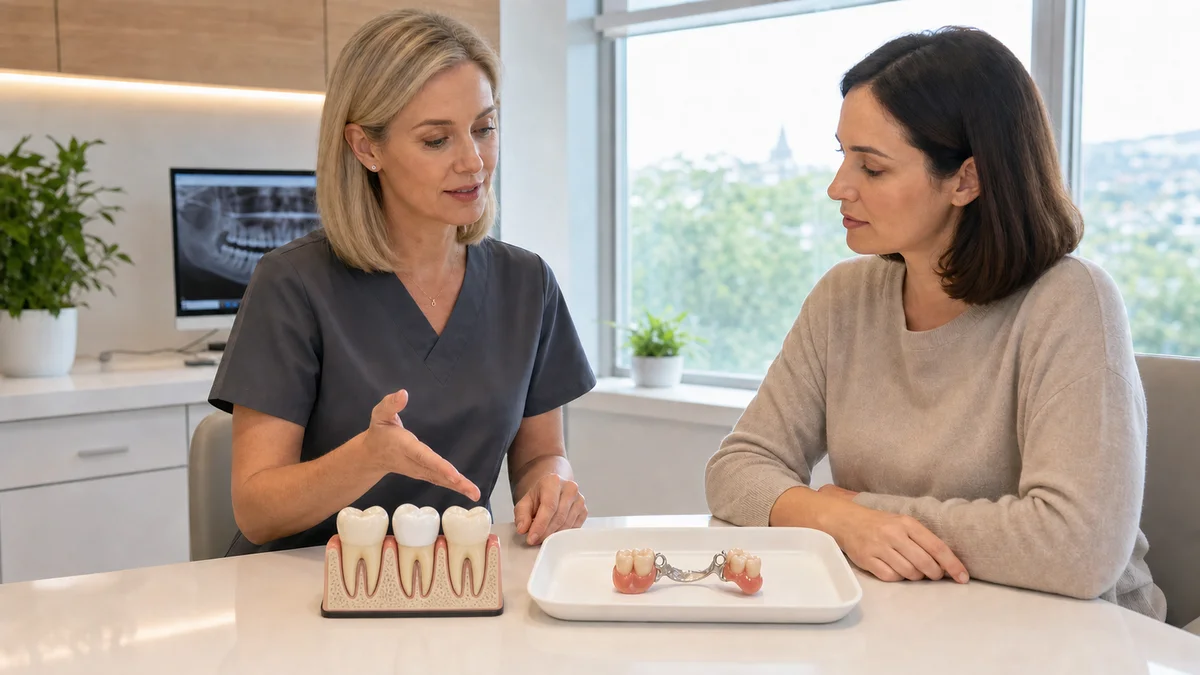
Quick answer: The answer to zirconia crowns or dentures which is better starts with anatomy, not material preference. A zirconia crown covers a restorable tooth or an implant abutment; a denture replaces teeth that are already missing or must be removed. Crowns usually preserve fixed function when sound support remains. Dentures can replace several or all teeth with less fixed treatment, but require adaptation, hygiene and periodic adjustment.
Patients often compare crowns and dentures because both can change a smile, but they do not normally solve the same problem. A crown is a cap made for one prepared natural tooth or one implant restoration. A removable partial denture replaces one or more missing teeth and gains support from the gums and, in many designs, remaining teeth. A complete denture replaces all teeth in an arch. An implant-supported full-arch zirconia prosthesis is another category again: it may be called a “zirconia denture” in advertising even though the patient does not remove it at home.
This distinction is clinically important. It would be unsafe to recommend removing restorable teeth merely because a denture looks faster or cheaper. It would also be impossible to place conventional crowns where no tooth or implant support exists. The decision must begin with an examination of decay, fractures, previous root canal treatment, gum and bone support, remaining tooth structure, bite, missing-tooth pattern, health risks and the patient’s ability to clean and maintain the result.
This evidence-based guide compares complete pathways rather than isolated prices or before-and-after photographs. It explains when zirconia is a reasonable crown material, when a denture addresses the actual problem, why a fixed zirconia full arch is not the same as a removable denture, and which questions protect natural teeth. It does not provide a diagnosis, promise that any restoration will last for life, or guarantee a cosmetic result.
zirconia crowns or dentures which is better begins with one diagnostic split
The first question is whether a tooth is present and predictably restorable. A tooth may be a crown candidate when disease can be controlled, adequate healthy structure remains or can be predictably created, the root and periodontal support are acceptable, and the finished margins can be maintained. A crown does not strengthen every compromised tooth in an unlimited way. Its prognosis depends on the tooth-crown system, including the root, core, bond or cement, bite and surrounding tissues.
The second question is whether teeth are missing or have a prognosis so poor that removal is being considered. A denture then becomes one possible replacement route. According to the NHS, partial dentures can replace one or more missing teeth and complete dentures can replace a full upper or lower arch. Alternatives for missing teeth can include bridges and dental implants, depending on the clinical situation.
These branches can meet. A natural tooth may receive a crown to improve the support or fit of a removable partial denture. The American Dental Association’s MouthHealthy information notes that crowns are sometimes used with partial dentures, especially for attachment designs. That is a combined plan, not evidence that one treatment defeated the other.
Define four different restorations before comparing them
Advertising language can blur distinct treatments. Ask the clinic to identify the proposed restoration in writing, including what supports it and whether the patient removes it.
- Tooth-supported zirconia crown: a ceramic cap placed on a prepared natural tooth. The biological prognosis remains tied to that tooth.
- Implant-supported zirconia crown: a crown connected to one dental implant. It replaces a missing tooth but requires a separate implant assessment and surgery pathway.
- Removable partial or complete denture: replacement teeth on a removable base, supported by gums and sometimes remaining teeth, clasps or attachments.
- Fixed implant-supported zirconia full arch: a multi-unit restoration connected to several implants. Although sometimes marketed as a hybrid denture, it differs substantially from a conventional removable denture.
The material name alone does not describe the treatment burden. A single tooth-supported crown may involve tooth preparation and possibly foundation treatment. A complete removable denture may involve extractions, healing, impressions or scans, trial stages and adjustments. A fixed implant-supported full arch may involve surgery, temporary teeth, healing, component choices and lifelong professional maintenance. Any fair comparison must name the category first.
Decision table: 8 scenarios rather than one winner
| Clinical scenario | Route usually worth discussing | Why it may fit | Critical limitation |
|---|---|---|---|
| One heavily restored but maintainable tooth | Direct restoration, onlay or crown after restorability assessment | Preserves the tooth and fixed function | A zirconia crown is not automatically more conservative than an onlay |
| One missing tooth with healthy neighboring teeth | Implant crown, bridge, small removable partial denture or monitored space | Each replaces or manages the space differently | A tooth-supported crown alone cannot occupy an unsupported gap |
| Several restorable teeth with localized damage | Individual risk-controlled restorations, sometimes including zirconia crowns | Retains natural roots and sensation where prognosis supports it | Multiple crowns do not treat active decay or gum disease by themselves |
| Several missing teeth with stable remaining teeth | Removable partial denture, bridge or implant-supported plan | A partial denture can replace multiple spaces in one removable framework | Fit, movement, clasp design and cleaning access matter |
| Remaining teeth have uncertain but not hopeless prognosis | Disease control, reassessment and a staged or adaptable design | A removable option may be easier to modify if the mouth changes | Premature irreversible work can reduce later options |
| All teeth in one arch are missing | Complete denture, implant overdenture or fixed implant-supported arch | These restore a full arch using different support systems | Individual tooth crowns are not possible without implants |
| Failing full dentition with active infection | Stabilize disease, assess every tooth and compare phased preservation with extraction pathways | Separates urgent control from definitive reconstruction | No photo-only plan can establish which teeth are hopeless |
| Patient asks for a “zirconia denture” | Clarify removable denture versus fixed implant zirconia full arch | Prevents confusion about surgery, removability, cleaning and cost | The shared material word does not make the procedures equivalent |
The table is a conversation framework, not a self-diagnosis. A mouth can contain more than one scenario. One tooth might need a crown while another is replaced by a partial denture. The sequence usually begins with pain or infection control, management of decay and periodontal disease, and reassessment before definitive prosthodontics.
Scenario 1: a natural tooth may be restorable with less than a crown
A full crown requires reduction around the tooth to create space, shape and retention for the restoration. That can be appropriate when a tooth is extensively damaged, cracked in a treatable pattern, heavily restored or structurally vulnerable after necessary treatment. Yet a small or moderate defect may be managed with a direct filling, inlay, onlay or other partial-coverage approach. The most conservative predictable option should be discussed before a full crown.
Restorability includes more than the visible enamel. The clinician assesses decay depth, cracks, ferrule or healthy circumferential tooth structure, the crown-to-root relationship, mobility, periodontal attachment, root shape and whether margins can be placed and cleaned. Symptoms or imaging may suggest a need for pulp or root canal assessment. A crown placed over unresolved disease can hide rather than solve the problem.
If the tooth is restorable and needs full coverage, zirconia may be one material candidate. It is not the only one. Metal-ceramic, lithium disilicate, metal or other systems can be appropriate depending on location, appearance, preparation design, bite and laboratory workflow. Asking “why full coverage?” should come before asking “which zirconia?”
Scenario 2: what zirconia changes and what it does not
Zirconia is a high-strength dental ceramic available in different formulations and designs. Monolithic zirconia is milled largely as one ceramic structure. Layered zirconia has veneering ceramic added for appearance, which creates a different technical profile. More translucent formulations may help aesthetics, while strength and preparation requirements vary among products. “Zirconia” is therefore a family label, not a complete specification.
The ADA’s review of indirect restorative materials describes promising strength and translucency but also notes that long-term survivability evidence continues to develop. Reported complications can include loss of retention, chipping or fracture, secondary decay at the tooth, endodontic problems and wear interactions with opposing teeth. Surface finishing matters: adjusted zirconia should be appropriately polished according to the clinical and manufacturer protocol.
A zirconia crown does not make the underlying tooth immune to decay. Plaque can accumulate at the margin, and exposed root surfaces remain vulnerable. Nor does “metal-free” mean allergy-free, biologically inert in every person or suitable for every bonding situation. The cement, preparation geometry, moisture control, occlusion and technician’s design contribute to the result.
Evidence should be matched to the restoration. Research on a single implant crown cannot be applied automatically to a long tooth-supported bridge or a fixed complete arch. A 2024 systematic review of tooth-supported zirconia fixed dental prostheses found important limitations in long-term evidence and different complication patterns compared with metal-ceramic prostheses. That does not prove a particular single monolithic crown will fail; it shows why broad lifetime claims are inappropriate.
Scenario 3: when a removable partial denture addresses the real problem
A removable partial denture can replace several missing teeth with one prosthesis, even when gaps occur in different parts of the arch. Designs may use an acrylic base, a metal framework, clasps, rests or precision attachments. The distribution and health of remaining teeth, shape of the ridges, bite, appearance and cleaning ability influence the design.
One advantage is retrievability: the patient can remove the prosthesis for cleaning, and some acrylic designs can be modified if another tooth is lost. NHS England’s 2026 prosthodontic pathway guidance highlights retrievability and adaptability when disease risk or future changes are important. This can be valuable during a staged plan, although adaptability does not excuse a poorly designed or unstable denture.
Tradeoffs can include bulk, movement, visible clasps, food trapping, altered speech and an adaptation period. Supporting teeth may need preparation, and selected designs may use crowns to create guide surfaces or attachments. Remaining teeth and gums must still be cleaned; a partial denture can increase plaque-retentive areas if daily care is inadequate.
Acrylic, cobalt-chromium and other materials are not simply quality levels. Framework rigidity, tissue support, repairability, allergy history, available space and anticipated change all matter. A digital scan or printed workflow does not remove the need for sound design, bite records, fitting and adjustment.
Scenario 4: complete dentures when an arch has no maintainable teeth
A complete denture replaces all natural teeth in the upper or lower arch and rests primarily on oral tissues. Retention and stability differ between people and between upper and lower jaws. Ridge form, saliva, muscle control, jaw relationship and tissue health affect function. A lower complete denture is often more challenging because the tongue and a smaller support area influence stability.
Immediate dentures may be inserted soon after extractions, but the mouth changes during healing. The NHS notes that immediate dentures often require adjustment or replacement as tissues change. A temporary or immediate prosthesis should not be sold as though its initial fit is the final long-term result.
Learning to speak and chew with complete dentures takes time. Even an excellent denture does not recreate the sensory feedback and support of natural teeth. Sore areas should be adjusted professionally; patients should not repeatedly grind or reshape a denture at home. Ongoing changes in gums and jaw shape may lead to looseness, relining, rebasing or replacement.
Implant overdentures can improve retention for some patients while remaining removable. They add surgical, component, bone and health considerations and still require cleaning and maintenance. A conventional complete denture may be preferable when surgery is unsuitable or undesired, but the comparison is individualized.
Scenario 5: crowns and dentures may work together
A combined plan can be appropriate when some teeth are maintainable and others are missing. Surveyed crowns can be shaped to guide a removable partial denture and provide planned rests or contours. Precision attachments may improve appearance in selected designs, but they add complexity, space requirements, maintenance and cost.
The crown material should be selected as part of the entire prosthesis design. Zirconia may be considered, but the dentist and laboratory must account for attachment interfaces, rest seats, guide surfaces, opposing materials and possible future repair. It is not enough to order separate crowns and then ask a denture to fit around them afterward.
Abutment teeth carry additional loads and plaque risk. Their periodontal support, root form and distribution matter. If an abutment has an uncertain prognosis, the team should explain how its loss would affect the denture and whether the design can be modified. A patient should receive a map of which teeth support the prosthesis and how to clean every interface.
Scenario 6: a fixed full-arch zirconia prosthesis is not a conventional denture
Fixed full-arch implant restorations are sometimes called fixed dentures, hybrid dentures or zirconia dentures. They replace an entire dental arch and are connected to several implants. The clinician removes them when necessary; the patient does not generally take them out every night. This makes them fundamentally different from tissue-supported removable dentures.
The pathway can include tooth removal where clinically justified, bone and medical assessment, implant surgery, temporary restoration, healing, verification of implant positions, framework and tooth design, and professional maintenance. Not every patient is a candidate for immediate loading or a fixed design. Bone anatomy, implant distribution, smoking, diabetes control, bruxism, hygiene access and willingness to attend follow-up affect planning.
Monolithic zirconia may offer rigidity and a polished ceramic surface, but repair can be more complex than replacing an acrylic tooth on some removable or hybrid designs. A highly rigid full arch also changes how forces are transmitted to implants and opposing teeth. The prosthesis needs a cleansable underside and the patient must be able to use appropriate tools beneath it.
Before consenting, clarify whether the quote is for a removable complete denture, an implant overdenture, an acrylic fixed provisional, a metal-acrylic hybrid or a definitive zirconia full arch. The words “permanent teeth” should not obscure the need for component checks, professional removal when indicated and future maintenance.
Scenario 7: uncertain teeth call for staged and reversible planning
When remaining teeth have active periodontal disease, extensive decay or uncertain prognosis, rushing to definitive crowns can lock a changing mouth into an expensive design. Equally, extracting every uncertain tooth can sacrifice teeth that might have been stabilized. The safest sequence may involve disease control, temporary restorations, periodontal therapy and a defined re-evaluation.
NHS England’s current pathway guidance emphasizes personalized disease and risk profiles and notes that fixed prosthodontics is generally postponed until active risks are managed. A removable interim option may preserve adaptability while healing and prognosis become clearer. This is not the same as promising that a temporary denture will feel or look identical to a definitive prosthesis.
A tooth-by-tooth prognosis should use categories and reasons rather than a vague statement that “all teeth are bad.” Ask what would improve or worsen each prognosis, whether specialist periodontal or endodontic input is needed, and how long the reassessment period is. Irreversible decisions deserve adequate diagnostic records and informed consent.
Scenario 8: maintenance capacity may decide the safer option
Every restoration creates new surfaces that collect plaque. NIDCR explains that plaque forms on crowns and dentures as well as natural teeth. A fixed crown requires brushing at the gumline and a way to clean between teeth. A partial denture requires care of both the appliance and the remaining teeth. A fixed implant full arch requires cleaning beneath the prosthesis and professional monitoring of implants and components.
Most removable dentures should be taken out at night unless the treating dentist gives a specific reason otherwise. NHS guidance advises daily cleaning, avoiding toothpaste on dentures because it can be damaging, and continuing to brush gums, tongue and remaining teeth with fluoride toothpaste. Individual instructions vary with material and attachments, so the laboratory and clinician’s directions matter.
Maintenance capacity includes dexterity, vision, caregiver support, dry mouth, memory, travel, access to professional care and willingness to remove an appliance. A technically sophisticated design is not better if it cannot be cleaned. The treatment team can demonstrate tools on a model and ask the patient to show the technique before finalizing the design.
- For natural-tooth crowns: monitor margins, decay risk, gum health, bite and symptoms from the tooth.
- For partial dentures: clean the denture and supporting teeth, watch clasp and tissue contact, and report looseness or sores.
- For complete dentures: clean tissues and the appliance, remove it as directed, and arrange adjustments rather than tolerating pain.
- For implant full arches: clean beneath the prosthesis, attend implant and component reviews, and report movement, chipping or persistent inflammation.
Function, speech and appearance: compare realistic endpoints
A well-designed crown can feel similar to a natural tooth because it remains fixed to a tooth or implant. Its shape must fit the bite and allow cleaning. Appearance depends on tooth position, stump or abutment color, zirconia formulation, thickness, translucency, surface characterization and the technician’s work. Very opaque or bulky crowns can look unnatural even when the material is strong.
Dentures replace teeth and some lost gum volume, which can support lips and facial contours. A removable base may affect tongue space, taste perception or speech during adaptation. Tooth position must balance appearance with phonetics, stability and the neutral zone created by muscles. A photograph cannot predict comfort or chewing performance.
Chewing with complete dentures is different from chewing with natural teeth or fixed implant restorations. A patient may need to learn balanced, smaller bites and progress through food textures. Claims that any denture will restore “100 percent natural chewing” are not credible. The goal should be safe, useful function within individual anatomy.
Risks and failure paths should be discussed before consent
No restorative option is maintenance-free. A zirconia crown can debond, chip, fracture or require replacement. The underlying tooth can develop decay, gum inflammation, root fracture or pulpal and endodontic complications. If a crown is removed, it may not be reusable. Highly polished surfaces, appropriate bite adjustment and a protective appliance when indicated may reduce some technical risks but cannot eliminate them.
A removable denture can become loose, crack, wear, lose a tooth, irritate tissues or contribute to infection when hygiene and fit are poor. Partial denture components can stress or damage supporting teeth if design, fit or maintenance is unfavorable. Denture adhesives may improve confidence in selected cases but should not be used to hide a major fit problem indefinitely.
Implant-supported options add surgical and biological risks, including failure to integrate, peri-implant disease and component complications. Fixed zirconia full arches can chip or fracture and may be difficult to repair quickly. Replacement decisions can involve the prosthesis, screws, abutments, implants and opposing arch.
Ask the dentist to describe the likely repair route for each option. A less expensive appliance that can be repaired locally may be preferable for one person; another may value fixed function and accept greater treatment and maintenance complexity. Better is a patient-specific balance, not a universal ranking.
Alternatives to both zirconia crowns and removable dentures
The correct alternative depends on whether the clinical objective is to restore a tooth or replace a missing one. For a damaged tooth, alternatives may include prevention and monitoring, a direct filling, an inlay, an onlay, another crown material, endodontic and restorative treatment, or extraction when the tooth is not maintainable. For a missing tooth, options may include a bridge, an implant-supported crown, orthodontic space management, a removable partial denture or accepting the space when clinically reasonable.
For a fully edentulous arch, alternatives may include a conventional complete denture, an implant overdenture or a fixed implant-supported prosthesis made from different materials. Each requires a different amount of surgery, tissue support, cleaning access, repair planning and financial commitment.
“No treatment” is also a choice with consequences that should be explained. A missing tooth may or may not require replacement depending on function, stability, appearance and disease risk. An infected or painful tooth cannot be made safe by simply choosing not to replace it. Urgent disease control is separate from the later replacement decision.
How to compare treatment plans and costs safely
There is no responsible fixed price that answers zirconia crowns or dentures which is better. A single crown, a multi-unit partial denture, a complete denture and a fixed implant full arch are different scopes. Fees can reflect examinations, imaging, disease control, extractions, root canal treatment, foundation restorations, implants, temporaries, laboratory materials, adjustments and maintenance.
Request written plans that use the same diagnostic assumptions. A crown quote should identify the tooth, material and design, whether foundation or root canal treatment is included, and the provisional and review process. A denture quote should identify partial or complete, immediate or definitive, support and attachment design, material, try-ins, post-insertion adjustments and anticipated relines. An implant full-arch quote should state implant number assumptions, temporary and definitive prostheses, components, grafting contingencies and maintenance.
Insurance coverage or finance approval is not a clinical endorsement. Confirm current terms directly with the payer and ask the clinic how changes in diagnosis affect the estimate. Avoid choosing only from an advertised “per tooth” or “per arch” number when necessary supporting care has not been itemized.
Planning zirconia crowns or dentures at Redent Klinik in Turkey
Dental travel adds a logistical layer to a biological decision. Photographs and a remote conversation can help organize records, but they cannot confirm crack depth, periodontal attachment, bone anatomy, bite or restorability. The final plan and price may change after examination and clinically necessary imaging.
Patients can review the Redent Klinik English website and send questions through the Redent Klinik contact page. Ask who will perform the restorative, periodontal, surgical and laboratory phases; which zirconia system or denture design is proposed; and how records will be shared with a dentist at home.
Travel timing should allow for diagnosis, treatment stages, laboratory work, healing and adjustments. Immediate dentures and implant temporaries may require later modification. A crown may need review if sensitivity or bite symptoms arise. Do not accept a guaranteed result, a lifetime claim or a plan to remove teeth based only on online photographs.
Red flags that justify urgent care or a second opinion
Seek prompt dental care for facial swelling, fever with dental pain, pus, spreading infection, trauma, uncontrolled bleeding or a rapidly worsening loose tooth. Difficulty breathing or swallowing with swelling may require emergency medical attention. A denture should be assessed if it causes persistent ulcers, severe pain, repeated choking concern or sudden inability to fit.
A second opinion is reasonable before extracting multiple teeth, crowning many minimally restored teeth, or beginning a fixed full-arch implant plan. It is particularly useful when the explanation relies on vague claims, no periodontal charting, no tooth-by-tooth prognosis, or no discussion of less invasive alternatives.
- Pressure to remove restorable teeth solely for speed or cosmetic uniformity.
- A promise that zirconia cannot chip, debond, wear opposing teeth or need replacement.
- A “permanent denture” offer that does not state whether it is patient-removable or implant-fixed.
- No written maintenance, adjustment, repair or complication pathway.
- A definitive full-mouth price before examination, imaging and disease assessment.
- Advice to stop prescribed medicine without coordination with the prescribing clinician.
Frequently asked questions: zirconia crowns or dentures which is better
Are zirconia crowns or dentures alternatives for the same problem?
Usually not. A tooth-supported zirconia crown restores an existing prepared tooth. A removable denture replaces missing teeth. They can appear in the same treatment plan when crowns help support a partial denture, but the indication for each remains different.
Can zirconia crowns replace several missing teeth?
Individual crowns need tooth or implant support. Several missing teeth may be replaced by implant crowns, a bridge, a removable partial denture or another prosthetic design. Connecting units creates a fixed dental prosthesis with different evidence and risks from a single crown.
Is it better to crown weak teeth or extract them for dentures?
Preservation is often preferred when teeth are predictably restorable, comfortable and maintainable. Extraction may be safer for hopeless teeth or uncontrolled disease. A tooth-by-tooth prognosis, periodontal findings, restorability and patient maintenance capacity should guide the decision.
Are zirconia crowns stronger than dentures?
This comparison is not meaningful without defining the denture. Zirconia is a strong ceramic used in fixed restorations. A removable denture is a prosthesis with a base, teeth and possibly a framework. Strength, flexibility and repairability are designed for different support systems.
What does “zirconia denture” mean?
It often refers to a fixed full-arch zirconia restoration connected to implants, but marketing use varies. Ask whether the patient removes it, what supports it, how many implants are assumed, what the temporary is made from and how it is cleaned and repaired.
Do zirconia crowns last forever?
No restoration has a guaranteed lifetime. A crown’s outcome depends on tooth health, design, material, cement or bond, bite, hygiene and follow-up. It can require recementation, repair, root canal treatment or replacement, and the tooth can still develop disease.
Do dentures prevent jawbone change?
Conventional dentures rest on oral tissues and do not replace tooth roots. The shape of gums and jaws can change over time, affecting fit. Implant-supported options change the support system but do not remove every biological or maintenance risk.
Can I sleep in removable dentures?
NHS guidance generally recommends removing dentures at night unless the dentist advises otherwise for an individual reason. This allows tissue rest and cleaning. Follow instructions for the specific material and storage method provided by the treating team.
Which option is easier to clean?
A removable denture can be taken out for cleaning but also creates surfaces around remaining teeth. A crown stays fixed and needs careful margin and interdental cleaning. A fixed implant full arch requires access beneath it. Ease depends on design and patient dexterity.
Can zirconia crowns support a partial denture?
Selected crowns can be designed as surveyed crowns or with attachments to support a partial denture. This must be planned jointly by the dentist and laboratory. Not every crowned tooth has sufficient periodontal support or suitable anatomy to serve as an abutment.
Will dentures look more natural than crowns?
Either can look natural when correctly indicated and designed. Crowns integrate with existing teeth; dentures replace teeth and gum volume. Appearance depends on tooth position, color, material, lip support, phonetics and technical execution rather than the treatment label alone.
Is a fixed zirconia full arch better than a removable denture?
It may offer greater stability and fixed function for a suitable patient, but it requires implants, surgery, cleaning access, component maintenance and a more complex repair pathway. A removable denture may be safer or more practical when surgery or maintenance demands are unsuitable.
Can a dentist decide from photos alone?
No. Photos cannot show root fractures, decay depth, periodontal attachment, bone anatomy, pulp status or bite forces. They can support a preliminary conversation, but irreversible treatment requires an in-person examination and any clinically indicated imaging or specialist assessment.
Final 8-point consultation checklist
- Confirm which teeth are restorable and which are missing or hopeless.
- Ask whether full crown coverage is necessary or a smaller restoration is possible.
- Name the exact zirconia crown, removable denture or implant full-arch category.
- Stabilize decay, gum disease and urgent infection before definitive work.
- Compare function, removability, speech, cleaning and adaptation, not appearance alone.
- Review failure and repair paths for the tooth, prosthesis, implants and components.
- Obtain an itemized plan that includes temporaries, adjustments and maintenance.
- Arrange local follow-up when treatment involves travel.
The most patient-safe answer to zirconia crowns or dentures which is better is not a material slogan. Preserve a natural tooth when it is predictably restorable and the required restoration is justified. Replace missing or hopeless teeth with the least complex design that meets function, appearance and maintenance needs. When a plan mixes crowns, dentures or implants, judge the complete system and its long-term care.
Sources and evidence
Public-health, professional and peer-reviewed sources accessed July 15, 2026.
- NHS: Dentures (false teeth)
- NHS England: Dentistry care pathways guidance, prosthodontics appendix
- American Dental Association: Materials for indirect restorations
- ADA MouthHealthy: Partial dentures
- National Institute of Dental and Craniofacial Research: Plaque on teeth and prostheses
- National Institute of Dental and Craniofacial Research: Tooth decay
- US Food and Drug Administration: Zirconia crown device record
- PubMed: Clinical performance of zirconia-based tooth-supported fixed dental prostheses
- PubMed: CAD/CAM versus traditional complete dentures
- American Dental Association
- World Health Organization: Oral health fact sheet