
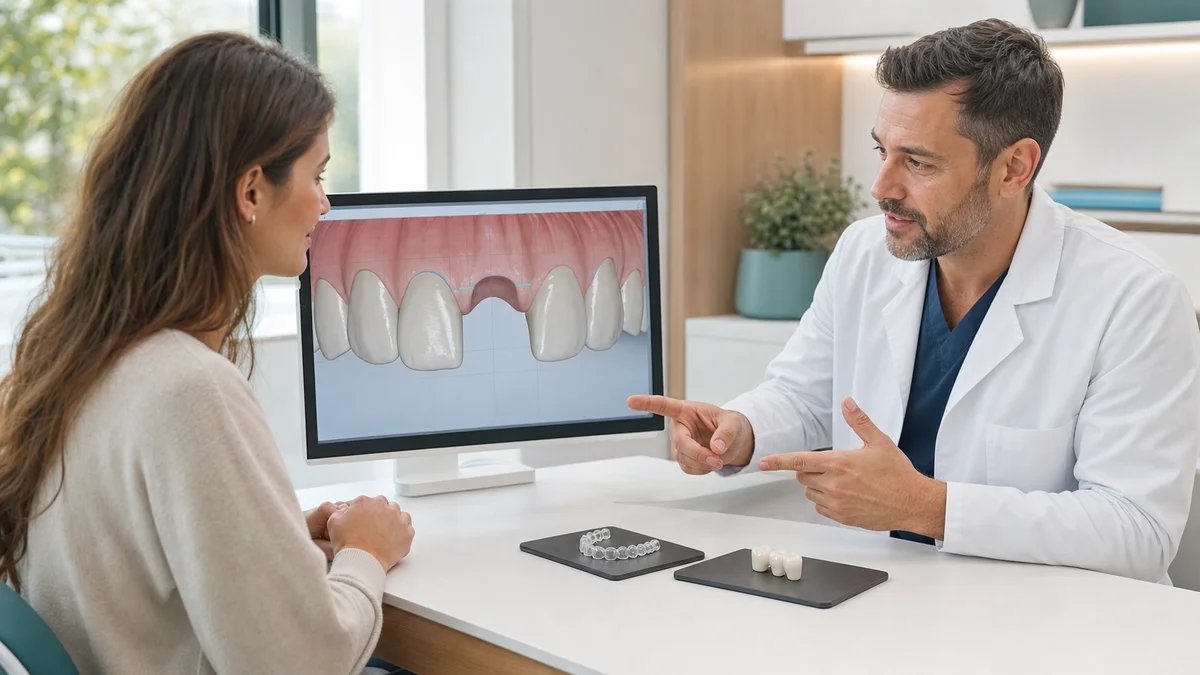
Quick answer: Clear aligners move natural teeth; a dental bridge replaces a missing tooth by attaching a false tooth to one or more supporting teeth. They usually solve different problems. If a missing-tooth space is too narrow, too wide or surrounded by tilted teeth, aligners may be used before the final bridge. Some spaces can instead be closed orthodontically, avoiding a replacement.
The most important fact in a clear aligners vs dental bridge discussion is that these treatments are not direct substitutes. Clear aligners are orthodontic appliances designed to move teeth and influence the bite. A bridge is a fixed restoration that fills a missing-tooth space. The useful question is rarely “Which product wins?” It is “Does the space need to be closed, prepared for a replacement, restored now or monitored?”
That distinction changes treatment order. A final bridge made before orthodontic planning can lock an unsuitable space into the bite. Starting aligners without deciding the future of a missing tooth can move neighbouring teeth in the wrong direction. In some cases, orthodontics creates or preserves ideal room for a bridge. In others, it closes the space and removes the need for a false tooth. Patients who already have a bridge need a different analysis because connected bridge units do not behave like separate natural teeth.
This guide is a decision framework, not an individual diagnosis. It avoids fixed prices, guaranteed timelines and universal claims. A safe plan depends on examination, gum and bone health, the cause of the missing tooth, the condition of potential bridge supports, root positions, bite, growth, medical history and suitable imaging. Complex cases may require coordination between an orthodontist and a restorative dentist or prosthodontist.
1. Clear Aligners vs Dental Bridge: Two Different Clinical Jobs
What clear aligners can do
Clear aligners are a sequence of custom trays that apply planned forces to teeth. Depending on the case, they may align crowded teeth, close selected gaps, open or redistribute space, correct rotations and contribute to bite improvement. Attachments, elastics or other aids may be needed. Some movements are more predictable with fixed braces or a combined approach, so choosing a transparent appliance should follow diagnosis rather than appearance alone.
The American Association of Orthodontists explains that aligners gradually reposition teeth and are not right for everyone. Treatment length and the number of trays vary with the problem and the movements required. Crucially, an aligner cannot create a biological replacement for a tooth that is absent. If it closes the space, it does so by moving existing teeth.
What a dental bridge can do
A bridge places a false tooth, called a pontic, in a gap and gains support from one or more neighbouring teeth. A conventional bridge generally uses crowns on prepared support teeth. An adhesive or resin-bonded bridge usually uses a wing bonded to the back of a neighbouring tooth and may require much less tooth preparation. Design depends on location, bite, available enamel, the condition of the supports and the forces expected.
Leeds Teaching Hospitals NHS Trust describes a bridge as a fixed option for replacing missing teeth and distinguishes conventional from adhesive designs. A bridge can restore appearance and chewing, but it does not straighten the rest of the arch or correct the underlying bite. It also does not automatically stop future movement of every tooth.
2. Start With an Empty-Space Audit
Before comparing appliances or materials, the team should identify why the space exists. A tooth may never have developed, may be impacted, may have been lost through trauma, decay or gum disease, or may still be present but judged unrestorable. Each origin changes the investigation. For example, a retained primary tooth, an unerupted permanent tooth and an extracted adult tooth should not share a generic “gap closure” plan.
The audit also asks whether the available space has changed. Neighbouring teeth can tilt or drift, opposing teeth can over-erupt, the midline can shift and roots can converge. The visible width between crowns does not reveal root positions or the full volume needed for a restoration. Clinical photographs and digital scans show surfaces; appropriate radiographs provide information that cannot be seen above the gum.
Questions the diagnosis should answer
- Is the tooth genuinely absent, unerupted, retained, fractured or potentially restorable?
- Is the goal to close the gap, preserve it, enlarge it or replace the tooth now?
- Are the neighbouring teeth healthy, heavily restored, tilted or already crowned?
- Are the roots positioned to allow safe movement and a suitable final restoration?
- How does the space relate to the midline, smile proportions and opposing bite?
- Is growth complete, and does that affect the available restorative options?
The Nottingham University Hospitals hypodontia service describes the same strategic choice for people born with missing teeth: orthodontic care may close and camouflage gaps or create the right amount of space for replacement teeth. The concept also helps adults with acquired tooth loss, although their periodontal and restorative considerations may differ.
3. Decision Table: Close, Prepare, Restore or Monitor
| Path | Primary goal | Possible role of aligners | Possible role of a bridge | Key planning risk |
|---|---|---|---|---|
| Orthodontic space closure | Move natural teeth together and avoid a replacement | Main treatment if movements are suitable and controllable | None for that gap, although reshaping may be discussed | Midline, bite or tooth proportions become unfavourable |
| Orthodontic space preparation | Create the correct crown and root space for a replacement | Align, upright and parallel neighbouring teeth | Final restoration after orthodontic objectives are stable | Bridge is made before root and bite positions are final |
| Immediate restorative planning | Replace a tooth where space and bite are already acceptable | No role unless another orthodontic problem is diagnosed | May be considered if supports and local conditions are suitable | A visible gap is restored without investigating disease or drift |
| Monitoring or temporary replacement | Delay irreversible care while growth, health or decisions evolve | May preserve or develop space under supervision | A definitive bridge may be deferred; a reversible temporary option may be used | Temporary care continues without review or a final strategy |
The table shows why a single answer cannot be generated from a photograph. The same front-tooth gap could be closed, reopened to a symmetrical width, maintained for later restoration or left temporarily. The correct direction is tied to the whole bite and long-term maintenance, not only to the gap’s appearance.
4. Scenario One: The Tooth Is Missing and No Bridge Exists Yet
This is the most flexible starting point. The team can assess space closure and replacement before irreversible preparation has occurred. If orthodontic closure is realistic, teeth can be moved into the gap while the plan controls angulation, roots, bite and aesthetics. If replacement is preferred, orthodontics can create a stable site with appropriate crown width and root separation.
When closing the space may enter the discussion
Space closure may be considered when the neighbouring teeth can be moved into useful positions without creating an unacceptable bite or facial imbalance. Tooth shape and colour may need adjustment after movement. Closing an upper lateral-incisor space, for example, can require detailed planning of canine position and appearance. This is not simply “drag the nearest tooth sideways.”
The benefit is that no artificial tooth is needed in that site. The trade-off is a potentially complex orthodontic movement and the need to manage the new roles of the moved teeth. Clear aligners may be suitable for some plans; fixed appliances may offer better control for others. A responsible plan presents the appliance as a tool, not the diagnosis.
When preparing space for a bridge may be preferable
Keeping a replacement space may better preserve tooth identity, symmetry or bite in selected cases. Aligners can be used to correct crowding, upright tilted supports, make space proportional to the planned pontic and position roots away from the restoration site. The restorative clinician should help define the target before the first tray is manufactured.
The AAO’s missing-teeth guidance notes that orthodontic treatment may close a missing-tooth space or create and save enough space for replacement. It also highlights the need for coordination with the general dentist and other specialists. That coordination prevents an orthodontically neat result that cannot support the intended bridge.
5. Scenario Two: A Fixed Bridge Already Exists
An existing bridge changes biomechanics. Its connected units are intended to function as a restoration, not as independently movable teeth. Trying to move bridge-supported teeth as though they were separate crowns may be ineffective, damage the restoration, overload a support or produce unwanted movement. Aligners can sometimes move other teeth around a stable bridge, but the bridge’s position and contour affect tray fit and treatment limits.
Why the existing bridge needs its own assessment
The dentist should examine margins, decay risk, gum health, mobility, support teeth, bridge span, bite and age of the restoration. Radiographs may be needed to evaluate roots and supporting bone. If the bridge is failing or blocks essential movement, removal and a temporary replacement may be considered before orthodontics. That decision is case-specific because bridge removal can damage the restoration or reveal support teeth needing additional care.
If a bridge remains, the aligner setup should identify which teeth are intended to move and which units should be treated as stationary. Attachments may be affected by restorative materials, and a tray designed from an inaccurate scan may not seat. The orthodontist and restorative dentist should agree who will modify, repair or replace the bridge if the fit changes.
Do not replace a bridge too early
When orthodontics will alter tooth positions or the bite, a new definitive bridge is generally planned after those targets are reached and stabilised. A temporary restoration can preserve appearance and space during treatment. Making the final contours too early can force the orthodontic plan to accommodate a restoration that was based on the old bite.
6. Conventional Bridge Versus Adhesive Bridge
“Dental bridge” is not one procedure. A conventional bridge requires preparation of one or more support teeth for crowns. This can be reasonable when those teeth already have large restorations or need crowns, but it removes tooth tissue and introduces biological and mechanical maintenance needs. The patient should understand what will happen to each support tooth.
An adhesive bridge, often called resin-bonded or Maryland, uses one or more wings bonded mainly to enamel. It can be more conservative and is frequently considered for selected single-tooth spaces. Its suitability depends on enamel, bite, span, space and design. Debonding can occur, and repeated recementing without diagnosing the cause is not a complete maintenance strategy.
In a clear aligners vs dental bridge sequence, the bridge design affects the target. The orthodontist needs to know whether space is being prepared for a conventional crown-retained pontic or a resin-bonded option, because support tooth positions, restorative clearance and contact design can differ. The final choice should be confirmed after orthodontic movement, not assumed at the beginning.
7. Can Clear Aligners Manage a Missing-Tooth Space Predictably?
Sometimes, but the answer depends on movement complexity and patient cooperation. Aligners rely on prescribed wear and accurate seating. Missing teeth reduce the surfaces available for tray retention and change force systems. Large space closure, substantial root control, difficult rotations or major bite correction may require attachments, elastics, temporary anchorage, fixed appliances or a hybrid plan.
Virtual movement is a proposal, not proof
A digital animation can show the intended sequence, but it is not a guarantee that biology will follow the screen. Teeth may track differently, attachments may lose contact, and refinements may be needed. Progress should be checked clinically. If an aligner is not seating, continuing through later trays can compound the mismatch.
In-person assessment is especially important when a tooth is missing. The American Dental Association’s guidance on do-it-yourself dentistry warns that moving teeth without a full assessment can contribute to bone loss, gum recession, bite problems and other harm. Scans and photographs alone do not show every condition around roots and supporting tissues.
Wear, hygiene and replacement-space control
Patients need to follow the prescribed wear schedule, remove trays as instructed for eating and cleaning, and keep the missing-tooth area and neighbouring surfaces clean. If a cosmetic tooth is incorporated into the tray, it must not prevent full seating. Lost or damaged trays, new dental work and changes to a temporary pontic should be reported because they can alter fit.
8. The Temporary Tooth During Aligner Treatment
A visible gap can be socially difficult, particularly in the front of the mouth. A tooth-coloured insert may be placed within an aligner to camouflage the space, or another temporary restoration may be designed. This insert is sometimes called a pontic, but it is mainly cosmetic and should not be confused with a definitive bridge tooth that is structurally supported for function.
As the space changes, the temporary tooth may need adjustment. It must not block planned movement, hold the tray away from teeth or create damaging bite contact. The team should explain whether the patient can chew on it, how to clean it, what to do if it detaches and who will alter it at later stages.
9. Health Gates Before Either Treatment
Orthodontic force and restorative preparation should begin in a healthy, maintainable mouth. Active decay, uncontrolled gum disease, infection, poor plaque control or a failing support tooth can undermine both routes. A bridge placed over unresolved disease does not make the cause disappear. Moving teeth through inflamed tissues can worsen recession or attachment loss.
Minimum pre-treatment checks
- Full dental and medical history, including medicines and relevant habits.
- Clinical examination of teeth, gums, bite, jaw relationship and missing-tooth site.
- Periodontal assessment appropriate to the patient’s risk and findings.
- Decay, cracks, root canal status and restorability of possible bridge supports.
- Imaging selected because it answers a diagnostic or planning question.
- A prevention and hygiene plan that the patient can maintain.
The cause of tooth loss matters. If gum disease led to the missing tooth, the remaining support and maintenance burden require particular attention. If trauma caused the gap, root damage or bone changes may influence movement and restoration. When a tooth never developed, growth and the shape of other teeth may influence long-term planning.
10. A Safe Treatment Sequence When Both Are Planned
Although every plan differs, a coordinated pathway usually follows a logical order. Skipping a stage can produce avoidable remakes or compromise.
- Diagnose and stabilise: identify the missing-tooth condition, treat active disease and define the final goal.
- Design backwards: the restorative dentist specifies the desired final space, bridge type and support requirements; the orthodontist translates them into movements.
- Move and monitor: aligners or another appliance create the planned tooth and root positions, with clinical checks and modifications as needed.
- Stabilise and verify: confirm bite, space and root relationships before definitive impressions or scans; provide retention and a temporary tooth when indicated.
- Restore and maintain: make the bridge for the stable result, then coordinate retainer design, hygiene and recall.
The restorative scan should represent the actual finished position, not only the last predicted digital frame. If additional aligner refinement is likely, a definitive bridge may be premature. Likewise, the final retainer needs to fit the completed bridge rather than an earlier temporary contour.
11. Retention After Alignment and Maintenance Under a Bridge
Teeth can move after orthodontic treatment, so retention is a long-term part of the plan. A bridge does not automatically act as a complete orthodontic retainer. It may connect some teeth while others can still shift, and a change elsewhere in the bite can affect bridge contacts. The orthodontist should specify retainer type, wear and replacement instructions for the final restored mouth.
Bridge hygiene also differs from cleaning a natural contact. Patients generally need a method to clean under the pontic and around support teeth, selected for their dexterity and bridge design. The dental team can demonstrate floss threaders, interdental brushes or other suitable tools. Bleeding, persistent odour, food trapping, looseness, pain or a change in bite warrants assessment rather than simply stronger cleaning.
Two maintenance calendars, one mouth
The final plan combines orthodontic retention reviews with routine dental and periodontal care. Retainers wear, bridge cement can fail, support teeth can develop decay and gum conditions can change. Follow-up frequency should reflect individual risk. A patient should know which clinician manages each problem and how records are shared.
12. Risks and Limitations Side by Side
Clear aligner considerations
- Not every planned movement tracks as predicted; refinements or a different appliance may be needed.
- Inconsistent wear can delay or compromise movement.
- Attachments, tray edges or elastics can affect comfort and appearance.
- Root shortening, gum recession, decalcification, relapse and bite changes are recognised orthodontic concerns whose personal relevance varies.
- Aligners do not replace a missing tooth unless the space is deliberately closed with natural teeth.
Dental bridge considerations
- Conventional designs require preparation of support teeth; biological cost depends on their starting condition.
- Support teeth remain vulnerable to decay, gum disease, fracture or root canal problems.
- Adhesive bridges can debond, while any design can chip, loosen or need replacement.
- Cleaning under the pontic requires a specific routine.
- A bridge fills a space but does not correct general crowding, root angulation or jaw discrepancy.
Risk lists are not predictions. The clinician should identify which factors are most important for the patient, what steps reduce them and what alternatives remain. Consent should cover the possibility that the plan changes if a support tooth proves unsuitable or orthodontic movement does not progress as intended.
13. Cost, Time and “Faster” Treatment Claims
There is no responsible fixed comparison without a diagnosis. Aligner costs can be influenced by complexity, records, number of stages, attachments, refinements, retainers and review. Bridge costs can vary with design, number of units, materials, support-tooth treatment, temporary restorations and laboratory work. When both are needed, the plan should identify each phase and the conditions that could add treatment.
A bridge may fill a prepared space sooner than a complex orthodontic plan closes or redistributes it, but speed is only one outcome. Preparing healthy teeth to avoid orthodontic time can have long-term consequences. Conversely, pursuing difficult space closure solely to avoid a restoration can prolong treatment or compromise the bite. Value is the fit between diagnosis, expected benefit, biological cost, maintenance and patient priorities.
Insurance rules vary by country, plan, indication and provider. Orthodontics and restorative dentistry may be assessed under different benefits or exclusions. Obtain written codes and estimates, ask what is provisional, and verify coverage directly with the payer. A financing approval is not evidence that treatment is clinically necessary.
14. Planning Clear Aligners and Bridge Care Abroad
Combined treatment requires continuity over time. If orthodontics is delivered in one country and the bridge in another, the clinicians need a shared target, compatible records and a handover plan. A digital setup alone is not a complete prescription for the restorative dentist. It should be accompanied by the diagnosis, intended final space, root assessment, bite goals and retention strategy.
Before travel, ask which stage can be completed safely during the visit, whether provisional care is expected, how complications will be reviewed and who pays for a remake if tooth positions change. Do not schedule a final bridge around a flight before the orthodontic result is clinically accepted. Travel, accommodation, time away from work and home follow-up belong in the total plan.
Patients considering care in Istanbul can review Redent Klinik’s English clinic overview and send existing records through the contact page for an initial discussion. Remote records can help the team understand the question, but only an appropriate examination can confirm whether aligners, a bridge, both or neither is suitable.
15. Consultation Checklist for a Coordinated Plan
Use the following questions to turn a broad clear aligners vs dental bridge search into an individual decision:
- Why is the tooth missing, and have impacted or restorable teeth been ruled out?
- Should the space be closed, preserved, enlarged or restored now?
- What will happen to the midline, bite and tooth proportions if the gap closes?
- If the gap stays, what exact crown and root space does the replacement require?
- Are clear aligners predictable for the planned movements, or would fixed or hybrid treatment offer better control?
- Which bridge design is being considered, and why are the proposed support teeth suitable?
- How will appearance be managed while teeth move?
- What findings could change the sequence or require a different restoration?
- Who approves the orthodontic endpoint before the bridge is made?
- How will the retainer, bridge cleaning and long-term reviews work together?
Written answers are useful in multidisciplinary and travel cases. They reduce the risk that one clinician assumes another has defined the target. For non-urgent irreversible treatment, asking for clarification or a second opinion is reasonable when the sequence remains unclear.
16. Frequently Asked Questions
Can clear aligners replace a missing tooth?
No. They can move natural teeth to close a space or prepare it for a replacement, and a cosmetic insert may disguise the gap during treatment. That insert is not a functioning natural tooth or definitive bridge. Whether closure is suitable depends on the complete bite and root positions.
Can a dental bridge straighten crooked teeth?
A bridge can alter the visible shape of its units, but it does not orthodontically move roots or correct general crowding and bite problems. Using extensive preparation to make teeth look aligned is biologically different from moving them. The risks and alternatives should be explained before healthy tissue is removed.
Should clear aligners come before a dental bridge?
Often they do when tooth positions, root angulation or space width must change. If the space and bite are already suitable and no orthodontic problem requires treatment, aligners may be unnecessary. The final restorative target should be designed before movement, even when bridge construction comes later.
Can clear aligners move teeth attached to an existing bridge?
Connected bridge units cannot be assumed to move like independent teeth. Some treatment may be possible around a stable bridge, while other plans require its removal or replacement. The bridge supports, cement, span, condition and intended movement need joint orthodontic and restorative assessment.
What is the false tooth inside an aligner?
It is usually a tooth-coloured cosmetic insert designed to mask the gap. It may be called a pontic, but it is not equivalent to a fixed bridge. It must be adjusted as space changes and must not prevent the tray from seating or create an inappropriate bite contact.
Is an adhesive bridge always better because it removes less tooth?
No. Its conservative nature can be an advantage, but suitability depends on enamel, support, bite, span and design. A conventional bridge may be considered when support teeth already need crowns. Neither design is universally superior; both require diagnosis and maintenance.
Can the missing-tooth gap simply be left open?
Sometimes monitoring is acceptable if appearance, chewing and oral health are satisfactory, but teeth can drift and the future restorative space can change. The decision should consider bite, food trapping, speech, patient preference and ability to review. “No immediate treatment” should still be a documented plan.
Do I need an implant instead of a bridge?
An implant is another replacement route, not an automatic upgrade. Bone, gum health, growth, medical factors, surgery, adjacent teeth, timing and maintenance all matter. A removable denture or no replacement can also be reasonable in selected cases. The comparison should include all realistic options.
How long will combined treatment take?
No universal timeline is reliable. It depends on the movements, biological response, wear, refinements, disease control, stabilisation and laboratory stages. Ask for a case-specific range and the assumptions behind it. A guaranteed finish date can be misleading when treatment depends on tissue response.
What is the clearest conclusion from clear aligners vs dental bridge?
First decide the destination of the space. Use aligners when controlled tooth movement is needed and appropriate; use a bridge when a fixed replacement is indicated and suitable. When both are planned, design the bridge target first, move teeth second and make the definitive restoration only after the result is verified.
17. Bottom Line
A missing-tooth plan should be designed backwards from a healthy, maintainable bite. Clear aligners can close a space or prepare it; a bridge can restore a space but cannot replace orthodontic diagnosis. Existing bridgework, support-tooth health, root position, growth, gum health and patient priorities can all change the sequence.
The safest decision is the one that explains the goal for the gap, the biological cost of each route, the division of responsibility between clinicians and the long-term retention and maintenance plan. That is more useful than selecting a treatment from appearance, speed or price alone.
Sources
- American Association of Orthodontists: Clear aligners
- American Association of Orthodontists: Orthodontics with missing teeth
- Leeds Teaching Hospitals NHS Trust: Bridges
- Nottingham University Hospitals: Missing teeth and orthodontics
- NHS: Dental treatments, bridges and orthodontics
- American Dental Association and MouthHealthy: Do-it-yourself dentistry
- World Health Organization: Oral health fact sheet