
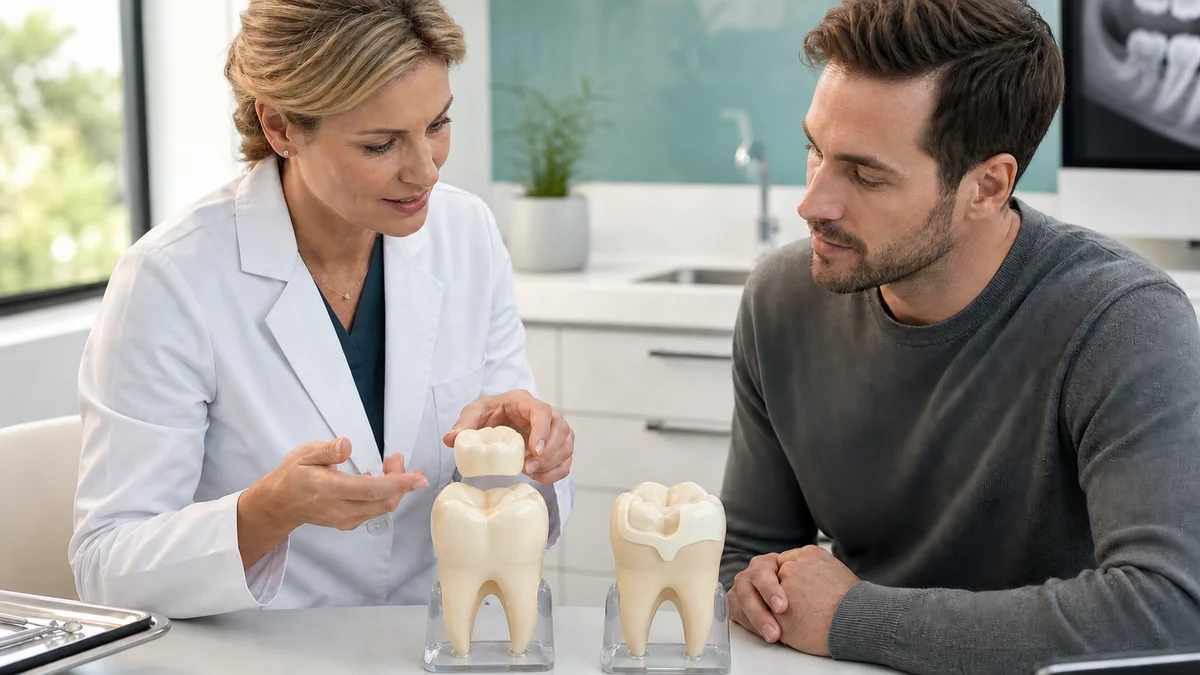
Quick answer: dental crowns best option is not a universal rule. A full crown may protect a restorable tooth with extensive structural loss, a large failing restoration, or selected post-root-canal needs. A filling, repair, onlay, veneer, monitoring, or other treatment may preserve more tissue when full coverage is unnecessary. Diagnosis, remaining tooth structure, pulp, gums, and bite come first.
A dental crown is a restoration that covers the visible portion of a tooth after that tooth has been shaped. It can rebuild form, help protect weakened structure, restore function, or serve as part of a bridge. Yet the fact that a laboratory can make a crown does not prove that full coverage is the safest first treatment. Preparing a tooth for a crown removes tissue that does not grow back, so the indication should be clearer than “this is the strongest material” or “this looks more premium.”
When people search dental crowns best option, they are often trying to solve several different problems at once: a large cavity, a cracked cusp, a root-filled tooth, an old crown, severe wear, discoloration, or a missing tooth. Those problems do not share one automatic solution. The condition of the tooth and surrounding tissues must be identified before the restoration type and material are selected.
This patient-safety guide explains how to move through that decision in the right order. It does not diagnose a tooth, promise a lifespan, or guarantee an outcome. A photograph, a scan, or a description of symptoms can support preliminary discussion, but final treatment planning requires a clinical examination and only the imaging that is justified by the findings.
1. dental crowns best option starts with the diagnosis, not the product
“Needs a crown” is a proposed treatment, not a diagnosis. The underlying reason might be active decay, a fractured cusp, extensive loss from wear, a failing large filling, an endodontically treated tooth, or a cosmetic concern. Each diagnosis changes what must be removed, what can be preserved, and what alternative treatments deserve consideration.
The American Dental Association describes a crown as a way to cover a tooth and restore shape, size, strength, or appearance. It notes that crowns may be useful when a large filling leaves too little tooth to retain another filling, when a tooth is weak or broken, or as part of bridge and implant treatment. These are possible indications, not a recommendation to crown every filled, discolored, or root-treated tooth.
A sound plan should answer four questions before discussing zirconia, ceramic, metal, or same-day fabrication:
- What disease, defect, or functional problem is being treated?
- Is the tooth restorable with a maintainable long-term design?
- What is the least destructive treatment that can meet the clinical objective?
- What happens if the restoration later chips, leaks, loosens, or needs removal?
2. The restoration ladder: escalate only as far as the tooth requires
Restorative dentistry is not a contest between a small filling and a “better” crown. It is a ladder of interventions. The safest rung is the one that controls the disease, restores necessary function, and preserves enough tissue for future care. Sometimes that is a crown. Sometimes it is prevention, repair, a direct restoration, or partial cusp coverage.
| Clinical situation | Possible crown role | Alternatives to discuss | Key decision test |
|---|---|---|---|
| Early or non-cavitated caries | Usually not the first escalation | Risk control, remineralisation, monitoring, non-restorative care | Is the lesion active, cavitated, and cleansable? |
| Small to moderate cavity with maintainable walls | May remove more tissue than needed | Direct filling or other conservative restoration | Can form, contact, and function be restored directly? |
| One or more weakened cusps | May be suitable if damage is extensive | Onlay, overlay, or direct cusp replacement | How much sound axial and cervical tissue remains? |
| Extensively broken but restorable tooth | Full coverage may protect and rebuild it | Partial coverage in selected designs | Can a maintainable margin and adequate resistance be achieved? |
| Root-filled posterior tooth with major structural loss | Often considered for cuspal protection | Onlay, overlay, endocrown, or other definitive restoration in selected cases | Which cusps and walls remain, and where are the forces? |
| Mostly intact tooth with a cosmetic concern | Full coverage may be disproportionate | No treatment, whitening, bonding, veneer, orthodontics | Can the goal be met while preserving more enamel? |
| Non-restorable fracture or disease | A crown cannot make the foundation sound | Specialist assessment, extraction and replacement options | Would restoration compromise root, bone, or adjacent tissues? |
This table is a discussion tool rather than a remote diagnosis. It helps reframe dental crowns best option as a sequence of clinical questions, not a product verdict. The same cavity size can have a different prognosis depending on crack direction, pulp condition, isolation, margin position, periodontal support, and bite.
3. Remaining tooth structure is the foundation of every crown
A crown gains value only when it is supported by a restorable tooth. The clinician assesses how much sound structure remains above the gum, whether margins can be placed on maintainable tissue, and whether the tooth can resist functional forces. A large buildup does not create a stronger root or replace missing periodontal support; it provides a shape for the final restoration within the limits of the remaining tooth.
For severely damaged or root-filled teeth, the concept of a ferrule is often discussed. In simple terms, a circumferential band of sound tooth structure engaged by the restoration can improve resistance to functional stress. The American Association of Endodontists notes that teeth in which a favorable ferrule cannot be achieved without harming adjacent support or creating an unfavorable crown-root relationship may have a compromised prognosis. This does not mean every tooth needs surgical crown lengthening. It means the biological cost of obtaining more exposed tooth must be weighed against the expected benefit.
Ask the dentist to show which walls and margins are sound after decay and old material are removed. A preoperative image cannot always predict the final amount of usable structure. If the plan may change after excavation, that uncertainty and the alternative pathways should be discussed before treatment.
4. Decay management: a crown does not treat the caries process by itself
A crown can restore damage caused by decay, but it does not remove the causes of caries. Plaque control, fluoride exposure, dietary frequency, dry mouth, and recall intervals still matter. New decay can occur at a crown margin or exposed root, particularly if risk remains high.
The ADA’s evidence-based guideline on restorative treatments for caries supports conservative approaches to carious tissue removal for many moderate and advanced lesions in vital teeth. Its stated objectives include maintaining healthy structure and protecting the pulp. The 2024 AWMF S3 guideline also supports direct composite restorations across broad indications, including selected cusp replacement, when clinical conditions and technique permit.
These recommendations do not forbid crowns. They challenge the assumption that the largest restoration is automatically the safest. The dentist must decide whether a direct or partial restoration can produce a sealed, cleansable, functional result, and whether the remaining tooth is too compromised for that approach.
5. Cracks and fractures: the pattern matters more than the label
“Cracked tooth” can describe a superficial craze line, a fractured cusp, an incomplete crack extending into dentine, or a split involving the root. These conditions have different prognoses. A crown may help bind and protect a restorable tooth with selected crack patterns, but it cannot guarantee that a crack will never propagate. A vertical root fracture or a split that makes the tooth non-restorable is not cured by covering the surface.
Diagnosis may involve history, bite tests, magnification, periodontal probing, transillumination, pulp tests, and appropriate imaging. No single photograph proves the full crack extent. Symptoms such as pain on release after biting, temperature sensitivity, or a localized deep periodontal pocket deserve assessment, but they are not enough for self-diagnosis.
If a crown is proposed for a crack, ask what part of the tooth is fractured, how pulpal status was assessed, and what findings would change the plan. The possibility of later root canal treatment, crown removal, or extraction should be explained without presenting those events as inevitable.
6. Does every root canal-treated tooth need a crown?
No single rule covers every tooth. Root canal treatment removes infected or inflamed tissue from the canal system; the definitive restoration then seals and protects the remaining tooth. The amount of lost structure, tooth position, access cavity, existing restorations, cracks, and bite all influence the restorative choice.
The American Association of Endodontists explains that posterior teeth such as premolars and molars generally require more protection because of chewing demands, while incisors and canines do not always require crowns. The phrase “root canal equals crown” is therefore too broad. A posterior tooth with major cusp loss is different from a relatively intact front tooth with a small access restoration.
Timing also matters. A delayed, leaking, loose, or fractured temporary or definitive restoration can allow contamination and jeopardize treatment. If endodontic treatment and crown placement involve different clinicians, the handover plan and temporary seal should be clear.
7. Filling, onlay, overlay, endocrown, or full crown?
A direct filling is placed and shaped in the mouth. It can be appropriate when remaining walls, moisture control, contacts, and load allow a predictable restoration. An inlay fits within the cusps, while an onlay or overlay covers one or more cusps. These partial-coverage approaches may preserve more external tooth tissue than a full crown, but they require suitable bonding conditions and design.
An endocrown is an indirect restoration that may use the pulp chamber for retention in selected root-filled teeth, often molars. It is not a universal substitute for every post, core, and crown. Chamber anatomy, remaining walls, margin position, material, isolation, and bite must be assessed.
A full crown becomes more reasonable as damage becomes circumferential, multiple surfaces and cusps are compromised, or a predictable partial design cannot be created. The best choice is not the restoration with the smallest name or the greatest coverage; it is the least destructive design that can still be sealed, supported, cleaned, and maintained.
- Which cusps require protection, and why?
- Can the margin remain above or near the gum where it is visible and cleansable?
- Can the tooth be isolated well enough for adhesive treatment?
- Would a partial restoration leave a high-risk crack or unsupported wall?
- How would each option be repaired or replaced later?
8. Cosmetic concerns rarely justify skipping conservative options
A crown can change color, shape, and alignment appearance, but cosmetic capability is not the same as biological proportionality. If a tooth is mostly intact, full circumferential preparation may sacrifice more tissue than whitening, direct bonding, a veneer, or orthodontic movement. The 2024 S3 composite guideline recommends tooth-preserving direct approaches for anterior shape correction whenever possible, with ceramic veneers as an alternative.
Very dark substrates, large existing restorations, severe structural damage, or the need for substantial form change can shift the balance. Even then, the plan should distinguish treatment of disease from optional aesthetic changes. Treating multiple healthy teeth solely to achieve uniform color increases the irreversible treatment footprint.
Mock-ups, photographs, and digital simulations can help communicate shape and proportion. They are planning aids, not outcome guarantees. The patient should understand how many teeth will be prepared and how much tissue is expected to be removed from each one.
9. Existing large fillings and the restorative replacement cycle
A large filling can weaken a tooth, particularly when cusps are undermined or cracks are present. A crown or partial-coverage restoration may then redistribute forces and restore anatomy. However, size alone does not settle the decision. The filling’s condition, remaining walls, caries activity, symptoms, and occlusion must be assessed.
Not every imperfect restoration must be replaced in full. FDI World Dental Federation’s minimal intervention policy supports preserving sound tissue and repairing rather than automatically replacing defective restorations when appropriate. A small marginal defect may sometimes be repaired or refurbished; recurrent decay, major fracture, or loss of seal may require a more extensive plan.
Every replacement can enlarge the preparation. That is why today’s decision should leave options for tomorrow. Ask whether a repair, direct restoration, onlay, or crown is proposed and what finding makes the less extensive option unsuitable.
10. Gum health, margin position, and restorability
A crown margin must be accessible to the dentist, laboratory, and patient. Deep decay or fracture below the gum can make isolation, impression accuracy, bonding, and cleaning difficult. Placing a margin very deep merely to “hide” it may harm the periodontal environment if biological dimensions and hygiene are not respected.
Options may include caries control, orthodontic extrusion, surgical crown lengthening, a different restorative design, or extraction when the tooth cannot be restored without disproportionate harm. Crown lengthening removes or reshapes supporting tissues to expose more tooth; it can alter aesthetics, root support, and the relationship to neighboring teeth. It should not be treated as a routine add-on.
Active gingivitis, unstable periodontitis, and inadequate plaque control should be addressed before definitive margins are placed. A beautiful ceramic surface does not compensate for an inflamed, inaccessible, or biologically unsound margin.
11. Bite forces, tooth position, and available space
Front and back teeth perform different functions. Molars handle heavy chewing loads; front teeth guide certain jaw movements and face demanding aesthetic requirements. The restoration must fit the available thickness without unnecessary removal, maintain stable contacts, and avoid damaging the opposing dentition.
Bruxism, clenching, limited space, deep bite, missing opposing teeth, and a history of chipping influence design and material. A night guard may be part of a risk-reduction plan for selected patients, but it does not cure bruxism or guarantee that a crown will never fracture. Bite adjustment should be precise and polished according to the material.
A crown that feels high, causes persistent pain on biting, or changes jaw comfort needs review. The patient should not be told to tolerate a clearly harmful contact indefinitely. Early adjustment may prevent avoidable overload, although symptoms can also have pulpal, periodontal, or fracture-related causes.
12. Choose the crown material only after the indication is secure
Material selection comes after the decision that a crown is appropriate. Metal, metal-ceramic, glass-ceramic, and different zirconia formulations have different space, bonding, strength, translucency, adjustment, and repair characteristics. “Ceramic” and “zirconia” are families, not single identical products.
Front teeth may prioritize optical integration and conservative bonding, while posterior teeth may emphasize load, thickness, opposing material, and connector design when part of a bridge. A monolithic design and a layered design can fail in different ways. The most expensive or newest material is not automatically the best option for every tooth.
Request the exact material and manufacturer documentation where relevant, especially for treatment abroad. The record should distinguish a tooth-supported crown from an implant crown and from a bridge retainer. Evidence from one restoration type should not be casually transferred to another.
13. The crown procedure: checkpoints that protect the tooth
A typical pathway begins with diagnosis, risk control, and consent. Decay and failing material are removed, and the tooth is assessed for restorability. A buildup may replace missing internal form, but it should not be confused with sound natural structure. The tooth is then prepared according to the planned material and margin design.
A conventional impression or digital scan records the preparation, neighboring teeth, and opposing arch. A temporary crown protects the tooth and maintains contacts while the definitive restoration is made. The temporary should be cleaned carefully and reviewed if it loosens, breaks, or causes significant pain.
At fitting, the clinician checks margin, internal fit, proximal contacts, shade where relevant, and bite. Cementation or bonding must match the restoration and tooth conditions. A same-day workflow may reduce the temporary phase, but speed does not replace diagnosis, preparation quality, isolation, finishing, and occlusal verification.
14. A crown is not maintenance-free
The crowned tooth can develop decay at its margin or root, periodontal inflammation, pulpal problems, fracture, or loss of retention. Daily brushing with fluoride toothpaste and cleaning between teeth remain essential. If a crown is part of a bridge, the area beneath the replacement tooth needs additional cleaning.
Recall intervals should be based on individual risk rather than a universal schedule. Dry mouth, high caries activity, smoking, diabetes control, periodontal history, and difficulty cleaning can justify closer monitoring. Professional review may include margin inspection, periodontal assessment, bite, and imaging only when clinically indicated.
Ask what can be repaired if ceramic chips, the contact opens, or the crown loosens. Some defects can be managed locally; others require removal and replacement. A laboratory or material warranty does not guarantee the health of the tooth, pulp, root, or gum.
15. When a crown may not be the best investment
A crown may be poor value when the diagnosis is uncertain, the tooth cannot support a maintainable restoration, active disease is uncontrolled, or full coverage removes much more sound tissue than necessary. It may also be premature when pain comes from a source that has not been identified.
Extraction should not be presented as the easy default simply because a crown is complex. Natural tooth preservation deserves serious assessment when feasible. Conversely, repeated expensive restoration of a tooth with a hopeless fracture or unmanageable periodontal support may expose the patient to cost and treatment without a sound foundation. A second opinion can help when the decision is close.
Red flags include a treatment plan based only on a photograph, a promise that a crown will last forever, unexplained preparation of many healthy teeth, or refusal to discuss partial restorations and no-treatment alternatives. Certainty in marketing language is not a substitute for clinical reasoning.
16. Cost, insurance, and written scope without false precision
Crown cost varies with country, tooth, material, buildup, root canal needs, laboratory, temporary restoration, imaging, and associated gum treatment. This guide does not provide a fixed fee. A low headline amount may exclude the buildup, temporary crown, specialist treatment, or remake conditions; a high amount does not prove superior indication or quality.
Insurance coverage depends on diagnosis, policy, network, exclusions, waiting periods, and preauthorisation rules. Ask the provider and insurer for written information before irreversible treatment. An estimate is not a guarantee of insurer payment.
- Which tooth and diagnosis does the quote cover?
- Are buildup, temporary crown, laboratory, and final material included?
- Could root canal, crown lengthening, or specialist review be added?
- What happens if the tooth proves non-restorable after old material is removed?
- What are the repair, remake, cancellation, and refund conditions?
17. Planning dental crowns at Redent Klinik in Turkey
International patients can review the English-language Redent Klinik overview and use the English contact page to share existing records and describe concerns. Remote review may support preliminary orientation, but it cannot establish final restorability or justify definitive preparation without examination.
Provide the date of any radiographs, a list of medicines and allergies, relevant medical conditions, smoking status, previous root canal treatment, and symptoms such as pain on biting or temperature sensitivity. If an old crown is present, describe when it was placed and whether it has loosened or fractured.
Before travel, request a phased plan that identifies diagnostic uncertainty. Allow time for assessment, laboratory work, fitting, and adjustment rather than choosing a schedule that requires every tooth to fit a pre-set package. Keep copies of radiographs, scans, material records, invoices, and aftercare instructions for continuity at home.
18. Warning symptoms that need timely assessment
Severe or increasing pain, facial swelling, fever, pus, trauma, uncontrolled bleeding, or difficulty swallowing or breathing needs urgent clinical assessment. Breathing or swallowing difficulty can require emergency medical help. A crown consultation should not delay evaluation of infection or airway risk.
A crown that becomes loose, breaks, or causes persistent pain should be assessed promptly. Do not use household glue or force a loose crown into place. Keep the restoration safe if it comes off and avoid chewing hard foods on the affected tooth until professional advice is obtained.
Frequently asked questions about dental crowns best option
Are dental crowns the best option for every large filling?
No. The dentist considers remaining walls, cusp support, cracks, decay, pulp, bite, and whether repair, direct restoration, onlay, or overlay can produce a maintainable result. A large filling raises the question of protection but does not answer it automatically.
Is a crown stronger than an onlay?
“Stronger” is incomplete without the tooth and design. A crown offers circumferential coverage but requires more preparation. An onlay can protect selected cusps while preserving more tissue. The safer option depends on damage pattern, bonding, thickness, margin, and load.
Does a crown prevent a cracked tooth from ever splitting?
No guarantee is possible. A crown may reduce stress across selected restorable cracks, but crack depth and direction affect prognosis. A split tooth or vertical root fracture may be non-restorable. Ongoing symptoms require review even after treatment.
Do all root canal-treated teeth need crowns?
No. Posterior teeth commonly need cuspal protection because of chewing forces and structural loss, while some anterior teeth may be restored without full coverage. The access cavity, remaining structure, prior fillings, cracks, and bite guide the final restoration.
Can decay develop under a crown?
Yes. The crown material does not decay, but the tooth can develop caries at a margin or exposed root. Fluoride toothpaste, interdental cleaning, diet, dry-mouth management, and risk-based professional reviews remain important.
Is a crown appropriate for a discoloured but healthy tooth?
It can change color, but full coverage may be disproportionate for an otherwise healthy tooth. The cause of discoloration should be diagnosed, and whitening, bonding, veneer, monitoring, or endodontic assessment may deserve consideration depending on the findings.
What if there is not enough tooth above the gum?
The clinician assesses margin access, root support, ferrule, and periodontal health. Orthodontic extrusion, crown lengthening, an alternative restoration, or extraction may be discussed. Creating more exposed tooth can have biological and aesthetic costs.
Is same-day crown treatment better?
It may reduce visits and avoid a longer temporary phase, but it is not inherently superior. Diagnosis, preparation, scan accuracy, material selection, milling, finishing, contacts, bite, and bonding still determine whether the result is suitable.
How long will a crown last?
No fixed lifespan can be promised. Tooth condition, margin, material, laboratory and clinical quality, bite, hygiene, caries risk, accidents, and maintenance all matter. Ask how the tooth-crown system will be monitored and repaired rather than relying on one number.
When is a second opinion useful?
Consider one when many healthy teeth are proposed for crowns, a tooth is labelled non-restorable without a clear explanation, symptoms remain undiagnosed, alternatives are not discussed, or treatment is driven by a time-limited sales package.
Conclusion: the best crown decision may be a crown, a partial restoration, or no crown
The search phrase dental crowns best option has a safe answer only after diagnosis and restorability assessment. A full crown can be an excellent way to rebuild and protect an extensively damaged, maintainable tooth. It can also be unnecessary when disease can be controlled or function restored with a repair, filling, onlay, overlay, bonding, veneer, or monitoring.
Ask the clinician to show the remaining structure, explain the escalation from conservative care to full coverage, and describe the failure and repair plan. Preserve healthy tissue where possible, stabilise caries and gum risk, and choose material only after the indication is sound. That sequence makes “best” a clinical judgment rather than a product claim.
Sources and clinical foundations
- American Dental Association: Caries management clinical practice guidelines – conservative caries removal and restorative material recommendations.
- American Dental Association – professional and evidence-based oral health resources.
- ADA MouthHealthy: Crowns – crown definition and common clinical uses.
- American Association of Endodontists: Fundamentals of restorability – ferrule, crown-root relationship, and maintainability.
- American Association of Endodontists: Root canal explained – definitive restoration needs by tooth position.
- AWMF S3 guideline: Direct composite restorations, 2024 – direct restorations, cusp replacement, and tooth-preserving anterior correction.
- FDI World Dental Federation: Minimal intervention dentistry – preservation and repair-first principles.
- NHS: Dental treatments – crown definition, preparation, temporary crowns, and alternatives.
- KZBV: Crowns – indications, tooth preparation, materials, and care.
- World Health Organization: Oral health fact sheet – prevention and the wider oral health context.
Sources checked 18 July 2026. This article provides general education and does not replace a clinical examination, diagnosis, or individual treatment plan.