
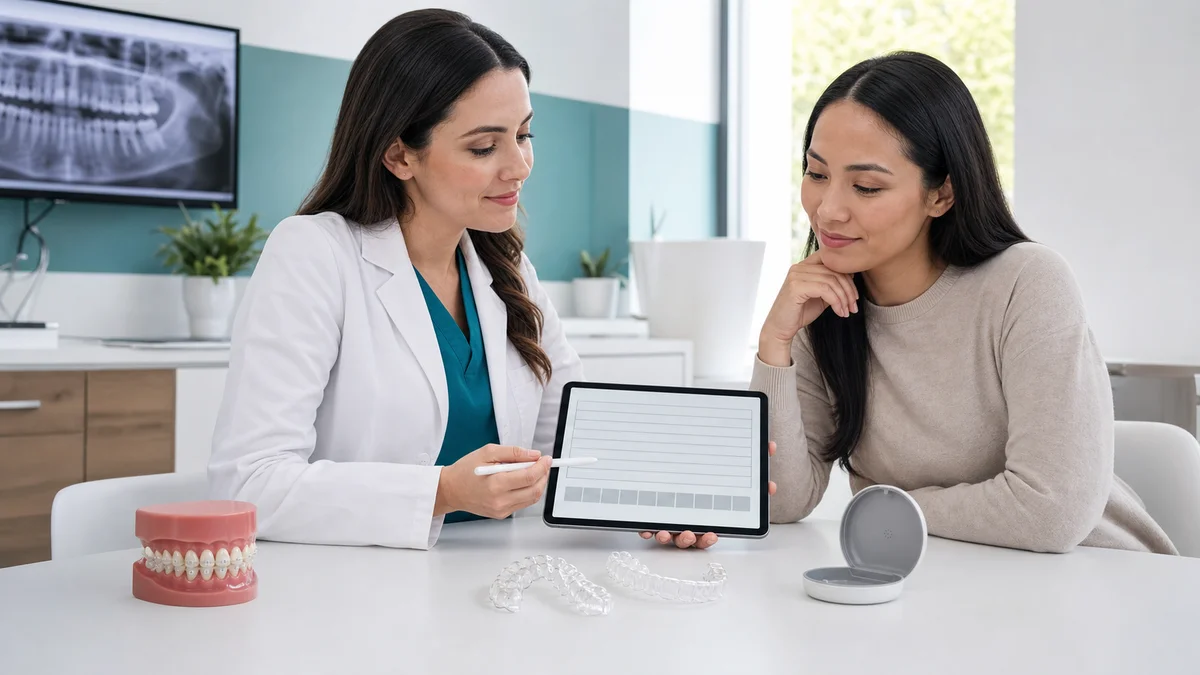
When patients ask how much is invisalign for a year, they often expect one annual price or twelve identical monthly charges. Orthodontic treatment is not normally sold as a one-year subscription. Invisalign® is a brand of clear aligner treatment, and the fee is usually shaped by the movements required, the professional care included, the number of aligner stages, monitoring, possible additional aligners and retainers. A twelve-month estimate describes a possible timeline; it does not by itself define the clinical scope or final amount.
This distinction matters because two plans described as “one year of Invisalign” may not purchase the same care. One could be a limited plan for selected front-tooth movements with a defined tray allowance. Another could address both arches, the bite, attachments, elastics, interproximal reduction, several progress reviews and a refinement phase. A third quote may include only the initial aligners while billing records, replacements or retainers separately. Comparing the first number without normalizing these differences can make the least complete proposal appear cheapest.
No online article can determine whether clear aligners are suitable for you or provide a binding quote. The American Association of Orthodontists advises that an orthodontic professional should determine whether aligners or braces fit the individual problem. Oral examination, periodontal assessment and appropriate records may change both the appliance choice and the estimate. This guide therefore focuses on how to read a quote, which uncertainties deserve written answers and how to separate clinical cost from insurance and financing.
1. Why “One Year” Is Not a Standard Price Unit
A treatment duration is a clinical estimate, not a standard product quantity. Orthodontic fees commonly cover a course of care defined by diagnosis and treatment scope. The professional may need to plan every tooth movement, supervise tissue response, check how trays are seating, manage attachments and finish the bite. Some of that work occurs before the first aligner is worn, and retention continues after the active year ends.
A patient with mild spacing might receive fewer stages and simpler auxiliaries than a patient whose visible crowding is accompanied by a deep bite, crossbite, root-position problem or significant rotation. Both could hear an approximate twelve-month timeline, yet their planning needs and biological uncertainty differ. Conversely, a treatment projected to last longer is not automatically more expensive if the provider uses a comprehensive fee structure. Time and price can be related, but they are not interchangeable.
Ask the provider which of these statements describes the proposal:
- A complete case fee covers active treatment until agreed clinical goals are reached, subject to written limits.
- A named aligner package includes a defined number of stages or additional-aligner rounds.
- A limited treatment plan addresses selected teeth or goals and intentionally excludes other bite findings.
- A fee is divided by appointments, phases or payment dates without changing the total clinical scope.
- A financing contract spreads repayment over a term that may be different from the active treatment period.
The answer should appear in the written estimate and consent documents. Marketing phrases such as “from,” “per month” or “one-year plan” are not substitutes for a list of included services, exclusions and change conditions.
2. How Much Is Invisalign for a Year? Start With Diagnosis
The safest answer to how much is invisalign for a year begins before price. A dentist or orthodontist should assess teeth, gums, bite, jaw relationships, previous dental work and the movements needed. A digital surface scan can record the visible shapes of teeth, but it does not by itself reveal every root, bone, impacted-tooth or disease finding. Radiographs should be prescribed when clinically indicated rather than automatically taken or omitted for convenience.
The AAO notes that gum health needs in-person evaluation and that radiographs may be required to assess roots and impacted teeth. Active decay, uncontrolled gum inflammation or other oral disease may need treatment before elective orthodontic movement. That preliminary care is not an aligner surcharge; it is a patient-safety step. It may nevertheless affect the amount and timing a patient must budget.
A sound assessment should clarify:
- the chief concern and realistic treatment goals;
- whether one or both arches need treatment;
- the bite and root movements required, not only front-tooth appearance;
- the condition of gums, bone, enamel, restorations and wisdom teeth;
- whether attachments, elastics, interproximal reduction or extraction may be considered;
- which alternatives, including fixed braces or no treatment, are reasonable;
- which records are necessary and who is clinically responsible for reviewing them.
A final treatment plan can differ from an online screening or preliminary record review. Patients considering care away from home should treat remote information as provisional until the treating clinician confirms the findings.
3. The 12-Line Clear Aligner Quote Audit
Use the following table to compare proposals on the same basis. A service does not need to be “free” or automatically included; it needs to be clearly labeled. Write the quoted amount, inclusion rule or exclusion beside every line. If a line is not clinically relevant, ask the provider to say so.
| Cost line | What to confirm in writing | Why it can change | Decision check |
|---|---|---|---|
| 1. Consultation and examination | Clinical exam, bite assessment and treatment discussion | Some clinics charge separately or credit it toward treatment | Was suitability assessed by the responsible clinician? |
| 2. Records and scan | Photographs, digital scan or impressions and diagnostic records | Initial and progress records may be priced differently | Are records available to the patient? |
| 3. Radiographs when indicated | Which images, clinical reason and interpretation | Existing usable images may reduce duplication; new findings may require more | Does the scan omit information the clinician needs? |
| 4. Pre-treatment oral care | Cleaning, decay, gum or restorative care listed separately | Needs vary by oral health | Is disease controlled before movement? |
| 5. Planning and aligner package | Brand or system, arches, goals, stage limits and expiration rules | Limited and comprehensive packages have different boundaries | Does the package match the diagnosis? |
| 6. Active aligners | Initial series, delivery and change instructions | Stage count and manufacturing scope differ | Are all planned trays included? |
| 7. Attachments | Bonding, repair and removal of composite attachments | Number and position depend on movements | Are visibility and maintenance explained? |
| 8. Auxiliaries | Elastics, buttons, interproximal reduction or other aids if indicated | Some movements require added clinical procedures | What finding triggers each item? |
| 9. Monitoring | In-person reviews, remote monitoring and urgent contact route | Frequency depends on risk, progress and travel | Who checks fit, gums, roots and bite? |
| 10. Refinements | New scans and additional aligner rounds, with limits and deadlines | Teeth may not track exactly as planned | When does an extra professional or laboratory fee apply? |
| 11. Lost or replacement trays | Replacement price, shipping, interim instructions and delay policy | Loss, damage or distortion is unpredictable | What should the patient do before the replacement arrives? |
| 12. Finishing and retention | Final records, attachment removal, bite finishing, retainers and reviews | Retainer type, quantity and replacement policy vary | Is retention inside or outside the active-treatment fee? |
Do not assume an empty line means included. Ask for “included,” “not applicable,” “estimated separately” or “patient pays” beside it. This single exercise is more useful than comparing two monthly advertisements because it exposes differences in clinical responsibility and aftercare.
4. Complexity Usually Matters More Than the Calendar
The Invisalign brand states on its official cost page that the treating doctor determines price based on case complexity and the number of aligners. That is a commercial manufacturer source, not an independent clinical guideline, but the principle is consistent with how individualized orthodontic care works. The responsible dentist or orthodontist must decide what is suitable; a brand calculator cannot diagnose a patient.
Complexity is not reliably measured by how crooked the front teeth look in a photograph. The plan may need to control roots, coordinate upper and lower arches, correct vertical or transverse relationships, create or close space, manage missing teeth or protect periodontal support. Crowns, bridges and implants can also influence the sequence. A dental implant does not move orthodontically like a natural tooth.
Factors that may expand planning, monitoring or aligner requirements include:
- large rotations, root torque or difficult vertical movements;
- significant overbite, open bite, crossbite or arch coordination;
- extraction spaces or teeth that are unerupted, impacted or missing;
- limited periodontal support, recession risk or previous root shortening;
- restorations that affect attachment bonding or the final tooth shape;
- the need for elastics, buttons, interproximal reduction or combined appliances;
- a staged restorative, periodontal or surgical treatment plan;
- previous orthodontic treatment and relapse.
More complex does not mean impossible with aligners, and simple-looking does not guarantee an easy case. The relevant question is which movements the clinician expects to be predictable with the proposed appliance and what the fallback plan is if tracking differs.
5. Limited, Comprehensive, Braces and Hybrid Plans
Quotes should be compared only when they aim to solve the same problem. A limited front-tooth plan may be an informed choice for a narrow goal, but it should not be presented as equivalent to a comprehensive bite correction. The clinician should document which findings will be treated, which will remain and whether the limited plan could create functional or periodontal compromise.
Four broad pathways may appear during consultation:
- Limited clear aligner treatment: a defined range of selected movements, stages or refinements.
- Comprehensive clear aligner treatment: a broader objective involving both arches, bite coordination and finishing, subject to package terms.
- Fixed braces: brackets and wires may offer different control, visibility, hygiene demands and appointment needs.
- Hybrid or combined care: aligners may be used with fixed appliances, elastics, restorative work or other clinically indicated methods.
There is no universally superior option. Clear aligners are removable and discreet, but removability transfers substantial responsibility to the patient. Fixed braces do not depend on tray reinsertion, yet they have their own hygiene, comfort and appearance considerations. The quote comparison should include clinical goals, expected cooperation, monitoring, retention and contingency plans, not only appliance aesthetics.
6. What the Initial Aligner Package May Exclude
A low starting estimate may describe the laboratory package rather than the complete episode of care. Ask whether professional planning, attachment procedures, progress visits and finishing are part of the same fee. If the provider uses a package name, request the patient-facing conditions: stage allowance, additional-aligner eligibility, submission deadline and what happens when treatment continues after the package window.
Additional aligners are often called refinements, midcourse corrections or continuation trays. They may be used when teeth have not followed the programmed sequence, when the bite needs finishing or when the clinical goal is revised. A refinement is not automatically evidence that the first plan failed. Biological response varies, and a digital animation is a plan rather than a guarantee. Still, patients should know whether the original fee includes new records and each additional round.
Also distinguish replacement from refinement. A replacement reproduces a lost or damaged stage. A refinement usually requires a new assessment, scan and revised sequence. Providers may charge these differently. Waiting for a replacement can interrupt progress, so the written policy should state which previous or next tray to wear and whom to contact; patients should not guess.
7. Attachments, IPR and Elastics Affect the Real Experience
Many aligner plans are not tray-only treatment. Tooth-colored composite attachments can help the plastic deliver specific forces. Buttons and elastics can influence upper-lower relationships. Interproximal reduction, often abbreviated IPR, may create measured space between selected teeth when clinically justified. These elements can affect chair time, appearance, consent and maintenance.
Ask where attachments are likely to be placed, whether their repair and removal are included, and how the enamel will be polished afterward. For IPR, ask why it is proposed, how much is planned, what alternatives exist and how the amount is controlled. Elastics add a second adherence requirement beyond aligner wear. None of these procedures should be added automatically simply because they are common.
The quoted fee should cover the actual proposed system, not an idealized image of plain transparent trays. If the plan changes and new auxiliaries become appropriate, the provider should explain the clinical reason, benefits, limitations and any added fee before proceeding.
8. Twelve Months Is an Estimate, Not a Result Guarantee
An estimated year can become shorter or longer. Duration depends on the starting problem, tooth movement, aligner fit, daily wear, tray loss, appointment attendance, oral health and biological response. Refinement stages or coordination with other dental treatment can extend the active phase. A patient should not advance to a new tray solely because a date has arrived when the clinician has advised a different schedule.
The Invisalign manufacturer commonly advises wearing aligners for most of the day, often described as 20 to 22 hours, but the treating clinician’s instructions govern the individual plan. Under-wear can prevent a tray from seating and make later stages progressively less accurate. Perfect adherence, however, cannot make an unsuitable movement predictable or remove biological uncertainty.
A responsible estimate states assumptions. Ask what daily wear, change interval and appointment schedule the timeline assumes; what signs indicate poor tracking; and what would trigger a rescan, extra aligners or a switch in appliance. Avoid providers who promise an exact completion date or guaranteed smile from a simulation.
9. Monthly Payment Is Not Monthly Treatment Cost
A displayed monthly amount is a cash-flow figure. It may be a clinic installment schedule, third-party credit payment or promotional calculation. It does not necessarily show the full fee, and its term may run longer or shorter than active treatment. A patient could finish aligners while still repaying finance, or complete repayment before the clinical course ends.
Before signing, separate the treatment agreement from the credit agreement. Record:
- the complete cash price for the stated clinical scope;
- the deposit and when it becomes non-refundable, if applicable;
- the amount financed and annual percentage rate;
- origination, account, late or early-settlement fees;
- number and size of payments and total repayment;
- what happens if treatment is paused, transferred or discontinued;
- how refunds are calculated and whether they go to the patient or lender;
- whether refinements, replacements and retainers are financed or billed later.
Zero-interest language may have eligibility rules, deferred-interest conditions or a limited promotional period. Read the lender’s current disclosure rather than relying on clinic advertising. Financing changes when money is paid; it does not make an appliance clinically appropriate or reduce the total clinical obligations.
10. Insurance Benefits Need Direct Confirmation
Orthodontic benefits vary widely between policies. A plan may use a lifetime orthodontic maximum, age restriction, waiting period, deductible, network rule, medical-necessity condition or coordination-of-benefits process. Another policy may exclude adult orthodontics. These are contract questions, not facts a clinic website can settle for every patient.
Ask the insurer for a current explanation of benefits and whether a pre-treatment estimate or prior authorization is required. Confirm which provider and procedure information must be submitted, whether payment goes to the clinic or patient, how benefits are released over time and what happens if employment or coverage ends during treatment. A pre-treatment estimate can improve planning but may not guarantee final payment because eligibility and remaining benefits can change.
Calculate the patient portion conservatively. Do not subtract an advertised insurance amount until the insurer has matched the proposed treatment, provider and current policy. If a clinic offers to check benefits, retain the insurer’s written response and verify any uncertainty directly.
11. Monitoring Is Clinical Care, Not an Optional Add-On
Sequential trays need professional monitoring. Reviews can assess seating, attachment integrity, oral hygiene, gum condition, tooth mobility, root or bone concerns when indicated, and the developing bite. Remote photographs or an app can support selected checks, but they do not automatically replace every in-person examination. The interval should reflect the patient’s risk and treatment stage.
The ADA’s teledentistry policy emphasizes transparent provider identity, licensure, costs and collection of relevant health history. Its direct-to-consumer dental services policy warns that removing a dentist’s diagnostic and treatment oversight can expose patients to damage and irreversible complications. Patients should know the licensed clinician responsible for the plan, changes and urgent decisions.
Ask the quote to state:
- how many routine reviews are anticipated and whether they are included;
- which visits must occur in person;
- who reviews remote submissions and how quickly concerns are escalated;
- how care works during travel or relocation;
- what an unscheduled assessment costs;
- how records and transfer information can be obtained.
A cheaper package with minimal oversight is not equivalent to supervised treatment. Convenience should preserve accountability rather than obscure it.
12. Retainers Belong in the One-Year Budget
Active tooth movement and retention are separate phases. Teeth can move after aligner treatment, so the finish is not clinically complete when the final active tray is removed. AAO and NHS orthodontic information both emphasize retention after active treatment. The retainer type and wear schedule should be individualized by the treating clinician.
Ask whether the fee includes fixed, removable or combined retainers; how many sets are supplied; when they are fitted; whether a final scan or impression is included; and how follow-up is arranged. Retainers can wear, crack, distort, become lost or stop fitting. Replacement may be a future patient cost even when the first set is included.
The Invisalign brand’s own retainer information says cost varies by provider, insurance and type and advises asking whether retainers are included in the overall treatment fee. That commercial source is useful for product-specific context, while clinical retention decisions remain with the treating professional. Budgeting only for the active twelve months leaves out the stage that helps preserve the result.
13. Oral Health Can Change Both Timing and Cost
Orthodontic movement should begin on a stable oral-health foundation. Untreated decay, gum inflammation, periodontitis or inadequate plaque control may require care first. The World Health Organization identifies untreated caries and severe periodontal disease among major oral diseases. Aligners do not cure these conditions, and covering teeth for much of the day does not remove the need for brushing, interdental cleaning and professional care.
Before the scan or appliance order, ask whether routine examination and cleaning are current and whether fillings, periodontal treatment or restorative work could change tooth shape. A new filling or crown after trays are manufactured can affect fit. Treatment of disease should be itemized separately so the patient understands which costs belong to oral health and which belong to orthodontics.
During treatment, frequent sugary or acidic drinks, reinserting trays over unclean teeth and inconsistent hygiene can increase risk. Follow the clinician’s cleaning instructions and continue routine dental care. A removable appliance makes tooth surfaces accessible, but it does not guarantee healthy gums or enamel.
14. Symptoms That Need Prompt Professional Review
Pressure or temporary tenderness can occur after an aligner change, but pain is not proof that treatment is working. Contact the treating team for a tray that repeatedly will not seat, a sharp edge causing injury, a broken attachment that affects fit, unexpected bite change or persistent symptoms. Do not heat, aggressively trim or reshape an aligner without instruction.
Seek prompt dental or medical assessment for worsening or severe pain, swelling, pus, fever, significant gum bleeding or recession, a tooth that feels unusually loose, persistent numbness, facial trauma, swallowing or breathing difficulty, or signs of an allergic reaction. The appropriate urgency depends on the symptom and local clinical advice. When away from the treating clinic, use local urgent services rather than waiting for a remote reply if the situation may be serious.
The financial plan should identify who handles urgent concerns and whether unscheduled care is included. A warranty or package promise cannot guarantee biological response, prevent every complication or replace timely examination.
15. Dental Travel and Continuity of Care
Patients comparing countries should add the complete care journey, not just convert the clinic fee. Clear aligner care may require an examination, records, attachment placement, progress reviews, refinements, attachment removal and retainer delivery. A remote monitoring option can reduce some travel, but the clinician should explain which steps still require attendance.
Budget for transport, accommodation, time away from work, currency fees, possible return visits and local emergency care. Confirm how replacement trays are shipped, whether customs or courier charges apply, and what happens if a rescan is needed. Ask for copies of records and a transfer protocol. A dentist in another country is not automatically responsible for continuing someone else’s plan and may charge for assessment.
Redent Klinik provides an English overview of its dental services and an English contact route for requesting a preliminary review. Any remote estimate should remain provisional until the treating clinician confirms clinical findings and gives a written scope.
16. Red Flags in a One-Year Aligner Offer
- An exact final fee or guaranteed finish date is promised from selfies alone.
- The responsible dentist or orthodontist cannot be identified.
- A surface scan is described as a complete substitute for examination and all clinically indicated imaging.
- The quote does not identify whether one or both arches and the bite are treated.
- Attachments, elastics, IPR, refinements and retainers are hidden until after payment.
- A limited package is marketed as comprehensive without explaining untreated findings.
- A monthly figure is shown without cash price, finance term and total repayment.
- Insurance reimbursement is presented as guaranteed.
- There is no plan for monitoring, urgent concerns, transfer or lost trays.
- A digital simulation is presented as a guaranteed biological result.
- Gum disease, decay, oral hygiene and routine dental care are dismissed.
- The patient is pressured to pay before reviewing consent and cancellation terms.
One red flag does not prove that a provider is unsafe, but it is a reason to pause and request clarification. Good consent identifies material risks, reasonable alternatives, uncertainties and the option not to proceed. A transparent provider can explain what the fee covers without promising a universal result.
17. A Practical Decision Process Before Paying
First, obtain a diagnosis and treatment objective. Second, ask for the twelve cost lines in writing. Third, normalize competing quotes so they cover the same arches, movements, monitoring and retention. Fourth, verify insurance directly. Fifth, calculate total finance repayment and travel cost. Finally, review the treatment, credit and cancellation documents as separate agreements.
Use these questions during consultation:
- What exact clinical findings are being treated, and which will remain?
- Why are clear aligners suitable compared with braces or another option?
- What is included from diagnosis through retainers?
- How many additional-aligner rounds are included, and what deadlines apply?
- Which possible extra charges are predictable today, and what finding triggers each one?
- Who monitors treatment, and what happens if the plan stops tracking?
- What assumptions support the twelve-month estimate?
- What is the total amount payable under the chosen payment method?
- What happens financially and clinically if treatment is paused or transferred?
Take time to compare answers. The aim is not to eliminate every uncertainty, which is impossible in biological treatment. It is to distinguish known scope, reasonable contingencies and genuinely unpredictable events before committing.
Frequently Asked Questions About How Much Is Invisalign for a Year
Is Invisalign charged by the month or by the year?
Usually neither description captures the clinical fee. Providers commonly price a diagnosed course or aligner package, then divide payment across dates. The payment schedule may not match active treatment length. Ask for the complete cash price, clinical scope and total financed repayment.
Can I get an exact one-year quote online?
A clinic may offer a preliminary estimate from records, but an exact treatment plan generally requires examination and appropriate diagnostics. Gum health, roots, bite, restorations and movement complexity can change suitability and scope. Treat a remote figure as provisional until the responsible clinician confirms it in writing.
Does a twelve-month Invisalign quote include every aligner?
Not automatically. It may include an initial series with limits on stages, additional-aligner rounds or submission dates. Ask whether refinements, midcourse scans, replacements and shipping are included and what happens when treatment continues beyond the package period.
Why do two one-year clear aligner quotes differ?
They may address different goals or include different records, arches, aligner packages, attachments, auxiliaries, reviews, refinements and retainers. Provider location and finance terms can also differ. Compare the twelve cost lines and the same clinical objective before comparing totals.
Are refinements a sign that treatment failed?
No. Teeth do not always track exactly like a digital plan, and additional aligners may help finish movement or bite coordination. Refinements should still have a clear clinical reason. Ask how many rounds and new scans are included and when extra fees apply.
Are retainers included in a one-year price?
Sometimes, but inclusion varies. Confirm retainer type, number of sets, fitting, follow-up and replacement policy. Retention begins after active movement and may continue long term, so its cost and responsibilities belong in the overall decision.
Will dental insurance cover adult Invisalign treatment?
Coverage depends on the individual policy. Age limits, waiting periods, lifetime orthodontic maximums, network rules and exclusions may apply. Ask the insurer to review the proposed treatment and provider. A pre-treatment estimate is helpful but may not guarantee final payment.
Is a low monthly payment the cheapest option?
Not necessarily. A low payment can reflect a longer term, deposit, interest or fees. Compare the cash price, amount financed, annual percentage rate, total repayment and services excluded from finance. Monthly affordability and total cost are different questions.
Can Invisalign always finish in twelve months?
No. Twelve months is an estimate based on assumptions about diagnosis, wear, biological response and tracking. Lost trays, missed visits, oral-health treatment or refinements can change the timeline. No clinician can ethically guarantee an exact completion date or result.
What is the single best question to ask a provider?
Ask: “What complete clinical result does this fee aim to deliver, what is excluded, and which finding would trigger each possible additional charge?” Request the answer in writing together with monitoring, refinement, retention and cancellation terms.
Conclusion: Compare Complete Care, Not a Calendar Label
The useful answer to how much is invisalign for a year is not one universal number. A year describes a possible active-treatment interval, while the fee reflects diagnosis, planning, aligners, auxiliaries, monitoring, refinements, finishing and retention. Start with suitability, then compare written proposals that address the same clinical goals.
Audit all twelve cost lines, verify insurance with the insurer and calculate total finance repayment. Include travel and continuity costs when treatment is away from home. Ask what could change the timeline or amount and who is responsible when a tray does not fit or symptoms develop. A trustworthy estimate makes known scope and uncertainty visible without promising an exact biological result.
Official Sources and Evidence Notes
- American Association of Orthodontists: Clear Aligners
- American Association of Orthodontists: Adult Orthodontic Questions, Examination and Gum Health
- American Dental Association: Direct-to-Consumer Dental Services Policy
- American Dental Association: Policy on Teledentistry
- Nottingham University Hospitals NHS Trust: Orthodontic Retainers
- World Health Organization: Oral Health Fact Sheet
- Invisalign Official: Cost, Insurance and Payment Options (Commercial Manufacturer Source)
- Invisalign Official: Retainer Cost Factors (Commercial Manufacturer Source)
Sources reviewed July 19, 2026. This article provides general education, not an individual diagnosis, binding quote, insurance decision, credit advice or result guarantee. Invisalign is a registered commercial brand; clinical suitability and treatment decisions belong to the responsible treating dentist or orthodontist.