
Getting the smile of your dreams doesn’t always end the moment your last aligner is removed. Sometimes, your teeth may need a little extra attention — and that’s where an Invisalign touch up comes in 🦷✨. This process fine-tunes your results, ensuring that every tooth is perfectly aligned and your smile meets both aesthetic and functional goals. Whether you’ve just completed your Invisalign journey or you’ve noticed minor shifting afterward, a touch up can help you achieve that flawless final look you’ve been waiting for.
The Invisalign touch up is a short, targeted phase of treatment that corrects small imperfections left after the main Invisalign process. These refinements are quite common — in fact, many patients require at least one round of touch ups to perfect alignment, bite, or rotation issues. Think of it as the “polishing stage” of your orthodontic transformation 😁. Just like artists add final details to their masterpiece, orthodontists use touch ups to deliver a picture-perfect smile.
During this stage, your orthodontist assesses your post-treatment smile using digital scans or impressions. They’ll determine if certain teeth need additional adjustments — such as slight rotations, gap closure, or alignment fine-tuning. The Invisalign system allows for the creation of new sets of clear aligners specifically designed for these refined movements. The goal is precision — subtle yet impactful changes that ensure your teeth look and function their absolute best.
One major reason patients seek an Invisalign touch up is natural tooth movement. Even with diligent retainer use, some shifting can occur over time. Factors like grinding, jaw pressure, or retainer wear issues can contribute to this. Fortunately, touch ups are much faster than the original Invisalign treatment because they focus only on a few teeth rather than the entire arch. Most touch up plans require fewer trays and can be completed in a few weeks to a few months ⏱️.
From a technical perspective, an Invisalign refinement or touch up is not considered a new treatment — it’s a continuation of your smile journey. Orthodontists often recommend it when a patient’s treatment results fall slightly short of the digital projection created in the original Invisalign plan. The process usually starts with a new 3D scan to capture your current tooth positions, followed by customized aligners that correct those last minor imperfections.
Aside from aesthetics, an Invisalign touch up can also improve bite function. For example, slight misalignments can affect chewing efficiency, cause uneven tooth wear, or lead to jaw discomfort. A precise refinement ensures your teeth fit together correctly, maintaining both oral health and long-term comfort. This level of detail is what differentiates a good smile from a great one 🌟.
It’s also worth noting that an Invisalign touch up isn’t limited to patients who’ve just finished treatment. If you completed Invisalign several years ago and notice your teeth have shifted due to inconsistent retainer wear, you may still qualify for a touch up plan. Many adults choose this option to restore their original smile without committing to a full-length treatment again.
When considering a touch up, always consult with a certified Invisalign provider. Clinics like Redent Klinik Contact Page offer personalized evaluations to determine whether a short refinement or a new aligner series is the right approach. A skilled orthodontist can identify even subtle misalignments and design a precise plan that enhances your results without unnecessary time or cost.
From a professional standpoint, the success of an Invisalign touch up depends on accurate diagnostics and compliance. Just like your initial Invisalign journey, you’ll need to wear your aligners for 20–22 hours a day and follow your orthodontist’s instructions closely. Skipping wear time or neglecting retainer use afterward may lead to further shifting, undoing the refinements achieved during your touch up phase.
According to the American Dental Association, maintaining tooth alignment after orthodontic treatment requires consistent retainer use and regular checkups. Invisalign touch ups are an excellent way to preserve the investment you made in your smile while addressing those last-minute imperfections that might otherwise go unnoticed. This approach embodies the modern philosophy of precision dentistry — small adjustments with maximum impact 🪞.
In summary, an Invisalign touch up is a personalized, efficient, and minimally invasive process designed to perfect your smile after your main Invisalign treatment. It targets minor misalignments, enhances comfort, and ensures lasting results. If your smile looks almost — but not quite — perfect, a touch up could be the key to achieving absolute harmony. Think of it as the final brushstroke on your masterpiece, giving you the confidence to smile with pride every day.
Common Reasons for Needing Invisalign Refinements
Even after completing your aligner journey, you might notice that your smile still isn’t 100% where you want it to be. That’s where an Invisalign touch up — also known as an Invisalign refinement — comes into play 🦷. Refinements are a normal and often necessary part of the treatment process, designed to make small but essential adjustments after the main Invisalign course has been completed. They ensure your teeth align precisely according to the original plan or any new goals your orthodontist may define during post-treatment evaluation.
Minor Tooth Movements That Weren’t Fully Corrected
During the main Invisalign phase, your teeth are guided through a series of gradual movements. However, not every tooth moves exactly as predicted. Biological factors, bone density, and even patient habits can slightly affect how efficiently teeth respond to aligners. If certain teeth — such as the canines or premolars — lag behind, your orthodontist may recommend an Invisalign touch up to target these stubborn areas. These refinements use new sets of trays specifically designed to perfect the alignment of these teeth, ensuring balance and symmetry in your final result 🌟.
For example, if you notice a small gap that didn’t fully close or one tooth that appears slightly rotated, it doesn’t mean your treatment failed. It simply means your body’s natural variations require a bit more precision. With a short Invisalign touch up plan, your orthodontist can focus on these isolated movements, often achieving full correction in just a few additional weeks.
Issues with Bite Alignment
Bite problems are another common reason for refinements. Even with perfect front-to-back alignment, you may still experience uneven bite pressure or slight contact issues between the upper and lower teeth. These bite discrepancies — called occlusal interferences — can cause discomfort or premature tooth wear over time if left untreated. A customized Invisalign touch up ensures that your bite functions smoothly, enhancing both comfort and long-term oral health 🦷💪.
Orthodontists use digital scans and occlusal mapping tools to identify these bite issues precisely. By adjusting tooth positions millimeter by millimeter, Invisalign refinements help ensure that your jaws close naturally without strain. This not only prevents pain but also contributes to a healthier temporomandibular joint (TMJ) over the years.
Shifting After Treatment or Poor Retainer Compliance
One of the most frequent causes of post-treatment touch ups is tooth relapse — a gradual shifting that occurs when retainers aren’t worn as instructed. After Invisalign treatment, teeth naturally tend to move back toward their original positions if they aren’t stabilized. Skipping retainer nights or inconsistent use can quickly undo months of progress. In such cases, an Invisalign touch up can reposition the teeth back into their correct alignment without restarting full orthodontic treatment 🔄.
It’s important to note that the longer you wait after noticing tooth shifting, the more extensive your refinement process might become. Early intervention with a short touch up phase is far easier and faster than waiting until the misalignment becomes significant. Many clinics, such as Redent Klinik Contact Page, emphasize periodic retention checks to catch these issues before they escalate.
Patient Habits That Influence the Need for Touch Ups
Some everyday habits can contribute to the need for an Invisalign touch up. Teeth grinding (bruxism), chewing on hard objects, or clenching the jaw can alter tooth positioning subtly over time. Likewise, failing to clean or properly insert aligners may cause uneven pressure distribution. These minor factors add up, and by the end of treatment, the results may appear slightly off from the projected outcome. Refinement aligners are an excellent solution, restoring harmony while reinforcing the importance of proper aligner care and wear habits.
Changes in Gum or Bone Structure During Treatment
Throughout an orthodontic journey, your gum tissue and bone structure adapt to new tooth positions. However, certain biological responses — like gum shrinkage, bone remodeling, or root resorption — may slightly influence final tooth alignment. When this occurs, a brief Invisalign touch up helps reestablish ideal spacing and contact points between teeth. These refinements play a crucial role in preventing long-term issues like black triangles (small gaps between teeth) and uneven gum lines.
Patients with periodontal sensitivity or mild bone loss benefit especially from careful monitoring during treatment. A refinement phase helps orthodontists make minor adjustments that protect overall oral stability while preserving aesthetics. For these cases, aligners are often designed with gentler forces to avoid overcorrection while still achieving visible improvement.
Refinements for Cosmetic Precision
Beyond functional reasons, some patients choose an Invisalign touch up for purely aesthetic perfection. A single degree of rotation or a fraction of a millimeter in tooth positioning can make a huge visual difference, especially in the front teeth that dominate your smile. If you’re aiming for symmetry under every lighting angle and photo flash 📸, a refinement can elevate your results from great to flawless.
Cosmetic refinements are especially popular before weddings, public events, or professional photoshoots, where small details matter. Since these adjustments usually involve fewer aligners, the time commitment is minimal — often between 4 to 10 weeks — but the outcome is dramatically enhanced.
When Orthodontic Attachments Need Repositioning
Attachments (the small enamel-colored bumps placed on teeth) guide Invisalign aligners for specific movements. Over time, these attachments can wear off, loosen, or lose their intended position. In such cases, orthodontists perform an Invisalign touch up by reapplying or repositioning attachments and ordering new trays that complement the updated setup. This ensures that every aligner exerts the correct pressure on the intended teeth, maintaining full treatment accuracy.
Final Thoughts on Why Refinements Matter
In essence, the reasons for needing an Invisalign touch up vary from biological to behavioral, from aesthetic to functional. What they all share is a commitment to precision — a desire to achieve the most natural, comfortable, and radiant version of your smile. According to the American Dental Association, continuous follow-ups and personalized refinements are essential for lasting orthodontic success. By addressing these small imperfections proactively, patients not only protect their investment but also ensure that their smile remains healthy and perfectly aligned for years to come 💎.
How the Invisalign Touch Up Process Works Step-by-Step
The Invisalign touch up process is a carefully designed refinement phase that focuses on making precise corrections to your smile after your main Invisalign treatment is completed 🦷. This phase is not a restart of your orthodontic journey but a continuation — a way to perfect the finer details that may have shifted or not fully aligned during the initial plan. Understanding each step of the process helps patients know exactly what to expect, from the initial consultation to the final retention phase.
Step 1: Post-Treatment Evaluation and Smile Assessment
After completing your final set of aligners, your orthodontist will schedule a comprehensive evaluation to determine if an Invisalign touch up is needed. During this visit, they’ll analyze your teeth alignment, bite position, and how well the actual outcome matches the digital simulation created before treatment. Sometimes, certain teeth—especially canines or premolars—don’t move as precisely as expected, which is completely normal. The orthodontist will use a combination of clinical examination, photographs, and 3D scans to assess these differences.
Advanced digital tools like the iTero scanner create a detailed 3D model of your mouth within minutes. This scan becomes the foundation for designing the next phase of aligners used in the touch up. The goal is to identify even the smallest misalignments, ensuring that your final smile is symmetrical, functional, and visually balanced. If refinements are needed, your orthodontist will explain which teeth need adjustments and how long the process might take ⏱️.
Step 2: Creating a New Digital Treatment Plan
Once your orthodontist confirms that an Invisalign touch up is beneficial, a new digital treatment plan is created. This plan focuses solely on the areas that need improvement—typically involving fewer teeth than your initial Invisalign program. The updated plan uses advanced ClinCheck software that allows both the doctor and patient to preview the expected final results on screen. This gives you a clear understanding of what will be achieved in the refinement phase.
Each aligner set is custom-fabricated to target specific teeth movements. Depending on the complexity, you may need anywhere from 5 to 20 new aligners. Unlike your initial full-length Invisalign treatment, these new trays usually address limited tooth movements such as slight rotations, closing tiny gaps, or aligning edges more perfectly. The manufacturing process follows the same precision standards, ensuring the aligners fit comfortably and deliver consistent pressure for optimal results 💎.
Step 3: Reattachment or Adjustment of Invisalign Buttons
Before you begin wearing your refinement aligners, your orthodontist may need to adjust or reapply attachments (small, tooth-colored bumps) on your teeth. These attachments act as anchors that help the aligners apply the right amount of force in the correct direction. If they’ve worn down or fallen off during your initial treatment, new ones may be placed. This step ensures the Invisalign touch up works efficiently and moves each tooth as planned.
For some patients, new attachments are unnecessary, especially if only minimal adjustments are required. However, when fine-tuning rotations or vertical movements, attachments can significantly improve precision. The orthodontist will make these adjustments quickly—usually in less than 30 minutes—and then fit your first refinement aligner to verify comfort and accuracy.
Step 4: Wearing Your Refinement Aligners
Once your new aligners are ready, you’ll begin wearing them just like your original Invisalign trays — typically 20–22 hours per day. Consistency is the most important factor in achieving the best outcome. The average Invisalign touch up lasts between 6 and 12 weeks, but some may extend slightly longer depending on the goals. Each set of aligners is worn for about one to two weeks before switching to the next, gradually guiding the teeth into their final ideal positions 🪞.
During this period, you may experience mild pressure or tightness when switching trays, a sign that your teeth are actively moving. Your orthodontist will schedule periodic checkups to ensure the progress aligns with the treatment plan. Adjustments can be made if certain movements need additional refinement along the way. Some clinics like Redent Klinik Contact Page offer digital progress tracking, allowing patients to upload smile photos for remote evaluations—making the process even more convenient.
Step 5: Monitoring and Mid-Course Adjustments
Throughout your refinement phase, your orthodontist will monitor the progress using both visual assessments and 3D tracking tools. If they notice that certain teeth aren’t responding as expected, they may perform mid-course corrections. These adjustments could involve adding new attachments, re-scanning your teeth, or ordering a few additional aligners. This proactive approach ensures that the Invisalign touch up remains efficient and effective without unnecessary delays.
Technology in Monitoring Progress
Modern Invisalign systems integrate artificial intelligence to analyze your smile’s movement pattern in real time. This ensures that every subtle adjustment brings your teeth closer to perfection. Using AI-supported models, orthodontists can compare each scan against the projected outcome, guaranteeing precision with every aligner change. The accuracy of this step makes Invisalign one of the most reliable and predictable orthodontic systems available today 🤖.
Step 6: Completion and Retention Phase
Once your Invisalign touch up phase concludes, your orthodontist will verify that your teeth are in their ideal final positions. After approval, you’ll receive a new set of retainers designed to maintain your results. This retention phase is critical — without consistent retainer wear, teeth can gradually shift back, undoing your hard work. Most orthodontists recommend wearing retainers nightly for at least the first year and then several nights a week indefinitely.
During this phase, small adjustments might still occur as your mouth adapts to its new alignment. Regular follow-up visits ensure that everything remains stable. According to the American Dental Association, maintaining post-treatment stability through retainers significantly increases the longevity of orthodontic results and minimizes relapse risks.
Step 7: Enjoying Your Perfected Smile
The final stage of the Invisalign touch up process is the most rewarding — seeing and feeling your perfected smile. Patients often report that even minor refinements make a major difference in confidence and comfort. With improved bite alignment, smoother tooth edges, and enhanced symmetry, your smile not only looks more attractive but also functions better.
In conclusion, the Invisalign touch up process is an advanced, precise, and highly personalized sequence that ensures you achieve the smile you envisioned from the beginning. By following each step carefully and maintaining compliance, you can enjoy a lifetime of aligned, healthy teeth. A touch up isn’t just a correction—it’s the final step toward dental perfection and a truly confident smile 😄.
How to Tell If You Need an Invisalign Touch Up After Treatment
Completing your Invisalign journey is a major milestone — but sometimes, your smile might not feel as “finished” as you expected. Maybe one tooth looks slightly out of place, or your bite doesn’t feel perfectly balanced. These small imperfections are completely normal and can often be corrected through an Invisalign touch up 🦷. Recognizing when you might need a touch up is essential for maintaining both the aesthetics and function of your smile. Let’s explore how to tell if you could benefit from this refinement phase, what signs to look for, and when to schedule a follow-up with your orthodontist.
Visible Misalignment or Uneven Teeth
One of the clearest signs that you may need an Invisalign touch up is noticing slight misalignment after finishing your final set of trays. For example, you might observe a small gap that hasn’t closed completely or a tooth that appears slightly rotated. These visual imperfections often occur when certain teeth respond slower to aligner pressure. Even if it’s subtle, your orthodontist can easily spot such issues and create a short refinement plan with a few new aligners to perfect your results ✨.
Pay special attention to your front teeth, as even the tiniest rotation or height difference can be noticeable in photos or when you smile. A refinement can correct these details with precision, ensuring your smile looks symmetrical and harmonious. Remember, your goal isn’t just straight teeth — it’s a balanced, confident, and natural-looking smile.
Changes in Bite Alignment or Discomfort When Chewing
Another indicator that an Invisalign touch up might be necessary is a change in your bite, known as occlusion. After treatment, your upper and lower teeth should fit together smoothly when you close your mouth. If you notice discomfort when biting, uneven contact points, or clicking sounds from your jaw, it could signal that minor bite adjustments are needed. Over time, these small misalignments can lead to enamel wear or jaw tension if not corrected 🪞.
Orthodontists use occlusal mapping tools to measure bite accuracy during post-treatment checkups. If certain areas of your teeth make premature contact, a short refinement phase can reposition them to distribute bite force evenly. This not only enhances comfort but also prevents long-term issues like temporomandibular joint (TMJ) discomfort or tooth grinding.
Retainer Fit Problems
Your retainers are custom-designed to fit your teeth exactly at the end of your Invisalign journey. If you notice that your retainers suddenly feel too tight, don’t fit properly, or don’t fully seat over your teeth, this could indicate minor shifting. Retainer misfit is one of the earliest warning signs that a touch up may be needed. Skipping retainer nights or inconsistent wear allows teeth to move back toward their old positions. A quick Invisalign touch up can reposition them before the misalignment becomes more significant ⏱️.
Tip: Don’t Force a Tight Retainer
Many patients try to “force” their retainers back into place after noticing tightness. This can cause unnecessary discomfort or even damage the appliance. Instead, consult your orthodontist right away. If caught early, your provider can perform a new 3D scan and create refinement aligners to realign your teeth safely. Clinics like Redent Klinik Contact Page offer quick evaluations to determine if a touch up or new retainer is the better solution.
Gaps, Crowding, or Uneven Spacing Returning
Some patients experience the gradual reopening of small gaps or mild crowding even after successful treatment. This typically happens due to natural movement, especially in the lower front teeth, which are more prone to shifting. A minor Invisalign touch up can effectively close these gaps and reestablish even spacing between teeth. The process is faster and easier than restarting a full treatment plan, often requiring just a few refinement trays.
It’s also worth noting that hormonal changes, tooth extractions, or changes in bone density can subtly influence tooth positions over time. Regular orthodontic checkups help detect these micro-shifts early, allowing for a short refinement phase before they become visible or bothersome.
Uneven Tooth Edges or Bite Planes
If your smile looks slightly uneven when you bite down or when viewed in the mirror, it may not be purely cosmetic — it can be functional too. Uneven bite planes occur when certain teeth finish in a slightly higher or lower position than intended. Over time, this imbalance can lead to extra wear on specific teeth. An Invisalign touch up can realign these areas with precision, helping you achieve a balanced bite and more polished appearance 😁.
Feeling Like Your Smile “Isn’t Quite Right”
Sometimes, the need for an Invisalign touch up is more about how you feel than what you see. Many patients describe a sense that their teeth look great but “not perfect.” Perhaps one tooth edge doesn’t match its neighbor, or the arch shape seems slightly off. These small details can make a big difference in your overall confidence and satisfaction. Since Invisalign refinements focus on fine-tuning, they can address even the most subtle issues that matter most to you personally 🌟.
Posture, Habits, and Lifestyle Influences
Your habits and daily routines can also affect tooth stability after treatment. For instance, sleeping on one side of your face consistently, resting your chin on your hand, or chewing on pens can create uneven pressure on specific teeth. These habits might lead to slight shifts over time. A brief Invisalign touch up corrects these minor misalignments while helping you become more aware of habits that might influence your smile’s longevity.
Monitoring Your Smile Over Time
Orthodontists recommend scheduling follow-up evaluations every six months after completing Invisalign treatment. During these visits, subtle changes can be detected early. Using 3D scanning technology, they can compare your current tooth positions with your final treatment records to see if a refinement is warranted. This proactive approach helps prevent small misalignments from becoming larger and more time-consuming to correct later on.
When to Schedule a Professional Evaluation
If you suspect that your teeth have shifted or you’re simply not satisfied with your final results, the best step is to schedule a consultation with your Invisalign provider. According to the American Dental Association, timely follow-up care plays a critical role in maintaining the health and longevity of orthodontic results. Orthodontists can determine whether a quick Invisalign touch up will resolve the issue or if a new retainer will suffice.
In summary, if you notice small gaps, bite irregularities, discomfort, or simply feel your smile could look a little better, don’t ignore it. An Invisalign touch up is a simple, effective solution that refines your results and restores your confidence. These refinements are faster, less expensive, and highly targeted — the perfect way to turn a good smile into a truly perfect one 😄.
Invisalign Touch Up vs. Full Invisalign Treatment: Key Differences
Although both procedures use the same clear aligner technology, an Invisalign touch up and a full Invisalign treatment serve very different purposes 🦷. Understanding these differences can help you make the right decision if you’re wondering whether your smile needs a quick refinement or a complete orthodontic re-treatment. Below, we’ll explore the distinctions in goals, duration, cost, and methodology between these two approaches — giving you a complete picture of what each process entails and when one might be better suited than the other.
Purpose and Treatment Goals
The main goal of a full Invisalign treatment is to correct moderate to complex alignment issues such as crowding, gaps, bite problems, or rotations throughout the entire dental arch. It’s a comprehensive process that typically takes several months to over a year to complete. By contrast, an Invisalign touch up focuses on subtle refinements and post-treatment adjustments. It’s like the “fine-tuning” stage — correcting the last 5% of imperfections that might remain after your initial treatment or that appear later due to natural tooth shifting ✨.
In other words, while a full treatment transforms the foundation of your smile, a touch up enhances the final result. Many orthodontists compare it to detailing a car after a full paint job — the touch up ensures perfection in symmetry and smoothness.
Duration and Number of Aligners
One of the clearest differences between a full Invisalign plan and an Invisalign touch up is treatment time. Full Invisalign treatments can involve anywhere from 20 to 50+ aligner sets depending on the complexity of the case, taking between 12 to 18 months on average. Touch ups, however, are significantly shorter — usually requiring 5 to 15 aligner sets and lasting 6 to 12 weeks.
The shorter timeline makes the touch up ideal for patients who only need minimal corrections. This efficiency is particularly beneficial for individuals preparing for special occasions like weddings, graduations, or photo sessions who want to perfect their smile in a short period.
Complexity and Scope of Treatment
Full Invisalign treatment addresses every tooth, including both arches (upper and lower). The orthodontist uses 3D modeling to design precise tooth movements for comprehensive correction. In an Invisalign touch up, the scope is much more limited — typically targeting a few specific teeth that need minor rotation, spacing, or leveling adjustments.
For instance, if your lower incisors have slightly shifted or if a small space remains between your upper front teeth, a touch up can correct these areas without involving the rest of your mouth. Since fewer teeth are being moved, aligners apply more focused pressure, and the refinement process becomes highly efficient 🔍.
Cost and Insurance Coverage
Cost is another major difference between these two treatments. Full Invisalign treatments generally cost between $3,000 and $7,000, depending on the case complexity, geographic location, and provider expertise. An Invisalign touch up, on the other hand, is far less expensive because it requires fewer aligners and appointments. Refinements often range between $500 and $1,500, making them a cost-effective way to maintain your smile’s perfection 💰.
How Insurance and Clinics Handle Refinements
Some orthodontists include one or two touch up phases in the original Invisalign package, especially if minor refinements are anticipated. However, after a certain period, touch ups may be billed separately. It’s always best to check your treatment agreement. Clinics like Redent Klinik Contact Page offer personalized consultations to estimate your refinement cost and determine if it qualifies as part of your initial Invisalign warranty or requires a new plan.
Attachments and Equipment Used
Both Invisalign treatments use small composite attachments placed on teeth to guide movement. However, during a full Invisalign plan, attachments are placed more extensively and strategically across multiple teeth. During an Invisalign touch up, only a few attachments are usually applied — or sometimes none at all — since the goal is minor, localized adjustments.
Additionally, while both treatments rely on 3D scanning and ClinCheck software, refinement aligners are made with updated scans taken after your initial treatment. This ensures accuracy based on your current tooth positions. The technology remains the same, but the application becomes more targeted and precise 🎯.
Maintenance and Follow-Up Requirements
Both Invisalign treatments require diligent aligner wear — 20 to 22 hours per day — but follow-up schedules differ. Full Invisalign treatments typically involve checkups every 6 to 8 weeks to track overall progress, while an Invisalign touch up may only need one or two brief visits for evaluation. Because refinements focus on smaller movements, progress is easier to monitor, and adjustments can be made more quickly if needed.
Patient Eligibility and Ideal Candidates
Not everyone qualifies for an Invisalign touch up. This option is best suited for patients who have already completed a full Invisalign or braces treatment and whose teeth are mostly aligned. It’s also perfect for individuals who notice minor shifting after not wearing retainers consistently. In contrast, patients with more significant misalignments, bite issues, or crowding will likely need to restart with a comprehensive Invisalign plan.
Orthodontists evaluate the extent of your misalignment using 3D imaging. If less than 20% of the total tooth movement from the original treatment is needed, a touch up is usually the recommended route. For larger corrections, a full treatment ensures long-term stability and proper occlusal balance.
Results and Longevity
When properly completed, both Invisalign treatments deliver excellent long-term results — but retention plays a key role. After either treatment, consistent retainer wear is essential to prevent teeth from shifting again. A successful Invisalign touch up restores your smile to its ideal state and reinforces retention habits to protect your results long-term.
According to the American Dental Association, post-treatment retention should last indefinitely, meaning retainers are a lifelong companion to your perfect smile. Patients who follow this advice rarely need another touch up in the future.
Final Thoughts: Choosing Between Touch Up and Full Invisalign
The choice between a full Invisalign treatment and an Invisalign touch up depends on your current dental condition, treatment goals, and timeline. If you’re simply looking to enhance an already well-aligned smile, a touch up is the smarter, faster, and more affordable choice. But if your teeth have shifted significantly or your bite feels off, starting a comprehensive plan may provide more durable results.
Ultimately, both paths lead to a confident, radiant smile — the difference lies in the scale and precision of correction. A consultation with a qualified Invisalign provider ensures that you receive the most appropriate care for your unique smile journey 😁.
How Long Does an Invisalign Touch Up Take? Timeline Explained
Many patients are pleasantly surprised to learn that an Invisalign touch up doesn’t take nearly as long as a full orthodontic treatment 🦷. Because the process focuses on refining already well-aligned teeth, the duration is significantly shorter, often lasting just a few weeks or months. However, the exact timeline depends on several factors, including how much movement is required, the complexity of your case, and your compliance with aligner wear. In this detailed guide, we’ll break down every phase of the touch up timeline so you know what to expect from start to finish ⏱️.
Initial Consultation and Assessment (1–2 Weeks)
The first stage of the Invisalign touch up journey begins with a professional evaluation. After completing your initial Invisalign treatment or noticing minor shifts, your orthodontist will assess whether a touch up is needed. During this appointment, they will take new 3D digital scans, photos, and X-rays to identify even the smallest misalignments. The assessment usually takes about an hour, and once completed, your scans are uploaded to the Invisalign system for analysis.
At this point, your orthodontist will discuss the expected time frame based on your unique smile. If you’ve only experienced small rotations or spacing issues, your refinement may last just a few weeks. More complex adjustments—like bite corrections or multiple tooth movements—may extend the process to a few months. The initial consultation phase typically takes about one to two weeks from scan to the approval of your new aligner plan 📆.
Creating the Digital Plan and Manufacturing Aligners (2–3 Weeks)
Once your orthodontist determines that an Invisalign touch up is appropriate, they’ll design your personalized digital treatment plan using ClinCheck software. This powerful platform allows for precise tooth movement simulation and helps forecast your final results. The digital plan is then sent to Invisalign’s laboratory for custom fabrication of your refinement aligners.
On average, it takes around 10 to 15 business days for the aligners to be manufactured and shipped back to your dental office. During this waiting period, your orthodontist may ask you to continue wearing your current retainers to maintain your existing alignment. Once the new aligners arrive, your refinement journey officially begins 🎯.
Active Aligner Phase (6–12 Weeks)
The active treatment phase is where most of the magic happens. You’ll wear your new set of refinement aligners 20 to 22 hours a day, removing them only for meals, drinking anything other than water, and oral hygiene. This stage typically lasts anywhere from 6 to 12 weeks, depending on the number of aligner trays in your touch up plan and how well you follow wear-time recommendations.
Frequency of Aligner Changes
Most Invisalign touch up patients switch to a new aligner every 7 to 10 days. Your orthodontist will provide a detailed schedule to follow, ensuring steady progress. The exact pace of change may vary based on how your teeth respond. Patients with excellent compliance often complete their refinements faster since consistent wear ensures predictable movement.
Each aligner set is designed to move specific teeth by small increments, typically around 0.25 mm per stage. By the end of the active phase, the collective adjustments result in a noticeably improved alignment and a polished, balanced smile 😁.
Checkups and Progress Evaluations (Every 3–4 Weeks)
During your refinement phase, your orthodontist will schedule follow-up visits every three to four weeks to ensure that your teeth are tracking correctly with the aligners. These checkups are shorter and simpler than those in full Invisalign treatment since fewer corrections are being made. If any teeth aren’t moving as expected, your orthodontist may make minor modifications or order a few extra refinement trays.
Many clinics, such as Redent Klinik Contact Page, also offer virtual check-ins, allowing you to upload progress photos online. This convenience reduces in-office visits and helps your orthodontist track progress in real-time. If everything goes as planned, these checkups confirm that your Invisalign touch up is progressing perfectly on schedule.
Possible Delays and Their Causes
Although touch ups are generally quick, certain factors can extend the timeline. Common causes include inconsistent aligner wear, skipping retainer nights during waiting periods, or attachment issues. If aligners aren’t worn for the recommended hours, tooth movement slows or stops, requiring additional refinement trays and extra time ⏳.
Biological Factors and Individual Variations
Everyone’s teeth and bone structure respond differently to aligner pressure. Factors like age, bone density, and gum health play a role in how quickly teeth move. Younger patients may experience faster results, while adults with denser bone tissue might require a slightly longer Invisalign touch up period. However, even with these differences, refinements still remain considerably shorter than the initial Invisalign process.
Final Evaluation and Retainer Fitting (1 Week)
Once your last refinement tray is complete, your orthodontist will perform a final evaluation to confirm that every tooth is in its optimal position. If the results meet both functional and aesthetic goals, you’ll move on to the retention stage. This typically includes taking a new 3D scan to create custom retainers designed to preserve your perfect smile.
This step usually takes one week — the time required for manufacturing and fitting your retainers. Some patients receive fixed retainers bonded behind their teeth, while others use removable Vivera retainers that are worn nightly. The choice depends on your lifestyle and how much movement correction was achieved during the Invisalign touch up.
Total Estimated Duration
When combining all the stages — consultation, planning, active aligner wear, and retainer fitting — the total time for an Invisalign touch up usually ranges between 8 and 16 weeks. For very minor adjustments, the process can be completed in as little as 4 weeks, while more involved refinements may extend up to 20 weeks. Either way, the overall timeline remains much faster and more convenient than a full Invisalign treatment 🪞.
Maintaining Results After Your Touch Up
Completing a touch up doesn’t mean your orthodontic care is over. Long-term success depends on consistent retainer wear and regular dental checkups. According to the American Dental Association, post-orthodontic retention is crucial for preventing relapse and maintaining optimal oral health. Wearing retainers nightly during the first year — and a few times weekly thereafter — ensures your smile remains aligned and stable.
In summary, an Invisalign touch up offers a fast, effective way to perfect your smile without the long commitment of full orthodontic treatment. With most refinements completed in under four months, it’s the ideal option for patients seeking precision, convenience, and beautiful long-term results. With commitment and consistency, you’ll be smiling confidently in no time 😄.
The Cost of Invisalign Touch Ups and Factors That Affect It
When considering an Invisalign touch up, one of the first questions patients ask is, “How much will it cost?” The answer varies based on several factors — from the complexity of the refinements to your provider’s expertise and location. The good news is that touch ups are significantly more affordable than full Invisalign treatment because they involve fewer aligners and shorter time frames. In this detailed guide, we’ll explore all cost-related aspects of an Invisalign touch up 💰, including what affects pricing, potential insurance coverage, and how to make the most of your investment.
Average Cost Range for an Invisalign Touch Up
The cost of an Invisalign touch up typically ranges between $500 and $1,500 USD. This is a fraction of the price of a full Invisalign treatment, which can range from $3,000 to $7,000 or more depending on complexity. The exact amount for your touch up depends on how many refinement aligners are required and how many follow-up visits your orthodontist recommends. Because every smile is unique, your orthodontist will determine the exact cost after evaluating your current alignment and post-treatment goals 🦷.
In some cases, your orthodontist may include one complimentary refinement round within your original Invisalign package. This is common among clinics that emphasize long-term satisfaction. However, if the touch up is requested long after your initial treatment or involves more significant corrections, you’ll likely need to pay separately.
Key Factors That Influence Invisalign Touch Up Cost
1. Number of Refinement Aligners Needed
The number of new aligners required is the most significant cost determinant. A short Invisalign touch up with just 5–7 trays will cost much less than one requiring 15 or more. Each additional tray increases lab and production costs. Most touch ups fall within the 6–12 week range, meaning fewer trays and lower expenses overall. Complex refinements involving multiple teeth or arches may push the total cost toward the higher end of the range.
2. Clinic Location and Provider Expertise
Orthodontic pricing varies depending on geographic region and the orthodontist’s level of experience. In large metropolitan areas, dental overhead and lab fees tend to be higher, which can slightly increase the cost of your Invisalign touch up. However, clinics with certified Invisalign Platinum or Diamond providers may also charge more due to their expertise and proven track record in achieving excellent results.
That said, a highly experienced provider can often complete the touch up more efficiently, reducing the total time and ensuring better results — which saves you money in the long run. For example, providers at Redent Klinik Contact Page specialize in precision aligner refinement, allowing patients to complete their refinements faster and with higher satisfaction.
3. Duration and Complexity of Treatment
The length of your refinement phase and the complexity of tooth movements required directly influence the total cost. If your Invisalign touch up addresses just a few rotated teeth, you may only need a short, low-cost refinement. However, if you have multiple bite adjustments or gaps to close, the price increases due to longer treatment times and additional orthodontic monitoring.
4. Retainers and Post-Treatment Care
After completing a touch up, most orthodontists recommend new retainers to maintain your perfect results. Depending on the type — fixed (bonded) or removable (Vivera retainers) — this can add anywhere from $150 to $400 to your overall cost. Investing in high-quality retainers ensures your Invisalign touch up results remain stable for years, preventing future relapse and further expenses 🪞.
Insurance and Financing Options
Many dental insurance plans that cover orthodontic treatment may also partially cover an Invisalign touch up, especially if it’s deemed medically necessary for bite correction rather than purely cosmetic reasons. Typically, insurance providers cover 20–50% of orthodontic costs, but it’s best to confirm with your insurer before starting treatment. If your touch up occurs shortly after your initial Invisalign plan, it might even fall under your existing policy coverage window.
Flexible Payment and Financing Programs
Orthodontic clinics often provide flexible financing plans for touch ups. Monthly installment options with 0% interest make it easier for patients to manage their payments. Some clinics also offer loyalty discounts or bundle retainers within the total cost of your Invisalign touch up. These options ensure that maintaining your dream smile stays affordable and stress-free 💳.
Cost Comparison: Touch Up vs. Full Invisalign
To put things in perspective, a full Invisalign treatment covers all teeth, often requiring extensive planning and numerous aligner sets. The cost reflects this complexity. On the other hand, an Invisalign touch up targets just a few misaligned teeth or small aesthetic improvements, dramatically reducing production and chair time. This explains why refinements are 70–85% cheaper than starting a new orthodontic plan.
Patients who remain diligent with retainer wear after their touch up typically avoid needing another refinement in the future. The minor investment in a touch up ensures that your smile remains perfectly aligned and attractive for many years — making it one of the most cost-effective dental procedures available 💎.
When Additional Costs Might Apply
While most refinement plans are straightforward, additional expenses can arise in certain situations. For instance, if you’ve lost your retainers and your teeth have shifted significantly, your orthodontist may recommend a more comprehensive correction, which increases costs. Similarly, new X-rays, bite analysis scans, or attachment replacements may incur small additional fees. However, these adjustments ensure that your Invisalign touch up achieves the best possible outcome safely and effectively.
Professional Cleaning and Whitening Add-Ons
Some patients combine their touch up with cosmetic enhancements such as professional teeth whitening or dental cleaning. While optional, these services can complement your refined alignment and provide a brighter, more radiant smile. Clinics often offer discounted packages when combined with touch up treatment.
Ensuring Long-Term Value
Ultimately, the value of an Invisalign touch up lies in preserving your investment in your smile. Refinements not only enhance aesthetics but also prevent bite imbalances and tooth wear that could lead to costly dental problems in the future. According to the American Dental Association, maintaining proper alignment contributes to improved oral hygiene, reduced periodontal risks, and overall dental health longevity. In that sense, an Invisalign touch up is not just a cosmetic upgrade — it’s a proactive dental care decision.
In summary, while the price of an Invisalign touch up varies, its long-term benefits far outweigh the cost. With flexible payment options, potential insurance support, and expert guidance, refining your smile is an accessible, affordable, and worthwhile investment in your confidence and oral health 😁.
Tips to Avoid Needing Invisalign Touch Ups in the Future
Completing your aligner journey is a big achievement — but keeping that perfect smile for life requires consistency and care 🦷. While an Invisalign touch up can easily correct minor misalignments, the goal should be to minimize the need for refinements in the first place. Preventing tooth shifting saves time, money, and effort while preserving the confidence you’ve gained from your new smile. Below, we’ll cover the most effective strategies to help you avoid future touch ups and maintain long-term alignment.
Commit to Consistent Retainer Wear
The number one reason people need an Invisalign touch up after treatment is inconsistent retainer use. Once your aligners are removed, your teeth will naturally try to return to their original positions — a process called orthodontic relapse. To prevent this, retainers must be worn as instructed by your orthodontist. Typically, you’ll wear them full-time for the first few months and then nightly thereafter.
Understanding Why Retainers Are Crucial
After treatment, your periodontal ligaments (the soft tissues that hold your teeth in place) need time to stabilize. Without retainers, they can slowly pull your teeth back into old positions. This can happen in as little as a few weeks. Wearing retainers as directed ensures these ligaments adapt to the new alignment permanently, reducing the likelihood of needing another Invisalign touch up later on 🛡️.
Removable retainers, like Vivera or Essix, should fit snugly over your teeth. If you ever notice looseness or tightness, contact your orthodontist immediately for an adjustment. For those who prefer a more maintenance-free option, fixed retainers bonded behind the teeth provide continuous protection against shifting.
Maintain Excellent Oral Hygiene
Gum health plays a surprisingly big role in keeping your teeth straight. When gums become inflamed or bone support weakens due to poor hygiene, teeth are more likely to move. To minimize this risk — and the potential need for an Invisalign touch up — maintain a consistent brushing and flossing routine. Brush twice daily with a soft-bristled toothbrush and fluoride toothpaste, and floss at least once a day to remove plaque buildup around the gumline 🪥.
Professional Cleanings and Checkups
Even with perfect brushing, plaque and tartar can accumulate in hard-to-reach areas. Regular dental cleanings every six months help prevent gum disease and maintain proper bone density around your teeth. Orthodontic experts recommend scheduling at least one cleaning during your first year after Invisalign treatment to ensure your gums and supporting structures remain healthy and stable.
Avoid Bad Habits That Cause Tooth Shifting
Certain habits can gradually undermine your smile alignment. Teeth grinding (bruxism), nail-biting, chewing on pens, or using your teeth to open packages can all apply unwanted pressure that leads to minor movement. Over time, these micro-movements might require an Invisalign touch up to correct them 😬.
Protecting Your Teeth from Grinding
If you grind your teeth at night, talk to your orthodontist about getting a custom nightguard. This simple device protects your enamel and minimizes the risk of shifting. Nightguards also prevent damage to retainers caused by excessive pressure. Avoiding these small but impactful habits can make a significant difference in keeping your smile perfectly aligned.
Store and Handle Retainers Correctly
Improper storage or cleaning of retainers can warp their shape, leading to poor fit and less effective retention. Always keep retainers in their case when not in use and avoid exposure to heat, which can distort the material. If your retainers feel off, have cracks, or don’t sit properly, schedule an appointment immediately. Using ill-fitting retainers is one of the fastest ways to undo your orthodontic results and require an Invisalign touch up.
Schedule Regular Orthodontic Checkups
Even after your treatment ends, follow-up visits are essential. These appointments allow your orthodontist to catch early signs of shifting, attachment wear, or retainer damage before problems become significant. Most experts recommend checkups every six months during the first two years post-treatment, and yearly after that. Consistent follow-up ensures that if any issues arise, they can be corrected quickly without a full Invisalign touch up process ⏰.
Digital Monitoring Tools
Some clinics now offer virtual check-in systems that let patients submit smile photos online for evaluation. This technology allows orthodontists to identify subtle changes early and advise preventive actions remotely. It’s an easy and efficient way to safeguard your results, especially if you have a busy schedule.
Keep a Balanced Diet and Healthy Lifestyle
Nutrition plays a subtle but important role in long-term dental stability. A balanced diet rich in calcium, vitamin D, and phosphorus supports strong teeth and bones, reducing the risk of relapse. Meanwhile, avoiding excessive sugar intake helps prevent decay that can compromise tooth structure and alignment. Hydration also matters — staying well-hydrated maintains saliva flow, which naturally protects your enamel and keeps your oral tissues healthy 🥦.
Know When to Seek Early Refinement
Sometimes, despite your best efforts, minor shifts may still occur. The key is to act early. If you notice any movement or tightness in your retainers, don’t wait months to schedule an appointment. Catching the issue early allows your orthodontist to correct it with a minimal Invisalign touch up, often requiring just a few trays and a short treatment window. Waiting too long can make the correction process longer and more expensive.
At clinics like Redent Klinik Contact Page, patients benefit from personalized follow-up plans and quick refinement options that ensure their smiles remain flawless. Regular monitoring and early response to shifting make the biggest difference in preventing major relapse.
Why Prevention Matters Long-Term
According to the American Dental Association, tooth movement can continue subtly for years due to natural aging and chewing pressure. By following preventive practices — consistent retainer use, strong hygiene habits, and regular dental checkups — you dramatically reduce the need for future aligner corrections. The small effort you put in now protects the time and financial investment you made during your Invisalign journey.
In summary, avoiding an Invisalign touch up in the future depends on maintaining good habits, attending regular checkups, and protecting your smile daily. With the right care and diligence, your perfectly aligned teeth can last a lifetime — no refinements needed 😄.
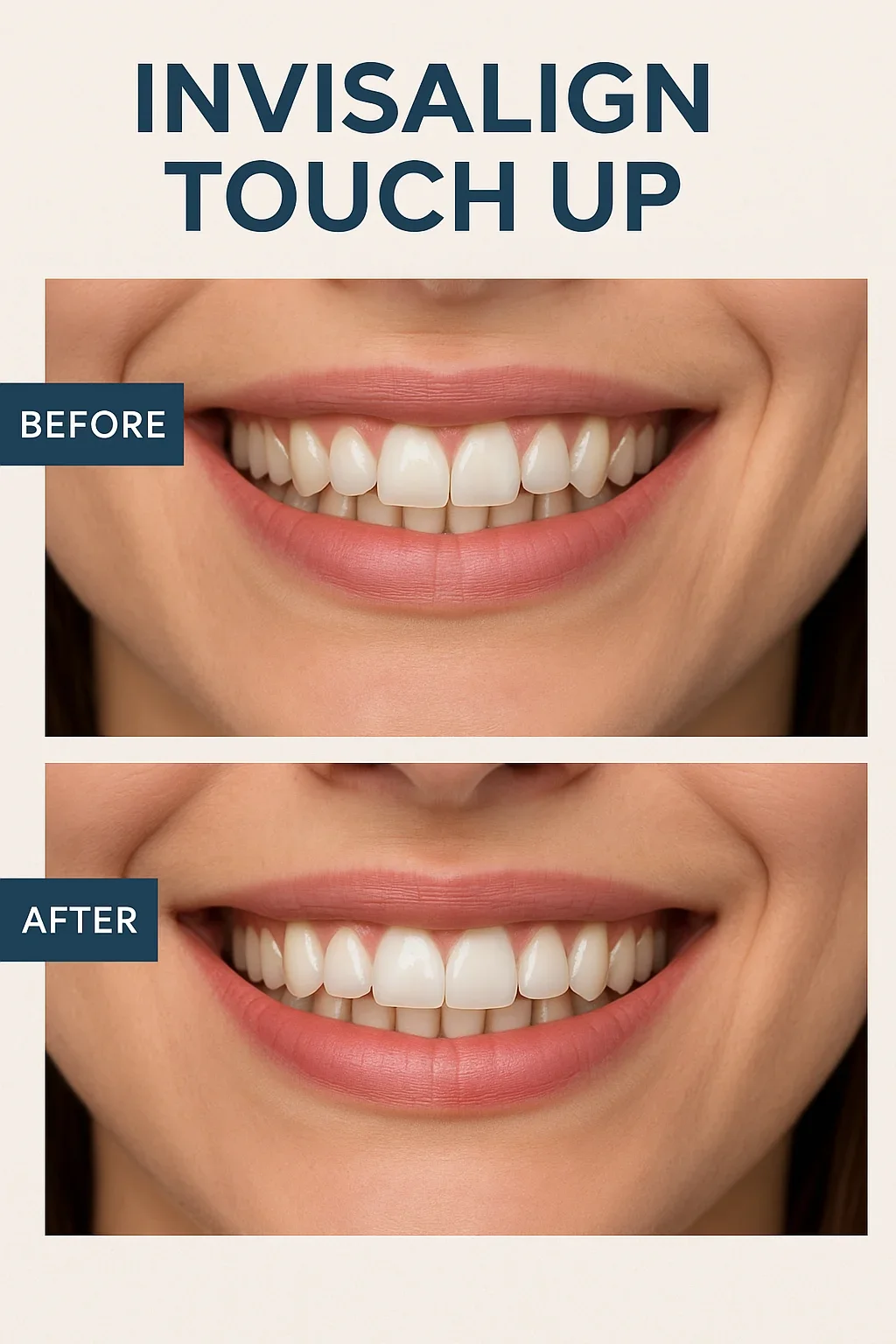
Real Patient Results: Before and After Invisalign Touch Up
Seeing real transformations helps patients understand the power of an Invisalign touch up 🦷. Many people assume refinements are only for major corrections, but the truth is that even the smallest adjustments can lead to dramatic improvements in smile aesthetics, comfort, and confidence. This section highlights what to expect before and after a touch up, real-world examples of outcomes, and the science behind these subtle but significant changes.
Before an Invisalign Touch Up: Common Smile Concerns
Before undergoing a refinement, patients often notice small details about their smile that don’t match the original treatment expectations. These imperfections can appear months or even years after finishing Invisalign. The most common concerns include:
- Minor rotations in front teeth or canines that didn’t fully correct during the original treatment.
- Tiny gaps between teeth, often appearing after retainer wear lapses.
- Slight crowding or overlapping of the lower front teeth.
- Uneven bite or contact pressure between molars.
- Small asymmetries in smile alignment or arch shape.
These issues may sound minimal, but because the human eye easily detects imperfections in symmetry and alignment, even a 1–2 mm difference can affect overall aesthetics. A targeted Invisalign touch up can resolve these inconsistencies quickly and effectively without restarting a full orthodontic process.
What Happens During the “Before” Stage
Before treatment begins, orthodontists perform a digital scan using advanced imaging tools like the iTero Element. This scan creates a detailed 3D model of your mouth, allowing your provider to pinpoint precisely which teeth require movement. Using the ClinCheck software, your orthodontist compares your current alignment to your original treatment plan and visualizes the ideal end result. This analysis helps determine the number of refinement trays needed and ensures every movement is calculated with accuracy 🎯.
At this point, some patients are surprised to learn how minor the required adjustments really are. A single round of refinement often involves fewer than 10 aligners — meaning you could complete your Invisalign touch up in under three months while achieving remarkable improvements in balance and smile symmetry.
After an Invisalign Touch Up: The Transformation
The “after” stage is where patients truly see the benefits of precision refinements. Following the completion of all refinement aligners, teeth appear smoother, more evenly aligned, and naturally harmonious. The changes are often subtle but visually powerful — enhancing facial aesthetics and improving bite functionality.
Common post-touch-up improvements include:
- Perfect closure of small spaces or gaps between teeth.
- Uniform alignment of incisal edges for a polished smile line.
- Correction of slight overlapping or crowding.
- Improved occlusion (bite alignment), leading to better chewing comfort.
- Enhanced overall symmetry and tooth proportion.
How Refinement Affects Confidence and Comfort
Beyond cosmetic benefits, many patients report a boost in confidence after their Invisalign touch up. Subtle imperfections that once drew their attention in mirrors or photos are gone. Even professional photographers and dentists note how small adjustments—such as evening out a single rotated tooth—can create a more harmonious and confident smile 😁.
Patients also experience improved oral comfort after refinements. When teeth fit together correctly, there’s less strain on the jaw joints and surrounding muscles. This balance reduces tension headaches, uneven tooth wear, and long-term bite issues.
Case Studies: Real Patient Experiences
Case 1: Small Gap Closure After Initial Invisalign
A 29-year-old patient completed Invisalign treatment but noticed a 1.5 mm gap between her upper central incisors. A short Invisalign touch up using six aligners over eight weeks completely closed the space. The result was a seamless smile line with natural tooth proportion. The patient reported higher satisfaction and no longer needed to conceal her smile in photos.
Case 2: Minor Crowding in Lower Teeth
A 35-year-old male experienced mild crowding in his lower front teeth after inconsistent retainer wear for one year. His orthodontist recommended a refinement plan consisting of 10 trays worn over 12 weeks. After the touch up, alignment was restored, and the patient received new retainers for long-term stability. His post-treatment scan showed 0.0 mm rotational deviation — an ideal alignment outcome confirmed through digital analysis.
Case 3: Bite Refinement and Edge Alignment
A 41-year-old woman felt her bite was slightly uneven on the right side after finishing Invisalign. A focused Invisalign touch up addressed minor occlusal discrepancies through a 10-week refinement phase. Her final results showed balanced bite pressure across all molars, smoother tooth contact, and an improved smile arc. She reported both aesthetic and functional improvements, describing the experience as “the perfect finishing touch.”
Before-and-After Image Comparison
In visual documentation, before-and-after images from real patients demonstrate how subtle movements can yield stunning transformations. In the “before” images, you might see slight rotations or uneven edges, while the “after” photos reveal an aligned, polished smile that reflects precision and artistry 🪞.
Orthodontic professionals use standardized photographic techniques — frontal smile view, lateral bite, and occlusal (top-down) perspectives — to evaluate these differences. Comparing these angles highlights how an Invisalign touch up can achieve exceptional detail and balance, sometimes improving alignment by fractions of a millimeter that dramatically enhance overall symmetry.
Emotional Impact and Quality of Life
Patients often underestimate how much small misalignments affect confidence until they experience their refined results. After completing an Invisalign touch up, many describe smiling more freely in social and professional settings. The sense of completion — knowing their smile is exactly as envisioned — provides lasting satisfaction and pride. Psychologically, these refinements contribute to improved self-image and a more positive demeanor.
Professional Insight and Long-Term Maintenance
Orthodontists emphasize that the success of refinements also depends on post-treatment care. After completing a touch up, patients should consistently wear retainers and attend follow-up appointments to maintain alignment. According to the American Dental Association, regular monitoring after orthodontic treatment ensures both functional and aesthetic stability. Following these guidelines helps preserve the impressive “after” results indefinitely.
For ongoing support, patients are encouraged to stay in touch with their treatment providers, such as Redent Klinik Contact Page, which offers professional follow-ups and new retainer options if needed.
Conclusion: The Subtle Power of Refinement
Before-and-after examples of an Invisalign touch up prove that small changes can have a transformative impact. Whether closing tiny gaps, realigning edges, or correcting bite issues, these refinements elevate an already beautiful smile to perfection. With advanced technology and skilled orthodontic guidance, achieving flawless alignment is more precise, predictable, and rewarding than ever 🌟.
Ultimately, every refinement represents more than a cosmetic upgrade — it’s a final step toward dental harmony, confidence, and lifelong satisfaction with your smile.
Expert Advice: When to Contact Your Orthodontist for a Touch Up
Even after completing your Invisalign journey, knowing when to reach out for an Invisalign touch up can make the difference between a lifetime of perfect alignment and gradual relapse. Many patients assume that once treatment ends, their teeth will stay perfectly in place forever. However, subtle changes can occur over time due to natural shifting, lifestyle habits, or incomplete correction from the initial plan. This comprehensive guide explains exactly when to contact your orthodontist for a refinement, what signs to look for, and how early intervention can save you from longer or more complex treatments later on 🦷.
Recognizing Early Signs That You May Need a Touch Up
The best time to schedule an Invisalign touch up is when you first notice slight misalignments rather than waiting for them to worsen. Some of the most common warning signs include:
- Minor gaps appearing between teeth that were previously closed.
- Crowding or overlapping in the lower front teeth, especially after not wearing retainers.
- Retainers feeling tight, uncomfortable, or difficult to insert.
- Visible rotation or unevenness in your smile line.
- Changes in how your upper and lower teeth meet when you bite down.
These signs often indicate that your teeth have started to shift back toward their pre-treatment positions. If you act quickly, a short Invisalign touch up involving only a few aligners can correct the issue efficiently without restarting full orthodontic treatment.
Timing Matters: Why Early Contact Is Key
Time is critical when addressing tooth movement. Orthodontic relapse typically begins slowly, but once the teeth start to shift, the surrounding bone and gum tissue begin adapting to their new positions. The longer you wait, the more movement must be corrected later. Contacting your orthodontist early allows for a faster, simpler Invisalign touch up plan with minimal aligners and shorter wear time ⏱️.
Ideal Follow-Up Schedule After Invisalign
Most orthodontists recommend checkups at the following intervals after your initial Invisalign treatment:
- 1 month after treatment completion (to verify initial stability).
- 3–6 months after completion (to monitor early retention).
- Every 6–12 months thereafter (to maintain long-term alignment).
During these checkups, your orthodontist can catch early shifting patterns before they become visible to you. Regular follow-up visits ensure that any future Invisalign touch up can be minimal and targeted instead of comprehensive.
Situations That Require Immediate Consultation
1. Retainer Doesn’t Fit Properly
If your retainer suddenly feels tight or doesn’t fit at all, it’s a clear indication that your teeth have moved. Continuing to force a retainer can cause discomfort or damage. Instead, contact your orthodontist immediately. They may recommend a quick scan and a short Invisalign touch up to restore alignment before creating a new set of retainers.
2. Teeth Feel Loose or Uneven
Slight looseness is common right after treatment, but if it occurs months later, it might suggest minor relapse or periodontal issues. Early intervention prevents more complex movement later. An orthodontist can determine whether a touch up or supportive retainer adjustment is the best solution.
3. Noticeable Bite Discomfort or Jaw Pain
Small misalignments can create bite imbalances that lead to jaw tension, TMJ strain, or uneven tooth wear. A properly timed Invisalign touch up can rebalance occlusion, relieving pressure on the jaw muscles and preventing long-term issues such as headaches or enamel wear.
Understanding the Evaluation Process
When you visit your orthodontist for a potential touch up, they’ll perform a detailed assessment involving visual inspection, bite analysis, and 3D scanning. The scans are compared against your post-treatment records to identify exact areas of deviation. Advanced software like ClinCheck allows your provider to simulate the desired tooth movements digitally before creating your new aligners 🎯.
This process ensures that your Invisalign touch up plan is completely customized and precise, targeting only the teeth that require adjustment while preserving the alignment of others. The digital preview also helps you visualize your expected results before committing to the treatment.
Why Communication with Your Orthodontist Matters
Open communication with your orthodontist plays a major role in maintaining treatment success. If you’re unsure whether a small change is normal or concerning, don’t hesitate to reach out. Orthodontists appreciate proactive patients because early communication prevents potential relapse. Most providers, including those at Redent Klinik Contact Page, offer free or low-cost consultations for post-treatment concerns, making it easy to stay on top of your smile health.
Preventing Unnecessary Touch Ups Through Consistency
In many cases, patients can avoid future refinements simply by maintaining good habits. Consistent retainer wear, regular cleanings, and avoiding behaviors like teeth grinding or chewing on hard objects are key preventive measures. Retainers should be replaced every 1–2 years, as material fatigue can reduce their effectiveness over time. By following these guidelines, you minimize the likelihood of needing another Invisalign touch up in the future.
Monitoring Long-Term Changes
Teeth continue to shift naturally throughout life due to chewing forces and jaw growth, even after orthodontic treatment. Regular dental X-rays and professional exams help detect subtle bone or gum changes that could influence alignment. Your orthodontist can recommend small retainer modifications or short refinement phases to maintain harmony over the years.
Professional Insights from Orthodontic Experts
According to the American Dental Association, consistent post-treatment monitoring is essential for lifelong dental health. Orthodontic specialists emphasize that early detection of movement and timely refinements reduce the need for extensive corrective treatment later. An Invisalign touch up should be viewed as a proactive measure — not a setback — that ensures your smile stays aligned and functional for years to come.
Final Takeaway: Listen to Your Smile
Your smile can tell you when something feels off — whether it’s a tight retainer, uneven bite, or visible tooth movement. Acting early by contacting your orthodontist ensures a quick, comfortable, and affordable resolution. A short Invisalign touch up often takes only a few weeks and delivers long-lasting benefits. Regular communication, retainer maintenance, and awareness of early warning signs all contribute to lifelong orthodontic success 😄.
In conclusion, scheduling a professional evaluation the moment you notice changes ensures your investment in your smile remains protected. With expert advice, digital precision, and ongoing care from trusted clinics like Redent Klinik Contact Page, your Invisalign touch up journey will be smooth, effective, and rewarding — keeping your smile exactly where it belongs: confidently perfect.